Equity Mining: The Dealership's Most Profitable Prospecting Strategy - 2026 Guide
Turn this article into takeaways for your work.


Each assistant summarizes the article only for you and suggests best practices for your work.
The average dealership has 300-500 customers sitting on $5,000+ equity right now. These are your hottest prospects, yet most dealers ignore this goldmine while chasing cold internet leads that close at 15% and cost $500+ to acquire.
According to Cox Automotive's market analysis, trade-in values remain 23% elevated above pre-pandemic levels, creating substantial equity opportunities. The Manheim Used Vehicle Value Index shows continued strength in wholesale used-vehicle prices, meaning many customers have more equity than they realize.
It makes no sense. You've already paid to acquire these customers. They trust your dealership. They're familiar with your brand. And they have positive equity that can serve as down payment on their next vehicle. The hard work is done. You just need to initiate the conversation.
Equity mining is the systematic process of identifying customers with positive equity and proactively reaching out to show them how they can upgrade to a newer vehicle, often with lower payments. It's the highest-ROI prospecting activity in your dealership. Let's break down exactly how to do it.
Understanding Equity Mining
Before you can execute an equity mining program, you need to understand what it is, why it works so well, and when market conditions create opportunities.
Definition: proactive outreach to customers with positive equity means you're not waiting for customers to think about trading their vehicle. You're initiating the conversation by alerting them to opportunity they didn't know existed. Most customers have no idea what their vehicle is worth or how much they owe. You're providing valuable information that helps them make informed decisions.
This isn't high-pressure sales. It's consultative marketing. You're reaching out to say: "Hey, your vehicle is worth more than you might think, and that creates some interesting options. Would you like to explore them?" Most customers appreciate this information even if they're not ready to trade immediately.
Market conditions that create equity opportunities fluctuate based on supply and demand dynamics. Low inventory and high demand create seller's markets where used vehicle values spike. This is when equity mining generates the most opportunities. But even in normal markets, customers who've been making payments for 2-3 years often have meaningful equity.
The 2021-2023 period was unprecedented for equity mining because supply chain disruptions and low inventory drove used vehicle values 30-50% above historical norms. Customers who bought vehicles in 2019-2020 suddenly had $5,000-$10,000 equity. Smart dealers mined this opportunity aggressively. Even as markets normalize, equity mining remains effective because customers naturally build equity through loan paydown and vehicle appreciation in certain segments.
Why equity customers close at 3x the rate of cold leads comes down to multiple factors. First, they're your customers already, there's an established relationship and trust. Second, they have equity that eliminates the biggest obstacle to trading (negative equity or no down payment). Third, they didn't initiate the inquiry, so they're not shopping multiple dealers and beating everyone up on price. For comprehensive retention strategies, see owner retention marketing.
Industry data shows equity mining leads close at 40-50% compared to 15-20% for internet leads and 8-12% for cold walk-ins. That massive difference in conversion efficiency makes equity mining dramatically more profitable even when you invest in multi-channel outreach and strong trade-in allowances.
Impact on gross profit and finance penetration is also favorable. Equity customers typically generate $2,500-$3,500 in front-end and back-end gross combined, not the highest gross per deal, but solid. More importantly, finance penetration on equity deals runs 75-85% because customers have strong credit (they've been making payments), need financing for the new vehicle, and aren't bringing cash down payment that would eliminate financing need.
Market data shows these equity positions create real value: according to TradePending's 2025 Automotive Trade-In Market Report, new vehicle sales involving a trade-in generate an average transaction price of $47,549 compared to $45,192 without a trade-in, a $2,357 premium. For used vehicles, the difference is even more dramatic at $7,030.
Higher finance penetration means more back-end product sales, which significantly increases total gross profit per deal. An equity deal that generates $2,000 front-end and $1,200 back-end is more profitable than a conquest deal that generates $2,500 front-end and $400 back-end.
Data Sources and Equity Calculation
You can't mine equity if you don't know which customers have it. Building accurate equity data requires the right tools and processes.
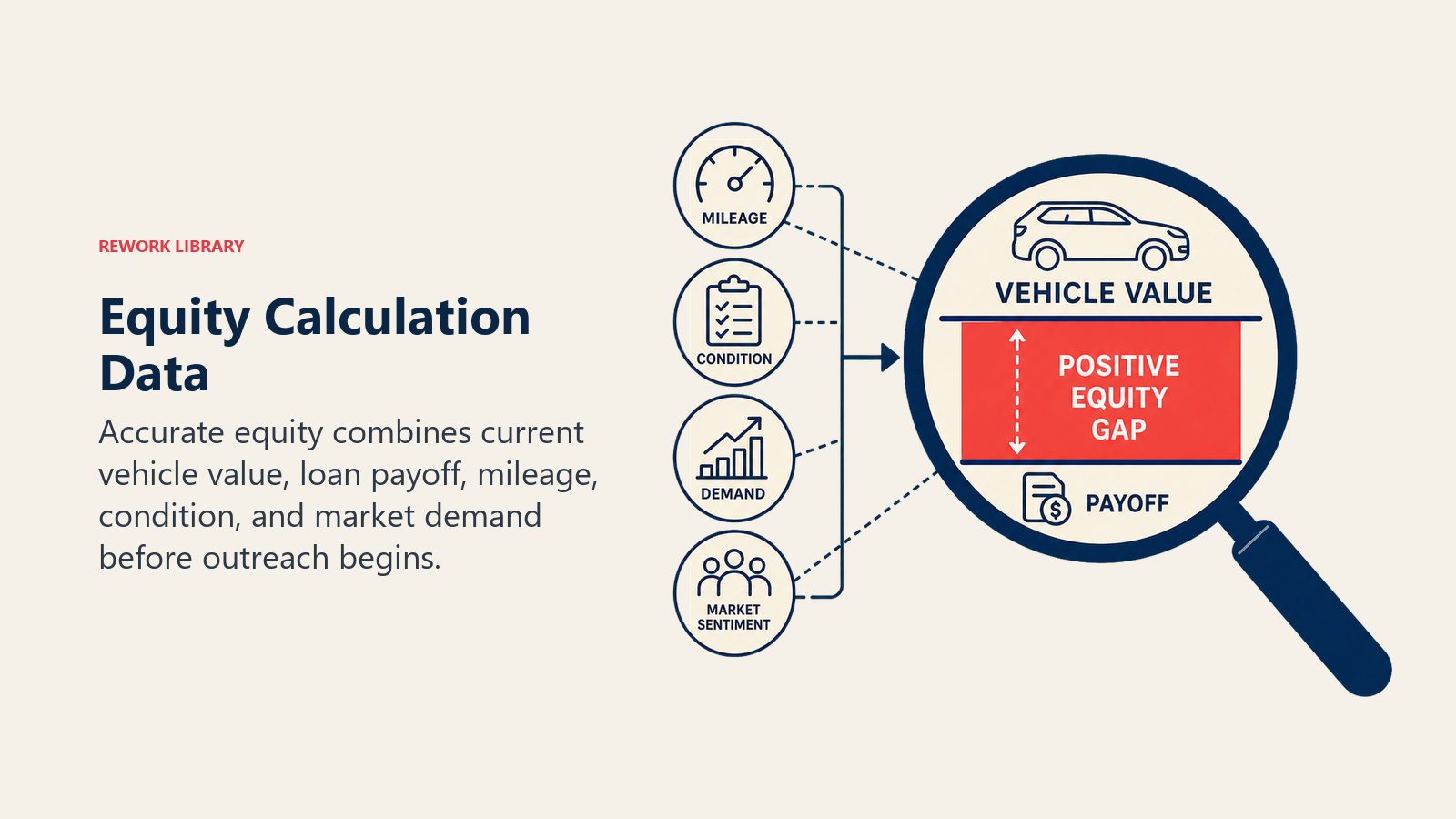
DMS data extraction and requirements start with pulling your [customer database](/libraries/automotive-sales-growth/automotive-crm-implementation). You need: customer name and contact information, vehicle details (VIN, year, make, model, mileage at purchase, purchase date), financing information (lender, original amount financed, term, payment), and current payoff amount if available in your DMS.
Most dealerships have this data in their DMS but don't extract it regularly for analysis. Work with your DMS provider to set up monthly exports that pull this customer and vehicle information. Many DMS platforms can automatically calculate time-based mileage estimates (purchase mileage + estimated annual mileage × years owned) which helps with valuation accuracy.
Third-party equity tools from vAuto, Black Book, KBB, and other providers automate the equity calculation process. These tools pull wholesale and retail values based on VIN, estimated mileage, and local market conditions. They also integrate with credit bureaus or third-party databases to pull current payoff amounts (with customer consent or based on estimated payoff schedules). For technology integration, see automotive CRM implementation.
The investment in third-party tools ($500-$2,000 per month typically) pays for itself immediately if you're running systematic equity mining campaigns. The tools save hours of manual work and provide more accurate valuations than spreadsheet estimations.
Calculating equity position means determining current market value minus payoff balance. The formula is simple, but the variables require good data. Actual Cash Value (ACV) should be based on current wholesale market values (what you'd actually pay for the trade-in), not retail or inflated numbers. Conservative valuations prevent customer disappointment when they come in and the actual appraisal is lower than your marketing claimed.
For estimated payoff, use your original financing data and calculate remaining balance based on term and payments made. This is usually accurate within $500 unless the customer has made extra payments or refinanced. Third-party tools pull actual payoff amounts, which is more accurate but sometimes requires customer authorization.
Equity calculation example: 2021 Honda Accord purchased for $28,000, financed $26,000 over 72 months at $425/month. After 36 payments, remaining balance is approximately $14,000. Current ACV is $19,000. Equity position: $19,000 - $14,000 = $5,000 positive equity.
Data accuracy and validation processes need attention because bad data kills campaigns. If you contact customers claiming they have $5,000 equity and they actually have negative equity, you destroy trust and waste resources. Validate your data before launching campaigns.
Run test samples on 20-30 customers where you manually verify payoff amounts and current values. If your estimated equity matches reality within $1,000-$1,500 most of the time, your process is accurate enough. If there are larger discrepancies, refine your calculations or invest in better data sources.
Prioritization and Segmentation
Not all equity customers are equal prospects. You need to prioritize who gets contacted first and how aggressively you pursue them.
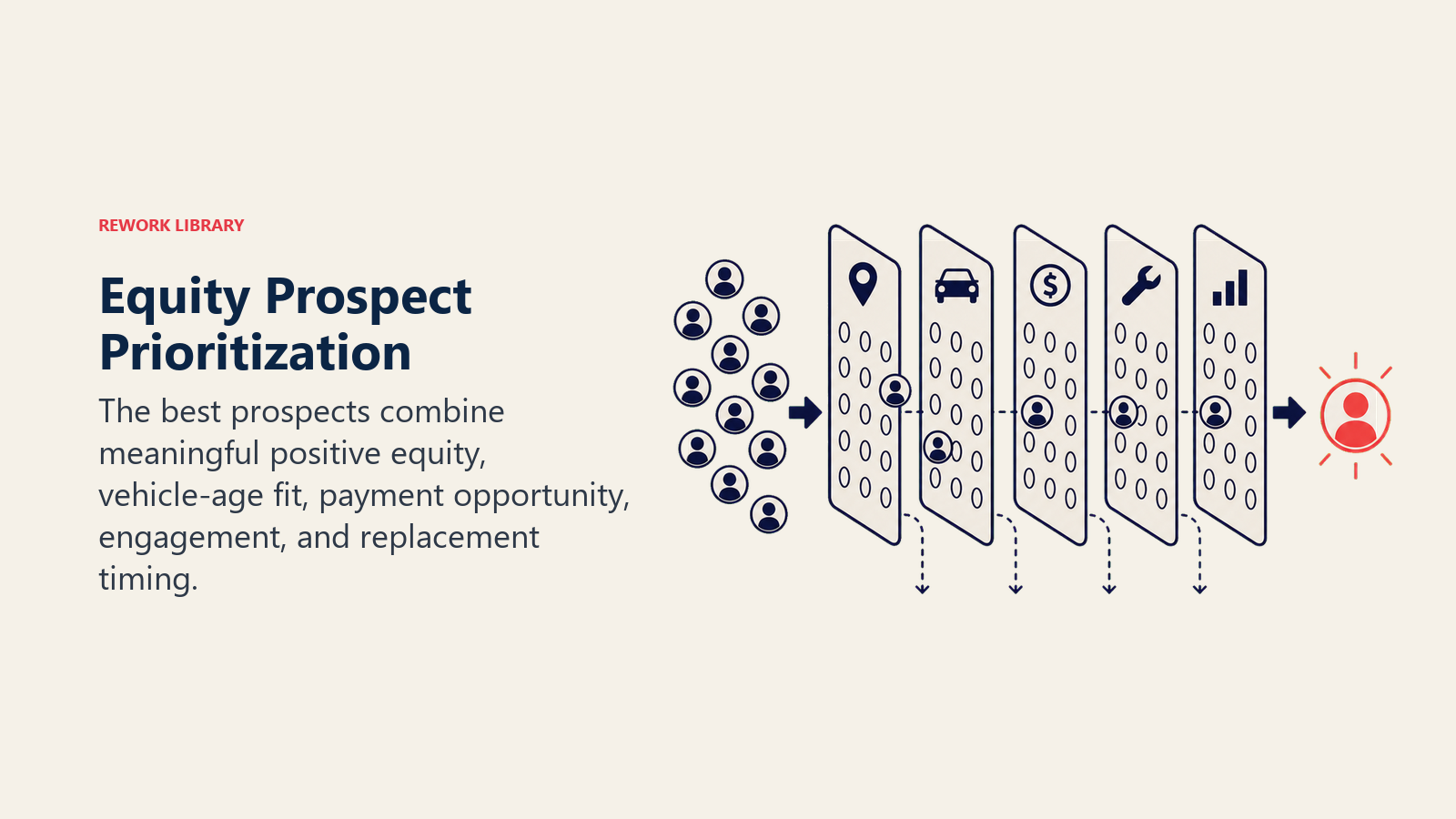
High-equity customers ($5,000+) are your priority targets because they have enough equity to make meaningful down payments or payment reductions on new vehicles. $5,000 equity can reduce payments by $100-$125/month or serve as down payment to structure competitive financing. That's enough to change customer behavior. Learn payment structuring in negotiation closing techniques.
Focus 70% of your equity mining effort on customers with $5,000+ equity. These customers will generate the highest response rates and close rates. Don't waste time on customers with $1,000-$2,000 equity unless they have other factors (lease maturity, warranty expiration) that make them attractive prospects.
Lease customers approaching maturity (within 6 months of lease end) should be contacted regardless of equity because they're in-market by definition. Leased vehicles technically don't have "equity" in traditional sense, but they can have favorable lease-end values where buying out the lease and trading is financially attractive. Calculate lease buyout amount minus current market value to find opportunities.
Many lease customers don't realize they can trade their leased vehicle before maturity, especially if the buyout amount is below market value. This creates opportunities to pull customers early and prevent them from shopping competitors when their lease actually ends.
Customers with loan seasoning (12+ months into term) have had time to build equity through paydown and potential appreciation. Customers who purchased 12-18 months ago are often past the steepest depreciation curve and starting to build equity. Customers 24-36 months in typically have the best equity positions relative to their trade cycle stage.
Don't waste effort on customers who purchased 3-6 months ago unless market conditions have created unusual appreciation. They're still in honeymoon phase with their vehicle and likely have negative equity or minimal equity. Focus on customers in the 18-48 month range for highest returns.
Vehicle age and mileage considerations affect how you prioritize customers. Certain vehicle segments (trucks, SUVs, luxury brands with strong residuals) hold value better than others (entry-level sedans, high-volume models). Customers with low-mileage trucks and SUVs should be priority targets even if their equity calculations show modest amounts, there's likely upside in the actual appraisal.
High-mileage vehicles create different opportunities. A customer with 80,000 miles on a 36-month-old vehicle might have lower market value but also has strong incentive to trade before major maintenance costs hit. Target high-mileage customers with messaging about avoiding expensive repairs and getting into a new warranty.
Trade-cycle timing averages 3-4 years nationally, but varies by vehicle type and customer demographics. Luxury customers tend to trade every 3-4 years. Truck customers often go 5-7 years. Practical sedan customers might keep vehicles 6-8 years. Use your historical sales data to identify average trade cycles for different segments, then target customers approaching those windows.
A customer 42 months into a typical 48-month trade cycle with $4,000 equity is a much hotter prospect than a customer 18 months in with $6,000 equity. Context matters as much as equity amount.
Multi-Channel Contact Strategy
Reaching equity customers effectively requires multiple touchpoints across multiple channels. One email doesn't cut it. You need systematic, multi-touch campaigns.
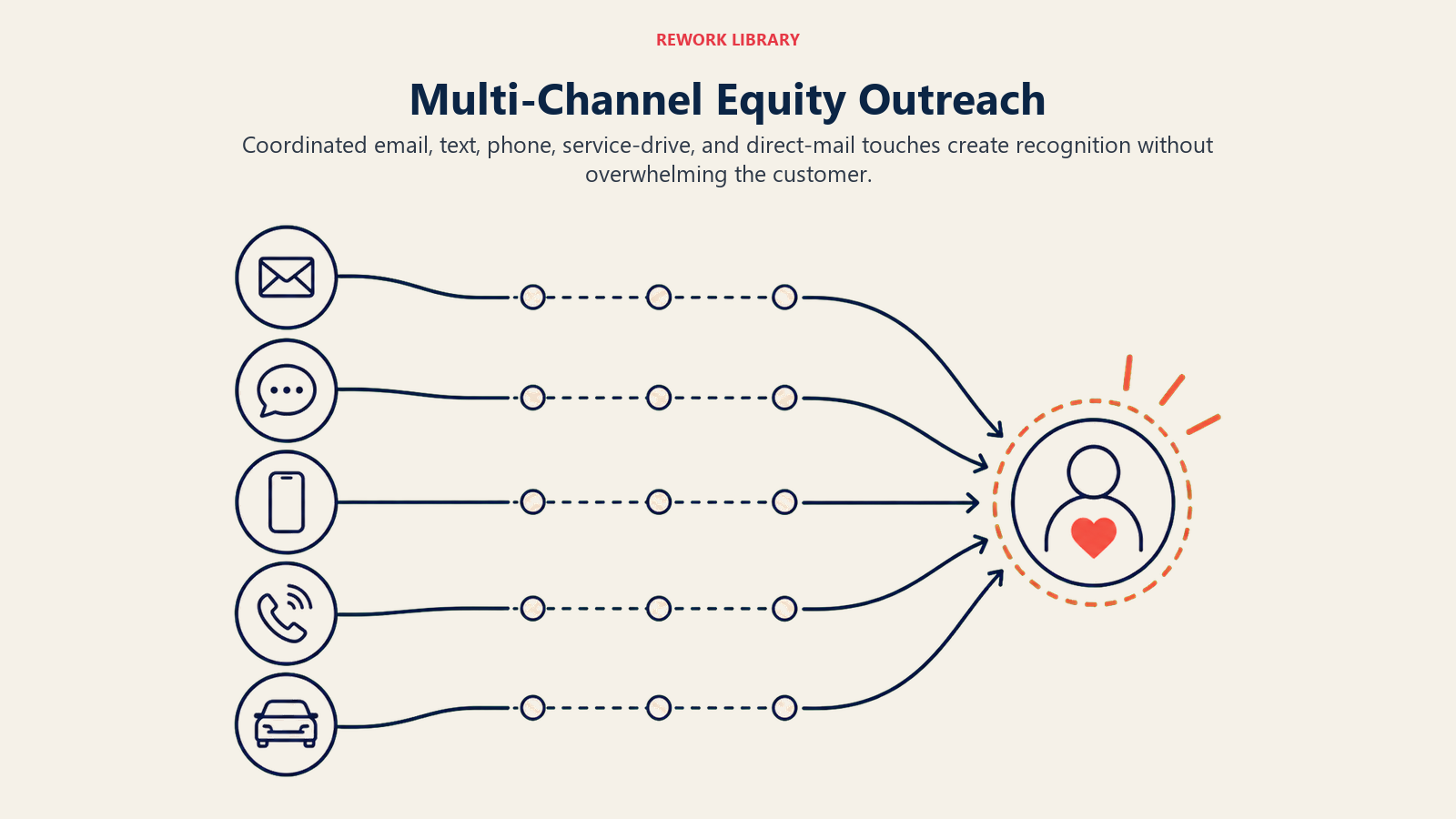
Personalized direct mail campaigns still work in automotive because people pay attention to physical mail in ways they don't with digital. A well-designed mailer with the customer's name, specific vehicle details, and estimated equity amount gets opened and read. Use variable data printing to customize every piece. Combine with digital approaches from dealership email marketing.
Sample direct mail piece: Front of postcard shows image of customer's vehicle model (or similar) with headline "Your 2021 Accord is worth $19,000." Inside shows equity calculation: "Market Value: $19,000. Estimated Payoff: $14,000. Your Equity: $5,000." Call-to-action: "Let us show you how this equity could lower your payment on a new 2026 model. Call [Your Name] at [Phone] or visit [URL]."
Include personal signature from a real salesperson or manager, not corporate branding. This should feel like personal outreach, not mass marketing.
Email sequences with equity alerts have the advantage of low cost and easy tracking. Send 2-3 emails over a 30-day period with different angles and messaging. Email 1 focuses on equity alert and opportunity. Email 2 focuses on specific vehicles their equity could get them into. Email 3 creates urgency about timing (values changing, incentives expiring).
Subject lines matter enormously. "Good news about your Accord" outperforms "Trade-in special event." "Your equity estimate is ready" outperforms "Get top dollar for your trade." Make subject lines personal and specific, not promotional and generic.
SMS messaging and opt-in strategies deliver highest open rates (98% within 3 minutes) but require proper consent and careful message crafting. Use SMS for initial alert and appointment confirmation, not lengthy sales pitches.
Effective SMS: "Hi [Name], this is [Your Name] from [Dealership]. Your 2021 Accord has about $5K equity, could lower your payment $100/month on a new model. Interested? Reply YES and I'll call you, or call me at [Phone]."
Keep messages under 160 characters when possible, include clear opt-out instructions ("Reply STOP to unsubscribe"), and never send more than 2-3 messages per campaign to avoid annoying customers.
Outbound phone campaigns and scripts are the highest-impact touchpoint but also the most labor-intensive. Your BDC or sales consultants need to systematically call high-equity customers using a consultative script focused on providing value, not pushing sales.
Opening script: "Hi [Name], this is [Your Name] from [Dealership]. How are you doing today? Great. Hey, the reason I'm calling is we're tracking market values and I noticed your [Vehicle] is worth significantly more than you might expect, showing about [Equity Amount] in equity, which is higher than typical. I wanted to make sure you knew about this because it creates some interesting options for you. Do you have a couple minutes to discuss?"
If customer says yes, continue: "Great. Based on market values, your [Vehicle] is worth approximately [Value], and with your estimated payoff around [Payoff Amount], you're sitting on about [Equity Amount]. That's enough to get into a new 2026 [Model] with payments close to what you're paying now, or potentially lower depending on current incentives. Have you thought about upgrading, or are you planning to keep your current vehicle long-term?"
Let the customer talk. If they express any interest, pivot to scheduling appointment: "What I'd like to do is have you stop by so we can give you an exact appraisal and show you what's available. This doesn't obligate you to anything, I just want to show you your options so you can make an informed decision. Do you have time this week? Thursday morning or Friday afternoon work better for you?"
Retargeting and digital advertising keeps your dealership visible to equity customers across the web. Upload your equity customer email list to Facebook and Google as a custom audience and serve them targeted ads about trading in their vehicle, current model availability, and payment-focused offers. For comprehensive digital strategies, see automotive paid advertising.
Retargeting is particularly effective for customers who opened your email or visited your trade-in landing page but didn't take action. These customers showed interest, retargeting keeps you top-of-mind until they're ready to act. Run retargeting ads for 30-60 days following your equity campaign launch.
The Equity Mining Call Process
Phone contact is where most equity mining campaigns succeed or fail. Your BDC and sales consultants need to be trained on proper approach, objection handling, and appointment setting.
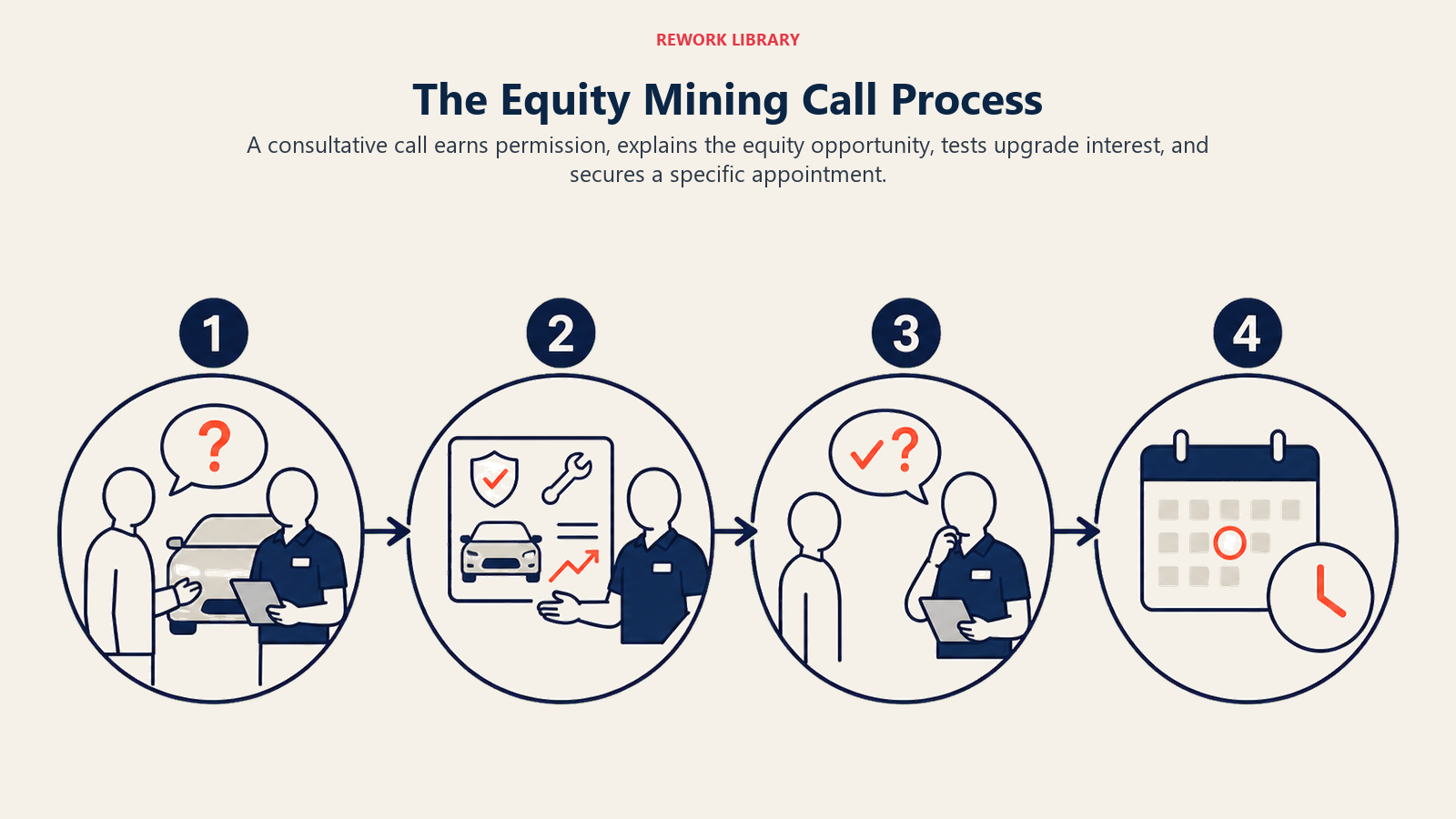
Opening script and permission-based approach starts by acknowledging you're calling without prior request. You need to quickly establish value and get permission to continue the conversation. Forcing a sales pitch on someone who says they're busy or not interested just creates negative sentiment.
After your opening (see previous section), if the customer says "I'm not interested" or "I'm busy," respond with: "I completely understand. Can I just text you the information so you have it when you're ready to think about your next vehicle?" Most customers will say yes to receiving information. That keeps the door open for future follow-up.
Communicating equity position without pricing vehicle over the phone is critical. You want to share enough information to create interest without getting into specific numbers that lead to phone negotiation. Your goal is to get them in the showroom, not close the deal over the phone.
When customers ask "Exactly how much are you offering for my trade?", respond with: "That's exactly why I'd like you to come in. I can give you a rough estimate based on average market values, but to give you an accurate number, I need to see the vehicle, check condition, verify mileage, and look at the actual payoff amount. What I can tell you is that your equity position is strong enough to make upgrading realistic. Let me show you exactly what that means in terms of actual payment options. Does Tuesday or Wednesday work better for you?"
You're not dodging the question, you're explaining why an in-person appraisal is necessary while reinforcing that their situation is favorable. This approach gets more showroom appointments than giving rough numbers over the phone.
Overcoming initial objections requires empathy and redirection to the appointment. Common objections include: "I'm happy with my current car," "I still owe too much," "I can't afford higher payments," and "I'm not ready right now." Each objection has a response that validates the customer's concern while refocusing on learning their options.
"I'm happy with my current car" → "That's great, and I'm not suggesting there's anything wrong with your vehicle. What I'm saying is that market conditions right now give you options you might not have at other times. You might decide to keep your vehicle, but wouldn't you want to at least know what your options are? It takes 30 minutes and costs nothing to find out."
"I still owe too much" → "I actually have good news for you, based on what I'm seeing, you don't owe too much. You have positive equity, which means your vehicle is worth more than your payoff. That's exactly why I'm calling. Let me show you the numbers, you might be surprised."
"I can't afford higher payments" → "I'm not talking about raising your payment. With your equity position, we can often get you into a new vehicle with payments similar to what you're paying now, or potentially lower depending on current rates and incentives. Let me show you some real examples. Would Thursday morning or Friday afternoon work better?"
"I'm not ready right now" → "I totally understand. This isn't about pressuring you into anything today. It's about making sure you have good information when you are ready. Values change, incentives expire, and market conditions shift. Let me at least show you the current opportunity so you can make an informed decision whenever the timing is right for you. Does next week work, or would you prefer the week after?"
Setting the appointment (trade appraisal focus) is the only goal of the phone call. Don't try to get credit applications, discuss specific vehicles, or talk payments. Focus exclusively on getting them to commit to a specific day and time to come in for an appraisal.
Use assumptive closing: "Let me get you on the calendar. Do mornings or afternoons work better for you?" Not "Would you like to come in?" but "When would you like to come in?" Offer specific options: "I have Thursday at 10 AM or Friday at 2 PM available. Which works better?"
Confirm appointment details clearly: "Perfect. I have you down for Thursday, March 15th at 10 AM. Plan on about 30-45 minutes. Bring your vehicle so we can do a complete appraisal, and if you have your payoff information from your lender, bring that too, it makes the process faster. I'm going to send you a confirmation text with my direct number. Any questions before I let you go?"
Follow-up cadence and persistence recognizes that most people don't respond to the first contact. Your campaign should include multiple attempts over 30-45 days before marking a customer as unresponsive. Industry best practice is 8-12 touchpoints before giving up.
Sample campaign cadence: Day 1 - Direct mail. Day 3 - Email. Day 5 - SMS. Day 7 - Phone call (first attempt). Day 10 - Second email. Day 14 - Phone call (second attempt). Day 21 - SMS follow-up. Day 28 - Phone call (third attempt). Day 35 - Final email. Day 42 - Mark as non-responsive.
Track response by channel to optimize your mix. Some customers will respond to text but ignore calls. Others will respond to calls but ignore email. Cover all channels to maximize response rates.
Showroom Presentation Strategy
Converting equity appointments to sales requires proper presentation that leverages the customer's equity position to demonstrate value.
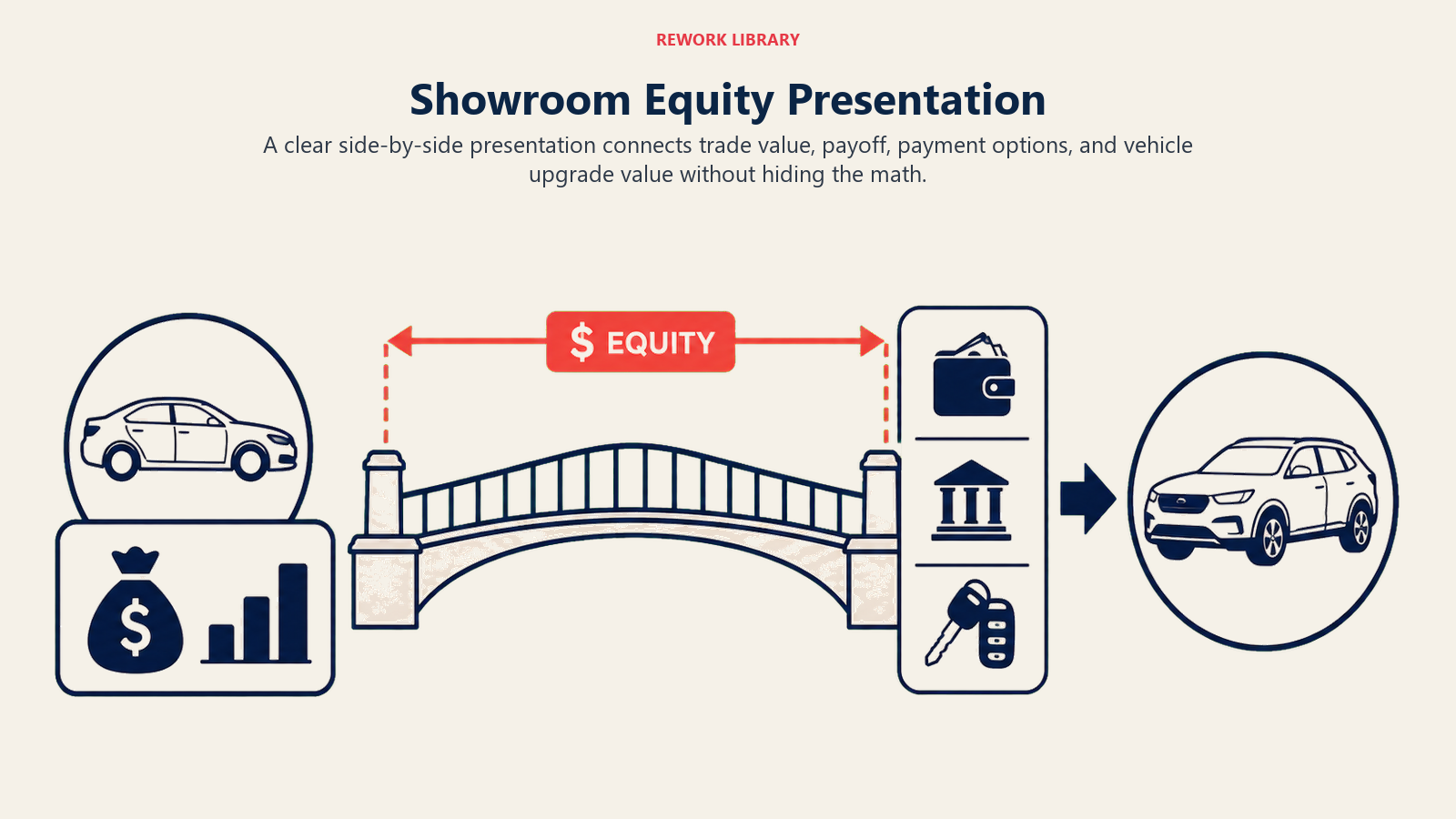
Trade-in appraisal and presentation should be thorough and professional. Walk around the vehicle with the customer, noting condition, features, and anything that affects value. Complete the appraisal in your system while explaining how you arrive at the number. Present the appraisal clearly with supporting data (comparable sales, wholesale market trends, condition adjustments). Master the complete trade-in appraisal process.
"Based on current wholesale market values for [Year/Make/Model] with [Mileage] miles in [Condition] condition, we're at $19,000 for your trade-in value. I'm also showing your payoff at $14,000, which gives you $5,000 in positive equity. This equity can work as down payment on your next vehicle or we can use it to lower your monthly payment. Let me show you what that looks like."
Present trade-in values that are fair and defensible. Don't lowball to create negotiating room, that strategy backfires with equity customers who have already received an equity estimate from you. Your appraisal should be close to what you communicated in your marketing (within $500-$1,000) or you'll lose credibility.
Payment-focused selling leverages equity for lower payments rather than focusing on vehicle price. Most equity customers are payment buyers. Show them how their equity affects their monthly payment on different vehicle options. For advanced techniques, see negotiation closing techniques.
"Your $5,000 equity takes about $100 off the monthly payment on any vehicle you choose. So if you're currently paying $425/month, we can get you into a new [Model] for around $325-$375 depending on which trim level you choose. Let me show you what's available in that range."
This approach is more compelling than talking about vehicle prices and trade-in allowances. Customers think in terms of monthly budget, so frame the opportunity that way.
Inventory matching based on payment range focuses the customer on available vehicles they can afford rather than features they want but can't afford. Use their current payment (minus the equity impact) as the starting point and show them 3-4 vehicles that fit that payment window.
"Based on your $5,000 equity and current payment of $425, here are three vehicles that would put you at $350-$400 per month with similar terms. [Vehicle 1] at $365/month, [Vehicle 2] at $385/month, and [Vehicle 3] at $395/month. Let's take a look at all three and see which one fits your needs best."
Let the customer drive multiple options. The more they drive, the more likely they'll find something they love. The equity already solved the affordability objection, now you're just helping them choose.
Lease vs. purchase decision tree depends on customer priorities. Lease works well for customers who want lower payments and plan to trade every 3-4 years anyway. Purchase works well for customers who drive high mileage or want to build ownership equity. Ask questions to determine which structure fits their lifestyle.
"How long do you typically keep your vehicles? Do you prefer lower monthly payments or building ownership equity? How many miles do you drive per year?" Use their answers to recommend lease or purchase based on what actually makes sense for them, not what generates highest gross for you.
F&I presentation for equity customers should emphasize protecting their new investment since they're starting with equity. Extended warranty, maintenance plans, and GAP insurance are easier sells to customers who have equity to protect. Frame products around maintaining and protecting their equity position. For comprehensive F&I strategies, see fi-department overview.
"You're starting with $5,000 in equity, which is a great position. Let's make sure we protect that. The extended warranty ensures that any major repairs are covered so you're not spending your equity fixing the vehicle. The maintenance plan keeps you on schedule for all required services, which protects resale value. And GAP insurance protects your equity if the vehicle is totaled. These products are designed specifically for customers in your situation."
Back-end product presentation for equity customers often generates higher penetration because the payment impact is smaller relative to the overall deal, and customers with equity feel they have more financial flexibility to add products.
Technology and Automation
Scaling equity mining requires proper technology to handle data management, campaign execution, and performance tracking.
CRM integration and workflow automation eliminate manual work and ensure consistent execution. Your equity mining process should be automated in your CRM: monthly equity reports trigger campaign workflows, customer responses automatically create tasks for follow-up, appointments schedule directly into calendars, and no-shows trigger automated follow-up sequences. For implementation guidance, see automotive CRM implementation.
Work with your CRM provider to build equity mining workflows. Most modern automotive CRMs (VinSolutions, DealerSocket, Elead) have campaign automation capabilities. Use them to create set-it-and-forget-it equity mining campaigns that run continuously.
Equity report scheduling and alerts should run automatically on the 1st of every month. Configure your system to generate equity reports, segment customers by equity amount and priority factors, and create leads for your BDC to work. Your BDC should wake up on the 1st with a fresh list of equity customers to contact, no manual report pulling required.
Set alerts for dramatic equity changes. If a customer's equity position jumps by $2,000+ in a month due to market appreciation or paydown, that should trigger immediate outreach. Market conditions can create time-limited opportunities that require fast action.
Campaign tracking and attribution tell you which marketing channels drive results. Use unique phone numbers, landing page URLs, and offer codes for each campaign channel so you can track whether customers responded to direct mail, email, SMS, or phone calls. This data tells you where to invest budget.
Build attribution into your CRM: when a customer makes an appointment, ask how they heard about their equity opportunity. Track this religiously so you know whether your direct mail was worth the cost or whether text messages are driving all your results.
Lead routing and task management ensure equity leads get proper follow-up. Configure your CRM to automatically assign equity leads to appropriate salespeople (ideally the person who originally sold them), create follow-up tasks with specific due dates, and escalate overdue tasks to management if follow-up doesn't happen.
Most equity mining campaigns fail not because of bad data or messaging, but because of poor follow-up execution. Technology can't fix lazy salespeople, but it can make consistent follow-up much easier and hold people accountable when they drop the ball.
Performance dashboards and reporting provide visibility into campaign effectiveness. Build dashboards that show: equity customers contacted (by channel), response rates, appointments scheduled, show rates, vehicles sold, and gross profit generated. Review these metrics weekly in sales meetings to maintain focus and accountability. Track results in your dealership KPI dashboard.
Compare equity mining performance to other lead sources. If equity mining generates 42% close rate at $150 per sale while internet leads generate 18% close rate at $450 per sale, you have clear evidence to shift resources toward equity mining.
Measuring Equity Mining Performance
Metrics and optimization separate professional equity mining programs from occasional half-hearted attempts.
Contact rate and conversation rate measure outreach effectiveness. Contact rate is the percentage of customers you reach (speak to directly, not leave voicemail). Conversation rate is the percentage who engage in meaningful discussion rather than immediately saying no. Industry benchmarks: 40-50% contact rate, 60-70% conversation rate among contacts.
If your contact rate is below 30%, your contact information is outdated or you're calling at wrong times. If your conversation rate is below 50%, your opening script needs work. Track these metrics by person making calls to identify who needs coaching.
Appointment show rate measures whether customers actually come in after scheduling appointments. Industry average is 60-70% for equity mining appointments (much higher than internet leads at 30-40%). If your show rate is lower, you're either setting appointments too far out or not doing proper confirmation and reminder process.
Send appointment confirmation immediately after scheduling (text and email). Send reminder 24 hours before appointment (text). Call the customer 2-3 hours before appointment to confirm they're still coming. This three-touch confirmation process dramatically improves show rates.
Close rate and sold units tell you how effectively you're converting appointments to sales. Equity mining appointments should close at 40-50% minimum. If yours are closing below 35%, the problem is likely showroom process, weak appraisals, poor inventory matching, or inadequate sales skills on equity presentations.
Average front-end and back-end gross measures profitability. Equity deals typically generate $1,500-$2,000 front-end gross and $800-$1,200 back-end gross. Total per-deal profit of $2,300-$3,200 is solid and sustainable. If your equity mining gross profit is significantly lower, you're giving away too much on trade allowance or negotiating poorly.
Remember: the goal isn't maximum gross per deal. It's maximum profit per customer over lifetime. An equity deal at $2,500 total gross that leads to five more years of service revenue and another repeat purchase is far more valuable than a conquest deal at $3,500 gross that you'll never see again.
Cost per equity sale vs. other lead sources proves the ROI case. Calculate total program costs (staff time, marketing spend, technology costs) divided by vehicles sold through equity mining. Compare this to cost per sale from internet leads, conquest marketing, and walk-in traffic. Equity mining should be your lowest-cost lead source by significant margin.
If your numbers show different results, either your equity mining execution is poor or you're not properly attributing sales to the program. Track carefully and honestly. The data will tell you where to invest.
Common Objections and Responses
Handling customer resistance effectively determines whether your equity mining campaigns generate sales or just annoy people.
"I'm not ready to trade yet" is the most common objection. Customers default to status quo unless you give them compelling reason to act now. Your response needs to acknowledge their position while creating urgency around timing.
"I totally understand. Most people aren't actively thinking about trading until something prompts them to explore options. The reason I reached out now is that your equity position is unusually strong because of current market conditions. Values are high, which might not last indefinitely. I'm not suggesting you have to decide today, but it makes sense to at least know what your options are while the opportunity is available. If we wait six months and values drop, we might not be able to structure the same deal. Does that make sense?"
Then pivot to appointment: "Let me at least show you the numbers so you can make an informed decision. Takes 30 minutes. If the numbers make sense, great. If not, at least you'll know. Fair enough?"
"I still owe too much" reflects customer assumption that they're underwater on their loan. Your job is to correct this misunderstanding with facts.
"I hear that from a lot of people, and I thought the same thing when I looked at your account, but that's actually why I'm calling. Based on current market values, you don't owe too much. You have positive equity. That's the whole point of this conversation. Your vehicle is worth more than your payoff, which means you're in a really good position to upgrade if you want to. Let me show you the exact numbers so you can see what I'm talking about."
Most customers have no idea what their payoff balance is or what their vehicle is worth. Provide the information they're missing and the objection disappears.
"I just want to keep my current vehicle" is a legitimate position that requires acknowledgment without pressure. Some customers genuinely don't want to trade. Respect that while keeping the door open.
"That's perfectly fine. I'm not trying to talk you out of a vehicle you love. The only reason I called is to make sure you're aware of your options since your equity position is strong. If you prefer to keep driving your current vehicle, that's absolutely the right decision for you. But if your situation changes or you start thinking about upgrading in the next year, keep this in mind, and feel free to reach out. I'll make sure we take care of you. Fair enough?"
Stay friendly and professional. Don't argue or push. Some customers will reconsider in a few months when circumstances change. You want them to remember you as helpful and respectful, not pushy and annoying.
"What are you offering for my trade?" is an attempt to get specific numbers before committing to appointment. Avoid this trap while still providing useful information.
"That's exactly what I want to show you when you come in. The challenge with giving you a number over the phone is that trade-in values depend on actual condition, exact mileage, and current market data. I can tell you that based on average market values for your [year/make/model], we're seeing wholesale values around [rough range], and with your estimated payoff around [amount], you're showing positive equity of approximately [amount]. But to give you an exact number I'd stand behind, I need to see the vehicle. That's why I'd like to get you in this week. Does Tuesday or Thursday work better?"
You're providing enough information to maintain credibility without committing to specific numbers that become negotiation starting points. Keep the focus on getting the appointment.
Building urgency without being pushy requires tying your offer to external factors outside your control, market conditions, inventory availability, incentive expiration, rather than artificial dealership deadlines.
"The reason timing matters is that used vehicle values have been unusually strong for the last 18 months, but we're starting to see softening in some segments. I can't predict the future, but I can tell you that your equity position is strong right now. Six months from now might be different. The other factor is manufacturer incentives on the new models. We have [specific incentive] available through end of month, which affects the overall payment I can structure for you. I'm not saying you have to buy today, but seeing your options this week while everything is in your favor makes sense, doesn't it?"
This creates real urgency based on legitimate factors without resorting to "this price is only good today" high-pressure tactics that customers see through immediately.
Equity mining works because it's fundamentally about providing value to customers. You're alerting them to opportunities they didn't know existed, backed by data, delivered through helpful communication. Do it systematically and professionally, and equity mining becomes your most productive prospecting activity, generating consistent sales at the highest margins with the lowest acquisition costs in your dealership. For broader retention strategies, see owner retention marketing and customer loyalty programs.

Senior Implementation Consultant