F&I Menu Presentation: Menu Design, Technology, and Configuration Strategy - 2026 Guide
Turn this article into takeaways for your work.


Each assistant summarizes the article only for you and suggests best practices for your work.
Most F&I training focuses on what your manager says: the questions, the word tracks, the objection responses covered in F&I Product Menu Presentation. That skill matters enormously. But the menu itself, the number of tiers, the product order, the pricing structure, and the technology that displays it, shapes the outcome before your manager says a single word.
The evidence for this is stark. Structured menu presentations deliver 2.76 products per retail unit, more than double the 1.26 products per unit that unstructured presentations produce. Two dealerships with equally skilled F&I managers can post very different penetration numbers purely because one runs a well-designed menu system and the other doesn't. This guide covers the menu as a designed artifact and a technology decision, not the presentation technique used to sell it.
Why Menu Structure Outperforms Ad-Hoc Selling
An unstructured presentation, where a manager pitches products one at a time based on feel, forces the customer to evaluate each product against its individual price. Every product becomes a fresh yes-or-no decision, and fatigue sets in after the second or third pitch. That's the psychology behind the 1.26 products per unit average for unstructured selling.
A well-designed menu changes the decision customers are actually making. Instead of evaluating each product against its price, customers choose a level of ownership experience, picking a tier the way they'd pick a service plan or a subscription level. That reframing, from itemized pricing to tiered packages, is a structural decision baked into the menu design, not a selling technique your manager applies in the moment.
This matters for how you think about F&I performance overall. If your PVR is below target, the first question shouldn't only be "are my managers presenting well." It should also be "is my menu structured to make presenting well easier."
Choosing the Number of Tiers
More options doesn't mean better penetration. Capping a menu at four package options, including any single-product fallback, keeps decision fatigue in check; pushing beyond four tiers reintroduces the same overwhelm that ad-hoc, product-by-product pitching creates.
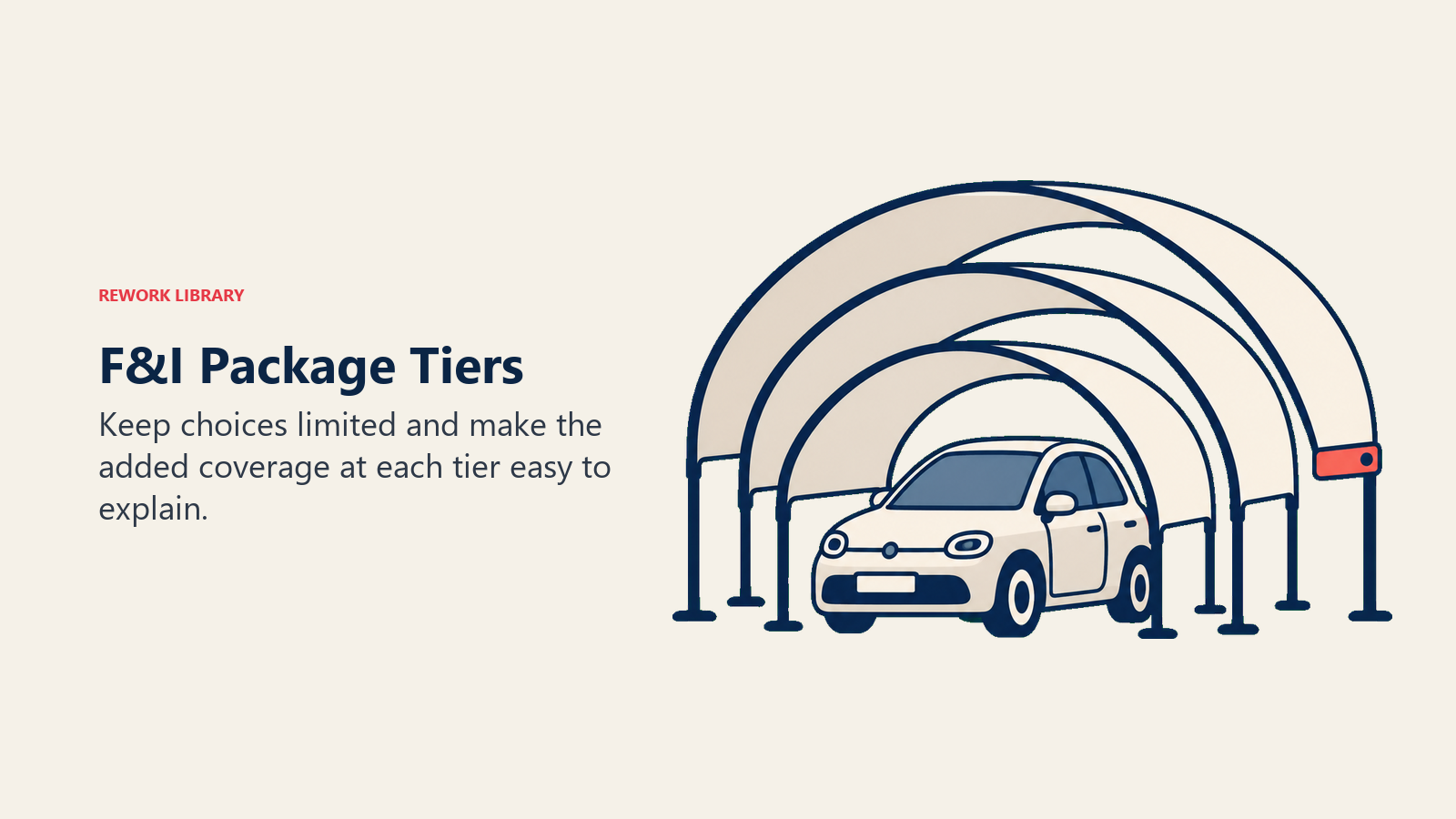
A three-tier good/better/best structure works well for most stores. A workable example: an entry tier bundling powertrain VSC and GAP, a mid tier adding full VSC coverage plus tire and wheel protection, and a premium tier adding prepaid maintenance on top of the mid tier. Each step up should feel like a clear expansion of value, not an arbitrary price increase.
Resist the temptation to add a fifth or sixth tier to capture every possible customer preference. A menu with too many options doesn't serve indecisive customers better, it makes every customer more indecisive, including ones who would have confidently picked from a simpler set of three or four choices.
Key Facts: Menu Structure and Penetration
- Structured menus produce 2.76 products per retail unit versus 1.26 for unstructured, product-by-product pitching (Vision M Group, 2026)
- Menus capped at four package tiers avoid the decision fatigue that longer option lists reintroduce (Vision M Group, 2026)
- Digital menu platforms let customers review and select protection products remotely via a link sent to their mobile device (Dealertrack, 2026)
Product Order and Bundle Logic
Within each tier, the order products appear affects which ones customers actually notice and value. Lead with your highest-value, most defensible product, typically the vehicle service contract, since it protects against the largest and most feared expense: a major mechanical repair. GAP and prepaid maintenance layer in naturally underneath it because they're easier to justify once the customer has already accepted the logic of protection against unpredictable cost.
Bundle logic should follow a clear narrative from tier to tier rather than a random grab-bag of products at each price point. If your premium tier includes five unrelated products with no coherent theme, customers struggle to understand what they're actually paying more for. A tier built around "everything you need to never think about vehicle costs again" tells a clearer story than a list of add-ons.
Price each tier as a package, not a sum of individual line items shown alongside the bundle. Once you show individual line-item pricing next to a bundle price, you've effectively recreated the itemized, ad-hoc pricing psychology the bundle structure was designed to avoid.
Digital Menu Technology
Electronic menu platforms have replaced paper four-squares at most stores, and the newer generation of these platforms does more than digitize the same paper layout. Modern F&I menu systems from providers like Dealertrack's eMenu, powered by Darwin Automotive, use predictive analytics to tailor product recommendations to individual customer profiles, aiming to lift penetration rates beyond what a generic, one-size-fits-all menu order can achieve.
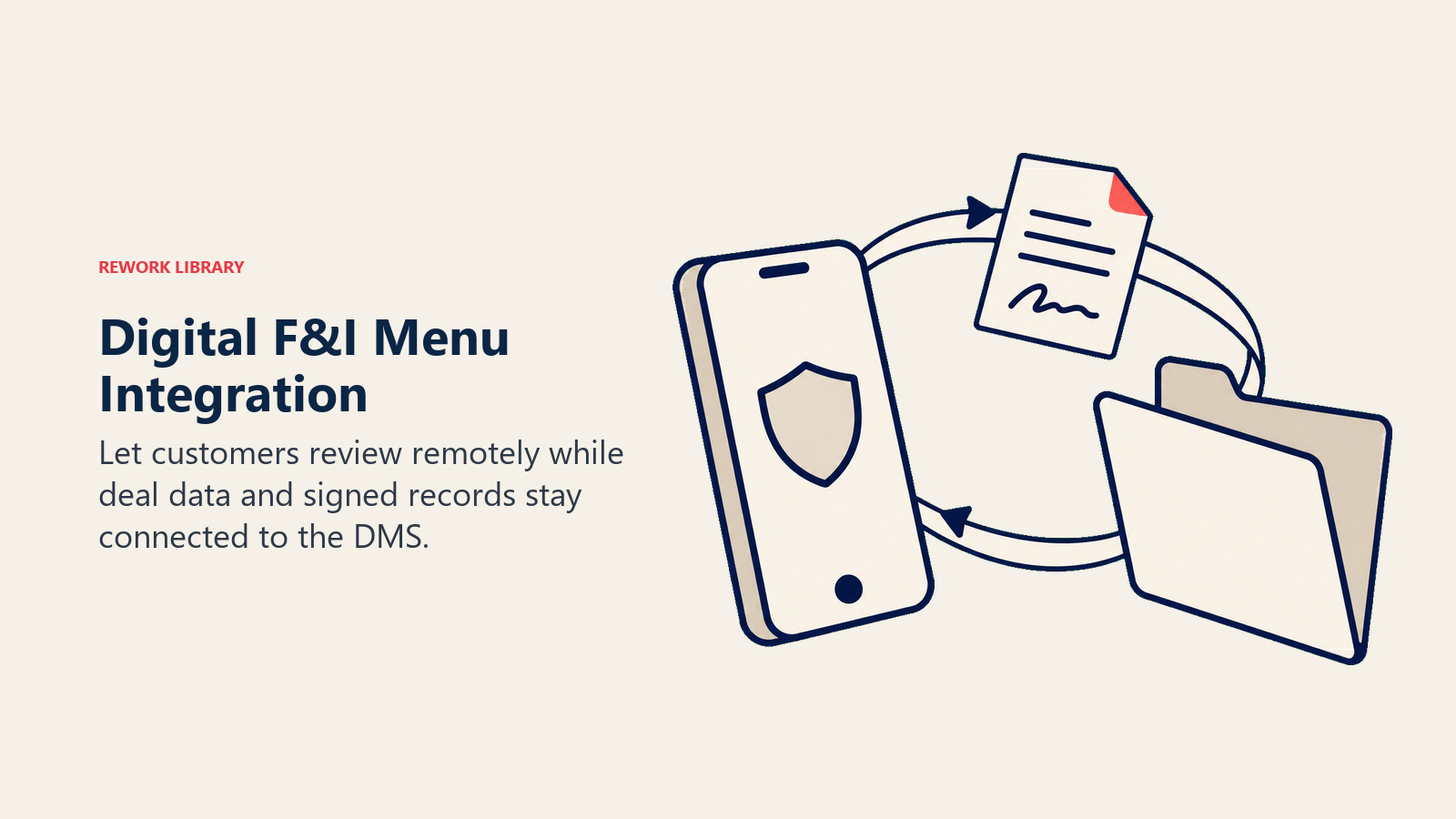
These platforms also extend the menu experience beyond the F&I office itself. Customers can receive an interactive menu presentation via text to their mobile device and review or select protection products remotely, which matters increasingly as more of the buying journey moves online through digital retailing and the broader digital F&I process.
Integration with your DMS is the practical factor that determines whether a menu platform actually gets used consistently. A system that requires manual re-entry of deal data, or that doesn't push signed menus and contracts back into the deal jacket automatically, creates friction that managers route around under time pressure, defeating the purpose of standardizing the menu in the first place. Evaluate menu platforms on DMS integration quality as seriously as you evaluate them on presentation design.
Configuring Your Menu by Customer Segment
A single fixed menu configuration for every customer leaves penetration on the table. Vehicle type, financing structure, and customer profile all suggest different optimal defaults.
High-mileage buyers and buyers of vehicles with historically expensive repair categories benefit from a menu that leads harder with extended coverage, since the real-world risk being protected against is genuinely higher. Buyers with negative equity or high loan-to-value ratios should see GAP positioned earlier and more prominently, since their financial exposure in a total-loss scenario is more severe.
First-time buyers of a given vehicle segment, someone moving into their first luxury vehicle or first EV, often don't yet understand true ownership costs and benefit from menu framing that explains real repair cost examples alongside the product, not just the coverage terms. Returning customers who've already owned a similar vehicle and understand the cost landscape can move through a more streamlined, faster version of the same menu.
Most modern menu platforms allow this kind of segment-based default configuration without requiring a manager to manually adjust the presentation each time. Set these defaults once, based on your store's actual deal mix and claims history, rather than relying on every manager to intuitively adjust their approach deal by deal.
Measuring Menu Effectiveness
Track product penetration by tier, not just overall penetration, to understand whether your menu structure is actually working as designed. If your premium tier almost never gets selected, that's a signal the tier's value proposition or price gap needs revisiting, not necessarily a signal that your managers are underselling it.
Track product-per-retail-unit (PRU) alongside average F&I gross per copy and bundle selection rates. A menu redesign that increases PRU while average gross per copy declines might mean you've made products too easy to add at the expense of premium tier selection, worth investigating before declaring the redesign a win.
Run periodic A/B tests on menu configuration when your platform supports it: test bundle composition, tier count, or product order across a sample of deals and compare penetration and gross outcomes. Menu design decisions made once and never revisited tend to drift out of alignment with your actual customer mix and vehicle inventory over time.
Review your menu configuration whenever you see a meaningful shift in your inventory mix (more EVs, more high-mileage used vehicles, more first-time buyers) since the optimal tier structure for one vehicle and customer mix isn't necessarily optimal for another. A menu built two years ago for a primarily new-vehicle store won't perform the same way if your used vehicle mix has grown substantially since then, tracked through Used Vehicle Acquisition and New vs Used Vehicle Profitability.
The menu is infrastructure, not decoration. A well-designed menu makes an average F&I manager look good and makes a great F&I manager look exceptional. A poorly designed menu, regardless of tiering or technology, forces even your best manager to work harder for the same result. Get the structure right first, then layer in the presentation skill covered in F&I Product Menu Presentation.
For related F&I topics, see F&I Department Overview, F&I Per Vehicle Retail (PVR), Extended Warranty Sales, GAP Insurance Sales, Ancillary Products Strategy, and F&I Compliance Best Practices.
Frequently Asked Questions about F&I Menu Design
How is menu design different from menu presentation technique?
Menu design covers the structure itself, how many tiers exist, which products sit in each tier, how they're priced and ordered, and what technology displays them. Presentation technique covers the words and questions an F&I manager uses once that structure is already in front of the customer. Both matter, but design sets the ceiling that presentation skill works within.
How many product tiers should an F&I menu have?
Cap the menu at four package options, including any single-product fallback. A three-tier good/better/best structure works well for most stores; adding a fifth or sixth tier tends to reintroduce decision fatigue rather than capturing more customers.
Does a structured menu really outperform an ad-hoc, product-by-product pitch?
Yes. Structured menu presentations produce 2.76 products per retail unit on average, compared with 1.26 for unstructured, itemized pitching, more than double the penetration for essentially the same set of products.
What should determine which product leads the menu?
Lead with your highest-value, most defensible product, typically the vehicle service contract, since it addresses the largest feared expense. GAP and maintenance plans layer in more easily once the customer has already accepted the logic of protecting against unpredictable repair costs.
Are digital menu platforms worth the switch from paper or basic electronic menus?
For most stores, yes, particularly platforms using predictive analytics to personalize product order by customer profile and platforms that let customers review menus remotely via mobile. Weigh this against DMS integration quality, since a menu platform that creates manual re-entry work gets bypassed under time pressure.
How often should a dealership revisit its menu configuration?
Review it whenever your inventory or customer mix shifts meaningfully, such as a growing share of EVs or used vehicles, and audit tier-level penetration data at least quarterly. A menu built for one vehicle and customer mix will underperform if that mix has changed significantly since it was designed.