Automotive Content Marketing: Building Authority to Capture In-Market Buyers - 2026 Guide
Turn this article into takeaways for your work.


Each assistant summarizes the article only for you and suggests best practices for your work.
The dealership with 150 blog posts captures 35% more organic leads than competitors with 20 posts. Combined with strong automotive SEO strategy, content becomes your most valuable lead source. That's not speculation, it's measurable data from Google Analytics across hundreds of dealer websites.
But most dealers give up on content after publishing 10 generic articles about "How to Buy a Car" that generate zero traffic. They conclude content marketing doesn't work for automotive. They're wrong about the conclusion. They're right that their content didn't work, because it was written for nobody, optimized for nothing, and promoted nowhere.
Content marketing works when it answers specific questions that real buyers are actively searching for. "Best used SUV under $30K in Phoenix" gets searched 320 times per month. "How to negotiate a fair trade-in value" gets searched 1,200 times monthly. These aren't vanity metrics, these are in-market buyers looking for answers your dealership can provide.
Content Marketing Goals for Dealerships
Organic search visibility determines whether buyers find you or your competitors when they start their research. This is where automotive lead generation begins for most modern buyers. According to industry research, 81% of car buyers begin their journey with search engines. They're not searching for dealer names, they're searching for vehicle comparisons, buying advice, and local options. Content optimized for these queries captures buyers at the research stage, 2-3 months before purchase decisions happen.
Trust and authority building separates you from the 15 other dealers in your market selling the same vehicles at similar prices. When a buyer has read 5 of your articles explaining buying strategies, vehicle comparisons, and ownership costs, you're not just another dealer. You're their trusted advisor. They'll drive past closer competitors to buy from the dealership that educated them.
Lead nurturing and education through content shortens sales cycles and improves close rates. A buyer who arrives at your lot after reading your "Ultimate Guide to Truck Buying" already trusts your expertise, understands their options, and knows what questions to ask. Your sales team spends less time educating and more time closing.
Social media content sourcing from your blog eliminates the daily struggle of "what do we post today?" Your content strategy feeds your entire social media presence. One 2,000-word blog post becomes 10 social media posts, 3 email newsletter sections, and 2 short videos. Content is the fuel for all other marketing channels.
Sales enablement materials help your team close deals. When a prospect asks "What's the difference between the Highlander and the Pilot?", your salesperson sends them a detailed comparison article from your blog. This supports your overall automotive sales process. This demonstrates expertise, provides value, and keeps the conversation moving forward when the prospect isn't ready to visit the lot.
Understanding Buyer Intent & Keywords
Top-of-funnel buyers are in research mode. They're searching for "best family SUV 2026," "hybrid vs electric cars," or "how much can I afford for a car payment." These broad informational queries represent early-stage buyers, 3-6 months from purchase. Content targeting these keywords builds awareness and captures email addresses for nurturing.
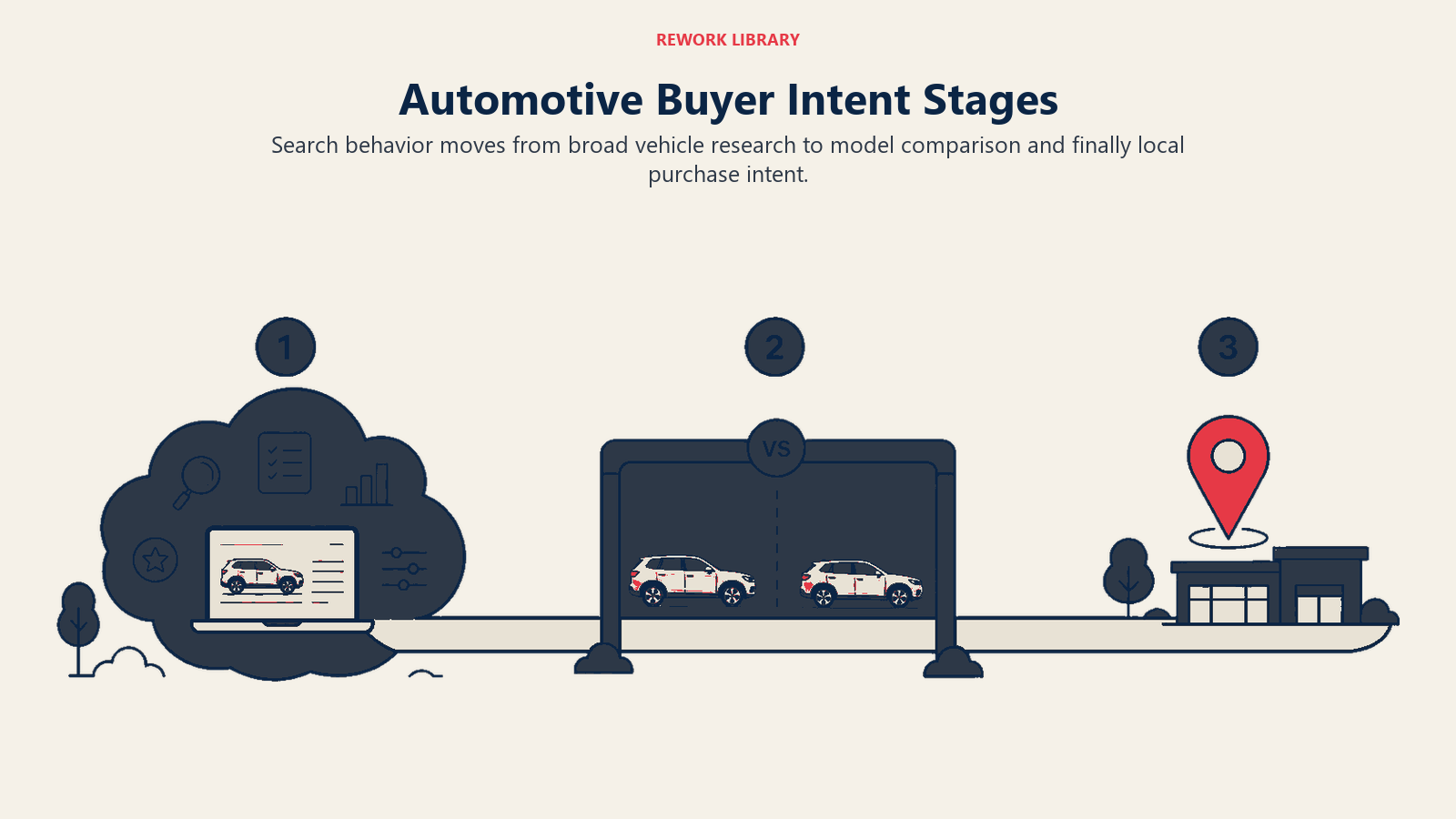
Mid-funnel buyers are comparing specific options. Searches like "RAV4 vs CRV reliability," "best truck for towing 10,000 lbs," or "Camry vs Accord cost of ownership" indicate they've narrowed their choices. These buyers are 1-2 months from purchase. Content here should be specific, comparison-focused, and subtly position your inventory or expertise.
Bottom-of-funnel keywords signal purchase readiness. "2024 F-150 for sale near me," "best Toyota dealer in Chicago," or "how to get pre-approved for auto loan" are high-intent searches. These buyers need decision support, not education. Content should emphasize your dealership's advantages, current inventory, and easy next steps with appointment setting.
Local intent keywords combine product research with geographic specificity. "Best used cars in Austin under $20K," "certified pre-owned BMW Seattle," or "truck dealers near Phoenix" indicate both product interest and location. These searches convert at 3-5x higher rates than non-local queries because the buyer is actively seeking a local solution.
Long-tail opportunities come from specific, detailed questions. "Is 100K miles too high for a used Honda Civic?" gets fewer searches than "used Honda Civic" but converts better because it matches exact buyer concerns. Write content addressing these precise questions. Rank #1 for 50 long-tail queries instead of #47 for one competitive keyword.
Core Content Types
Buying Guides establish your expertise and capture early-stage buyers. "The Complete Guide to Buying a Used Truck in 2026" should be comprehensive (2,500+ words), covering selection criteria, inspection checklists, financing options, negotiation strategies, and common mistakes. Include downloadable checklists to capture email addresses.
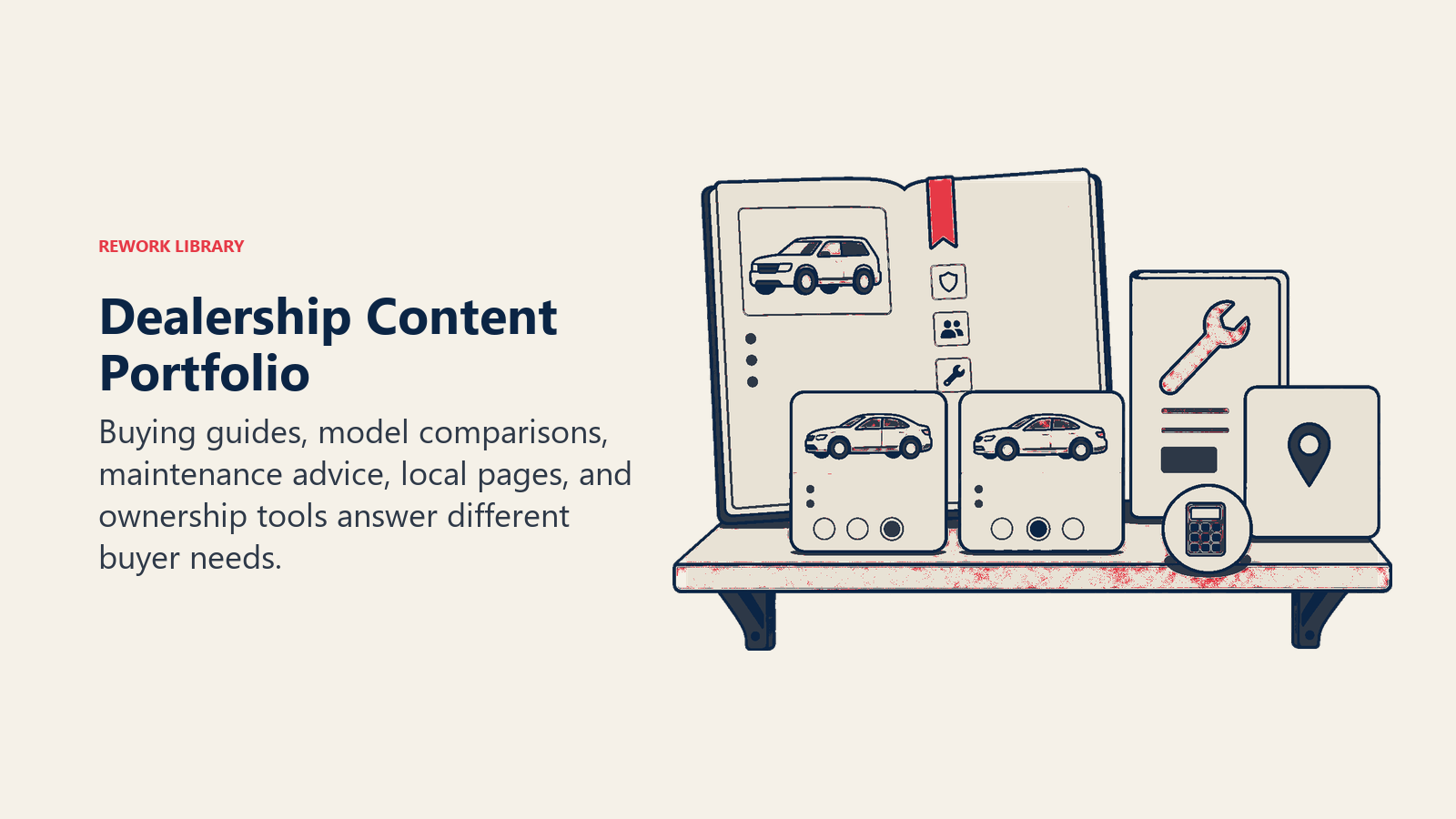
Model Comparisons answer the questions buyers are already asking. Your sales team hears "Should I get the RAV4 or the CRV?" five times per week. Write the definitive comparison once: specs, pricing, reliability data, real-world ownership costs, ideal use cases. Update annually. Send the link to every prospect asking this question. This article works for years.
Maintenance Guides serve current owners and position you as a service authority. "Complete Maintenance Schedule for Toyota Camry (2018-2024)" helps owners, ranks for service-related searches, and drives service department traffic. Include pricing transparency for each service interval. This builds trust and generates service appointments.
Local Content captures geo-specific searches. "Best Family Vehicles for Colorado Winters" or "Most Reliable Cars for Long Highway Commutes in Texas" combines local relevance with buyer intent. These articles face less competition than national content and convert better because they match local buyer contexts.
FAQ Content addresses specific objections and concerns. "Is Extended Warranty Worth It for Used Cars?", "How to Check for Flood Damage on Used Cars," "What Credit Score Do I Need to Finance a Car?" These questions get asked constantly. Comprehensive answers rank well and build trust by showing you understand buyer concerns.
Owner Tips provide post-purchase value that keeps customers engaged. "10 Things Every New F-150 Owner Should Know," "How to Maximize Fuel Economy in Your RAV4," or "Best Apps for Tracking Vehicle Maintenance." These articles serve existing customers, generate returning traffic, and position you as a partner beyond the initial sale.
Content Strategy Framework
Topic research starts with your sales team and service advisors. What questions do customers ask repeatedly? What comparisons do they research? What concerns do they express? These conversations reveal real buyer needs. Use keyword research tools (Google Keyword Planner, Ahrefs, Semrush) to validate search volume and identify related questions.
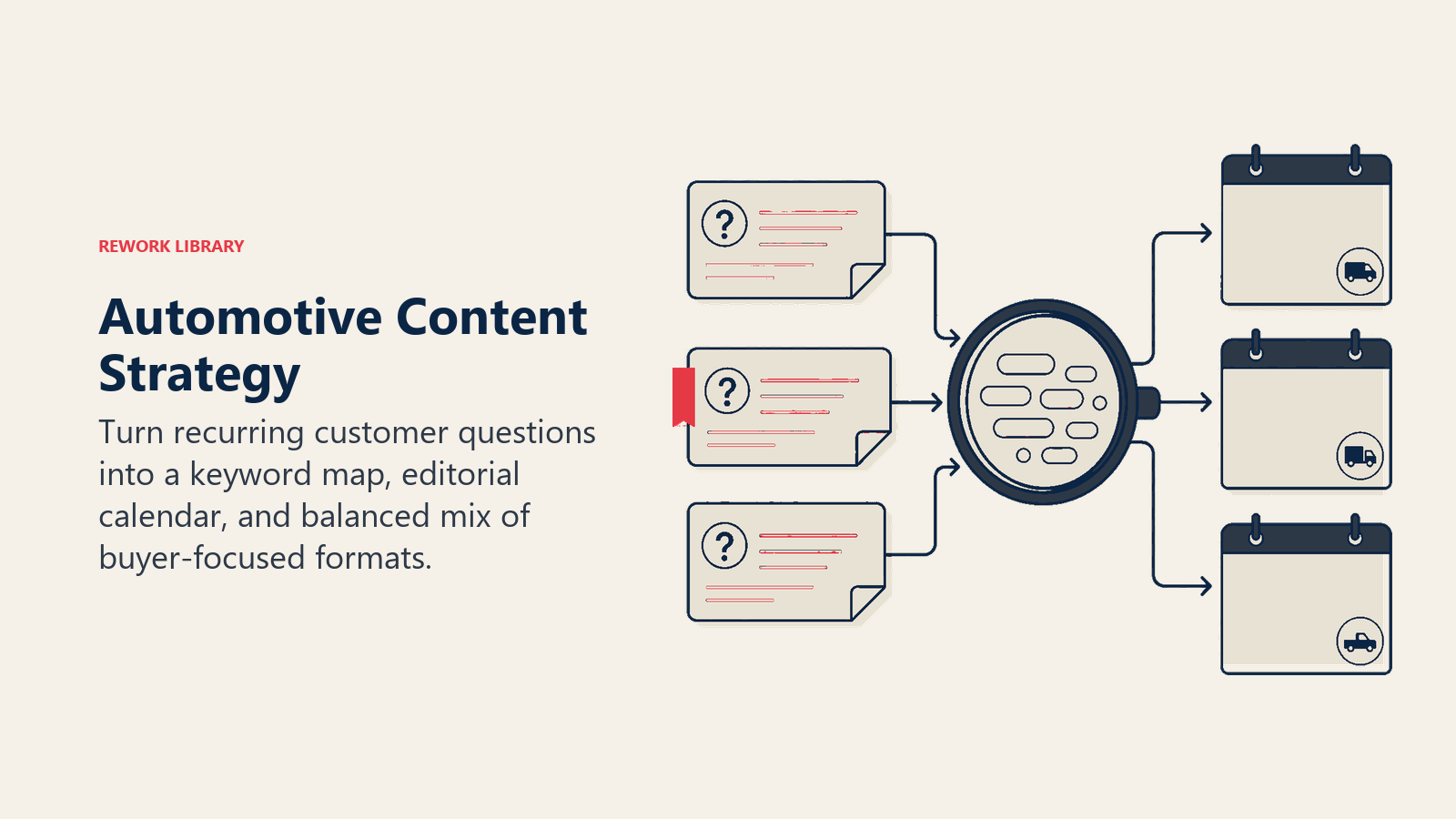
Keyword mapping assigns target keywords to specific articles. Create a spreadsheet with primary keyword, monthly search volume, competition level, content angle, and target URL. This prevents duplicate content targeting the same keyword and ensures comprehensive coverage of buyer journey stages.
Editorial calendar planning maintains consistent publishing. Aim for 2-4 substantive posts per month, 8-16 annually. Prioritize topics by search volume and buyer intent. Mix content types: 40% buying guides and comparisons, 30% local content, 20% FAQ, 10% owner tips. Plan 3 months ahead to allow time for research and quality production.
Content depth requirements have increased. 1,500+ words for pillar content isn't arbitrary, it's what ranks. Comprehensive articles that answer all related questions, include examples, and provide actionable advice outperform thin content. Google rewards depth because it correlates with user satisfaction. Content marketing statistics show that articles with at least one video generate 70% more organic web traffic.
Internal linking strategy connects related content and builds topical authority. Every article should link to 3-5 related posts on your site. "Used Car Buying Guide" should link to "How to Inspect a Used Car," "Financing Options Explained," "Vehicle History Report Guide." This keeps readers engaged and signals to Google that you have comprehensive coverage of the topic.
Update and refresh schedules keep content accurate and rankings stable. Review top-performing posts quarterly. Update statistics, pricing, model years, and examples. Add new sections addressing emerging questions. Republish with updated dates. Google rewards fresh, current content.
Creating High-Value Content
Writing for search intent means matching content to what the searcher actually wants. Someone searching "best fuel-efficient SUV" wants a list with specs, MPG comparisons, and pricing. They don't want your dealership history or a hard sell. Give them the information they searched for first. Your credibility and subtle CTAs handle conversion.
Incorporating dealership expertise differentiates your content from generic automotive sites. Include insights from your sales team: "In our experience selling 200+ trucks annually, customers who plan to tow regularly should prioritize..." or "Our service department sees that owners who follow this maintenance schedule have 40% fewer major repairs." This insider knowledge adds unique value.
Using visuals and video improves engagement and rankings. Original photos of vehicles you sell, comparison charts, infographics explaining complex topics, embedded YouTube videos, all increase time on page. Research from Deloitte shows that automotive consumers visit an average of 4.2 websites in their purchasing process, often using multiple devices, making multi-platform content consistency crucial. Articles with 3+ images get 94% more views than text-only posts. Original visuals signal quality and effort.
Adding CTAs and lead capture turns traffic into leads. Every article should include 1-2 contextual CTAs: "See Our Current SUV Inventory," "Get Pre-Approved in 60 Seconds," "Download Our Free Buying Checklist." Place lead magnets strategically, offer the "Complete Used Car Inspection Checklist" in an article about buying used cars.
Optimizing for featured snippets captures position zero in search results. Featured snippets appear above regular results and drive significant traffic. Format content to answer common questions clearly: use numbered lists, bulleted answers, definition paragraphs, comparison tables. Target question-based keywords and provide direct, concise answers.
Content Production Workflow
In-house vs outsourced writing depends on resources and quality standards. In-house content from your team costs less and includes dealership-specific insights but requires time and writing skill. Outsourced content from automotive writers costs $150-400 per article, maintains consistency, and saves internal time. Many dealers use a hybrid: outsource primary research and writing, have internal team add dealership-specific details and examples.
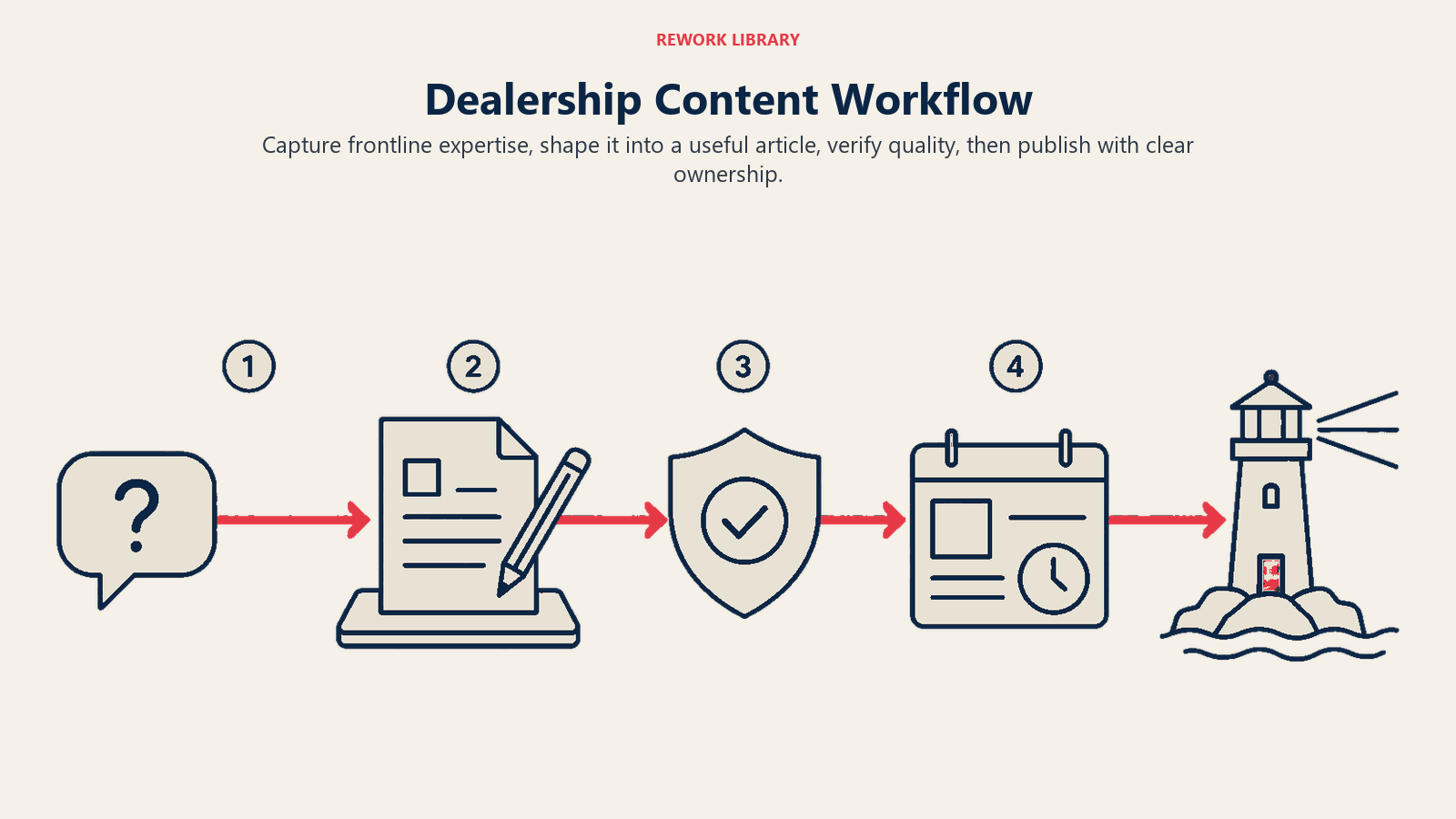
Leveraging sales team expertise doesn't require them to write. Interview your top salespeople and service advisors. Record 15-minute conversations about common questions, vehicle comparisons, or buying advice. Have a writer convert these transcripts into articles. This captures authentic expertise without burdening your sales team with writing duties.
Quality control process ensures every article meets standards before publishing. Checklist: target keyword used naturally 3-5 times, 3+ internal links, 1-2 CTAs, original images, mobile-friendly formatting, no grammar errors, factual accuracy verified, metadata optimized (title tag, meta description, URL slug).
Publishing frequency matters less than consistency. Two articles monthly, published consistently for 18 months, generates more results than 10 articles one month then nothing for six months. Search engines reward regular publishing patterns. Pick a sustainable frequency and maintain it.
Content promotion strategy amplifies reach beyond organic search. Share on social media, include in email newsletters, send to relevant sales prospects, distribute to sales team for prospect education. Content doesn't automatically find its audience, promotion multiplies its impact.
Content Distribution
On-site blog optimization starts with proper site structure. Your blog should live at yoursite.com/blog/ with a clean, navigable archive. Each article should load fast (under 3 seconds), be mobile-optimized, and include clear navigation to related content. Learn more about dealership website optimization. Technical SEO matters, if your site is slow or poorly structured, great content won't rank.
Social media sharing extends reach and drives referral traffic. Share each article 3-4 times over 90 days on Facebook, LinkedIn, and Instagram. Create custom graphics with key statistics or quotes from the article. Don't just post links, provide context on why the content matters to your audience.
Email newsletter integration keeps your database engaged. Feature one article per newsletter with a summary and "Read More" link. See dealership email marketing for campaign strategies. Segment your list, send truck-buying content to truck buyers, maintenance guides to service customers. Relevant content strengthens relationships and drives website traffic.
Sales team utilization converts content into a sales tool. Train your sales team to use blog articles in their follow-up. When a prospect is researching options, send them your comparison article. When someone has financing questions, send your financing guide. This demonstrates expertise and provides value while keeping your dealership top-of-mind.
Community partnerships create backlinks and local authority. Write "Best Vehicles for [Local Activity]" articles and share with local organizations. Partner with local businesses for joint content. Sponsor community events and write recap articles. Local links from reputable sites boost your search rankings and local visibility.
Video & Visual Content
Blog post video supplements increase engagement dramatically. A 2-minute video embedded in an article increases average time on page from 2 minutes to 5+ minutes. Learn more about automotive video marketing techniques. Videos don't need professional production, a sales consultant explaining key points from the article works perfectly. Embed YouTube videos to leverage video search traffic.
Infographics for complex topics make information digestible and shareable. "Total Cost of Ownership Comparison: Gas vs Hybrid" or "Complete Car Buying Timeline" work well as infographics. These get shared on social media and linked from other sites, generating referral traffic and backlinks.
Photo galleries enhance vehicle-focused content. "Best Used Trucks Under $30K" should include actual photos from your inventory with pricing. This combines content value with inventory merchandising. Update galleries quarterly with current inventory.
YouTube video embedding serves dual purposes: adds video content to your blog and drives YouTube search traffic. Create videos for high-traffic articles. Optimize video titles and descriptions for search. Link back to blog article in video description.
Podcast opportunities exist for dealers willing to commit to regular episodes. A weekly 15-minute podcast discussing market trends, vehicle reviews, or buyer advice builds authority and creates content for blog transcription. Audio content reaches buyers during commutes, prime automotive consideration time.
Measuring Content Performance
Organic traffic growth is the primary metric. Track monthly organic sessions in Google Analytics. Healthy content programs grow 5-10% monthly in year one, then stabilize at 2-5% monthly growth. Compare year-over-year to account for seasonality. If organic traffic isn't growing, your content strategy needs adjustment.
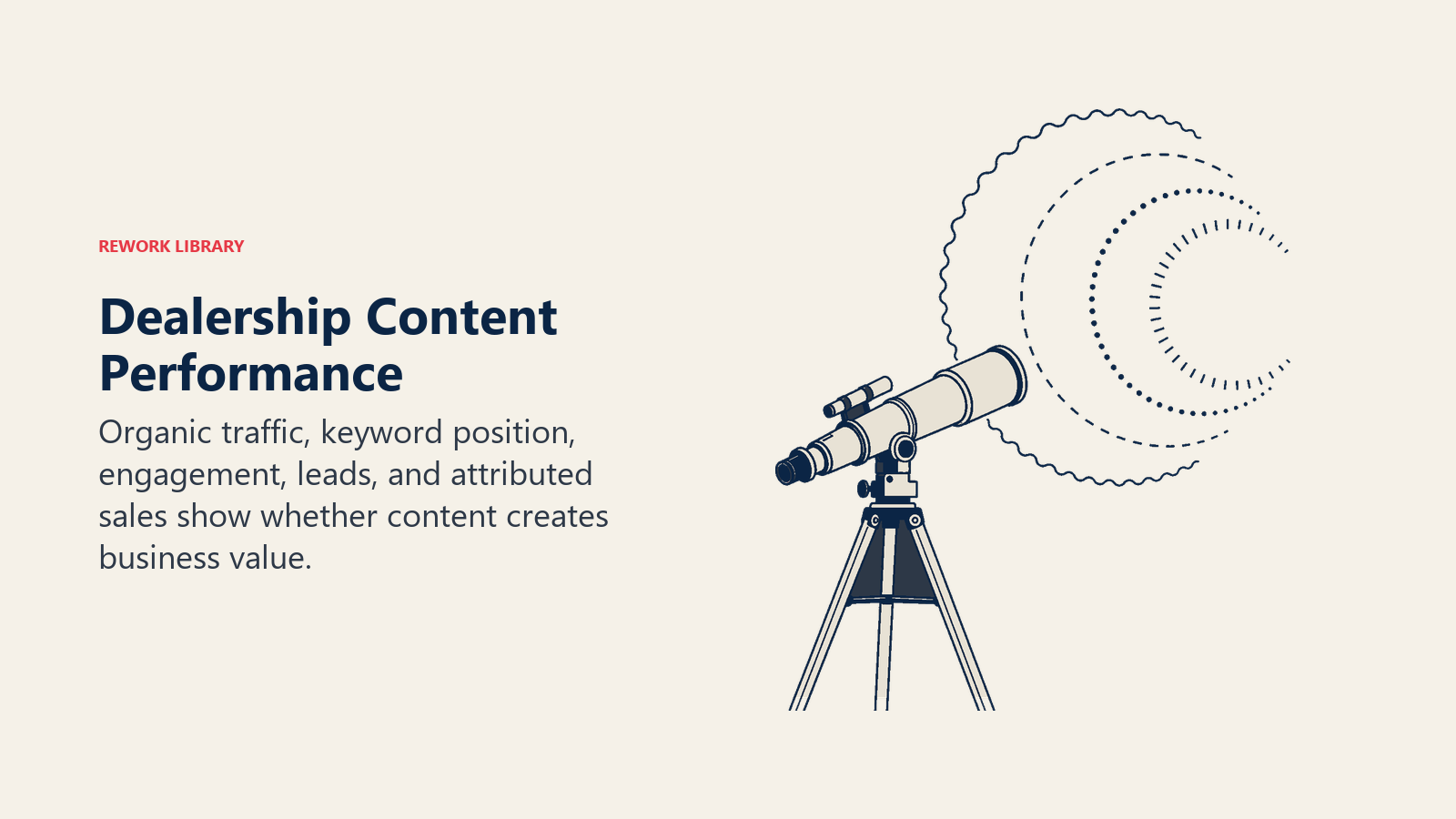
Keyword rankings track visibility for target terms. Use ranking tools (Ahrefs, Semrush, Moz) to monitor positions for your target keywords. Aim for page-one rankings (positions 1-10) for priority keywords. Track ranking changes monthly. Declining rankings signal either stronger competition or content becoming outdated. According to automotive SEO research, the benchmark for organic conversion rates in the automotive industry stands at 1.57%, with ROI from SEO being the highest compared to all marketing channels.
Time on page and engagement indicate content quality. Articles with 3+ minute average time on page signal valuable content. High bounce rates (70%+) suggest content doesn't match search intent or quality is poor. Engagement metrics help identify which topics and formats resonate with your audience.
Lead generation attribution connects content to revenue. Use UTM parameters and CRM source tracking to identify leads originating from blog content. Track how many blog visitors submit forms, call, or chat with dealership analytics. Calculate conversion rates by article topic. This data reveals which content drives actual business, not just traffic.
Assisted conversions measure content's role in the buyer journey. Most buyers don't convert on first visit. Content often serves as an early touchpoint that influences later conversion. Google Analytics' multi-touch attribution shows how blog visits contribute to eventual conversions, even if they're not the last click.
ROI calculation justifies continued investment. Track content costs (writing, optimization, promotion) against attributed revenue. Include both direct conversions (form submissions from blog) and assisted conversions (blog visits in the conversion path). Most dealers find content marketing generates 6-12 month payback periods, then becomes increasingly profitable as content library compounds.
Content marketing isn't a quick win. It's a 12-18 month investment that compounds over time. The article you publish today might generate leads for 3-5 years. But you have to start. Publish the first article this week. Then the second next week. Build the library systematically. Six months from now, you'll wish you started today.
For the technical foundation, see Automotive SEO Strategy. Video content deserves special attention, check out Automotive Video Marketing. Your content lives on your website, so Dealership Website Optimization matters. Content feeds social channels, integrate with Social Media for Dealerships. And remember content is one piece of the larger strategy outlined in Automotive Lead Generation Overview.

Senior Implementation Consultant