Maintenance Menu Pricing - Package Services for Higher Value and Conversion - 2026 Guide
Turn this article into takeaways for your work.


Each assistant summarizes the article only for you and suggests best practices for your work.
Service departments using menu pricing for maintenance packages see 35-45% higher average RO values and 20% less price resistance compared to à la carte pricing, customers prefer clear options over complicated itemized quotes.
Think about the last time you went to a restaurant and faced a menu with 200 items, no descriptions, and no prices. Overwhelming, right? Now imagine a menu with three set meals clearly described with everything included and transparent pricing. You'd make a decision in 30 seconds.
That's exactly how your service customers feel when you hand them an itemized repair order with 15 line items versus a simple menu offering Bronze, Silver, and Gold maintenance packages.
Menu pricing isn't about tricking customers or hiding costs. It's about simplifying their decision-making while bundling services that belong together, creating perceived value, and making it easy to say yes to the maintenance their vehicle needs. This approach is a critical lever in improving service absorption rates.
Let's build your menu pricing system.
Why Menu Pricing Works Better Than Itemized Quotes
The psychology behind menu pricing is simple: people don't want to do math, they don't want to feel nickel-and-dimed, and they respond positively to clearly defined options that match their needs.
When you quote a customer an oil change for $49.95, then add tire rotation for $29.95, then add multi-point inspection for $39.95, then suggest an engine air filter for $45, they're mentally calculating totals, questioning whether each item is necessary, and feeling like you're upselling them on everything.
The total is $164.85 before tax. But it feels expensive because they came in thinking "oil change" and now you're at $165.
Now consider the menu approach. You present three options:
Bronze Package - $89.95: Oil change (up to 5 quarts synthetic blend), tire rotation, multi-point inspection, fluid top-offs, exterior wash
Silver Package - $134.95: Everything in Bronze, plus engine air filter replacement, cabin air filter replacement, battery test, brake inspection
Gold Package - $179.95: Everything in Silver, plus coolant test and top-off, transmission fluid check, differential fluid check, throttle body cleaning, premium exterior wash and interior vacuum
Same services. Different presentation. The customer now sees options that match their needs rather than feeling pressured to buy individual items.
The Bronze package is for customers who just need basic maintenance. Silver is for those at the 30K-45K mile mark who need filters and more comprehensive inspection. Gold is for higher-mileage vehicles or customers who want everything taken care of.
Most customers choose Silver. Some choose Gold. Almost nobody chooses just Bronze, they see the value in the additional services for $45 more.
And here's the magic: your average RO just jumped from $89.95 (oil change only) to $134.95 (Silver package) without any objections. That's a 50% increase in revenue per customer.
Bundling creates perceived value. When customers see "engine air filter replacement" as a standalone service for $45, they question whether it's necessary. When it's included in a package with four other services for $45 more total, it feels like they're getting a deal.
Transparent pricing builds trust. Customers appreciate knowing the exact cost upfront without surprise line items or hidden fees. When the price you quote is the price they pay (plus tax), satisfaction increases.
Decision fatigue is real. Studies show that people make worse decisions when they're forced to evaluate too many options or variables. Menu pricing reduces decisions from "Do I need this?" fifteen times to "Which package is right for me?" once.
Creating Your Maintenance Package Menu
The foundation of effective menu pricing is understanding what services naturally belong together and what customers actually need at different mileage intervals.
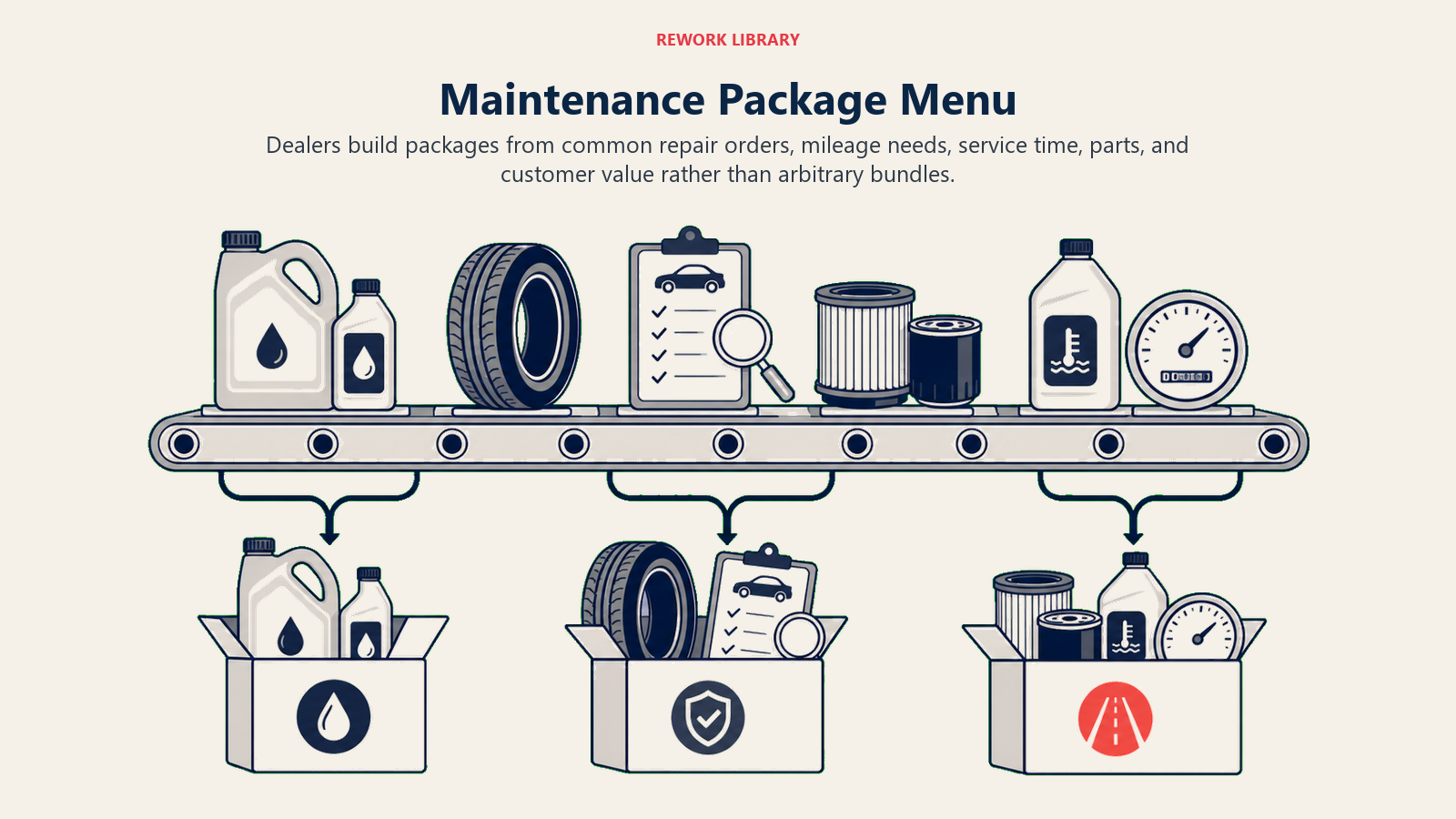
Start with your most common services. Pull 90 days of repair orders from your DMS data and identify your highest-volume services. Oil changes, tire rotations, multi-point inspections, brake inspections, battery tests, and filter replacements will dominate the list.
These services form your Express Service tier, quick, routine maintenance that every customer needs regularly regardless of mileage.
Express Package (Bronze) should include your basic quick services:
- Oil change with synthetic blend (or full synthetic for premium brands)
- Tire rotation
- Multi-point inspection
- Fluid level check and top-offs
- Exterior wash
- Estimated time: 45-60 minutes
- Price point: $79-$99 depending on your market and brand
This package replaces your standalone oil change offering. Yes, some customers will balk that your "oil change" costs $89 instead of $49. But you're delivering substantially more value and setting the foundation for a thorough vehicle inspection every visit.
Mileage-based packages should align with manufacturer maintenance schedules. According to Wikipedia's automotive service guidelines, minor services are typically performed every 10,000 to 15,000 kilometres (6,200 to 9,300 miles), while major services occur every 30,000 to 45,000 kilometres (19,000 to 28,000 miles). Every OEM publishes recommended service intervals, use those as your guide.
30,000-Mile Package (Silver):
- Everything in Bronze
- Engine air filter replacement
- Cabin air filter replacement
- Brake system inspection (measure pad/rotor thickness)
- Battery test and terminal cleaning
- Estimated time: 90 minutes
- Price point: $199-$249
60,000-Mile Package (Gold):
- Everything in Silver
- Coolant drain and fill
- Transmission fluid exchange (if applicable to vehicle)
- Differential fluid service (if applicable)
- Spark plug replacement (if due)
- Throttle body cleaning
- Serpentine belt inspection
- Estimated time: 2.5-3 hours
- Price point: $449-$599
The 60K service is your highest-value package. Don't be afraid to price it appropriately, customers understand that major service intervals cost more, and they've likely been budgeting for it.
Seasonal packages create marketing opportunities around specific times of year.
Winter Prep Package: Battery test, coolant test, tire inspection and pressure adjustment, wiper blade replacement, heater system check, exterior wash and undercarriage spray
- Price point: $129-$159
Summer Ready Package: A/C performance check, coolant test, battery test, tire inspection and pressure adjustment, exterior detail
- Price point: $119-$149
These packages drive traffic during typically slow months and address real customer needs based on climate and driving conditions.
Brand-specific packages leverage your OEM relationship and factory maintenance schedules. Honda has specific maintenance at 30K/60K/90K. Toyota has their ToyotaCare schedule. Mercedes has Service A and Service B.
Build your menu around those schedules and use the OEM branding. "This is your BMW 60,000-mile service as outlined in your owner's manual" carries more weight than "We recommend these services."
Pricing Strategy That Maximizes Profit and Take Rate
The most common mistake dealers make with menu pricing is setting prices too low out of fear that customers won't buy.
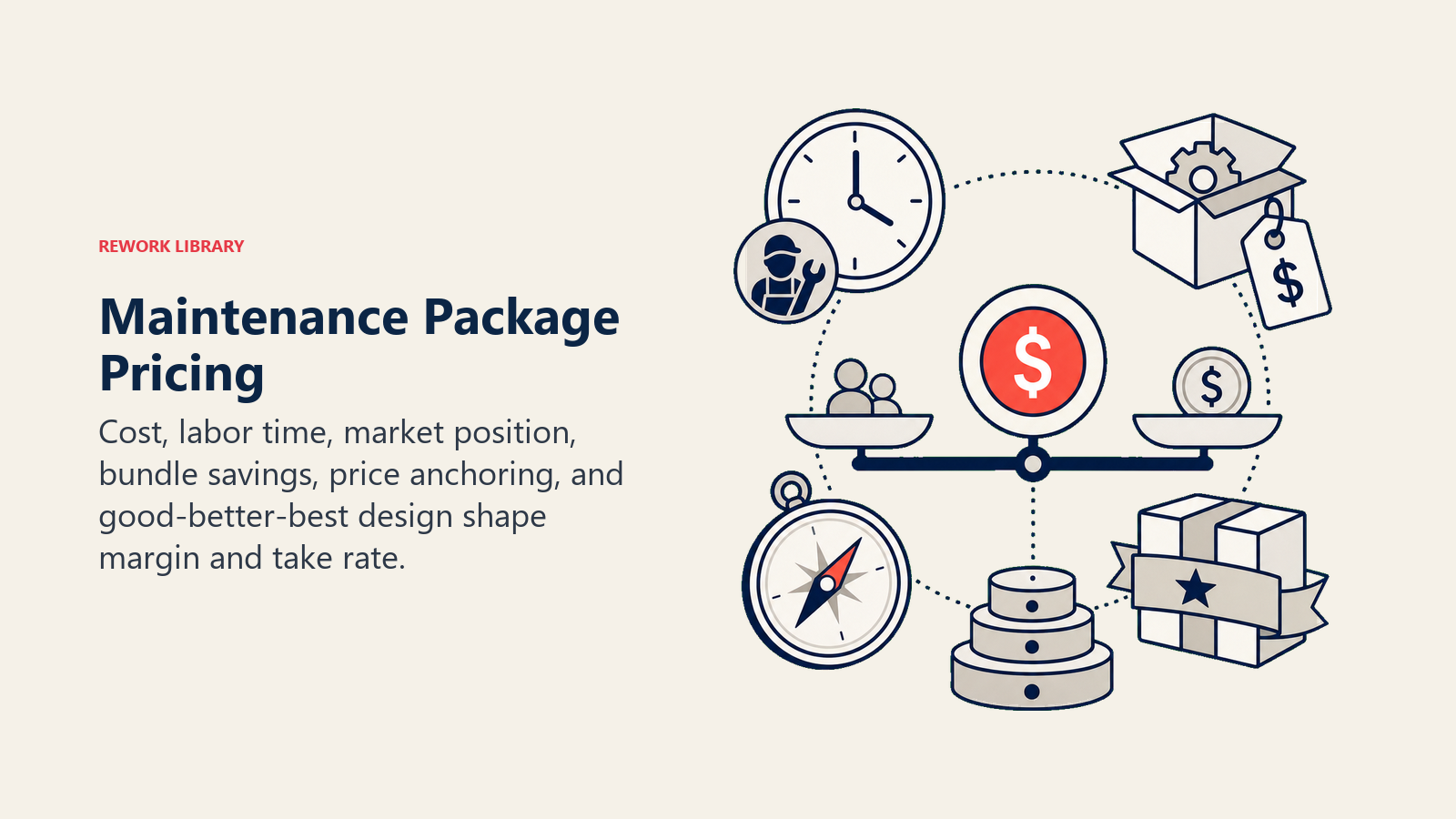
Here's the reality: customers aren't shopping your service pricing against other dealers. They're evaluating the value of what you're offering against the price you're charging.
Cost-plus-margin pricing starts with calculating your actual costs. What does the oil cost? Filters? Labor at your effective labor rate? Shop supplies? Then add your target margin.
If your cost to perform the Silver package is $85 in parts, labor, and supplies, and you want 60% gross profit, you price it at $212.50. Round to $214.95 or $219.95 depending on your market positioning.
But cost-plus ignores market value. Just because something costs you $85 to deliver doesn't mean customers will only pay 1.6x that amount.
Market-based pricing considers what competitors charge, what customers expect to pay, and what the perceived value justifies. McKinsey research on aftermarket pricing shows that AI and ML technologies in pricing applications have enhanced margins by 2 to 6 percent of sales while maintaining coordinated pricing strategies. If independent shops charge $180 for similar services and other dealers charge $240, you have room to price competitively while maintaining margin.
Package discount vs. à la carte pricing should show customers the savings from bundling. If they bought each service individually, the total would be $275. Your package price is $214.95. That's a $60 savings for buying the bundle.
List the à la carte total on your menu so customers see the value: "Silver Package: $214.95 (À la carte value: $275)"
This isn't manipulation, it's transparency that highlights the benefit of bundling. NADA research on fixed operations demonstrates that optimized service pricing strategies directly impact dealership absorption rates and profitability.
Regional competitive analysis matters more for general services than specialized repairs. Pull pricing from 3-5 competitive franchised dealers in your market. Where do you rank? If you're significantly below average, you're leaving money on the table. If you're significantly above, you need to justify the premium through better service, faster turnaround, or additional benefits.
Balancing gross profit with take rate requires testing and optimization. If your package prices are too high, take rate drops. If they're too low, take rate is great but you're not maximizing profit.
Start with a target 60% gross profit on packages and monitor take rates for 60 days. If 85% of customers choose a package, you can likely increase prices 10-15% without significant impact. If only 40% choose packages, your pricing might be too aggressive or your value communication needs work.
Presenting Your Menu Effectively
You've built great packages at smart price points. Now you need to display them where customers make decisions as part of your overall automotive customer experience strategy.
Service drive visual menu boards should be the first thing customers see when they pull into your service area. Large, professionally designed boards showing your package options, what's included, and prices.
This is not a hand-written poster board. This is a professionally designed graphic display that looks like a restaurant menu or retail pricing board. Invest in quality design and printing, you're representing a premium service operation.
Position the menu board where customers naturally look while waiting for their service advisor. If they've already reviewed the options before the write-up conversation, the advisor is confirming their choice rather than convincing them to buy.
Digital presentation on tablets and monitors enables interactive menu exploration. Your service advisor should have a tablet showing the menu packages with the ability to expand each option, show included services, and even display photos of the services being performed.
This is where digital vehicle inspection integration shines. "Based on your mileage and what we're seeing in your service history, the Silver package is perfect for you. Here's everything included..." then you hand them the tablet showing the full details.
Website service pricing pages are essential for pre-shopping customers. 70% of service customers research pricing online before visiting or calling. If your dealership website doesn't clearly show service pricing, they're going to competitors who do.
Create a dedicated "Service Pricing" page showing your packages, what's included, estimated time, and price. Add an online scheduling button so customers can book immediately.
Address the objection before it happens: "All pricing includes parts, labor, shop supplies, and our 12-month/12,000-mile warranty on all work performed. Additional services may be recommended based on vehicle condition and manufacturer maintenance schedules."
Mobile-friendly formatting is non-negotiable. Your service pricing page needs to render perfectly on smartphones because that's where most people are viewing it.
Clean, simple layout. Large, readable fonts. Clear package names. Easy-to-scan included services. Prominent pricing. One-tap calling or scheduling buttons.
Training Service Advisors to Sell Packages
The best menu won't drive results if your service advisors don't present it confidently and consistently.
Start with menu training during the write-up. Every service advisor should know every package cold, what's included, estimated time, price, and which customers each package serves best.
Role-play package presentations. "When a customer comes in for an oil change and they're at 32,000 miles, which package do you recommend and why?" The advisor should immediately say "Silver package, because they're due for filters and we should do a comprehensive brake inspection at this mileage."
Recommending the right package based on customer needs shows expertise rather than sales pressure. Ask the right questions:
- When was your last service?
- How many miles are on the vehicle?
- Are you planning any long trips soon?
- Have you noticed any issues with the vehicle?
Their answers tell you which package fits. If they're at 29,000 miles and planning a road trip, the Silver package makes sense. If they're at 8,000 miles and just need routine maintenance, Bronze is appropriate.
Upselling from Bronze to Silver or Gold happens naturally when you identify vehicle needs during the multi-point inspection.
"You came in for the Bronze package, but during our inspection we found your engine air filter is pretty dirty and your cabin air filter has leaves and debris in it. Both are due for replacement based on your mileage. The Silver package includes both of those, plus a comprehensive brake inspection and battery test. For just $45 more, you get significantly more value."
Most customers upgrade when presented with evidence and clear value.
Handling "I just want an oil change" customers requires patience and education. Some customers genuinely only want the basic service. Others just don't understand what else they need.
"I completely understand. We can absolutely do just the oil change for you. However, all our oil services include a multi-point inspection at no charge. If we find anything that needs attention, I'll call you before doing any additional work. Sound good?"
Now you've performed the inspection, identified needs, and earned the right to recommend the appropriate package based on what you found.
Explaining package value and savings uses the à la carte comparison. "If you purchased these services separately, the total would be $275. The Silver package bundles everything for $214.95, saving you $60 while making sure your vehicle gets the comprehensive maintenance it needs."
Value proposition beats price objection almost every time.
Measuring Menu Performance and Optimizing
Implementation is only the beginning. The best-performing service departments measure package performance obsessively and optimize constantly.
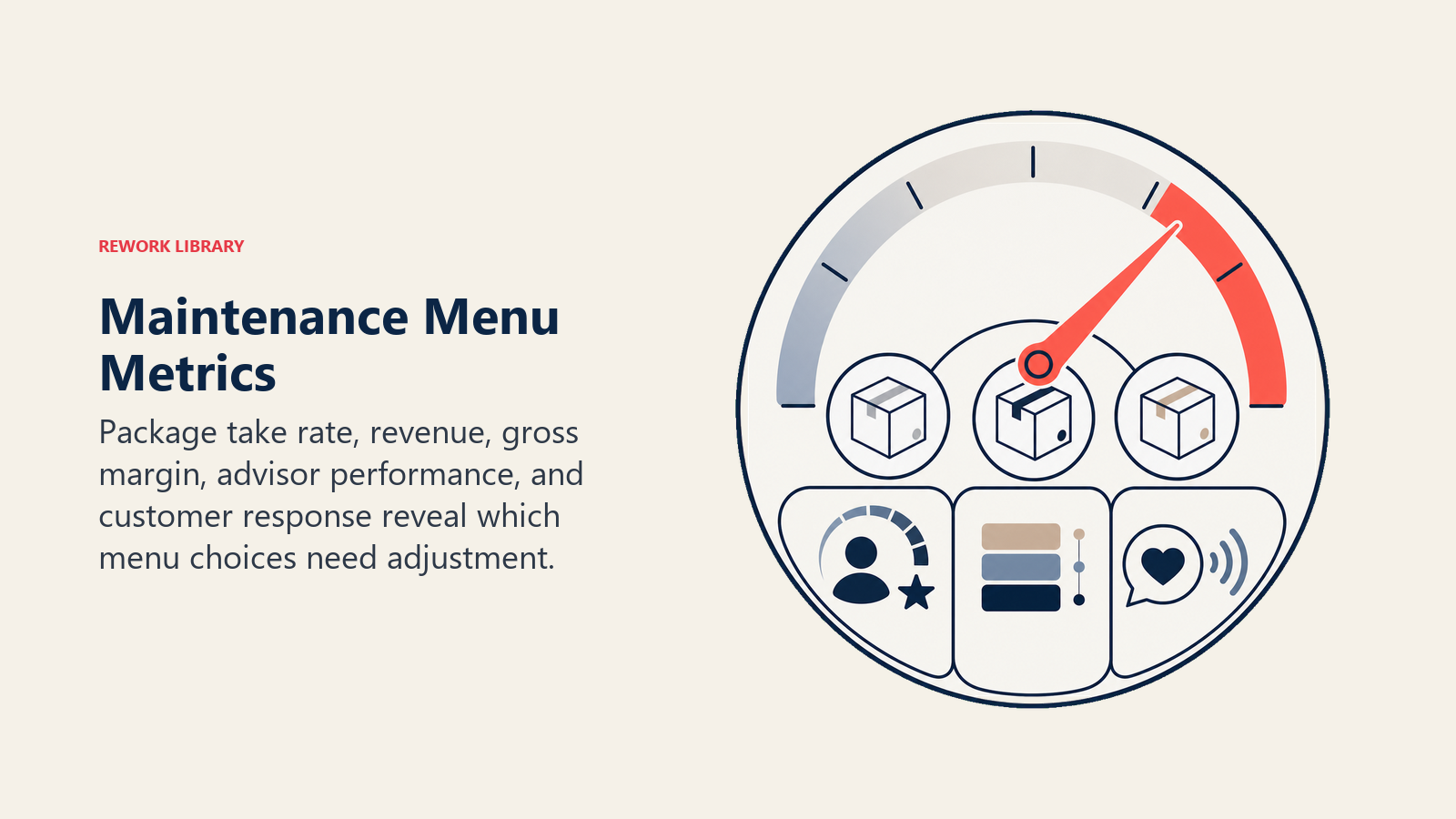
Package take rate by menu item tells you which packages are most popular. If 65% of customers choose Silver, 20% choose Bronze, and 15% choose Gold, you know your middle option is priced and positioned well.
If nobody chooses Gold, it's either priced too high or the value isn't communicated effectively. Test a new Gold package with different services or adjust pricing.
Average RO by package type shows profitability. Your Bronze package might average $89.95, Silver averages $214.95, and Gold averages $549.95. When you know these numbers, you can calculate the revenue impact of shifting more customers to higher tiers.
If you service 400 customers per month and 70% choose Bronze at $89.95, that's $25,186 in package revenue. If you shift that mix to 40% Bronze, 50% Silver, 10% Gold through better presentation and advisor training, monthly package revenue jumps to $53,978, more than double.
Gross profit per package category tracks profitability, not just revenue. A package with high take rate but thin margins isn't as valuable as one with moderate take rate and strong margins.
Calculate gross profit percentage for each package and optimize the mix. You might find that Silver package has the best balance of take rate and margin, so you focus advisor training on recommending Silver to most customers.
Customer satisfaction correlation ensures you're not sacrificing quality for revenue. Track CSI scores for customers who purchased packages versus those who declined. If package customers have higher satisfaction, you're doing it right. If they're less satisfied, investigate why, are you overselling, under-delivering, or missing something in execution? Connect this data to your broader KPI tracking.
Making Menu Pricing Work for Your Dealership
Menu pricing isn't a one-time project. It's an ongoing strategy that requires refinement, testing, and optimization.
Start with three core packages, Bronze, Silver, Gold, based on your most common service intervals. Price them with healthy margins but fair to market positioning. Design professional displays for your service drive and website. Train every service advisor on consultative package selling.
Launch and measure for 60 days. What's your package take rate? Which package is most popular? What's your average RO before and after implementation? How are customers responding?
Optimize based on data. Adjust pricing if needed. Refine package contents if certain services aren't valued by customers. Create seasonal variations to drive traffic during slow months.
The dealerships that master menu pricing transform their service departments from transactional oil change centers into comprehensive vehicle maintenance operations. Average RO increases 35-50%. Customer satisfaction improves. Technician productivity increases because you're selling more hours per RO.
Your customers want simplicity, transparency, and value. Menu pricing delivers all three while driving the service department profitability your dealership needs. This approach feeds directly into gross profit optimization efforts.
Build your menu. Train your team. Measure the results. You'll never go back to à la carte pricing. For complete service department optimization, explore fixed operations overview, service absorption rate, service advisor selling skills, service customer retention, and service marketing campaigns.

Senior Implementation Consultant