Customer Data Platforms: Unifying Dealership Customer Intelligence
Turn this article into takeaways for your work.


Each assistant summarizes the article only for you and suggests best practices for your work.
Your customer database lives in six different systems, DMS, CRM, website analytics, service scheduler, marketing automation platform, and email system. Each one holds different pieces of the customer puzzle. Your DMS knows purchase history and service visits. Your CRM tracks sales conversations and lead sources. Your website knows browsing behavior and vehicle interests. Your marketing platform has email engagement data.
But here's the problem: these systems don't talk to each other effectively. The customer who test-drove a truck last month, opened three service reminder emails, and just browsed your SUV inventory looks like three different people across your systems. You're making marketing decisions with incomplete information.
A Customer Data Platform (CDP) solves this by creating one unified, persistent customer record that combines data from all these sources. It's the foundation for the kind of personalized, intelligent marketing that customers now expect and that drives measurable ROI.
What is a Customer Data Platform
A CDP is fundamentally different from the systems you already use, even though it integrates with all of them. At its core, a CDP is a unified, persistent customer database that's accessible by other systems. "Unified" means it pulls data from multiple sources and combines it into single customer records. "Persistent" means it maintains this data over time, creating a historical view of each customer relationship. "Accessible" means other systems can tap into it to personalize experiences.
This differs from your CRM in important ways. A CRM manages sales processes, tracks leads, and helps sales teams close deals. It's designed around sales workflow, not customer identity. A CDP focuses purely on creating a complete view of who your customers are and what they've done across every touchpoint.
It's also different from your DMS, which is a transactional system for managing dealership operations. Your DMS records what happened (sales, service, payments), but it doesn't synthesize that with digital behavior, marketing engagement, or cross-channel interactions.
And it's not marketing automation, though it powers marketing automation. Marketing automation platforms execute campaigns and workflows. They need to know who to target and when. A CDP provides that intelligence by maintaining rich customer profiles that marketing automation can act on.
The CDP landscape includes both dealer-specific platforms built for automotive retail and general-purpose platforms that can be configured for any industry. Dealer-specific options understand DMS data structures, vehicle ownership lifecycles, and dealership marketing needs. According to Gartner research on customer data platforms, automakers and dealers are increasingly approaching CDP vendors to create a data fabric that connects all customer data across various enterprise application silos. General platforms offer more flexibility and advanced features but require more configuration.
The Dealership Data Challenge
Why do dealerships need CDPs when they've managed customer data for decades without them? Because the data problem has gotten exponentially worse. Customer data is fragmented across more systems than ever. Twenty years ago, you had a DMS and maybe a basic CRM. Now you have a DMS, CRM, website with analytics, chat platform, social media advertising, email marketing, direct mail vendor, third-party lead providers, service appointment scheduler, and more. Each system creates its own version of customer truth. In automotive retail, customers move fast, they jump from online research to chat to an in-store visit in a matter of hours, making unified customer data management essential. Duplicate records proliferate because systems don't share unique identifiers. John Smith who bought a car shows up in your DMS. JSmith99 who filled out a web lead is in your CRM. John.Smith@email.com who opened marketing emails is in your email platform. They're the same person, but your systems don't know that. You might have 15,000 customer records across systems that represent only 10,000 actual unique customers.
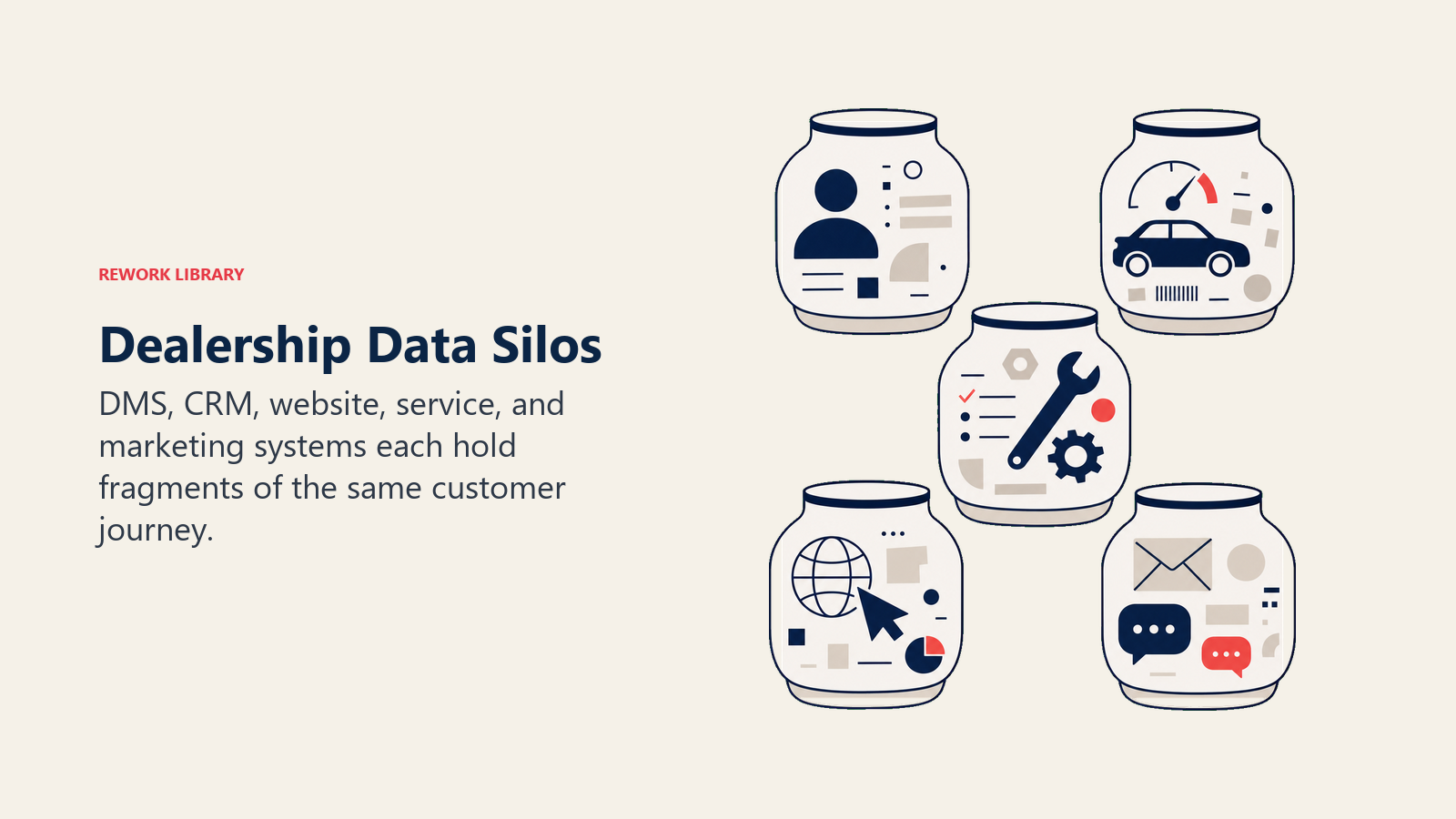
This makes tracking the full customer journey nearly impossible. You can't see that the customer who just requested service pricing online is the same person who test-drove a vehicle three months ago and has positive equity in their current vehicle. These connections, which seem obvious to a human, are invisible to disconnected systems.
Limited personalization results from this fragmentation. Without a unified view, your marketing is generic. You send the same email to everyone with a 2019 vehicle, whether they've been to your service department six times or never. You advertise trucks to someone who just browsed sedans on your website. You market new vehicles to someone who only buys used.
Poor handoffs between departments create frustrating customer experiences. Sales sells a vehicle, but service doesn't know the customer bought from you. F&I finishes a deal, but marketing continues sending "Come test drive!" emails for weeks. The customer sees dysfunction; you see siloed systems that nobody's bothered to connect.
CDP Architecture and Components
Understanding how a CDP works technically helps you evaluate options and implement effectively. Data ingestion from multiple sources is the foundation. The CDP needs connectors or integrations with your DMS, CRM, website, email platform, advertising accounts, and any other system that touches customers. Some of these connections are simple API integrations. Others require file exports and imports. The best CDPs make this easy with pre-built connectors for common dealership platforms.
Identity resolution and record matching is where the magic happens. When data flows in from different sources, the CDP uses multiple identifiers to figure out which records belong to the same person: email address, phone number, VIN, name and address combination, device IDs, cookies, and more. It creates probabilistic and deterministic matches, consolidating duplicates into single customer profiles.
Real-time profile updates and enrichment keep customer records current. When someone browses your inventory, that behavior updates their profile immediately. When they open an email or visit for service, those events add to their history. The CDP doesn't wait for nightly batch processes, it maintains current state continuously.
The segmentation engine enables audience creation for marketing. Instead of pulling lists from individual systems, you build segments in the CDP using any combination of data: "Customers who own 2019-2021 vehicles, have visited our website in the past 30 days, and haven't been to service in 6 months." The CDP evaluates all customer profiles against these criteria and delivers the audience.
Integration with activation tools closes the loop. Once you've built a segment, you push it to your email platform to send a campaign, to Facebook for lookalike audience creation, to your CRM for sales outreach, or to your website for personalized content. The CDP is the brain; other systems are the hands that execute.
Unifying the Customer Journey
The power of a CDP becomes clear when you see what's possible with a 360-degree customer view. Website behavior and digital interactions reveal intent and interests. Your CDP knows which inventory pages customers view, how long they spend, what they search for, and what makes them submit a lead or leave. When this connects to identity, you can personalize future visits based on past behavior, showing the SUVs they browsed instead of generic homepage content. Sales history and purchase patterns inform lifecycle marketing. The CDP knows who bought what vehicle, when they bought it, how they financed it, what F&I products they purchased, and how much they paid. This enables precise vehicle replacement campaigns based on typical ownership cycles.
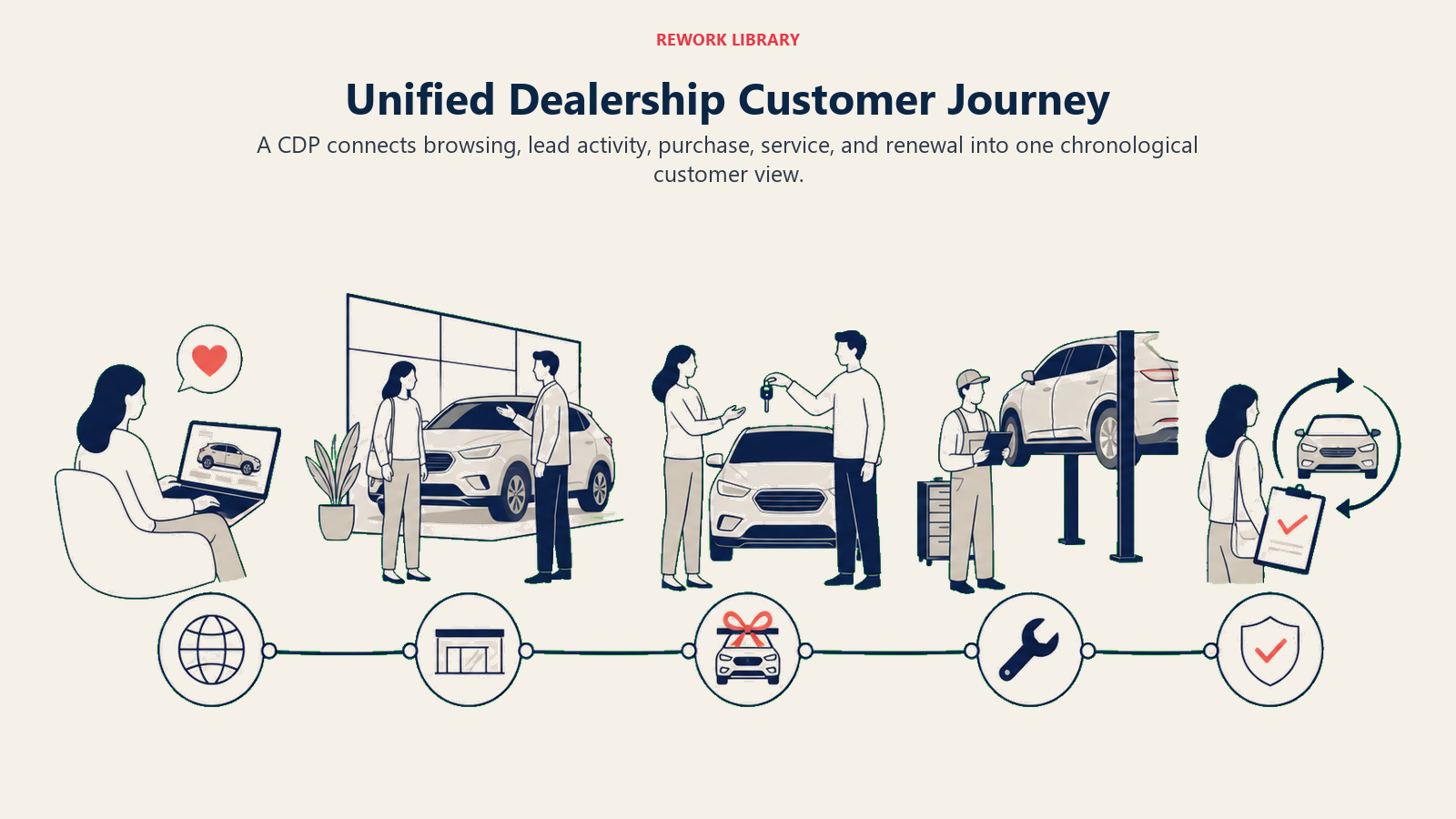
Service history and repair order data predict needs and identify opportunities. A customer with 48,000 miles who's due for major maintenance gets targeted messaging about service packages. Someone with repeated transmission repairs gets early outreach about trade-in options. Customers who service regularly get loyalty recognition; those who've defected get win-back campaigns.
Marketing engagement history shows what resonates. The CDP tracks every email sent, every ad impression, every click, and every conversion. You see which messages drive action and which get ignored. This guides message personalization: some customers respond to price promotions, others to feature benefits, others to trade-in offers.
Communication history across all channels prevents over-messaging and ensures coordination. If someone talked to a sales consultant yesterday, your marketing system shouldn't blast them with "Haven't heard from you!" emails today. If they just booked a service appointment online, your BDC shouldn't call about service scheduling.
Vehicle ownership and equity position enable sophisticated targeting. The CDP combines DMS data (what they own, what they owe, their payoff) with market data (current trade-in value) to calculate equity. High-equity owners get purchase offers. Negative-equity owners get lease-end transition campaigns or incentive-based messaging.
Advanced Segmentation Capabilities
Basic email marketing segments by purchase date or vehicle type. CDP-powered segmentation is exponentially more sophisticated. Behavioral segmentation separates engaged customers from dormant ones. Someone who visited your website three times in the past month, opened two emails, and clicked on inventory listings is highly engaged. Someone who hasn't interacted in 8 months is dormant. These groups need different messaging frequencies and approaches. It also distinguishes high-value customers from price-sensitive ones. Purchase history, vehicle types bought, F&I product acceptance, service spending, and payment methods all signal value. Your marketing budget should concentrate on high-value customers with high retention potential.
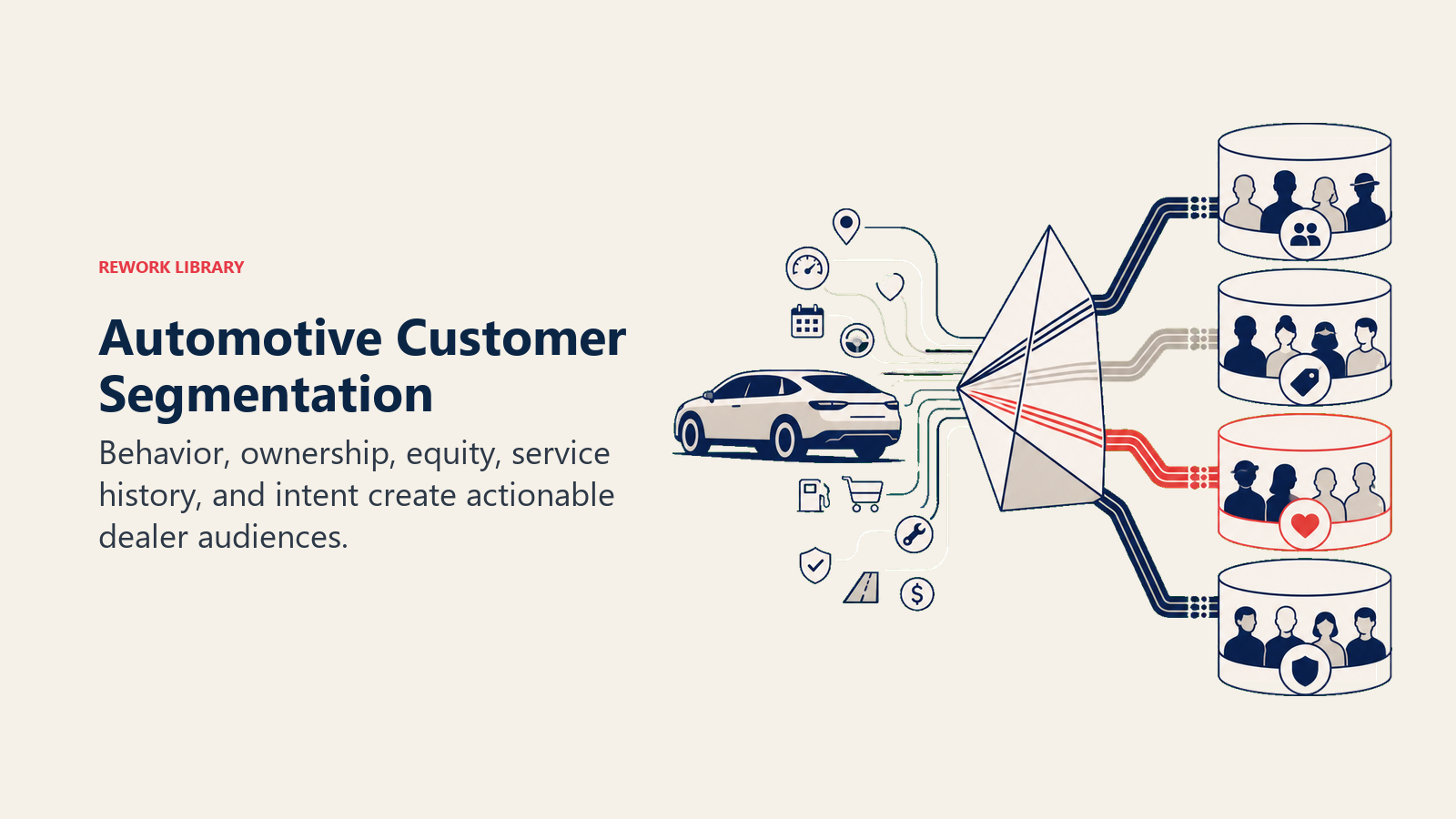
Lifecycle stage segmentation matches messaging to the customer's position in their relationship with your dealership. Prospects who've never purchased need different content than active owners who bought 18 months ago, who need different content than conquest targets who've defected to competitors.
Vehicle-based segments account for important differences. Lease customers have different timelines and motivations than finance customers. EV owners have different service needs than ICE vehicle owners. Luxury buyers respond to different messaging than mass-market buyers. The CDP makes these segments easy to create and maintain.
Predictive segments use machine learning to identify patterns humans miss. Which customers are most likely to purchase in the next 90 days based on browsing behavior, equity position, vehicle age, and historical patterns? Which are at high risk of defection based on declining service frequency and competitor website visits? Predictive models score customers, enabling you to focus efforts where they'll deliver the most return.
Real-time audience creation and updates keep segments current without manual work. Traditional list management requires someone to pull reports, combine data, de-dupe, and export. By the time you execute, the list is outdated. CDP segments update automatically as customer behavior changes, ensuring your targeting is always current.
Personalization and Activation
Unified customer data is pointless unless you use it to deliver better experiences and drive results. Dynamic website personalization transforms your site from generic to tailored. When a known customer visits, show them inventory matching their browsing history and purchase profile. Highlight service offers if they're due for maintenance. Display trade-in value calculators if they have positive equity. This requires CDP integration with your website CMS, but the conversion lift can be 20-40%. Email personalization goes beyond first names. Instead of "Hi John," imagine emails that reference their specific vehicle ("Your 2020 F-150"), acknowledge their relationship ("Thanks for being a service customer for 3 years"), and make relevant offers ("We have three 2023 F-150s in stock matching your preferences"). This level of personalization requires the rich customer profiles only a CDP provides.
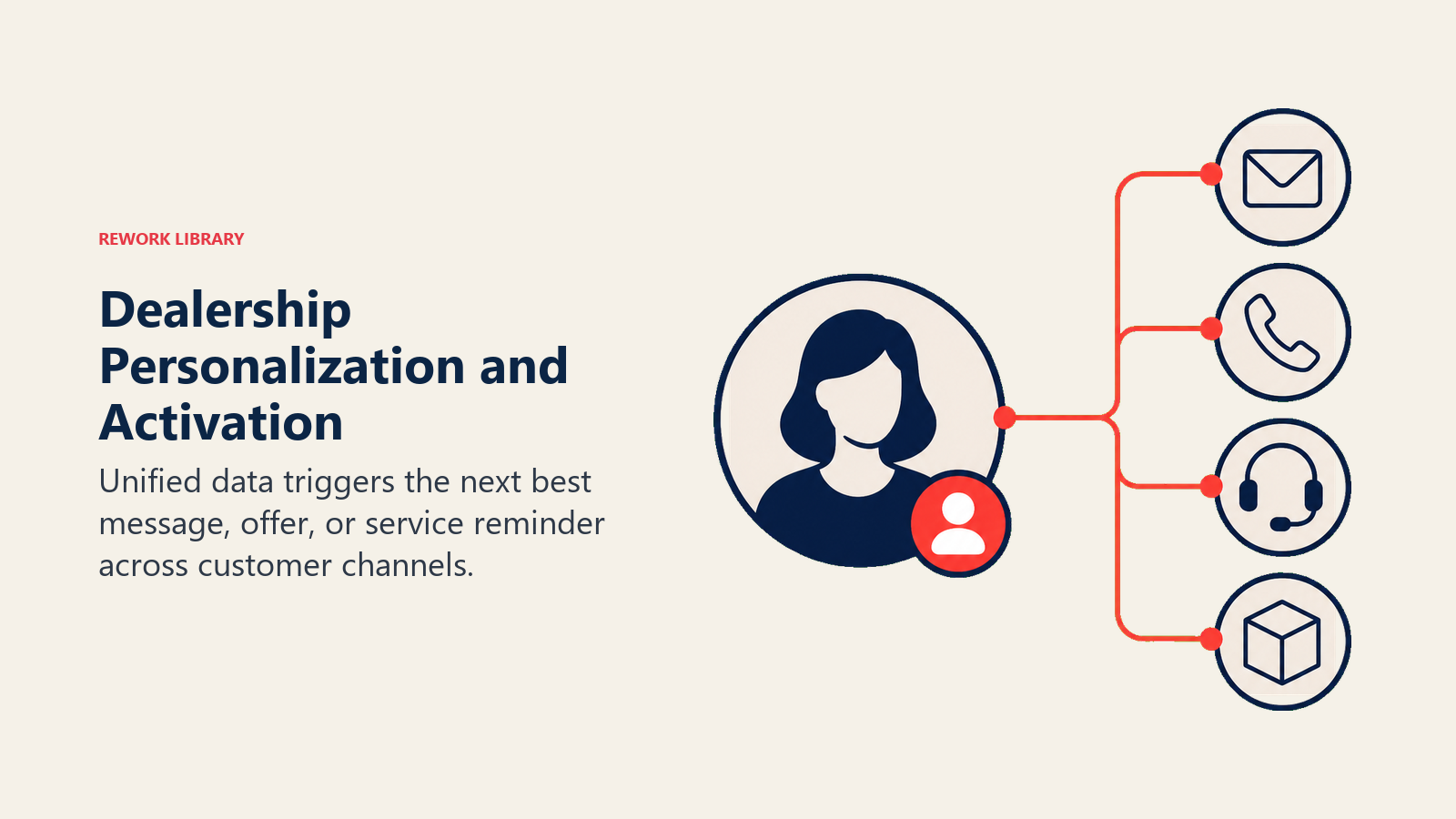
Retargeting with precise audience matching stops wasted ad spend. Don't retarget people who already bought. Do retarget service customers who browsed new inventory. Do retarget high-equity owners with trade-in offers. Do retarget people who abandoned vehicle configuration. The CDP enables targeting precision that improves ROI dramatically.
Lookalike audience creation for paid media leverages your best customers to find similar prospects. Upload your list of high-value purchasers to Facebook or Google. Their algorithms find people with similar characteristics, behaviors, and interests. This works vastly better when your source list is clean, unified customer data from a CDP rather than messy exports from disconnected systems.
Cross-channel orchestration and journey mapping coordinate touchpoints across email, ads, direct mail, phone calls, and in-person visits. When someone enters a journey ("Just hit 6 months of ownership"), the CDP can trigger a sequence: email week 1, retargeting ad if no response by week 2, direct mail week 3, phone call week 4. Each step builds on the previous one instead of operating independently.
CDP Use Cases in Automotive
Theory is nice. Practical applications drive ROI. Here's how leading dealers use CDPs. Equity mining with behavior plus DMS data combination identifies the best opportunities. Your DMS knows who has equity. Your website knows who's been browsing. Combine them, and you find customers with both equity and intent, far more valuable than either signal alone. Focus sales outreach on this high-potential segment. Service-to-sales opportunity identification surfaces hidden revenue. Which service customers own vehicles more than 5 years old, have positive equity, high credit scores, and strong service loyalty? These customers are excellent sales prospects, but most dealers never connect these dots systematically. The CDP does it automatically.
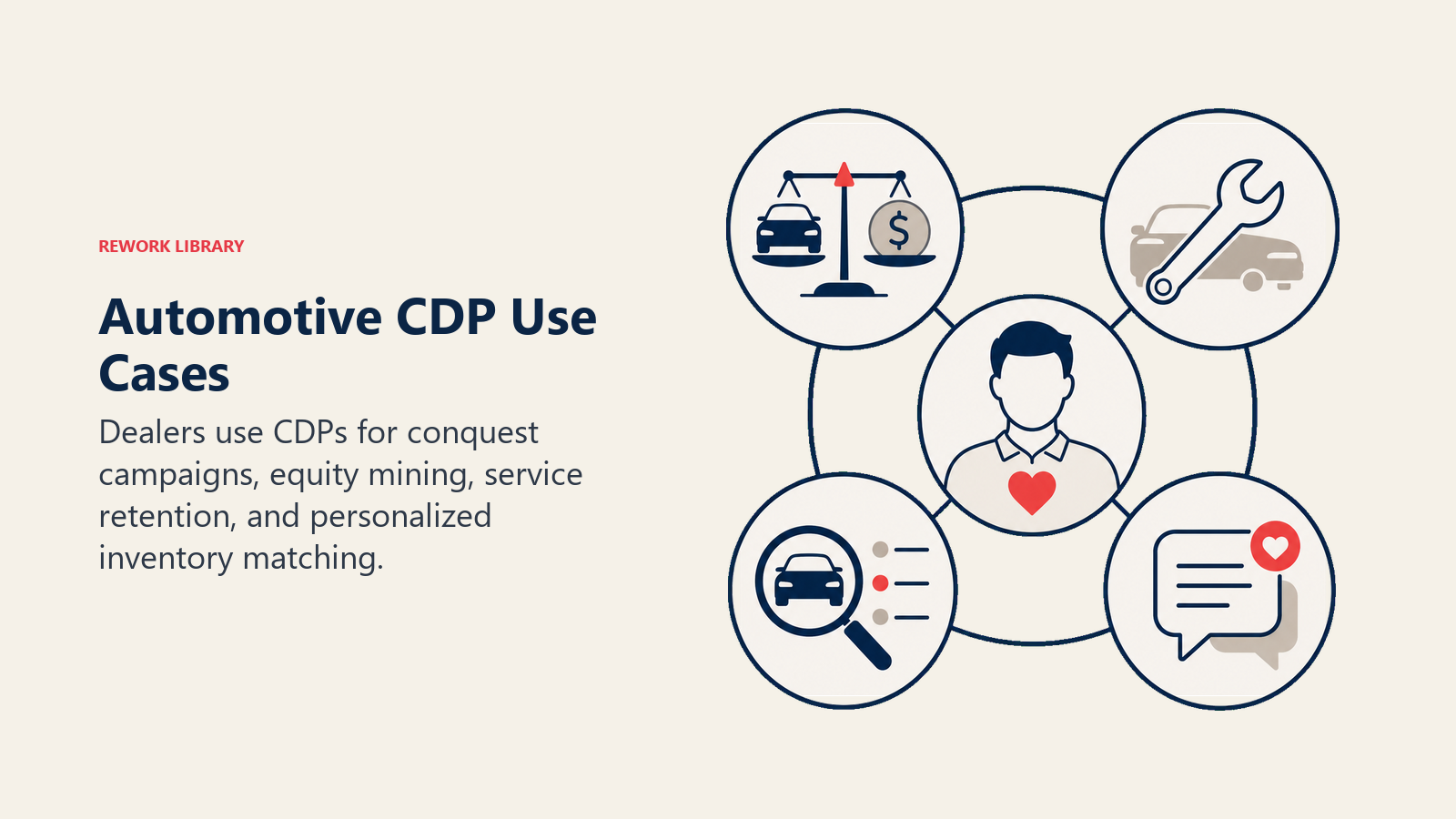
Defection prediction and win-back campaigns catch customers before they're gone. When service frequency declines, email engagement drops, and website visits include competitor research, the CDP flags the customer as at-risk. Trigger retention outreach before they buy elsewhere.
Lease maturity pipeline management ensures you don't lose customers at lease end. The CDP knows lease maturity dates (from DMS), tracks engagement levels (from marketing systems), and enables graduated campaigns that intensify as maturity approaches. Personalize based on payment preferences, driving behavior, and vehicle interests.
Personalized new inventory alerts beat generic blast emails. When you get a trade-in matching a customer's browsing history and preferences, notify them immediately. "We just got the white Tahoe with captain's chairs you were looking at." This responsiveness drives urgency and shows you pay attention.
Multi-location customer relationship management helps dealer groups coordinate efforts. If a customer purchased at Store A but lives closer to Store B, route service marketing from Store B. If they've interacted with both locations, ensure messaging doesn't conflict. The CDP provides the shared customer view that prevents internal competition.
Implementation Considerations
CDPs deliver value, but implementation requires planning and realistic expectations. The build versus buy decision comes first. Could you build a custom CDP on your own data warehouse? Technically, yes. Should you? Probably not unless you're a large dealer group with dedicated technology resources. Pre-built platforms deliver value faster, include ongoing updates, and cost less than custom development for most dealers.
Data governance and privacy compliance can't be afterthoughts. A CDP centralizes customer data, which means it centralizes compliance risk. You need clear policies about data collection, storage, usage, and deletion. You need to honor opt-outs across all systems. You need to comply with state privacy laws, which vary. Don't implement a CDP without addressing governance first.
Integration requirements and API availability determine how well a CDP can actually unify your data. If your DMS doesn't offer APIs or data exports, you can't pull that data into the CDP. Evaluate your current systems' integration capabilities before selecting a CDP. Some combinations work seamlessly; others require custom development or workarounds.
Change management and adoption strategy separate successful implementations from failed ones. You can build a perfect CDP, but if your marketing team keeps using their old spreadsheet-based processes, it's worthless. Plan training, create new workflows, demonstrate value, and hold teams accountable for using the platform.
Cost structure and ROI expectations need to be realistic. CDP platforms range from $1,000/month for small dealer-specific solutions to $50,000/month for enterprise general platforms. Implementation might add $20,000-$100,000 depending on complexity. Calculate ROI based on marketing efficiency improvements, not just new revenue, better targeting with the same budget often delivers better returns than increasing spend.
CDP Vendors and Solutions
The market offers multiple options at different price points and capability levels.
Automotive-specific CDPs from companies like DealerSocket, VinSolutions, and AutoAlert understand dealership data structures and workflows. They offer pre-built integrations with major DMS platforms and automotive CRMs. They include automotive-specific segments and campaigns out of the box. The trade-off is less flexibility than general platforms and potential limitations if you want advanced capabilities.
General CDP platforms like Segment, Tealium, and Adobe offer enterprise-grade capabilities with maximum flexibility. They handle complex data integration, advanced analytics, and sophisticated personalization. They're overkill for single-point dealers but make sense for large dealer groups with dedicated marketing technology resources.
Building a custom CDP on a data warehouse is the ultimate flexibility route. You extract data from all systems into a warehouse, build identity resolution logic, create segmentation tools, and integrate with activation platforms. This requires significant technical expertise but can deliver exactly what you need without vendor limitations.
Selection criteria should include: integration capabilities with your current systems, ease of use for your team, support quality from the vendor, scalability as you grow, cost versus budget, and references from similar dealerships. Don't pick based on features alone, implementation difficulty and ongoing support matter more than flashy capabilities you'll never use.
Building the Customer Intelligence Foundation
Customer Data Platforms represent the evolution of dealership marketing from spray-and-pray to precision-targeted, personalized engagement.
The dealerships winning long-term aren't necessarily spending the most on marketing. They're spending smarter by knowing their customers better and personalizing every interaction based on unified intelligence.
Start with your data challenge: if you can't easily answer "What vehicles has this customer browsed, what do they own, when did they last visit service, and what marketing have they received?" you need better customer data infrastructure.
A CDP solves that problem and unlocks marketing capabilities that are impossible with fragmented systems. The investment pays back through higher conversion rates, better customer retention, and more efficient marketing spending.
The question isn't whether customer data platforms are valuable for automotive retail. The question is whether you'll implement one before your competitors do.

Senior Implementation Consultant
On this page
- What is a Customer Data Platform
- The Dealership Data Challenge
- CDP Architecture and Components
- Unifying the Customer Journey
- Advanced Segmentation Capabilities
- Personalization and Activation
- CDP Use Cases in Automotive
- Implementation Considerations
- CDP Vendors and Solutions
- Building the Customer Intelligence Foundation