New Vehicle Inventory Management - Factory Allocation & Turn Optimization - 2026 Guide
Turn this article into takeaways for your work.


Each assistant summarizes the article only for you and suggests best practices for your work.
Dealerships that optimize factory allocation see 15-20% higher new vehicle gross profit than those who passively accept whatever the factory sends. That difference, $300-400 per vehicle, compounds across hundreds of sales annually, creating $100,000+ profit swings.
But most dealers don't actively manage allocation. They complain about getting the wrong mix, too many slow sellers, not enough hot models. Then they accept next month's allocation with minimal input.
New vehicle inventory management isn't passive. It's strategic negotiation with manufacturers, data-driven ordering decisions, and relentless focus on matching supply to market demand.
How Factory Allocation Actually Works
Manufacturers don't randomly distribute vehicles. They use algorithms that consider multiple factors to decide who gets what.
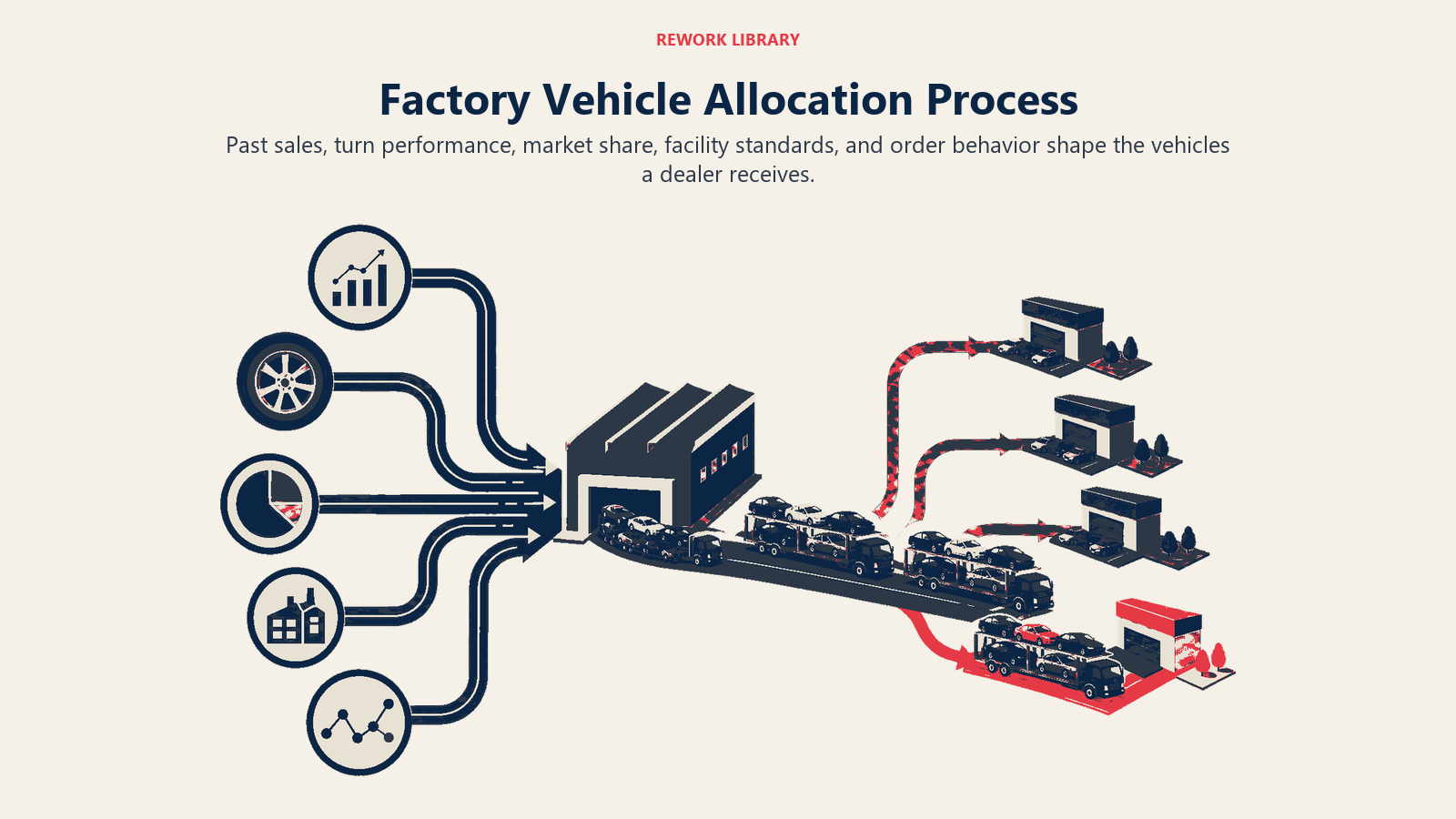
Sales history carries the most weight. If you sold 100 Silverados last year, you'll get allocation for roughly 100-110 this year. According to Cox Automotive's 2026 outlook, new-vehicle inventory levels are expected to remain tight as manufacturers focus on profitability over volume. The manufacturer isn't going to send you 150 Silverados if you've never demonstrated ability to sell that volume. Want more allocation? Sell more vehicles. It's circular, but that's the system.
Allocation factors beyond sales volume include CSI scores, facility standards compliance, market share performance, and sales effectiveness. Some manufacturers weight CSI heavily, poor CSI scores cost you allocation on desirable models. Others care more about facility compliance. If your dealership hasn't completed required facility upgrades, you're penalized with reduced allocation.
Turn and earn programs reward dealers who move inventory quickly. Manufacturers track your day supply by model. Dealers running 35 day supply get preferential allocation. Dealers running 90 day supply get cut. The manufacturer's logic is simple: why send more vehicles to dealers who aren't selling what they have?
Regional allocation variations reflect local market realities. Dealers in Texas get heavy truck allocation. Dealers in California get more hybrids and EVs. Manufacturers adjust regional allocation based on registration data and market trends. You can't overcome regional allocation if your market doesn't support certain models.
Franchise agreement obligations create floor requirements. Most franchise agreements require maintaining minimum model representation, at least one of every model in the lineup. You can't refuse to stock sedans entirely just because you prefer selling trucks. But you can minimize sedan allocation to the minimum required while maximizing truck allocation.
Order Bank Management
Your order bank is your control mechanism within allocation constraints.
Sold orders vs. stock orders create the fundamental allocation decision. Sold orders are customer commitments with deposits. Stock orders are speculative inventory for walk-in traffic. The right mix depends on your market. High-traffic urban dealers might run 80% stock orders. Low-traffic rural dealers might run 50% stock, 50% sold.
Order timing and lead times vary by manufacturer and model. Domestic brands typically run 6-10 week lead times from order to delivery. Import brands might run 8-16 weeks. Hot models with constrained supply run even longer. Understanding lead times lets you anticipate inventory arrivals and plan marketing accordingly.
Build constraints and option packages limit configuration flexibility. Manufacturers bundle options into packages to simplify production. You can't order heated seats without ordering the premium audio package because they're bundled. These constraints force compromises, you order what's available, not necessarily what's optimal.
Managing customer sold orders requires communication discipline. When customers order vehicles, they expect updates. Weekly status reports, "your vehicle entered production," "your vehicle shipped," "expected delivery next Tuesday", keep customers engaged and prevent cancellations. Silent periods create anxiety and lost sales.
Adjusting orders based on market changes keeps inventory relevant. If gas prices spike and truck sales slow, reduce truck orders and increase crossover orders. If incentives shift making one model more attractive, pivot allocation toward it. Your order bank isn't static, it should flex with market conditions.
Order cancellation and modification policies vary by manufacturer. Most allow order changes up to production start. Once production begins, you own that vehicle regardless of market changes. Strategic dealers monitor production schedules and cancel orders on slow-turning models before production begins. This requires close factory rep relationships and timing discipline.
Model Mix Strategy
Getting the right mix of models, trims, colors, and options separates profitable dealers from everyone else.
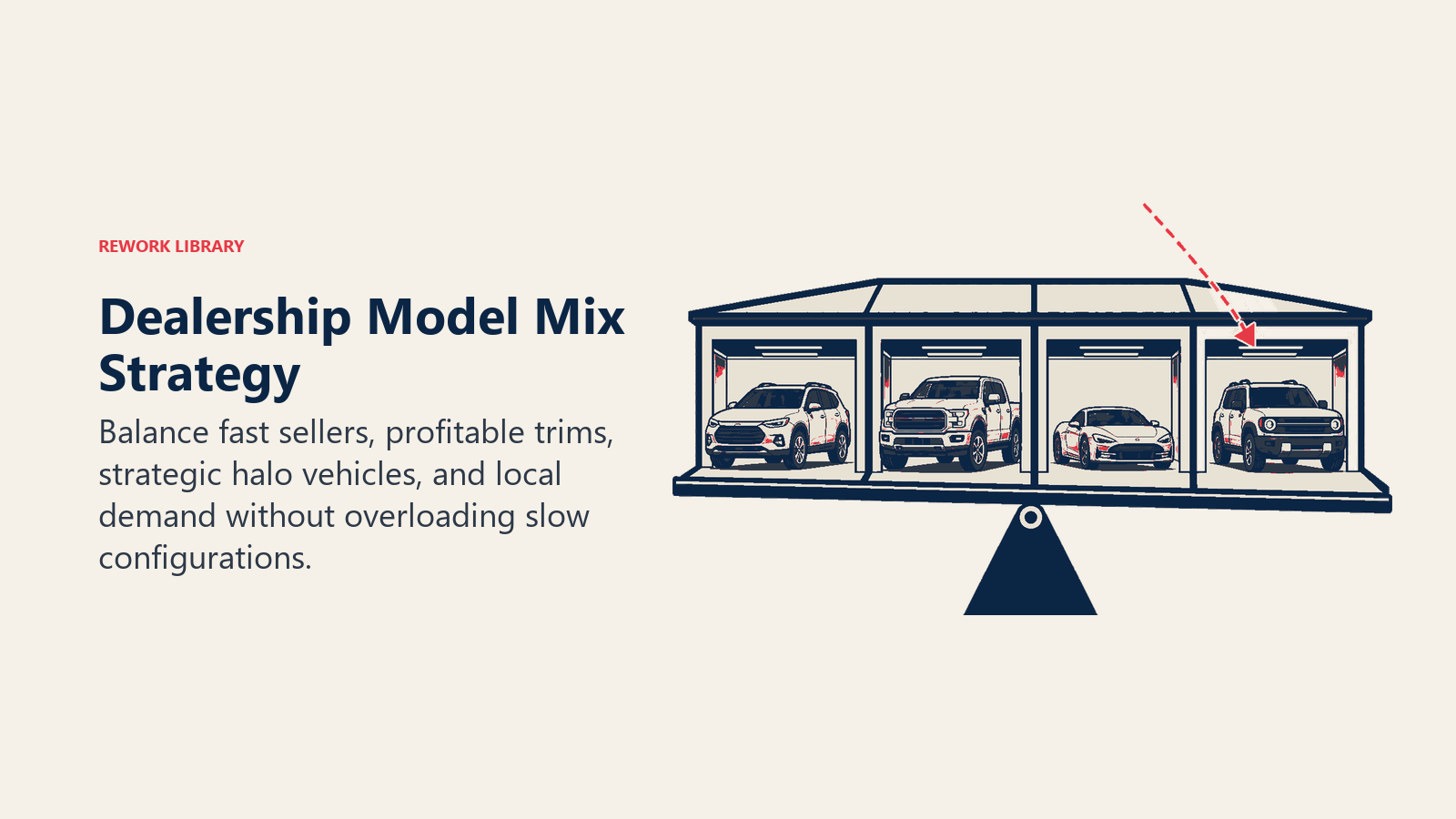
Market demand analysis by model starts with sales data. Which models are you selling fastest? Which generate highest gross profit? Which have lowest day supply? These three metrics, velocity, profit, turn, determine model prioritization. Maximize allocation on models scoring high across all three.
Trim level and package selection drives profitability. Base trim models generate lower gross profit than mid and upper trims. But base trims also sell faster in price-sensitive markets. The optimal mix is typically 20% base trim, 50% mid trim, 30% upper trim. This ladders customers from budget to premium while maintaining inventory turn.
Color and option preferences sound trivial until you stock six black vehicles that sit while competitors' white vehicles sell in 15 days. Local color preferences are real. Some markets prefer white, silver, and gray (urban/suburban). Others prefer red, blue, and black (rural). Order colors matching local preferences, not your personal taste.
Price point distribution ensures you're not clustered at one price. If all your inventory sits at $42,000-48,000, you're missing customers with $38,000 budgets and $55,000 budgets. Create price ladders with vehicles at $35,000, $40,000, $45,000, $50,000, $55,000. Let customers choose their entry point.
Profit per model considerations matter more than volume. Some high-volume models generate $1,200 gross profit. Lower-volume models generate $2,500 gross. You need both. The high-volume models drive traffic and absorb factory overhead allocation. The higher-profit models fund dealership operations. Balance volume and margin.
Days to turn by model historical data predicts future performance. If Camrys consistently turn in 25 days but Avalons take 65 days, weight your allocation toward Camrys. Historical turn data is the best predictor of future turn, assuming market conditions remain stable.
In-Transit Management
The period between order and arrival offers pre-selling opportunities most dealers waste.
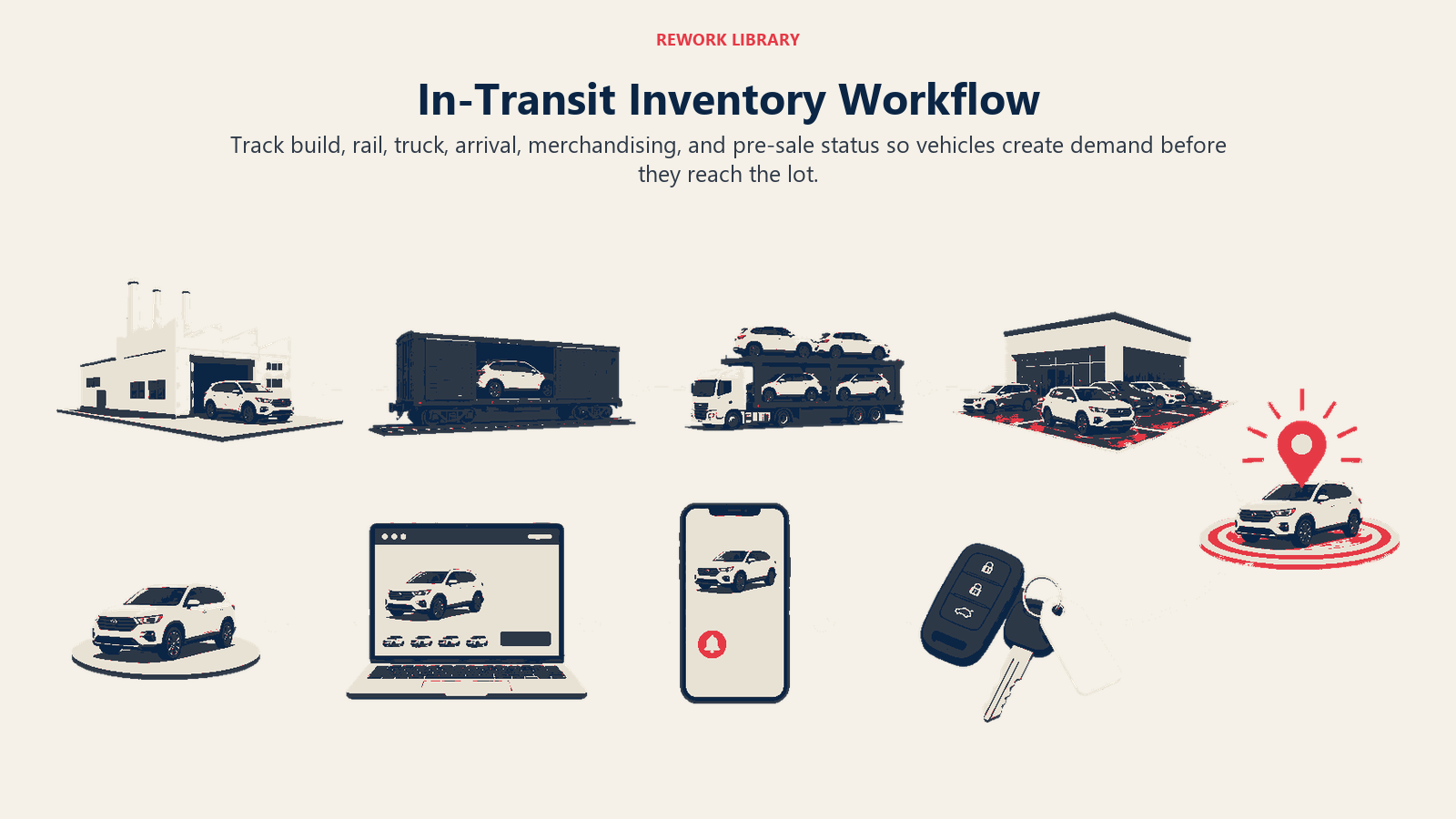
Tracking in-transit inventory requires systems integration. Your DMS should show in-transit vehicles with VIN, build specs, estimated arrival date, and assignment status. Without visibility, you can't market vehicles before arrival.
Pre-marketing arriving vehicles generates sold commitments before vehicles hit the lot. Create "reserve this vehicle" landing pages with window stickers and 360-degree photos (from manufacturer sites). Run targeted ads to customers in your CRM who match the vehicle profile. The goal is turning a stock order into a sold unit upon arrival.
Customer matching before arrival leverages your CRM data. If you've got a 4Runner TRD Off-Road arriving in 10 days, search your CRM for customers who inquired about 4Runners in the past 90 days. Call them with a heads-up: "The exact vehicle you were looking for is arriving next week. Want to reserve it?" This converts leads that went cold.
Allocation to sales vs. loaner use gets decided at arrival. Some high-demand vehicles should go straight to retail. Others might serve as loaners for 3-6 months before transitioning to retail sale. Demo vehicles for managers get allocated at arrival too. Make these decisions consciously, not reactively.
Delivery preparation planning ensures vehicles hit the lot quickly. Coordinate with service to perform PDI (pre-delivery inspection), detail, and accessory installation within 24-48 hours of arrival. Every day a new vehicle sits in recon is a day it's not selling.
Incentive and Program Management
Manufacturer incentives significantly impact profitability if you understand and leverage them.
Volume bonuses and stair-step programs pay dealers for hitting volume thresholds. Sell 50 vehicles, earn $500 per vehicle. Sell 60 vehicles, earn $750 per vehicle retroactively on all 60. These programs force end-of-month push strategies. If you're at 58 vehicles sold with two days left in the month and the stair-step kicks in at 60, you discount aggressively to hit 60 because the bonus pays for the discount.
Dealer cash and holdback are built-in profit margins the customer never sees. Dealer cash is manufacturer incentive paid directly to dealers (typically $500-2,000 per vehicle). Holdback is 2-3% of MSRP paid quarterly to dealers. Understanding these manufacturer incentive programs helps maximize profitability. These margins let you discount invoice price and still make money.
Customer incentives alignment means pairing manufacturer cash (customer rebates) with dealer cash (dealer incentives) for maximum impact. If the manufacturer offers $3,000 customer cash and $1,500 dealer cash on a model, you've got $4,500 total available to move the vehicle. Use customer cash for marketing ("$3,000 cash back!") and preserve dealer cash for negotiation.
Floorplan assistance programs reduce holding costs on slow-turning inventory. Many manufacturers offer 90-120 days of floorplan interest assistance on specific models. This buys you time to sell vehicles without accruing interest costs. Take advantage of these programs by stocking up on eligible models when assistance is available.
Model-specific push programs happen when manufacturers need to clear excess production. They'll offer extra dealer cash, extended floorplan assistance, and enhanced customer incentives to move specific models. These programs create profit opportunities if you stock aggressively and market hard while the programs are active.
Balancing volume and margin creates monthly tension. Volume bonus programs push you toward discounting to hit thresholds. Margin discipline pushes you toward holding gross. Elite dealers hit volume targets while maintaining acceptable margin through strategic discounting, aggressive on low-profit vehicles to drive volume, disciplined on high-profit vehicles to preserve margin.
Demo and Loaner Strategy
Demo and loaner vehicles are necessary costs, but they consume allocation and capital.
Demo vehicle allocation typically runs 1-2% of annual sales. A 1,200-unit dealership might have 12-24 demo vehicles for GMs, sales managers, and top salespeople. These vehicles serve business purposes, client transportation, test drives, visibility, but they also represent 12-24 retail opportunities you can't sell.
Service loaner fleet sizing depends on service customer volume and loaner usage rates. A busy service department with 80 customers daily might need 20-25 loaners. A smaller service operation needs 8-12. Right-size your loaner fleet to meet customer needs without excess. Every extra loaner is wasted capital.
Age and mileage policies prevent loaners from becoming problem used cars. Rotate loaners to retail sale at 6-12 months or 10,000-15,000 miles. Past these thresholds, loaners become hard-to-sell used cars. Establish automatic rotation policies and stick to them.
Transitioning to retail sale requires marketing and pricing strategy. Former loaners need disclosure and pricing adjustments. Customers won't pay full used car price for a vehicle with 15,000 miles from loaner use. Discount appropriately and market honestly ("former service loaner, fully maintained, eligible for CPO").
Accounting and depreciation on demos and loaners impacts financial statements. Demos typically stay on new vehicle inventory. Loaners might be depreciated as fixed assets if held long-term. Work with your accountant to structure demo and loaner accounting for optimal tax treatment and financial reporting.
Special Order Process
Selling what you don't have requires trust-building and expectation management.
Customer deposit policies protect you from order cancellations. Require $500-1,000 refundable deposits on special orders. This ensures customer commitment. Deposits don't prevent all cancellations, but they filter out customers who aren't serious.
Order timing and expectations must be crystal clear. If the vehicle takes 10 weeks to arrive, tell customers 12 weeks. Underpromise and overdeliver. When it arrives in 10 weeks, customers are thrilled. When you promise 8 weeks and it takes 12, customers are angry.
Communicating delays keeps customers engaged during long wait periods. Weekly updates, even when there's no news, maintain relationship. "Still waiting on production schedule" is better than silence. Silence creates anxiety and increases cancellation risk.
Preventing cancellations requires relationship maintenance throughout the order period. Check in weekly, send build updates, share photos of similar vehicles, invite customers to dealership events. The more touch points during the wait period, the lower the cancellation risk.
Factory order vs. dealer trade offers alternatives when customers can't wait. If the customer needs the vehicle in two weeks but factory order takes 10 weeks, search dealer trades. Other dealers might have the exact vehicle in stock. You pay a dealer trade fee ($300-500) but close the sale immediately. This beats losing the customer to a competitor.
Aging Inventory Management
Every new vehicle dealership has aged inventory. How you handle it determines profitability.
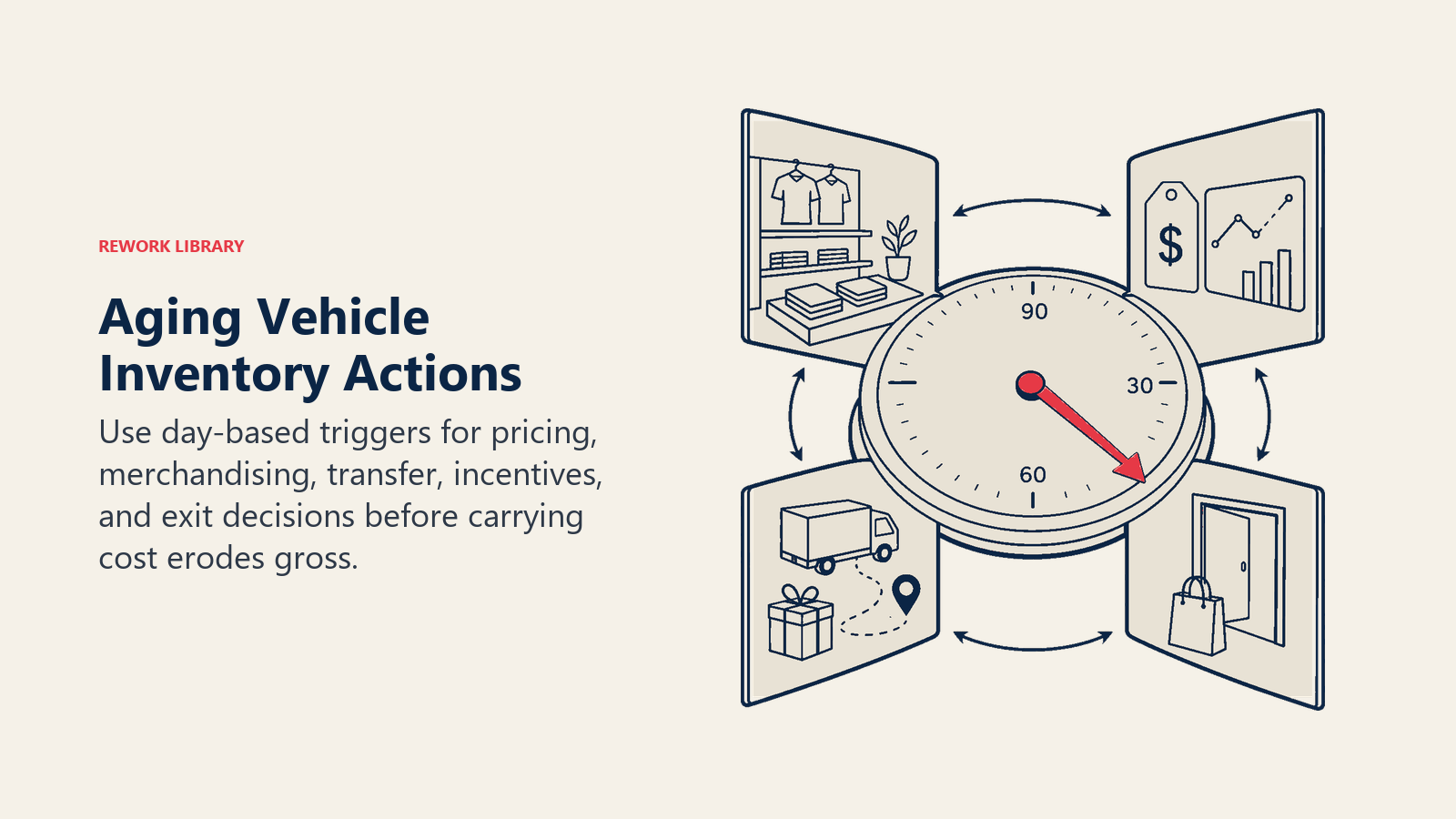
Identifying at-risk units starts at 60+ days. Any new vehicle sitting 60 days is at risk of becoming a problem. Flag these vehicles for special attention, pricing review, marketing investment, sales team focus. Don't wait until they hit 90+ days to take action.
Age-based discount strategies should be systematic. Vehicles at 60-75 days get $500 discount. Vehicles at 76-90 days get $1,000 discount. Vehicles past 90 days get aggressive discounting or wholesale consideration. Automate these decisions rather than negotiating each one.
Marketing investment in aged units creates visibility without throwing good money after bad. Spend $200-300 on targeted Facebook and Google ads for aged units. If that investment doesn't generate sold commitments within 2-3 weeks, it's time to move on via other channels.
Dealer trade opportunities move aged inventory to dealers who want it. What's a slow seller in your market might be a fast seller in another market. Dealer trade networks (and manufacturer programs) facilitate these swaps. You trade your aged Mustang for another dealer's aged F-150, both dealers get fresh inventory that matches their market.
Factory return or swap programs allow returning specific aged units to the factory in exchange for different models. Not all manufacturers offer these programs, and qualification requirements are strict (CSI score, sales performance, allocation compliance). But when available, these programs bail you out of aged inventory mistakes.
Turn Rate Optimization
Speed of sale matters more in new vehicle departments than most managers realize.
Days supply calculation for new vehicles is total inventory divided by daily sales rate. If you have 150 vehicles and sell five per day, your day supply is 30 days. Industry data shows that top-performing dealerships maintain 45-60 days supply overall, but calculate by model to identify problems.
Model-specific turn targets vary by popularity. Your high-volume models (likely mid-size trucks and SUVs) should turn every 30-40 days. Lower-volume models (sports cars, large SUVs) might run 60-90 days. Set different targets by model rather than one-size-fits-all.
Pricing strategy for quick turn means pricing at invoice plus holdback plus dealer cash from day one. Don't start at MSRP and slowly discount. Price competitively immediately. Fast turn at lower margin beats slow turn at higher margin when you factor in floorplan interest.
Marketing responsiveness generates immediate traffic on fresh inventory. When a hot new model arrives, blast email, social media, and paid ads within 24 hours. Create urgency: "Just arrived, only one available, in stock now." Speed matters.
Sales team inventory training ensures your sales team knows what's in stock and can match customers to inventory quickly. Weekly inventory walks, model spotlight training, and incentives for selling aged units create focus. Salespeople sell what they know.
New vehicle inventory management is part art, part science, and mostly discipline. You can't control allocation completely, but you can influence it. You can't control market demand, but you can respond to it. And you can absolutely control how quickly you turn inventory and how much profit you make per vehicle. Those factors alone separate top performers from the rest. For comprehensive strategy, explore automotive inventory strategy, inventory turn optimization, inventory pricing and aging, vehicle merchandising, and certified pre-owned programs.