Gross Profit Optimization: Strategic Pricing and Margin Management for Dealers
Turn this article into takeaways for your work.


Each assistant summarizes the article only for you and suggests best practices for your work.
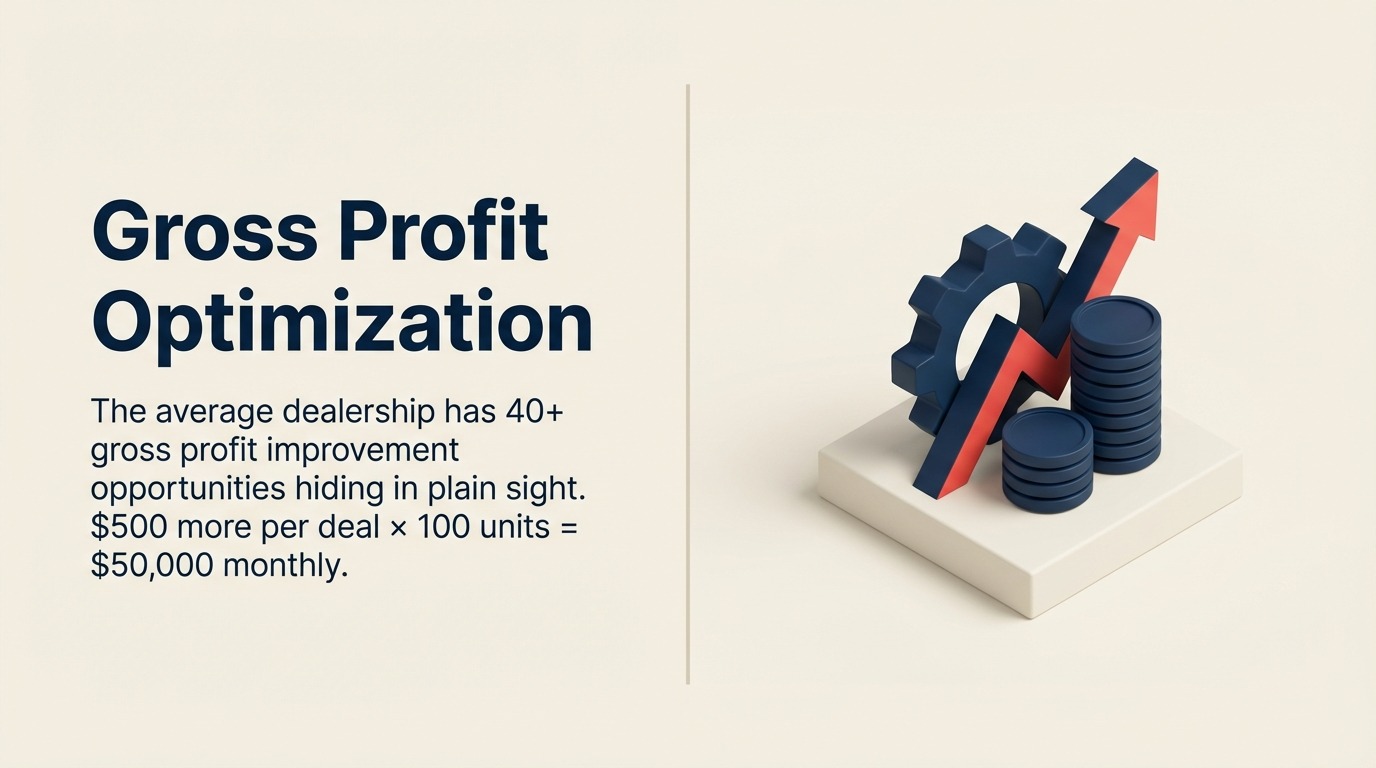
The average dealership has more than 40 gross profit improvement opportunities hiding in plain sight. They're buried in appraisal tactics, F&I presentation methods, service menu pricing, trade-in allowances, reconditioning processes, and compensation structures that incentivize the wrong behaviors.
Here's the math that should wake up every dealer principal: an extra $500 in gross profit per vehicle doesn't sound transformational. But multiply that by 100 units monthly, and you've added $50,000 in monthly gross, $600,000 annually. That's not revenue. That's gross profit that drops almost directly to the bottom line.
Most dealers chase volume while watching margin slowly erode. Top-performing dealers manage both dimensions simultaneously through systematic processes, data-driven pricing, and compensation structures that reward profitable sales.
The Anatomy of Dealership Gross Profit
Before optimizing gross profit, you need to understand where it comes from and how different profit centers interact.
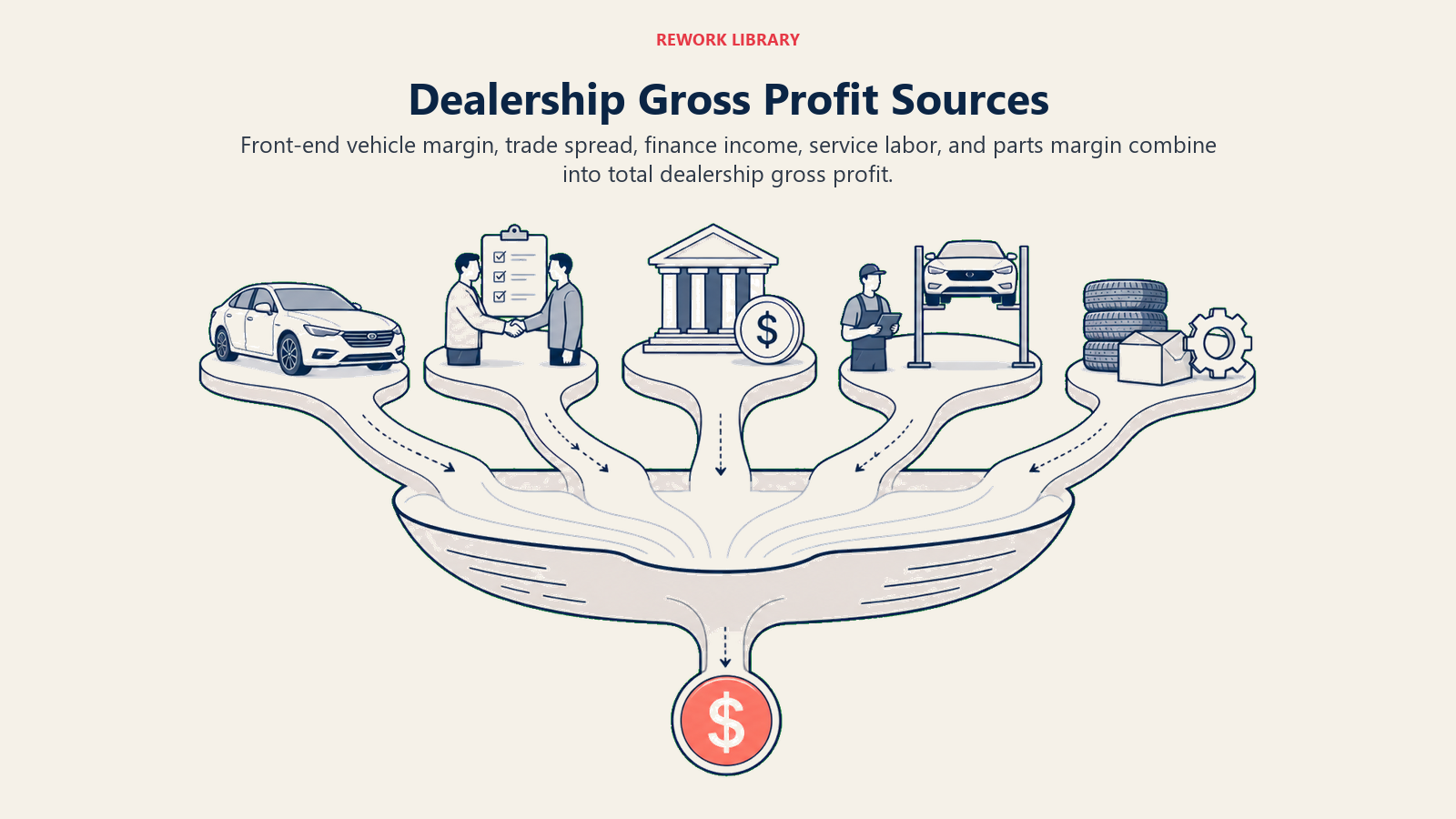
Front-end gross on new and used vehicles is what most people think of first. It's the spread between what you paid for the vehicle (actual cost for used, invoice minus holdback for new) and what the customer pays. New vehicle front-end gross typically ranges from $1,200 to $3,500 depending on brand, model, and market. Used vehicle front-end averages $2,000 to $3,500, with wider variation based on price point and acquisition source.
Back-end gross from FBack-end gross from F&I products and finance reserveI products and finance reserve often exceeds front-end gross. The average F&I department produces $1,600 to $2,000 per vehicle retailed, including extended warranties, GAP insurance, maintenance plans, appearance protection, and finance reserve. Top F&I departments hit $2,200 to $2,500. This is pure profit with minimal incremental cost.
Service and parts gross profit represents the most sustainable long-term revenue stream. A well-managed service department generates 50-60% gross profit on labor (after technician wages) and 40-45% on parts. Unlike vehicle sales, service revenue recurs monthly as long as you retain customers.
Aftermarket and accessories add incremental profit with minimal sales effort. Bed liners, running boards, tint, paint protection, and other add-ons typically carry 50-70% margins. A $1,200 accessory package costs $400-500, adding $700-800 to gross with almost no sales resistance if presented correctly.
Total gross profit per sale and PVR (per-vehicle revenue) benchmarks vary by dealership type and market. A mainstream brand dealer might average $3,500 total gross ($1,800 front, $1,700 back). A luxury dealer might average $5,500 total gross ($3,200 front, $2,300 back). According to Deloitte's ProfitFocus research, a well-balanced dealership should aim for 56% of gross income from the front end and 44% from the back end. Know your numbers. Track trends. Compare to similar dealers in your market.
New Vehicle Gross Profit Strategy
New vehicle margins are tighter than ever, making strategic pricing essential.
The debate between invoice-based pricing and market-based pricing has largely been settled, market wins. Twenty years ago, dealers could hold gross by negotiating down from MSRP. Now customers research dealer cost, invoice pricing, and incentives before they walk in. Market-based pricing tools like vAuto and Kelley Blue Book show you what similar vehicles sell for in your market, enabling competitive pricing that still protects reasonable gross.
Leveraging OEM incentives and stair-step programs can add thousands to effective gross. A $2,000 dealer cash incentive on a model isn't customer-facing, but it lowers your true cost. Stair-step programs that pay bonuses for hitting volume thresholds create interesting dynamics: sometimes selling a vehicle at lower gross makes sense to hit the next tier and earn $500-1,000 per vehicle sold that month.
Dealer cash and holdback optimization requires attention to detail. Holdback typically runs 2-3% of MSRP and represents money you get back when the vehicle sells, regardless of selling price. Dealer cash varies by model, region, and timing. Track every incentive available. Ensure your desking tools reflect actual cost including all incentives.
Volume versus margin trade-offs vary by model within your lineup. You might sell compact sedans at $800 gross just to move them and hit volume bonuses, while maintaining $3,000+ gross on trucks and SUVs where market demand supports it. This requires sophisticated inventory and pricing management, not blanket policies.
Allocation management for high-demand vehicles is pure profit opportunity. When you get an allocation of a hot model, maybe an EV with 6-month wait lists or a limited-edition truck, you can command thousands over MSRP. Don't squander these opportunities with timid pricing. Market-based pricing works both ways: charge what the market will bear.
Accessories and add-ons at point of sale are low-hanging fruit. Floor mats, cargo liners, wheel locks, and nitrogen tire fills cost you $50-150 and sell for $300-600. Present them during F&I or delivery as standard practice. Half your customers will say yes, adding pure profit with zero negotiation.
Used Vehicle Pricing and Margin Management
Used vehicle gross profit is both art and science, with more science than most old-school dealers admit.
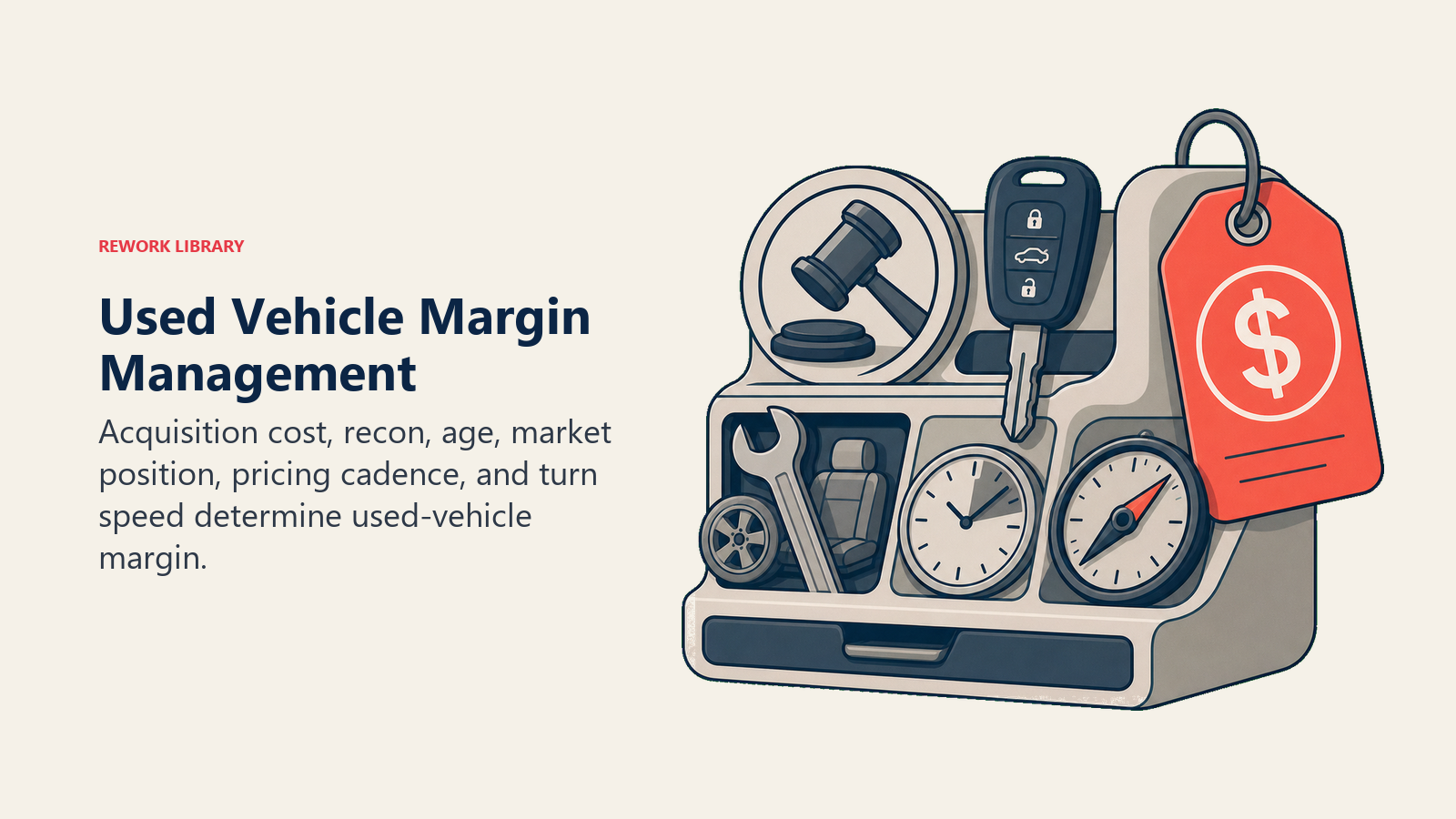
Acquisition strategy, trade-ins versus auction versus direct purchase, fundamentally impacts margin potential. Trade-ins let you control purchase price through negotiation and typically offer the best margins if acquired right. Auction vehicles offer volume and selection but thinner margins due to competition. Direct customer purchases (buying outright without a sale) can deliver exceptional margins if you identify motivated sellers.
Appraisal tactics that protect gross start at acquisition. When a customer has trade equity, every $500 you over-allow is $500 less gross on the sale. Use book values as anchors, not ceilings. Inspect thoroughly and document issues that lower value. Walk away from deals where you'd need to over-allow by more than $1,000 to make the deal work, that gross hit rarely gets recovered.
Market-based pricing using vAuto, Black Book, and KBB removes emotion and guesswork. These tools show you what similar vehicles in your market have sold for recently. Price competitively within that range based on your reconditioning quality and market position. Ignore what you have in the vehicle, the market doesn't care what you paid.
Days-to-market and aging impact margins significantly. A vehicle priced to sell in 30 days at $2,500 gross beats one that sits 90 days and sells at $2,200 gross. You've saved 60 days of floor plan interest ($150-300), lot space, and opportunity cost. Price to move quickly, not to maximize absolute gross on every unit.
Reconditioning cost control prevents margin erosion. Before you buy a trade-in, estimate recon costs: mechanical repairs, detail, minor body work, tires. If a $10,000 trade needs $2,500 in recon, your acquisition cost is really $12,500, not $10,000. Dealers who ignore recon costs consistently overpay at acquisition.
Front-line versus aged vehicle pricing strategy needs to be aggressive. Fresh inventory (0-30 days old) gets premium pricing. Aging inventory (60+ days) gets priced to move immediately. Don't fall in love with vehicles. The market has spoken when something sits 90 days, reprice or wholesale.
Trade-In Appraisal Optimization
Trade-ins represent your largest gross profit opportunity and your largest risk. Control the appraisal, control your margin.
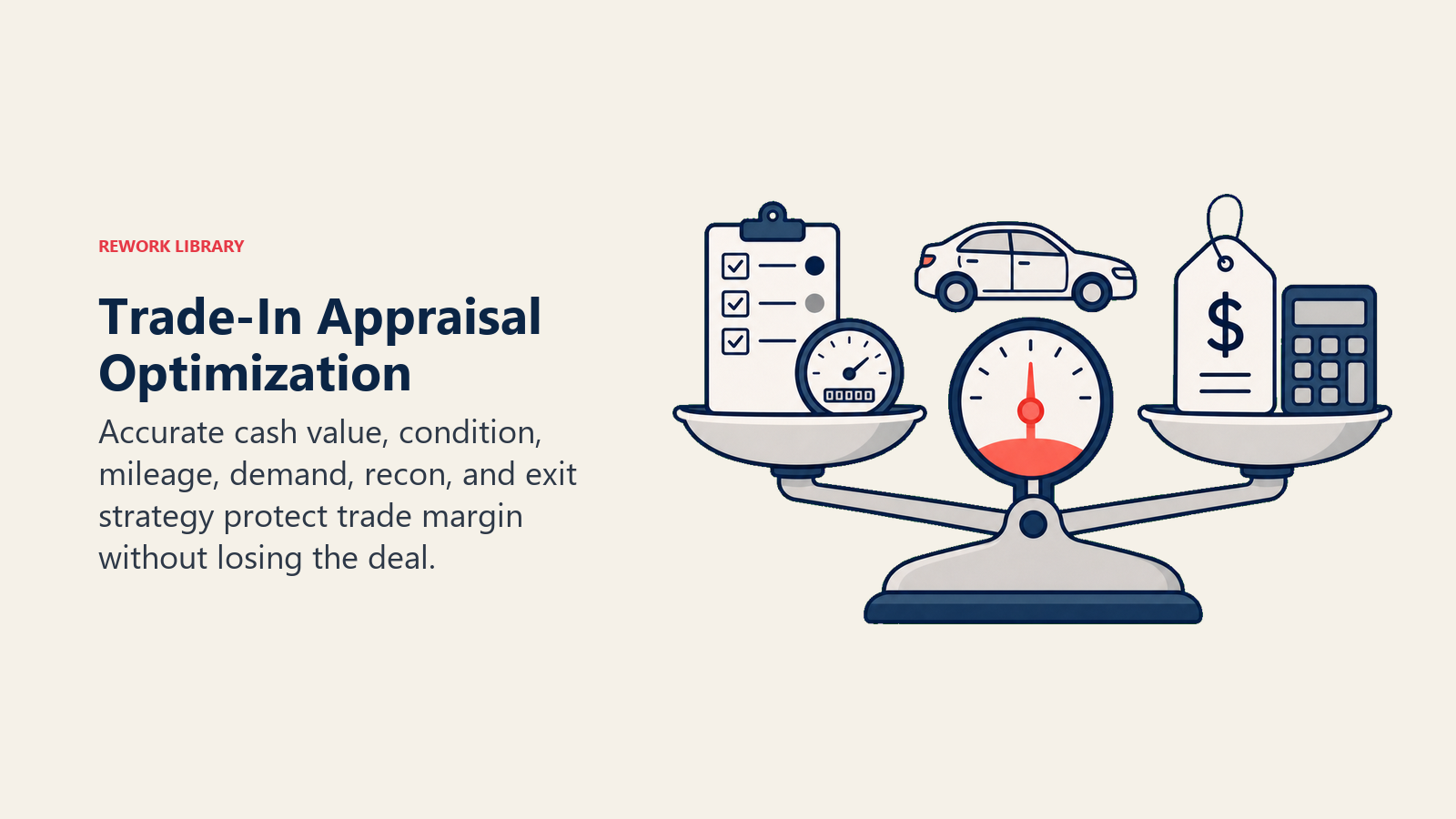
ACV (actual cash value) calculation and validation is the foundation. Use multiple sources: Kelley Blue Book, Black Book, NADA, and auction data. Get the average. Adjust for condition, miles, options, and local market demand. Don't rely on one source or gut feel.
Wholesale value versus retail potential assessment determines whether to retail or wholesale. If wholesale is $8,000 and retail market is $11,500, you have $3,500 of potential gross minus recon costs (maybe $800), leaving $2,700 of margin. But if it's a slow-selling model, maybe you wholesale it for the quick $8,000 and avoid the carrying costs.
Negotiation tactics and walk-away discipline protect profit. Anchor the customer to the low end of book value early. Highlight every issue that reduces value. Use silence after making your offer, let them counteroffer first. And be willing to walk away from deals where you'd have to over-allow significantly. That discipline prevents margin destruction.
When to pay over book and when not to is situational. Pay over book if: the customer is buying a high-margin vehicle from you, their trade is in exceptional condition and will retail quickly, or walking away loses a deal with strong total gross. Don't pay over book if: you're already at minimum acceptable margin, their trade is problematic, or they're price-shopping with no intention to buy.
Trade-in allowance versus actual cash value creates customer confusion you can use strategically. The customer thinks in terms of "trade allowance", what shows on their paperwork. You think in terms of ACV, true market value. You can offer aggressive trade allowance while protecting gross by adjusting new vehicle price. This satisfies the customer's need to feel they got good trade value without destroying your margin.
Gross profit impact of over-allowance compounds. Over-allow by $1,000, and you've lost $1,000 in used vehicle profit when you retail that trade. If you were at $2,800 gross, you're now at $1,800, a 36% margin reduction. Do this on 40% of your trades, and you've given away tens of thousands monthly.
F&I Profit Maximization
F&I represents the easiest gross profit improvement opportunity because it's pure profit with no incremental inventory cost.
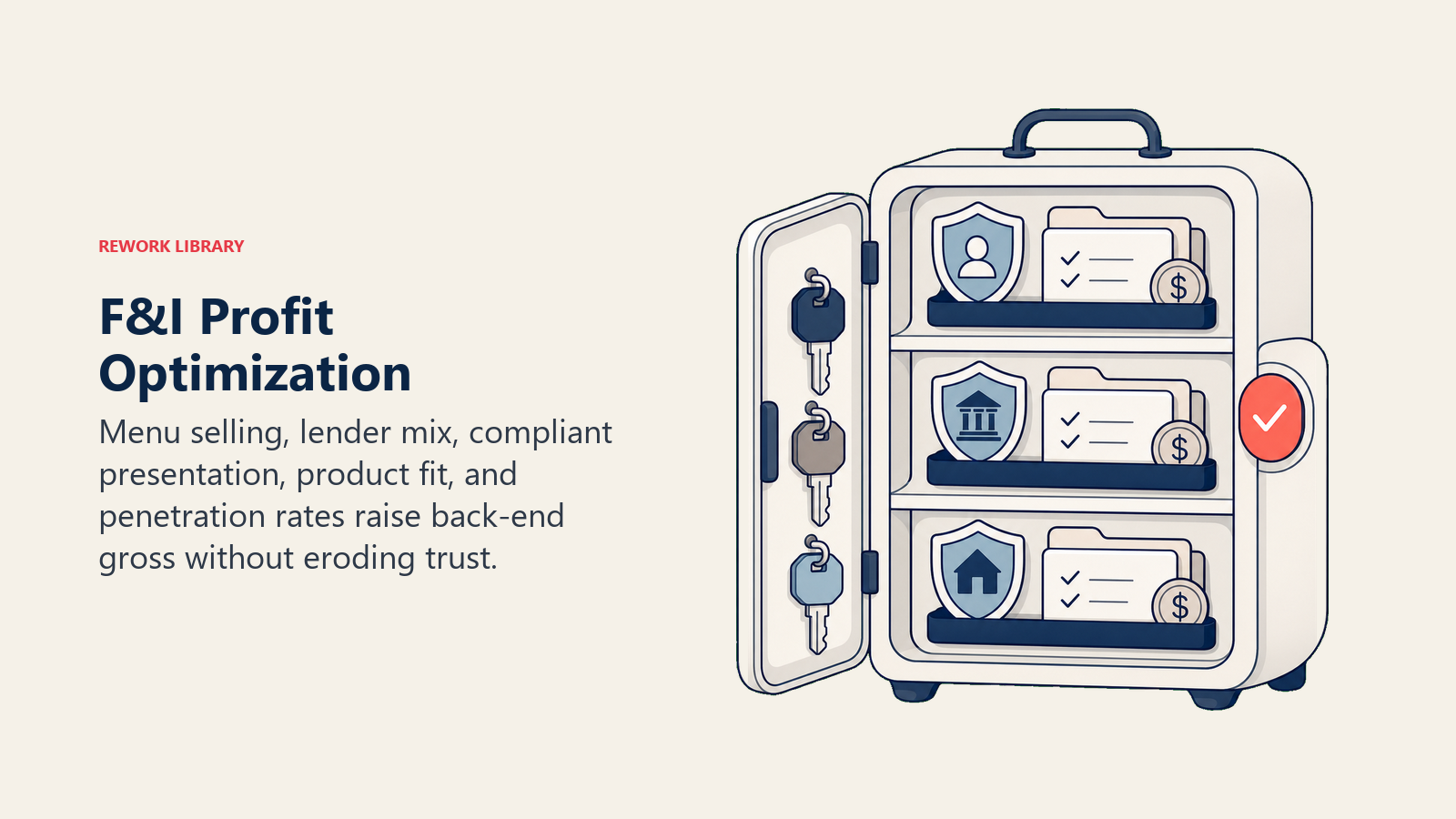
Menu selling versus traditional presentation has been proven superior for 15+ years, yet many dealers still don't use it. Menu selling presents product packages at three price points (good, better, best) and lets customers choose their comfort level. It normalizes product purchase, reduces pressure, increases penetration, and improves compliance. Traditional "a la carte" presentation invites customers to decline everything.
Product penetration rate optimization is pure math. If you currently sell extended warranties on 45% of finance customers and you improve to 55%, you've added 10 percentage points of penetration. At $1,400 profit per warranty, that's $140 per financed vehicle. Multiply by 80 financed deals monthly, and you've added $11,200 in monthly gross, $134,000 annually.
Reserve and finance income strategies require lender relationship management. Different lenders pay different reserve rates. Some pay 2% of amount financed, others pay 2.5%. Over a $30,000 loan, that 0.5% difference is $150. Multiply across 80 finance deals monthly, and lender mix matters. Track reserve by lender and optimize mix.
PVR improvement tactics come from multiple levers: increase penetration rates on existing products, add new products (appearance protection, tire and wheel), improve finance penetration rate, increase finance reserve through better lender mix, and improve F&I manager skills through training and coaching. Each lever adds incrementally to PVR.
Overcoming price objections with value demonstration shifts the conversation. Customers resist $2,500 for an extended warranty. They don't resist $49/month to avoid a $4,800 transmission repair risk. Present in monthly payment terms. Use stories of actual customers who needed the coverage. Show the math: $49 monthly for 60 months is $2,940, but one major repair costs $3,000-5,000.
Compliance while maximizing profit is non-negotiable. State and federal regulations govern F&I product sales. You can't misrepresent products, force purchases, or discriminate in finance terms. But within compliance boundaries, you can optimize presentation, product selection, lender relationships, and F&I manager training to maximize profit ethically.
Service and Parts Profit Optimization
Fixed operations generate higher margins and more predictable revenue than vehicle sales, making optimization crucial.
Labor rate strategy and competitive positioning determines revenue per hour. You don't need the lowest labor rate in town, you need competitive pricing on common services while commanding premium rates on dealer-exclusive work like diagnostics, warranty, and complex repairs. Survey competitors quarterly and position yourself within $5-10 of market average for standard services.
Parts pricing and matrix optimization balances competitiveness on high-visibility parts with strong margins on low-visibility parts. Customers shop oil filter prices online. They don't shop obscure sensors. Use matrix pricing that keeps competitive parts close to market while maintaining 45-50% margins on everything else.
Effective labor rate versus door rate management reveals pricing effectiveness. Your door rate (posted rate) might be $175, but discounts, warranty work, and efficiency losses might bring your effective rate to $148. Track this gap monthly. Work systematically to close it through less discounting, improved efficiency, and better menu selling.
Menu selling service packages increases average RO value while improving customer experience. Instead of selling à la carte (oil change $79, tire rotation $35, filter $45), package them (Complete Service $139). Customers perceive value. You increase ticket. Win-win. Train service advisors to present packages first, itemize only if requested.
Maintenance plan penetration creates recurring revenue and retention. Prepaid maintenance plans sold at delivery lock customers into your service department for 3-5 years. They're profitable for you (customers use 70-80% of services on average) and convenient for customers (no payment at each visit). Target 40%+ penetration on new vehicle sales.
Declining warranty and internal work impact requires adaptation. As vehicles age out of warranty coverage, warranty RO volume declines. Focus shifts to customer pay retention. Internal work (used vehicle recon, loaner maintenance) consumes technician capacity without generating gross. Track internal hours as a percentage of total capacity and minimize them.
Team Performance and Gross Profit
People deliver profit. Compensation and accountability systems determine whether they're motivated to do so.
Sales consultant gross profit goals and tiering create the right incentives. Pay structure should reward both volume and margin. A commission plan that pays the same for a $500 gross deal as a $2,500 gross deal incentivizes volume at the expense of margin. Tier commissions: higher percentage on deals above $2,000 gross, lower on deals below $1,500.
Manager pack and deal approval processes prevent give-aways. Every sales consultant has a minimum gross they can deliver without manager approval (often $1,200-1,500). Anything below that requires sales manager sign-off. This forces consultants to negotiate harder and prevents them from discounting unnecessarily to close deals quickly.
F&I compensation structures that drive performance balance salary and commission. Pure commission can create pressure that leads to compliance issues. Pure salary removes motivation. Hybrid models work best: base salary covering 50-60% of desired income, plus commission on products sold and reserve earned. Add bonuses for CSI to reward customer experience.
Service advisor commission and gross targets align their interests with dealership profitability. Pay service advisors a percentage of gross profit (labor + parts), not just labor sales. This incentivizes them to sell parts, packages, and higher-margin services. Track gross profit per RO by advisor and set monthly targets.
Daily, weekly, and monthly gross profit tracking creates accountability. Post gross profit numbers visibly. Rank sales consultants by total gross delivered. Recognize top performers publicly. Address underperformers privately. Make gross profit as important as unit count in your culture.
Balancing volume and margin incentives prevents unintended consequences. If you only reward unit volume, consultants destroy margin. If you only reward gross profit, consultants won't discount when they should to move aged inventory. The best comp plans reward total gross profit delivered (volume × margin), letting consultants find the right balance on each deal.
Technology and Data for Gross Profit Management
Modern dealerships use technology to optimize pricing and manage margin systematically.
Desking tools and pricing intelligence like TradePending, vAuto, and others show real-time market pricing, competitor inventory, and customer equity. They help sales managers structure deals at market-appropriate pricing instead of guessing. These tools pay for themselves quickly through improved pricing discipline.
Real-time gross profit dashboards give managers visibility into performance as it happens. Track gross profit today, week-to-date, and month-to-date by new/used, by consultant, by F&I manager. See problems early enough to intervene. Celebrate wins immediately to reinforce behaviors.
Historical performance analysis by vehicle, consultant, and time period reveals patterns. Which models deliver the best gross? Which consultants consistently maintain margin? Which times of month see margin erosion? Use this intelligence to coach, set targets, and allocate inventory.
Competitive pricing and market data from third-party sources like vAuto, HomeNet, and CarGurus tell you what competitors are pricing similar inventory at. Don't price in a vacuum. Know your market position and adjust accordingly.
What-if scenario modeling helps managers make complex decisions. If you reduce price by $1,000 and sell in 20 days instead of 45, are you better off? The model accounts for floor plan savings, turn rate improvement, and opportunity cost. Data-driven decisions beat gut feel.
Gross Profit Improvement Roadmap
Systematic improvement requires process, not hope.
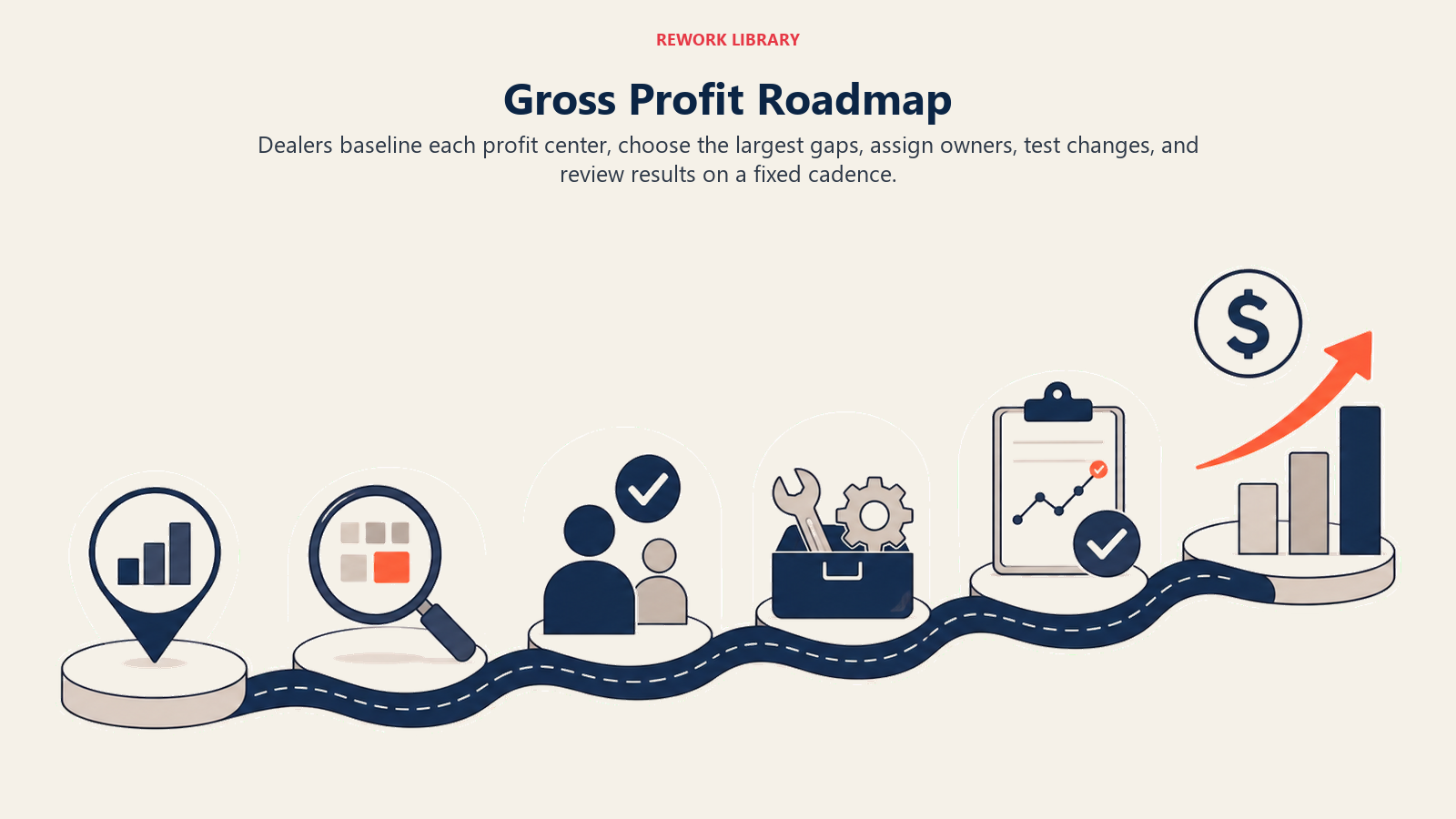
Baseline your current performance by profit center. Calculate average front-end gross (new and used separately), average back-end gross, service and parts margin percentages, and total gross profit per vehicle sold. Track these for 3 months to establish reliable baselines.
Identify the top 3-5 improvement opportunities with highest ROI. Maybe your F&I penetration rates are 15 points below industry average. Maybe service labor rate is $20 below market. Maybe trade-in over-allowance costs you $40,000 monthly. Prioritize based on profit impact and implementation difficulty.
Set realistic improvement targets. Don't expect to go from $1,400 F&I PVR to $2,200 overnight. Target 10-15% improvement over 90 days. Maybe $1,400 to $1,575. Success builds momentum for the next improvement cycle.
Implement process changes and training to drive improvement. If the opportunity is F&I penetration, that might mean: implement menu selling, train all F&I managers, add new products, change compensation to reward penetration. If it's service labor rate, that might mean: adjust pricing matrix, train advisors on value messaging, improve efficiency to boost effective rate.
Monitor and adjust continuously. Track your targeted metrics weekly. Are you making progress? What's working? What isn't? Adjust approach based on results. Treat gross profit optimization as ongoing practice, not a one-time project.
Building a Culture of Profitable Growth
The dealerships that win long-term don't choose between volume and margin. They systematically improve both through data-driven processes, smart technology, aligned compensation, and relentless focus on metrics that matter.
Every dollar of gross profit improvement drops almost directly to the dealership's bottom line. Unlike revenue growth, which carries proportional cost increases, margin improvement is nearly pure profit gain.
Start measuring what you haven't been tracking. Implement the processes that protect margin. Train your teams on the tactics that work. Use technology to make smart decisions faster.
The improvement opportunity is there. The question is whether you'll capture it systematically or watch it slip away one deal at a time.

Senior Implementation Consultant
On this page
- The Anatomy of Dealership Gross Profit
- New Vehicle Gross Profit Strategy
- Used Vehicle Pricing and Margin Management
- Trade-In Appraisal Optimization
- F&I Profit Maximization
- Service and Parts Profit Optimization
- Team Performance and Gross Profit
- Technology and Data for Gross Profit Management
- Gross Profit Improvement Roadmap
- Building a Culture of Profitable Growth