Strategic Owner Retention Marketing: Keeping Customers in Your Dealership Family - 2026 Guide
 Loyalty customers generate 67% higher gross profit per sale and cost 5x less to sell to. Yet most dealerships invest 80% of marketing budget on conquest. The retention opportunity is massive and largely ignored.
Turn this article into takeaways for your work.


Each assistant summarizes the article only for you and suggests best practices for your work.
Think about it. You spent hundreds of dollars acquiring a customer, building trust through the sales process, and delivering a vehicle. That customer has proven they like your brand, your dealership, and your people. They're statistically more likely to buy from you again than a cold conquest lead. Yet most dealers spend more effort chasing strangers on the internet than nurturing the customers they already have.
Research shows the stakes are high: GM reported that every 1% increase in retention contributes an average of $150,000 per dealer annually, translating to a $700 million increase in annual revenue across the dealer network. For broader customer relationship strategies, see Automotive Customer Experience and Post-Sale Follow-Up Process.
This is backwards economics. Strategic retention marketing flips the script and builds predictable revenue from your existing customer base while dramatically lowering customer acquisition costs. Let's break down how to do it systematically.
Understanding Customer Defection
Before you can prevent defection, you need to understand why customers leave and when intervention matters most. Critical retention windows are predictable based on customer lifecycle stage. The highest-risk periods are lease maturity (18-24 months into a lease when customers start thinking about their next vehicle), loan payoff (when customers own their vehicle free and clear and could trade anytime), and warranty expiration (when customers start shopping for peace of mind). For timing strategies, see lease renewal process.
These windows represent your greatest vulnerability and your biggest opportunity. If you reach customers proactively during these periods with compelling reasons to stay, you'll capture a much higher percentage of repeat business. If you ignore these windows, competitors will exploit them.
Defection warning signs and predictive indicators tell you which customers are at risk before they're actually gone. Declining service frequency is the biggest red flag. A customer who was coming in every 90 days who suddenly hasn't been back in six months is likely servicing elsewhere, or thinking about trading.
Other indicators include: not responding to marketing communications, price shopping visible in your CRM notes, asking about trade-in values 12+ months before typical trade cycle, and declining equity position that limits options. These signals let you intervene before the customer is lost.
Service frequency as loyalty predictor is the most reliable metric you have. Customers who service regularly are exponentially more likely to buy their next vehicle from you. The correlation is clear: 3-4 service visits per year equals 60-70% repurchase rate. 1-2 visits per year equals 30-40% repurchase rate. Zero service visits equals 10-15% repurchase rate.
Data from Cox Automotive confirms this relationship: customers who use dealership service are 74% more likely to buy their next car there. Unfortunately, the study also reveals that U.S. dealerships have lost 12% of service visits to independent competitors since 2018, making service retention marketing more critical than ever.
Your retention marketing should prioritize keeping customers in your service drive because service retention leads to sales retention. They're not separate goals, they're directly connected. For comprehensive service retention strategies, see Service Customer Retention and Service Marketing Campaigns. To optimize the first service experience, see Service Appointment Scheduling.
Competitive conquest timing and tactics follow predictable patterns. Competitors start marketing to your customers 6-12 months before typical trade cycles. They're pulling equity reports from third-party data providers and targeting your customers with aggressive trade-in offers. Learn defensive strategies in conquest marketing strategy.
If you're not marketing to your own customers during this window, you're letting competitors have the first conversation about their next vehicle. That puts you on defense. You want to be on offense, engaging customers before competitors even know they exist.
Building a Retention Marketing Database
Effective retention marketing requires good data. You can't market to customers you don't understand or can't segment appropriately. Essential customer data points and segmentation start with your DMS. You should be extracting: purchase date, vehicle information (year/make/model, VIN, mileage at purchase), financing details (lease vs. purchase, term, payment, payoff amount), service history (dates, revenue, RO details), contact information (address, email, phone, SMS opt-in status), and communication preferences.
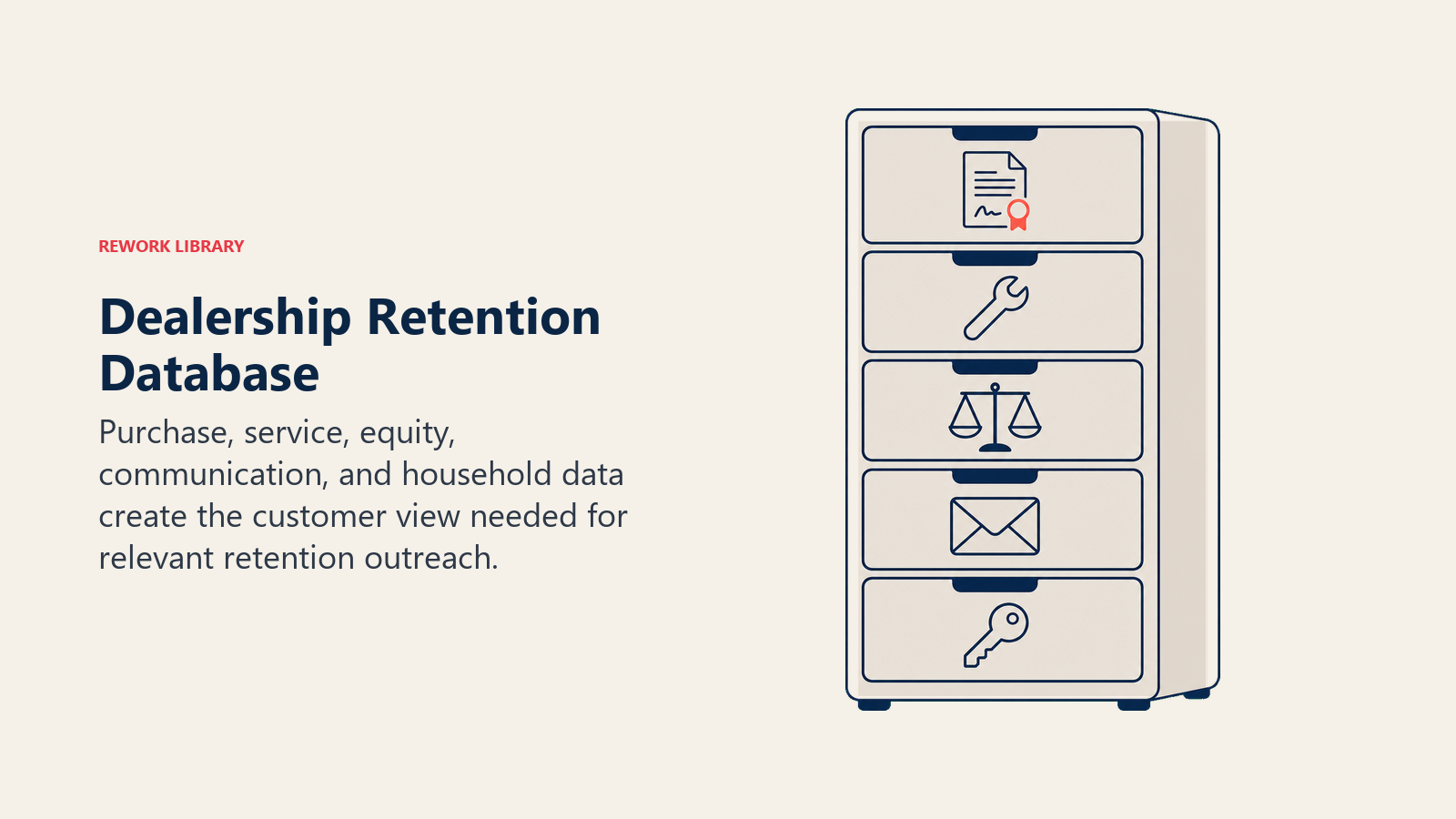
This data lets you segment customers by ownership type (lease vs. purchase), time in current vehicle, equity position, service behavior, and demographics. Different segments need different marketing approaches. A lease customer 18 months in needs a different message than a purchase customer 54 months in with $8,000 in positive equity.
DMS and CRM data integration requirements can't be overstated. If your CRM doesn't automatically pull customer and vehicle data from your DMS, you're working with outdated information and missing critical triggers. The integration needs to run daily or in real-time so your marketing automation can act on current data.
Work with your CRM and DMS providers to establish data flows. Most modern systems have built-in integration capabilities. If yours don't, third-party middleware solutions can bridge the gap. This investment pays for itself immediately in campaign effectiveness.
Equity position tracking and monitoring is critical for identifying ready-to-buy customers. You need to know which customers have positive equity, how much equity they have, and how that equity position is changing over time. This requires either DMS reports that calculate equity (current market value minus payoff) or third-party equity mining tools that pull valuation data.
Run equity reports monthly for your entire customer base. Segment customers into brackets: negative equity, break-even, $1-$3K equity, $3-$5K equity, $5K+ equity. Higher equity customers are hotter prospects and should receive more frequent, more aggressive marketing.
Behavioral scoring models help prioritize which customers to contact and how aggressively. Build a simple scoring system that assigns points based on factors like positive equity (+10 points), approaching lease maturity (+8 points), regular service visits (+5 points), high service spend (+3 points), referred others (+3 points), and opened recent emails (+2 points).
Customers with higher scores get more touchpoints, more personal outreach, and priority handling when they respond. Customers with low scores get basic retention campaigns but less intensive effort. This ensures you're spending marketing resources where they'll generate the highest ROI.
Lifecycle Marketing Campaigns
Triggered communications based on ownership stage keep you top-of-mind throughout the customer journey. These aren't batch-and-blast promotions, they're personalized messages tied to specific customer lifecycle events. New owner onboarding and engagement starts immediately after delivery. Send a welcome email series over the first 90 days covering topics like: how to use your vehicle's technology features, service schedule and recommendations, loyalty program benefits, referral opportunities, and invitation to connect on social media. For structured onboarding, see guest onboarding experience.
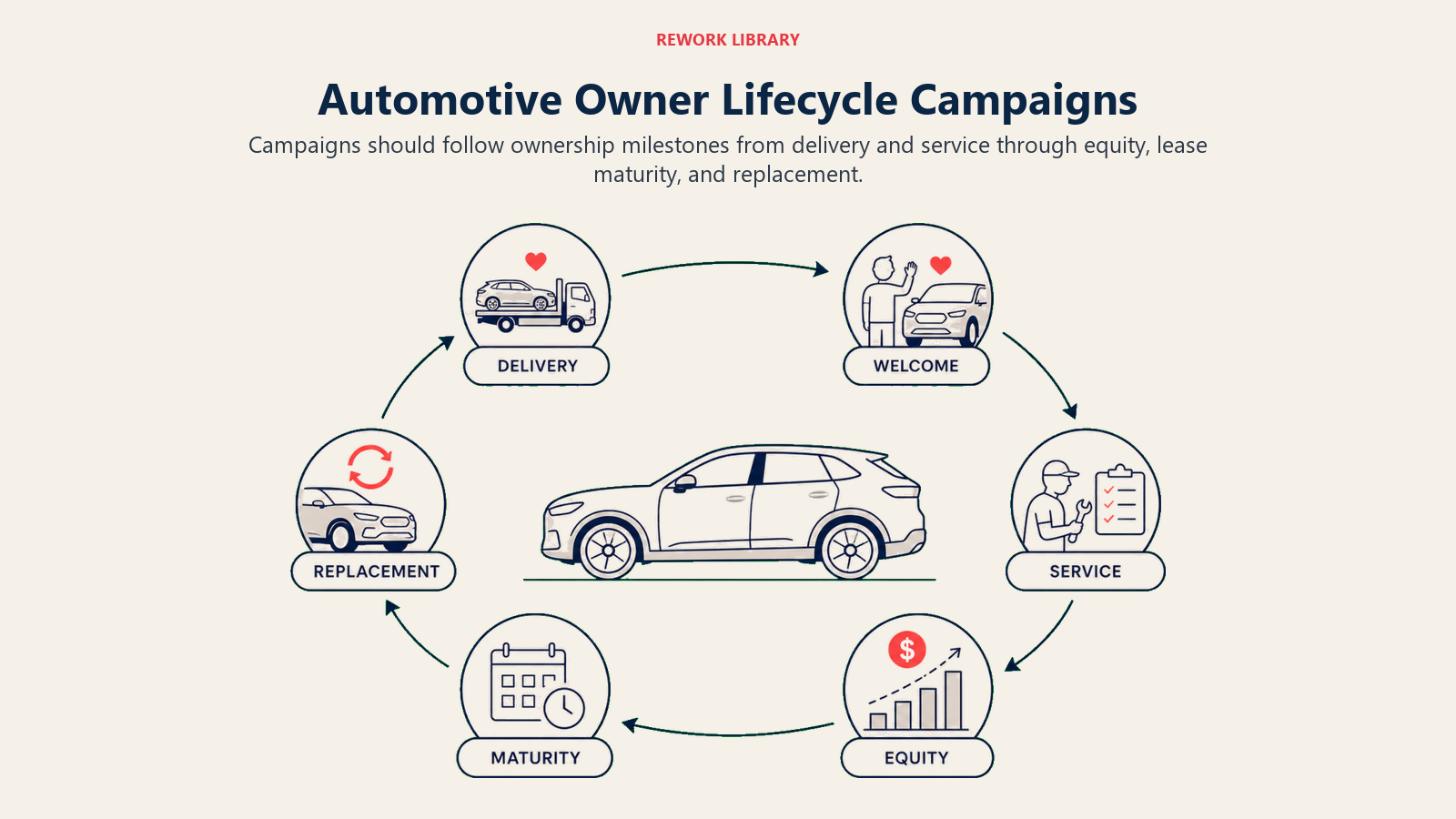
This onboarding period is when customers form lasting impressions about your dealership beyond the sales transaction. Stay engaged, provide value, and demonstrate that you care about their ownership experience, not just the sale.
Service reminder and maintenance campaigns are your most frequent customer touchpoint. Automated campaigns should trigger based on mileage (estimated from purchase date) or time since last service. Messages should be helpful and educational, not pushy or sales-focused. Explore dealership email marketing best practices.
Example: "Your Accord is due for its 30,000-mile service, which includes oil change, tire rotation, brake inspection, and multi-point inspection. This service typically costs $189 and takes about 90 minutes. Click here to schedule your appointment." That's informative, transparent, and actionable.
Lease maturity and pull-ahead programs target lease customers 3-6 months before maturity. These campaigns should lead with the value proposition: "You're eligible to upgrade to the new model up to 90 days early with no disposition fee and no remaining payments. Let's explore your options."
The goal is to get lease customers back into the showroom before competitors contact them. Timing matters enormously. If you wait until lease maturity, you're too late, they've already been shopping for months. Reach out early and make it easy to upgrade.
Loan payoff and trade-cycle campaigns target purchase customers at 36-48-60 month marks depending on your average trade cycle. These campaigns should focus on equity position and upgrade opportunities: "Your Pilot is worth more than ever, and you have $4,200 in equity. That's enough to significantly lower your payment on a new 2026 model. Let's show you what's available."
Position trade-ins as smart financial decisions, not impulse purchases. Customers need a rational justification for trading before they're done paying off their current vehicle. Positive equity and payment reduction provide that justification.
Warranty expiration and extended warranty offers target customers 3-6 months before factory warranty expires. Some customers will want to trade to avoid post-warranty repair costs. Others will want to extend coverage on their current vehicle. Both are sales opportunities.
Message: "Your factory warranty expires in 90 days. Let's discuss your options: extend your coverage with a service contract, or explore upgrading to a new vehicle with full factory warranty. Either way, we'll make sure you're protected."
Equity Mining Strategy
Proactive outreach to customers with positive equity is your highest-ROI retention activity. These customers are ready to buy now, you just need to initiate the conversation. For detailed equity mining processes, see Equity Mining Strategy. Monthly equity report generation should be a standing process in your dealership. Run reports on the 1st of every month that list all customers with $3,000+ in positive equity. Sort by equity amount and time since last purchase. These are your hot leads for the month.
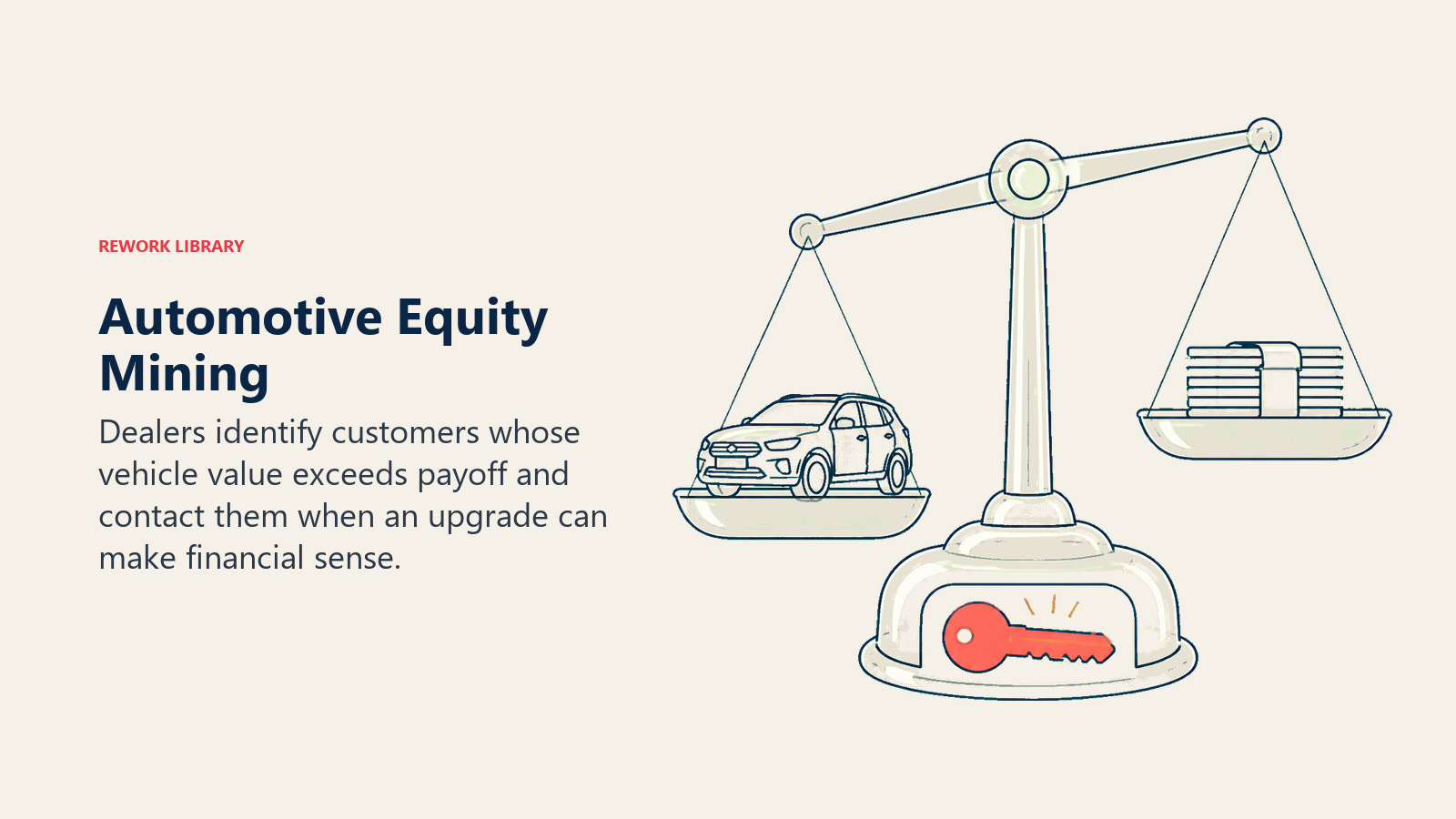
High-equity customer prioritization focuses your BDC and sales team efforts where they'll generate the most sales. Customers with $5,000+ equity should get multiple touchpoints: personalized direct mail, email, SMS, and phone calls. These customers can often trade with little to no money down and lower payments, they're the easiest sales you'll ever make.
Multi-channel contact strategy increases response rates dramatically. A customer who ignores your email might respond to a text. A customer who ignores your text might answer a phone call. Use all channels in coordinated sequences.
Sample 30-day campaign: Day 1 - Personalized direct mail piece with equity estimate. Day 3 - Email with subject "Good news about your [Vehicle]." Day 5 - SMS: "Hi [Name], this is [Your Name] from [Dealership]. I sent you info about your trade-in value. Did you receive it?" Day 7 - Phone call. Day 14 - Second email with different angle. Day 21 - Second phone call. Day 30 - Final text.
Trade-in appraisal scheduling tactics should focus on getting the customer into the dealership for an appraisal, not trying to sell over the phone. The goal of every communication is to schedule an appointment. Once they're in your showroom, your sales team can take over. For detailed appraisal processes, see trade-in appraisal process.
Phone script: "Hi [Name], this is [Your Name] from [Dealership]. I wanted to reach out because we're seeing unprecedented values on [Year/Make/Model] right now. Your [Vehicle] is showing about [Equity Amount] in equity, which is significantly higher than normal. I'd love to give you an exact appraisal and show you what that equity could do on a new vehicle. Do you have 30 minutes this week to stop by?"
Win-Back Campaigns
Re-engaging defected customers is challenging but worthwhile. These customers already know your dealership, and their reasons for defecting might not have been personal. Life circumstances, competitive offers, or temporary dissatisfaction could have pushed them away. Many are recoverable. Identifying defection requires monitoring service and purchase behavior. A defected customer is someone who hasn't serviced in 12+ months and either purchased elsewhere (visible in third-party data) or is past typical trade cycle without trading. These customers are lost but potentially recoverable.
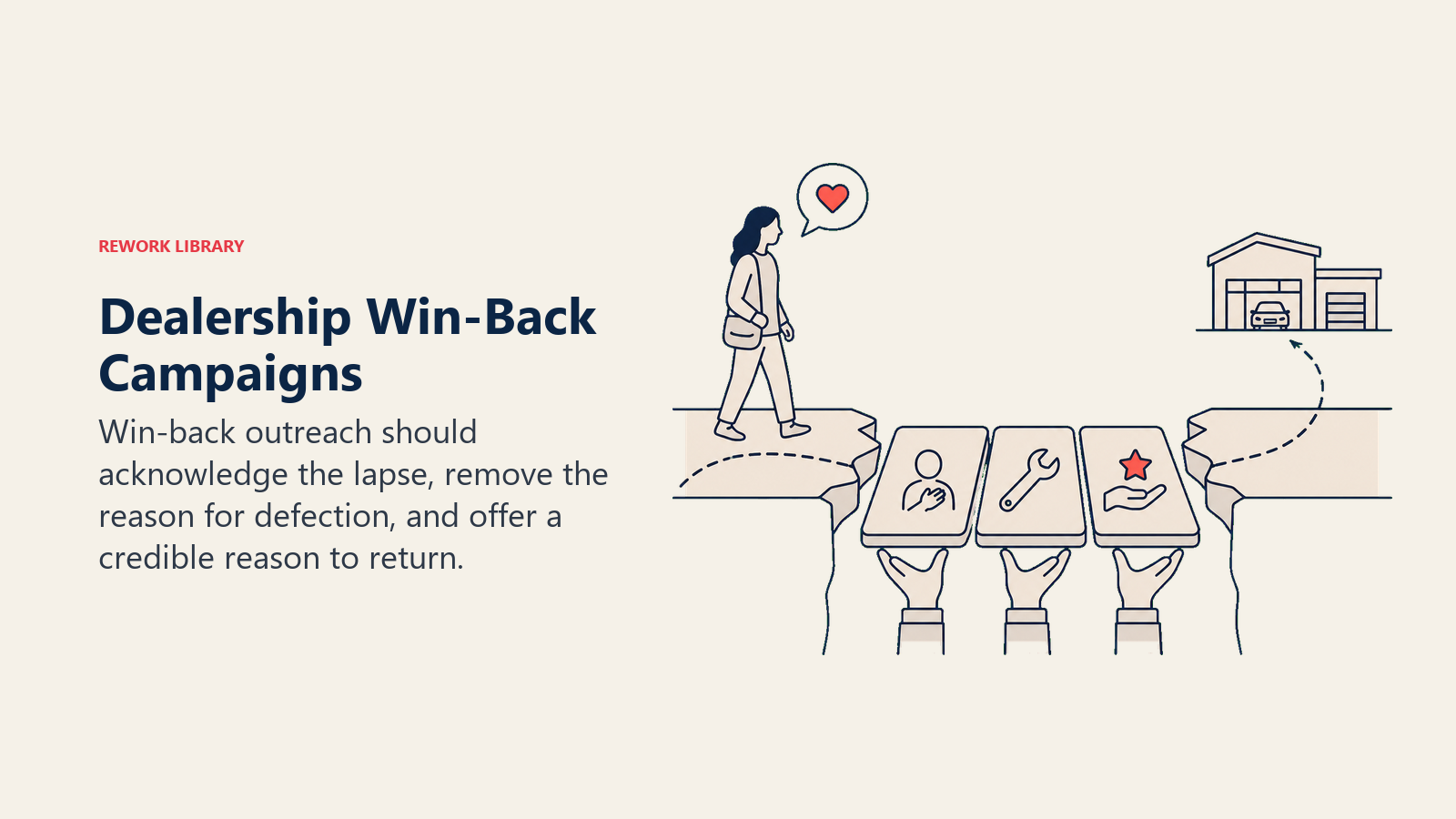
Segment defected customers by time since last interaction and reason for defection if known. Recent defectors (12-18 months) are easier to win back than long-lost customers (36+ months). Customers who defected due to specific issues (bad service experience, personality conflict) need different messaging than customers who simply got a better deal elsewhere.
Segmented messaging strategies acknowledge why they left without dwelling on it. For customers who had negative experiences: "We've made significant changes to our service department based on customer feedback, and I'd love a chance to earn back your trust. Can I offer you a complimentary service visit to show you the improvements?"
For customers who simply found better deals elsewhere: "We understand you made the best decision for your situation at the time. We've expanded our programs for previous customers with special loyalty pricing and trade-in bonuses. I'd love to show you how we can make coming back worth your while."
Special offers and incentives that work include: loyalty return bonus ($500-$1,000 on trade-in for customers who previously purchased from you), complimentary service package (3 free oil changes or equivalent service value), waived fees (no disposition fee on lease returns even if you leased elsewhere), and VIP treatment (concierge service, priority scheduling, personal sales consultant). For comprehensive win-back strategies, see travel win-back campaigns.
The offer needs to be meaningful enough to overcome the inertia and negative perception that led to defection. A $50 service coupon won't do it. A $1,000 loyalty bonus and VIP treatment might.
Measurement and ROI tracking tells you whether win-back campaigns are worth the investment. Track: number of defected customers contacted, response rate, appointments scheduled, show rate, vehicles sold, and cost per win-back sale. Compare these metrics to conquest campaign performance. If win-back campaigns cost less per sale and generate similar or higher gross profit, invest more in them.
Personalization and Segmentation
Relevant messaging for different customer types dramatically improves campaign performance. One-size-fits-all retention marketing misses opportunities and wastes budget. By vehicle type segmentation recognizes that luxury vs. mass market customers have different priorities, and EV vs. ICE customers have different concerns. Luxury customers care about prestige, exclusivity, and concierge service. Mass market customers care about value, reliability, and convenience. EV customers care about range, charging infrastructure, and technology features. Tailor your messaging accordingly.
Don't send the same trade-in offer to a Civic owner and an MDX owner. The Civic owner probably cares about payment and reliability. The MDX owner cares about features, safety, and space. Your messaging should reflect what matters to each customer.
By purchase history segmentation distinguishes first-time buyers, loyal repeat customers, and conquest customers. First-time buyers need education and reassurance. Loyal repeat customers need recognition and appreciation. Conquest customers need validation that they made the right choice by switching to your dealership.
Loyal repeat customers should receive special treatment: "As someone who has purchased three vehicles from us over 15 years, you're part of our dealership family. We want to make sure you get priority access to the new [Model] and our best trade-in value on your current vehicle."
By service behavior segmentation separates regular customers from lapsed customers. Regular service customers (3-4 visits per year) are highly engaged and need gentle reminders and appreciation. Lapsed customers (0-1 visits per year) need aggressive re-engagement and compelling reasons to return.
For lapsed customers: "We noticed you haven't been in for service in over a year. We'd love to earn back your business. Here's a $100 service credit and priority scheduling, no appointment needed for oil changes. We've made improvements and want to show you."
By demographics and life stage, tailor messaging to young professionals (care about technology and image), families (care about safety and space), empty nesters (care about comfort and luxury), and retirees (care about reliability and value). Use data from your CRM and make reasonable assumptions based on vehicle choice and purchase history.
Multi-Channel Execution
Coordinated touchpoints across channels create consistent presence without annoying customers. The key is strategic sequencing and message variation. Email marketing automation should be the backbone of your retention program because it's scalable and measurable. Build automated email sequences for every lifecycle stage: new owner welcome series, service reminders, lease maturity campaigns, trade-cycle campaigns, and win-back campaigns. Learn automation techniques in automotive marketing automation.
Use personalization tokens (first name, vehicle model, specific dates) and behavioral triggers (opened previous email, clicked link, scheduled appointment) to make emails feel personal rather than mass-produced. A/B test subject lines and messaging to optimize open and click rates.
Direct mail and variable data printing still work, especially for high-value opportunities. A personalized letter or postcard with the customer's name, vehicle details, and equity estimate stands out in a digital world. Use direct mail for high-equity customers and critical lifecycle milestones where investment justifies higher cost per contact.
Variable data printing lets you customize every piece with specific customer information. "Mr. Johnson, your 2022 Accord has approximately $5,200 in equity, enough to upgrade to a 2026 model with similar or lower payments. Let's explore your options."
SMS and text messaging campaigns have the highest open rates (98%) but require opt-in consent and careful frequency management. Use SMS for time-sensitive opportunities and appointment confirmations, not general marketing.
Effective SMS: "Hi Sarah, this is Mike from ABC Honda. Your Pilot's equity just hit $6,000, highest we've seen in months. Can I show you the new models this week? Takes 30 minutes. Reply YES for my calendar link." Short, personal, action-oriented, and respectful of their time.
Outbound phone campaigns and BDC integration provide personal touch for high-value opportunities. Your BDC should be calling high-equity customers, lease customers approaching maturity, and defection-risk customers. These calls aren't cold calls, they're warm outreach to your own customers with legitimate reasons to connect. For BDC phone techniques, see Phone Skills for Automotive.
Train your BDC on consultative approaches: "Hi [Name], this is [Your Name] from [Dealership]. I'm calling because our records show you're approaching your lease maturity, and I wanted to make sure you know about your options before competitors start calling. Do you have a minute to discuss?"
Retargeting and paid digital advertising keeps your dealership visible to customers across the web. Upload your customer email list to Facebook and Google as a custom audience and serve them targeted ads about trade-in opportunities, service specials, and new model announcements. For broader digital strategies, see automotive paid advertising.
Retargeting is particularly effective for customers who visited your website or opened marketing emails but didn't take action. These customers are showing interest, retargeting keeps you top-of-mind until they're ready to act.
Measuring Retention Marketing ROI
Metrics and analytics that matter prove whether your retention marketing investment is working or wasting money. Customer retention rate and defection rate are your primary success metrics. Calculate retention rate as: (number of customers who repurchased from you) / (total customers who were in typical trade cycle window) × 100. Track this quarterly and compare to previous periods.
If your retention rate is improving, from 35% to 42% for example, your programs are working. If it's declining or flat, you need to adjust strategy. Industry average for most brands is 30-45%. Top-performing dealers hit 55-65%.
Repurchase rate by cohort shows which customer groups have highest loyalty. Compare retention rates for: lease vs. purchase customers, customers who service regularly vs. infrequently, loyalty program members vs. non-members, and customers by initial salesperson. This reveals what drives retention and where to invest.
If loyalty program members have 60% repurchase rate while non-members have 30% rate, your loyalty program is working. If there's no difference, your program needs changes.
Campaign attribution and lift analysis measure specific campaign effectiveness. Use unique phone numbers, landing pages, and offer codes to track which campaigns drive responses. Calculate lift by comparing response rates from different campaign variations or against control groups who receive no marketing.
If your equity mining campaign generates 8% response rate while your generic "trade-in event" campaign generates 2% response rate, you know where to invest budget.
Cost per retained customer is your efficiency metric. Calculate: (total retention marketing spend) / (number of customers who repurchased due to retention marketing). Compare this to cost per acquired customer from conquest marketing. Retention should be dramatically lower cost, typically 5-10x more efficient.
If your cost per retained customer is higher than cost per conquest customer, your retention programs are broken or badly executed.
Lifetime value impact shows the long-term payoff of retention marketing. Track lifetime value (total gross profit from vehicle sales and service) for retained customers vs. conquest customers. Retained customers should generate significantly higher LTV because they're more likely to service with you and repurchase multiple times.
This metric justifies retention marketing investment even when per-sale costs appear similar to conquest costs. The compounding effect over multiple purchase cycles makes retention the clear winner in lifetime profitability.
Integration with Sales Process
Connecting marketing to showroom results ensures retention leads don't get lost in execution.
Lead routing and priority handling give retention leads proper attention. When a customer from your database responds to retention marketing, that lead should be flagged as high-priority in your CRM and routed to sales consultants who specialize in retention sales or to the consultant who originally sold them.
Retention leads are warm leads with established relationships. They deserve faster response times and more experienced handling than cold internet leads. Configure your CRM to notify sales teams immediately when retention leads come in.
Sales consultant notification and briefing should provide context about the customer's history. When a retention lead is assigned, the consultant should see: purchase history (what they bought, when, from whom), service history (frequency, spend, last visit), campaign details (why they were contacted, what offer they received), and current situation (equity position, lease status, trade cycle).
This information lets consultants personalize their approach and reference specific details that build trust. "Hi Sarah, I see you purchased your Pilot from us three years ago and you've been servicing regularly. Thanks for your loyalty. Mike mentioned you're interested in exploring what your equity could do on a new model..."
Trade-in appraisal preparation lets you start strong. Before the retention appointment, pull trade-in values from your appraisal tools, review recent market trends for that vehicle, and prepare a strong offer. These customers expect special treatment as existing customers. Don't disappoint them with lowball offers or sloppy appraisals. Master the trade-in appraisal process for consistent results.
Be ready to present strong trade-in values and clearly explain your loyalty bonus or special retention pricing. These customers cost you nothing to acquire, you can afford to be more aggressive on trade-in and still make great money.
Offer presentation and negotiation strategy should emphasize continuity, loyalty value, and seamless transaction. "We're excited to keep you in the [Dealership] family. As an existing customer, you qualify for our loyalty trade-in bonus of $750, priority financing approval, and complimentary first three oil changes. Let me show you how this all comes together on payment..."
The entire experience should feel different than a first-time transaction. Less adversarial, more collaborative, faster, and more appreciative. Retention customers should leave thinking: "That's why I came back here instead of shopping around."
Retention marketing works because it's good business, economically, operationally, and strategically. Every dollar invested in keeping existing customers generates better returns than dollars spent chasing strangers. Build your retention marketing systematically, measure results religiously, and optimize continuously. The payoff is a predictable, profitable, sustainable sales funnel built on your most valuable asset: your existing customer base. For implementation through your CRM system, see Automotive CRM Implementation. To track success, monitor your Dealership KPI Dashboard.

Senior Implementation Consultant