Lead Response Time Optimization: Why the First 5 Minutes Determine Your Close Rate - 2026 Guide
Turn this article into takeaways for your work.


Each assistant summarizes the article only for you and suggests best practices for your work.
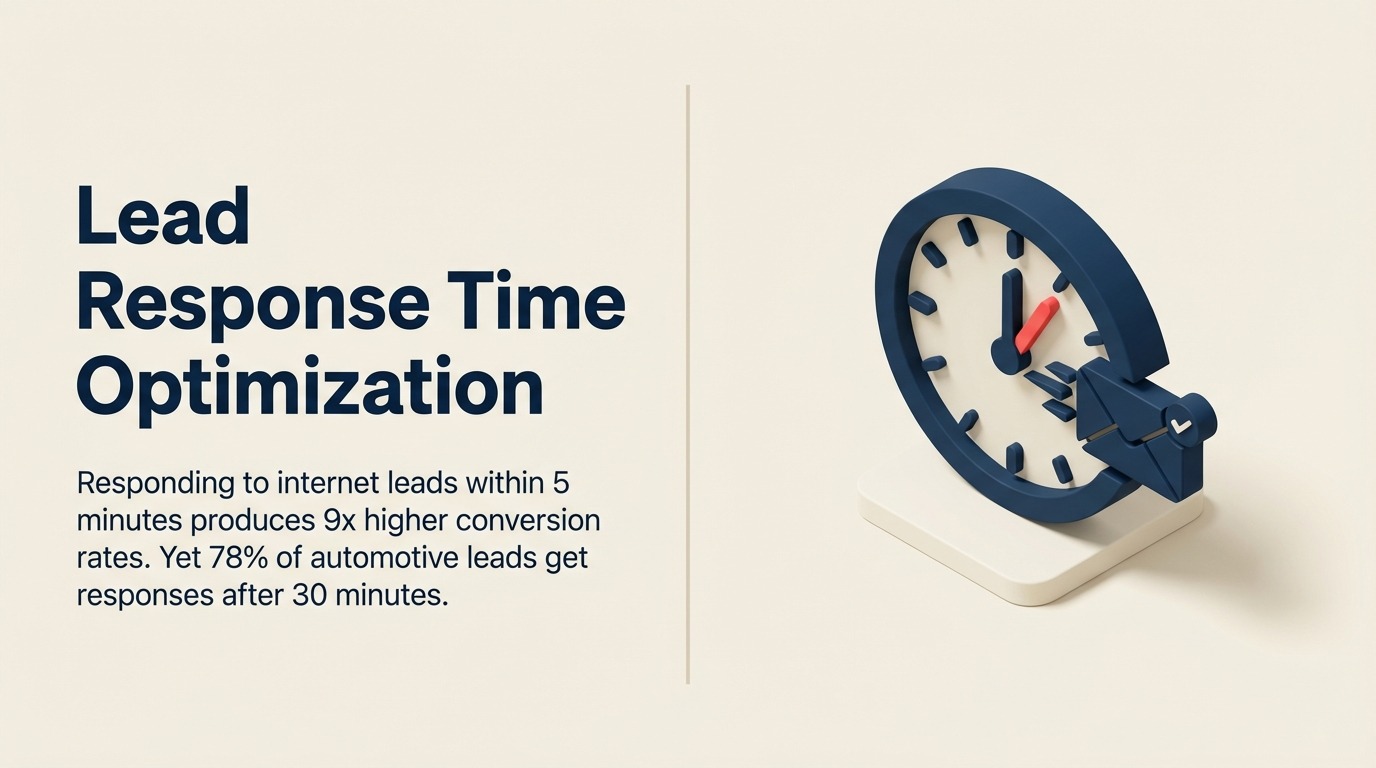
Responding to internet leads within 5 minutes produces 9x higher conversion rates than responding after 30 minutes. Yet 78% of automotive leads receive their first response after 30 minutes, and 32% never receive any response at all.
That gap represents millions in lost revenue for dealerships every year. When a customer submits an inquiry about a vehicle at 2:47 PM on Tuesday, they're actively shopping. They've probably got three other dealership tabs open. They're comparing inventory, reading reviews, calculating payments.
The dealer that responds first doesn't just have an advantage, they often win the entire sale. Because by the time your competitor responds an hour later, the customer is already test driving your vehicle.
This isn't about being pushy. It's about meeting customers when they're actually engaged and ready to talk.
The Response Time Data
MIT and Harvard researchers studied 2.1 million sales leads across multiple industries. Their findings were stark: companies that tried to contact potential customers within an hour were seven times more likely to qualify the lead compared to those that waited even 60 minutes. But the real magic happened in the first five minutes.
Leads contacted within five minutes were 21 times more likely to enter the sales process than leads contacted after 30 minutes.
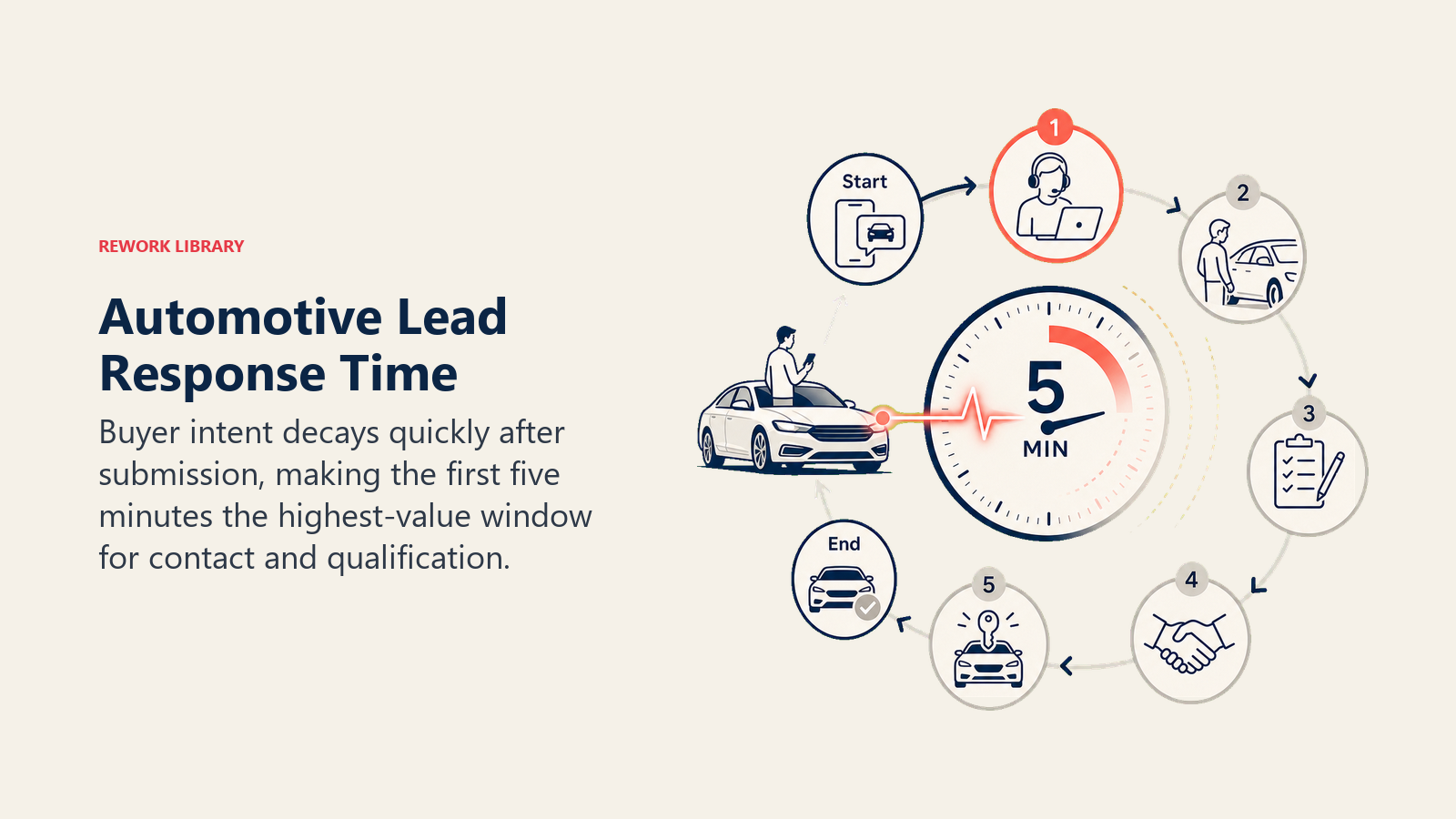
In automotive specifically, the numbers are even more dramatic. Cox Automotive research found that internet leads contacted within five minutes convert at rates of 25-32%, depending on lead source. That same lead, contacted after one hour, converts at just 3-5%. After 24 hours, conversion rates drop below 1%.
The difference between a five-minute response and a one-hour response isn't marginal, it's the difference between closing one in four leads versus one in twenty.
But here's where most dealerships get confused: first response doesn't mean first meaningful conversation. Sending an automated "We received your inquiry" email in 30 seconds is better than nothing, but it's not the response that drives conversion. Conversion comes from actual human contact, a phone call, a personalized text, a video message, within that five-minute window.
Response time also varies significantly by lead source. Chat leads expect immediate response (they're literally waiting for you to type). Form submissions need response within 5-10 minutes. Phone inquiries that go to voicemail need callbacks within 15 minutes. Third-party leads from sites like Autotrader or Cars.com often sit for hours because dealers assume they're lower quality, a costly mistake when those leads are shopping five other dealers simultaneously.
And your competitors? Mystery shopping data from 2025 shows that 67% of franchised dealers don't respond to internet leads within the first hour. Another 18% never respond at all. If your BDC can consistently hit that five-minute mark, you're outperforming 85% of the market before you even open your mouth.
Consumers also know what they want. Research from McKinsey shows that 70% of auto customers start their journey digitally, and customers who receive fast, helpful responses are significantly more likely to convert than those who wait. Speed isn't everything, but it creates the opportunity for everything else.
Technology Solutions
You can't respond in five minutes if your BDC agent is walking to the bathroom when a lead comes in. Technology bridges the gap between lead arrival and human response.
Lead notification systems should hit multiple channels simultaneously. When a new lead enters your CRM, your BDC team should receive SMS alerts, email notifications, and push notifications to their mobile devices. The goal isn't to bombard them, it's to ensure someone sees that lead immediately regardless of what they're doing.
Mobile CRM applications let agents respond from anywhere. Your top BDC rep can handle a hot lead from their phone while they're grabbing lunch. Most modern automotive CRMs (VinSolutions, DealerSocket, Eleads) have mobile apps that allow call-making, text sending, and basic lead management from anywhere. Make sure your team has these apps installed and actually uses them.
Automated acknowledgment responses buy you time while your team mobilizes. Set up instant-fire emails and texts that say "We received your inquiry about the [VEHICLE]. A product specialist will call you within 10 minutes." This manages customer expectations and shows you're not ignoring them, even if your human response takes a few minutes.
Call routing and auto-dialing eliminate the time wasted dialing numbers manually. When a lead comes in, your system should automatically route it to available agents and begin dialing the customer's number. Some systems even use predictive dialing to connect agents the moment the customer answers, cutting response time from five minutes to thirty seconds.
Lead alert escalation systems handle the problem of missed alerts. If Agent A doesn't respond within two minutes, the lead automatically escalates to Agent B. If Agent B doesn't respond within another two minutes, it goes to the BDC supervisor. If the supervisor doesn't grab it, it might route to the sales floor or a backup agent. No lead should ever sit unworked because someone was on break.
Response time tracking dashboards make performance visible. Every agent should see their average response time displayed in real-time. Public leaderboards create healthy competition. If Sarah's averaging 3 minutes and Mike's averaging 18 minutes, Mike knows he needs to move faster. What gets measured gets managed.
Process Design for Speed
Technology enables speed, but process determines who gets the lead and what happens when they don't respond.
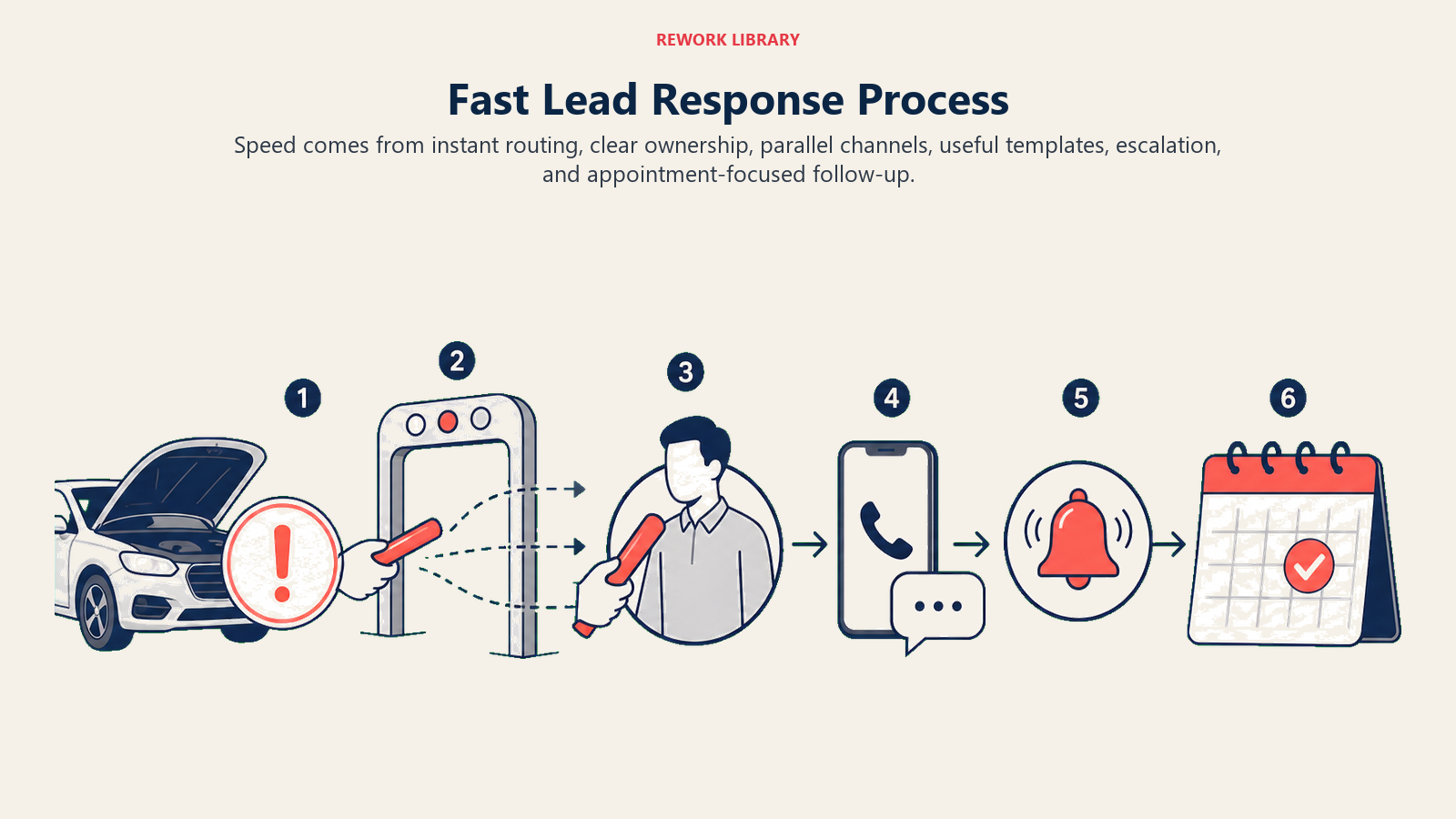
Lead routing logic determines which agent sees which lead first. Round-robin assignment distributes leads evenly but can send hot leads to agents who are already on calls. Simultaneous routing sends leads to multiple agents at once, first responder wins the lead. Skills-based routing matches lead characteristics (luxury vs economy, new vs used) to agent expertise. Each approach has tradeoffs between fairness, speed, and quality.
Most high-performing BDCs use hybrid systems: hot leads (scored above 70, chat inquiries, repeat customers) get simultaneous routing to top agents. Warm leads use skills-based routing. Cold leads follow round-robin to ensure everyone gets opportunities.
BDC vs sales floor responsibility should be crystal clear. If the BDC handles all internet leads Monday-Saturday 8am-8pm, salespeople shouldn't be grabbing leads during those hours. It creates confusion, duplicate outreach, and poor customer experience. Outside BDC hours, leads should automatically route to on-call salespeople or after-hours protocols.
Backup and escalation protocols prevent leads from falling into black holes. If no one grabs a lead within three minutes, it needs a backup path. That might mean routing to the sales floor, sending to a supervisor's phone, or triggering an alarm that tells everyone this lead is sitting. Dealerships that sell 100+ vehicles per month should never have a lead go unresponded for more than five minutes during business hours.
Lead recycling for non-response happens when agents can't reach customers. After three call attempts and two texts in the first hour, leads should recycle to a different agent who tries again in 2-3 hours. Fresh voice, fresh approach, better chance of connection.
After-hours handling strategies separate top performers from everyone else. From 8 PM to 8 AM, most dealerships go dark. But 34% of internet leads arrive outside normal business hours. You need a plan: automated acknowledgment plus next-morning priority routing, on-call BDC agents who respond from home, or third-party answering services that handle initial contact and schedule morning callbacks.
Staffing for Coverage
You can't respond in five minutes if nobody's working.
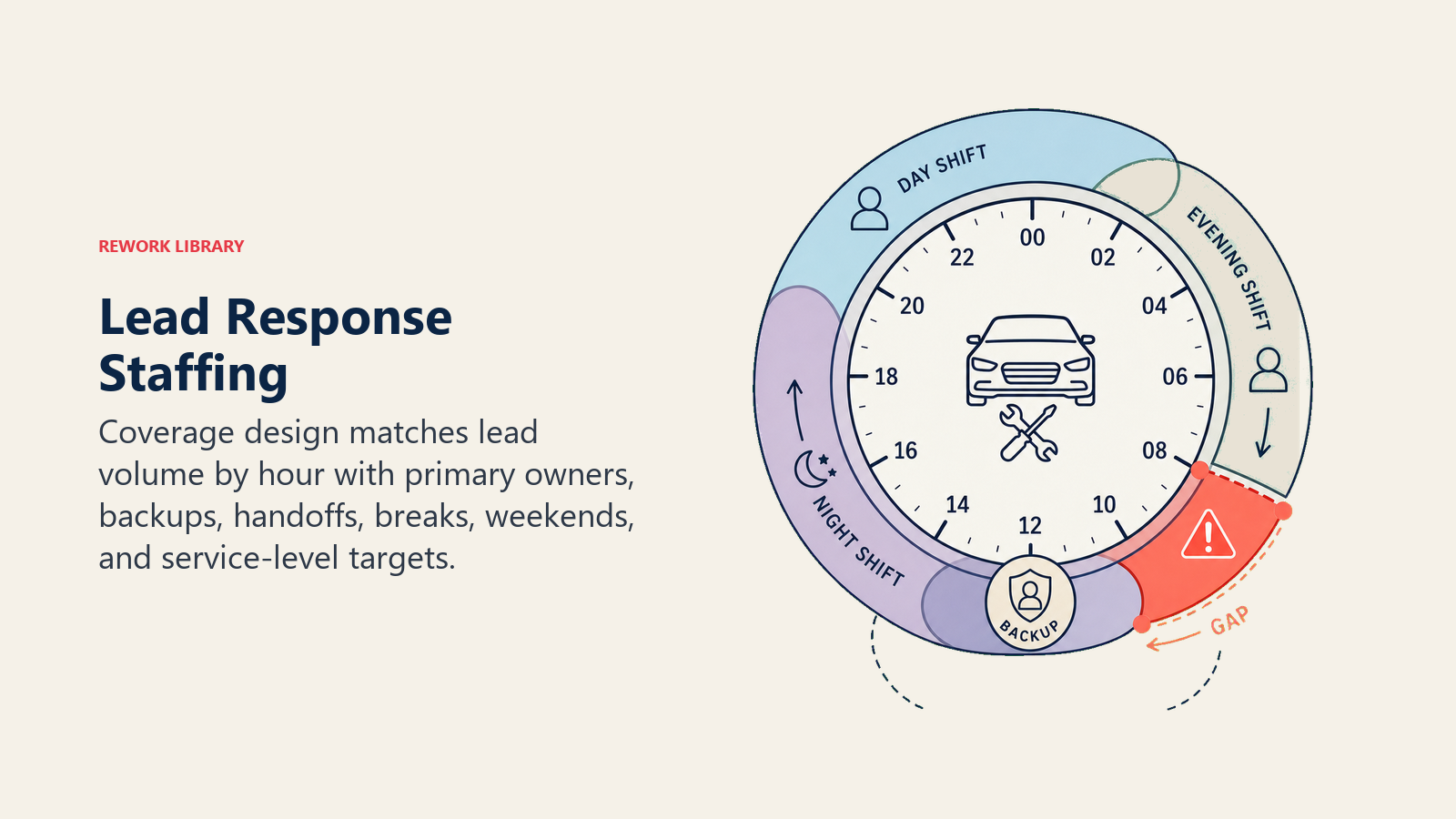
BDC shift scheduling should mirror lead arrival patterns. Most dealerships see peak lead volume from 10 AM to 2 PM and again from 6 PM to 9 PM. Your strongest agents should work those hours. Don't staff your BDC 9-5 and wonder why evening leads sit for 14 hours before anyone responds.
Weekend and evening coverage is non-negotiable for stores serious about internet sales. Saturday generates 22% of weekly lead volume. Sunday generates another 12%. Evening hours (5-9 PM) account for 28% of weekday leads. If you're closed Saturday afternoon and all day Sunday, you're leaving 30%+ of your weekly leads to age overnight.
On-call rotations spread the weekend burden. Instead of forcing the same two BDC agents to work every Saturday, rotate duty so agents take one or two weekends per month. Compensate fairly, weekend response time directly correlates to Monday's appointment schedule.
Mobile response requirements set minimum standards. Even on-call agents need to respond within 10 minutes. That means having the CRM app installed, notifications enabled, and actually checking their phone. Too many "on-call" agents ignore leads for hours because they're not truly available.
Outsourced overflow solutions handle volume spikes or after-hours coverage when you can't staff internally. Third-party BDC services (CallRevu, ResponseLogix, etc.) can provide 24/7 first response for $150-500/month per lead source. They acknowledge the lead, attempt contact, and route hot prospects to your team the next morning. Not ideal, but better than zero response.
Holiday and special event planning prevents coverage gaps during high-lead periods. Labor Day weekend, Black Friday, end-of-year sales events, these generate massive lead volume. If your BDC takes the day off, your competitors will happily respond to your leads.
Quality vs Speed Balance
Fast response with poor execution loses to slightly slower response with great execution.
First touch acknowledgment vs full response is a compromise worth making. If you can't call within five minutes, at least text or email within two minutes to acknowledge receipt. "Got your inquiry about the Civic. Pulling your trade value and availability now. Will call you in 10 minutes." This buys you time while showing responsiveness.
Automated vs personalized initial contact trades scale for authenticity. Fully automated "We received your inquiry" messages keep the clock running but don't build relationships. Hybrid approaches work best: automated acknowledgment fires instantly, but includes specific vehicle details and agent name, followed by human contact within 10 minutes.
Template efficiency without sounding robotic requires customization fields. "Hi [NAME], this is [AGENT] from [DEALER]. I see you're interested in the [YEAR] [MAKE] [MODEL]. I have that vehicle right here and can confirm [SPECIFIC DETAIL]. When's a good time to discuss?" Templates speed up response, but blanks filled with specific information make them feel personal.
Research time before callback is a judgment call. Spending three minutes reviewing the customer's trade value and payment options makes your call more valuable, but spending eight minutes means someone else already responded. The right balance: spend 60-90 seconds reviewing the lead details, make the call, and tell the customer you'll follow up with detailed numbers in 30 minutes. This gets you first contact without sacrificing preparation.
Multi-tasking and parallel processing matter for high-volume BDCs. While waiting for a customer to answer, agents can pull up vehicle details for the next lead. While leaving a voicemail, they can send the confirmation text. Small efficiency gains compound when you're handling 30 leads per day.
When to slow down for better conversion: after you've made contact. Once you have the customer on the phone or engaged in text conversation, speed becomes counterproductive. Take time to build rapport, ask discovery questions, handle objections properly. Rushing the appointment set after a fast response kills the advantage you just earned.
After-Hours Strategy
Leads that arrive at 10 PM don't want to wait until 9 AM for a response.
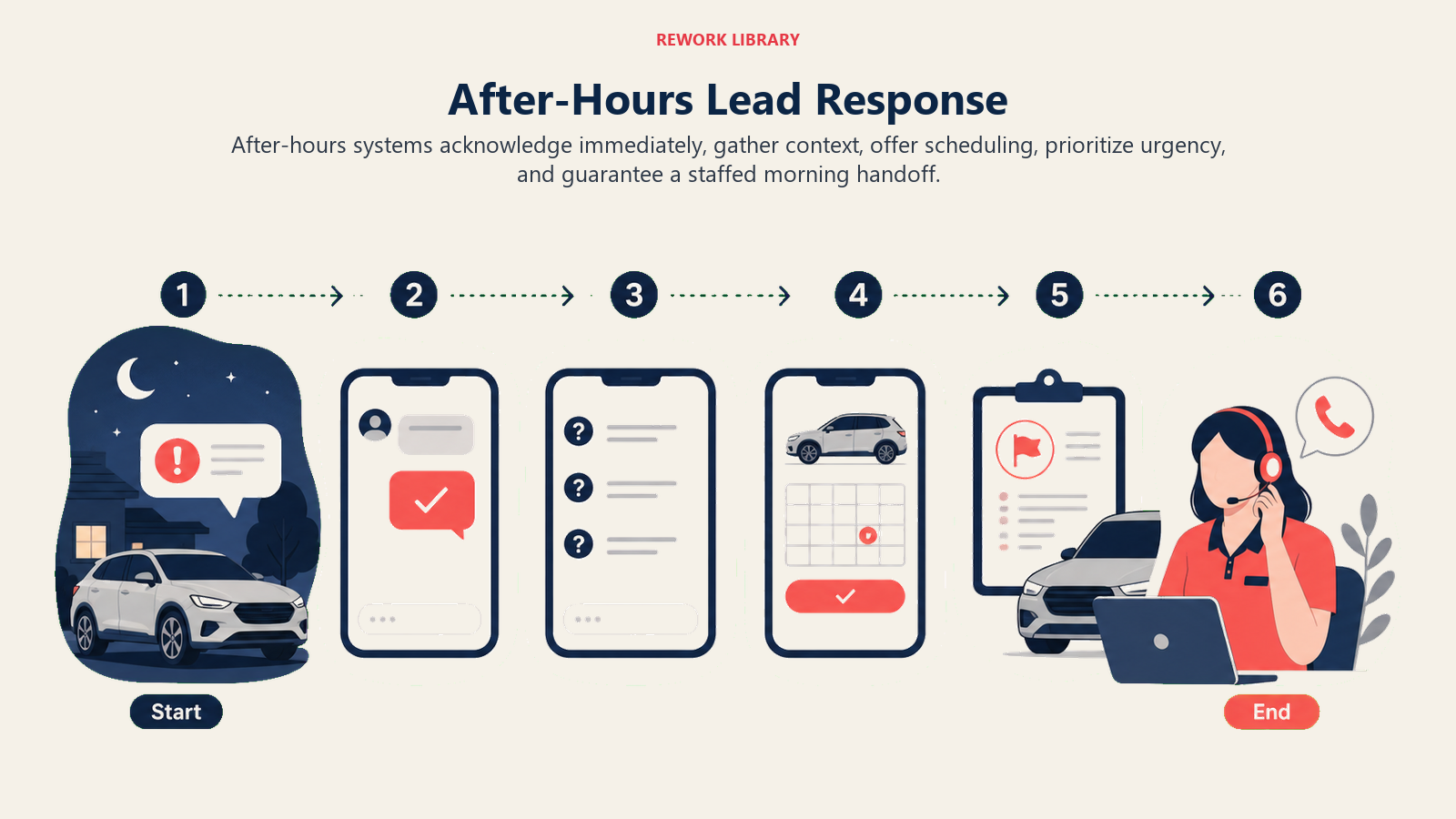
Automated acknowledgment best practices start with setting expectations. "Thank you for your interest in the [VEHICLE]. Our sales team is available Monday-Saturday 8am-8pm. A product specialist will contact you tomorrow morning by 9am." This manages timing expectations while confirming receipt.
But better than waiting until morning: include a scheduling link. "Click here to book a specific appointment time, or we'll call you tomorrow at 9am." Self-service scheduling converts 12-18% of after-hours leads without any human involvement.
Next-day morning prioritization sorts after-hours leads by arrival time and quality score. Leads that came in at 6am should be contacted by 8:15am. Leads from 11pm can wait until 9:30am. Don't treat all after-hours leads equally, prioritize by recency and intent.
Weekend lead aging prevention is about Sunday evening work. Leads that arrived Friday night through Sunday afternoon should receive response by Sunday evening, not Monday morning. If you can't staff Sunday evenings, at least have someone review and respond to hot leads (chat inquiries, repeat customers, high-quality sources) for 1-2 hours Sunday at 6pm.
Third-party answering services provide live-agent response 24/7. Services like CallRevu or Response Logix employ real BDC agents who answer your dealership line after hours, handle basic inquiries, and schedule callbacks. Costs run $500-2,000/month depending on volume, but capture 15-25% more appointments from after-hours leads than automated-only approaches.
Chatbot and AI response options have improved dramatically. Modern automotive chatbots can answer basic questions, provide inventory details, schedule service appointments, and capture lead information, all without human involvement. J.D. Power research shows that customers increasingly prefer text-based communication, with 68% preferring text updates over phone calls. Chatbots won't replace BDC agents, but they can handle 30-40% of after-hours inquiries and escalate hot leads to on-call staff.
Setting customer expectations honestly beats overpromising. If your BDC truly isn't available after 8pm, say so. "Our sales team is available 8am-8pm Monday-Saturday. We'll contact you first thing tomorrow morning. If you prefer, schedule a specific time here: [LINK]." Customers respect honesty more than being told "someone will call shortly" at 11pm.
Measurement & Accountability
If you don't measure response time, it doesn't improve.
Response time tracking by agent should be visible in your CRM dashboard. Every agent should see their current stats: average response time, percentage under 5 minutes, percentage under 10 minutes, longest response today. Transparency drives accountability.
Source-specific performance reports reveal which lead types get fast response and which get ignored. You might discover chat leads get 2-minute average response while third-party leads average 45 minutes. That tells you where to focus improvement efforts.
Time-of-day analysis shows when your response times slip. Maybe morning leads get 4-minute response but afternoon leads average 18 minutes because agents take lunch breaks. Schedule overlapping shifts or stagger breaks to maintain coverage.
Conversion rate correlation proves the response time investment pays off. Pull reports showing conversion rates by response time brackets: 0-5 minutes, 5-15 minutes, 15-30 minutes, 30-60 minutes, 60+ minutes. You'll see conversion rates drop off a cliff after 15 minutes. Share these reports with your team monthly so they see the direct revenue impact of speed.
Competitive mystery shopping tells you where you stand. Submit inquiries to your own dealership and five competitors. Track who responds first, who calls vs emails, who sets appointments, who never responds. Do this quarterly to benchmark your performance and identify best practices to steal.
Continuous improvement systems turn data into action. Monthly BDC meetings should review response time trends, celebrate improvements, address problem areas, and set goals. If your team averaged 8 minutes last month, aim for 6 minutes this month. Small improvements compound into major competitive advantages.
Implementation Roadmap
Start with technology. Get your CRM notifications configured correctly and make sure every BDC agent has the mobile app installed.
Next, optimize scheduling. Align your BDC coverage hours with your lead arrival patterns. If you're getting 40% of leads outside your current BDC hours, fix the schedule.
Then measure everything. Turn on response time tracking, create dashboards, and make metrics visible. You can't improve what you don't measure.
Finally, create accountability. Set response time goals (under 5 minutes for 80% of leads), review performance weekly, and coach agents who lag behind.
Speed doesn't guarantee sales, but it creates the opportunity to sell. The dealership that responds first, responds personally, and responds with value will dominate internet lead conversion, even if competitors have better inventory or pricing.
The first five minutes don't just matter. They determine everything. For comprehensive response strategies, review automotive lead management, internet lead follow-up, appointment setting best practices, automotive lead scoring, and phone skills for automotive.