Appointment Setting Best Practices: Converting Leads into Confirmed Showroom Visits - 2026 Guide
Turn this article into takeaways for your work.


Each assistant summarizes the article only for you and suggests best practices for your work.
Dealerships that master appointment setting sell 3-4x more vehicles per internet lead than stores that invite customers to "stop by anytime." The appointment is the bridge between digital interest and showroom conversion.
Think about what happens when you tell a customer "Come by whenever you'd like, we're here all day!" They say "Okay, thanks," hang up, and never show. No commitment, no accountability, no preparation on either side.
But when you say "I have the vehicle ready for you at 2:30 tomorrow afternoon, does that work or is 4:00 better?" something different happens. The customer commits to a specific time. You prepare for their arrival. The salesperson knows they're coming. The vehicle is clean and ready. The test drive route is planned.
Appointments transform casual interest into structured selling opportunities. They increase show rates from 20-30% (people who "stop by sometime") to 65-80% (confirmed appointments). Industry benchmarks show that phone leads achieve 74% appointment set rates compared to just 40% for internet leads, demonstrating the power of direct engagement. They let you staff properly, prepare vehicles, and allocate your best salespeople to scheduled opportunities.
Most importantly, customers who keep appointments buy at 2-3x the rate of walk-ins because they've already invested time and mental energy in the process. They're coming to buy, not browse.
Psychology of Automotive Appointments
Understanding why customers resist appointments helps you overcome that resistance.
Customers resist commitments because appointments feel like pressure. When you ask someone to commit to a specific time, they worry they're being boxed into a high-pressure sales situation. They're afraid you'll waste two hours of their life. They don't want to feel obligated to buy just because they showed up.
This fear is real and legitimate, because many dealers do exactly that. But it's also why appointment setting works. Customers who overcome this hesitation and commit to appointments are showing you they're serious enough to invest time.
Building value in the appointment itself changes the equation. Don't ask customers to "come in and look at vehicles", that's not compelling. Ask them to "meet with [SPECIFIC SALESPERSON] who'll have your vehicle prepared, your trade value estimated, and your payment options ready to review." Now the appointment has value beyond just showing up.
Creating urgency without pressure means giving customers real reasons to act now. "The vehicle you're interested in had two other inquiries today" creates urgency from market demand. "Our end-of-month incentives expire Tuesday" creates urgency from timing. "I can hold this vehicle until 5pm tomorrow if you'd like to see it" creates urgency from scarcity. These are all true, not manipulation.
Overcoming the "just browsing" objection requires empathy and redirection. "I completely understand, most of our customers are researching options before they buy. That's exactly why I want to schedule time to show you the vehicle properly and answer all your questions without interruption. Would tomorrow at 2pm work, or is Wednesday morning better?" You're acknowledging their position while making the case for the appointment.
The power of specific times vs ranges is psychological. "Can you come in this week?" gets vague responses. "Can you come in at 2:30 tomorrow?" gets yes or no answers. Even if they say no to 2:30, they'll often counter with "Can we do 4:00 instead?" which is still an appointment.
Confirmation bias and commitment consistency are psychological principles that work in your favor. Once someone says "Yes, I'll be there at 2:30," they experience cognitive dissonance if they don't follow through. They've committed publicly (to you), which makes them more likely to show up than if they just told themselves "I'll stop by sometime."
Phone Appointment Techniques
The phone remains your most effective appointment-setting tool because it's real-time and interactive. Mastering phone skills is essential.
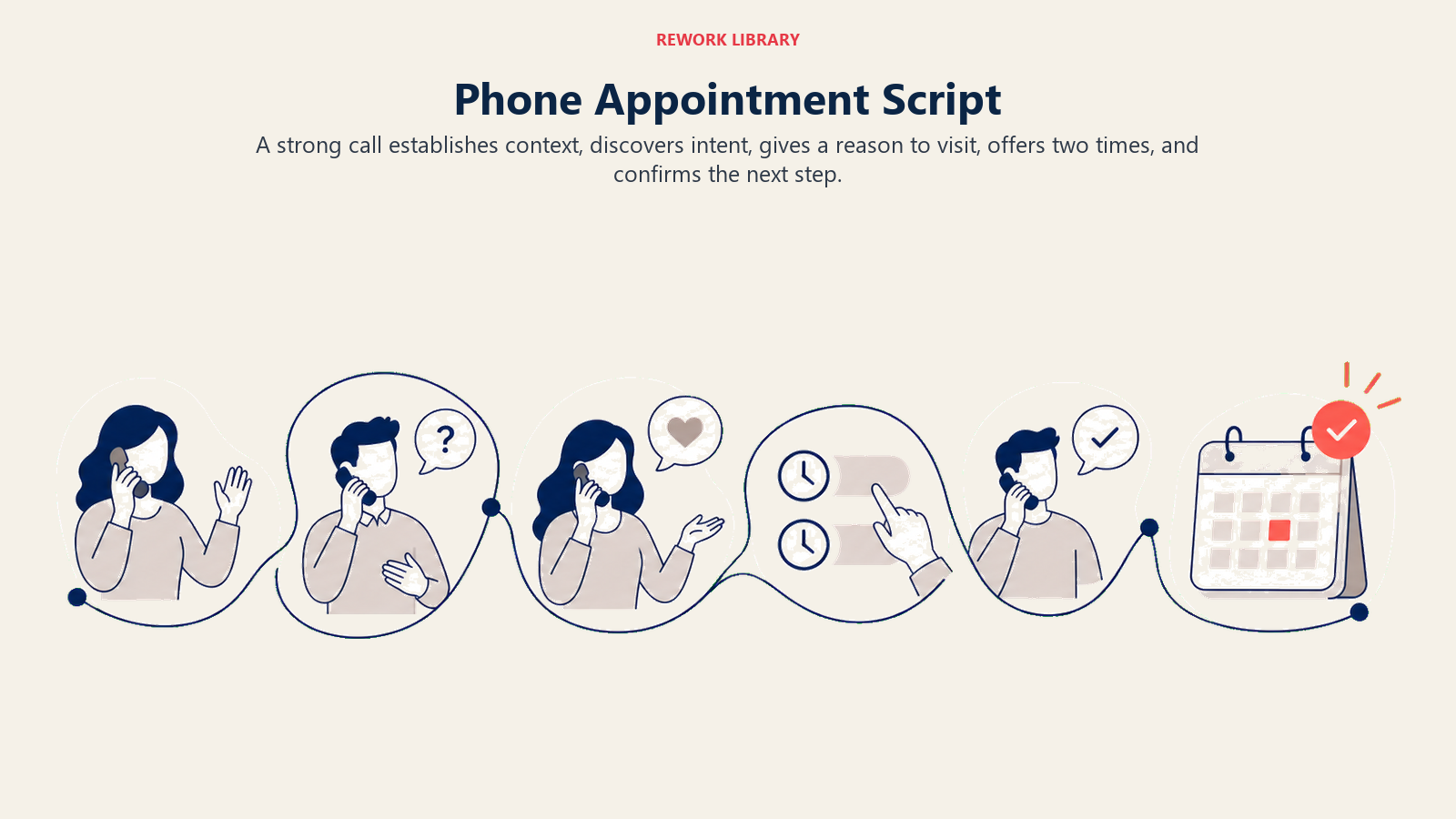
Opening statements that earn conversation should reference the customer's interest immediately. "Hi, this is Marcus from Honda of Springfield. You submitted an inquiry about the 2026 Civic EX, I'm actually looking at it right now and wanted to make sure you have all the details." This establishes context and purpose immediately without generic "how are you today?" nonsense.
Discovery questions before the ask build context for your appointment request. Don't jump straight to "When can you come in?" Ask about their timeline: "Are you looking to purchase in the next few weeks or just gathering information?" Ask about their current vehicle: "What are you driving now?" Ask about preferences: "Is the EX the right trim level or would you like to see the Sport as well?" These questions help you tailor your appointment pitch.
Assumptive close language treats the appointment as inevitable, not questionable. Don't ask "Would you like to come in and see the vehicle?" Ask "I have some availability tomorrow afternoon, would 2:30 work or is 4:00 better for your schedule?" The question isn't whether they're coming in, it's when.
Alternative choice technique gives customers control while maintaining commitment. "Morning or afternoon?" "Weekday or weekend?" "2:30 or 4:00?" "Tomorrow or Wednesday?" Every question leads to an appointment, just at different times. This eliminates "no" as an option without being pushy.
Handling hesitation and stalls requires addressing concerns directly. If they say "I'm not sure about my schedule," respond with "I completely understand. Let's pencil something in, if something comes up, we can always reschedule. Does tomorrow afternoon work tentatively?" If they say "I need to talk to my spouse first," respond with "Perfect, bring them with you. We can show you both the vehicle together. Does Saturday morning work for both of you?"
Confirming and summarizing details prevents misunderstandings. "Great! I have you scheduled for Saturday at 11am with Jessica. You'll be looking at the 2026 Civic EX in white. We'll have your trade appraisal ready when you arrive. I'm going to send you a text confirmation right now with our address. Does this all sound right?" This confirmation sets expectations and gives customers a chance to correct any misunderstandings.
Email & Text Appointment Strategy
Digital appointment setting requires different tactics than phone.
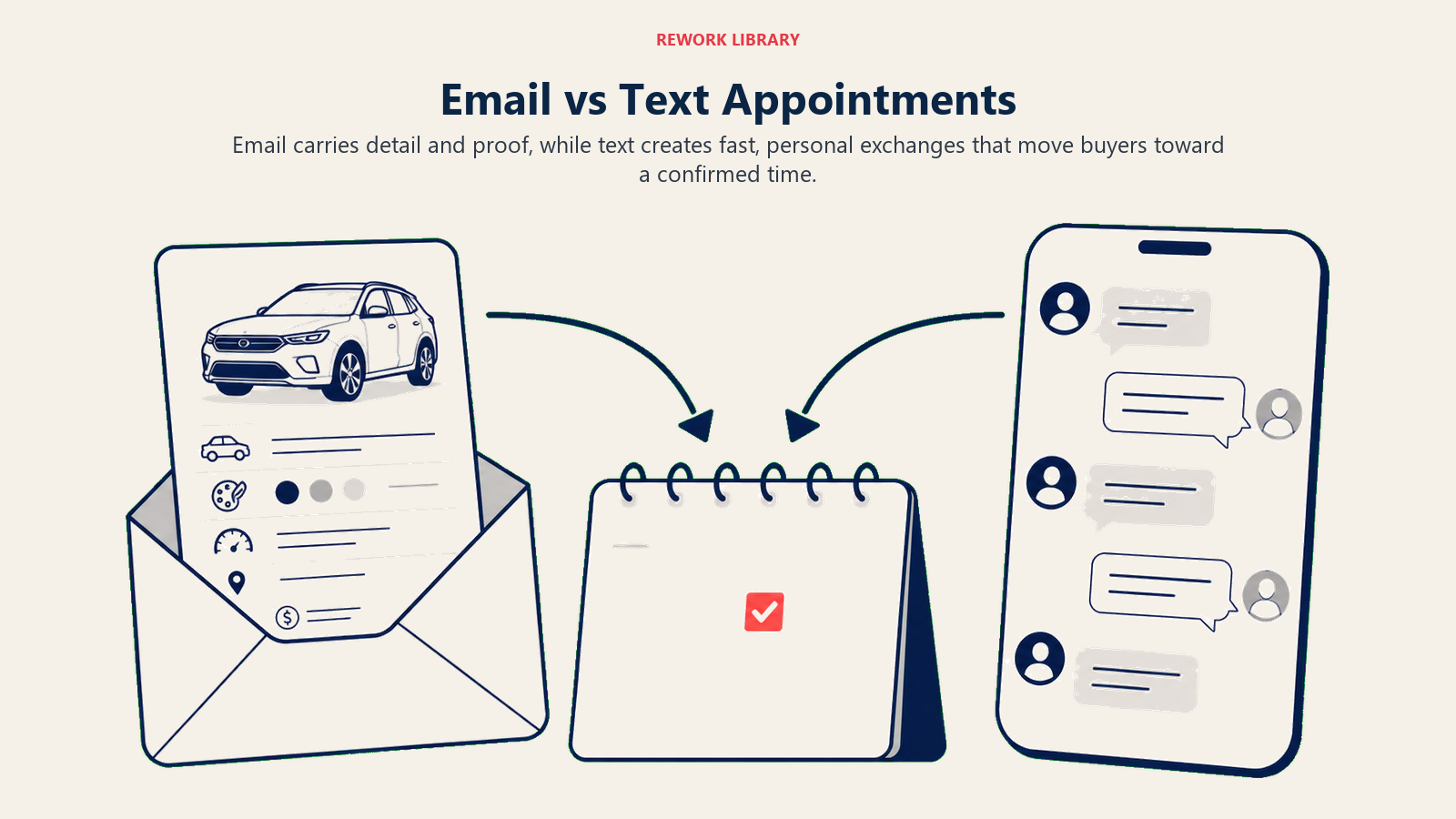
Calendar link integration removes friction from scheduling. Including a Calendly, Square Appointments, or similar scheduling link in your email lets customers book their own appointments. "Click here to choose a time that works for your schedule" converts 12-18% of email leads without any back-and-forth. Make sure your calendar tool syncs with your CRM so appointments populate automatically.
Available time slot presentation works when you can't use scheduling software. "I have availability at the following times: Tuesday 2pm, Tuesday 5pm, Wednesday 11am, Wednesday 3pm. Reply with your preferred time and I'll confirm." Offering specific options performs better than asking "When works for you?" which creates decision paralysis.
One-click scheduling tools like "Reply 'A' for Tuesday 2pm or 'B' for Wednesday 11am" make responding effortless. SMS appointment booking platforms (Podium, Kenect) excel at this. Customers text a single letter and the appointment books automatically.
SMS appointment requests should be conversational, not formal. "Hi Sarah, Marcus from Honda here. Still interested in the white Civic EX you looked at? I can have it ready for you tomorrow at 2pm or Thursday at 11am. Which works better?" This reads like a text from a friend, not a business form letter.
Video invitation messages dramatically increase appointment rates. Record a 30-second video on your phone: "Hey Sarah, Marcus here from Honda. I'm standing next to the white Civic EX you inquired about. I wanted to show you it's still here and in great shape. Can we get you in to test drive it tomorrow afternoon? Give me a call or text when you have a minute." Personal video messages feel authentic and create connection.
Multi-touch appointment sequences recognize that first attempts often fail. Your sequence might look like: Email with scheduling link (immediate), follow-up phone call (2 hours), text message with video (4 hours), second phone call (next day), email with specific time slots (next day). Each touch offers an appointment opportunity through different channels.
Appointment Value Proposition
Customers need reasons to invest time in your dealership.
Vehicle preparation and test drive ready is table stakes. "Your vehicle will be fueled, cleaned, and ready for an extended test drive" tells customers you respect their time. Most customers have been to dealerships where salespeople say "Let me go find the keys" then disappear for 20 minutes. Promising ready vehicles differentiates you.
Trade appraisal commitment demonstrates seriousness. "We'll have your trade value evaluated and ready when you arrive" shows you're prepared to do business, not just show vehicles. This is especially effective for customers with trade-ins because it addresses their primary question: "What's my vehicle worth?"
Finance pre-approval or credit discussion appeals to customers worried about affordability. "We work with 15+ lenders and can usually get you approved regardless of credit history. We can discuss payment options when you arrive." This removes a major barrier for credit-challenged customers who fear wasting time if they can't get approved.
Exclusive pricing or incentive access creates appointment value. "I can't email our best pricing, but I can show you our Internet Price when you come in, it's typically $1,500-2,500 below MSRP." This isn't deceptive; most dealers genuinely reserve best pricing for in-person negotiations. You're just making this policy work for you.
Limited-time inventory holds create urgency. "I can put a hold on this vehicle until 3pm tomorrow if you can come see it by then." This works because it's true, you can hold vehicles temporarily. And it gives customers a deadline that encourages commitment.
VIP or red carpet treatment promises appeal to customers who fear typical dealer experiences. "I'll have Jessica, our Honda specialist, meet you at the entrance when you arrive. No wandering around looking for someone, we'll be ready for you." This differentiates your process from typical dealership chaos.
Confirmation & Reminder Process
Setting the appointment is half the battle. Ensuring customers show up is the other half.
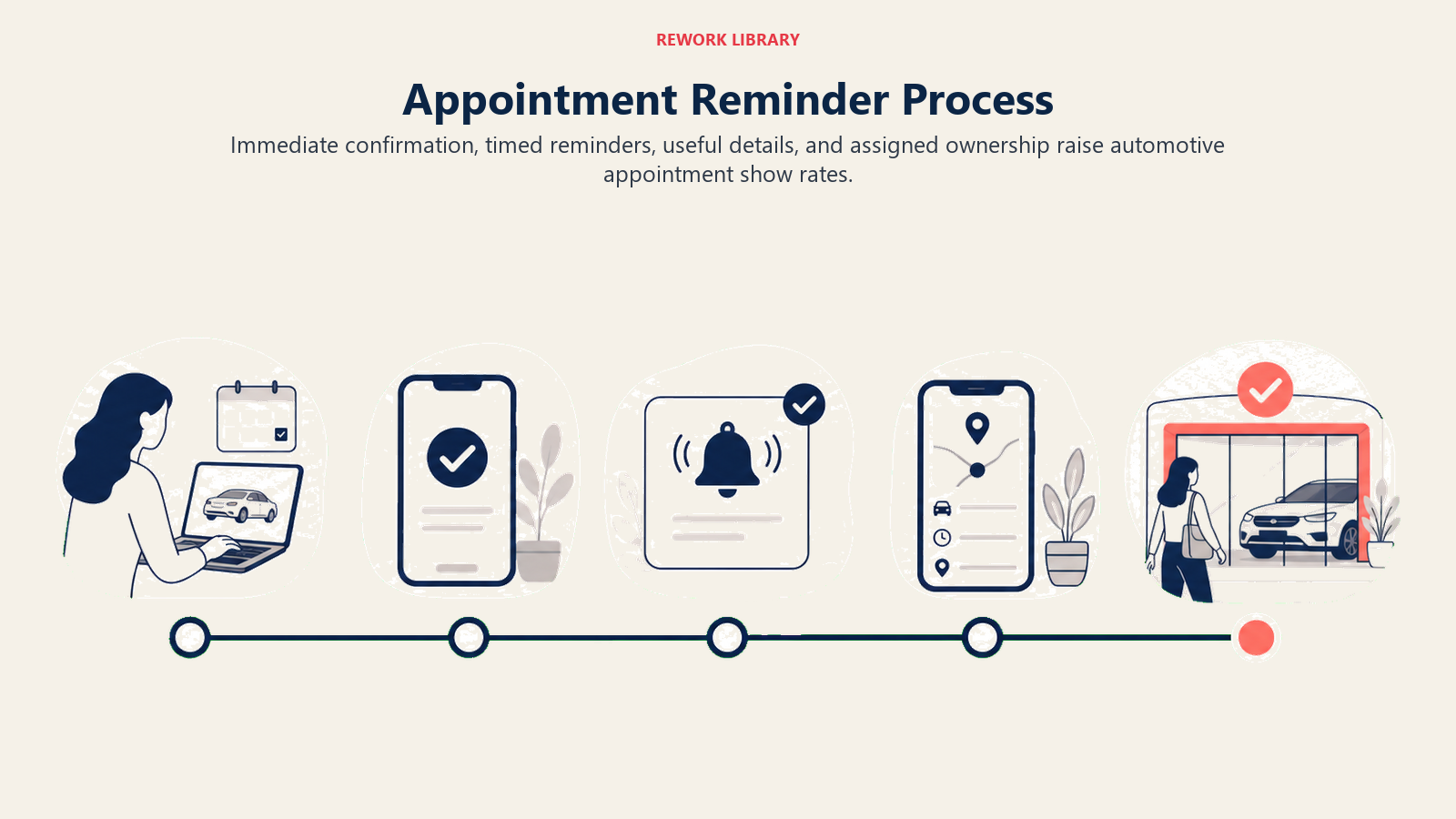
Same-day confirmation calls or texts should happen within hours of scheduling. "Hi Sarah, confirming our appointment Saturday at 11am. Looking forward to showing you the Civic! Reply Y to confirm." This serves two purposes: it confirms the customer received the appointment details and gives them early opportunity to reschedule if something conflicts.
Day-before reminder protocol reduces no-shows by 20-30%. Call or text the afternoon before: "Hi Sarah, Marcus from Honda. Just confirming our appointment tomorrow (Saturday) at 11am. The white Civic EX is prepped and ready. Are we still good for 11am?" Research shows that the average dealership has a 50% show rate, meaning systematic confirmation processes are essential. This catches scheduling conflicts early when you can still reschedule, rather than discovering a no-show when the customer doesn't arrive.
Morning-of final confirmation is controversial, some dealers think it's overkill, others swear by it. "Good morning Sarah! Looking forward to seeing you at 11am today. Text me when you're on your way!" This catches last-minute cancellations and reinforces commitment. For high-value appointments (premium vehicles, hot leads), morning-of confirmation is worth the effort.
Multi-channel reminder strategy uses different communication methods. Book via phone, confirm via text, remind via email, final confirmation via text. Multiple touches through different channels increase the chances customers see at least one reminder.
Rescheduling before no-shows preserves the relationship. If a customer says "Actually Saturday won't work anymore," respond immediately with "No problem, does Monday afternoon work instead?" Converting a cancellation into a reschedule is infinitely better than a no-show. Train your team to always offer alternative times when customers cancel.
Calendar invites and digital integration help customers who live on their phones. Send Outlook or Google Calendar invitations with dealership address, contact info, and appointment details. Many customers manage their lives through calendar apps, make it easy for them to integrate your appointment into their systems.
Handling Objections & Resistance
Common objections require scripted responses.
"I'm not ready to buy yet" gets addressed with education positioning. "I completely understand, most customers research for 2-3 weeks before buying. That's exactly why I'd like to show you the vehicle now while it's available. We can answer all your questions and you can test drive without any pressure. Even if you're not buying today, you'll have all the information when you are ready. Does tomorrow afternoon work?"
"I'm still shopping around" gets validated and reframed. "That's smart, you should compare options. Here's why an appointment makes sense: we'll show you our best pricing and explain exactly what makes the Civic EX the best value in its class. Then when you look at other vehicles, you'll have a clear benchmark. Would tomorrow at 2pm work?"
"Just email me the numbers" gets redirected to the appointment. "I'd love to, but our best pricing includes your trade value and available incentives, which vary by timing and credit approval. That's why our Internet Manager prefers to go through everything in person so you see the complete picture. Can we do Thursday afternoon?"
"I want to think about it" needs urgency and structure. "Absolutely, this is a big decision. Here's what I suggest: let's schedule time for you to see the vehicle and test drive it. That gives you all the information to think about. You're not committing to buy by making an appointment. Does Saturday work?"
Distance and travel concerns require acknowledging the investment. "I understand, 45 minutes is definitely a drive. Here's why customers make that trip: we typically save customers $2,000-3,000 compared to closer dealers, and we have the exact vehicle you want in stock. How about this: if you come in Saturday and we can't beat your best offer by at least $1,000, we'll give you a $100 gift card for your time."
Spousal approval requirements get handled by including the spouse. "Bring them! Most couples like to make this decision together. Does Saturday morning work for both of you?" Never act like the spouse is an obstacle, treat joint attendance as the obvious solution.
Show Rate Optimization
Even confirmed appointments no-show 20-35% of the time. Let's improve that.
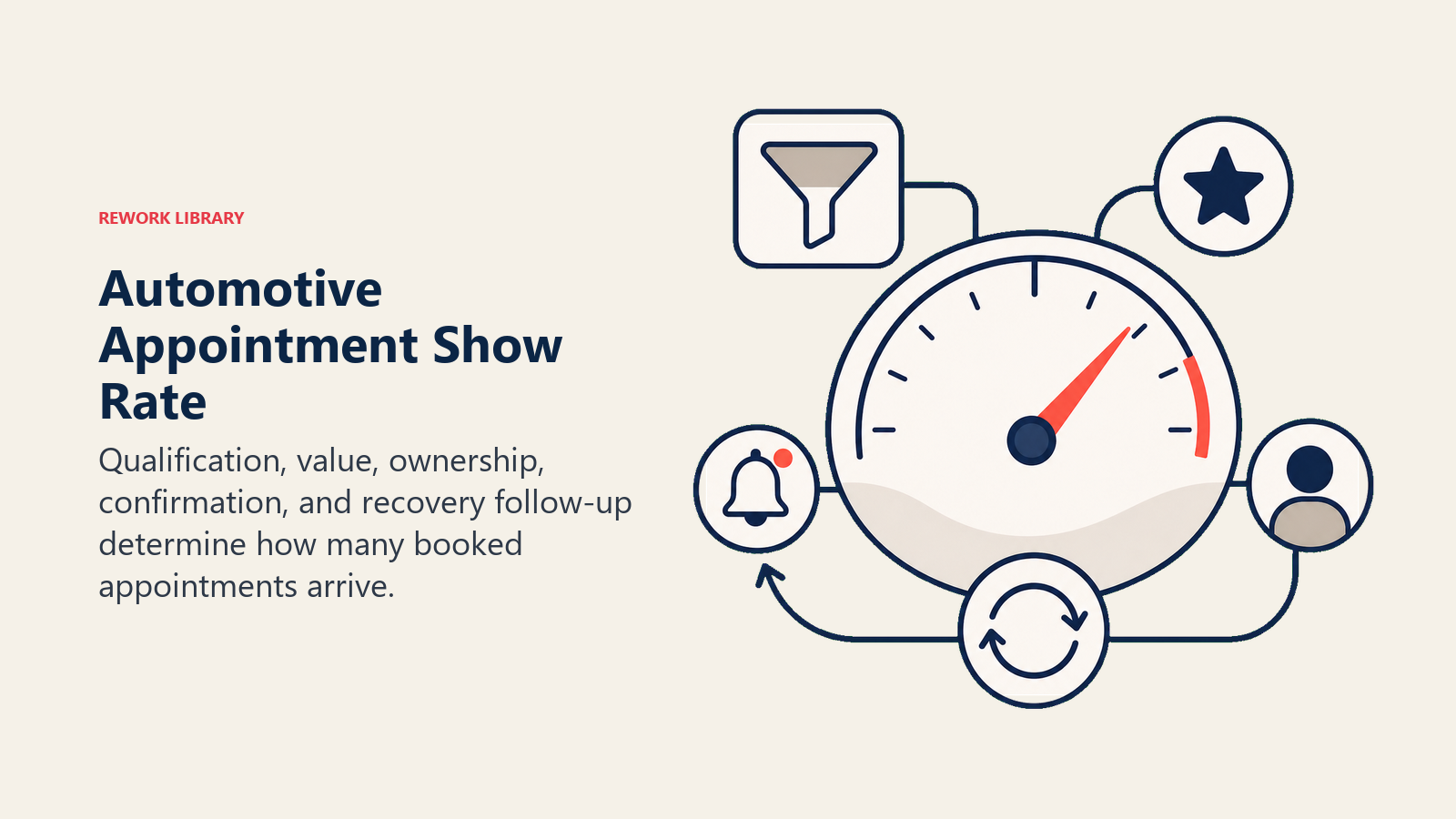
Factors that predict no-shows include appointment distance in the future (Saturday appointments booked on Monday show at 70%, but Saturday appointments booked the previous Saturday show at 45%), customer engagement level (customers who reply to confirmations show 15-20% more than those who don't), and appointment channel (phone-set appointments show at higher rates than email-set appointments). NADA research confirms that only 10% of prospective car buyers are contacted by dealer personnel, highlighting the importance of systematic follow-up processes.
Deposit or commitment strategies are controversial but effective. Some dealers ask for $500 refundable deposits to hold vehicles for appointments. Others ask for credit card information to "hold your spot." These tactics increase show rates to 85-90% but risk alienating customers. Use them selectively for high-demand vehicles or chronic no-show customers.
Personal connection building during the appointment-setting process improves show rates. Customers who feel like they know their salesperson are more likely to show up. Spend an extra 2-3 minutes on the phone building rapport. Send personal video messages. Add personal touches to confirmation texts: "Looking forward to meeting you!" rather than robotic confirmations.
Salesperson pre-assignment dramatically increases show rates. "Jessica will be your Honda specialist, she's been with us for 8 years and knows the Civic inside and out. She'll meet you at the entrance when you arrive." Named salespeople create accountability. Customers feel obligated to show up when they know someone is specifically waiting for them.
Special preparation mentions reinforce the appointment's value. "I'm going to fuel up the Civic and make sure it's spotless for your test drive." "I'm pulling your trade comp so we have realistic values ready." "I'm blocking out extra time so we're not rushed." These statements show you're investing effort, which makes customers more likely to reciprocate by showing up.
Accountability and follow-through from the dealership side matter too. If you promise the vehicle will be ready at 2:30pm and it's not, you've broken trust. If you say Jessica will meet them at the entrance and Jessica is nowhere to be found, you've validated their fears about dealerships. Everything you promise during appointment setting must actually happen.
Real-World Application
Here's a complete appointment-setting framework for your BDC operations:
Phone Script Framework:
- Introduction and context (15 seconds)
- Discovery questions (30-60 seconds)
- Appointment value proposition (30 seconds)
- Assumptive close with alternatives (15 seconds)
- Confirmation and next steps (30 seconds)
Confirmation Sequence:
- Immediate: Text confirmation within 60 seconds
- Same day: Email with calendar invite and directions
- Day before: Reminder call or text
- Morning of: Final confirmation text
Show Rate Targets:
- 75%+ for phone-set appointments
- 65%+ for email/text-set appointments
- 85%+ for appointments with confirmed reminders
- 90%+ for deposit-backed appointments
Agent Accountability:
- Track appointment set rate (percentage of leads who book appointments)
- Track show rate (percentage of booked appointments who arrive)
- Track sale-from-appointment rate (percentage of shown appointments that result in sales)
- Compensate agents for appointments shown, not just set
The dealers winning internet sales today aren't the ones with the most leads, they're the ones who convert leads into appointments and appointments into showroom traffic. Master appointment setting and you'll sell 3-4x more vehicles from the same lead volume.
Stop inviting customers to "stop by anytime." Start scheduling specific appointments with specific salespeople at specific times. For deeper context on lead response strategies, review Lead Response Time Optimization and Automotive Sales Process. Your show rate, your sales, and your bottom line will all improve.