EV Sales Strategy: Winning in the Electric Vehicle Market Transition - 2026 Guide
Turn this article into takeaways for your work.


Each assistant summarizes the article only for you and suggests best practices for your work.
Electric vehicles represent just 8% of retail sales today. According to Cox Automotive's 2026 forecast, EV adoption is accelerating rapidly. In five years, they'll be 30% or more. Dealers who master EV sales processes now will dominate their markets as traditional inventory shrinks and allocation shifts to battery-electric vehicles.
But selling EVs isn't like selling gas cars. The customers are different. The concerns are different. The value proposition is completely different. And dealers treating EVs like another trim level are missing sales and losing customers to competitors who actually understand the product.
The transition is happening whether you're ready or not. The question is whether you'll lead it or get dragged along.
The EV Market Landscape
EV adoption hit 8.2% of retail sales in 2025. That might sound small, but it's doubling every 2-3 years. By 2028, industry analysts project 25-30% adoption. By 2030, possibly 40-50% in certain markets like California and the Northeast.
OEM commitments make this inevitable. GM committed to all-electric by 2035. Ford is investing $50 billion in EV development. Volkswagen, Mercedes, BMW, every major manufacturer has announced aggressive EV timelines. Your allocation of gas vehicles will shrink as manufacturers shift production to meet regulatory requirements.
EV customer demographics skew higher income and higher education, but that's changing rapidly. Early adopters were tech enthusiasts and environmentally conscious buyers willing to pay premiums. Today's buyers are mainstream consumers who want lower operating costs and appreciate the driving experience.
Regulatory drivers accelerate adoption. Federal tax credits make EVs affordable. California and other states are banning gas-only vehicle sales starting in 2035. Corporate fleet mandates push commercial buyers toward EVs. Emissions regulations make it increasingly expensive for manufacturers to sell gas vehicles.
The competitive landscape is evolving fast. Tesla proved EVs could be aspirational and profitable. Startups like Rivian and Lucid target premium segments. Legacy manufacturers are flooding the market with options. Chinese manufacturers are entering with low-cost EVs. The days of limited choice are over.
EV Customer Education
The biggest barrier to EV adoption isn't the product, it's knowledge. Most buyers have never driven an EV, don't understand charging, and worry about range. Systematic EV customer education addresses these concerns effectively.
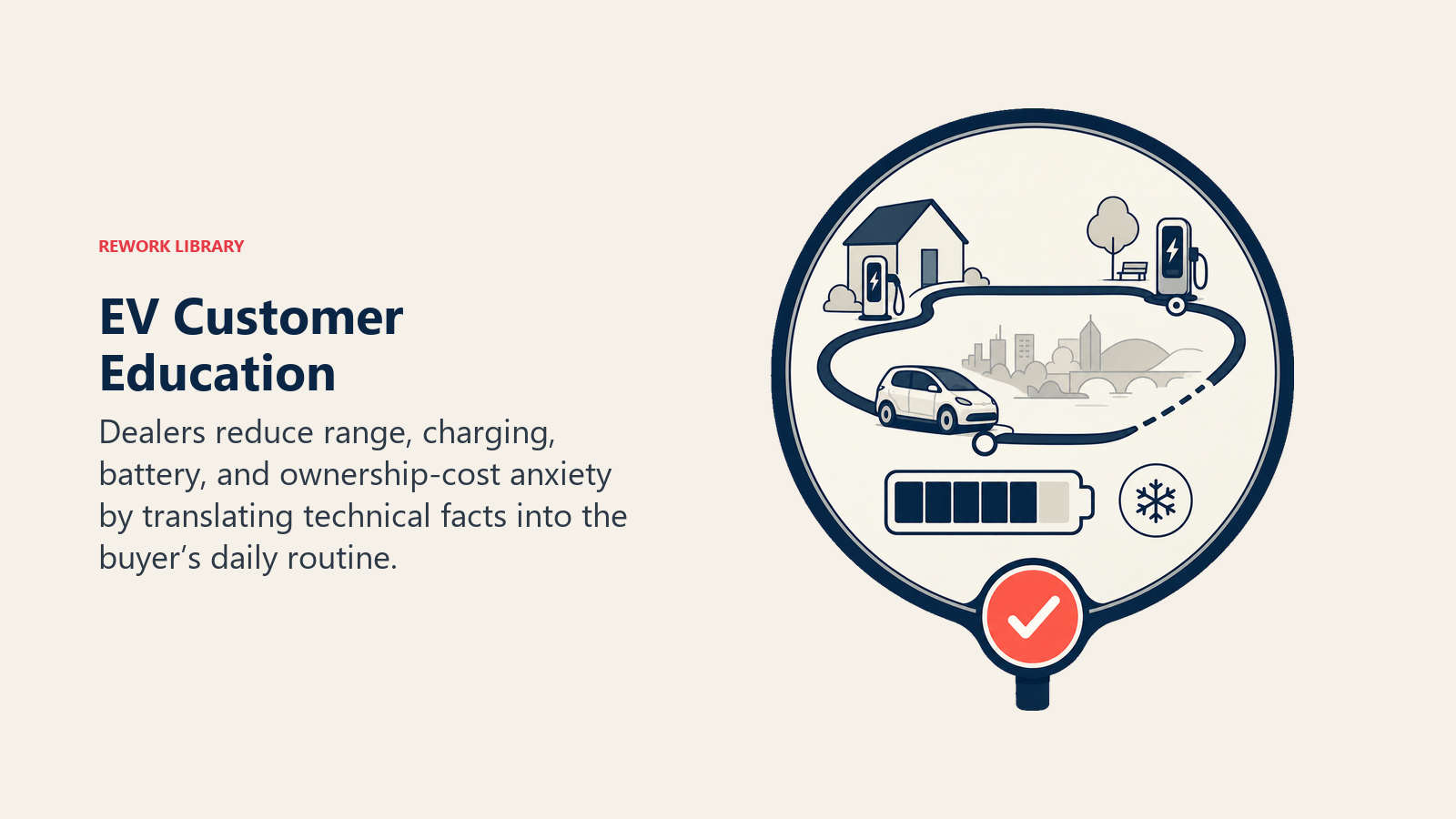
Range anxiety tops every survey of EV concerns. "What if I run out of power?" drives purchase hesitation despite the reality that most EVs now offer 250-350+ miles of range and most people drive under 40 miles daily.
Your job isn't to dismiss these concerns. It's to address them systematically with data, examples, and reassurance.
Charging infrastructure availability creates real anxiety. Buyers picture running out of power with no charging station nearby. The reality: according to the U.S. Department of Energy Alternative Fuels Data Center, there are now over 67,000 public DC fast-charging ports in the US, growing by 20% annually. Apps like PlugShare show real-time availability. Fast chargers are proliferating along highways.
Charging time versus gas fill-up speed is a legitimate difference. You can't fill an EV in 5 minutes, yet. But most EV owners charge at home overnight, starting each day with a "full tank." The question isn't "How long does it take?" but "When do you charge?"
Higher upfront cost perception persists despite narrowing price gaps. Federal tax credits ($7,500 for qualifying vehicles) plus state and local incentives often put EVs at price parity with gas equivalents. Total cost of ownership including fuel and maintenance savings tilts heavily toward EVs.
Battery life and replacement cost fears come from outdated information. Modern EV batteries are warrantied for 8 years/100,000+ miles and typically retain 85-90% capacity after a decade. According to EPA research, battery replacements have been rare, at an average of 2.5%, and since 2016 have had less than a 0.5% failure rate. Replacement costs are falling and rare within the vehicle's useful life.
Resale value uncertainty is real but improving. Early EVs depreciated faster than gas cars. Today's EVs from mainstream manufacturers are holding value much better, especially as used car buyers discover the operating cost savings.
Unfamiliarity with technology makes buyers cautious. Most people have never driven an EV. They don't understand regenerative braking, one-pedal driving, or instant torque. Test drives fix this fast.
The EV Sales Process
The traditional steps of the sale need adaptation for EVs.
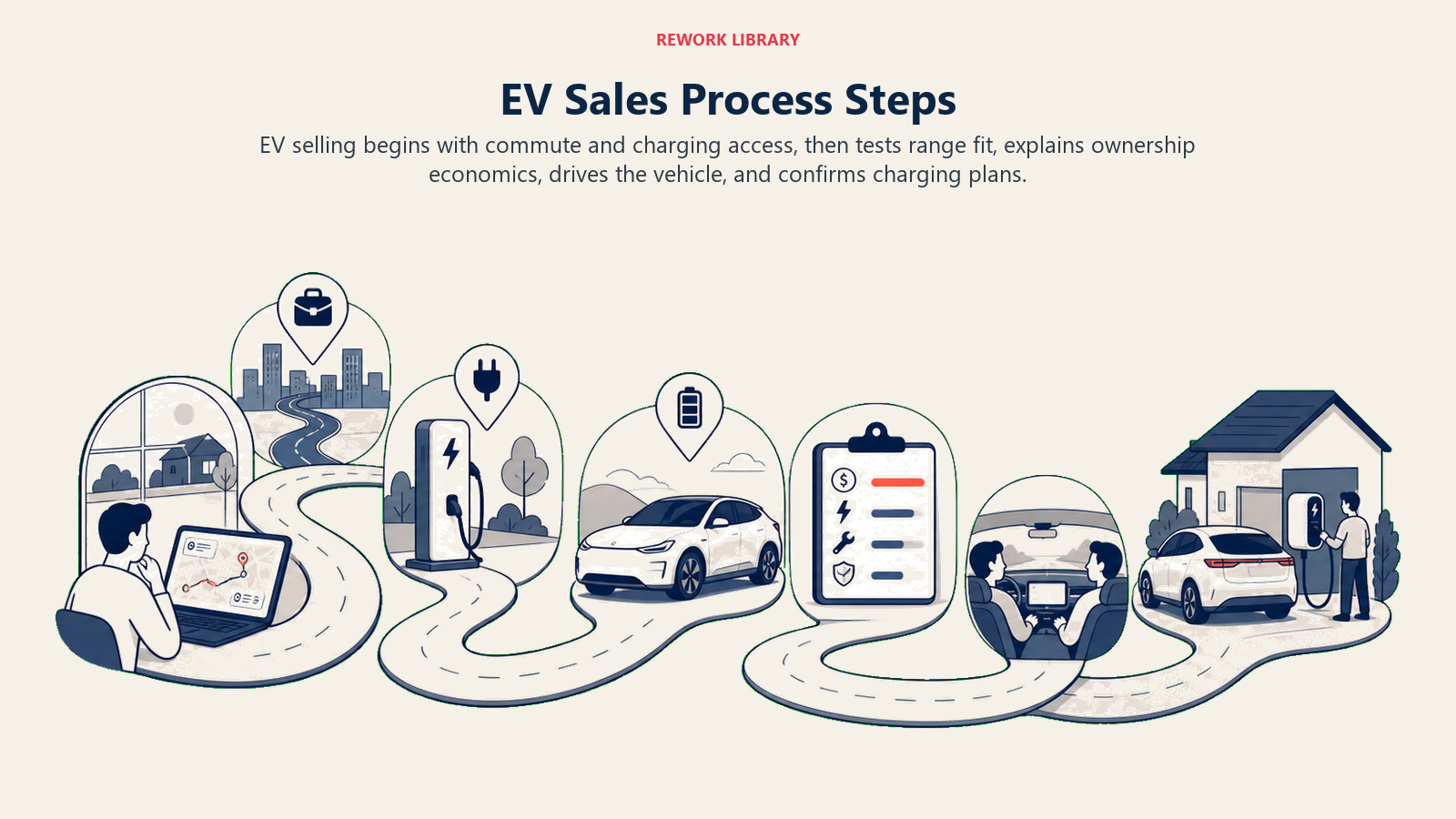
Needs analysis starts differently. Don't ask "What are you driving now?" Ask "What's your daily commute?" and "Do you have a garage or covered parking?" Driving patterns and charging access determine EV suitability more than vehicle preferences.
Range calculation and suitability assessment happen early. If someone drives 150 miles daily in winter conditions, a 250-mile range EV might not fit without workplace charging. Be honest about fit. Putting someone in the wrong EV destroys trust and creates buyer's remorse.
Extended test drives work better than 15-minute loops around the dealership. Offer 24-hour home trial programs. Let customers experience charging at home, driving to work, running errands. Real-world experience beats any sales pitch.
Charging demos are mandatory. Show them the charging port. Explain the three levels (1, 2, DC fast). Walk through how to find charging stations. Demonstrate the mobile app. Make charging tangible and simple.
Total cost of ownership presentations shift the conversation from sticker price to 5-year cost. Show monthly payment, subtract fuel savings ($150-200/month typical), add maintenance savings ($50-100/month), include tax credits. Suddenly the "expensive" EV is cheaper to own than the gas equivalent. This approach works similarly to consultative selling techniques.
Address common objections proactively. Don't wait for "But what about long road trips?" Bring it up first. Show them the charging network along their common routes. Explain DC fast charging adds 150 miles in 20-30 minutes, enough time for a meal break. Apply proven objection handling techniques to EV concerns.
Pricing and Incentive Navigation
EVs come with complex incentive structures that can make or break a deal.
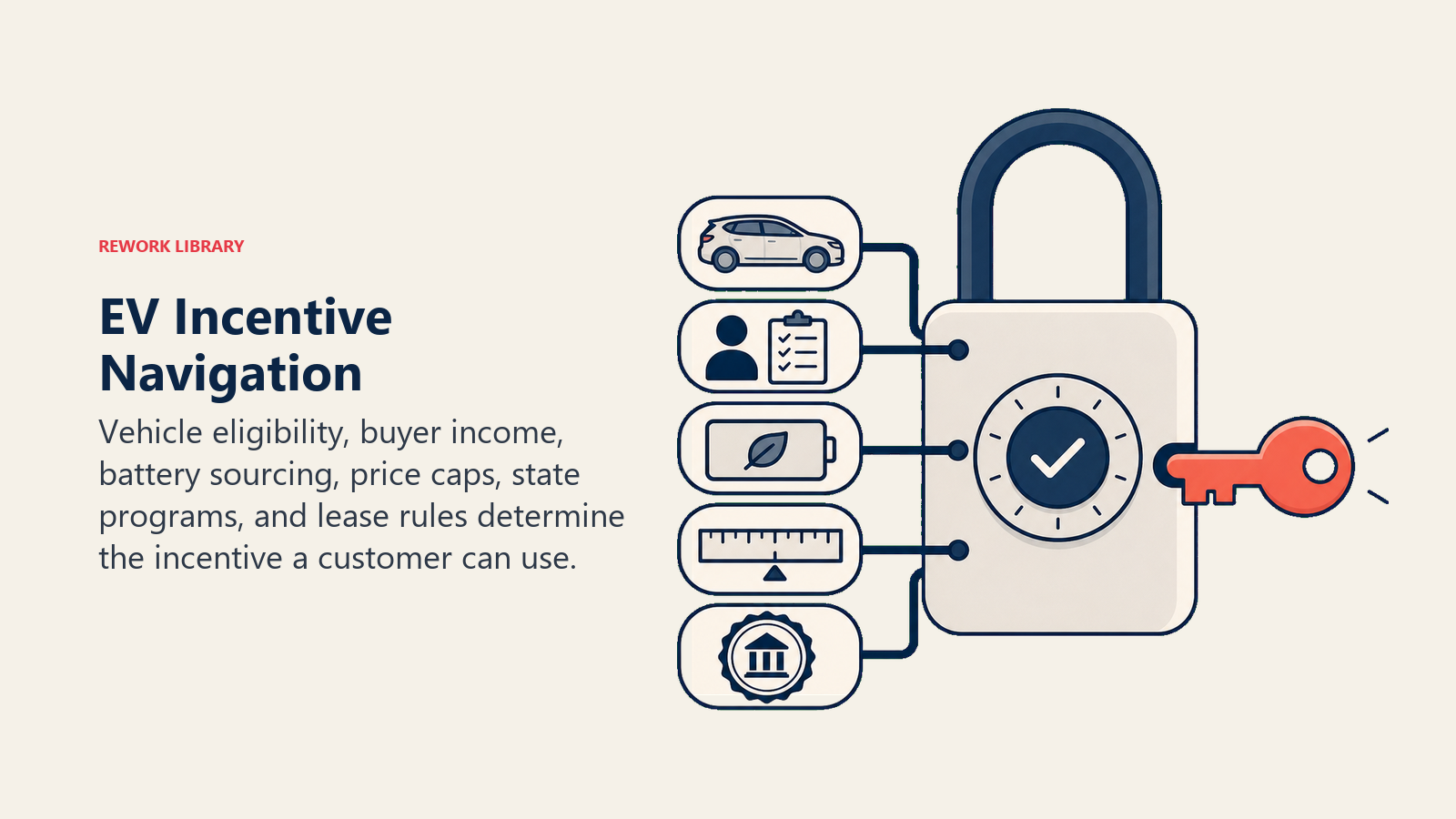
The federal EV tax credit provides up to $7,500 for qualifying new electric vehicles. But not all EVs qualify. Vehicles must meet domestic content requirements, price caps ($55,000 for cars, $80,000 for SUVs/trucks), and manufacturer caps. Know which vehicles on your lot qualify.
As of 2024, the credit can be applied at point of sale as a dealer rebate. This is huge. Instead of waiting until tax season to recoup $7,500, customers get it as a down payment or payment reduction immediately.
State and local incentive programs vary dramatically. California offers up to $7,500 in additional rebates. Colorado provides $5,000. New York offers $2,000. Some states offer nothing. Know your state's programs cold.
Utility company rebates and off-peak charging rates add savings. Many utilities offer $500-1,000 rebates for installing Level 2 home chargers. Some provide discounted electricity rates for EV charging during off-peak hours (overnight), cutting charging costs by 40-50%.
OEM incentives and subsidies supplement federal credits. Manufacturers offer conquest bonuses, loyalty incentives, and lease subventions to move EVs. Stack these with federal and state credits for maximum value.
Lease versus purchase economics favor leasing for many EV buyers. Leases allow manufacturers to claim the federal tax credit and pass savings through lower payments. Buyers who worry about technology changes or resale value prefer leasing. Those who want to maximize savings over 10+ years prefer purchasing.
Gross profit strategies in an incentive-rich environment require transparency. Don't bury incentives in negotiations. Lead with them. Show customers the total savings. You'll still gross well because volume and backend penetration offset front-end compression.
Inventory and Model Mix Strategy
Stocking the right EVs matters as much as selling them well.
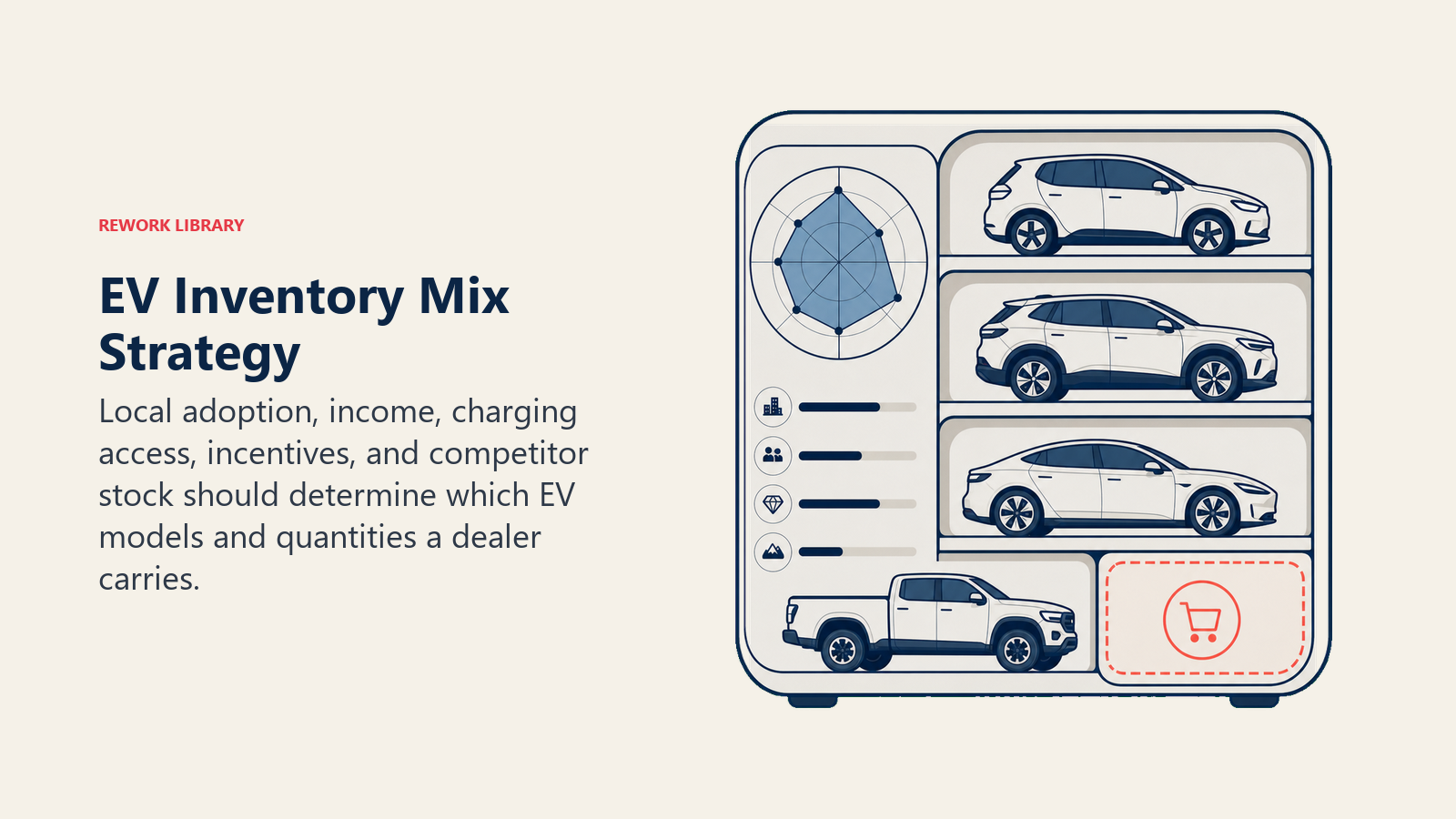
Forecast EV demand in your market by analyzing demographics, income levels, charging infrastructure, local incentives, and competitive activity. Urban markets with high incomes and climate concerns lead adoption. Rural markets lag. Adjust your inventory strategy accordingly.
Balance EV allocation with ICE inventory carefully. Don't overcommit to EVs in low-adoption markets. Don't ignore EVs in high-adoption markets. Start with 10-15% of your mix in EVs and scale based on sell-through.
Range and trim level selection impacts sales velocity. Long-range trims (300+ miles) sell faster than standard range. Mid-level trims balance features and price. Top trims sit longer unless you're in a luxury market.
Demo and loaner EV fleet investment pays dividends. Keep 2-3 EVs in your loaner rotation so service customers experience them. Use them for test drives. Let salespeople drive them home to build product knowledge.
Certified pre-owned EV programs are emerging. Used EVs are a growth opportunity as more vehicles come off lease. Certification programs with battery health checks and warranties address buyer concerns.
Charging Infrastructure and Partnerships
Supporting EV customers starts with charging.
Install on-site charging for customers and demos. Six to eight Level 2 chargers in your customer parking area let buyers charge during service visits or test drives. Budget $5,000-8,000 per charger including installation.
Partner with charging networks like ChargePoint, EVgo, or Electrify America. Some offer co-marketing programs, dealer referral fees, or discounted charging for your customers. These partnerships add value to your EV sales.
Home charger sales and installation programs create profit and convenience. Partner with local electricians to offer installation services. Sell Level 2 chargers (Grizzl-E, ChargePoint Home, JuiceBox) for $500-800. Margin plus installation referral fees add $200-400 per sale.
Charging education and support resources should be available in multiple formats: website FAQ, videos, printed guides, one-on-one consultations. Make customers confident they can charge successfully.
Service department charging capabilities are mandatory. You can't service EVs without high-voltage training and charging. Install DC fast charging if possible for quick diagnostic cycles and customer convenience.
Marketing and Lead Generation
EV buyers research differently and respond to different messages.
Create EV-specific digital advertising and content. Landing pages dedicated to EVs with range calculators, cost comparisons, and FAQs convert better than generic pages. Run separate Google Ads campaigns for EV keywords.
Target environmentally conscious and tech-savvy buyers through channels they use. LinkedIn works well for professional buyers. Instagram reaches younger, environmentally minded customers. Reddit and EV forums attract enthusiasts.
Host EV education events and ride-and-drive programs. Invite prospects to a Saturday EV showcase with multiple vehicles, charging demos, owner testimonials, and test drives. Low-pressure education events convert at higher rates than traditional sales approaches.
Run conquest marketing to Tesla and other EV owners. These buyers already understand EVs. They might be ready for an upgrade, better charging network, or lower cost. Target them with trade-in offers and incentive announcements.
Develop trade-in programs for ICE-to-EV switchers. Offer guaranteed trade values. Highlight the upgrade from gas to electric. Make the transition easy and valuable.
Trade-In and Used EV Management
EVs require different appraisal and remarketing approaches.
Battery health assessment and valuation are critical. Use diagnostic tools to check battery degradation. A 5-year-old EV with 95% battery health is worth significantly more than one with 85% health. Factor this into trade-in appraisal processes and retail pricing.
Used EV pricing and market dynamics are still developing. Check national marketplaces (Carvana, Vroom, CarMax) for comps. Price competitively because used EV buyers are savvy and will shop nationally.
Make wholesale versus retail decisions carefully. Low-range EVs (under 200 miles) or older technology might be wholesale material. Newer EVs with desirable features and good battery health retail well.
Certification and warranty programs for used EVs build buyer confidence. Offer battery health reports, extended warranties on high-voltage components, and complimentary charging installation assistance.
Manage older EV technology and depreciation by pricing aggressively. A 2019 Nissan Leaf with 150-mile range won't command premium pricing. Move it quickly.
Team Training and Certification
Your team's EV knowledge makes or breaks the strategy.
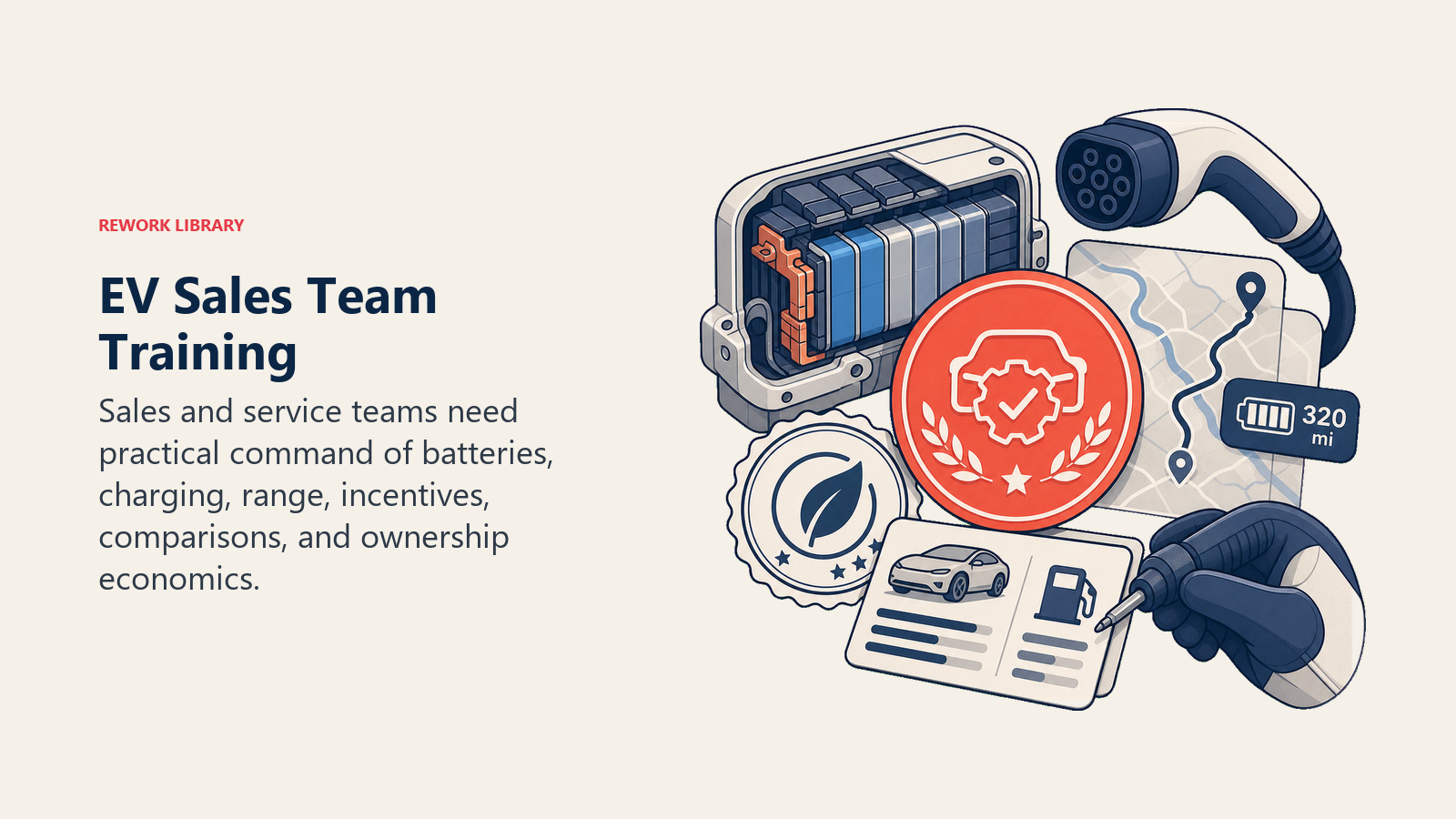
Product knowledge and technical training should cover battery capacity, charging levels, range calculations, incentive programs, and competitive comparisons. Salespeople need to answer customer questions confidently.
OEM EV certification programs are often required to sell certain models. GM's EV certification, Ford's EV specialist program, and similar manufacturer training ensure your team understands their specific EVs deeply.
Teach charging technology and infrastructure thoroughly. Salespeople should be able to explain the difference between Level 1, Level 2, and DC fast charging in terms customers understand. They should know where public chargers are located and how to use charging apps.
Practice test drive and demonstration skills specific to EVs. How to explain one-pedal driving. How to showcase instant torque. How to demonstrate regenerative braking. These features differentiate EVs and need clear explanation.
Overcome internal resistance and skepticism directly. Some salespeople and managers resist EVs because they're unfamiliar or threaten traditional business models. Address concerns honestly. Show data on market trends. Make believers by putting skeptics in EVs for extended test drives.
The EV transition is the biggest change in automotive retail since the internet. Dealers who adapt will thrive. Those who ignore it will watch market share evaporate as customers find dealers who actually understand what they're buying. Position your dealership for success by mastering both EV customer education and future revenue models.

Senior Implementation Consultant