Dealership Benchmarking: Using Comparative Data to Drive Performance - 2026 Guide

Turn this article into takeaways for your work.


Each assistant summarizes the article only for you and suggests best practices for your work.
Is your 15% gross profit margin good or bad? Without benchmarking, you don't know. You might be crushing it in your market or leaving millions on the table. Dealers using comparative data systematically outperform those flying blind, because they know exactly where they're weak and where they're strong.
Benchmarking isn't about copying competitors or chasing arbitrary numbers. It's about objective assessment. Where do you stand compared to similar dealers? Where are the biggest gaps? And what realistic improvement could mean for your bottom line?
The dealers who benchmark well don't just know their numbers, they know what the numbers mean and what to do about them.
The Value of Benchmarking
Most dealer principals think they know how they're performing. "We had a good month" or "Sales are down but so is everyone else." Gut feel and anecdotes replace data.
Benchmarking provides objective performance assessment versus assumptions. When NADA Data shows the average dealer your size grossing $2,800 per used vehicle and you're at $2,100, that's not a bad month, that's a $700,000 annual opportunity if you sell 1,000 used units.
It identifies strengths to leverage and weaknesses to address. Maybe your new car department underperforms but your service department crushes industry averages. That insight shapes where you invest time and resources.
Goal-setting becomes realistic when based on achievable standards. Telling your F&I director to hit $1,800 PVR is arbitrary. Showing them that top-quartile dealers hit $1,950 and you're at $1,550 creates a meaningful, achievable target.
Understanding competitive positioning within your market matters for strategic planning. If every dealer in your region underperforms national averages on used car gross, maybe the market is hyper-competitive and you need different strategies.
And benchmarking improves board and stakeholder communication. Showing ownership that you're in the 75th percentile for service absorption but 40th percentile for sales efficiency focuses strategic discussions on what matters.
Benchmark Data Sources
You can't benchmark without data. Here's where to get it. Understanding these data sources helps you compare performance against peers using dealership data analytics and track progress with your dealership KPI dashboard.
NADA Data reports provide dealership financial profiles aggregated from thousands of dealers. NADA Data publishes annual reports breaking down financial performance by dealership size, brand, and region. It's the industry standard for financial benchmarking.
20 Groups and peer networks like NCM, Dealer Synergy, and NADA 20 Groups offer deeper data sharing among 15-20 non-competing dealers. Members share detailed financials monthly and meet quarterly to compare performance and exchange best practices.
OEM dealer performance reports from your manufacturer show how you stack up against other brand dealers regionally and nationally. These reports typically cover sales volume, CSI scores, and operational metrics.
Digital marketing benchmarks come from industry platforms and agencies. Google publishes automotive industry benchmarks for website traffic and conversion. Third-party lead providers share close rate and cost per lead data.
State and regional dealer associations often compile performance data for members. These reports are smaller sample sizes but highly relevant because they're your direct competitors.
Third-party analytics platforms like DealerSocket, CDK, and others provide benchmarking dashboards comparing your CRM, marketing, and operational metrics to aggregated peer data.
Key Benchmarking Metrics
Not everything deserves measurement. Focus on metrics that drive profit.
Sales volume per salesperson reveals productivity. The average dealer gets 8-10 units per salesperson monthly. Top performers hit 12-15. If you're at 6, you're either overstaffed or undertrained. Track sales consultant performance systematically.
Gross profit per vehicle for new, used, and F&I shows pricing power and negotiating effectiveness. New car gross averages $1,800-$2,200 depending on brand. Used car gross runs $2,200-$2,800. F&I PVR (per-vehicle revenue) averages $1,500-$1,800 industry-wide.
Total PVR combines front and back gross. Top-quartile dealers deliver $5,000+ total PVR. Average dealers struggle to hit $4,000. That $1,000 gap on 100 monthly sales is $1.2 million annually. Learn more about optimizing gross profit across all departments.
Service RO count per advisor measures fixed ops productivity. Advisors should close 100-125 repair orders monthly. Below 80 means inefficiency or underutilized bays. Above 150 might mean rushed service and declining CSI.
Parts and service margin percentages show pricing strategy and cost control. Service labor should gross 70-75%. Parts should gross 40-45%. Lower margins suggest discounting problems or competitive pressure.
Customer retention and defection rates predict future revenue. Service retention should exceed 60%. Sales repurchase rates depend on lifecycle but tracking 3-year and 5-year loyalty programs identifies whether you're building relationships or just completing transactions.
Expenses as a percentage of gross profit measure operational efficiency. Total expenses (excluding vehicle cost) should run 70-75% of gross profit. Higher percentages mean bloated overhead or underperforming sales.
Net profit margin and ROI separate good operators from great ones. Healthy dealerships net 2.5-3.5% on total revenue and deliver 20-40% ROI on dealer equity. Below that suggests inefficiency. Above that shows excellence.
Understanding Peer Groups
Comparing yourself to the wrong dealers produces useless insights.
Dealership size and volume matter enormously. A 50-unit-per-month store operates completely differently than a 300-unit store. Economies of scale, staff specialization, and inventory turn all differ. Compare to similar-sized peers.
Geographic market differences impact everything. Urban dealers face higher real estate costs but more traffic. Rural dealers have lower costs but less volume. Coastal markets skew higher income and prices. Midwest markets run leaner.
Brand and franchise mix affects profitability dramatically. Luxury brands deliver higher grosses but lower volume. Domestic brands move volume but face margin pressure. Import brands balance both. Multi-point stores have different dynamics than single points.
Urban versus rural market dynamics change strategies. Urban stores invest heavily in digital marketing and fight intense competition. Rural stores rely on reputation, community ties, and limited competition.
Select the right comparison group by matching size, brand, and market type as closely as possible. NADA Data lets you filter by these factors. 20 Groups intentionally group similar dealers.
NADA Data Deep Dive
NADA Data is the gold standard for dealership financial benchmarking.
NADA collects data annually from thousands of dealers who submit complete financial statements. The reports aggregate this data while maintaining anonymity. Published reports show composite averages, medians, and quartile breakdowns.
Reading NADA financial statements takes practice. The reports mirror a dealer income statement: gross profit by department, expense categories, and net profit. But they add benchmarks showing where you fall relative to peers.
Composite versus median versus top-quartile data tell different stories. Composite is the average across all dealers, useful but skewed by outliers. Median is the middle dealer, half above, half below. Top-quartile shows what the best performers achieve, your north star.
Adjust for your specific situation when interpreting benchmarks. A dealer in Manhattan pays 3x the occupancy costs of one in rural Kansas. Real estate as a percentage of gross will differ, and that's fine.
Study trends and year-over-year changes, not just single-year snapshots. If the industry is trending toward lower new car gross and higher F&I penetration, understand why and adapt accordingly.
20 Groups and Peer Networks
NADA Data provides broad benchmarks. 20 Groups provide deep, actionable insights.
20 Groups work by gathering 15-20 non-competing dealers (similar brand, size, market) who share detailed financial and operational data monthly and meet quarterly to review performance. NADA 20 Groups provide online financial composites showing individual and group stats 24/7, enabling dealers to analyze profitability, expense absorption and employee productivity across departments.
Benefits include detailed data sharing far beyond what NADA provides, best practice exchange where top performers share exactly how they achieve results, and accountability because you're presenting your numbers to peers who will ask hard questions.
Selecting the right 20 Group fit matters. NCM (National Car Wash Association) is the largest and most established. NADA runs groups. Dealer Synergy focuses on digital performance. Some consultants run private groups. Interview group leaders and current members before joining.
Monthly meeting structure typically includes pre-meeting data submission, group video calls reviewing each dealer's performance, problem-solving sessions on common challenges, and best practice sharing.
Cost versus value proposition runs $15,000-$30,000 annually depending on the group. That sounds expensive until you realize one $100,000 insight pays for three years of membership. Most dealers who join stay for decades.
Digital and Marketing Benchmarks
Financial benchmarks matter, but so do digital metrics in 2026.
Website traffic and conversion rates show online effectiveness. The average dealer website gets 5,000-15,000 monthly visitors and converts 2-4% to leads. Top performers hit 6-8% conversion through better design and optimization.
Lead source close rates and cost per sale benchmark marketing effectiveness. Organic website leads should close at 15-25%. Third-party leads run 8-12%. Cost per sale should land in the $400-$800 range depending on source and market.
Email marketing performance metrics include open rates (20-25% is average, 30%+ is good), click rates (2-4% average, 5%+ good), and conversion rates (leads to sales). Review email marketing strategies for improvement.
Social media engagement and reach vary wildly by platform. Facebook page engagement averages 1-3% of followers. Instagram runs higher at 3-6%. What matters is trend over time and cost per engagement. Optimize your social media for dealerships approach.
SEM and PPC performance benchmarks include cost per click ($2-$5 for most automotive keywords), click-through rate (4-6% average, 8%+ good), and conversion rate from click to lead (5-10%).
Digital retailing adoption and completion rates are newer metrics. Tools like digital trade-in appraisals see 15-20% completion rates. Online credit applications convert at 10-15%. Track your digital retailing implementation against these benchmarks.
Turning Data into Action
Benchmarking without action is just interesting trivia.
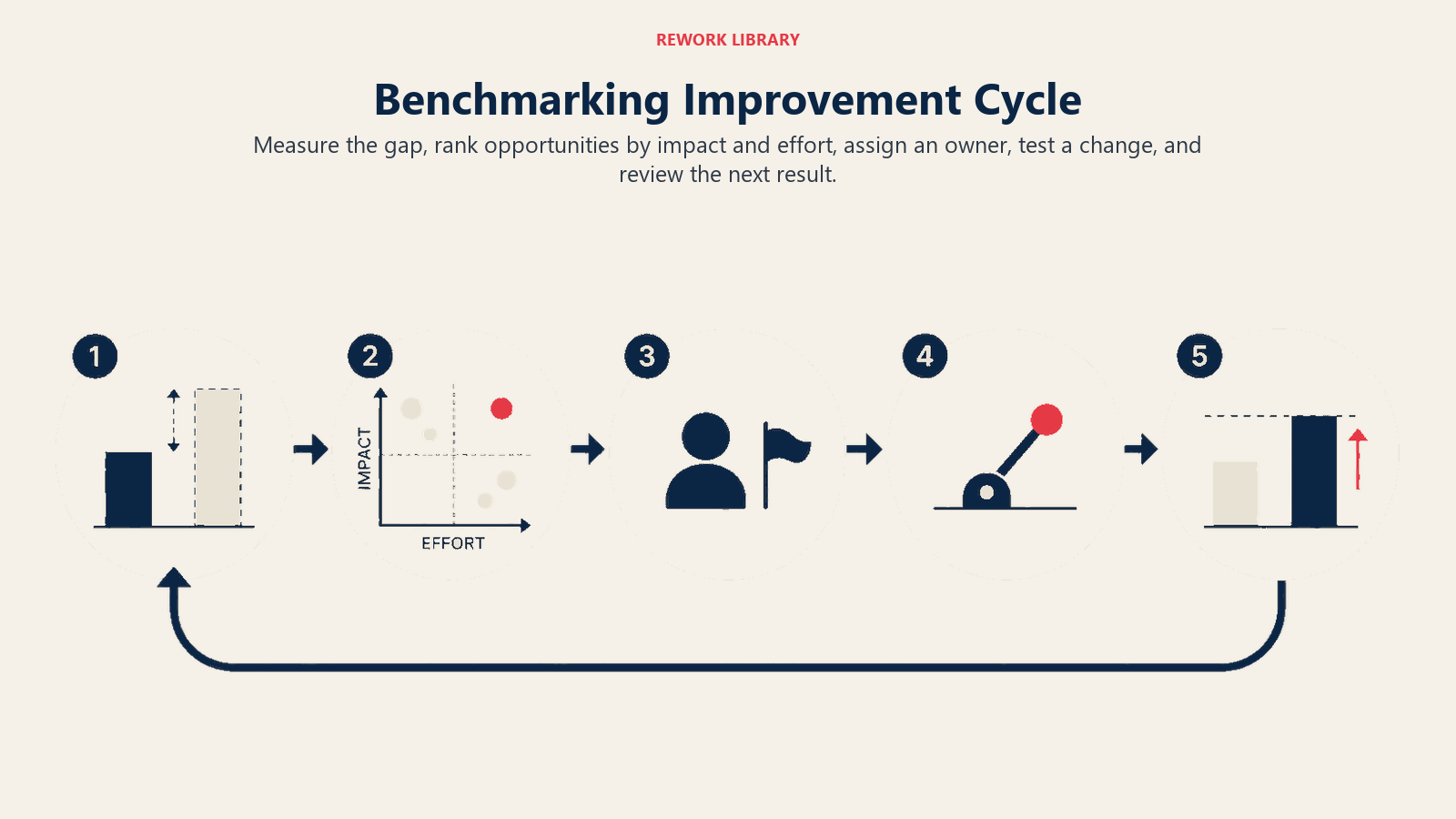
Start with gap analysis: your performance versus benchmark. Create a spreadsheet showing key metrics, your current performance, peer average, and top-quartile performance. The gaps between columns are opportunities.
Prioritize improvement opportunities using an impact-versus-effort matrix. Improving F&I PVR from $1,400 to $1,700 might require only better training, high impact, low effort. Overhauling your used car reconditioning process might deliver huge gains but require major investment.
Set realistic improvement targets based on where you are now. If you're at the 30th percentile, targeting 90th percentile in one year is fantasy. Target 50th percentile and build from there.
Create action plans with specific owners and timelines. "Improve service retention" isn't actionable. "Implement 3-touch follow-up process for service customers, owner: Service Director, deadline: March 31" is actionable.
Track progress and measure results monthly. Don't set annual goals and check them in December. Review key metrics monthly with your KPI dashboard, adjust tactics quarterly, and celebrate incremental wins.
Share successes and celebrate progress with your team. When service retention climbs from 55% to 62%, that's worth recognition. Benchmarking creates accountability, but celebrating wins creates momentum.
Common Benchmarking Mistakes
Even data-driven dealers make these errors.
Comparing to the wrong peer group produces misleading insights. Don't compare your 100-unit rural Chevrolet store to 400-unit urban BMW dealers. Match brand, size, and market.
Focusing only on weaknesses while ignoring strengths is demoralizing. Yes, fix the underperforming areas. But also leverage your strengths. If your service department crushes benchmarks, study what they do right and apply those lessons elsewhere.
Analysis without action is the most common trap. Dealers pay for NADA Data, review it once, file it away, and change nothing. Benchmarking only works if you act on what you learn.
Not accounting for market and brand differences leads to unrealistic expectations. A Kia dealer won't gross $3,000 per new vehicle like a Mercedes dealer. Understand structural differences.
Short-term thinking versus trend analysis misses the bigger picture. One bad month doesn't mean you're failing. But six consecutive months of declining margins versus flat industry margins signals a problem.
Gaming metrics instead of improving fundamentals destroys the value of benchmarking. Don't manipulate how you count service ROs to make your numbers look better. The only person you're fooling is yourself.
Benchmarking works because it replaces assumptions with facts. It turns "I think we're doing well" into "We're in the 72nd percentile for service absorption and 41st percentile for used car gross." That clarity drives action. And action drives profit through systematic gross profit optimization.