BDC Operations Setup: Building a Business Development Center That Drives Consistent Appointments - 2026 Guide
Turn this article into takeaways for your work.


Each assistant summarizes the article only for you and suggests best practices for your work.
Dealerships with dedicated BDC operations convert internet leads at 18-22% compared to 8-12% for stores handling leads on the sales floor. That gap represents 40-60 additional sales per month for a store receiving 400 internet leads monthly. At typical gross profit, that's $100,000-150,000 in monthly margin.
The BDC model isn't new, many dealerships tried and abandoned it in the mid-2000s, declaring it "didn't work." But the ones that failed were running poorly structured operations with inadequate training, weak compensation plans, and no clear success metrics. The ones still running BDCs profitably have refined their approach over 15+ years.
If you're receiving 200+ internet leads monthly and handling them on the sales floor between walk-ins, you're leaving significant revenue uncaptured. Here's how to build a BDC that actually delivers.
BDC vs Sales Floor Model
When BDC makes financial sense depends on lead volume, market dynamics, and current conversion performance. The breakeven calculation: BDC costs (staff, technology, space) must generate enough incremental sales to cover expenses and return profit. At 200+ monthly leads with current conversion below 12%, a 3-person BDC typically breaks even within 90 days based on dealership profitability metrics. At 400+ leads monthly, not having a BDC means you're operationally negligent. Your sales floor can't handle that volume effectively while also serving walk-in traffic and taking deliveries. In-house vs outsourced vs hybrid models each serve different situations. In-house BDC gives you complete control over quality, scripts, and integration with your sales floor. Outsourced BDC (24/7 answering services, offshore lead handling) costs less but delivers lower-quality appointments and damages brand reputation with scripted, impersonal interactions.
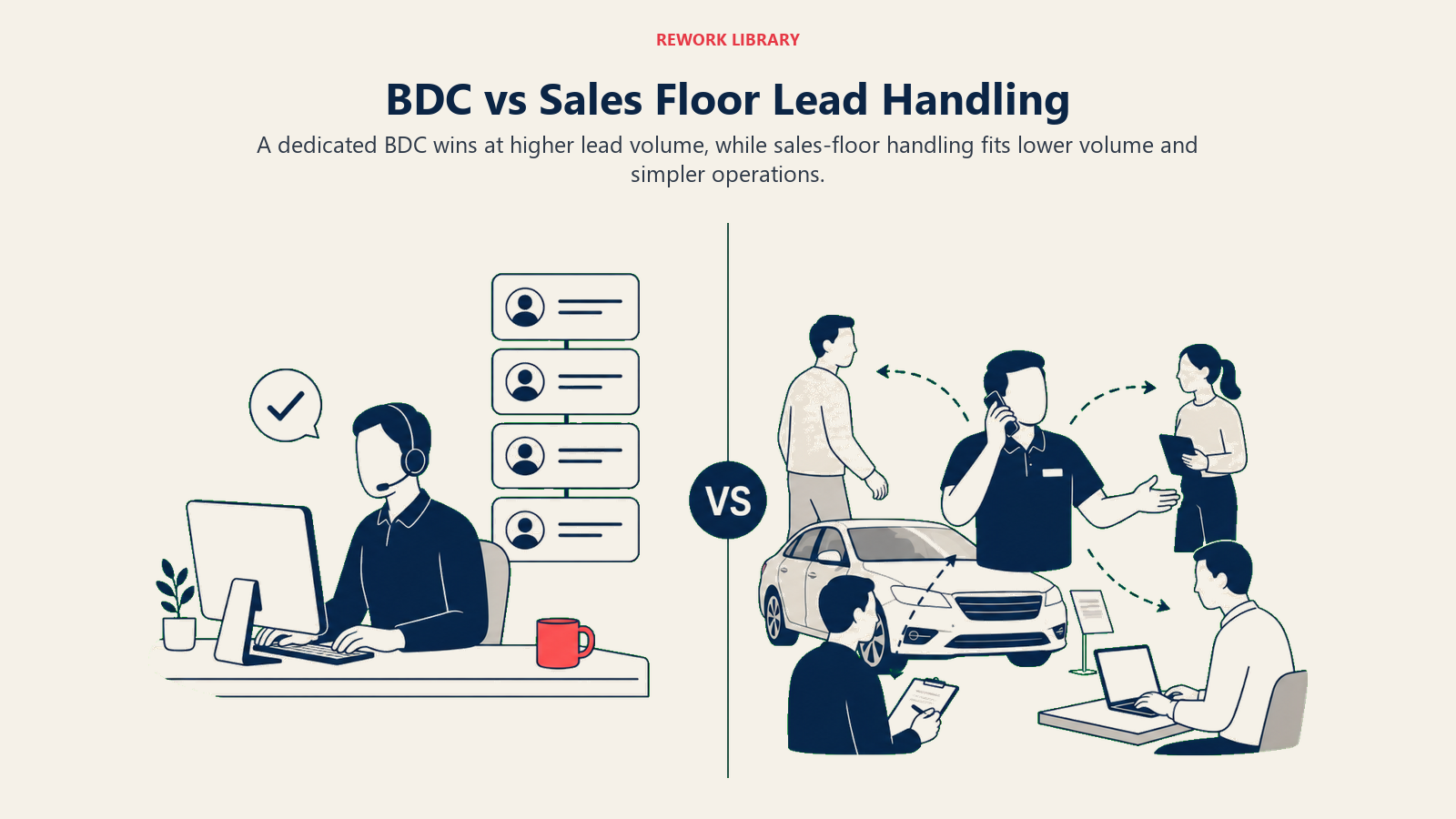
Hybrid models use in-house BDC during prime hours (8 AM - 8 PM) and outsourced overflow/after-hours coverage. This balances quality during high-value hours with cost-effective availability outside core times.
Sales BDC vs service BDC vs combined operations reflects strategic priorities. Sales BDC focuses exclusively on internet leads, phone-ups, and appointment setting for vehicle sales. Service BDC handles maintenance scheduling, recall notifications, and service-to-sales referrals. Combined operations (common in smaller stores) handles both with cross-trained staff.
Most stores start with sales BDC, then add service capabilities as they prove ROI and develop operational expertise.
Cost-benefit analysis should be brutally realistic. BDC expenses include: salaries ($35K-45K per agent, $55K-75K for manager), CRM and phone system costs ($3K-5K monthly), workspace and equipment ($2K-3K per workstation setup), training and development (80-120 hours initially per agent). A 3-person BDC with manager runs $25K-35K monthly in total costs.
Return calculation: if BDC increases conversion from 10% to 18% on 400 monthly leads, that's 32 additional sales. At $2,500 average gross profit, that's $80,000 monthly gross, or $960,000 annually. The $300K-400K annual BDC investment returns 2.5-3x.
Cultural and organizational considerations often kill BDCs that make financial sense. Sales floors resist "losing" their internet leads to BDC. Consultants complain that BDC appointments are "weak" or "unqualified." Management treats BDC as cost center rather than profit driver.
Successful BDC implementation requires executive commitment, sales floor buy-in (often through compensation incentives for appointment shows), and clear delineation of responsibilities.
Physical Setup & Infrastructure
Space requirements depend on BDC size and structure. Each agent needs 40-60 square feet of functional workspace, enough for desk, dual monitors, storage, and privacy without isolation. BDC works best in centralized location where agents can collaborate, managers can monitor, and sales floor can easily coordinate handoffs. On-site vs off-site location impacts integration quality. On-site BDC (within dealership building) enables face-to-face handoffs, easier training, and cultural integration. Off-site BDC (separate building or remote work) reduces costs but weakens connection to sales floor and complicates appointment handoffs.
Most successful BDCs are on-site during first 12-24 months, then may expand to remote agents after processes are proven and culture established.
Workstation design and ergonomics matter when agents spend 6-8 hours daily on phones and computers. Adjustable desks (sitting/standing options), ergonomic chairs, dual monitor setups (one for CRM, one for scripts/email), adequate lighting, and noise management (acoustic panels, spacing) prevent burnout and increase productivity.
Don't cheap out on workspace, $800 invested in proper furniture and equipment per station pays back in reduced turnover and higher performance.
Technology equipment requirements include: business-grade computers (not consumer-grade laptops that die in 18 months), professional headsets with noise cancellation ($80-150, not $20 USB headsets from Amazon), high-quality webcams for video messages, reliable high-speed internet (redundant connections if possible).
Phone system requirements must support auto-dialer functionality, call recording, intelligent call routing, CRM integration, text messaging, and detailed analytics. Cloud-based systems (RingCentral, Dialpad, Nextiva) offer flexibility and features that justify 2-3x cost over traditional PBX systems.
CRM and DMS access requirements mean every BDC agent needs full CRM access (not read-only), view-level DMS access to check inventory and deal status, and integration tools that minimize system switching. If agents are toggling between 5 different platforms, you're killing efficiency.
Staffing Model & Structure
Team size based on lead volume follows rough formula: 1 BDC agent per 80-100 internet leads monthly, plus manager ratio of 1:6-8 agents. A dealership receiving 400 leads monthly needs 4-5 agents plus manager. Under-staffing destroys response times and follow-up quality. Over-staffing kills profitability. Research shows that proper BDC staffing levels directly correlate with appointment conversion rates. Start conservative (3 agents) and add capacity based on demonstrated demand rather than hiring 8 agents on day one hoping volume materializes.
BDC manager role and responsibilities include: call monitoring and coaching, performance tracking and reporting, schedule management, escalation handling, training coordination, sales floor liaison, and process improvement. The manager shouldn't spend 80% of their time setting appointments, they should spend 80% developing their team.
Agent vs specialist model determines role definition. "Agent" model has each person handling full lead lifecycle: inbound calls, internet lead follow-up, outbound appointment setting, and confirmation. "Specialist" model splits functions: inbound call specialists, internet follow-up specialists, confirmation specialists.
Generalist agent model works better in BDCs under 8 people. Specialist model creates efficiency at scale but requires more management overhead.
Shift scheduling determines coverage hours and work/life balance. Most BDCs operate 10-12 hour days (8 AM - 8 PM) with staggered shifts: early shift (8 AM - 5 PM), mid shift (10 AM - 7 PM), late shift (11 AM - 8 PM). Weekend coverage (Saturday 9 AM - 6 PM, Sunday 11 AM - 5 PM) requires rotation or dedicated weekend staff.
Avoid burnout by limiting agents to 4-5 hour phone time per 8-hour shift, with breaks, follow-up time, and administrative work filling the remainder.
New vs used specialization makes sense in large BDCs (10+ agents) where knowledge depth matters. New vehicle specialists understand incentives, allocation, factory orders. Used vehicle specialists know market pricing, vehicle history, certification programs. In smaller BDCs, everyone handles both.
Sales vs service separation depends on whether you're running combined BDC or dedicated sales team. Service appointment setting requires different tone and approach than sales lead handling. Cross-training helps with coverage but specialization improves conversion.
Hiring & Training
BDC agent job profile requires specific personality traits and skills that differ from floor sales consultants. Ideal profile: comfortable on phone (not just in person), resilient to rejection (95%+ of calls go to voicemail or rejection), organized enough to manage 40-60 active leads simultaneously, coachable and process-oriented, not ego-driven about who gets credit for sales. Many failed salespeople make excellent BDC agents. Many top salespeople make terrible BDC agents who resent "not closing their own deals."
Recruitment sources include: internal transfers from service drive or sales assistants, previous call center or customer service experience (hospitality, banking), recent college graduates, and surprisingly, former teachers who are moving to higher-paying careers.
Screening process should include phone interview (test phone presence), personality assessment (resilience, coachability), role-play scenarios (handling objections, appointment setting), and reference checks focused on reliability and attitude.
Initial training curriculum runs 2-4 weeks before agents take full lead load. Week 1: CRM training, phone system, scripts, product knowledge. Week 2: Call shadowing, objection handling practice, email and text templates. Week 3: Live calls with manager monitoring, appointment setting, confirmation process. Week 4: Full lead assignment with close coaching.
The most common mistake is 2 days of training followed by "figure it out", that creates bad habits and early failure.
Ongoing skill development includes: weekly call reviews, monthly role-play sessions, quarterly refresher training, and access to top-performer recordings. BDC performance improves continuously with coaching or stagnates without it.
Sales floor promotion path should be clear: top BDC agents who want to move to sales floor get first shot at openings. This creates BDC career progression and maintains sales floor quality by promoting people who already understand the dealership's processes and customer base.
Retention strategies focus on: competitive compensation, recognition programs, career pathing, and tolerable work environment (reasonable hours, adequate breaks, supportive management). BDC turnover under 25% annually is excellent. Over 60% means your environment, compensation, or management is broken.
Compensation Structure
Base salary vs hourly pay depends on jurisdiction labor laws and your compensation philosophy. Salaried BDC agents ($35K-42K base) feel more professional and committed. Hourly agents ($17-22/hour) provide scheduling flexibility and eliminate overtime concerns with part-time staff.
Most successful BDCs use base salary plus performance bonuses rather than pure hourly or pure commission.
Appointment bonuses and thresholds drive behavior. Typical structure: $20-30 per confirmed appointment that shows, with monthly volume bonuses (50 appointments = $500 bonus, 75 appointments = $1,000 bonus). This rewards both quality (shows) and quantity (volume) following appointment-setting best practices.
Show rate quality gates prevent gaming. If an agent books 80 appointments but only 40 show up (50% show rate), they're booking weak commitments. Minimum 65-70% show rate should be required to earn appointment bonuses.
Team vs individual incentives balance collaboration and accountability. Individual bonuses reward top performers and drive competitive improvement. Team bonuses encourage helping struggling agents and sharing best practices. Many stores use both: 70% individual performance, 30% team performance.
Sales credit and spiffs need clear rules to prevent conflict. When BDC sets appointment and sales floor closes deal, who gets credit? Answer: both should benefit. BDC gets appointment bonus, sales consultant gets full commission, and dealership gets the sale. Everyone wins.
If sales consultants feel BDC is "stealing their deals," your compensation structure is wrong.
Performance review cycles should be monthly for first 90 days, then quarterly for established agents. Reviews should be data-driven (actual performance metrics) not subjective feelings. Agents should know exactly where they stand and what improvement looks like.
Process & Scripting
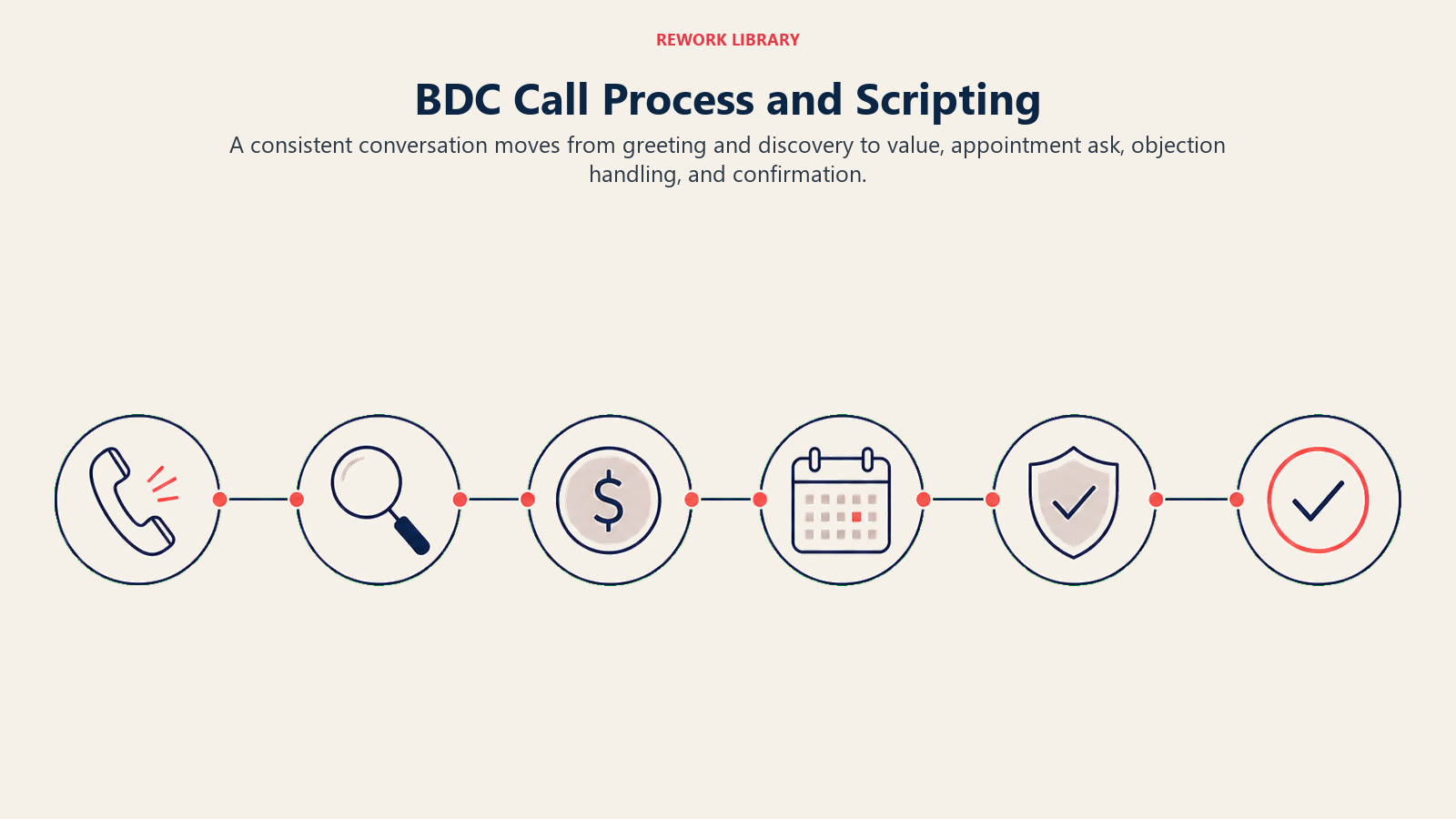
Call handling procedures provide consistent structure without robotic delivery. Framework: greeting, introduction, reason for call, qualification question, value statement, appointment ask, objection handling, confirmation. But the exact words should feel natural to the agent's communication style. Scripts that work: "Hi Jennifer, this is Mike from Valley Honda. I'm calling about the 2024 CR-V you requested information about this morning. Quick question, are you looking to come in this week, or are you still gathering information?" Scripts that fail: "Hello, this is Mike calling from Valley Honda, the number one Honda dealer in the tri-state area. I'm calling to inform you that we received your inquiry and would like to schedule you for an appointment with one of our award-winning sales professionals..."
Email response templates balance speed with personalization. Immediate auto-response confirms receipt: "Thanks for contacting Valley Honda. We're reviewing your request and will reach out within 30 minutes." Followed by personalized email from assigned agent within that timeframe.
Text messaging protocols require casual tone and value focus. Good: "Hey Sarah, Mike at Valley Honda. Saw you asked about the CR-V. Coming in this week or still shopping?" Bad: "Dear Ms. Johnson, Thank you for your inquiry regarding our inventory. We would be delighted to schedule..."
Objection handling scripts address common situations: "Just looking" (value proposition without pressure), "Call you back" (book specific follow-up time), "Price too high" (payment vs price discussion), "Other dealer offered less" (differentiation not price matching) using proven objection handling techniques.
The best objection handling is conversational: "I get it, you're looking at a few options. Here's what I'd suggest: come take a look at this one, see if it's what you want, and let's talk about the numbers. If we're close, great. If not, at least you'll know what you're comparing everywhere else to. Does Thursday at 4 work?"
Appointment confirmation process prevents no-shows. Confirmation sequence: initial appointment set (note in CRM), 24-hour confirmation (text or call: "Still good for tomorrow at 4?"), 2-hour reminder (text: "See you at 4 today!"), no-show follow-up within 30 minutes if they don't arrive.
Handoff to sales floor procedures complete the BDC function. When customer arrives, BDC agent walks them to assigned consultant, makes personal introduction, provides consultant with lead history and notes, then exits gracefully following proper automotive sales process. Smooth handoffs feel professional. Awkward handoffs damage customer experience.
Management & Metrics
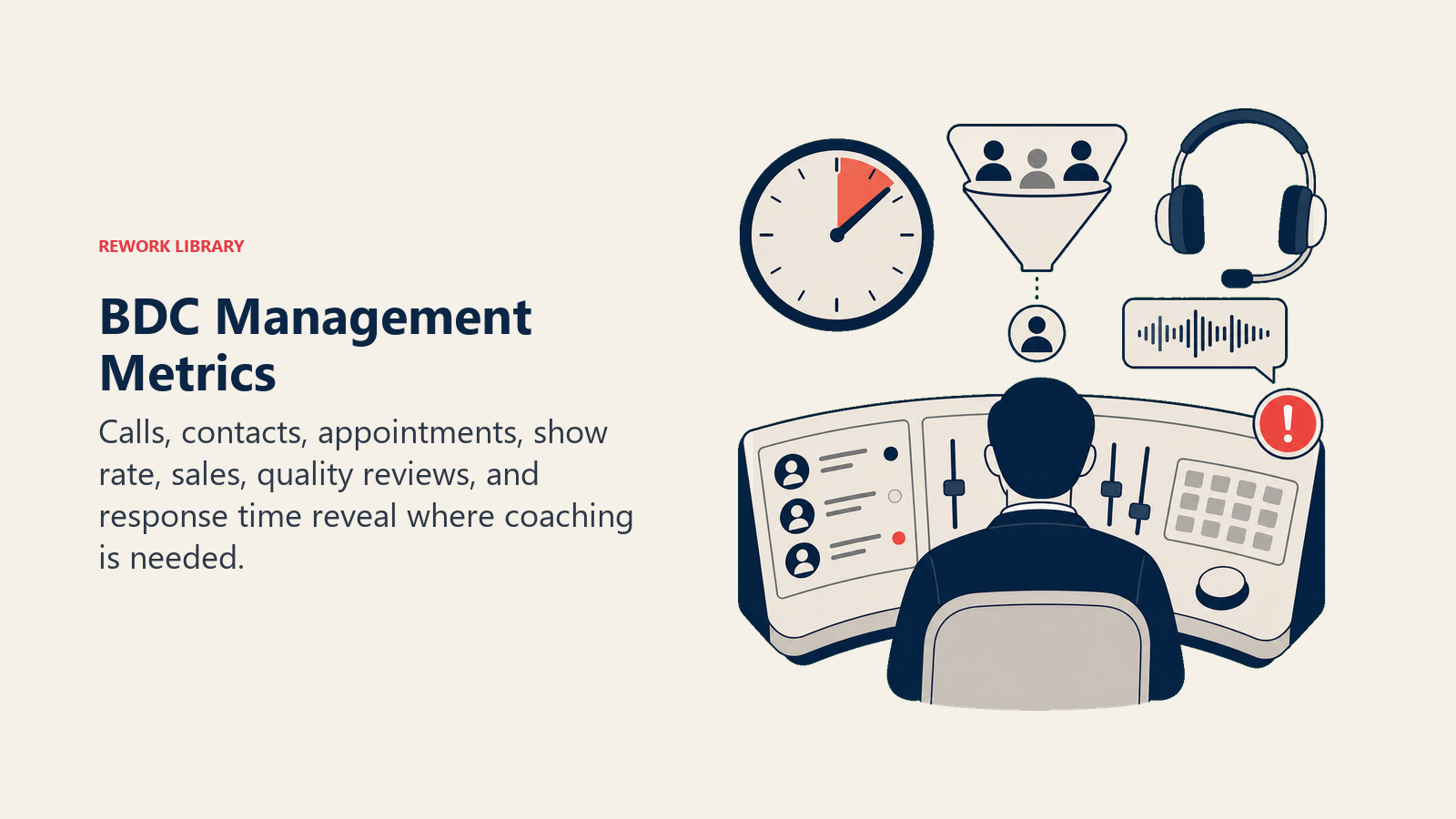
Daily scoreboards and accountability make performance visible. Wall-mounted display or TV showing: calls made, contacts reached, appointments set, show rate, by agent and team total. Update in real-time or hourly. Public visibility drives performance through healthy competition. Call monitoring and quality assurance should be continuous, not occasional. Manager should monitor 5-10 calls per agent weekly, providing immediate feedback. Recorded calls allow reviewing and coaching on specific interactions rather than general "you need to be better on the phone" feedback. Industry data shows that by 2026, over 70% of high-performing dealerships will meet the 5-minute response benchmark consistently, driven by systematic coaching and AI automation. Appointment-to-show rate tracking reveals BDC quality. Target 70-75% show rate. Below 60% indicates weak appointment quality, poor confirmation process, or scheduling people who aren't really committed. Above 80% suggests you're being too selective and leaving opportunity untouched. According to automotive BDC benchmarks, dealerships tracking these metrics see up to 30% more appointments booked.
Show-to-sale conversion measures floor sales effectiveness and BDC appointment quality. Target 30-40% close rate on BDC appointments. Below 25% suggests either weak appointments or floor sales execution problems. Above 45% indicates excellent BDC qualification and strong floor closing.
Cost per appointment analysis determines BDC efficiency. Calculate: total monthly BDC costs / appointments set = cost per appointment. Typical range: $40-80 per appointment. Compare to cost of additional advertising to generate showroom traffic, which often runs $150-300 per customer visit.
Agent performance rankings should be posted weekly, not hidden. Top performers get recognition and rewards. Bottom performers get coaching and development plans. Middle performers see what top-performers do differently and adjust, tracked through BDC performance metrics.
The dealerships winning with BDC operations treat them as strategic sales channels, not cost centers or necessary evils. They invest in training, maintain quality standards, compensate competitively, and hold people accountable for results. The BDC model works, but only when executed with the same discipline you apply to your sales floor, finance office, and service department.
For broader context on how BDC fits into lead management strategy, see Automotive Lead Management. For response time optimization that BDC teams must execute, review Lead Response Time Optimization. To learn appointment-setting tactics specifically, reference Appointment Setting Best Practices. For phone skills development, explore Phone Skills for Automotive. And to understand how BDC coordinates with service opportunities, see Service Appointment Scheduling.

Senior Implementation Consultant