Dealership Website Optimization: Converting Visitors to Showroom Appointments - 2026 Guide
Turn this article into takeaways for your work.


Each assistant summarizes the article only for you and suggests best practices for your work.
Your dealership website is your best salesperson. It works 24/7 without breaks, touches 95% of buyers before they ever walk into your showroom, and costs a fraction of what you pay in sales commissions. But most dealer websites convert at a dismal 1.5-3% from visitor to lead.
That's not a technology problem. It's a strategy problem. Too many dealership websites are built to look impressive rather than convert visitors. They prioritize flashy animations over fast load times. Complex navigation over simple paths to action. Artistic design over user experience.
The dealers winning online treat their website as a conversion machine. Every element serves a purpose. Every click moves the customer closer to an appointment or inquiry. Every page is optimized based on real data about what works.
Website Performance Benchmarks
Before you can improve, you need to know where you stand. Here are the current industry benchmarks for dealership websites:
Traffic-to-lead conversion: 1.5-3% is average. Top performers hit 4-6%. If you're below 1.5%, you've got serious usability or trust issues to address.
Lead quality: Website leads typically convert to sales at 8-15%, compared to 6-10% from third-party sources. Your own website traffic is warmer because they chose to visit you specifically.
Page load speed: Under 3 seconds is the standard. Google penalizes slower sites in search rankings. More importantly, 53% of mobile visitors abandon sites that take longer than 3 seconds to load. Recent industry analysis reveals that 99.6% of dealership websites fail Google's Core Web Vitals on at least one platform, creating massive conversion leakage.
Mobile traffic percentage: Expect 60-70% of your traffic from mobile devices. McKinsey research indicates that 70% of customers view the presence of a physical car as the main reason for their visit to a dealership, with most stating they would prefer to finance and pay for a car digitally. If your mobile conversion rate lags desktop by more than 20%, you've got mobile experience problems.
Bounce rate: 40-60% is typical. Higher bounce rates on the homepage often indicate irrelevant traffic or poor value proposition. High bounce on VDPs suggests pricing issues or poor photos.
Track these metrics monthly in Google Analytics. Set up custom dashboards that show conversion funnels from homepage to lead submission. Understand which pages leak visitors and why.
Homepage Optimization
Your homepage has one job: get visitors to the next step. Not to tell your entire story. Not to show every feature. Just get them deeper into your site toward inventory or contact.
Clear value proposition - Within 5 seconds, visitors should understand what makes your dealership different. "Family owned since 1987" isn't a value proposition. "Guaranteed best price in 50 miles or we'll write you a check for the difference" is.
Prominent inventory search - Most visitors arrive with a vehicle type in mind. Make it easy to find. Large search boxes with filters for new/used, make, model, and price range. Don't bury it below the fold.
Multiple lead capture points - But don't assault visitors with popup forms in the first 10 seconds. Use exit intent popups, scroll-triggered offers, or time-delayed prompts. Give people a chance to see value before asking for information.
Trust signals - Reviews, awards, certifications, and manufacturer affiliations build credibility. Feature your Google rating prominently. Show real customer testimonials with photos and names. Display any consumer satisfaction awards.
Mobile-first design - Stop designing for desktop and adapting for mobile. Design for mobile first, then enhance for desktop. Most of your traffic is already mobile. Act like it.
The homepage should feel clean, fast, and focused. Every element should answer the question: "Will this help convert visitors to leads?"
Navigation & Site Architecture
Complex navigation kills conversion. Dealers add every possible page to their menu because they want to highlight all services. The result is overwhelming choice paralysis.
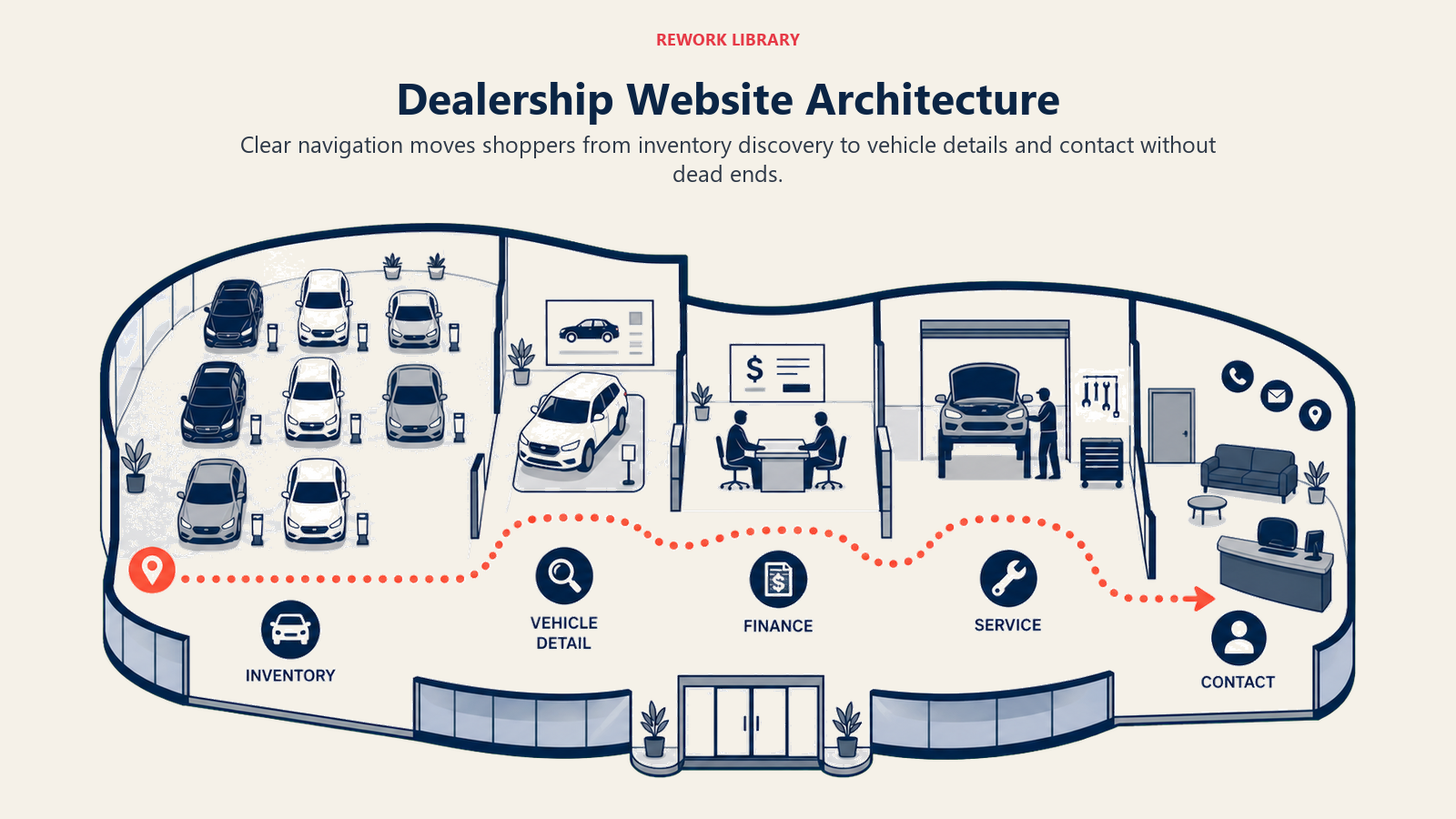
Keep your main navigation to 5-7 top-level items maximum. Common structure:
- New Inventory
- Used Inventory
- Service
- Finance
- About
- Contact
Use dropdown menus sparingly. They work on desktop but create terrible mobile experiences. Consider a simplified mobile menu with quick access to key actions.
Search functionality matters more than you think. Site search users convert at 2-3x the rate of non-searchers. Make your search box prominent. Include both inventory search and site-wide search. Show autocomplete suggestions as users type.
Department access should be intuitive. Service customers shouldn't have to navigate through sales pages to schedule an appointment. Finance applicants shouldn't hunt for the credit application. Clear pathways for different visitor intents.
Quick access to key actions, "Schedule Service," "Value My Trade," "Apply for Credit", should be available from every page via sticky headers or prominent buttons.
Inventory Presentation
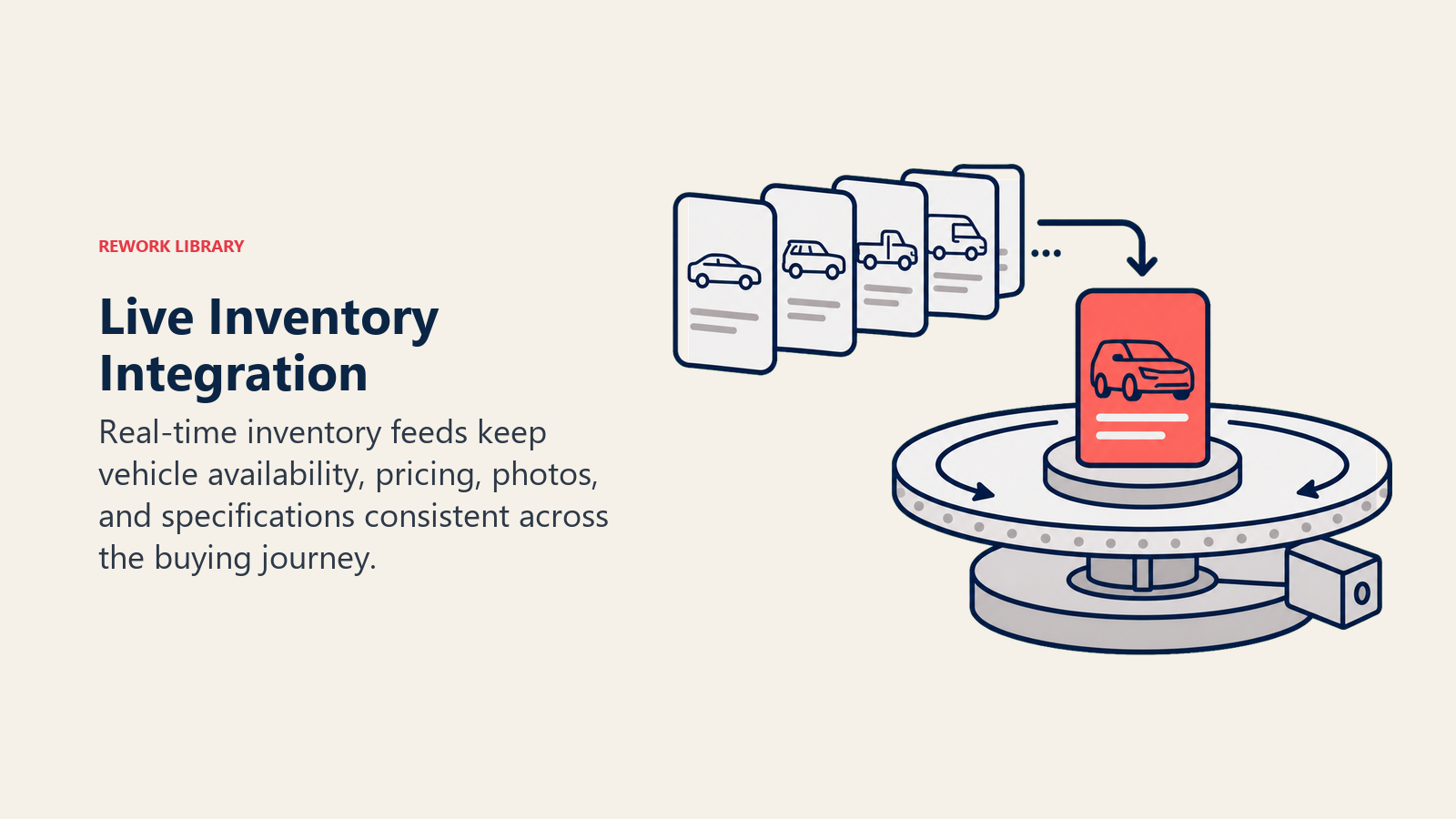
Search and filter functionality is critical. Customers want to narrow 300 vehicles down to the 3 they'll consider. Make it easy with filters for:
- Price range (slider or predefined ranges)
- Mileage (especially for used)
- Year
- Make and model
- Body style
- Drivetrain (AWD, 4WD, FWD)
- Fuel type (gas, hybrid, electric)
- Color (exterior and interior)
- Features (leather, sunroof, navigation)
Sort options should include price (low to high, high to low), mileage, year, newest arrivals, and best match. Default to "newest arrivals" to highlight fresh inventory.
Featured vehicle spotlights work well for units with strong profit margins or that need to move. Don't just feature what you want to sell, feature what customers want to buy.
New arrivals deserve prominent placement. Fresh inventory generates excitement and gives repeat visitors a reason to check back frequently.
Specials and incentives should be visible but not overwhelming. Create a dedicated specials page and feature 2-3 top offers on the homepage. Update monthly at minimum.
Vehicle Detail Page (VDP) Optimization
VDPs receive 75% of your website traffic. They're where buying decisions happen. And yet most dealerships treat them as afterthoughts, auto-generated from DMS feeds with minimal optimization.
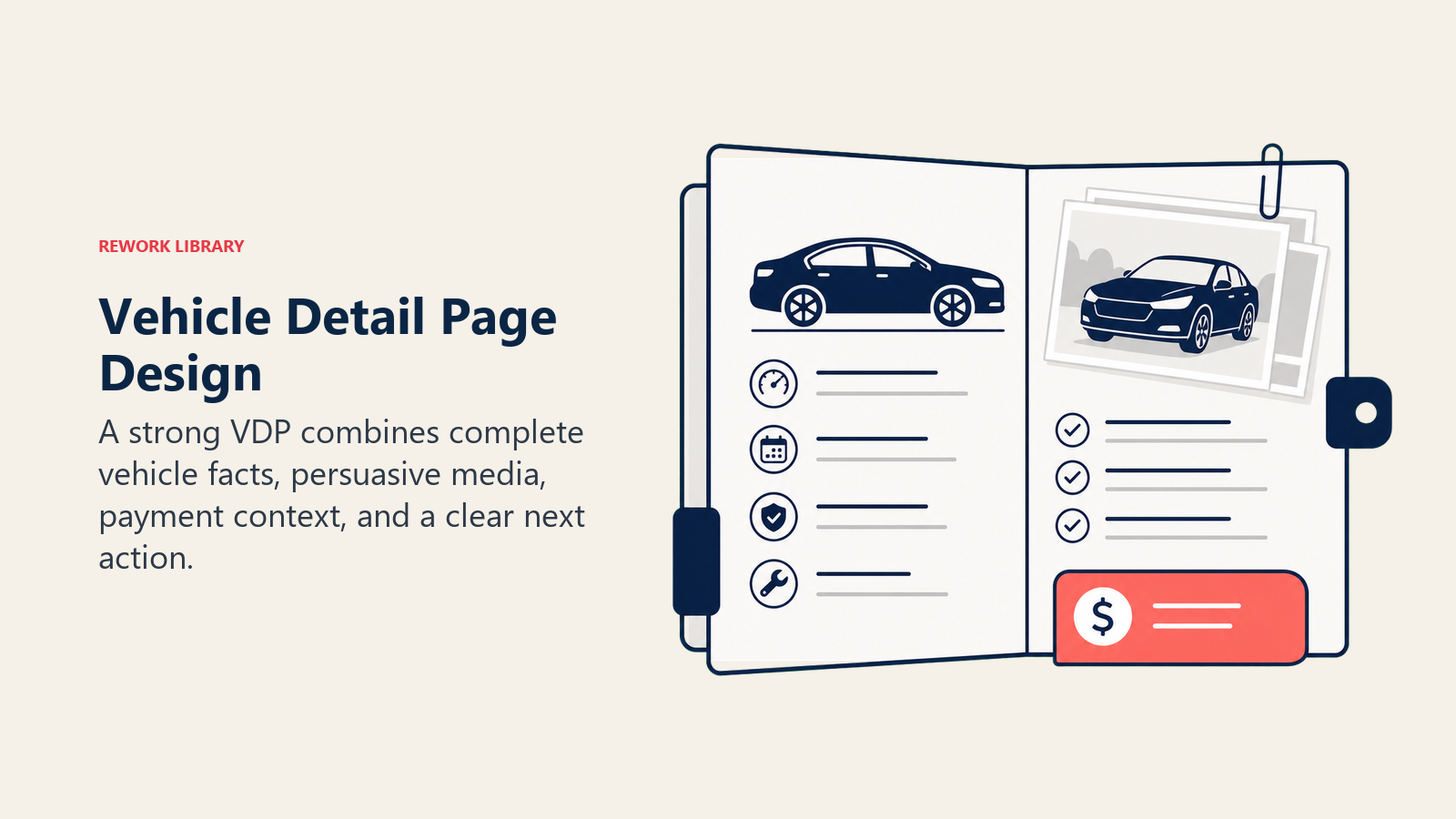
This deserves its own detailed guide, but the essentials:
High-quality photos - 20 minimum, 30-40 ideal. Exterior, interior, features, engine bay. Professional photography when possible. Consistent angles and lighting across your inventory.
Video integration - A 60-second video walkaround increases inquiries by 4x. Even smartphone videos shot by your lot attendants perform well. Movement and narration create engagement.
Detailed specifications - Don't just list standard features. Highlight what matters: safety technology, entertainment systems, performance specs, efficiency ratings.
Payment calculator - Not just a link to a separate page. Embedded right on the VDP with realistic rates and terms. Let customers adjust down payment and term length to see payment impacts. Learn more about online pricing transparency.
Trade-in tools - Integrated appraisal widgets that give instant estimates. Customers can value their trade while looking at your vehicle, making it easier to visualize their net cost.
Clear CTA buttons - Multiple contact options: Call, Email, Text, Chat. Don't make customers choose one forever. Some will call from mobile but email from desktop later. Make all options available.
Similar vehicle recommendations - Show alternatives based on price, type, or features. Keep customers on your site even if their first choice isn't quite right.
For comprehensive VDP optimization strategies, see Vehicle Detail Page Optimization.
Lead Capture Optimization
Every additional form field reduces conversion by 5-10%. The traditional dealer lead form asks for name, email, phone, address, preferred contact method, best time to call, trade-in info, and comments. That's 8-10 fields. You just cut your conversion rate in half.
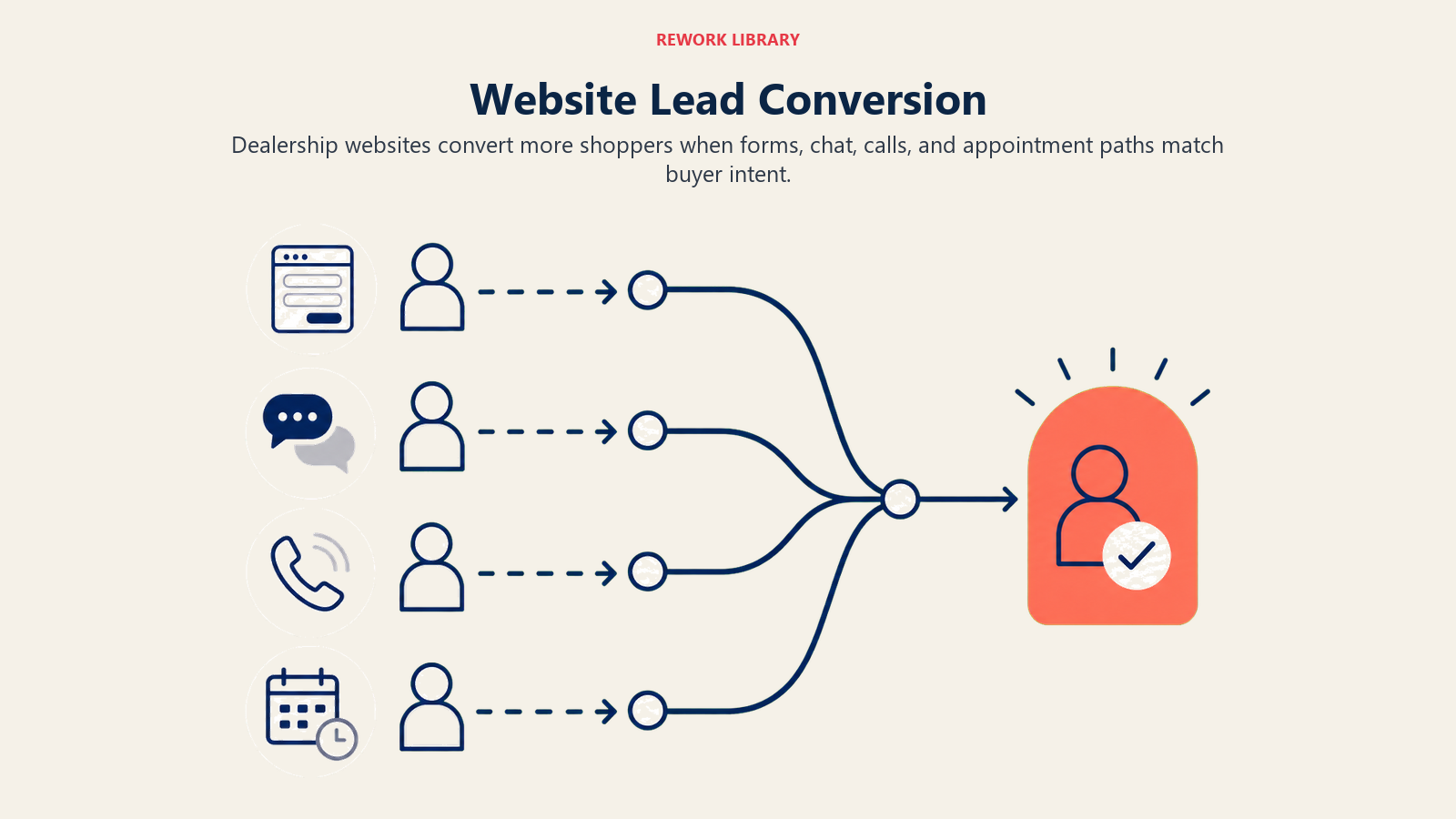
Form simplification is critical. Start with 2-3 fields maximum: name, phone or email, and comments (optional). Use progressive profiling to gather additional information later in the process.
Multiple contact methods respect customer preferences. Some people hate phone calls. Others won't wait for email responses. Offer call, text, email, and chat. Let the customer choose.
Live chat vs chatbot strategy depends on your resources. Live chat converts better (15-25% compared to 8-15% for chatbots) but requires staff. Hybrid approaches work well, chatbot for qualification and after-hours, live agents during business hours.
Lead response time commitment messaging builds trust. "We respond within 10 minutes during business hours" or "Text us and get a response in under 5 minutes" sets expectations and differentiates from competitors who respond in 24+ hours. Implement strong lead response time optimization processes.
Mobile-optimized forms are non-negotiable. Larger input fields, dropdown menus instead of type-ahead, click-to-call buttons that actually dial. Test your forms on multiple devices and screen sizes.
Speed & Technical Performance
Page speed isn't just about user experience. It's a direct ranking factor in Google search results. Slow sites rank lower. And lower rankings mean less traffic and fewer leads. Google reports that a one-second delay in mobile website load time can decrease mobile conversion rate by up to 20%, and dealerships with sites failing Core Web Vitals waste $30 of every $100 spent on advertising.
Image optimization is the biggest opportunity for most dealers. High-resolution inventory photos are necessary but shouldn't slow your site to a crawl. Use modern image formats like WebP. Implement responsive images that serve appropriate sizes based on device.
Lazy loading for inventory listings means images below the fold don't load until users scroll. This dramatically improves initial page load time on inventory search results.
CDN usage (Content Delivery Network) serves your site from servers geographically close to your visitors. This matters more than you think, it can cut load times by 40-60%.
Code minimization and compression reduce file sizes. Your website provider should handle this automatically, but many don't. Ask specifically about minification and GZIP compression.
Hosting infrastructure matters. Cheap shared hosting might save $50/month but cost you thousands in lost leads from slow load times. Invest in quality hosting with SSD drives and adequate resources.
Run Google PageSpeed Insights monthly. Track your mobile and desktop scores. Anything below 70 needs immediate attention. Aim for 85+.
Trust & Social Proof
Car buying involves significant financial commitment and emotional investment. Customers need to trust you before they'll inquire, much less visit.

Review integration from Google, DealerRater, and Facebook should be prominent. Don't just show your overall rating, display recent reviews with customer names and comments. Real feedback from real people.
Customer testimonials in video format convert better than text. A 30-second video of a happy customer talking about their experience is worth 100 written testimonials.
Awards and certifications matter if they're meaningful. "Top Dealer" from your manufacturer carries weight. "Best of Web" from an SEO company nobody's heard of doesn't.
Team photos and bios humanize your dealership. Customers want to know who they'll work with. Feature your sales managers, F&I managers, and service advisors with real bios and photos.
If you don't have enough positive reviews, you've got a bigger problem than website optimization. Fix your customer experience and review management first, then showcase it online.
Service & Fixed Ops Integration
Service generates higher profit margins than sales and produces repeat business. Your website should drive service appointments as aggressively as vehicle sales.
Online appointment scheduling should be simple and available 24/7. No phone calls required. Customers select services needed, choose date and time, and get instant confirmation. Well-designed service appointment scheduling drives fixed ops revenue.
Service specials and coupons need dedicated pages updated monthly. Oil changes, tire rotations, brake inspections, multi-point inspections. Make it easy to find and easy to schedule.
Maintenance reminders can be automated if you integrate your website with your DMS. Send emails to customers due for service with one-click scheduling links.
Parts catalog and online ordering convert DIY customers into parts buyers. Even if you require pickup, making parts searchable and orderable online captures sales that would otherwise go to Amazon or AutoZone.
Service-to-sales crossover is the hidden opportunity. Customers in for service are potential vehicle buyers. Feature new arrivals or trade-in offers on service pages. Make it easy to transition from service customer to sales prospect.
Mobile Experience
With 60-70% of traffic coming from mobile devices, this isn't optional. But mobile optimization goes beyond responsive design.
Click-to-call functionality should be prominent on every page. Phone numbers that dial with one tap. No copy-paste required.
Mobile-optimized forms with larger input fields, appropriate keyboard types (numeric for phone, email for email), and minimal fields required.
Location and hours prominence matter more on mobile. Customers researching on phones often plan to visit soon. Make your address, hours, and directions easy to find.
Speed optimization for mobile networks is critical. 4G and 5G are fast, but not everywhere. Your site needs to load quickly even on slower connections.
Test your mobile experience regularly on actual devices, not just desktop browser simulators. Hand your phone to someone unfamiliar with your site and watch them try to find inventory, get a price quote, and schedule an appointment. Note every frustration point. Optimize the full mobile experience for buyers.
Conversion Rate Optimization (CRO)
Optimization is never finished. Continuous testing and improvement should be built into your marketing process.
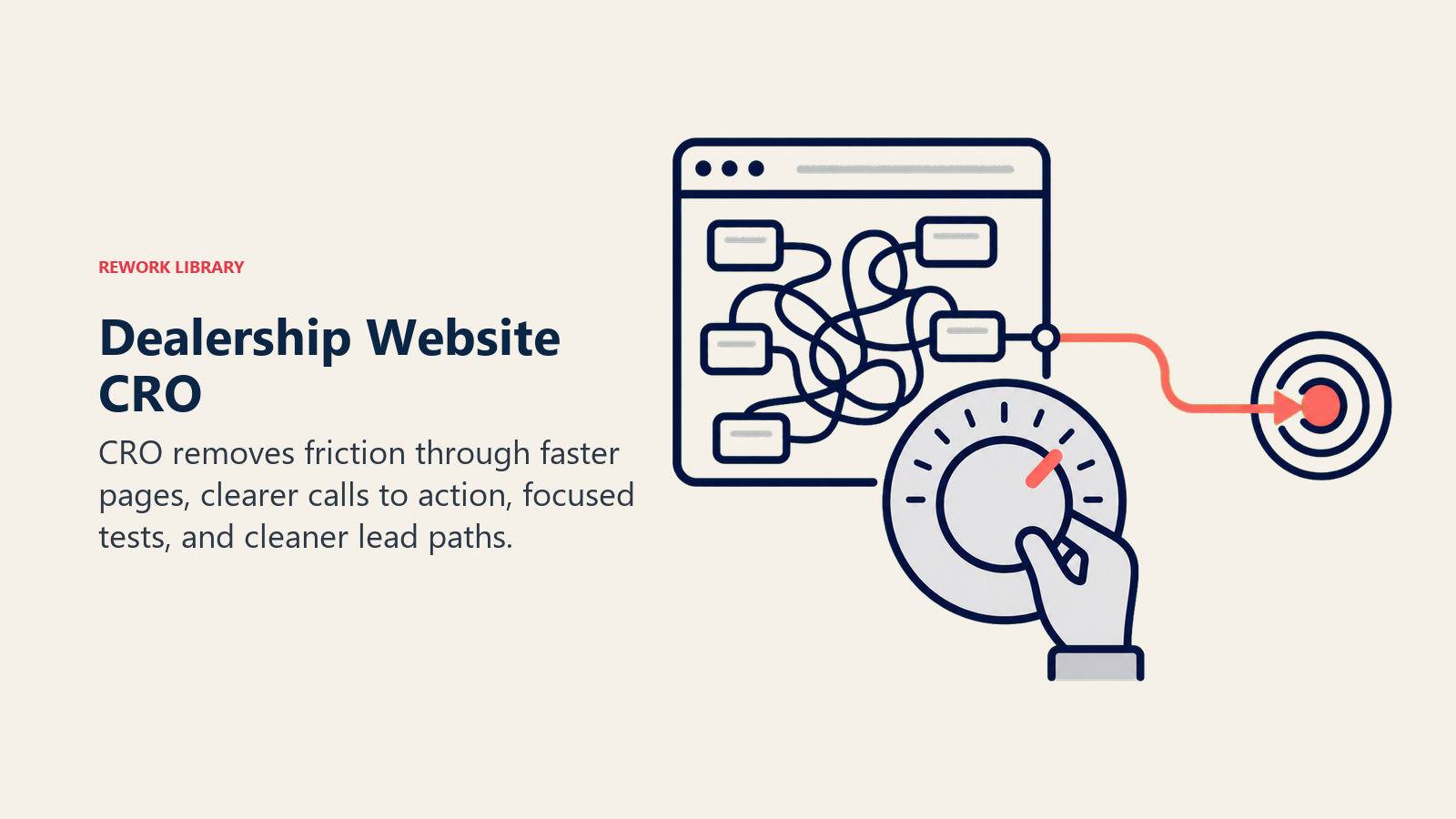
A/B testing framework lets you test different versions of pages against each other. Change one element at a time, CTA button color, headline copy, form placement, and measure which performs better.
Heatmap and user recording tools like Hotjar or Microsoft Clarity show you exactly how visitors interact with your site. Where they click, how far they scroll, where they abandon. This data is invaluable for identifying friction points.
Funnel analysis tracks customer movement through your site. From homepage to inventory to VDP to lead form. Where do people drop off? Why? Fix the biggest leaks first.
Exit intent strategies capture visitors about to leave. Popup offers, special pricing, or chat prompts triggered when users move to close the tab or browser window.
Continuous testing cadence - Top performing dealers run 2-4 tests per month. Small improvements compound over time. A 0.2% conversion increase might not sound impressive until you calculate it across 10,000 monthly visitors.
Moving Forward
Your website will never be "done." Customer expectations evolve. Technology improves. Competitors get better. The dealers who commit to continuous optimization will pull ahead of those who launch a new site and forget about it.
Start with the fundamentals: speed, mobile experience, clear CTAs, and simple forms. Get those right before worrying about advanced features. Track your conversion metrics religiously. Test changes methodically. Learn from data, not opinions.
And remember: the goal isn't to win design awards. It's to convert visitors into appointments, appointments into customers, and customers into repeat buyers. Track your progress with a comprehensive dealership KPI dashboard. Everything else is just decoration.
For specific optimization of your highest-traffic pages, see Vehicle Detail Page Optimization. To implement the digital features customers increasingly expect, explore Automotive Digital Retailing and Chat & Messaging for Dealerships. For driving qualified traffic to your optimized site, check out Automotive SEO Strategy.

Senior Implementation Consultant
On this page
- Website Performance Benchmarks
- Homepage Optimization
- Navigation & Site Architecture
- Inventory Presentation
- Vehicle Detail Page (VDP) Optimization
- Lead Capture Optimization
- Speed & Technical Performance
- Trust & Social Proof
- Service & Fixed Ops Integration
- Mobile Experience
- Conversion Rate Optimization (CRO)
- Moving Forward