Used Vehicle Acquisition - Trade-Ins, Auctions & Direct Purchase Strategies - 2026 Guide
Turn this article into takeaways for your work.


Each assistant summarizes the article only for you and suggests best practices for your work.
Acquisition cost is the single biggest factor in used vehicle gross profit. You can't sell your way out of bad buys. A vehicle purchased wrong stays wrong until you wholesale it at a loss.
Elite used car managers obsess over acquisition. They know exactly what to buy, where to buy it, and how much to pay. They walk away from hundreds of vehicles to acquire the few dozen that fit their criteria perfectly. They're not afraid to pay strong money for the right vehicles, and they're ruthless about passing on everything else.
This discipline separates $3,000 average gross profit used car departments from $1,200 departments.
Acquisition Channel Overview
Not all acquisition sources are created equal.
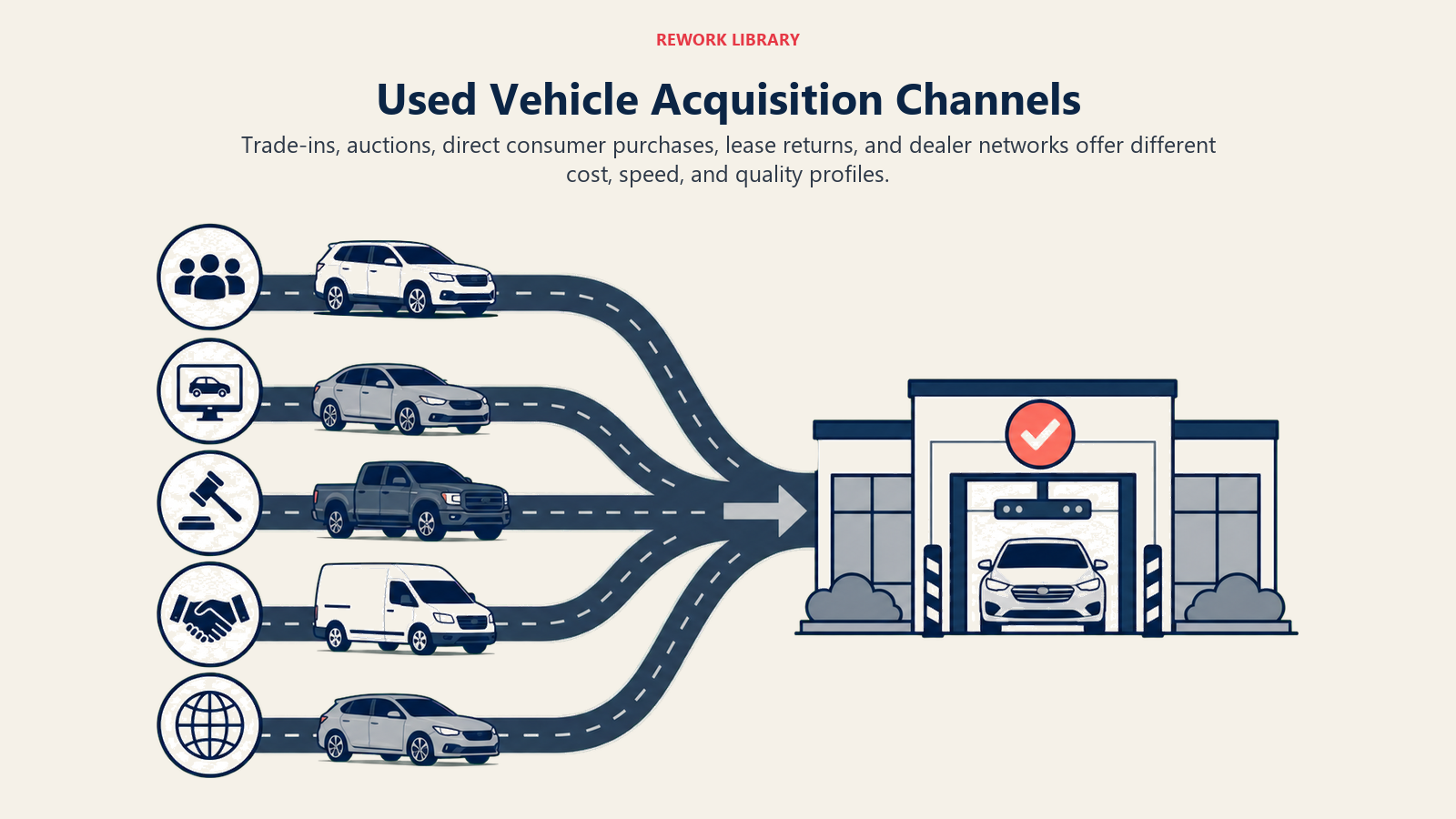
Trade-in retention offers the lowest acquisition cost and highest profit potential. You already own these vehicles, they're coming in regardless. The only question is retail or wholesale. Trade-ins also carry acquisition advantages: you know the customer, you know the service history (if they serviced with you), and you control negotiation timing.
Most franchised dealers retail 40-60% of trade-ins. The rest go straight to auction. That ratio should flex based on reconditioning capacity, inventory needs, and market demand. When inventory is lean, retail more trades. When you're overstocked, be selective and wholesale more.
Auction purchases provide volume and selection. Physical and digital auctions offer hundreds of vehicles weekly. You can acquire 10-20 vehicles per week from auctions if you're disciplined. But auctions are competitive. Everyone has access to the same vehicles. Your edge comes from better evaluation skills, stronger buy limits, and faster reconditioning.
Direct consumer purchases, "We Buy Cars" programs, create acquisition opportunities from customers who aren't buying from you. These programs compete with CarMax, Carvana, and Vroom for purchase volume. The challenge is marketing cost and appraisal accuracy. You need traffic and you need to appraise correctly at scale.
Off-lease vehicle sources provide CPO pipeline inventory for franchised dealers. Captive finance companies (Toyota Financial, Honda Financial Services) offer lease return programs to franchise dealers. These vehicles are often CPO-eligible, have known service history, and carry one-owner clean titles. They're premium acquisition sources, but volume is limited and allocated based on sales performance.
Program vehicles and dealer trades add flexibility. Some manufacturers offer program vehicles (former loaners, rentals, or demos) at wholesale prices. Dealer trades let you swap slow-turning inventory for vehicles that match your market better. Both channels require relationships and willingness to help other dealers.
Channel mix strategy varies by dealership type. Franchised dealers might run 50% trade-ins, 35% auctions, 10% direct purchase, 5% off-lease. High-volume independents might run 30% trade-ins, 60% auctions, 10% direct purchase. Match your acquisition mix to your market position and volume targets.
Trade-In Retention Strategy
Maximizing retention of good trades starts with clear appraisal criteria.
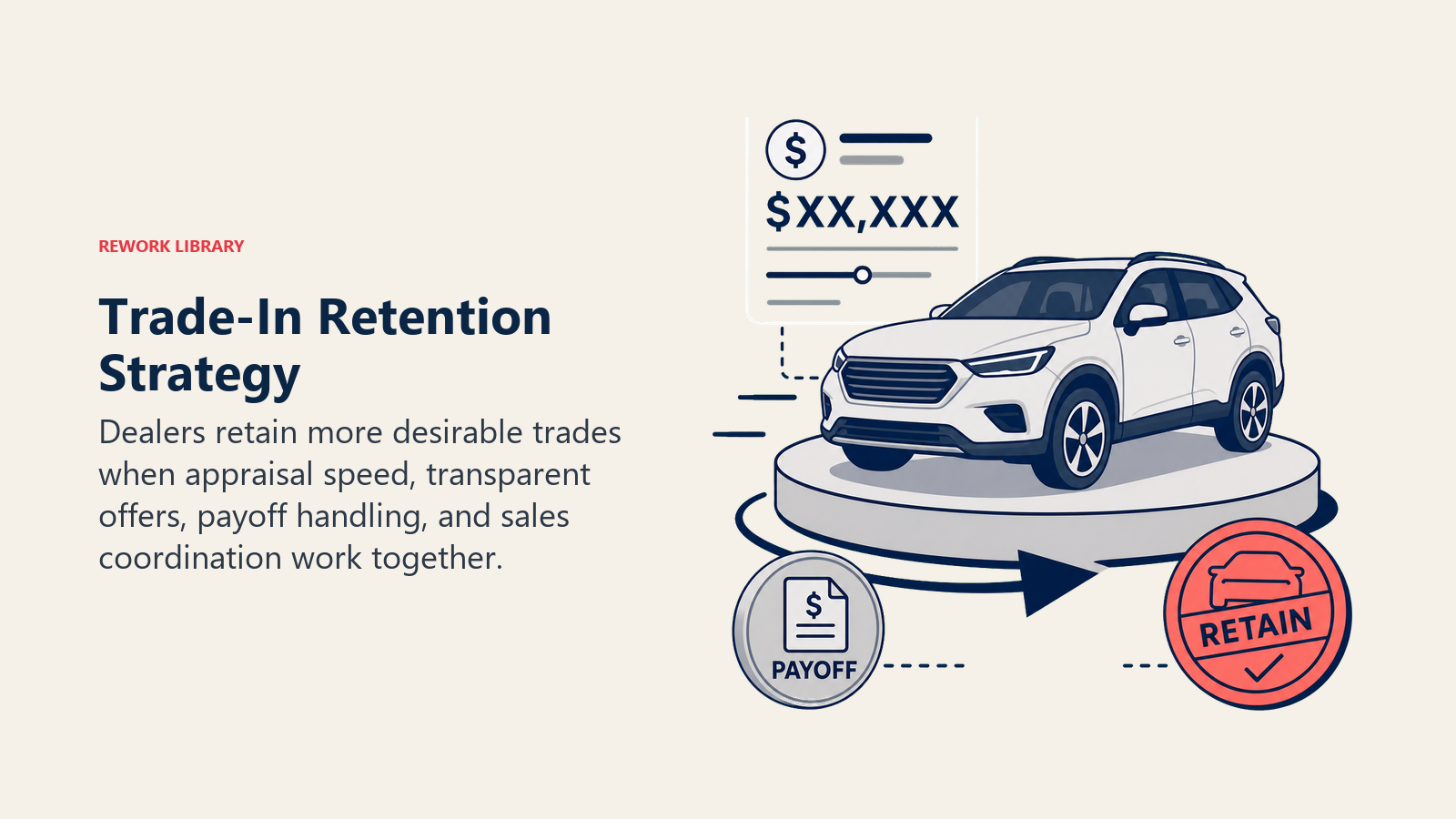
Appraisal guidelines and criteria should be documented. Which makes, models, years, and mileage ranges do you retail? What condition standards must be met? Which title issues are acceptable? When every appraiser follows the same guidelines, you get consistency. Without guidelines, you get chaos, retailing vehicles you should wholesale and wholesaling vehicles you should retail.
Retail vs. wholesale decision framework needs to be fast. You don't have 48 hours to decide. The decision happens during the deal, retail it or wholesale it, right now. Smart dealers use simple decision trees: clean title, under 100,000 miles, no frame damage, popular model in your market, recon under $1,500 = retail. Everything else needs manager approval or goes wholesale.
Age, mileage, and condition sweet spots vary by market. Luxury franchised dealers might retail vehicles up to 7-8 years old because their customers value brand. Mass-market dealers often cut off at 6 years. Mileage sweet spots typically run 20,000-80,000 miles. Below 20,000 suggests the vehicle's too new (expensive). Above 80,000 suggests too high-risk for retail. Condition trumps everything, a clean 85,000-mile vehicle beats a rough 45,000-mile vehicle every time.
Brand alignment considerations matter for franchised dealers. If you're a Toyota dealer, retail Toyota, Lexus, and Honda trades. These vehicles match your customer base, your service department can support them, and you can CPO same-brand trades. Off-brand trades create challenges, your sales team doesn't know them well, your service department may lack expertise, and customers question why you're selling other brands.
Reconditioning cost estimation must happen during appraisal. Walk around the vehicle and mentally calculate recon: $400 for detail and minor touch-up, $800 for brake work, $300 for tire replacement, $500 for dent removal. If estimated recon exceeds $2,000, that vehicle's margin gets squeezed. Factor recon into your retail decision.
Market demand verification prevents stocking vehicles nobody wants. Before retailing a trade, check your market data. How many similar vehicles are for sale locally? What are they priced at? How long have they been sitting? If there are 15 similar vehicles all aged 60+ days, maybe your market doesn't want that vehicle. Wholesale it and move on.
Auction Buying Strategy
Auction acquisition requires preparation, discipline, and speed.
Physical auctions vs. online platforms each have advantages. Physical auctions (Manheim, ADESA) let you inspect vehicles personally, but they require travel time. Online platforms (ACV Auctions, BacklotCars) offer convenience and broader selection, but you rely on condition reports without physical inspection.
Auction selection matters. Not all auctions carry vehicles that fit your market. Manheim typically has higher-quality inventory but higher prices. ADESA offers broader selection. ACV Auctions and BacklotCars focus on dealer-to-dealer trades with fast transactions. Test multiple auctions and concentrate buying at the two that best match your acquisition criteria and budget.
Pre-auction research and vehicle targeting should happen the night before. Most auctions publish online listings 24 hours in advance with photos, condition reports, and vehicle history. Identify 15-20 target vehicles before the auction starts. Know your max bids. Don't show up and buy reactively.
Condition report interpretation is a learned skill. A condition report showing "minor wear" on the interior might mean light scuffing or it might mean torn seats, you won't know until you see it. "Small dent front bumper" could be a $200 repair or a $1,000 repair. Conservative buyers discount condition report vehicles by $300-500 to account for uncertainty. Aggressive buyers accept the risk and adjust bids accordingly.
Buy limits and max bid discipline separate profitable auction buyers from the rest. Set your max bid based on target retail price, estimated recon, target gross profit, and auction fees. If your math says max bid is $17,500, do not bid $17,600 because you really want the vehicle. Walk away. Emotional buying kills profit.
Transportation and logistics add cost and time. If you're buying 200 miles away, transportation costs $200-400 per vehicle and takes 3-7 days. Factor transportation cost and time into your economics. Buying locally is faster and cheaper, but selection is limited.
Auction Purchasing Process
Day-of execution determines whether you buy profitably or emotionally.
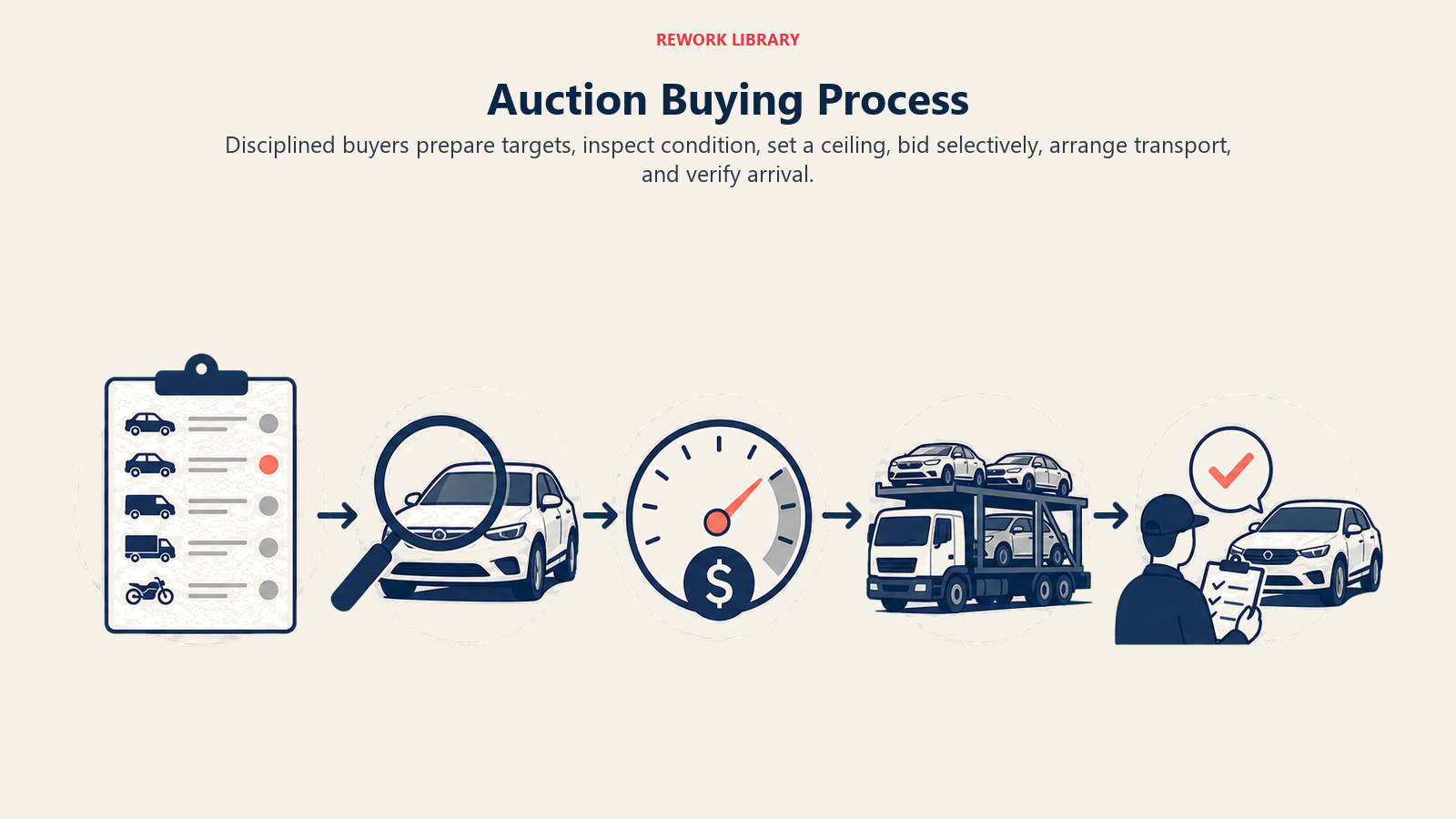
Lane strategy and timing matter more than most buyers realize. Popular models run early in the auction, that's when the most buyers are present and competition is highest. Less popular vehicles run later when many buyers have left. If you're buying commodity vehicles (Camrys, Accords, F-150s), arrive early. If you're buying specialty vehicles, wait until late lanes when competition thins.
Physical inspection when possible gives you information condition reports can't. If the auction allows pre-sale inspection, walk the vehicle. Start it, check for smoke, look under the hood, inspect frame for damage, check tires, smell the interior for smoke or mold. Five minutes of inspection can save you $1,000 in unexpected recon.
Digital auction bidding tactics differ from physical auctions. Most digital auctions use proxy bidding, you set a max bid and the system bids incrementally for you. This prevents emotional bidding but requires accurate max bid calculation. Some platforms allow real-time bidding with countdowns. These create urgency and auction fever. Stick to your max bid regardless of platform.
Post-sale arbitration understanding protects you from bad vehicles. Most auctions offer arbitration periods (typically 24-72 hours) where you can return vehicles with undisclosed damage or title issues. Know your arbitration rights. If you discover frame damage not disclosed in the condition report, arbitrate immediately. Don't accept bad vehicles just because you bought them.
Title and payment processing needs to happen fast. Most auctions require payment within 24-48 hours. Have floorplan financing lined up and ready. Delayed payment can result in penalties or loss of auction privileges. Title transfers can take 2-4 weeks depending on the state. Plan for title delays and don't sell vehicles until you have the title in hand.
If-bid and proxy bidding let you buy even when you can't attend. If-bids are max bids submitted before the auction. If the vehicle runs and bidding stays below your if-bid, you win. Proxy bidding (online platforms) works similarly. Both tactics let you buy 24/7 without attending auctions personally. But both require trust in condition reports since you're not inspecting vehicles.
Direct Consumer Acquisition
"We Buy Cars" programs create acquisition channels independent of your sales funnel.
Marketing for direct purchases requires visibility and trust-building. Billboard advertising, digital ads, and website pages promoting "sell us your car" drive traffic. But customers won't sell to you unless they trust you'll offer fair value. Your reputation matters more in direct purchase than in trade-ins because there's no reciprocal sale.
Online appraisal tools provide instant offers to consumers. Customers enter their VIN, mileage, and condition info, and your system generates an instant cash offer. These tools (often powered by third-party software like vAuto or Black Book Instant Cash Offer) create convenience but risk over-appraising if customers inflate condition ratings. Build conservatism into your offer algorithms.
Instant cash offer process needs to be fast. The customer submits information online, receives an offer immediately (or within 30 minutes), schedules an appointment for inspection, and receives payment same-day if the vehicle matches the described condition. Any delay or friction in this process costs you acquisitions. CarMax and Carvana set customer expectations for instant, easy transactions. Match or exceed their process speed.
Inspection and verification prevents bad buys. The instant offer is preliminary, subject to verification. When the customer arrives, inspect the vehicle thoroughly. Verify VIN, confirm mileage, check for undisclosed damage, test drive, and confirm title status. If the vehicle matches the description, honor the offer. If it doesn't, renegotiate or decline. Transparency prevents customer complaints.
Purchase without sale requirement differentiates you from trade-in acquisition. Customers don't have to buy a vehicle from you to sell their vehicle to you. This expands your acquisition volume but reduces backend profitability since there's no F&I opportunity. Build this cost into your acquisition math, direct purchase vehicles need stronger margins since there's no backend profit.
Competitive with Carvana, CarMax, Vroom means matching their offers closely. These companies use aggressive pricing to acquire inventory. They'll overpay by $500-1,000 on some vehicles to maintain acquisition volume. You don't need to match every offer, but if you're consistently $1,500-2,000 below their offers, customers will sell elsewhere. Be competitive on desirable vehicles, let them overpay for undesirable ones.
Off-Lease Vehicle Sources
Lease returns create CPO pipeline inventory for franchised dealers.
Manufacturer lease return programs notify dealers when lease customers are nearing return dates. You get first right of refusal to purchase the vehicle before it goes to auction. These vehicles are typically 2-4 years old, under 45,000 miles, and one-owner with full service history. They're premium inventory if you can acquire them at the right price.
Captive finance lease returns flow through brand-specific channels. Honda Financial Services offers lease returns to Honda dealers. Toyota Financial Services prioritizes Toyota dealers. Understanding captive finance programs helps optimize acquisition opportunities. Volume and relationship determine your access. High-volume dealers with strong payment history get priority notification.
CPO eligibility and certification make lease returns attractive. Many lease returns qualify for certified pre-owned programs due to age, mileage, and condition. CPO vehicles command $1,500-3,000 premiums and carry factory-backed warranties. If you can acquire a lease return at $18,000, certify it for $800, and retail it as CPO for $23,500, that's strong margin.
Volume advantages and pricing come from consistent participation. If you buy one lease return monthly, you're not a priority. If you buy 10-15 monthly, captive finance companies prioritize your access and may offer better pricing. Build volume in lease return acquisition to negotiate favorable terms.
Reconditioning standards on lease returns tend to be lower than auction purchases. Lease customers maintain vehicles better on average because they're turning them in for inspection. But lease returns aren't perfect, expect normal wear, minor cosmetic issues, and maintenance needs. Budget $800-1,500 for recon on typical lease returns.
Vehicle Valuation and Pricing
Acquisition cost discipline starts with accurate valuation.
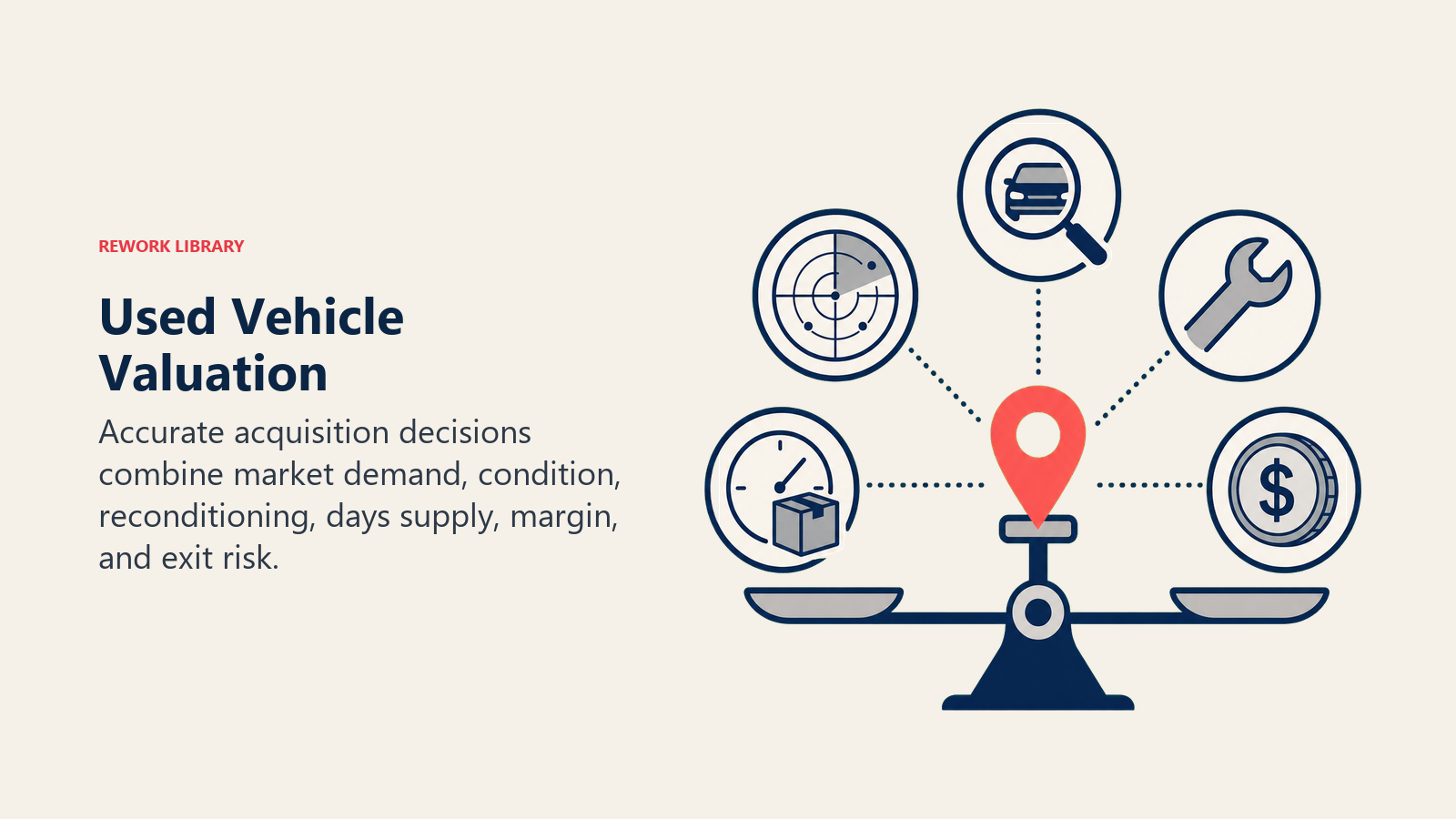
Using multiple valuation sources prevents overreliance on one data source. Check MMR (Manheim Market Report), Black Book, and KBB dealer pricing. If all three sources cluster around $19,500-20,500, you've got confidence. If they vary widely ($18,000 to $23,000), dig deeper to understand why. Look at actual sold listings, not asking prices.
Adjusting for condition and market means taking book values and modifying based on what you see. A "clean" vehicle per Black Book gets full value. An "average" vehicle gets $500-800 less. A "rough" vehicle gets $1,500-2,000 less. Local market adjustments matter too, a 4×4 truck in Colorado is worth $2,000 more than the same truck in Florida.
Target margin backing into max cost creates acquisition discipline. If you target $3,200 front-end gross, plan for $1,200 recon, estimate retail price at $24,500, and factor in $400 auction fees, your max acquisition cost is $19,700. That's your walk-away number. If bidding exceeds $19,700, you pass.
Regional market variations are real. West Coast markets typically run $1,000-2,000 higher than Midwest markets for the same vehicle. Southern markets favor trucks. Northern markets favor AWD. When buying at auction, account for regional price differences. Don't buy California-priced vehicles to sell in Oklahoma unless you adjust your retail pricing.
Reconditioning budget inclusion is mandatory. Never buy a vehicle without estimating recon cost. If you pay auction price without factoring in recon, you'll discover your gross profit evaporated into recon expenses. Walk the vehicle, estimate recon, include it in your cost calculation.
Acquisition Criteria and Guidelines
Quality control starts with clear buying criteria.
Age and mileage parameters depend on your brand and market. Luxury dealers might retail 6-8 year old vehicles successfully. Mass-market dealers often stop at 6 years. Mileage limits typically range from 80,000-100,000 miles depending on the vehicle. High-mileage luxury vehicles are harder to retail than high-mileage Camrys and Accords. Know your market's tolerance and stay within it.
Condition standards prevent retailing vehicles that need major repair. No frame damage, no salvage titles, no flood or fire damage, no check engine lights, no transmission issues. These are hard stops. Even if the price is tempting, vehicles with major issues become problems. They sit, they need unexpected repairs, they generate customer complaints post-sale.
Title issues to avoid include salvage, rebuilt, branded titles (flood, hail, lemon law buyback), and theft recovery. Some dealers retail these vehicles at deep discounts. Most dealers avoid them entirely. Clean title is standard customer expectation. Branded titles require disclosure, create financing challenges, and limit resale value. The discount needed to retail branded titles often exceeds the acquisition savings.
High-risk makes and models should be avoided unless you have specific expertise. Some vehicles have known reliability issues, expensive repair costs, or poor resale value. German luxury vehicles past 80,000 miles can be money pits. Certain domestic models have transmission issues. Do your research and avoid known problems.
Technology and equipment preferences vary by market. In tech-forward markets, backup cameras, navigation, and advanced safety features are expected. In budget markets, these features are nice but not required. Know what your market values and prioritize those features in acquisition.
Matching current inventory gaps ensures you're not stacking similar vehicles. If you've got five Honda Accords in inventory, stop buying Accords and focus on segments where you're thin. Inventory diversification reduces risk and improves turn rate.
Technology and Tools
Data-driven acquisition requires software investment.
Market-based pricing tools like vAuto and ProfitTime GPS analyze real-time market data to determine optimal acquisition prices. Instead of relying on Black Book values from 30 days ago, these tools show you what similar vehicles are actually selling for right now in your market. They also predict days-to-turn based on your price point. This lets you make informed buy decisions.
Auction mobile apps from Manheim, ADESA, and ACV Auctions let you bid from anywhere. You don't need to attend auctions physically. Pre-auction research, bidding, and post-sale management all happen on mobile. This increases your buying opportunities without travel costs.
Inventory management systems track acquisition source, costs, recon expenses, holding time, and gross profit by vehicle. This data reveals which acquisition channels produce best results. If auction purchases average $2,800 gross profit but take 45 days to sell, and trade-ins average $3,200 gross profit and sell in 30 days, prioritize trade retention.
Predictive analytics use machine learning to forecast turn rates and profit potential. Input vehicle details (make, model, year, mileage, price) and the system predicts: "38-day turn at $3,100 gross profit" or "62-day turn at $1,800 gross profit." This helps you pass on vehicles that look good but won't perform.
Turn and profit reporting by acquisition source shows you where to focus. If direct purchases generate 18% ROI but auctions generate 12%, shift more resources to direct purchase marketing. Data-driven decisions beat gut feel every time.
Acquisition is where used vehicle profit is won or lost. Buy right, everything else gets easier. Buy wrong, nothing else matters. Elite used car managers understand this reality and obsess accordingly.