Inventory Turn Optimization - The Path to Higher Profitability - 2026 Guide
Turn this article into takeaways for your work.


Each assistant summarizes the article only for you and suggests best practices for your work.
The math is brutal and unavoidable: a dealer turning inventory every 45 days makes more money than a dealer turning inventory every 75 days, even if they're making identical gross profit per vehicle. Why? Because the 45-day dealer cycles their capital more times per year, generating more total gross profit from the same inventory investment.
High-performing dealerships understand this relationship instinctively. They turn inventory every 30-45 days while maintaining adequate selection for shoppers. Their slow-turn competitors at 75+ days aren't just moving vehicles slower, they're sacrificing $200K+ annually in unnecessary floorplan interest, depreciation, and opportunity costs. That's real profit walking out the door every month.
Inventory turn isn't about rushing sales or sacrificing gross profit. It's about deploying working capital efficiently, aligning inventory with market demand, and creating systems that keep fresh vehicles flowing through your lot at optimal velocity.
Understanding Turn Economics
The return on inventory investment calculation is straightforward: gross profit per vehicle multiplied by annual turns. If you average $2,500 gross per used vehicle and turn inventory 10 times per year (roughly 36 days), you're generating $25,000 annual gross per inventory slot. A competitor averaging the same $2,500 gross but turning 6 times per year (60 days) generates only $15,000 per slot.
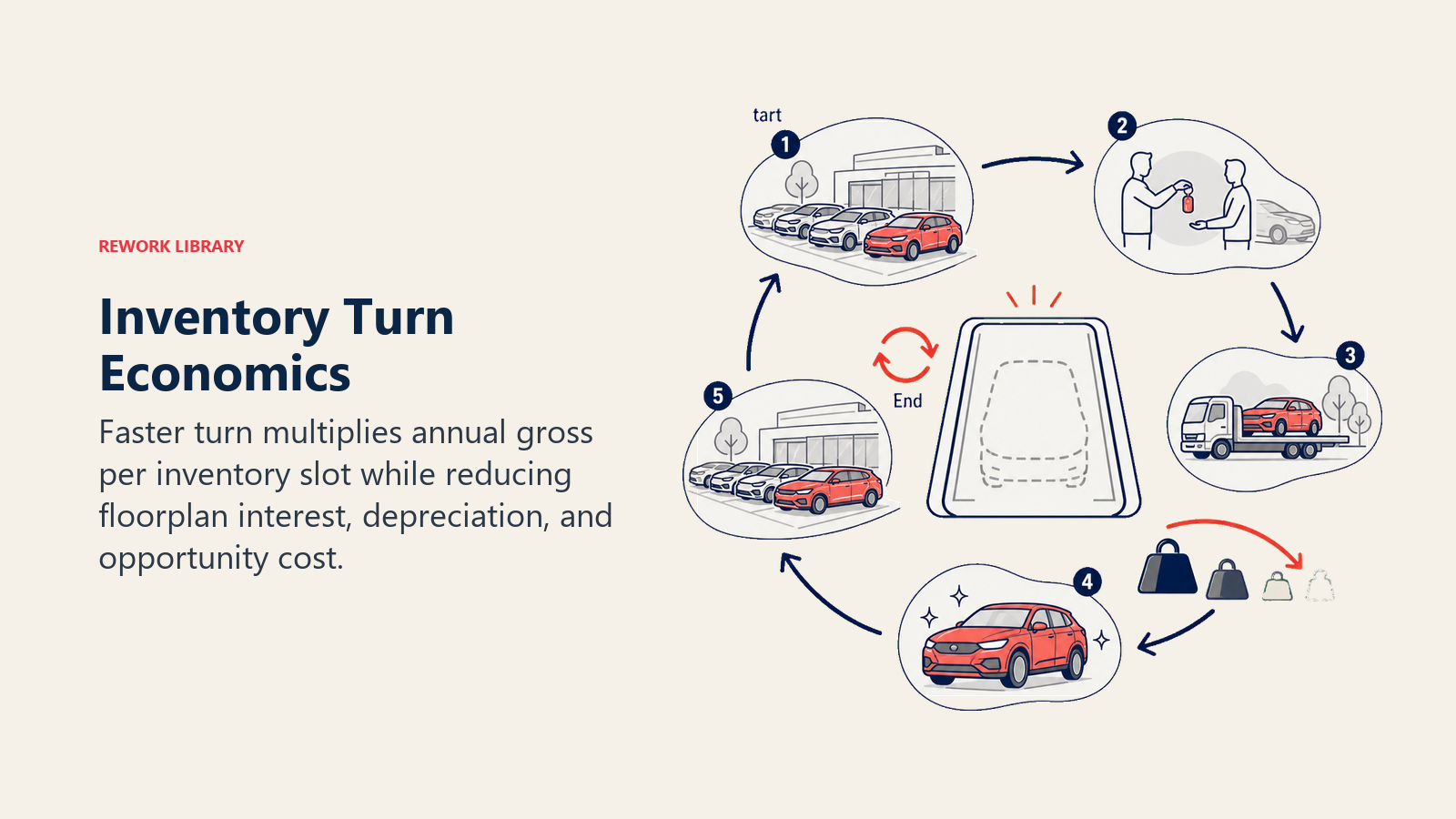
That difference scales dramatically across your entire inventory. With 100 used vehicles on the lot, the fast-turn dealer generates $2.5M in annual gross while the slow-turn dealer generates $1.5M, a million-dollar difference from the same inventory investment and same per-vehicle gross. Turn rate multiplies your effectiveness.
But turn rate alone doesn't tell the full story. You need to account for the costs accumulating while vehicles sit. Floorplan interest runs $150-300 per vehicle per month depending on your interest rate and the vehicle's value. Over 12 months of holding inventory, you might pay $30K-50K in floorplan costs on a 100-vehicle inventory. Faster turn directly reduces this expense.
Depreciation hits every day a vehicle sits on your lot. Most used vehicles depreciate $100-200 monthly, though trucks and SUVs during spring/summer months can depreciate faster. Electric vehicles and luxury segments often depreciate even more aggressively. Cox Automotive's 2026 forecast predicts a return to normal depreciation patterns, with used vehicle values rising approximately 2% year-over-year. This depreciation is real, when you finally sell that 90-day-old unit, market value has dropped $300-600 from where you started.
Then there's opportunity cost, the hardest cost to see but often the most expensive. Capital tied up in slow-turning inventory can't be deployed into fast-turning alternatives. If you've got $400K in aged inventory sitting 90+ days, that's $400K you can't use to acquire fresh units that would turn in 35 days. The foregone profit from those missed opportunities often exceeds your floorplan interest costs.
Ideal Turn Rates by Type
New vehicle inventory typically turns every 45-60 days in healthy markets through effective new vehicle inventory management. According to NADA industry standards, the gold standard is 12 inventory turns annually (approximately 30 days), though actual performance varies significantly by brand and market. Faster than 45 days usually means you're under-stocked and missing sales opportunities. Slower than 60 days suggests you're over-allocated in slow-moving models or colors. Most OEMs provide turn guidance, but your local market might differ from national averages.
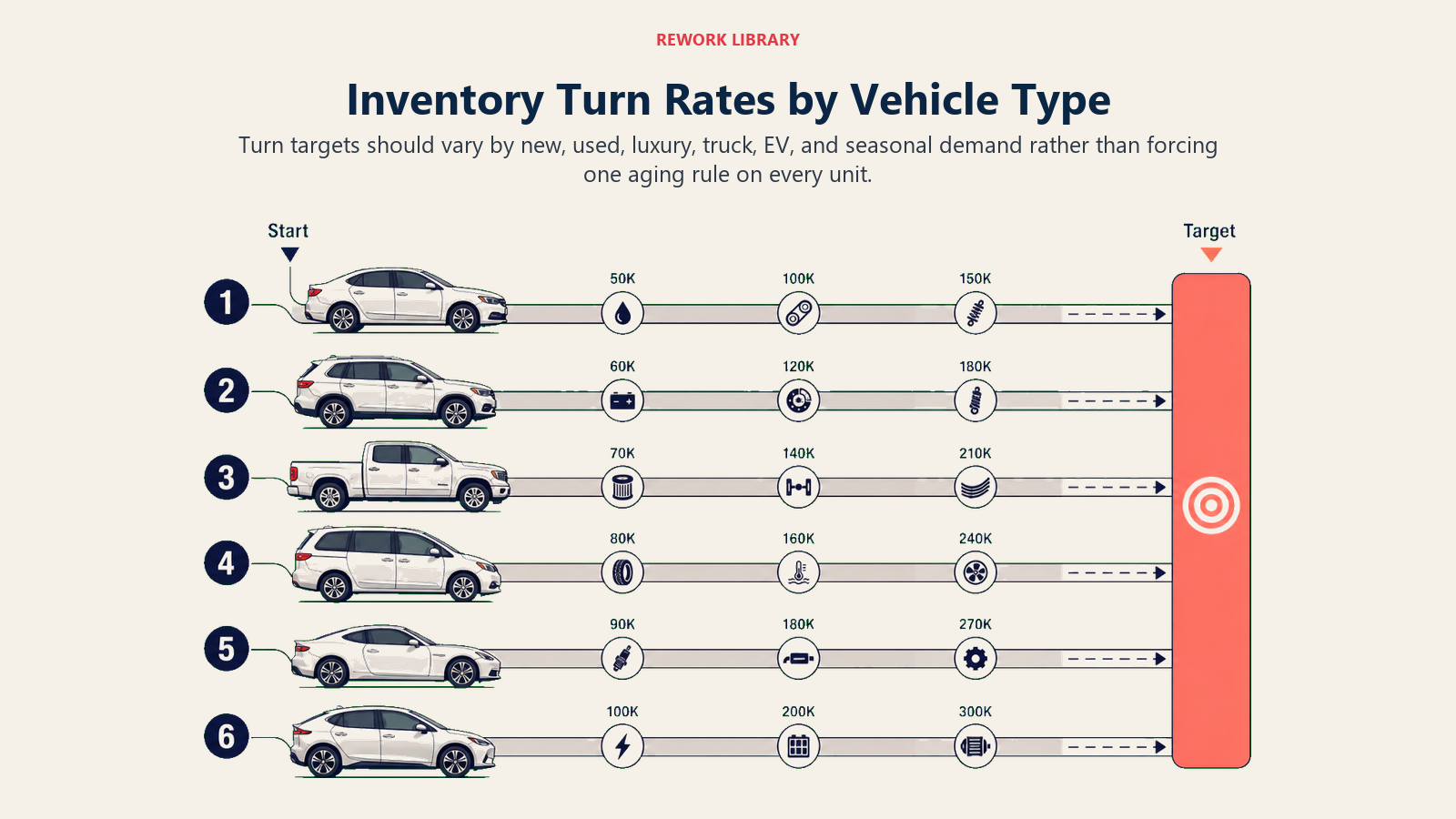
Certified pre-owned inventory should turn faster than new, typically 35-50 days. CPO vehicles compete with both new and used alternatives, so they need aggressive pricing and strong merchandising to move quickly. The certification process and warranty backing justify premium pricing, but only if shoppers perceive value. If your CPO inventory is turning slower than regular used, you've got a pricing or positioning problem.
Core used vehicle inventory performs best at 30-45 day turn rates. These are your bread-and-butter units: popular makes and models, mainstream pricing, broad appeal. This inventory should flow quickly because you're stocking to market demand. If core inventory is sitting 60+ days, you're either acquiring wrong, pricing wrong, or merchandising wrong.
Age and mileage outliers, the 10-year-old truck or the higher-mileage luxury vehicle, might run 60+ days and that's acceptable if you've priced them right and built in appropriate margin. These aren't core inventory. You're taking calculated risks on specific units where wholesale values are soft but retail demand might support premium pricing. Just limit how many of these you carry at once.
Right-Sizing Total Inventory
The most common mistake dealers make is carrying too much inventory relative to sales velocity. They convince themselves that more selection drives more sales, but the data doesn't support it. Beyond a certain threshold, additional inventory doesn't increase sales, it just increases carrying costs and average age.
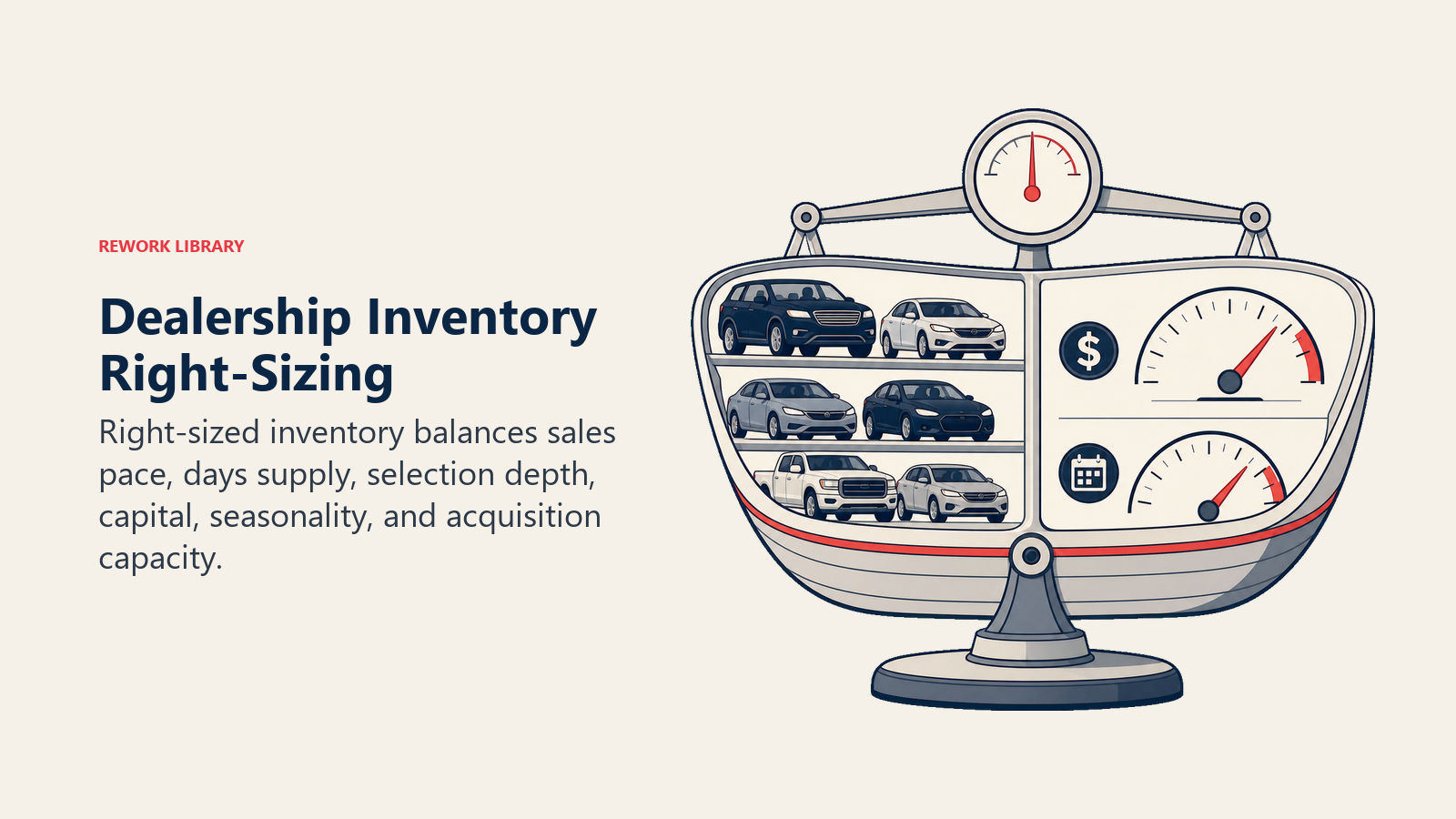
Calculate your ideal inventory level by working backward from sales velocity through dealership economics analysis. If you're retailing 50 used vehicles monthly and targeting 40-day turn, you need roughly 67 units on the ground at any given time (50 × 40 / 30). Carrying 100 units doesn't double your sales, it just means 33 vehicles are excess inventory slowing your turn rate and costing money.
But raw inventory count matters less than segment mix. You might need 70 total units to achieve 40-day turn if you're properly diversified across segments. Twenty units in compact cars, fifteen in mid-size SUVs, twelve in trucks, eight in luxury, fifteen in economy, whatever matches your local market demand. The dealers who struggle with turn are usually over-concentrated in segments with low local demand.
Days supply by segment is your guide here. If there are 120 used RAV4s within 50 miles and you're stocking six, you've got 45+ days supply assuming equal market share. That's appropriate. If there are 40 used Wranglers locally and you're stocking six, you've got 15 days supply, too lean. You'll sell out and miss opportunities. Right-sizing by segment, not just total count, optimizes turn.
Acquisition Discipline Drives Turn
Fast inventory turn starts with smart acquisition. Buy vehicles the market wants, in the condition market wants, at prices that allow competitive retail pricing. That sounds obvious, but most slow turn problems trace back to poor acquisition decisions that looked fine at the time.
Age and mileage parameters should be data-driven, not arbitrary. Review your last 100 sales by vehicle age and mileage. You'll probably find that 70-80% fall within specific ranges. Those ranges are your sweet spot, acquire there consistently through used vehicle acquisition and auction buying strategy. The outliers you sold likely sat longer and delivered lower gross. Avoid repeating those mistakes.
Off-brand inventory deserves scrutiny. If you're a Toyota dealer, acquiring Toyotas makes sense, you understand the product, service capabilities are strong, and shoppers trust your expertise. Acquiring Chrysler products because they're cheap at auction usually backfires. Shoppers don't expect Chrysler inventory from Toyota dealers, you can't service them as competently, and you'll hold them longer while trying to find the right buyer.
Wholesale discipline prevents turn problems before they start. Just because a vehicle is cheap doesn't mean it's a good buy. A $15K wholesale on a vehicle you'll retail for $19K isn't a bargain if comparable units sit 75 days. You'll pay $300-400 in floorplan interest and face $200-300 in depreciation. Your $4K margin becomes $3,300 if you're lucky, and that's if you sell it before 90 days and wholesale becomes the better option.
Balancing Turn and Gross
The tension between turn velocity and gross profit per unit creates constant decision-making pressure. Hold for higher gross and accept slower turn? Or price aggressively for faster turn and accept lower gross? There's no universal answer, it depends on vehicle type, market conditions, and your capital situation.
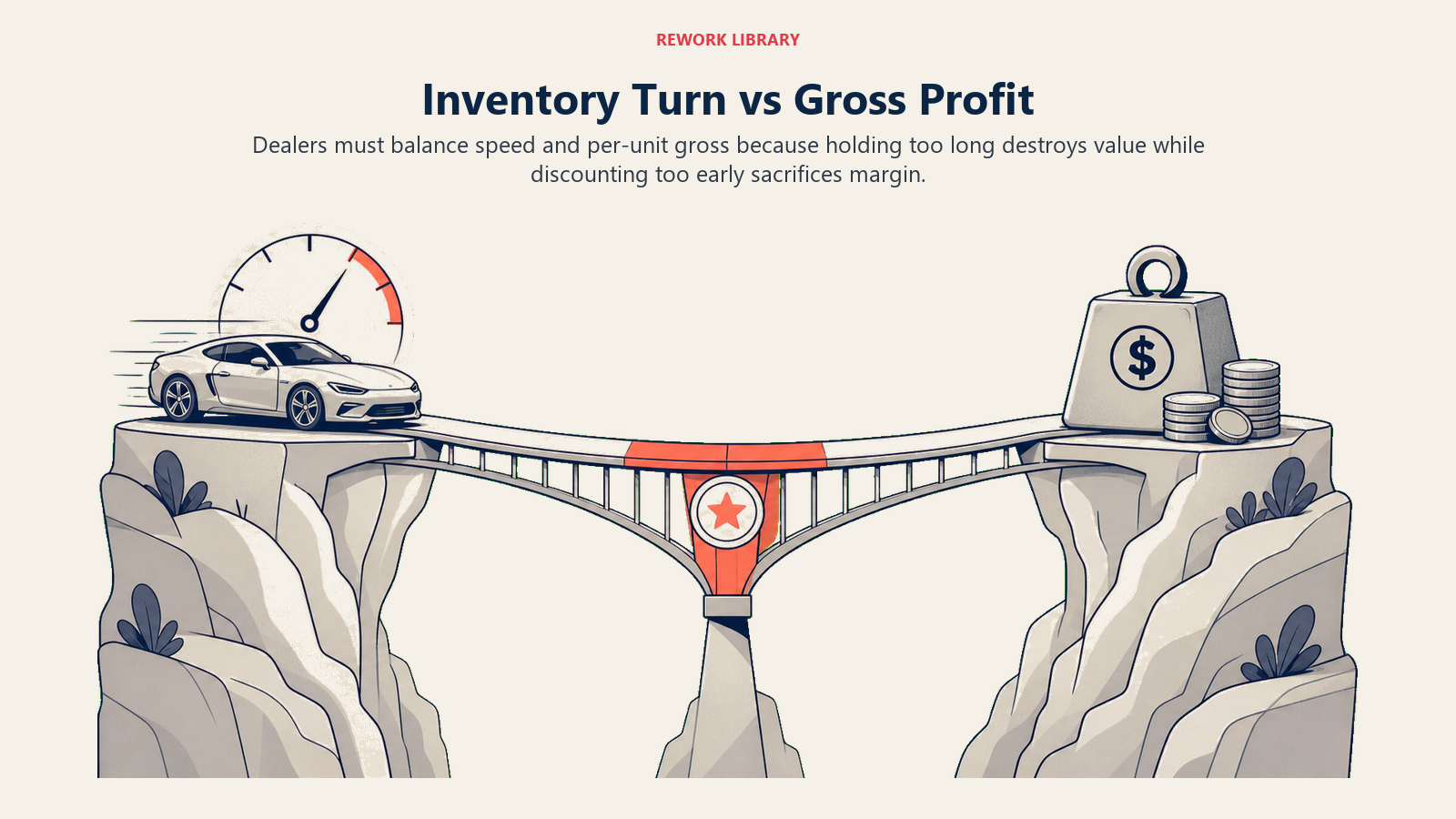
High-margin opportunities where you've got $5K+ potential gross often justify slower turn. A unique specialty vehicle, a recently discontinued model with strong demand, a low-mileage luxury unit, these deserve patience if market indicators support holding through strategic pricing. Just set clear thresholds. If you're not seeing serious shopper interest by day 45, reevaluate. Don't fall in love with potential gross that may never materialize.
Common inventory with commodity characteristics should prioritize turn over gross. Late-model Camrys, RAV4s, F-150s, these aren't rare. Price them to move in 35-40 days and keep fresh units flowing through. You'll make $2,000-2,500 per unit instead of $3,500, but you'll do it eight times per year instead of five. The math favors velocity.
Category management by segment formalizes this approach. Establish turn and gross targets for each segment in your inventory. Trucks: 45-day turn, $3,500 gross. Compact cars: 35-day turn, $2,200 gross. Luxury vehicles: 55-day turn, $4,200 gross. These targets align acquisition decisions, pricing strategy, and wholesaling discipline with realistic market conditions by segment.
Managing Long-Tail Inventory
Every dealer has aged inventory, it's not whether you'll have 90-day+ units, it's how many and what you do about them. The best dealers treat aged inventory as a crisis requiring immediate action. The worst dealers let it accumulate while hoping market conditions improve.
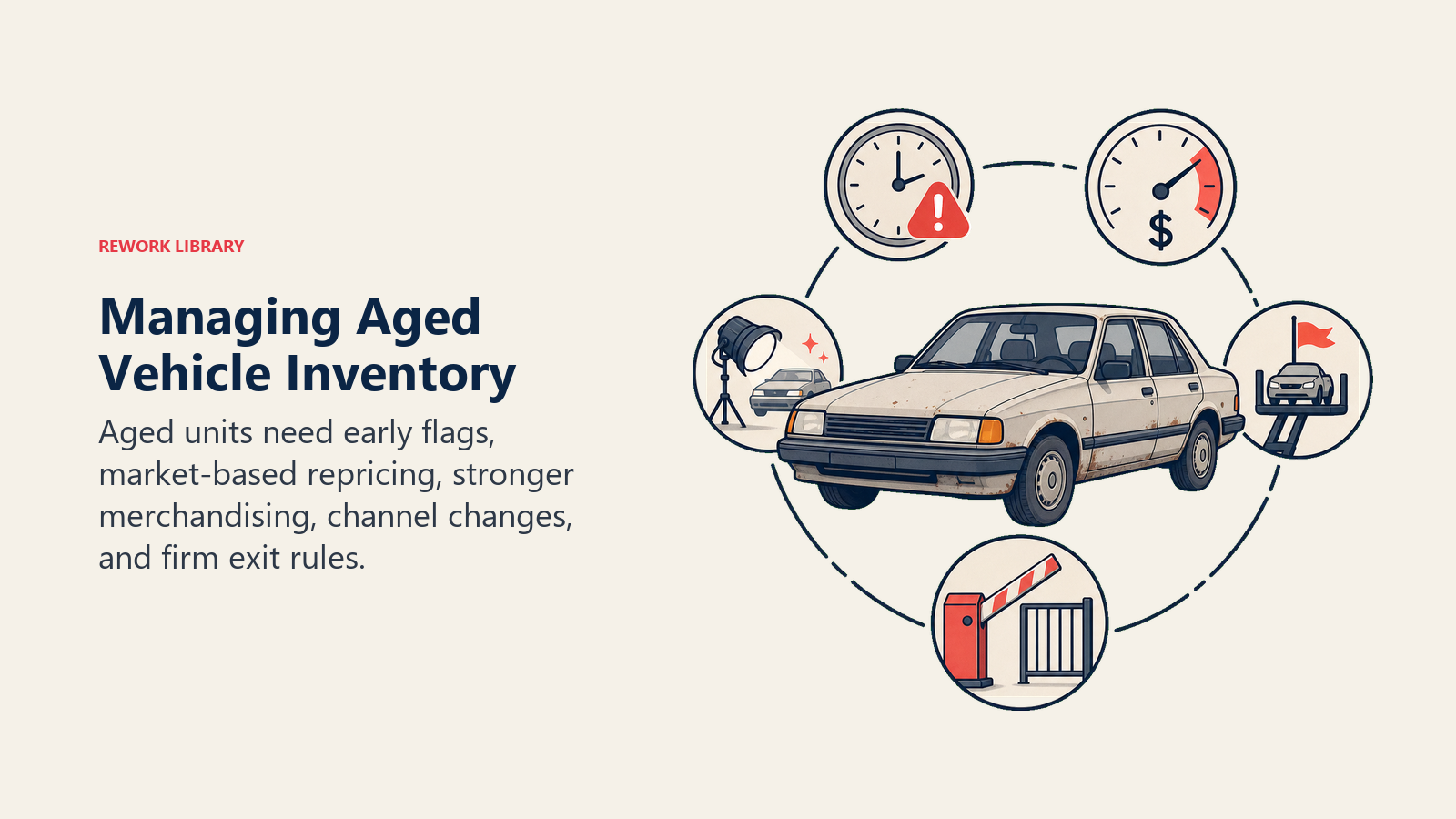
At 90 days, establish a 30-day action plan for every unit. Option one: aggressive price reduction of $1,500-$2,500 below market leaders. Option two: additional reconditioning investment if the vehicle has issues preventing sale. Option three: increased marketing spend including boosted social media ads or third-party lead generation. Option four: wholesale evaluation and immediate decision.
These action plans should be documented and reviewed weekly. What's the status of that 95-day Accord? Have we executed the $2,000 price drop? Have we generated any additional leads? Have we received updated wholesale bids? This visibility forces accountability and prevents units from drifting to 120+ days through inattention.
Marketing spend allocation should favor aged units strategically. Spending $300 on targeted Facebook ads for a 95-day unit where you're $4,000 away from wholesale bid makes sense if it generates serious interest. Spending that same $300 on a fresh 20-day unit that's already generating organic traffic doesn't. Focus marketing dollars where they can solve specific turn problems.
Wholesale timing decisions require discipline over emotion. If wholesale bid is within $1,000 of breakeven after factoring in all costs, take it. If you've had zero serious interest for 45 days despite pricing adjustments, take it. If you've dropped price twice without changing shopper behavior, take it. These rules override your gut feeling that "someone will pay my number eventually." Maybe they will. Probably they won't.
Building Systems and Reporting
Daily turn rate monitoring by department and manager creates accountability. Your used car manager should know their current turn rate, how it compares to last month, and which specific vehicles are impacting performance. This transparency drives better decisions in acquisition, pricing, and wholesaling.
Stocking mix analysis against sales mix reveals misalignment through your automotive CRM. If 35% of your sales are compact SUVs but only 20% of your inventory is compact SUVs, you're under-stocked in a fast-turn segment and likely over-stocked elsewhere. Realign inventory to match sales patterns and your overall turn rate improves automatically.
DMS reporting capabilities vary, but most systems can generate critical turn metrics with proper setup. Configure reports showing: inventory by age buckets, average days to sale by segment, turn rate trending over 12 months, stocking mix vs. sales mix comparison, and cost-to-own calculations by unit. These reports should be reviewed in weekly inventory meetings.
Weekly inventory meetings need structure to be effective. Review aged inventory action plans. Discuss upcoming auction inventory opportunities. Analyze recent acquisitions vs. market conditions. Evaluate pricing performance on recently listed units. These meetings aren't about reviewing every vehicle, they're about managing the portfolio strategically.
Measuring What Matters
Turn rate calculation is simple: annual sales divided by average inventory on hand. If you retail 600 used vehicles annually and average 50 units in inventory, your turn rate is 12 (every 30 days). But avoid vanity metrics, some dealers artificially inflate turn by understocking inventory, which costs sales opportunities. The goal is optimal turn, not maximum turn.
Days to sale by acquisition source reveals which inventory sources produce faster turn. Trade-ins might turn in 38 days while auction buys turn in 52 days. That difference suggests either your auction buying strategy needs refinement or your trade appraisal process is identifying more desirable units. Use this data to adjust acquisition strategy.
Cost to own by age bucket makes the financial impact visible. Calculate total costs including floorplan interest, depreciation, reconditioning, and acquisition fees for units in different age ranges. A vehicle might cost $25K to acquire but $27,800 to own by the time it sells at 75 days. This analysis makes the case for faster turn more compelling than theoretical arguments.
Return on inventory investment (ROII) measures overall portfolio performance. Total annual gross profit divided by average inventory value tells you how efficiently you're deploying capital. A dealer generating $1.8M gross profit from $1.2M average inventory has 150% ROII. Improving turn rate directly improves this metric if you maintain per-vehicle gross.
Making Turn Optimization Work
The dealers who excel at inventory turn share common characteristics. They're disciplined in acquisition, objective in pricing, and ruthless about wholesaling when appropriate. They measure performance daily and adjust strategy weekly. And they understand that turn rate isn't just an operational metric, it's a profitability multiplier.
Start by establishing baseline metrics: current turn rate, average days to sale, cost to own by age bucket, and segment mix vs. sales mix. You can't improve what you don't measure. These benchmarks identify where problems exist and help you set realistic improvement targets.
Then create accountability systems. Every aged unit should have an owner, someone responsible for creating and executing the action plan. Review progress on these units weekly. This visibility prevents aged inventory from becoming accepted background noise instead of urgent problems requiring solutions.
Finally, build acquisition discipline that prevents future turn problems through dealership benchmarking. Develop clear parameters for age, mileage, and condition by segment. Train buyers to evaluate not just wholesale cost but likely days to sale and achievable retail pricing. The best way to optimize turn is to stop acquiring inventory that won't turn quickly.
Your market will reward efficient capital deployment through faster turn rates. You'll generate more total gross profit from the same inventory investment. You'll reduce carrying costs. And you'll maintain fresher, more appealing inventory that attracts shoppers and closes deals. That's the difference between dealerships that generate strong returns and dealerships that struggle despite reasonable sales volume. Complement your turn optimization with inventory pricing and aging, automotive inventory strategy, vehicle merchandising, gross profit optimization, and new vs used vehicle profitability analysis.

Senior Implementation Consultant