Lease Renewal Mastery: Retaining Customers and Maximizing Profitability - 2026 Guide
Turn this article into takeaways for your work.


Each assistant summarizes the article only for you and suggests best practices for your work.
Lease customers represent your highest-quality prospects with 60%+ retention potential, if you engage them early. Wait until lease-end and you're competing with 10 other dealers. Timing is everything.
The problem? Most dealerships treat lease renewals reactively. They wait for the customer to call. They miss the pull-ahead window. They lose customers who already trust them to competitors offering slightly better payments.
This guide shows you how to build a systematic lease renewal process that maximizes retention while optimizing profitability through strategic engagement, pull-ahead program execution, and smart lease-to-lease or lease-to-purchase transitions. According to NADA industry data, effective lease management is a key driver of dealership profitability, making systematic renewal processes critical to long-term success.
Understanding Lease Maturity Economics
Lease customers aren't just another lead source. They're your most profitable customer segment when handled correctly.
The average lease renewal customer generates 40% higher gross profit than a conquest customer. They know your dealership. They trust your service department. And they're pre-qualified, you already sold them once.
But here's what makes lease renewals financially compelling:
Higher finance penetration rates. Lease customers renew into finance contracts at 35-45% rates, compared to 25-30% for general traffic. That F&I income adds $800-1,200 per deal.
Lower acquisition costs. You're not paying $300-500 per lead to third-party platforms. Your customer acquisition cost for lease renewals runs $50-75 when you factor in mail, email, and outreach programs.
Pull-ahead program economics. Manufacturers will waive 3-6 payments (worth $1,500-3,000) to keep customers in-brand. You're not paying that, the OEM is. But you get credit for the loyalty retention. These pull-ahead lease programs have become popular manufacturer incentives that dealers can stack with other offers to maximize customer retention.
Current equity positions. In today's market, 40-50% of lease customers have equity in their current vehicle due to residual values being set conservatively. That equity becomes down payment on the next lease or purchase.
The math is simple: a lease customer who returns generates $3,000-4,000 total gross profit (front-end + back-end) versus $2,200-2,800 for a conquest customer, while costing 85% less to acquire.
The Lease Renewal Timeline
The biggest mistake dealerships make? Starting too late. When you contact a lease customer 30 days before maturity, you're already behind. They've been receiving offers from competitors for months. They're shopping. You're just another option. Here's the strategic timeline that maximizes retention:
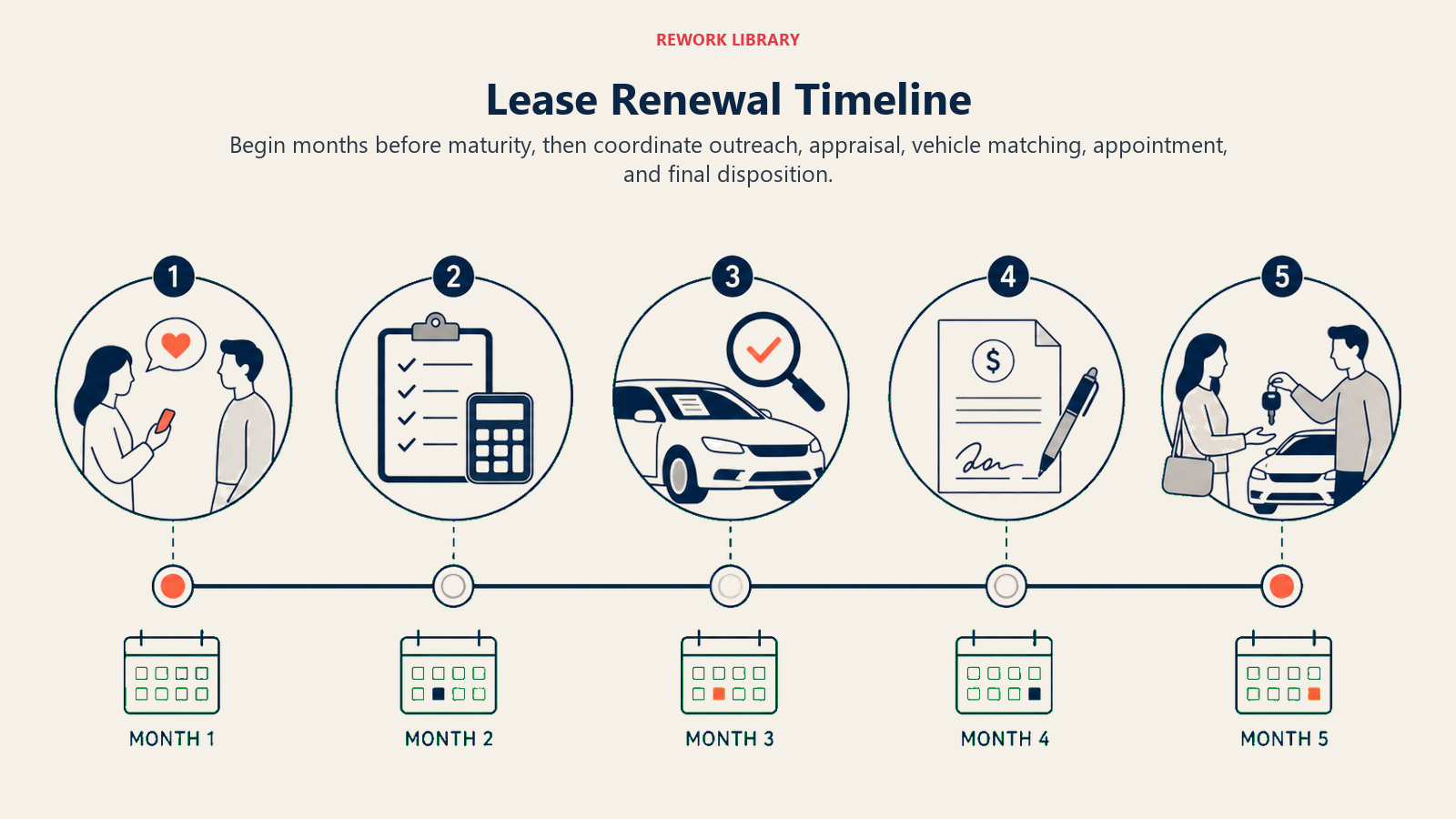
6 months out: initial contact and relationship building. This isn't a sales pitch. It's a "we appreciate your business" touchpoint. Send personalized email marketing with their current lease details, thank them for being a customer, and let them know you'll help make their lease-end process smooth. The goal is top-of-mind awareness before competitive offers flood their mailbox. Leverage your automotive CRM implementation to automate this initial outreach at exactly the right time.
4-5 months out: pull-ahead program introduction. Now you're offering value. If manufacturer incentives allow payment waivers, this is when you introduce the concept. "You could get out of your current lease early, skip your last 3-4 payments, and drive a newer model with similar payments." Schedule an exploratory appointment. No pressure. Just information and vehicle selection discussion.
2-3 months out: inventory matching and test drives. You know what they're driving. You know their payment. Now you're showing them what's new, what's improved, and what fits their lifestyle. This is relationship selling, connecting features to their specific needs and usage patterns. Secure a reservation deposit if they fall in love with a vehicle.
1 month out: urgency and competitive pressure. Payment waivers expire. Inventory allocation tightens. Other customers want the same vehicle. This is when you shift from consultative to closing mode. Present concrete numbers, negotiate terms, and push for commitment.
Lease maturity: turn-in prevention and final offers. If they haven't committed, you're in save mode. Last-minute equity positions. Special finance options. Lease extensions. Whatever it takes to prevent them driving to a competitor and turning in your manufacturer's vehicle.
The dealers who execute this timeline retain 60-70% of lease customers. The dealers who skip it and start at 60 days? They're at 30-35%.
Pull-Ahead Programs and OEM Incentives
Pull-ahead programs are the single most effective tool for early lease renewals, but most salespeople don't understand how to maximize them. Here's how they work: Manufacturers want to keep customers in-brand. When lease-end approaches, the OEM will waive the final 3-6 payments (typically worth $1,500-3,000) if the customer leases or purchases a new vehicle from the same brand. Understanding the qualifying criteria. Not every customer qualifies. Most programs require:
- 3-6 months remaining on current lease
- No excess wear and tear beyond allowances
- Mileage within contracted limits (or acceptable overage)
- No payment delinquencies
- Leasing or financing a new vehicle, not used
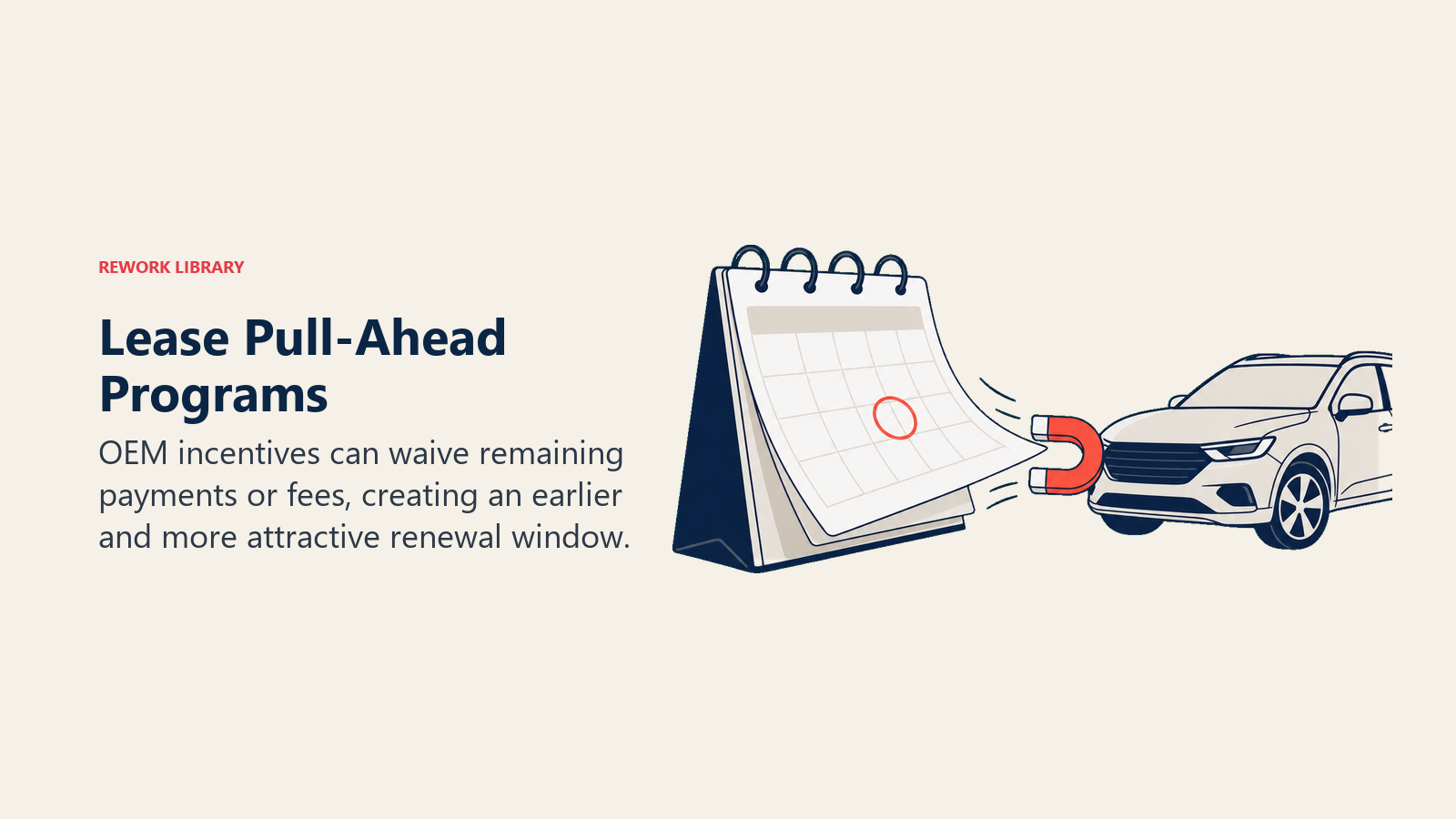
Payment waiver calculations and customer presentation. Don't just say "you get out early." Show the math. If they have 4 payments of $425 remaining, that's $1,700 in savings. Present it as: "Instead of paying $1,700 over the next four months, you drive a 2026 model today with the same $425 payment." As CarPro explains in their pull-ahead guide, these programs generally allow customers to skip their last three payments when leasing another vehicle of the same brand, creating immediate value that's easy to demonstrate.
Stacking incentives for maximum impact. Pull-ahead programs stack with other OEM incentives. You can combine payment waivers with:
- Lease loyalty rebates ($500-1,500)
- Conquest bonuses (if switching from another brand)
- Seasonal promotions and financing offers
- Dealer cash and volume bonuses
Competitive pull-ahead conquest tactics. Some manufacturers offer pull-ahead programs for other brands' lease customers. If you sell Toyota and a customer is leasing a Honda with 3-4 months remaining, you might have a conquest pull-ahead offer that waives their Honda payments to switch brands. These programs are aggressive, and they work.
The key is timing. Pull-ahead eligibility windows are typically 90-180 days before lease maturity. Wait too long and the program expires. Act too early and the customer isn't ready to think about it yet.
Lease vs. Purchase Analysis
Not every lease customer should lease again. Your job is helping them make the right decision, which sometimes means recommending a purchase. When to recommend lease renewal:
- Customer wants latest technology and safety features every 3 years
- They drive within mileage limits comfortably (under 12k-15k annually)
- They prefer predictable payments and no maintenance surprises
- They use the vehicle for business and prefer tax deductions
- They have strong credit and qualify for favorable lease rates When to transition to purchase (balloon, finance):
- Customer consistently exceeds mileage limits and pays overage fees
- They keep vehicles long-term (5-7+ years) and prefer ownership
- Their credit has improved significantly since the original lease
- They have significant equity in the current lease
- Interest rates are favorable and payments are comparable
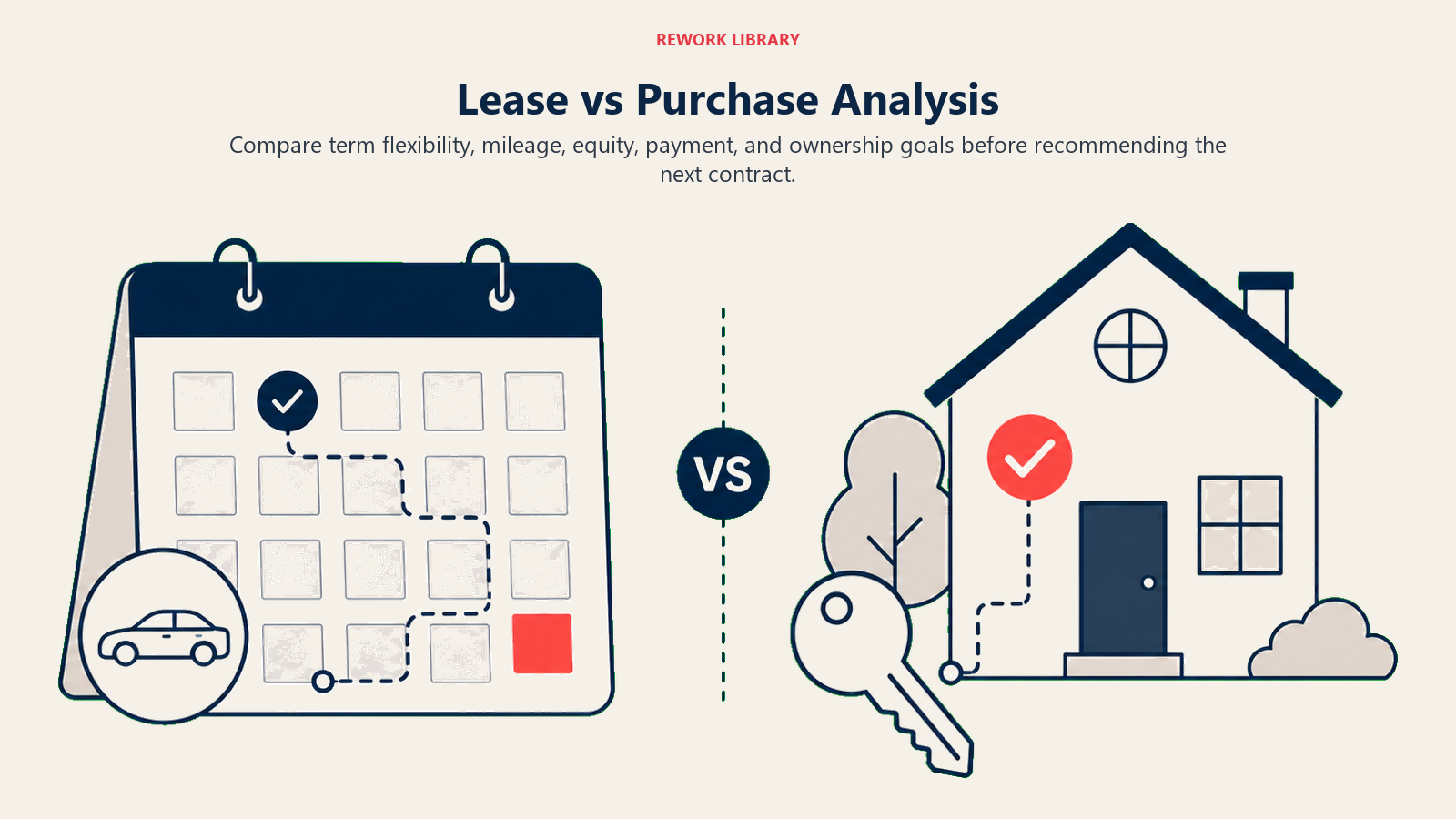
Payment comparison worksheets are essential. Don't make customers guess. Show them:
- Current lease payment vs. new lease payment
- Lease payment vs. finance payment (60, 72, 84 months)
- Total cost over 3 years, 5 years, 7 years
- Equity build and ownership timeline differences
Your desking and deal structure process should include these comparison tools as standard equipment.
Mileage considerations change the equation dramatically. If a customer drives 18,000 miles annually, a lease charges them $0.20-0.25 per mile overage. That's $900-1,125 in annual penalty fees, or $2,700-3,375 over a 3-year lease. Suddenly, purchasing with no mileage restrictions looks much more attractive.
Tax advantages vary by customer situation. Business owners often prefer lease payments as fully deductible expenses. Individual buyers benefit from sales tax savings in states that allow trade-in credit. Run the numbers for their specific situation.
The best sales consultants don't push one direction. They analyze the customer's actual usage, financial goals, and lifestyle, then recommend the solution that makes the most sense. That consultative approach builds trust and increases long-term retention.
The Early Contact Strategy
The 6-month outreach program is where retention is won or lost. Do it right and you're top-of-mind. Skip it and you're competing with everyone else later. Personalized mail and email campaigns work best when they're clearly not generic. Use variable data printing to include:
- Customer name and current vehicle details
- Exact lease maturity date
- Photos of their actual vehicle (pulled from DMS)
- Personalized message from their original salesperson
Make it feel like you're paying attention. Because you are.
Service drive intercept programs are gold. When lease customers come in for oil changes and tire rotations, that's your opportunity. Train service advisors to mention: "I see your lease is up in 5 months. Have you thought about what you'd like next? Let me have our team reach out." This is where your service-to-sales pipeline strategy directly impacts retention rates.
Loyalty appreciation events create touchpoints that don't feel like sales pitches. Host a "lease customer appreciation night" with:
- New model previews and first-look access
- Complimentary vehicle inspection and detailing
- Lease-end process education (what to expect, how to prepare)
- No-pressure test drives and reservation opportunities
Initial needs assessment and preference gathering happens early. Ask:
- "Are you happy with your current vehicle size, or considering something different?"
- "What features do you wish you had that your current model doesn't offer?"
- "Have you thought about whether you'll lease again or consider purchasing?"
- "What other brands are you looking at?" (competitive intelligence)
This isn't interrogation. It's relationship building. And it tells you exactly how to position vehicles when it's time to present.
Inventory Matching and Reservation
The worst-case scenario: customer is ready to commit, but you don't have the right vehicle in stock. Preference profiling starts during early contact. You document:
- Color preferences (exterior and interior)
- Must-have features vs. nice-to-have
- Trim level and package preferences
- Technology and safety priorities
Similar-vehicle selection uses that profile to identify 2-3 vehicles in current inventory that match their needs. Even if they're not ready to commit, show them options so they start visualizing themselves in something specific.
Build-to-order vs. in-stock decisions depend on timing and availability. If the customer is 4-5 months out and wants a specific configuration not in stock, place a factory order. If they're 60 days out, work with in-stock inventory and find acceptable alternatives.
Reservation deposits create commitment without full purchase. "$500 refundable deposit holds this vehicle for you. If we sell it to someone else and you come back in 30 days ready to buy, you'll be disappointed." Light pressure. Real urgency.
Allocation prioritization matters when inventory is tight. Dealerships get limited allocation of high-demand models. Use your lease customers to justify allocation requests, showing the manufacturer that you have committed buyers waiting.
Demo and test drive scheduling happens well before lease maturity. Get them in the vehicle. Let them experience the improvements. Connect emotionally before the numbers conversation.
The Lease Renewal Appointment
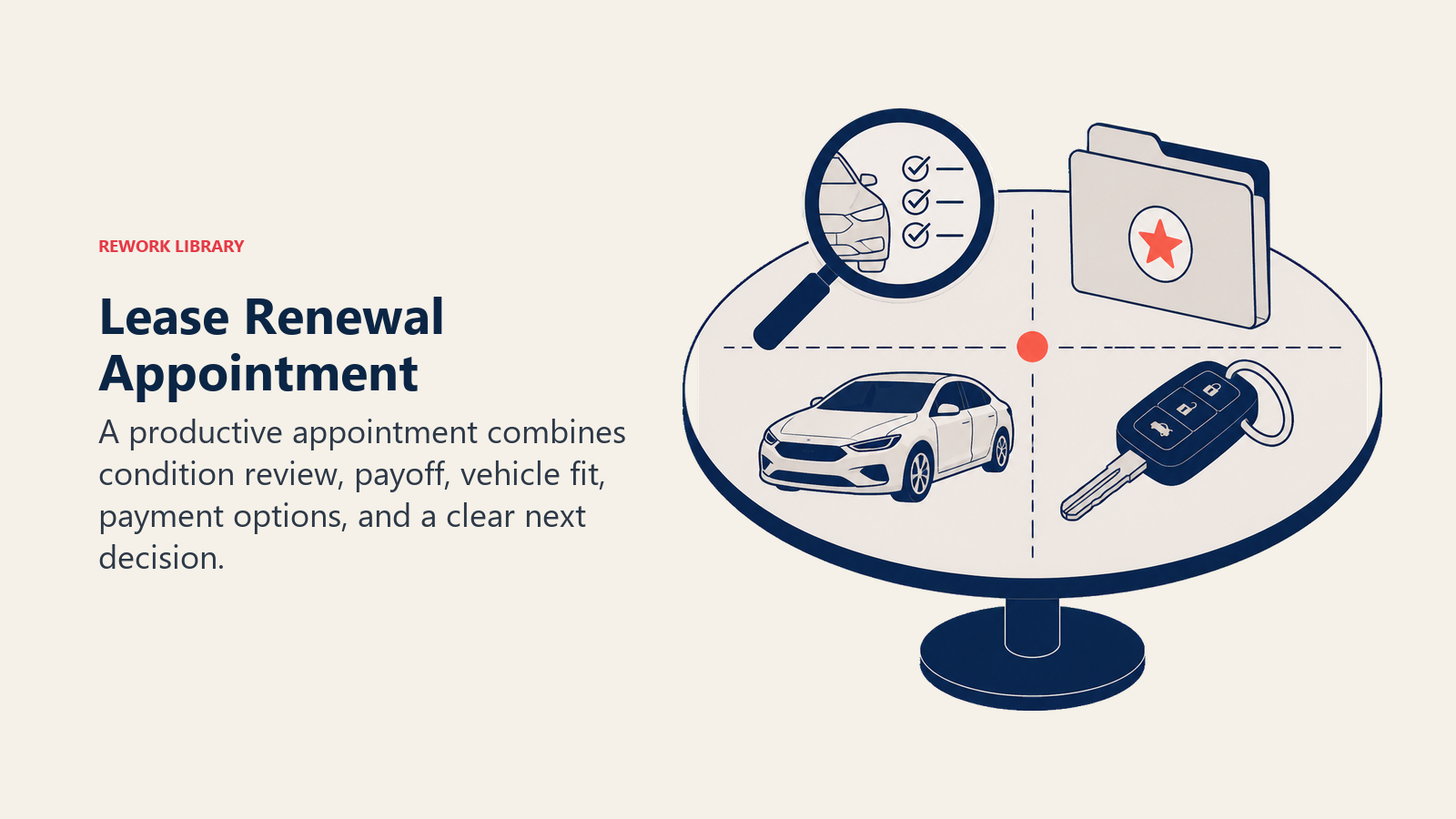
When the customer arrives for the renewal appointment, you're not starting from zero. You've built the relationship, identified their needs, and matched them to inventory. Now you're confirming details and closing. Trade-in inspection and excess wear negotiation happens first. Walk the current lease vehicle with them. Document condition. If there's excess wear (scratches, dents, interior damage), negotiate it now. Use your standard trade-in appraisal process but factor in lease-end fees for excess wear. Most lease agreements allow $500-1,000 in wear and tear. Anything beyond that triggers fees, typically $75-150 per panel for dents, $200-400 for windshield cracks, $100-250 for interior stains.
If excess wear is present, your options:
- Absorb the fees in the new deal (if gross profit supports it)
- Offer dealership repair services at discounted rates
- Negotiate a mixed solution (customer pays half, dealer covers half)
Don't surprise them at lease-end. Handle it now while they're emotionally committed to the new vehicle.
New vehicle presentation and feature comparison focuses on improvements over their current model. "Your 2023 had adaptive cruise control. This 2026 version adds lane-centering and automatic lane changes. Let me show you how it works."
Payment structuring and term optimization requires flexibility. Some customers want lowest payment (extend term, maximize rebates). Others want fastest payoff (shorter term, higher payment). Run multiple scenarios.
Overcoming "I want to shop around" objection: "I understand. You should feel confident in your decision. Here's what I can tell you: we're offering payment waiver of $1,700, lease loyalty of $1,000, and a payment that's $15 less than what you're paying now. I can't control what other dealers offer, but I can guarantee this is a strong deal. If you find something better, come back and we'll see if we can match it. But this vehicle, with these programs, might not be here next week."
This approach combines value justification with scarcity, two principles from negotiation and closing techniques.
Same-day delivery tactics seal the deal. If they're committed, take delivery today. Process the paperwork. Register the vehicle. Hand them keys. The longer you wait, the higher the chance they change their minds or visit a competitor.
Technology and Process Management
Lease renewal success requires systems, not just hustle. DMS reporting and lease maturity lists should run automatically. Every Monday morning, pull:
- Leases maturing in 6 months (initial contact list)
- Leases maturing in 90-120 days (pull-ahead eligible)
- Leases maturing in 30-60 days (urgency mode)
- Leases past maturity (save opportunities)
These reports require solid DMS integration best practices to ensure data flows accurately between systems.
CRM workflow automation and task management creates accountability. When a lease hits the 6-month mark, the CRM should:
- Create tasks for the assigned salesperson
- Trigger email and mail campaigns
- Schedule follow-up reminders
- Track customer responses and engagement
This level of automation is exactly what automotive marketing automation platforms excel at delivering.
Lease equity tools and calculators show customers their current position. Tools like AutoAlert, VinSolutions, and DealerSocket provide equity calculations based on current payoff, residual value, and market pricing.
Campaign tracking and attribution answers the critical question: which outreach efforts work? Tag every touchpoint:
- Mail campaign response rate
- Email open and click rates
- Phone outreach connection and appointment rates
- Service drive intercept conversion
Performance metrics and dashboards should display:
- Lease renewal rate (industry average: 35-40%, best-in-class: 60-70%)
- Pull-ahead program utilization
- Average days to first contact (target: within 7 days of 6-month mark)
- Appointment show rate
- Appointment-to-sale conversion rate
Build these into your dealership KPI dashboard for executive visibility and accountability.
Preventing Lease Turn-Ins
Even with perfect execution, some customers plan to turn in their lease and walk away. Your job is understanding why, and presenting alternatives. Understanding why customers plan to turn in:
- "I'm not driving right now" (pandemic habit, remote work)
- "I can't afford the payments anymore" (financial hardship)
- "I want to try a different brand" (competitive conquest)
- "I'm buying used to save money" (economic concerns)
- "I don't need a car" (lifestyle change)
Each reason requires a different approach.
Special finance options for challenged credit. If finances are tight, explore:
- Extended term financing (lower payments)
- Lease with lower money factor
- Used/certified pre-owned with lower price point
- Co-signer options for improved approval
Your F&I department can structure creative solutions that fit challenging situations while maintaining profitability.
Alternative inventory and payment solutions. If they can't afford their current $550 payment, show them vehicles at $425. Step down in trim level. Consider previous model year. Explore different brands in your group.
Lease extension negotiations. Some manufacturers allow 3-6 month lease extensions at the same payment. This buys time for customers who need flexibility while keeping them in your ecosystem.
Referral programs when retention fails. If you can't save them, ask for referrals. "I understand you're not moving forward. If you know anyone looking for a vehicle, I'd appreciate the referral. Here are my cards."
You lose some. But don't lose them without trying everything.
Key Takeaways
Lease renewal isn't luck. It's systematic execution:
Start early, 6 months before maturity, not 30 days. Build relationships before competitors flood them with offers.
Maximize pull-ahead programs. Payment waivers are free money from the manufacturer. Use them to create urgency and value.
Analyze lease vs. purchase for each customer. Don't default to "lease again" if their situation suggests ownership makes more sense.
Use technology to track, automate, and measure. CRM workflows and DMS reporting ensure no customer falls through the cracks.
And most importantly: treat lease customers like the valuable assets they are. They already trust you. Don't wait until the last minute to remind them why they should stay.
For additional retention strategies, explore equity mining strategy, owner retention marketing, customer loyalty programs, and post-sale follow-up process. For customer experience optimization, see automotive customer experience and vehicle delivery experience.

Senior Implementation Consultant