Automotive Sales Process: Modern Frameworks That Adapt to Digital-First Buyers
Turn this article into takeaways for your work.


Each assistant summarizes the article only for you and suggests best practices for your work.
The traditional 12-step automotive sales process was designed for uninformed buyers with time to spare. Buyers who needed product education, feature demonstrations, and patient guidance through decisions they weren't equipped to make on their own.
That buyer no longer exists.
Today's customers arrive having viewed 18+ online sources and spent 14+ hours researching. They know vehicle specs better than many salespeople. They've compared pricing across six dealerships. They've watched video reviews, read owner forums, and calculated payments down to the penny. 95% of buyers research online before making purchase decisions.
The traditional process doesn't just feel outdated to these buyers, it feels insulting. Like you're following a script designed for someone much less informed than they are.
Yet dealerships that abandon process entirely underperform too. Structure still matters. Qualification still drives profit. Steps still ensure nothing gets missed.
The answer isn't no process. It's a modern process that adapts to informed buyers while maintaining the structure that protects margins and conversion rates.
Evolution of Automotive Sales Process
The classic 12-step process emerged in an era when information asymmetry heavily favored dealerships. Customers needed extensive education because they simply didn't have access to the data required to make informed decisions.
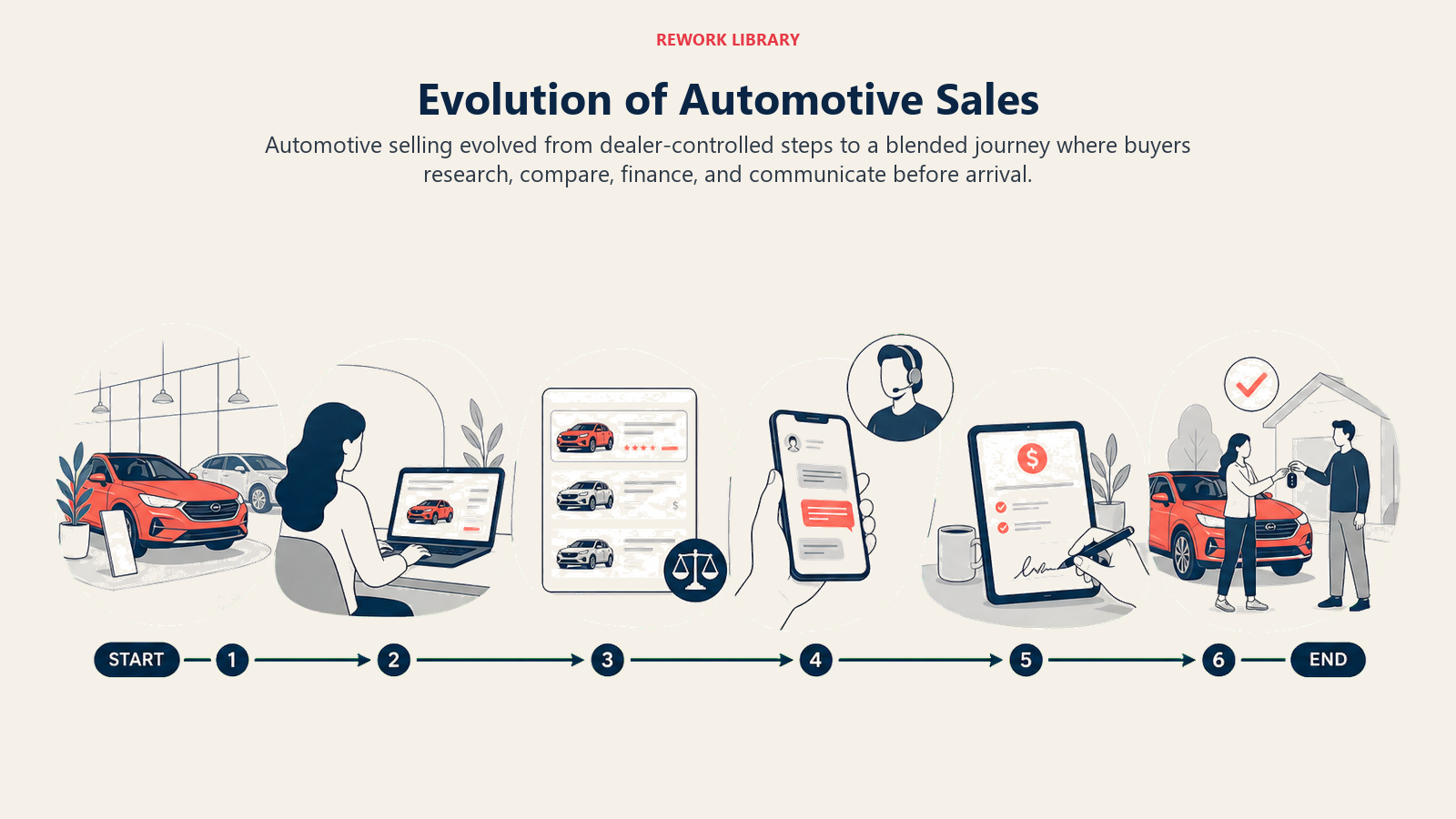
Salespeople controlled pricing information, inventory availability, feature comparisons, and financing options. The process was designed to slowly reveal information while building commitment at each step. It worked because customers had no alternative.
The internet destroyed that model completely. Information parity now favors buyers, who often know more about specific vehicles than the generalist salespeople greeting them. Buyers arrive with pricing screenshots from six dealerships, payment calculations from three lenders, and detailed feature comparisons they've built themselves.
Compressed timeframes reflect changed buyer expectations. Where buyers once expected to spend 3-4 hours at a dealership, they now want to complete purchases in 90-120 minutes. The traditional leisurely pace feels disrespectful of their time, especially for appointment customers who've already done research. McKinsey research shows that almost 60 percent of potential car buyers under 45 prefer to purchase their vehicle online, accelerating the shift toward efficiency.
Digital integration throughout the journey means buyers expect seamless connections between online and in-person experiences. They started on your website, perhaps chatted with your BDC, maybe completed credit applications online, and now they're in your showroom expecting you to know everything they've already told you digitally. Deloitte research indicates that brand and dealer websites have the greatest impact on new car-buying decisions.
Flexible versus rigid adherence matters more now. The old process assumed every customer needed every step in the same order. Modern buyers might skip steps they've completed digitally, accelerate through steps where they're already convinced, or need extra time on specific concerns unique to their situation.
Trust-based versus manipulation-based selling reflects broader cultural shifts. Buyers smell manipulation immediately and reject it. Modern sales success comes from genuine consultative selling, understanding needs, providing unbiased guidance, and earning business through competence and trustworthiness.
Modern Sales Process Framework
An effective modern process maintains structure while allowing flexibility. Here's a framework that works across buyer types while adapting to individual situations.
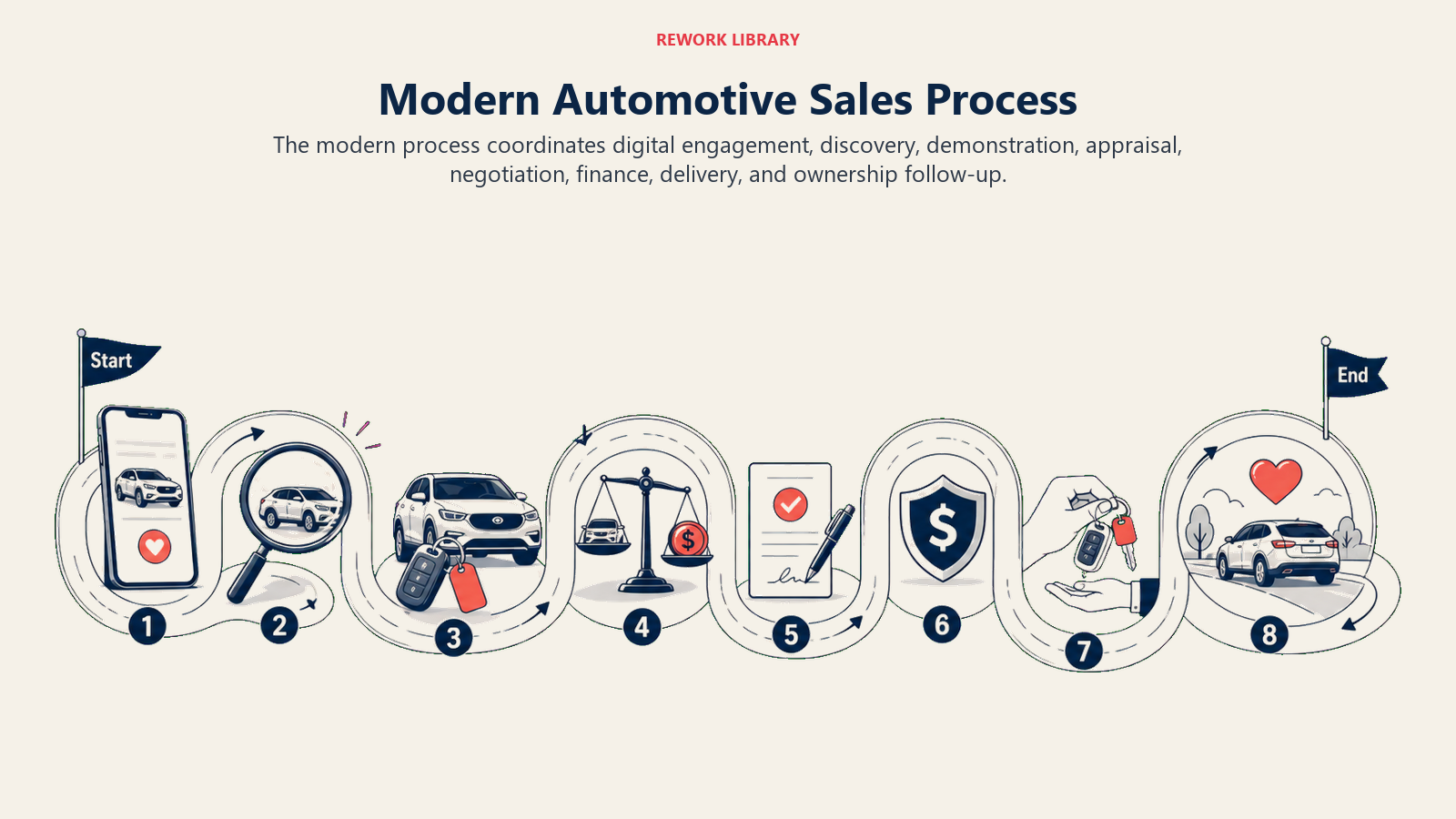
Preparation (Before Customer Arrival)
For appointment customers, preparation is mandatory. Review CRM history to understand their digital journey, online inquiries, and previous contacts. Pull and prepare the specific vehicles they're interested in, clean them, gas them, stage them prominently. Research their trade-in using available tools so you're ready to discuss value intelligently.
Even for walk-ins, quick preparation creates advantages. When customers arrive, spend 60 seconds pulling up their information (if they're return visitors) or researching the vehicles they're interested in while a colleague engages them.
Meet & Greet (First 2 Minutes)
First impressions form in 60 seconds. For appointment customers, greet them by name at the entrance, thank them for scheduling time, and acknowledge their digital research. For walk-ins, use natural conversation starters that build rapport without immediately selling.
The goal here is simple: establish yourself as a competent professional who respects their intelligence and time. Everything else flows from this foundation.
Discovery (Understanding Needs and Motivations)
Even informed buyers benefit from good discovery. They've researched features and pricing, but you still need to understand their specific situation, motivations, decision criteria, timeline, and budget realities.
The key is avoiding redundancy. If they told your BDC they're trading a 2022 sedan, don't ask "what are you driving now?" You already know. Instead, ask deeper questions: "I see you're in a 2022 sedan now, what's prompting you to look at SUVs?" This shows you've done homework while advancing discovery.
Discovery shouldn't feel like interrogation. Weave questions into natural conversation. Listen for what they volunteer. Pay attention to body language and enthusiasm. The best discovery feels like friendly conversation where you happen to learn everything you need to know.
For truly informed buyers, discovery might take 5-7 minutes. For those still figuring things out, take 15-20 minutes. Match the time investment to their needs.
Presentation (Vehicle Demonstration)
Modern buyers don't need feature-by-feature walkarounds. They've watched the manufacturer videos. They've read the spec sheets. They know what blind-spot monitoring is.
Focus presentation on experiential elements they can't get digitally. How the vehicle feels when you sit in it. How controls are positioned. How cargo space actually compares to their current vehicle. The sensory experience of materials, visibility, ergonomics.
Reference their stated priorities from discovery. If they mentioned safety for teenage drivers, focus on safety features and driver-assist systems. If they're outdoor enthusiasts, emphasize cargo versatility and towing. Personalization creates value that generic presentations miss.
For appointment customers seeing vehicles they specifically requested, presentations can be brief, confirming it matches expectations rather than educating from scratch.
Test Drive (Experience Creation)
Test drives remain the single most important step. Customers who drive close at 50-65% rates. Those who don't drive close under 15%.
Modern test drives should be longer (20-30 minutes), less scripted (let them explore), and more experiential (varied road conditions, highway and city, parking scenarios). Your job is creating ownership feelings, not narrating features.
Trial closes during test drives build commitment: "Can you see yourself in this?" "Does this fit what you're looking for?" "How does this compare to others you've driven?"
Trade Appraisal (Value Presentation)
Trade handling has evolved dramatically. Many customers arrive with online valuations and competitive offers. If you're not within 10% of market value, you'll lose deals.
Present trade values honestly and competitively. Explain your methodology. Show supporting data. If you're low versus their online estimate, explain why (condition factors, market reality, timing). If you're competitive, highlight that.
Equity discussion sets up negotiation. Positive equity creates flexibility. Negative equity requires creative structuring or expectation management.
Negotiation (Pencil and Desk Process)
Negotiation has changed more than any other step. Informed buyers arrive with competitive quotes and pricing data. Old-school back-and-forth feels antiquated.
Progressive dealerships increasingly move to transparent one-price or near-one-price approaches that eliminate most negotiation. For dealerships still negotiating, the key is efficiency, fewer trips to the desk, faster responses, clearer explanations.
Understand that today's buyers are negotiating terms and structure more than pure price. Monthly payment, incentives, financing rates, warranty products, accessories, the total package matters more than just vehicle price.
F&I Transition (Smooth Handoff)
The sales-to-F&I handoff creates frustration when handled poorly. Long waits, redundant questions, inconsistent information, these kill deals at the finish line.
Pre-qualifying customers for F&I (understanding credit situations, budget parameters, insurance considerations) allows F&I managers to prepare appropriate product presentations and streamline the process.
Brief F&I on the customer's situation, priorities, and any concerns raised during the sales process. This context helps F&I managers personalize their approach.
Delivery (Experience Creation)
Delivery is your last chance to create memorable experiences. Rushed deliveries with hurried explanations waste this opportunity.
Quality deliveries include: thorough vehicle orientation, technology setup and pairing, maintenance schedule explanation, warranty and service plan overview, and creating excitement about ownership.
Follow-Up (Satisfaction and Referrals)
Post-sale follow-up closes the loop. Contact customers within 24-48 hours to ensure satisfaction, answer questions, address concerns, and reinforce their decision.
Follow-up also opens referral conversations. Satisfied customers will refer friends and family when asked at the right moment.
Adapting to Buyer Types
Different buyer types need different process adaptations.
Appointment Customers (70% Ready to Buy): These buyers have done research and are prepared to make decisions. Accelerate through early steps they've completed digitally. Focus on confirmation, experience, and execution. Push for same-day decisions when appropriate.
Walk-In Shoppers (Research vs Buying Phase): Distinguish between shoppers gathering information and those ready to purchase. Research-phase shoppers need education and relationship building. Ready buyers need urgency and decision facilitation.
Be-Backs and Return Visitors: These customers already know your dealership. Skip redundant discovery. Reference previous conversations. Focus on what's changed or what questions remain.
Internet Leads Converting to Showroom: These buyers have digital relationships with your BDC. Ensure sales consultants know the history. Maintain continuity rather than starting over.
Service Customers with Sales Interest: These are warm leads who already trust your dealership. Lead with that relationship. Position upgrades as natural next steps.
Referrals and Repeat Buyers: Existing relationships allow abbreviated processes. These customers already trust you, honor that with efficiency and preferential treatment.
Digital Integration Points
Modern processes integrate digital touchpoints throughout:
Pre-Appointment Online Research: When customers research your inventory, complete build-and-price tools, or watch videos before arriving, reference this activity. It shows you're paying attention.
Trade-In Tool Data Utilization: If customers used your online trade valuation tool, have those results ready. Build from their estimate rather than starting fresh.
Credit Application Timing: Offering online credit applications before showroom visits streamlines F&I and sets clearer budget parameters upfront.
Digital Document Signing: Electronic signatures eliminate paperwork delays and allow remote completion of routine documents.
Online Payment Calculations: When customers build payment scenarios online, save their configurations and reference them in person.
Review and Social Media Integration: Encourage reviews and social sharing during the delivery process when excitement peaks.
Process Efficiency & Cycle Time
Time kills deals. Long processes create opportunities for buyer's remorse, competitive shopping, and decision paralysis.
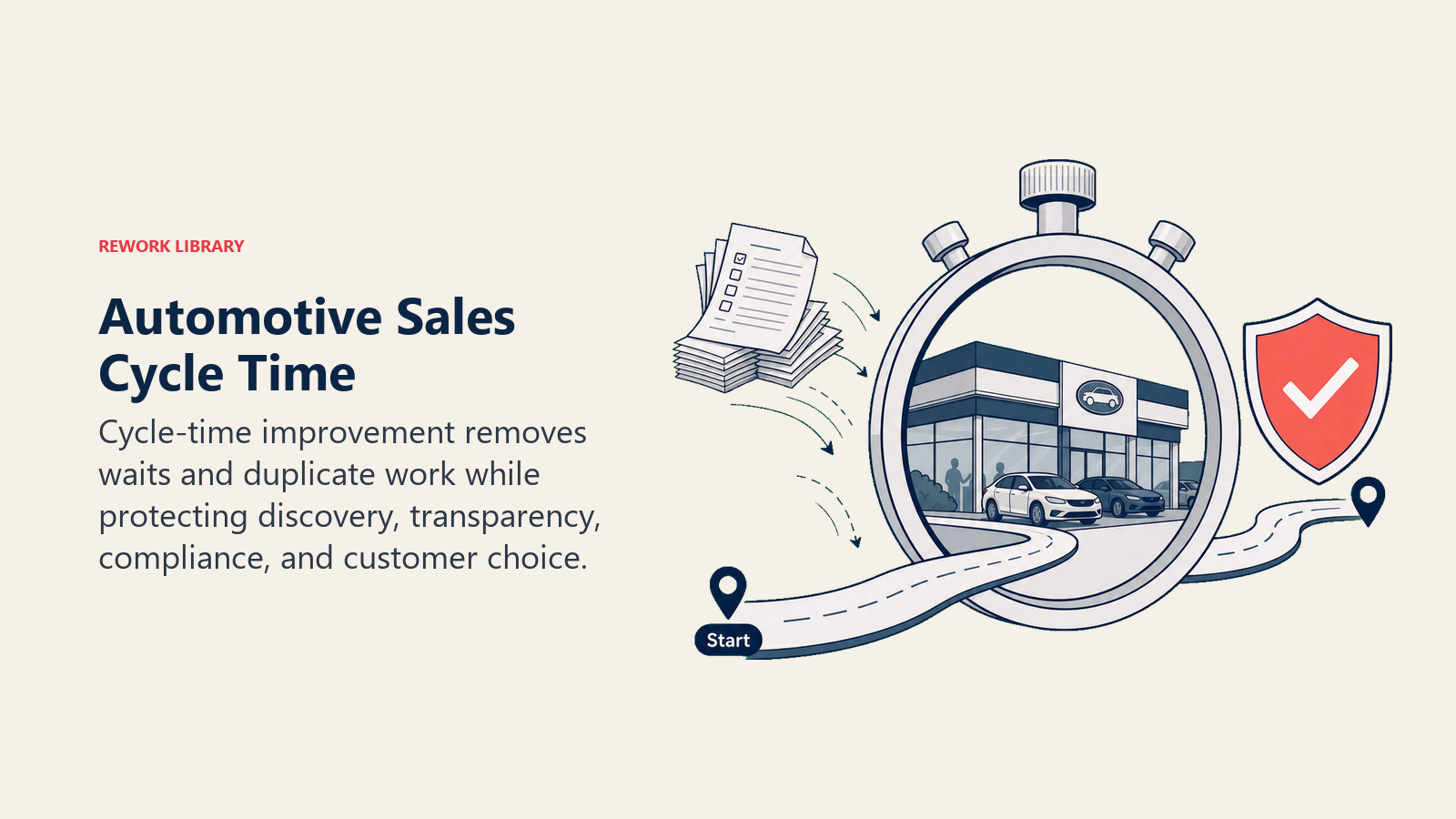
Eliminate unnecessary steps that don't add value. If customers have completed tasks digitally, don't repeat them in person. If they've decided on specific vehicles, don't show them alternatives unless asked.
Parallel processing reduces total time. Run trade appraisals while customers test drive. Process credit applications while F&I prepares. Detail vehicles while negotiation happens. Coordinate activities to minimize sequential waiting.
Manager involvement optimization means having clear criteria for when managers engage. Don't pull managers into every deal, but don't wait too long when intervention could save a stalling deal.
Desk time reduction strategies eliminate the traditional "let me talk to my manager" cycle that frustrates informed buyers. Empower consultants with more authority or use technology to get manager approvals without physical trips to the desk.
Customer wait time management addresses one of the biggest frustration points. Communicate expected wait times clearly. Provide comfortable environments. Keep customers informed about what's happening and why.
Same-day delivery processes complete transactions while excitement is high. When possible, deliver vehicles the same day customers decide to buy. This eliminates overnight doubt and competitive shopping between decision and delivery.
Quality Control & Consistency
Process only works if it's consistently followed. Quality control ensures the system actually operates as designed.
Process adherence monitoring through deal jackets, CRM documentation, or digital checklists shows which steps are being completed and which are being skipped. Regular audits reveal compliance gaps.
Deal documentation requirements ensure critical information gets captured: customer needs, vehicles shown, objections raised, commitments made, next steps. This documentation protects the dealership and enables better follow-up.
CRM data entry standards make customer information useful beyond individual deals. Consistent data enables better marketing, more personalized service, and improved long-term relationships.
Customer experience checkpoints at key moments, after test drives, after negotiation, before delivery, catch problems before they become crises.
Compliance and legal requirements around disclosures, documentation, and customer rights must be built into the process to protect the dealership from liability.
Continuous improvement mechanisms like monthly process reviews, consultant feedback, and customer surveys identify what's working and what needs refinement.
The Balance: Structure with Flexibility
The modern automotive sales process isn't a rigid script, it's a flexible framework. You maintain the structure that drives results while adapting to individual buyer situations.
Informed buyers don't need lengthy presentations of features they already know. Give them experiential demonstrations and confirmations.
Time-conscious buyers don't need four-hour experiences. Run efficient processes that compress unnecessary steps while maintaining thoroughness on what matters.
Skeptical buyers don't need manipulation tactics. Build trust through competence, transparency, and genuine consultation.
The dealerships winning with modern buyers aren't abandoning process, they're evolving it. Keeping what works, eliminating what frustrates, and adapting what needs updating.
Your process should feel helpful, not restrictive. Professional, not scripted. Efficient, not rushed. Personal, not generic.
That's the modern automotive sales process. Structure that adapts. Framework that flexes. Process that performs.

Senior Implementation Consultant
On this page
- Evolution of Automotive Sales Process
- Modern Sales Process Framework
- Preparation (Before Customer Arrival)
- Meet & Greet (First 2 Minutes)
- Discovery (Understanding Needs and Motivations)
- Presentation (Vehicle Demonstration)
- Test Drive (Experience Creation)
- Trade Appraisal (Value Presentation)
- Negotiation (Pencil and Desk Process)
- F&I Transition (Smooth Handoff)
- Delivery (Experience Creation)
- Follow-Up (Satisfaction and Referrals)
- Adapting to Buyer Types
- Digital Integration Points
- Process Efficiency & Cycle Time
- Quality Control & Consistency
- The Balance: Structure with Flexibility