AI in Automotive Sales: Practical Applications Driving Dealership Results - 2026 Guide
Turn this article into takeaways for your work.


Each assistant summarizes the article only for you and suggests best practices for your work.
AI isn't replacing car salespeople, it's handling the repetitive tasks they hate (lead qualification, follow-up, data entry) so they can focus on what they do best: building relationships and closing deals.
The automotive retail conversation about AI has been ridiculous. Half the vendors claim AI will solve every problem. The other half dismiss it as overhyped nonsense. Both are wrong.
The reality? AI is already working in dealerships today, delivering measurable improvements in specific, well-defined applications. Not science fiction. Not revolutionary transformation. Just practical tools that make existing processes faster, more consistent, and more profitable. According to Deloitte's AI in automotive research, AI has become a transformative force in automotive retail, with dealers leveraging AI for diverse applications in production, sales, and personalized customer experiences.
This guide cuts through the hype and shows you exactly where AI is delivering real ROI in automotive retail, what to expect from each application, and how to implement it successfully.
The State of AI in Automotive Retail
Let's separate reality from marketing promises.
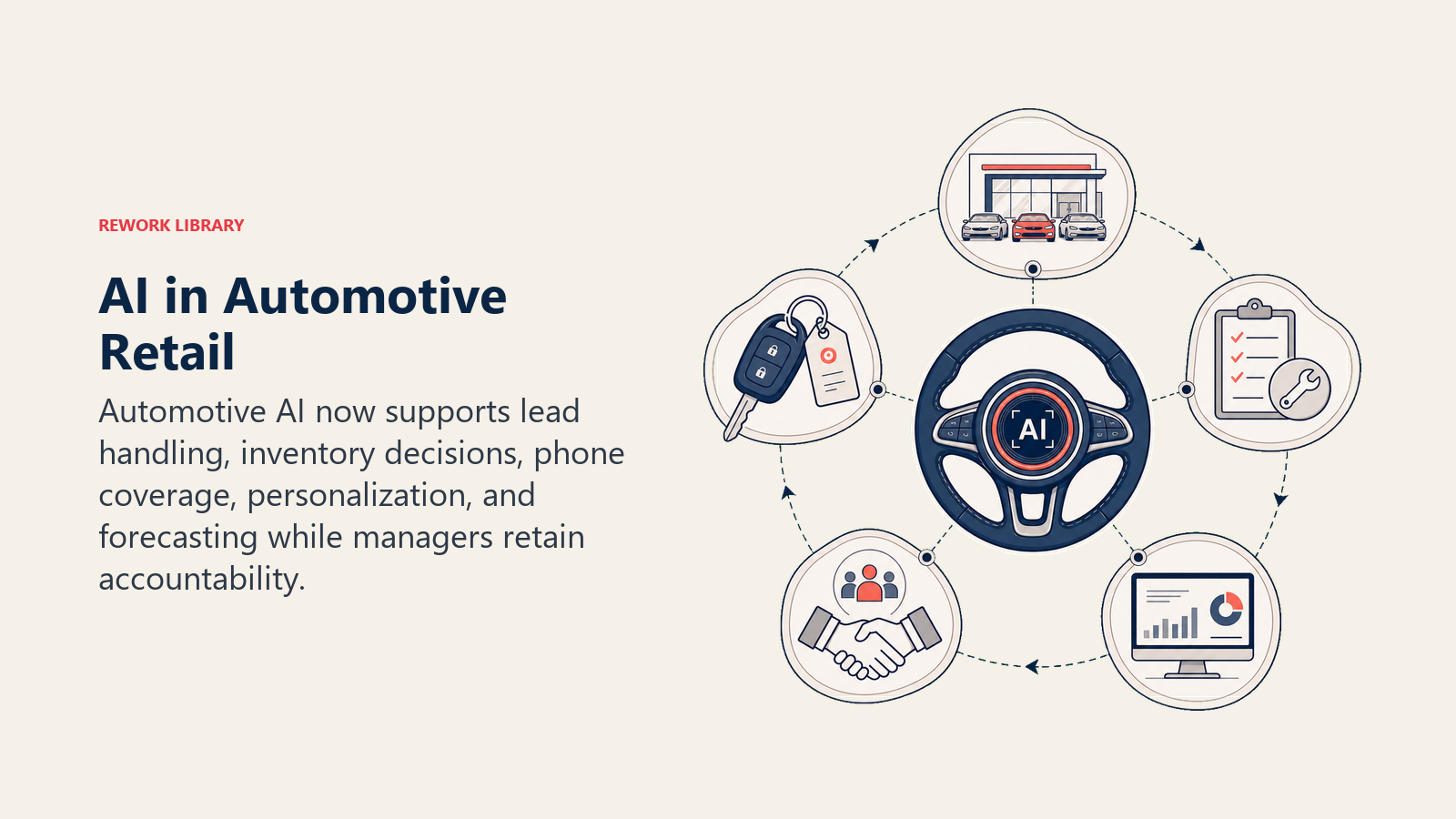
Where AI is making measurable impact today:
- Lead qualification and scoring (15-25% conversion improvement)
- Chatbot engagement and appointment setting (40% response time reduction)
- Inventory pricing and acquisition optimization (10-15% gross profit improvement)
- Predictive analytics for customer defection and retention (20-30% save rate improvement)
- Conversational AI for phone systems (60% after-hours lead capture improvement)
Hype vs. reality: what works, what doesn't:
Works: AI-powered lead scoring that prioritizes hot prospects based on engagement patterns and historical conversion data.
Doesn't work: AI that claims to "automatically close deals" without human involvement. Car buying is relationship-driven. AI assists, humans close.
Works: Chatbots that qualify leads, answer basic questions, and schedule appointments 24/7.
Doesn't work: Chatbots that try to negotiate price or close deals in chat. Customers want human interaction for complex discussions.
Works: AI-powered inventory pricing that analyzes market demand, competitor pricing, and turn rates to optimize gross profit.
Doesn't work: AI that claims to predict exactly which vehicles to stock without considering local market nuances and dealer strategy.
Adoption rates among leading dealer groups:
Progressive dealer groups (AutoNation, Lithia, Penske) are deploying AI in:
- 75%+ of locations use AI-powered lead management
- 60%+ have chatbot implementation on websites
- 50%+ use AI for inventory pricing and acquisition
- 30%+ have voice AI for phone systems
- 20%+ use AI for personalization and recommendations
Industry data shows that nearly 40% of dealers are already using AI in some way, with 77% having integrated AI tools into existing systems, and another 22% actively planning AI investments.
Vendor ecosystem and platform options:
Lead management AI: Conversica, Impel, Prodigy Chatbots: Impel, CarNow, Gubagoo Inventory optimization: vAuto, ProfitTime GPS, FirstLook Voice AI: Invoca, CallRail with AI features Predictive analytics: AutoAlert, IHS Markit, Urban Science
AI-Powered Lead Management
AI transforms lead management by instantly identifying which leads are most likely to convert, allowing sales teams to prioritize effectively.
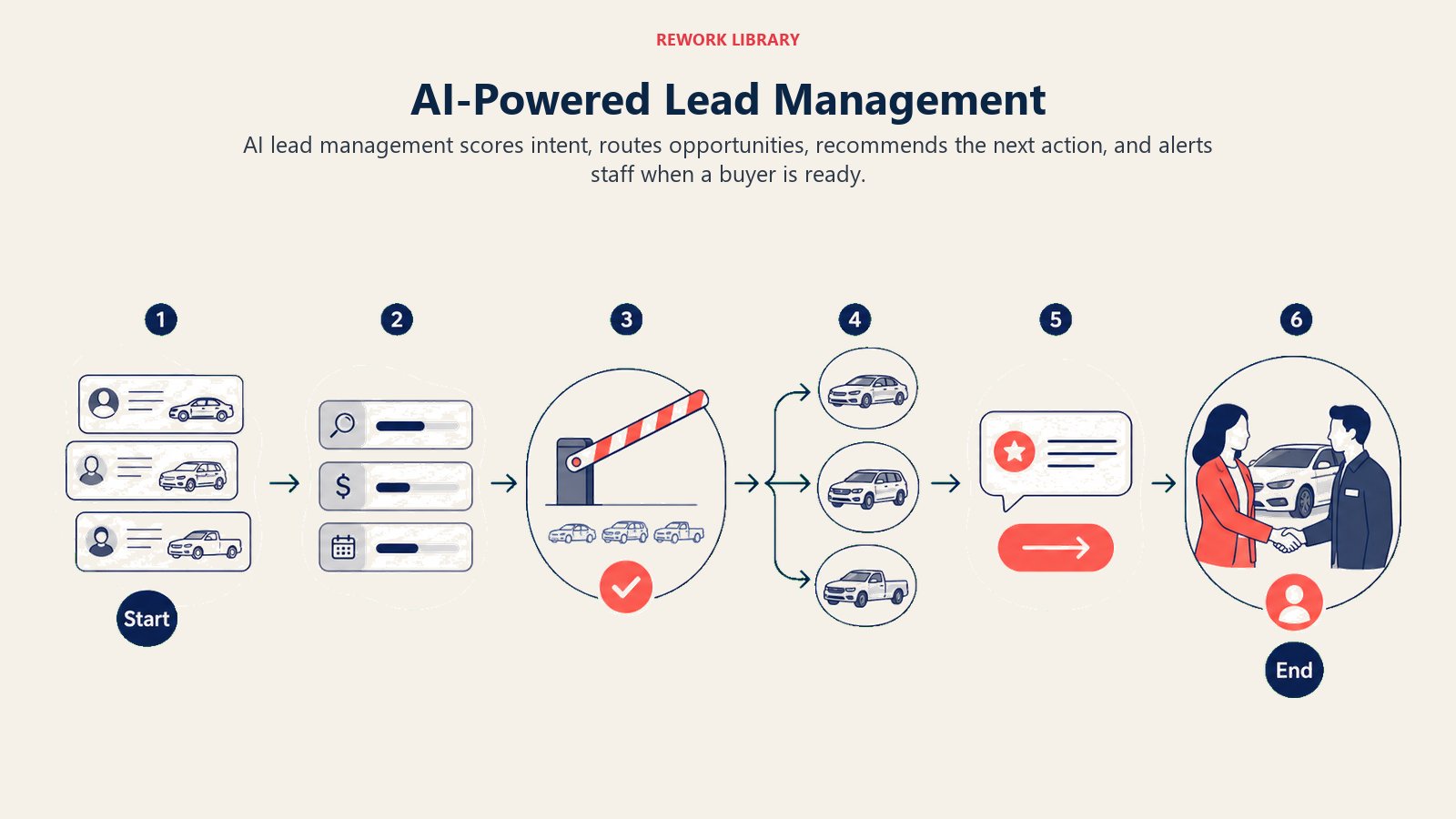
Predictive lead scoring based on conversion probability:
Traditional approach: All leads treated equally or manually scored based on source.
AI approach: Every lead gets a score (0-100) based on:
- Engagement behavior (email opens, website visits, time on site)
- Demographic signals (location, credit profile, vehicle interest)
- Historical conversion patterns (leads with similar profiles converted at X% rate)
- Timing factors (day of week, time of day, seasonal patterns)
Result: Sales team focuses on 80+ score leads first (25-40% conversion) instead of wasting time on 20-score leads (2-5% conversion).
Automated lead assignment and routing optimization:
AI analyzes which salespeople excel with specific lead types:
- Salesperson A converts luxury leads at 28%, economy at 12% → luxury leads routed to A
- Salesperson B converts high-credit finance leads at 22% → those leads go to B
- Salesperson C excels at lease renewals (35% conversion) → lease maturities assigned to C
The system automatically routes each lead to the salesperson statistically most likely to close it. This optimization happens within your BDC operations workflow.
Real-time lead response and engagement:
AI-powered systems (like Conversica) send personalized responses within 60 seconds:
- "Hi [Name], I'm [AI Assistant Name] from [Dealership]. I saw you're interested in the [Vehicle]. I'd love to connect you with [Salesperson]. Are you available for a quick call today?"
The AI handles initial engagement and qualification while alerting the human salesperson to jump in when the lead is warm.
Lead nurture optimization and send-time prediction:
Instead of sending emails at arbitrary times, AI analyzes when each customer is most likely to engage:
- Customer A opens emails at 7-8am on weekdays → schedule sends for 7:15am
- Customer B engages 8-10pm evenings → schedule for 8:30pm
- Customer C is weekend browser → send Saturday morning
ROI: 15-25% improvement in lead conversion:
100-car-per-month dealership:
- 500 leads monthly at 10% baseline conversion = 50 sales
- AI implementation improves to 12% conversion = 60 sales
- Additional 10 sales × $2,500 gross profit = $25,000 monthly
- Annual impact: $300,000 additional gross profit
- AI platform cost: $500-1,500 monthly ($6,000-18,000 annually)
- ROI: 1,566-4,900%
Conversational AI and Chatbots
Customers expect immediate responses 24/7. Chatbots deliver.
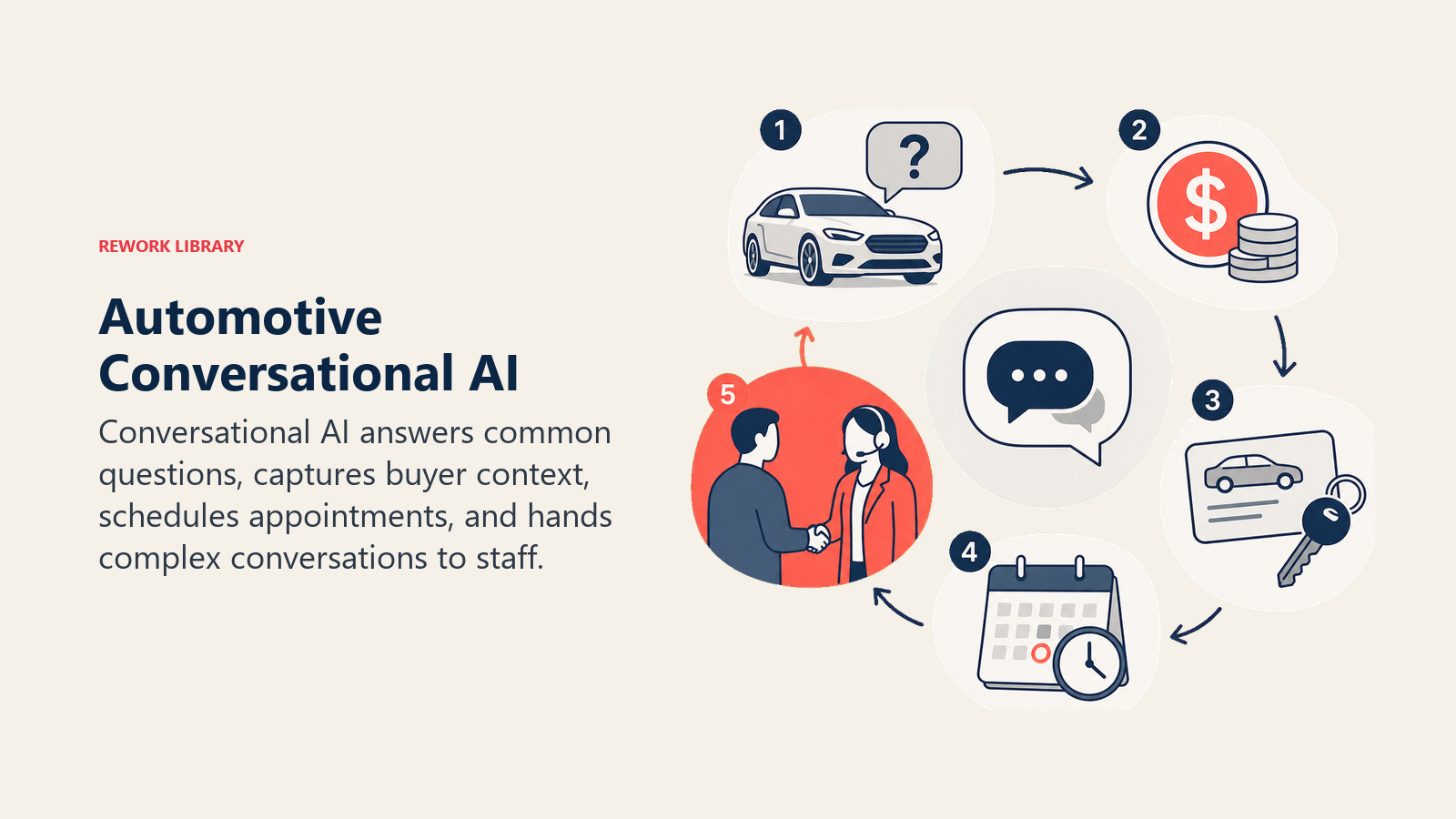
Website chat for sales and service inquiries:
Customer lands on vehicle details page at 10pm (dealership closed):
- Chatbot: "Hi! Interested in the 2026 [Vehicle]? I can answer questions and help you schedule a test drive."
- Customer: "What's the monthly payment?"
- Chatbot: "Payments start around $425/month with $3,000 down. Want me to have a specialist work up your specific numbers tomorrow?"
- Customer: "Yes"
- Chatbot captures contact info, schedules follow-up call
Without chatbot: Lead lost (customer moves to next dealership website).
Automated appointment scheduling:
Chatbot: "When would you like to test drive this vehicle?" Customer: "Tomorrow afternoon?" Chatbot: [Displays available appointment slots from CRM calendar] Customer: [Selects 2pm] Chatbot: "Perfect! You're scheduled for 2pm tomorrow with [Salesperson]. Confirmation sent to your email/phone."
Appointment logged in CRM, salesperson notified, customer receives automated reminders. This automation executes appointment setting best practices perfectly every time.
FAQ handling and information delivery:
Common questions chatbots handle instantly:
- "What's your service department hours?"
- "Do you take trade-ins?"
- "What's the price of this vehicle?"
- "Do you have [Vehicle] in [Color]?"
- "Can I get pre-approved for financing?"
This frees salespeople from answering the same basic questions 50 times daily.
Handoff protocols to human agents:
Smart chatbots recognize when to escalate:
- Customer asks complex question → "Let me connect you with a specialist who can help better."
- Customer expresses frustration → immediate handoff to BDC or salesperson
- Customer ready to buy → "I'll have [Salesperson] call you right now."
- Business hours → option to live chat with human immediately
Text/SMS conversational AI:
Extends chatbot capabilities to text messaging:
- Customer texts dealership number with vehicle question
- AI responds instantly with relevant information
- Back-and-forth conversation qualifies the lead
- When ready, human salesperson takes over conversation
- Seamless transition (customer doesn't care if initial responses were AI)
ROI: 40% reduction in response time, 2-3x after-hours conversion:
Before chatbots:
- After-hours leads (6pm-8am): 200 monthly, 5% conversion = 10 sales
- Response time: 12+ hours (next business day)
After chatbots:
- Same 200 leads, 15% conversion = 30 sales
- Response time: Immediate engagement, qualification, appointment setting
- Additional 20 sales × $2,500 gross = $50,000 monthly gross profit increase
- Chatbot cost: $300-800 monthly
- ROI: 6,150-20,567% annually
AI for Inventory Management
Buying the right vehicles at the right price is the difference between profit and loss. AI optimizes both aspects of inventory management.
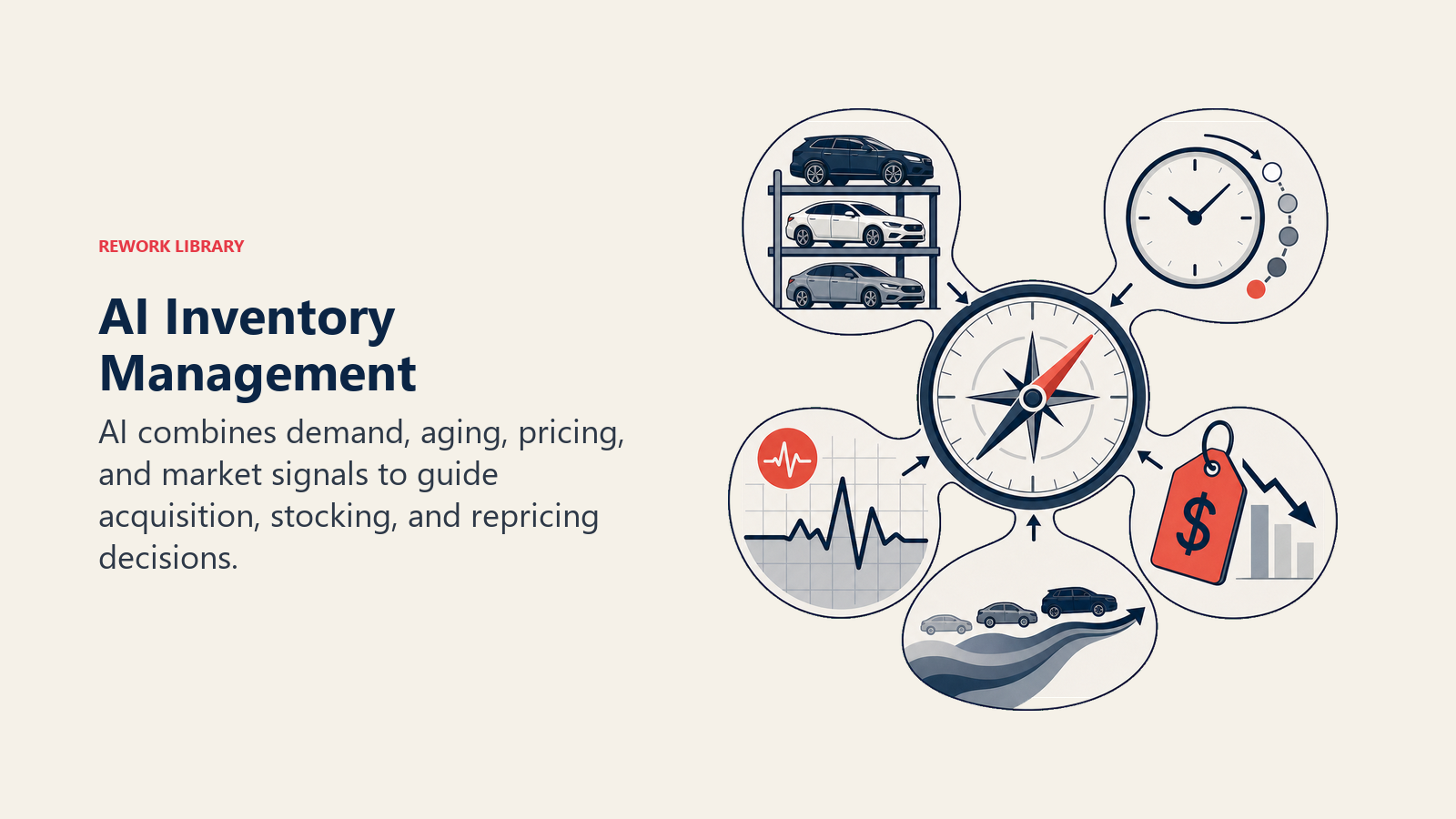
Predictive analytics for inventory acquisition:
AI analyzes:
- Local market demand by make/model/trim
- Seasonal trends and buying patterns
- Competitor inventory and pricing
- Days to turn by vehicle type
- Profit per unit by segment
Recommendations: "Stock 40% more [Popular SUV] for spring season based on 3-year trend data. Reduce [Sedan Model] by 25% due to declining demand."
Dynamic pricing based on market demand:
Instead of static pricing rules (cost + $2,500 markup), AI adjusts daily:
- High-demand vehicle with low market supply → price aggressively, hold firm
- Aging inventory (60+ days) → gradual price reductions to accelerate turn
- Competitor pricing shifts → automatic adjustments to stay competitive
- Seasonal factors → SUVs priced higher in winter, convertibles in summer
Cox Automotive's vAuto platform demonstrates how AI-powered inventory optimization manages every step from acquisition to sale, backed by powerful data and insights to help dealers move vehicles faster and boost ROI.
This approach optimizes your inventory pricing and aging strategy for maximum profitability.
Turn-rate optimization and aging vehicle alerts:
AI monitors every vehicle's age and turn rate:
- Target: 45-day average turn
- Day 30: Alert to increase marketing exposure
- Day 45: Suggest $500 price reduction
- Day 60: Recommend aggressive discounting or wholesale
- Day 75: Flag for immediate action (costing floor plan interest)
These alerts support inventory turn optimization by flagging aging units before they become profit drains.
Competitor pricing intelligence:
AI scrapes competitor websites daily:
- Identifies similar vehicles (same make/model/year/mileage)
- Compares your pricing to market
- Alerts when you're priced significantly above/below market
- Suggests optimal pricing position (competitive but not lowest)
ROI: 10-15% improvement in gross profit per vehicle:
100-car-per-month dealership:
- Baseline: $2,200 average gross profit per vehicle
- AI optimization: $2,420 average gross (10% improvement)
- Additional $220 per vehicle × 100 units = $22,000 monthly
- Annual impact: $264,000 additional gross profit
- AI platform cost (vAuto, ProfitTime): $1,000-2,000 monthly ($12,000-24,000 annually)
- ROI: 1,000-2,100%
Voice AI and Phone Systems
Phones ring all day. AI ensures every call is answered, qualified, and routed correctly.
Call routing and intent recognition:
Customer calls dealership main line:
- AI: "Thanks for calling [Dealership]. Are you calling about sales, service, or parts?"
- Customer: "I want to schedule service for my car."
- AI: "Perfect. Let me connect you to our service team." [Routes to service advisor]
Alternative: Customer says "I'm interested in the [Vehicle] I saw online."
- AI captures details, creates lead in CRM, routes to available salesperson immediately
Appointment scheduling via voice AI:
AI: "I can schedule your service appointment. What day works best?" Customer: "Thursday morning." AI: "I have 8am, 10am, or 11am available. Which do you prefer?" Customer: "10am." AI: "Great! You're scheduled for Thursday at 10am. Confirmation sent to your phone."
Appointment logged in DMS, customer receives text confirmation, service advisor sees it in schedule.
Service reminder confirmation:
AI calls customers with upcoming service due:
- "Hi [Name], this is [Dealership] calling to remind you your [Vehicle] is due for service. Would you like to schedule an appointment?"
- Customer responds yes/no
- If yes, AI schedules immediately
- If no, notes response in CRM and reschedules follow-up
This automation enhances service appointment scheduling efficiency while reducing BDC workload.
After-hours call handling:
When dealership is closed, AI answers:
- "Thanks for calling [Dealership]. We're currently closed but I'd be happy to help. What can I assist you with?"
- Qualifies intent (sales vs. service vs. parts)
- Captures contact information
- Schedules callback for next business day
- Creates lead/task in CRM for team
Sales call coaching and analysis:
AI analyzes recorded sales calls for:
- Script adherence and best practice execution
- Objection handling effectiveness
- Appointment setting success rate
- Talk time vs. listen time ratio
- Keyword and sentiment analysis
Provides coaching insights: "Salesperson A asks for appointment 40% of calls. Top performers ask 80% of time. Coach on asking for appointment earlier and more directly."
This data-driven approach to phone skills for automotive training dramatically accelerates rep development.
Personalization and Recommendation Engines
AI predicts what each customer wants and surfaces it proactively.
Vehicle recommendation based on browsing behavior:
Customer visits website and views:
- 3 midsize SUVs
- 2 vehicles with third-row seating
- 1 luxury trim level
AI recommendation engine displays:
- "Based on your interests, you might also like [Similar SUV with third row]"
- Email next day: "We noticed you're looking at [SUVs]. Here are 3 in stock with features you care about."
Content personalization on website:
Instead of generic homepage for everyone:
- Returning visitor who looked at trucks → homepage hero displays truck inventory
- Customer who submitted credit app → "Finish your application in 2 minutes" banner
- Previous buyer → "Welcome back! Check out what's new since your last visit"
Email subject line and message optimization:
AI tests thousands of subject line variations and learns what drives opens:
- Customer A responds to urgency: "Only 2 [Vehicles] left in stock"
- Customer B responds to value: "Save $3,200 on [Vehicle] this week"
- Customer C responds to curiosity: "Is [Vehicle] right for you?"
Each customer receives the subject line style statistically most likely to get opened.
Next-best-action suggestions for sales team:
Salesperson logs into CRM:
- AI suggests: "Contact [Customer] today. High engagement score. Viewed vehicle 3 times this week."
- "Follow up with [Customer] about trade-in. Equity increased $1,200 this month."
- "Call [Customer]. Lease matures in 60 days. Pull-ahead program active."
Prioritizes sales team's time on highest-probability opportunities.
Trade-in and upgrade recommendations:
Customer purchased 3 years ago. AI analyzes:
- Current vehicle value vs. payoff (equity position)
- Typical trade-in cycle for similar customers
- New inventory matching their preferences
- Current incentives and programs
Recommendation: "Contact [Customer] about upgrading. $2,800 positive equity. Similar customers trade in at 36-40 months. They're at 37 months."
These insights power proactive equity mining strategy campaigns that bring customers back sooner.
AI-Enhanced Video and Virtual Sales
Video selling is effective, but creating personalized videos at scale is time-consuming. AI solves this.
Personalized video message creation at scale:
Salesperson records one video walking around a vehicle. AI:
- Adds personalized intro: "Hi [Customer Name], I'm [Salesperson]. Based on your interest in [Features], I wanted to show you this [Vehicle]."
- Generates custom thumbnail with customer name and vehicle
- Creates multiple versions with different CTAs
- Tracks which customers watch and for how long
Virtual vehicle presentations and walk-arounds:
AI-powered virtual tour tools:
- Customer explores vehicle 360° interactively
- AI highlights features customer cares about based on previous behavior
- Comparison overlays show differences vs. competitors
- "Want to see this in person? Schedule test drive here."
AI-generated video scripts and thumbnails:
AI analyzes top-performing videos and generates scripts:
- "Hi [Name], you asked about [Feature]. Here's how it works in the [Vehicle]..."
- Suggests optimal video length (1:30-2:00 for engagement)
- Creates thumbnail variations and A/B tests performance
- Recommends best CTA based on customer stage
Engagement tracking and follow-up triggers:
CRM logs:
- Customer watched 80% of video → high interest, call immediately
- Customer watched 20% and stopped → different approach needed
- Customer watched full video but no response → send alternative vehicle option
- Customer rewatched video → very high interest, urgent follow-up
This behavioral tracking improves automotive video marketing effectiveness by identifying truly engaged prospects.
Predictive Analytics and Forecasting
AI transforms historical data into forward-looking insights.
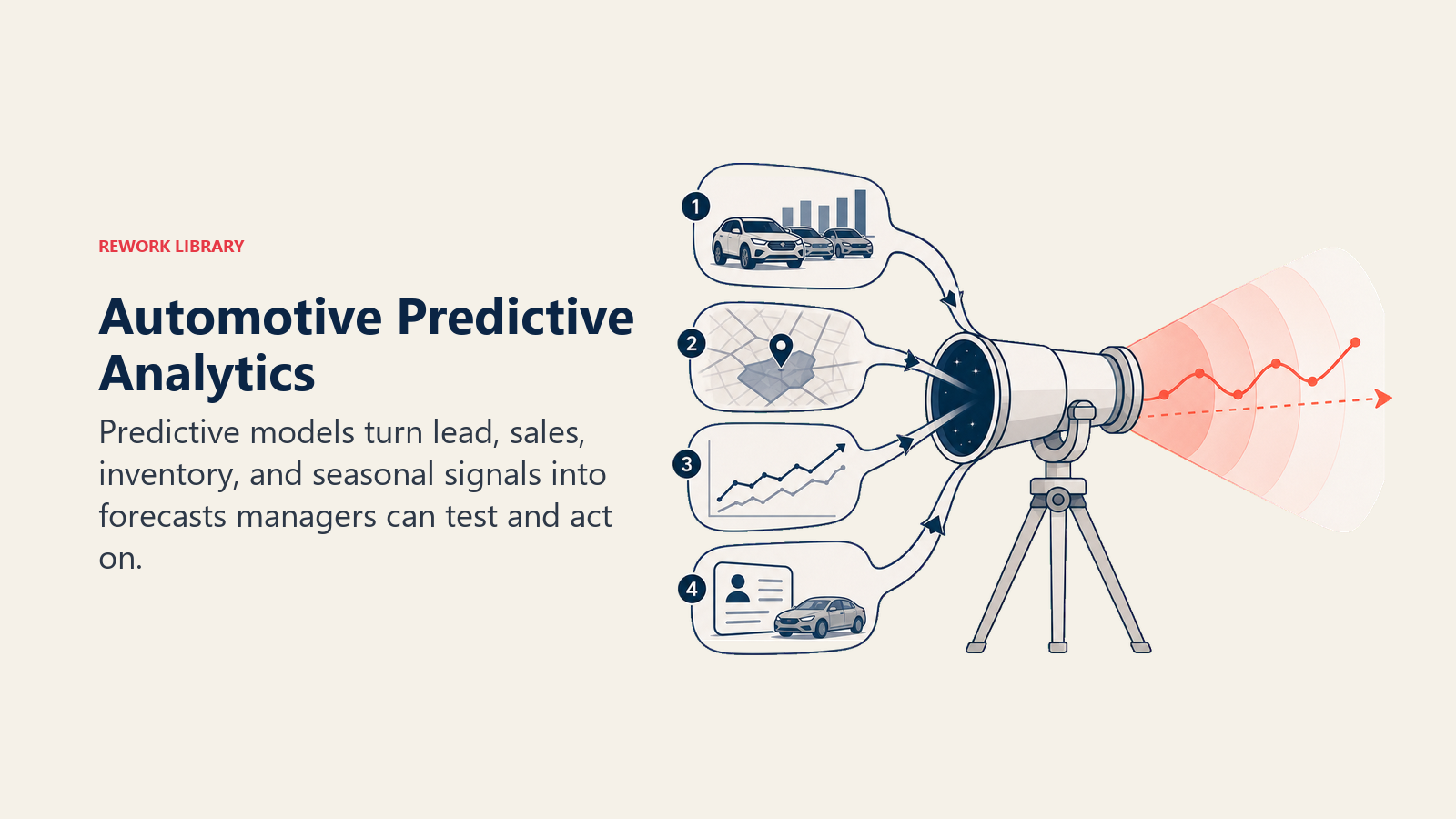
Sales forecasting and goal setting:
AI analyzes historical data to improve dealership analytics:
- Historical sales patterns by month/quarter/year
- Seasonal trends and market conditions
- Inventory levels and days supply
- Marketing spend and lead flow
- Economic indicators and local market health
Forecast: "Based on current trends, expect 98-104 units next month (95% confidence). Increase marketing $3,000 to hit 110-unit goal."
Customer defection prediction and retention triggers:
AI identifies customers at risk of defecting:
- Service frequency declining (3 visits/year to 1 visit)
- Haven't responded to recent communications
- Similar customers in this stage typically defect within 60 days
Action: Trigger retention campaign with special service offer and personal outreach.
Service-to-sales opportunity identification:
AI flags service customers ready to buy:
- Vehicle has 85,000+ miles and 6+ years old
- Recent repair costs increasing
- Customer has good service payment history (indicates ability to buy)
- Similar customers typically purchase at this point
Alert: "Customer [Name] is high-probability service-to-sales. Have sales call to discuss upgrade options."
This predictive capability captures revenue that would otherwise be lost to competitors when customers decide independently to trade.
Market trend analysis and competitive intelligence:
AI monitors:
- Local market inventory levels by segment
- Pricing trends up or down
- Competitor market share shifts
- New model launches and impact
- Economic indicators affecting demand
Insights: "Compact SUV demand increasing 12% quarter-over-quarter. Competitors increasing prices 3-5%. Recommend expanding inventory 15-20 units and pricing confidently."
According to Statista's automotive software market analysis, the global automotive software market is expected to grow from $21.8 billion in 2026 to $56.5 billion in 2035, reflecting the increasing adoption of AI and data analytics tools in automotive retail.
Implementation Strategy and ROI
AI implementation succeeds when you start focused and expand methodically.
Where to start: highest-ROI applications first:
- Lead management and scoring (fastest ROI, easy implementation)
- Chatbots for website and after-hours engagement (immediate impact)
- Inventory pricing optimization (high-dollar impact)
- Service-to-sales predictive analytics (underutilized opportunity)
- Voice AI and phone systems (longer implementation, high value)
Build vs. buy decisions:
Build custom AI only if:
- You have significant in-house technical expertise
- Your needs are truly unique (unlikely in automotive retail)
- You have budget for ongoing development and maintenance
Buy proven platforms because:
- Automotive-specific AI vendors have trained models on industry data
- Faster time to value (weeks vs. months/years)
- Ongoing updates and improvements included
- Support and training provided
Change management and staff adoption:
AI fails when teams resist it. Ensure adoption by:
- Positioning AI as assistant, not replacement ("AI handles boring tasks, you focus on selling")
- Training on how AI helps them personally (higher close rates, better prioritization)
- Celebrating wins ("AI identified this hot lead, salesperson closed $3,200 gross deal")
- Incorporating AI metrics into performance reviews
Measuring success and optimizing performance:
Track before/after metrics:
- Lead conversion rate
- Response time (leads, phones, chats)
- Gross profit per vehicle
- Customer retention rate
- Sales per rep productivity
Review quarterly and optimize:
- Which AI applications delivering ROI?
- Where is adoption lacking?
- What additional features to enable?
- Where to expand AI usage?
Future-proofing your technology stack:
Choose AI vendors that:
- Integrate with your existing CRM and DMS
- Provide API access for future integrations
- Regularly update and improve AI models
- Aren't dependent on single platform or provider
- Have strong financial backing and customer base
Key Takeaways
AI in automotive retail is real, practical, and delivering measurable ROI today in specific applications.
Start with lead management and chatbots, these deliver fastest results with lowest implementation complexity.
Focus on augmenting your team, not replacing them. AI qualifies, prioritizes, and engages. Humans build relationships and close.
Measure everything. Track conversion rates, response times, and gross profit improvements to prove ROI.
Expand methodically. Master one AI application before adding another.
And ignore the hype. AI won't revolutionize your dealership overnight. But it will make your existing processes 15-25% more efficient, and that compounds into significant profit improvement over time.
The dealerships winning with AI aren't betting their entire operation on it. They're deploying it strategically in areas where automation delivers clear value, while keeping humans at the center of customer relationships.
Related Resources:

Senior Implementation Consultant
On this page
- The State of AI in Automotive Retail
- AI-Powered Lead Management
- Conversational AI and Chatbots
- AI for Inventory Management
- Voice AI and Phone Systems
- Personalization and Recommendation Engines
- AI-Enhanced Video and Virtual Sales
- Predictive Analytics and Forecasting
- Implementation Strategy and ROI
- Key Takeaways