Service Advisor Selling Skills - Turn Write-Ups Into Revenue Opportunities - 2026 Guide
Turn this article into takeaways for your work.


Each assistant summarizes the article only for you and suggests best practices for your work.
The service advisor role has evolved from order-taker to trusted consultant, top-performing advisors average $125+ hours per RO vs. $65 for their peers, directly impacting department profitability and customer vehicle safety.
When a customer pulls onto your service drive at 7:15 AM, they're not just bringing you a vehicle. They're giving you their trust, their time, and an opportunity to help them make informed decisions about a $30,000+ asset they depend on every day.
Most service advisors see a transaction. The best ones see a relationship. That difference shows up directly in hours per RO, customer retention, and fixed ops profitability.
If you're still taking orders rather than making recommendations, you're leaving $50,000-$100,000 in annual labor sales on the table. Let's change that.
The Service Advisor as Consultant
The old-school service advisor approach was transactional. Customer says they need an oil change. You write it up. Tech performs the service. Customer pays and leaves. Maybe you average 0.8 hours per RO because you're only doing what the customer asked for.
The modern service advisor is a vehicle health consultant. You're the intermediary between the customer and their vehicle's actual condition. You're the expert who interprets what the technician finds and helps the customer make smart decisions about maintenance and repairs. This role is fundamental to achieving strong service absorption rates.
This requires a mindset shift. You're not selling services the customer doesn't need. You're identifying what the vehicle requires and presenting those recommendations with confidence and clarity.
Think about how a dentist operates. They don't just clean your teeth and send you home. They do a comprehensive examination, identify issues, explain what they found, recommend treatment, and give you options. That's exactly what a service advisor should do.
Building trust starts the moment the customer arrives. Greet them by name if you have their information from the appointment. Make eye contact. Ask about their vehicle concerns. Listen carefully without interrupting. Take notes on their responses.
When customers feel heard and understood, they're far more receptive to recommendations. When they feel rushed or dismissed, they decline everything beyond what they came in for.
Understanding customer priorities is critical. Some customers prioritize safety above all else, they want to know their family is secure in that vehicle. Others care most about reliability, they can't afford breakdowns that disrupt their work schedule. Budget-conscious customers need to understand long-term cost, not just today's repair cost.
Position yourself as the vehicle health expert, not a salesperson. Use phrases like "Based on what I'm seeing in your service history and the inspection, here's what your vehicle needs" rather than "Would you like to add this service today?"
The language matters. Customers respond to confidence backed by expertise, not sales pressure.
Multi-Point Inspection Selling Process
The multi-point inspection is your revenue generation tool. But only if you actually perform it thoroughly and present the findings effectively.
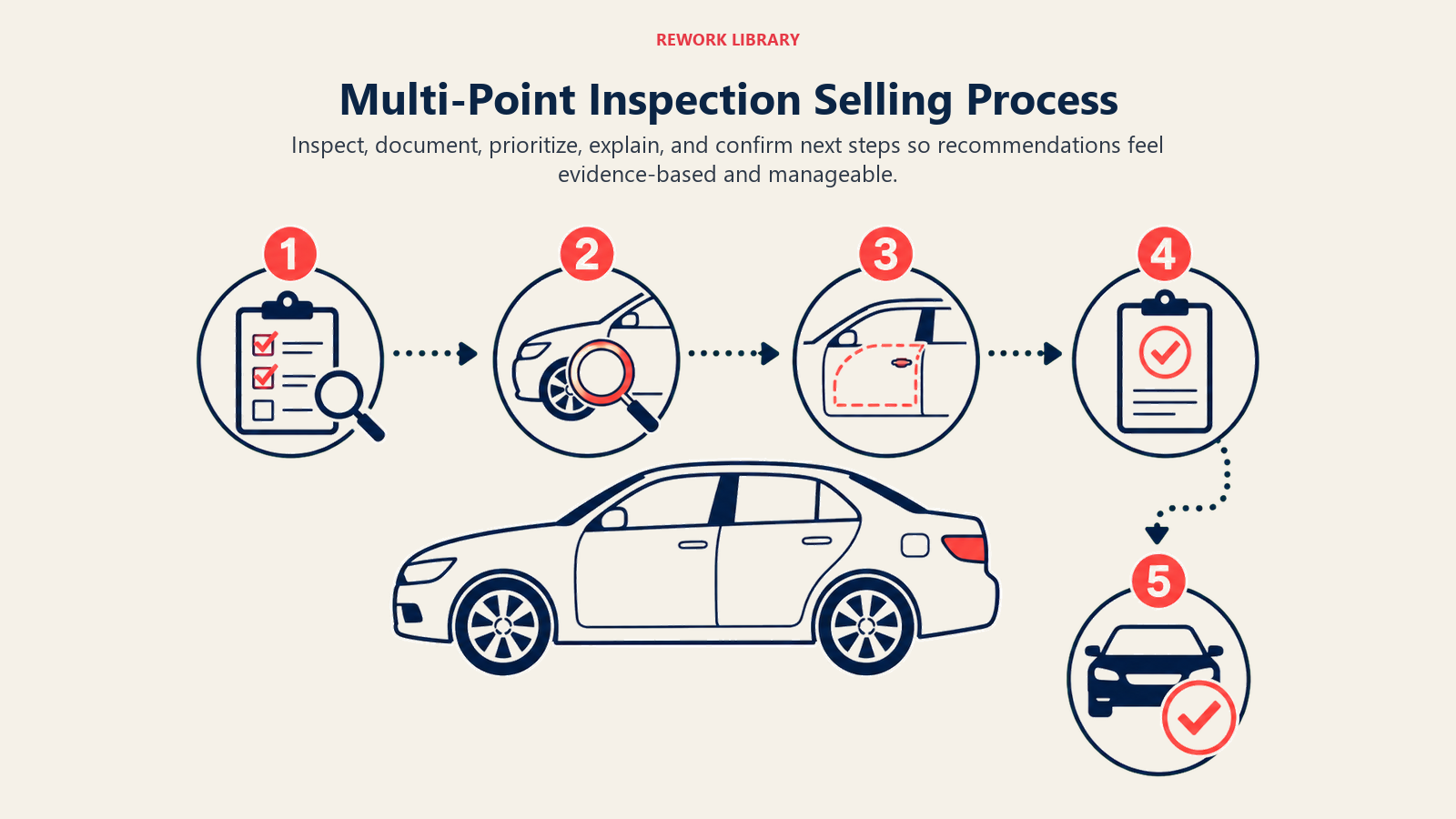
A proper MPI should inspect every major system: tires (tread depth, wear patterns, pressure), brakes (pad/shoe thickness, rotor/drum condition, fluid level), fluids (engine oil, coolant, transmission, brake, power steering, washer), filters (engine air, cabin air, fuel), battery (voltage, terminals, age), belts and hoses (condition, cracks, wear), lights (all exterior and interior), suspension (shocks, struts, bushings, ball joints), exhaust system, and visual underbody inspection.
This takes 20-30 minutes when done properly. That's billable time that also uncovers revenue opportunities that contribute to overall fixed operations performance.
The red/yellow/green classification system makes recommendations clear and actionable. Red items are immediate safety concerns, the vehicle shouldn't leave your lot without addressing these. Worn brake pads metal-to-metal. Tire tread below 3/32". Critical oil leaks. Safety issues aren't optional.
Yellow items are maintenance that's due soon based on mileage, time, or condition. Engine air filter that's dirty but not completely clogged. Coolant that's due for flush based on mileage. Brake pads at 4mm that'll need replacement in the next few months. These items give customers options, address now or schedule for next visit.
Green items are systems that look good and don't need attention. "Your suspension looks great, no concerns there" builds confidence and shows you did a thorough inspection, not just looking for problems to sell.
Digital vehicle inspection tools transform how you present findings. Instead of walking out to the customer with a paper checklist and trying to describe what you found, you're showing them photos and videos on their phone.
When a customer sees a photo of their brake pads worn to 2mm next to a new brake pad photo for comparison, the conversation changes. You're not convincing them they need brakes, you're showing them undeniable evidence.
Video is even more powerful. A 15-second video of the technician demonstrating a worn suspension bushing, showing the customer the movement and explaining why it's a concern, is worth ten minutes of verbal explanation. J.D. Power research confirms that when customers receive photo or video communication about needed maintenance, they're three times more likely to approve advisor-recommended work.
The best DVI systems let you text or email the inspection report directly to the customer's phone while they're in your waiting room or after they've returned to work. They can review the findings, see the evidence, and approve work with a few taps.
Prioritizing recommendations properly shows professionalism and builds trust. Always lead with safety concerns. "Here's what's critical, your front brake pads are at 2mm, which is metal-to-metal territory. We need to address this today for your safety."
Then move to recommended maintenance. "Based on your mileage, your coolant is due for a flush. Your engine air filter is pretty dirty and replacing it will improve fuel economy and engine performance."
Finish with the green items. "The good news is your tires look great with 7/32" tread remaining, your battery tested strong, and we don't see any fluid leaks."
This structure, critical first, recommended second, good news last, keeps customers engaged and makes it easy for them to make decisions.
Recommendation Presentation Framework
How you present recommendations determines approval rates. According to J.D. Power's Customer Service Index Study, communication is critical, four of the top 10 most influential performance indicators are communication-related, including completely focusing on customer needs and keeping customers informed of service status. The difference between a 30% approval rate and a 65% approval rate isn't the quality of your inspection, it's your presentation.
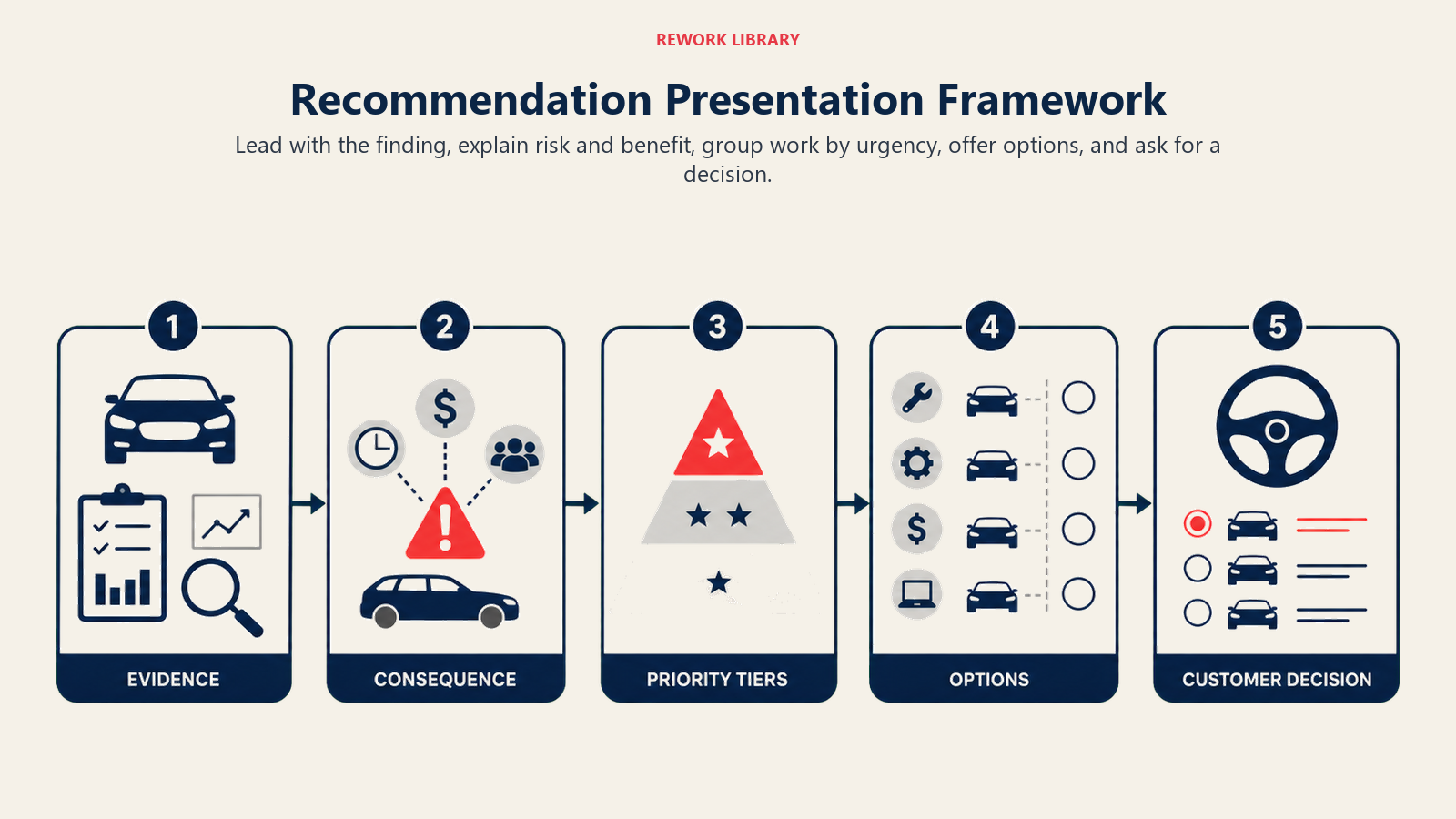
Lead with safety, always. "The most important thing I need to discuss with you is your front brakes. Here's a photo showing the pad thickness at 2mm. At 3mm, we consider brakes safety-critical. You're past that point. I strongly recommend we replace these today."
Most customers approve safety recommendations immediately when they're presented with conviction and evidence. The ones who hesitate usually need more context about what happens if they don't address it.
Explain "why now" for yellow items. Customers have been trained by poor service experiences to assume every recommendation is a sales pitch. Your job is to educate them on timing and consequences.
"Your engine air filter is pretty dirty. You're at 32,000 miles and the manufacturer recommends replacement at 30,000. A dirty filter reduces fuel economy by about 5-10% and can impact engine performance. Replacing it now will improve your gas mileage and help your engine run properly."
That's not a sales pitch. That's education backed by manufacturer specifications and clear benefits.
Menu pricing simplifies decision-making for packages. Instead of itemizing every service in a brake job (pads, rotors, labor, shop supplies, brake fluid flush), present a complete brake service package at a bundled price.
"Your front brake service is $485, which includes new pads, resurfacing rotors, brake fluid flush, and a test drive to verify everything's working properly."
Customers prefer package pricing because it's transparent and comprehensive. They're not worried about being nickeled and dimed with additional charges.
Provide options when possible, good, better, best. "For your brake service, we have a few options. The good option is replacing pads and resurfacing rotors for $485. The better option includes new rotors instead of resurfacing for $625, which I recommend given your mileage. The best option adds a complete brake fluid flush for $695, which ensures the entire brake system is refreshed."
Most customers choose the middle option. Some choose the best. Very few choose the lowest option when you frame it this way.
But don't overwhelm customers with too many choices. Three options work. Seven options paralyze decision-making.
Handling Common Objections
Even with perfect presentation, you'll face objections. How you handle them determines whether you close the sale or lose the opportunity.
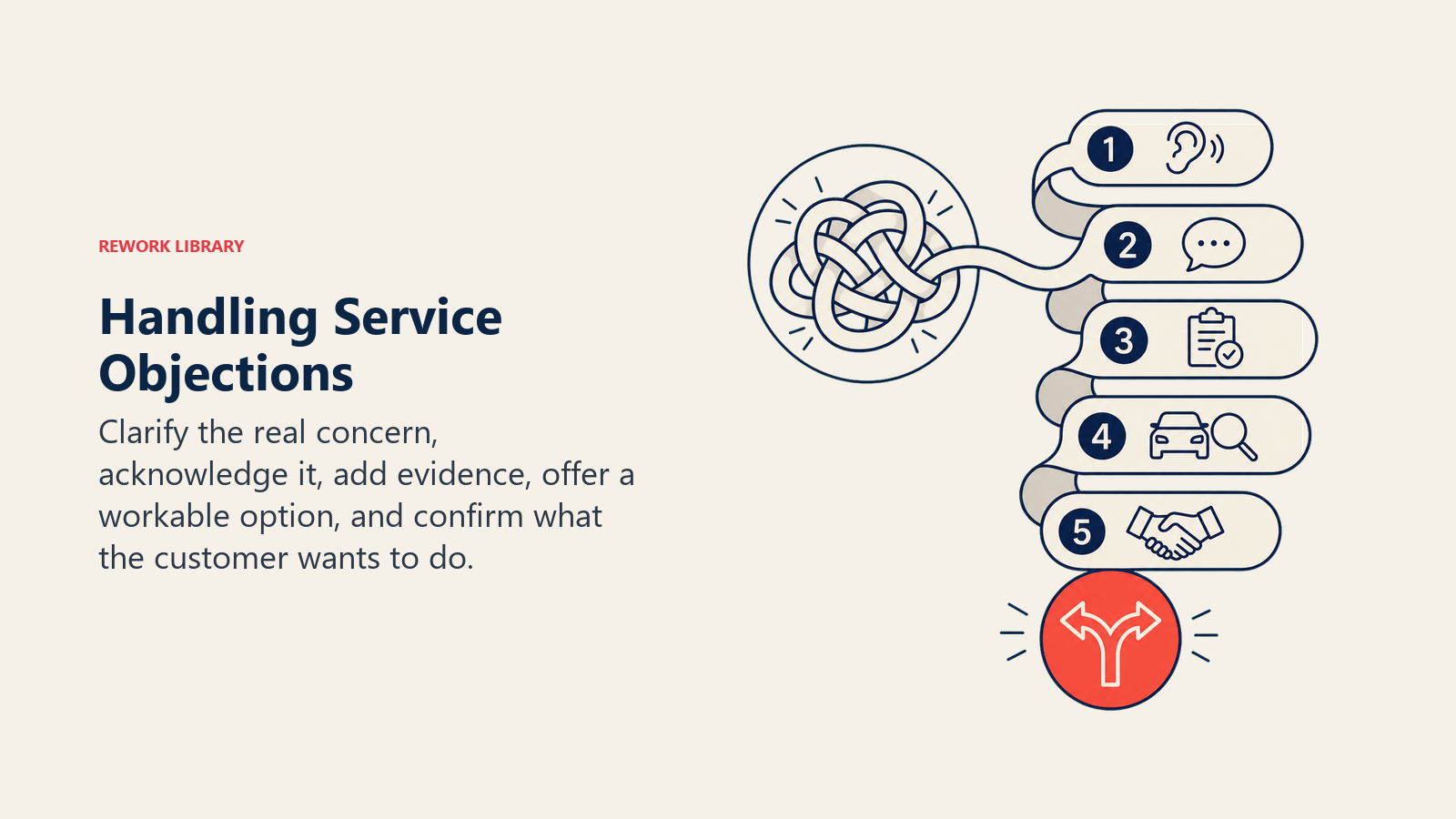
"I need to think about it" usually means the customer doesn't understand the urgency or value. Create urgency around safety items.
"I completely understand wanting to consider it. If this were a maintenance item, I'd say take your time. But this is a safety concern with your brakes. Every time you press the pedal, you're adding more wear to metal that's already at the minimum thickness. I want to make sure you and your family are safe."
For non-safety items, offer to schedule a follow-up appointment. "Let's get this scheduled for two weeks from now so it's on your calendar. You can always reschedule if needed, but at least we'll have it planned."
"That seems expensive" is an opportunity to reframe value and long-term cost.
"I understand the concern. Let's break this down. Your front brake service is $485. That's about $1.33 per day over the next year. Compare that to the cost of replacing rotors if we don't address it now, that jumps to $725. Or the cost of a brake failure causing an accident. This is actually the least expensive option."
You're not defending your price. You're explaining the value and consequences of inaction.
"Can I wait?" requires honest assessment and education.
"For safety items like brakes, I can't recommend waiting. But for something like your engine air filter, yes, you could wait another few weeks without major consequences. However, you're here today, we have the part in stock, and it takes 10 minutes to replace. Doing it now is convenient and ensures you're getting the best fuel economy."
Give honest answers. If something can wait, say so. Your credibility increases when customers realize you're not pushing everything aggressively. Deloitte research on automotive customer experience shows that consumers prioritize service quality, trust, and transparency when choosing service providers. This builds the trust that drives long-term customer retention.
"I'll get a second opinion" usually means the customer doesn't trust you yet.
"Absolutely, I encourage that. In fact, I'll email you the photos and video from our inspection so you have the documentation. I'm confident any reputable shop will tell you the same thing based on what we found. Just please be careful driving with those brake pads in that condition."
When you're confident and transparent, customers often don't bother getting the second opinion. And if they do, they come back because you were right.
Phone Skills for Service Advisors
The write-up conversation is only half the job. Outstanding service advisors master outbound phone skills during the service process.
When your technician finds additional items during the MPI, you need to call the customer for approval. This call determines whether you add $300 in labor sales or just complete the basic oil change they scheduled.
The approach matters. "Hi Sarah, this is Mike from ABC Motors. We're working on your Accord right now and wanted to update you on what we found. Do you have a couple minutes to review the inspection results?"
Get permission to discuss findings. Don't launch into a list of repairs without context.
"Our technician completed the multi-point inspection and found a few things that need attention. I'm going to text you photos right now so you can see what we're looking at. The most important one is your front brake pads, they're measuring 2mm, which is safety-critical. Take a look at the photo I just sent."
Send the photos before or during the call. Visual evidence closes sales over the phone.
Present the findings clearly. "Based on what we found, I recommend we take care of the front brakes today. We have the parts in stock and can have you out the door by 3 PM as scheduled. The cost is $485 including parts, labor, and brake fluid flush."
Shut up and let the customer respond. The natural inclination is to keep talking and justify the recommendation. Resist that urge.
If they approve, confirm: "Perfect, we'll get started on the brakes right away. Your new total will be $485 plus the oil change, so $554. Still planning to pick up around 3 PM?"
If they decline, ask why: "Can I ask what's holding you back? Is it the cost, the timing, or something else?" Understanding the objection lets you address it.
Handle price concerns over the phone with the same techniques as in-person. Break down the cost, explain long-term value, offer payment options if available.
Before ending the call, confirm next steps: "We'll have your vehicle ready by 3 PM with the oil change and brake service completed. I'll send you a text when it's ready."
Then, and this is critical, confirm their next maintenance visit before they leave: "Based on your mileage, your next service will be around 38,000 miles, which should be in about 4-5 months. Can we get that scheduled now? We have a Thursday morning at 8 AM available."
Booking the next appointment before they leave increases retention by 40%+ because it's on their calendar rather than relying on them to remember and call later. This practice is essential for effective appointment scheduling.
Technology Tools That Transform Selling
Digital vehicle inspection apps are non-negotiable in 2026. BOLT ON, AutoVitals, TruVideo, UVeye, the specific platform matters less than having one and using it consistently.
These tools do three things exceptionally well: they capture inspection findings with photos and video, they deliver those findings to customers instantly via text or email, and they track approval rates so you can measure performance.
Service history integration from your DMS and CRM systems shows customers what they've had done previously and what's due based on manufacturer schedules. When you can pull up a customer's complete service history in seconds and show them "You last had your transmission fluid serviced at 45,000 miles, you're now at 92,000 miles, and the manufacturer recommends service at 90,000," there's no debate about whether it's needed.
OEM service schedules and maintenance reminders are built into most DMS systems but underutilized. Your system should flag upcoming maintenance based on mileage and months since last service. When a customer comes in at 29,500 miles, your DMS should alert you that 30K service is due.
Parts pricing transparency tools eliminate the "I can buy that part for $50 on Amazon" objection. Show customers the part cost, the labor time, the markup, and the total. Transparency builds trust.
The technology exists to double your hours per RO. But only if you use it systematically and train every service advisor on proper implementation.
Measuring and Improving Your Performance
Track your personal hours per RO weekly through your dealership KPI dashboard. The average service advisor in your dealership might hit 1.8 hours per RO. You should be targeting 2.5-3.0 hours per RO within six months of implementing these techniques.
Calculate your recommendation approval rate. Of the items you recommend during multi-point inspections, what percentage do customers approve? Top advisors see 60-70% approval rates on yellow items and 90%+ on red items.
Monitor customer retention among your personal customers. Are they coming back for subsequent services? If not, you're either over-recommending (breaking trust) or under-recommending (they're going elsewhere for repairs you should have caught).
Gather feedback from customers through post-service surveys and CSI tracking. When satisfaction scores dip, identify what's causing the issue and adjust.
The best service advisors obsessively track their metrics and compete with themselves to improve month over month. That's how you go from $65 per RO to $125+ per RO while building customer loyalty.
You're not just writing up repairs. You're building relationships, protecting vehicle safety, and driving overall dealership profitability. Master consultative selling and you'll transform your career and your dealership's fixed ops performance.

Senior Implementation Consultant