Phone Skills for Automotive: Converting Calls into Appointments and Sales - 2026 Guide
Turn this article into takeaways for your work.


Each assistant summarizes the article only for you and suggests best practices for your work.
Dealerships receive 200-400 phone inquiries monthly, with average conversion rates of 15-25%. Top-performing BDCs with trained staff achieve 50% conversion rates on inbound calls and up to 80% with proper coaching, the difference between 30 and 120 appointments per month from the same call volume.
The phone call is where internet interest becomes real conversation. It's where customers reveal their actual timeline, budget concerns, trade-in situations, and objections. Industry data shows that phone leads achieve 74% appointment set rates compared to just 40% for internet form submissions, making phone skills critical for BDC success. It's where skilled BDC agents overcome the "just email me the price" objection and convert digital shoppers into showroom appointments.
Most importantly, it's where differentiation happens. Every dealer has similar inventory, similar pricing, similar financing. But the dealership whose BDC agent builds rapport in 60 seconds, asks smart discovery questions, handles pricing objections smoothly, and makes appointment setting feel natural, that dealership wins the customer.
Phone skills aren't natural talent. They're learnable techniques, practiced responses, and systematic approaches. This article breaks down exactly what top-performing BDC agents do differently on the phone.
Phone Call Fundamentals
Great phone conversations start with fundamentals. Professional greeting and brand representation set the tone immediately. "Thanks for calling Honda of Springfield, this is Marcus, how can I help you today?" is clean, professional, and inviting. Don't answer with just "Honda" or "Sales department." Use your name, speak clearly, and project competence from the first syllable.
Voice tone, pace, and energy management matter more than most agents realize. Match your customer's energy level, if they're excited and fast-talking, speed up. If they're calm and methodical, slow down. Smile while talking; customers can hear smiles through the phone. Vary your tone to avoid monotone delivery. Record yourself and listen, you might be surprised what you sound like.
Active listening and mirroring techniques build subconscious rapport. When customers use specific phrases, echo them back: "You mentioned you're looking for something with good fuel economy, the Civic EX averages 33 mpg combined." When they emphasize concerns, acknowledge them: "I hear you, reliability is your top priority." Mirroring shows you're listening, not just waiting to talk.
Building rapport in 60 seconds requires finding common ground quickly. Listen for clues: accents (local area vs out of state), background noise (at work, in car, at home), tone (stressed, relaxed, excited). Comment appropriately: "Sounds like you're having a busy day, I'll keep this quick and helpful." Small acknowledgments create human connection.
Overcoming caller skepticism is necessary because customers expect typical dealer behavior. They expect you to dodge questions, pressure them to come in, or waste their time. Acknowledge this directly: "I know most dealers make phone calls painful, I promise I'll be straightforward and respectful of your time." Early reassurance defuses defensive attitudes.
Creating conversational flow vs interrogation means avoiding rapid-fire questions. Don't: "What vehicle are you interested in? When are you looking to buy? What's your budget? Do you have a trade?" Do: "Tell me a little about what you're looking for... That makes sense, are you replacing a vehicle or adding one?... What's your timeline looking like?" Conversational transitions feel natural; interrogation feels aggressive.
Inbound Call Handling
Customers calling you are the warmest leads you'll get. Don't waste them. Capturing caller information early prevents losing leads. Within the first 60 seconds, get name and contact info: "I'd love to help, let me pull up your information. What's your first name?... And your phone number in case we get disconnected?" This feels like service, not data collection. If they resist, reassure: "No worries, just want to make sure we can follow up if we get cut off." Determining vehicle of interest quickly focuses the conversation. "What brought you in today, were you looking at something specific on our website?" or "What kind of vehicle are you considering?" Get to the point fast so you can provide relevant information. The faster you know what they want, the faster you can help them.
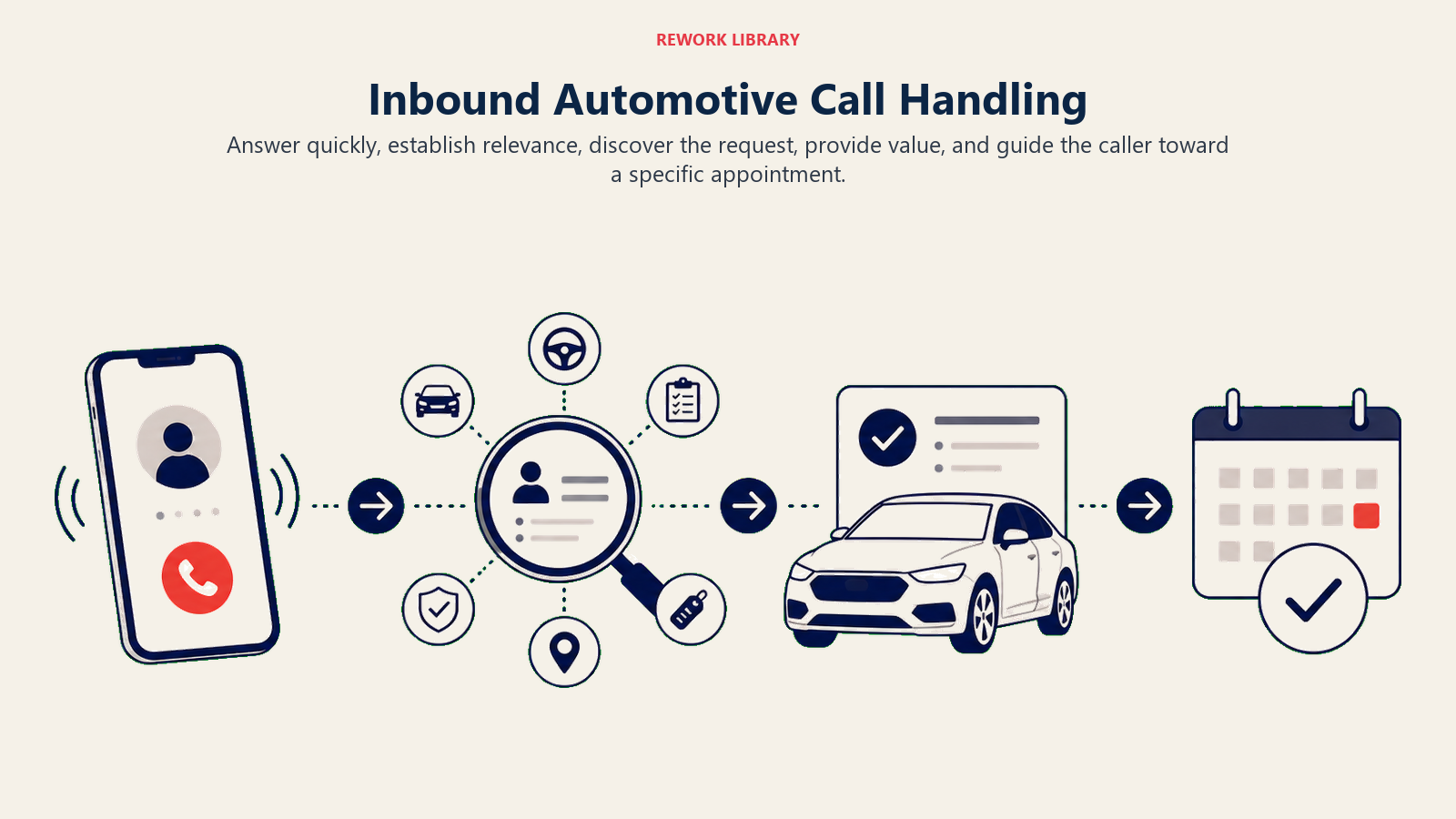
Availability and pricing questions come up in every call. For availability: "Yes, we have that exact vehicle, it's right here on the lot. When would you like to see it?" For pricing: "Great question, our internet pricing typically runs $1,500-2,500 below MSRP, but final pricing depends on your trade value and available incentives. That's why I'd love to go through everything with you in person. Does tomorrow afternoon work?"
Trade-in discussion strategies vary by customer readiness. Some customers lead with trade questions: "How much will you give me for my 2019 Accord?" Get details: "I can pull a quick estimate, what trim level is it and how many miles?" Provide realistic ranges: "Similar Accords are trading in the $16,500-18,500 range depending on condition. Want me to get you a firm number when you come see the new vehicle?" Don't give lowball numbers that kill credibility.
Transitioning to appointment setting should happen naturally after you've provided value. "So it sounds like the Civic EX in white with the sunroof package is exactly what you're looking for, and we have it in stock. I can have it ready for you tomorrow at 2:30, does that work or is 4:00 better for your schedule?" Natural transitions feel helpful, not pushy.
Handling multiple shopper questions requires organization. If customers ask eight questions in rapid-fire, acknowledge: "Great questions, let me go through these one by one." Then systematically address each one. If questions require research, set expectations: "That's a great question about towing capacity, give me 30 seconds to pull the exact specs... Okay, the Pilot can tow 3,500 pounds on the standard model, 5,000 with the tow package."
Outbound Call Strategy
Calling customers who haven't answered your previous attempts requires different tactics. Voicemail strategies that get callbacks focus on curiosity and value. Don't leave: "Hi, this is Marcus from Honda, just following up on your inquiry, give me a call back." Do leave: "Hi Sarah, Marcus from Honda. I have good news about the white Civic EX you looked at, our inventory manager found one with the sunroof package you wanted. Give me a call back at 555-0123. Again, that's Marcus at 555-0123." Specific information creates curiosity; generic "following up" gets ignored. Opening lines that engage should reference previous interaction or new information. "Hi Sarah, Marcus from Honda, I know I've tried to reach you a few times. I wanted to try one more time because Honda just announced new financing that might change the numbers on the Civic EX you looked at." Or: "Hi Sarah, Marcus here, I noticed you opened my email this morning about the Civic. Did you have any questions?" These openers show persistence with purpose.
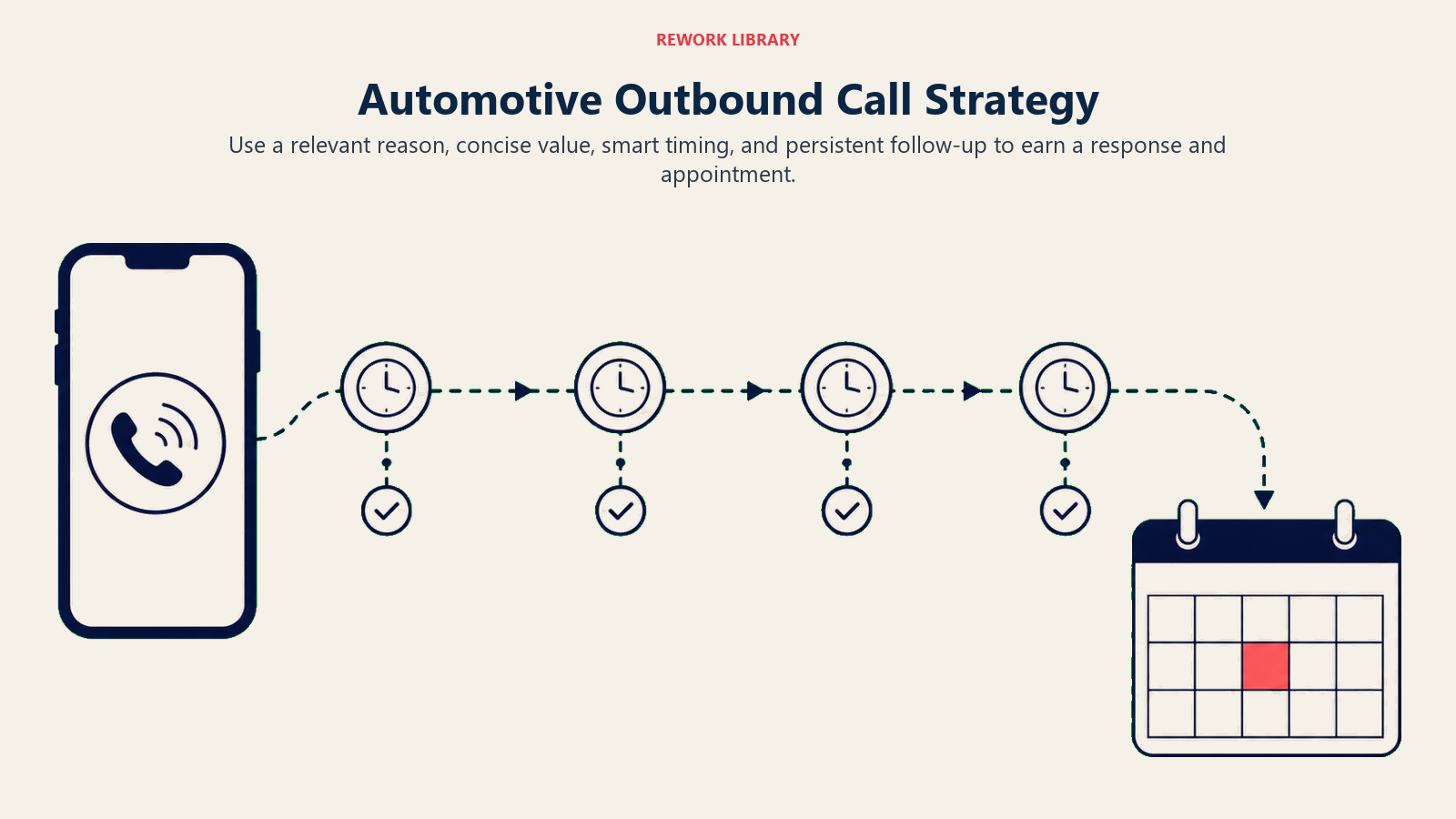
Reference to previous interaction or interest validates your call. "You submitted an inquiry about the Civic EX on Tuesday" or "When we spoke last week, you mentioned you wanted to think about the payment options" or "I saw you visited our website again yesterday looking at Civics." These references prove you're not calling randomly, you're following up on their demonstrated interest.
Permission-based conversation flow respects customer time. After your opening, ask: "Is this a good time to talk for a couple minutes?" or "Did I catch you at an okay time?" Asking permission disarms defensiveness. If they say no, respond: "No problem, when's a better time? I can call back this evening or tomorrow morning." Respecting their time builds trust.
Overcoming gatekeepers and resistance happens when calling cell phones that screen calls. If someone answers with clear skepticism, acknowledge: "I know you probably don't recognize this number, this is Marcus from Honda of Springfield. You inquired about a Civic on our website Tuesday. Is now an okay time to discuss details?" Transparency and directness work better than pretending to be someone you're not.
Optimal calling times and frequency vary by lead quality. Hot leads (recent inquiries, high engagement): call 3-4 times in first 24 hours at different times. Warm leads: call once daily for first week, then 2-3 times weekly. Cold leads: call twice weekly maximum. Research shows it takes an average 3.4 phone calls to connect with a customer, so persistence is essential. Try different times: morning (9-11am), lunch (12-1pm), afternoon (2-4pm), evening (6-8pm). Track what works for your market.
Discovery & Qualification
You can't help customers without understanding their situation. Purchase timeline assessment happens early in conversation. "Are you looking to purchase in the next few weeks, or are you gathering information for down the road?" This tells you how aggressively to pursue the appointment. "Next two weeks" gets appointment push. "Just researching" gets value-add approach: "Perfect, let's get you all the information you need now so when you're ready, you can make a confident decision." Budget and payment exploration requires finesse. Never ask "What's your budget?" That feels invasive. Instead: "Were you looking to purchase or lease?" Then: "Okay, and ballpark what monthly payment range works for your budget? Just so I show you appropriate options." Or: "The Civic EX typically runs $420-460/month with average trade and credit. Does that range work or would you need to be lower?" These approaches explore budget without making customers defensive.
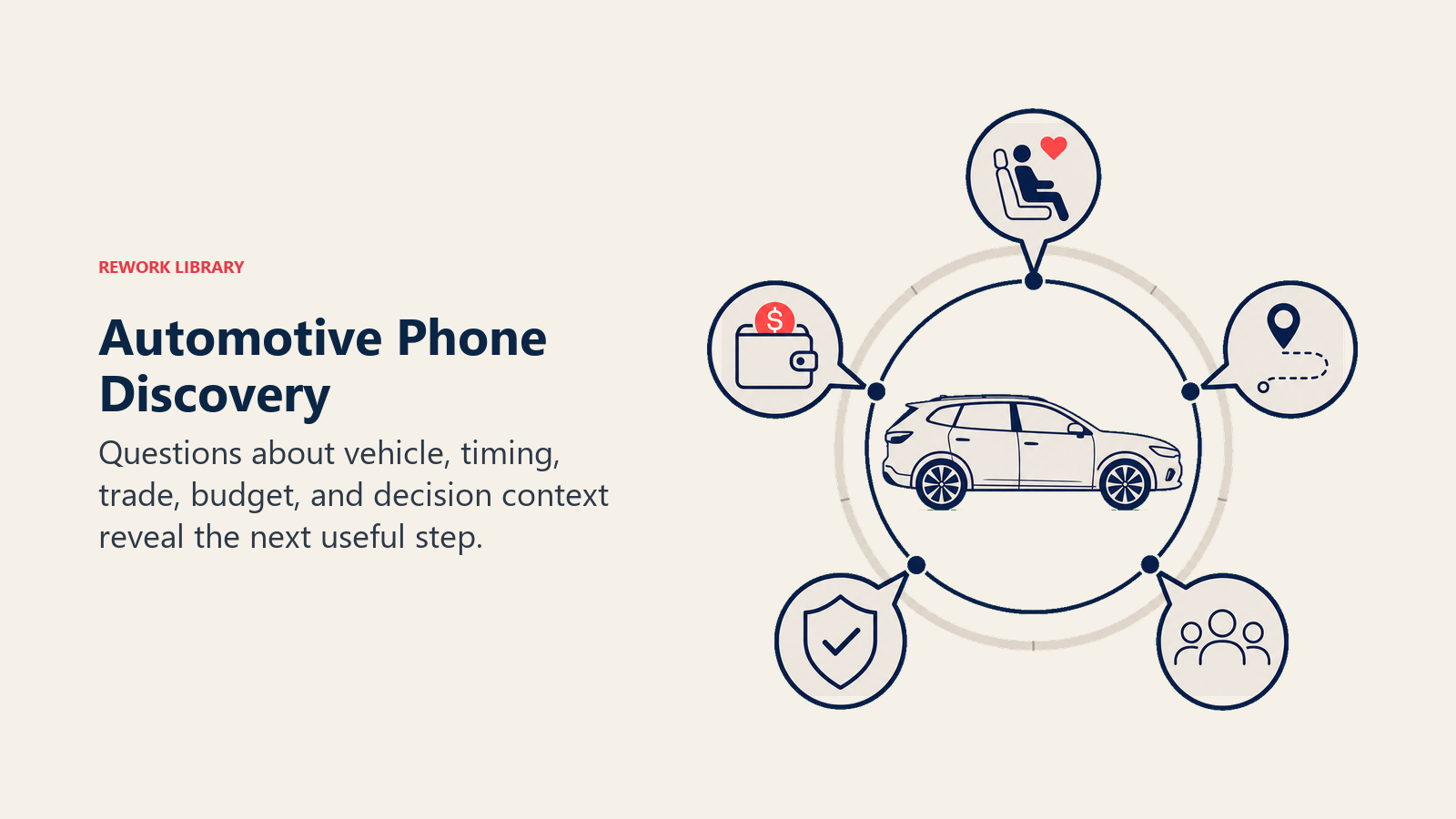
Trade-in equity discovery helps you qualify and provide value. "Are you trading in your current vehicle or keeping it?" If yes: "What are you driving now?... How many miles?... Do you know roughly what you owe on it?" Calculate quick equity: "Okay, similar 2021 Accords with 35K miles are trading around $24,000. If you owe $18,000, you've got about $6,000 equity, that's great news for your down payment." This positions you as helpful advisor.
Decision-maker identification prevents wasted appointments. "Will anyone else be involved in this decision, spouse, co-signer?" If yes: "Perfect, we should get both of you here together so you can both see the vehicle and make the decision together. Do Saturday mornings work for both of you?" Include all decision-makers from the start.
Credit situation awareness helps set appropriate expectations. Don't ask: "What's your credit score?" Do ask: "Have you financed a vehicle before?... How did that go?" or "Do you anticipate any challenges with financing?" Customers with good credit will tell you: "Oh no, my credit's fine." Customers with challenged credit will volunteer: "I've had some issues..." Tailor your approach accordingly.
Urgency and motivation uncovering reveals why customers are shopping. "What's prompting you to look for a new vehicle now?" Listen for: lease ending, current vehicle problems, family expansion, lifestyle changes. Real urgency creates natural appointment motivation. If they say "My lease ends in 30 days," you respond: "Got it, so you definitely need to make a decision soon. Let's get you in this week to test drive options."
Pricing & Payment Objections
Every dealer call includes pricing questions. Handle them skillfully. "What's your best price?" response strategies avoid quoting numbers without context. Option 1, Redirect to value: "Great question, our best pricing includes your trade value and available rebates, which vary by timing. That's why I'd like to sit down with you and go through complete numbers. When works for you?" Option 2, Range approach: "Our internet pricing on Civic EXs typically runs $27,500-28,200 depending on specific features and your trade situation. I can get you exact numbers when you come in." Never quote bottom-line pricing on first call without trade and credit info. Email vs phone disclosure decisions depend on what you're disclosing. You can email: general price ranges, available inventory, standard features, payment examples "with approved credit." You shouldn't email: final negotiated pricing, trade values without seeing vehicle, exact payment commitments. Explain this: "I'd love to email you complete numbers, but I'd be guessing on your trade value and available incentives. Let me get accurate numbers when you come in, that way you know exactly what you're working with."
Building appointment value over pricing transparency positions the appointment as beneficial, not evasive. "Here's why coming in makes sense: I'll show you the exact vehicle, explain all the features, give you a real trade value after inspecting your vehicle, and go through actual payment options based on your credit and down payment. That way you have complete information, not estimates. Sound fair?"
Payment range discussions are safer than exact quotes. "The Civic EX typically runs $420-460/month with 60-month financing, average trade, and good credit. Where you land in that range depends on your specific trade value and credit approval. Does that general range work for your budget?" Ranges set expectations without commitment.
Competitive pricing positioning acknowledges the shopping process. "I know you're probably talking to three or four dealers, that's smart. Here's what I can tell you: we price aggressively on internet leads because we know you're shopping around. Our typical customer saves $1,500-2,500 compared to walk-in pricing. When you come in, if we're not competitive, you'll know immediately."
Incentive and rebate explanations add value. "Honda's currently offering $1,000 customer cash plus 0.9% financing on Civics through month-end. But, and this is important, you can only use one or the other, not both. Most customers with good credit choose the 0.9% because it saves more over time. I can show you both scenarios when you come in." Education builds trust.
Appointment Setting on Calls
The call should end with a scheduled appointment or clear next step. Assumptive close techniques treat the appointment as foregone conclusion. Don't ask: "Would you like to come in and see the vehicle?" Do ask: "I have some availability tomorrow afternoon, does 2:30 work or would 4:00 be better?" The question isn't whether they're coming in; it's when. Assumptive language increases appointment conversion by 30-40%.
Specific time vs "when can you come in" dramatically affects results. "When can you come in?" creates decision paralysis and vague responses. "Can you do tomorrow at 2:30?" gets yes/no answers and often prompts counter-offers: "Can we do 4:00 instead?" which is still an appointment.
Creating urgency without false scarcity uses real factors. Vehicle demand: "The Civic EX you're looking at had another inquiry this morning, I can hold it until tomorrow afternoon if you want to see it." Incentive timing: "The 0.9% financing expires Friday, so ideally we'd get you in this week to take advantage." Market conditions: "Used vehicle trade values are still strong right now, if you're trading, sooner is better." Real urgency is ethical; fake urgency destroys trust.
Overcoming "I'll come by if I'm in the area" requires reframing. "I totally understand, but here's why a scheduled appointment makes sense: I'll have the vehicle fueled and ready for an extended test drive, your trade value researched, and a product specialist dedicated to you instead of juggling three other customers. It's just a better experience. Can we do Saturday morning?" Appointments benefit customers, not just dealers.
Confirmation and next steps prevent misunderstandings. "Perfect! I have you scheduled for Saturday at 11am with Jessica. She'll have the white Civic EX ready for your test drive. Our address is 123 Main Street, I'll text you right now with confirmation and directions. What's your cell number?... Great. See you Saturday at 11!"
Post-call text or email summary reinforces commitment. Within two minutes of ending the call, text: "Hi Sarah! Confirming our appointment Saturday 11am at Honda of Springfield, 123 Main St. Jessica will have the white Civic EX ready. Reply Y to confirm. -Marcus 555-0123" or email a calendar invite. Immediate follow-up shows professionalism.
Call Monitoring & Improvement
Phone skills improve through measurement and coaching. Recording and review processes should be standard practice. Record all calls (with legal disclosure), then randomly review 5-10 calls per agent weekly. Listen for: greeting quality, rapport building, discovery questions, objection handling, appointment setting techniques, closing effectiveness. Use recordings in coaching sessions to provide specific feedback.
Key performance indicators track what matters. Monitor: total calls handled, contact rate (percentage reaching live person), conversation length (longer usually means better engagement), appointment set rate (percentage of calls resulting in appointments), show rate (percentage of appointments that arrive). Industry benchmarks show contact rates of 70-80% are considered excellent. Track these metrics by agent and use for performance reviews.
Call scoring rubrics provide objective evaluation. Create a scoring sheet: Greeting (1-5 points), Rapport Building (1-5), Discovery Questions (1-5), Product Knowledge (1-5), Objection Handling (1-5), Appointment Setting (1-5). Listen to calls and score them. Agents scoring below 24/30 need coaching on specific deficiencies.
Coaching and feedback techniques should be specific and constructive. Don't say: "You need to handle objections better." Do say: "When the customer asked about pricing at the 3:15 mark, you gave an exact number without context. Let's practice redirecting to appointment value instead." Role-play the scenario, have the agent practice the new technique, then monitor future calls for improvement.
Role-playing and practice sessions build muscle memory. Weekly team meetings should include role-play exercises: "Sarah, you're the BDC agent. Mike, you're a customer asking for best price over the phone. Go." Practice common scenarios: price objections, "just email me" responses, appointment resistance, trade-in discussions. Repetition builds confidence and skill.
Continuous skill development recognizes that phone skills are never "mastered." Even top performers need ongoing development. Quarterly training on new objection handling techniques, monthly review of top performer calls as learning opportunities, sharing successful approaches across the team. Treat phone skills as evolving capabilities, not static knowledge.
Real-World Scripts
Here's practical language you can use immediately: Opening (Inbound): "Thanks for calling Honda of Springfield, this is Marcus speaking. How can I help you today?... Perfect, were you looking at something specific on our website?"
Opening (Outbound): "Hi Sarah, this is Marcus from Honda of Springfield. You inquired about the white Civic EX on our website yesterday. I wanted to make sure you got all the information you needed. Is now a good time to talk for a couple minutes?"
Price Objection: "Great question, our internet pricing typically runs $1,500-2,500 below MSRP. But final pricing depends on your trade value and available incentives. That's why I'd love to sit down with you and show you complete numbers with your specific situation. I have availability tomorrow at 2:30 or Thursday at 11am. Which works better?"
Email Request: "I'd love to email you numbers, but I'd be guessing on your trade value without seeing it, and incentives change based on your credit profile. What I can do is get you real numbers when you come in, takes about 30 minutes and you'll know exactly what you're working with. Does Saturday morning work?"
Just Browsing: "I completely understand, most of our customers shop for 2-3 weeks before buying. That's exactly why I'd like to get you in now while the vehicle's available. You can test drive, ask questions, and get all the information without any pressure. Even if you're not buying today, you'll have what you need when you are ready. Does that make sense?"
Appointment Close: "Based on everything we've talked about, it sounds like the Civic EX is exactly what you're looking for and we have it in stock. Let's get you in to see it, I have some time tomorrow afternoon. Does 2:30 work or would 4:00 be better for your schedule?"
The Phone Skills Difference
The difference between 15% and 50% appointment rates isn't talent, it's technique. Top performers use specific language patterns, handle objections with practiced responses, and guide conversations toward appointments systematically.
Record yourself. Listen critically. Practice with colleagues. Get coaching. Measure your metrics. Improve incrementally.
Phone skills are the highest-leverage area for BDC improvement because they affect every lead. Better phone skills mean more appointments from the same lead volume, which means more sales with zero additional marketing spend.
Master the phone and you'll master internet lead conversion.