Fixed Operations Overview - The Profit Center That Powers Dealership Success - 2026 Guide
Turn this article into takeaways for your work.


Each assistant summarizes the article only for you and suggests best practices for your work.
Variable operations, new and used vehicle sales, get most of the attention in automotive retail. Dealers track unit sales daily. Manufacturers measure market share monthly. Industry publications celebrate volume leaders annually. But here's what the data reveals: fixed operations generate 50-70% of dealership net profit despite representing only 15-20% of total revenue. McKinsey research on dealer profitability confirms that with focused improvements in parts and service, dealer groups can significantly enhance fixed-cost absorption and reduce pressure on vehicle sales to drive overall profitability.
That ratio isn't a typo. Service and parts departments consistently produce higher net profit margins than sales departments, and they do it with less volatility, better cash flow characteristics, and more sustainable customer relationships. The dealerships that thrive understand this fundamental truth. The dealerships that struggle focus exclusively on sales volume while their fixed ops departments underperform.
Mastering fixed operations separates the dealerships consistently generating strong returns from those barely surviving market downturns. When new vehicle margins compress and used vehicle values fluctuate, fixed ops provides stable, predictable profitability that carries the entire operation.
The Five Revenue Streams
Customer pay service and parts represent the most profitable segment of fixed ops. These are retail customers paying market rates for maintenance, repairs, and parts. No negotiated warranty times. No manufacturer reimbursement rates below retail. Pure margin business where efficient service advisors and productive technicians generate exceptional returns.
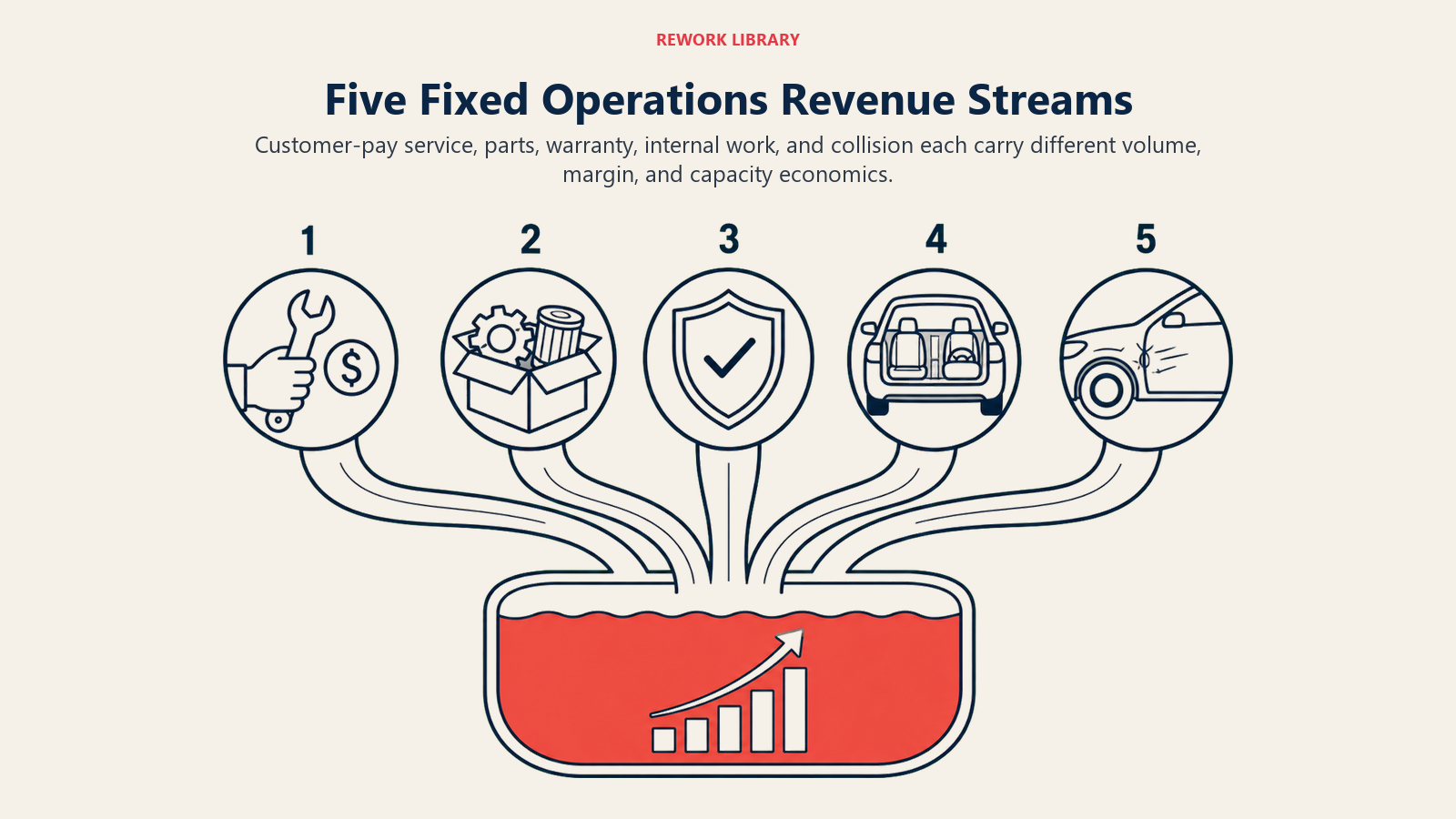
Gross profit margins on customer pay work typically run 65-75% on labor and 40-50% on parts. A $400 brake job might cost $120 in parts and $80 in technician labor, generating $200 in gross profit. Scale that across 100 repair orders daily and you understand why customer pay drives profitability. The challenge is maintaining volume, customer retention and conquest marketing directly impact this revenue stream.
Warranty service provides volume but lower margins. Manufacturers reimburse labor at negotiated rates (typically 20-30% below customer pay retail rates) and parts at invoice plus modest markup. A warranty job paying $150 in labor might generate only $120 if your effective labor rate is $150 but manufacturer reimbursement is $100. You're covering fixed costs and keeping technicians productive, but you're not building wealth on warranty work.
Internal work, reconditioning trade-ins and used inventory for retail sale, deserves more strategic attention than most dealers give it. This work keeps technicians productive during slow periods and it should be charged at rates that reflect actual value delivered. Too many dealers treat internal work as "free," creating artificial profitability in used vehicles while undermining fixed ops gross profit. Charge internal work at competitive rates and allocate those costs accurately.
Wholesale parts to independent repair shops remains an underutilized opportunity. Independent shops need OEM parts for customer repairs. You've got those parts in inventory. Sell them at wholesale prices (invoice plus 15-25%) and you generate incremental gross profit from inventory you're carrying anyway. Many dealers ignore this revenue stream entirely, leaving money on the table while independent shops order parts from regional wholesalers instead.
Understanding Key Metrics
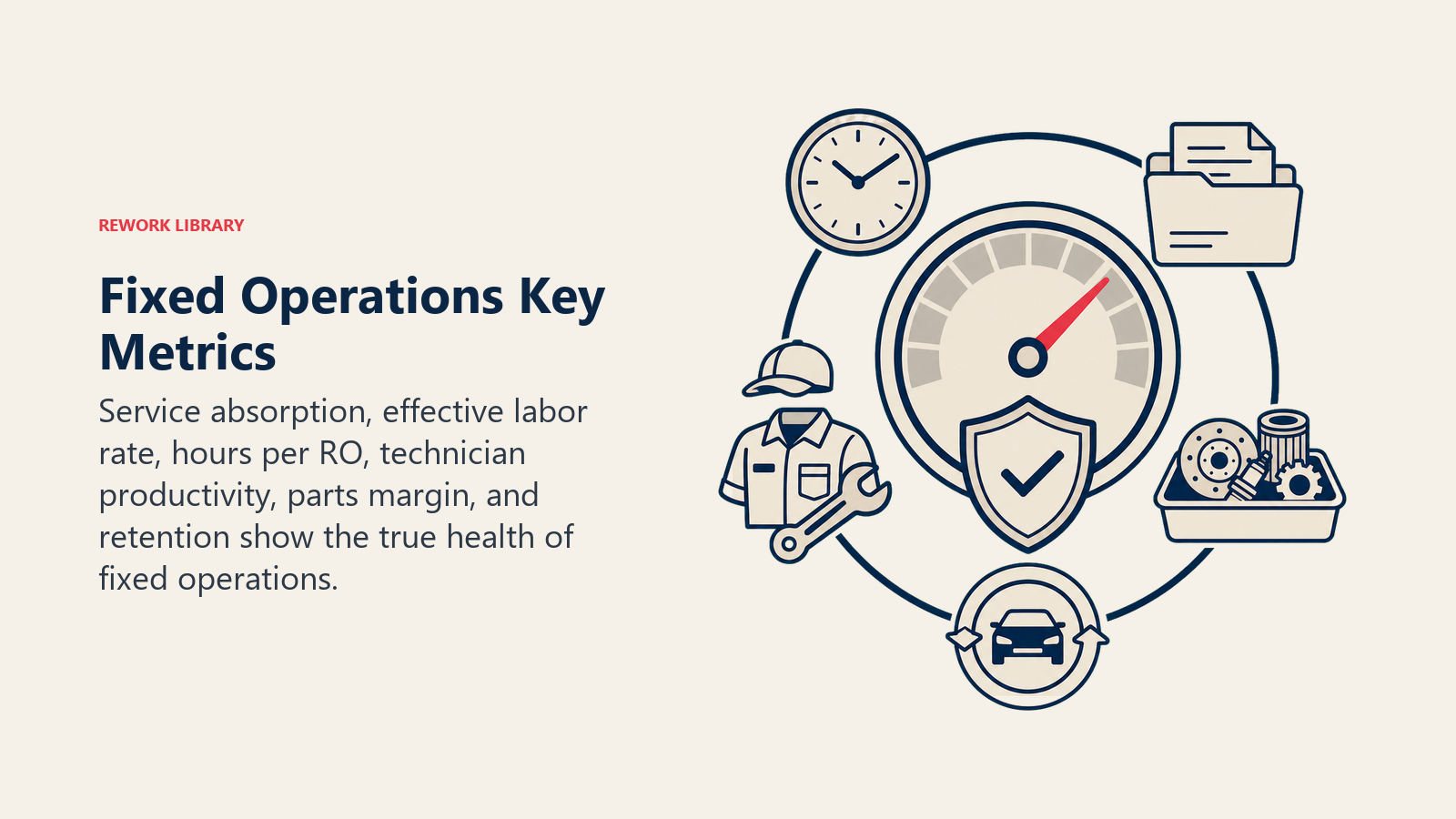
Service absorption rate measures whether your fixed ops department generates enough gross profit to cover total dealership overhead. The calculation is simple: fixed ops gross profit divided by total dealership overhead expenses. According to NADA data, the national average for service absorption is around 56 percent, though top performers target 100%+. A 100% absorption rate means fixed ops pays all overhead, rent, utilities, administrative salaries, facility costs, and every dollar of variable ops profit drops to the bottom line.
Achieving 100%+ absorption transforms dealership economics. When fixed ops covers overhead, sales departments can operate profitably at much lower margins. You can be more competitive on vehicle pricing because you're not trying to extract enough gross to cover overhead. Dealers consistently achieving 120-150% absorption are essentially operating two separate profit centers instead of a single integrated operation dependent on sales volume.
The path to 100% absorption requires focus on both revenue growth and expense management. Increasing customer pay hours per repair order, improving parts-to-labor ratios, raising effective labor rates, and expanding wholesale parts business all boost gross profit. Simultaneously, managing technician productivity, controlling parts inventory costs, and optimizing facility efficiency manage the expense side. Absorption improves through coordinated efforts across both dimensions.
Effective labor rate (ELR) measures actual labor revenue generated per hour technicians clock to customer work. If your posted labor rate is $175 but your ELR is $145, you're discounting heavily or experiencing significant unbilled time. That $30 gap multiplied across thousands of annual hours represents substantial lost profit. Top-performing service departments maintain ELR within 10% of posted rates through disciplined pricing and effective service advisor selling.
Hours per repair order (RO) directly impacts department profitability. If your average RO is 1.8 hours, you're generating $315 in labor revenue per customer at $175 ELR. Increase that to 2.4 hours through better inspection processes and improved upselling, and you're generating $420 per customer, a 33% increase from the same number of customers. This metric improvement requires better training, better processes, and better menu selling by service advisors.
Service Department Profit Centers
Express service and quick lube operations provide high-volume, low-margin entry points that build customer relationships. Oil changes, tire rotations, inspections, these services get customers in the door, where thorough inspections identify additional needs. The express lane isn't meant to be a massive profit center itself, it's meant to generate customer traffic that converts to higher-margin repair work.
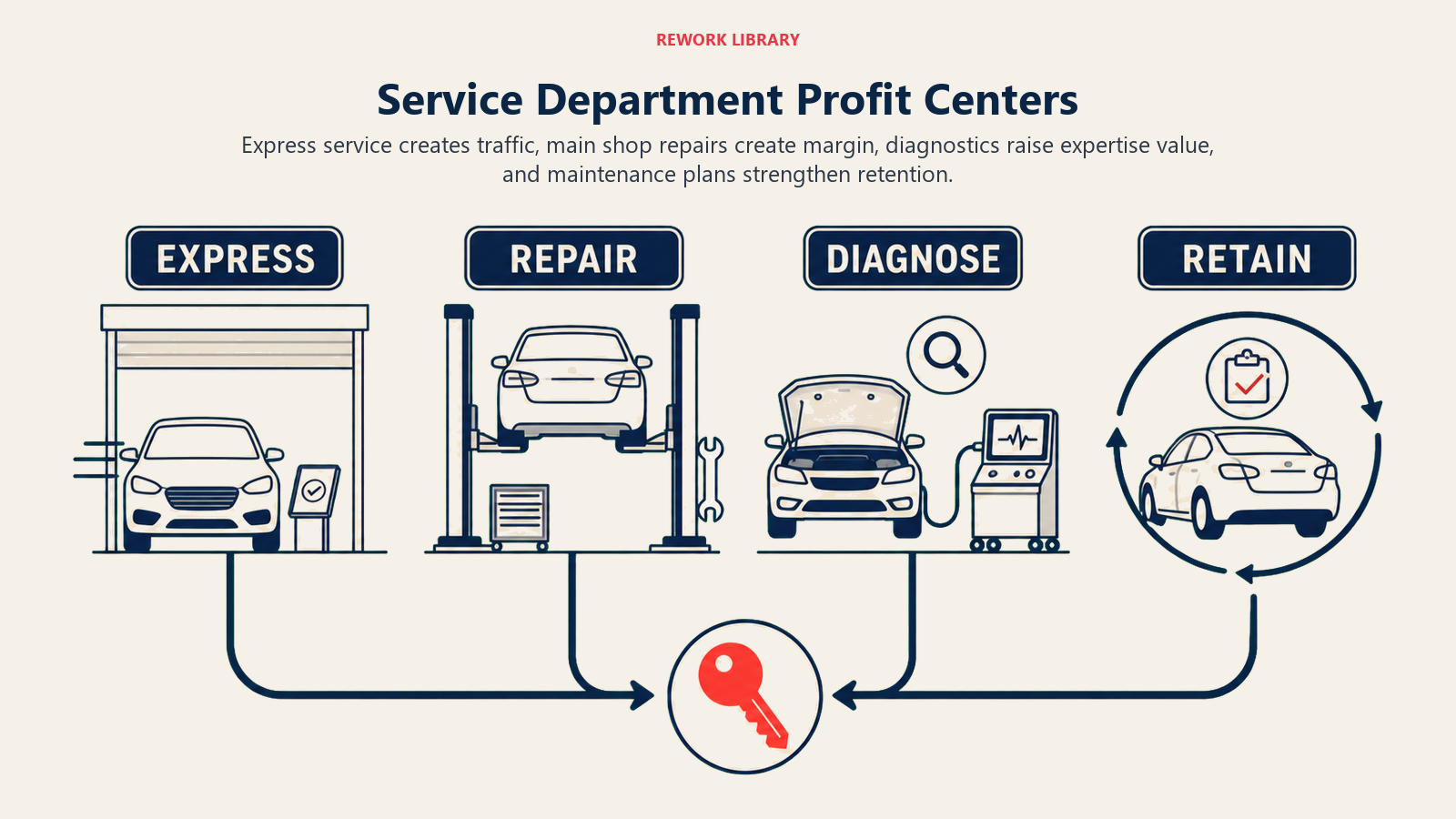
The economics of express service require volume and speed. You need to process customers quickly (targeting 30-45 minutes per RO), maintain steady appointment flow, and convert 20-30% of express customers to additional service recommendations. If you're running express operations at 1.5 hours per RO or failing to generate add-on work, you're losing money on real estate and labor that could be deployed more profitably.
Scheduled maintenance programs create predictable service revenue streams by enrolling customers in manufacturer-recommended service intervals. A customer who commits to your maintenance program becomes a regular customer generating 3-4 visits annually. The lifetime value of one enrolled maintenance customer might be $3,000-5,000 over vehicle ownership, compared to $400-600 for occasional service customers.
Diagnostic and major repair work generates the highest gross profit per RO but requires skilled technicians and sophisticated equipment. A transmission repair might generate $2,500 in labor revenue from 15-20 hours of work. Engine diagnostics for check engine lights create opportunities for high-margin repairs. Investment in diagnostic training and equipment pays dividends when you can capture this work instead of losing it to independent shops.
Tire and wheel services represent significant margin opportunities often overlooked by dealers. Tire sales generate parts margins of 35-45% plus installation labor. Wheel alignment, balancing, and TPMS service add incremental revenue. Many dealers cede this business to tire chains and quick lube shops when they could easily capture it with modest inventory investment and trained staff.
Parts Department Optimization
Parts inventory management balances availability for service department needs against carrying costs of excess inventory. Turn rate targets should be 6-8 times annually for dealer parts departments. Slower turn means you're tying up capital in slow-moving parts. Faster turn might mean stockouts that delay repairs and frustrate customers. The sweet spot varies by dealership size and service volume.
Wholesale parts business development focuses on building relationships with independent repair shops that need OEM parts through your parts department optimization strategy. Assign a parts specialist to call on independents, offer competitive pricing (typically invoice plus 20-25%), and provide reliable same-day delivery. You're leveraging parts you're already stocking for service needs to generate incremental profit from external customers.
Online parts sales to retail customers remain underdeveloped at most dealers despite significant opportunity. Many customers prefer DIY repairs or want to supply their own parts to independent mechanics. Setting up an online parts ordering system with local pickup or shipping opens this revenue stream. The margin might be lower than service department internal sales, but it's incremental business with minimal additional overhead.
Matrix pricing for parts balances competition from online parts retailers against margin goals. Instead of uniform markups (invoice plus 40% on all parts), matrix pricing applies variable markups based on part cost and competitive environment. High-dollar parts might carry 25% markup. Low-dollar parts might carry 60% markup. This strategy optimizes total gross profit while remaining competitive on price-sensitive items.
Technology Stack Requirements
DMS integration and reporting provide the foundation for fixed ops management through dealership data analytics. Your DMS should track every metric mentioned in this guide, service absorption, ELR, hours per RO, parts-to-labor ratios, technician productivity. If your DMS can't generate these reports easily, you're flying blind. Modern DMS platforms make this data accessible in real-time dashboards that inform daily decisions.
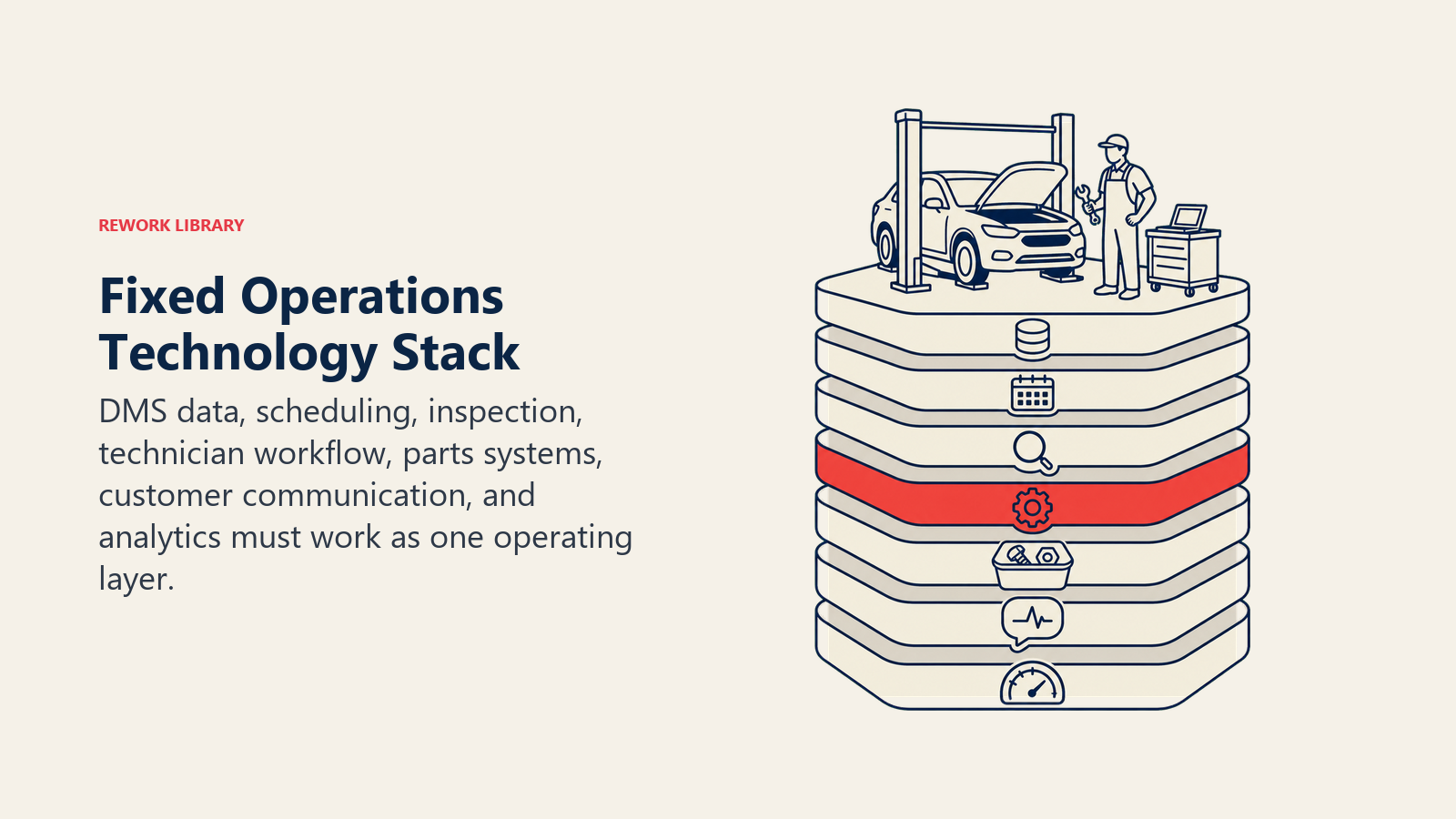
Service scheduling and appointment systems reduce missed appointments and optimize technician utilization. Online scheduling lets customers book service at their convenience. Automated appointment reminders via text and email reduce no-shows by 30-40%. Two-way texting for service updates improves customer experience and reduces phone volume. These systems pay for themselves quickly through improved efficiency.
Digital vehicle inspection (DVI) tools transform how service advisors present recommendations. Instead of verbally explaining why a customer needs brake service, advisors send photos and videos showing actual brake pad condition. This visual evidence increases approval rates from 30-40% to 60-70%. DVI systems like AutoVitals, Tekmetric, or OEM-provided tools typically cost $50-100 per month per bay but generate thousands in additional monthly revenue.
Parts catalog and ordering systems integrated with your DMS streamline parts procurement and reduce ordering errors. Electronic parts catalogs with VIN decoding ensure correct parts ordering. Integration with manufacturer and warehouse distributor systems enables real-time pricing and availability checking. Automated replenishment based on usage patterns optimizes inventory levels.
Customer communication platforms tie all technology together into cohesive customer experience. Automated service reminders based on mileage and time. Post-service follow-up surveys. Targeted marketing for seasonal services. These platforms maintain engagement between service visits, driving higher customer retention and increased service frequency.
Strategic Importance to Dealership Value
Fixed ops performance dramatically impacts dealership valuation when it's time to sell. Dealerships trading at 4-5x earnings might command 6-7x earnings if fixed ops absorption exceeds 120%. As noted by Haig Partners' analysis, fixed operations serve as the quiet profit engine driving dealership value in 2025 and beyond. Buyers recognize that strong fixed ops provides stable profit streams less dependent on volatile vehicle sales and manufacturer incentives.
The predictability of fixed ops cash flow makes dealerships with strong service departments more attractive to lenders and private equity buyers. Vehicle sales fluctuate with economic cycles, manufacturer inventory, and incentive programs. Service revenue streams remain relatively stable because customers need maintenance and repairs regardless of whether they're buying new vehicles.
Customer lifetime value calculations emphasize fixed ops importance. A customer who buys one vehicle from you generates $2,000-3,000 in total gross profit. That same customer servicing their vehicle with you for 7 years generates $4,000-6,000 in service gross profit plus $800-1,200 in parts gross profit. Retaining service customers is more valuable than selling additional vehicles to transaction-oriented shoppers.
Fixed ops provides cushion during market downturns when vehicle sales slow. The 2008-2009 recession revealed this clearly, dealers with absorption rates above 100% survived while dealers dependent on sales volume for profitability failed. Strong fixed ops departments provided the cash flow to weather 18-24 months of depressed sales volume.
Building Sustainable Profitability
The most profitable dealerships don't just run good service departments, they operate fixed ops as an intentional profit center with dedicated leadership, clear metrics, and strategic investment. They recognize that every customer buying a vehicle represents potential service revenue worth more than the initial sale gross profit.
Sales integration with fixed ops starts at vehicle delivery. When a customer takes delivery of their new vehicle, enrollment in service programs should be standard procedure. First service scheduled before they leave. Maintenance program explained and enrolled. Service department introduction completed. This handoff determines whether the customer returns for service or visits a competitor.
Marketing investment in fixed ops should be proportional to its profit contribution. If fixed ops generates 60% of net profit, it should receive meaningful share of marketing budget. Service-specific marketing campaigns for seasonal maintenance, recall completion, or competitive service conquest drive incremental revenue that compounds over customer lifetime.
Facility and equipment investment often skews toward sales areas, upgraded showrooms, customer lounges, fancy displays, while service areas remain dated. This sends the wrong message to both customers and employees. A modern, clean, well-equipped service department signals quality and professionalism. It helps retain customers and attract skilled technicians.
The Path Forward
Fixed operations mastery requires shifting mindset from "service is what we do to support sales" to "service is a primary profit center that deserves strategic focus and investment." That shift shows up in resource allocation, leadership attention, compensation structures, and daily operating priorities.
Start by establishing clear fixed ops metrics and tracking them rigorously. Service absorption rate, ELR, hours per RO, parts-to-labor ratio, technician productivity and efficiency. Create dashboards that make these metrics visible to leadership daily. What gets measured gets managed, and what gets managed improves.
Invest in service advisor training and development. These positions are critical to department profitability but often treated as entry-level roles with minimal training. Service advisors who understand menu selling, inspection processes, and customer communication drive significantly higher hours per RO and customer satisfaction. Training investment here generates immediate returns.
Develop systematic customer retention strategies that extend beyond generic service reminders. Personalized outreach based on vehicle age and mileage. Targeted campaigns for out-of-service customers. Loyalty programs that reward consistent service. These strategies cost less than customer conquest and they compound over time as retention rates improve.
Your fixed ops department either powers dealership profitability or it represents missed opportunity. The difference between 85% absorption and 125% absorption might be $500K-$800K in annual net profit. That gap is closable through focused attention on revenue growth, expense management, and operational excellence. Master fixed operations and you master dealership profitability.