Conquest Marketing Strategy: Winning Customers from Competing Dealerships - 2026 Guide
 Top dealers capture 22% of sales from competitor brand owners. That's not loyalty defection, it's strategic conquest marketing targeting customers actively shopping, dissatisfied with current dealers, or ready to switch brands.
Turn this article into takeaways for your work.


Each assistant summarizes the article only for you and suggests best practices for your work.
The average market has 15-25 dealerships competing for the same 3,000 monthly car buyers. According to J.D. Power research, brand loyalty dynamics continue to shift as consumers cross-shop multiple brands, with tariffs introducing greater volatility into shopping behavior. Buyers cross-shop 4-6 brands before purchasing. This creates massive opportunity for dealers willing to systematically target competitor customers rather than waiting for walk-in traffic.
But conquest marketing isn't about disparaging competitors or making false claims. It's about identifying customers poorly served by competitors and demonstrating genuine advantages, better service, more transparent pricing, superior selection, or stronger value propositions.
Understanding Conquest Opportunities
Brand conquest targets customers currently driving competitor brands. A Honda dealer targeting Toyota owners, a Ford dealer targeting Chevy truck buyers. This works because brand loyalty varies significantly by brand and segment. Recent brand loyalty data shows that while brands like Toyota maintain 62% loyalty in the mass market car segment, conquest opportunities exist among practical buyers focused on value, features, and price rather than emotional attachment. OEM conquest incentives often subsidize these efforts with $500-1,500 bonuses for switching brands. Dealer conquest focuses on customers who might buy your brand but currently purchase from competing dealers. A Toyota dealer targeting customers who service or bought from another Toyota dealer 40 miles away. This strategy leverages convenience, service reputation, or inventory advantages. It's particularly effective in multi-dealer metro markets.
Market share analysis reveals conquest opportunities. If your brand holds 12% market share but you're only capturing 8% of local sales, you're losing customers to same-brand competitors. If competitor reviews highlight consistent complaints (aggressive sales tactics, poor service), those dissatisfied customers represent conquest targets. Track performance with dealership benchmarking. Deloitte benchmarking data shows that top-performing dealers (top 30%) achieve significantly higher conquest rates by systematically targeting underserved competitor customers.
Competitive vulnerability indicators help prioritize targets. Dealers with declining CSI scores, frequent management turnover, inventory shortages, or negative review trends have customers ready to switch. Monitor competitor reviews on Google, Yelp, and DealerRater monthly. Each complaint represents a potential conquest opportunity.
Competitive Intelligence
Identifying competitor weaknesses requires systematic monitoring, not guesswork. Track competitor CSI scores (available through OEM reports), sales rankings, inventory levels, and staffing changes. Dealers struggling with any of these metrics have vulnerable customers. Pricing strategy monitoring reveals positioning gaps. Use third-party listing sites to compare pricing on similar vehicles. If competitors consistently price $800 higher on certified pre-owned inventory, that's your opening. But don't compete on price alone, compete on value (better warranty, included services, superior reconditioning).
Review analysis surfaces pain points that drive customers away. Read 50+ competitor reviews monthly. Categorize complaints: sales pressure, finance issues, service delays, pricing transparency, post-sale support. These patterns reveal exactly what customers are unhappy about. Your conquest messaging should emphasize how you excel in those specific areas.
Service satisfaction gaps create conquest opportunities even among loyal brand buyers. A customer who loves their Toyota but hates their dealer's service department will eventually buy elsewhere. Target customers who purchased from competitors but service at independent shops, clear signal of dealer dissatisfaction.
Inventory availability differences provide tactical conquest angles. During supply shortages, dealers with allocation advantages can conquest customers frustrated by competitor backorders. "Can't find the Maverick you want at [Competitor]? We have 8 in stock." This only works if you actually have inventory advantages, false scarcity is unethical and illegal.
Conquest Audience Identification
Customers in-market right now represent immediate conquest opportunities. These are active shoppers visiting multiple dealerships, researching online, and submitting inquiries. They haven't made final decisions. Capture them with superior response speed, better information, and stronger value propositions. End-of-lease opportunities from competitor brands combine natural replacement timing with open-mindedness. A customer completing a 36-month Hyundai lease is contractually required to make a decision. They might default to another Hyundai, but they're more open to alternatives than someone mid-contract. OEM conquest programs heavily subsidize these conversions.
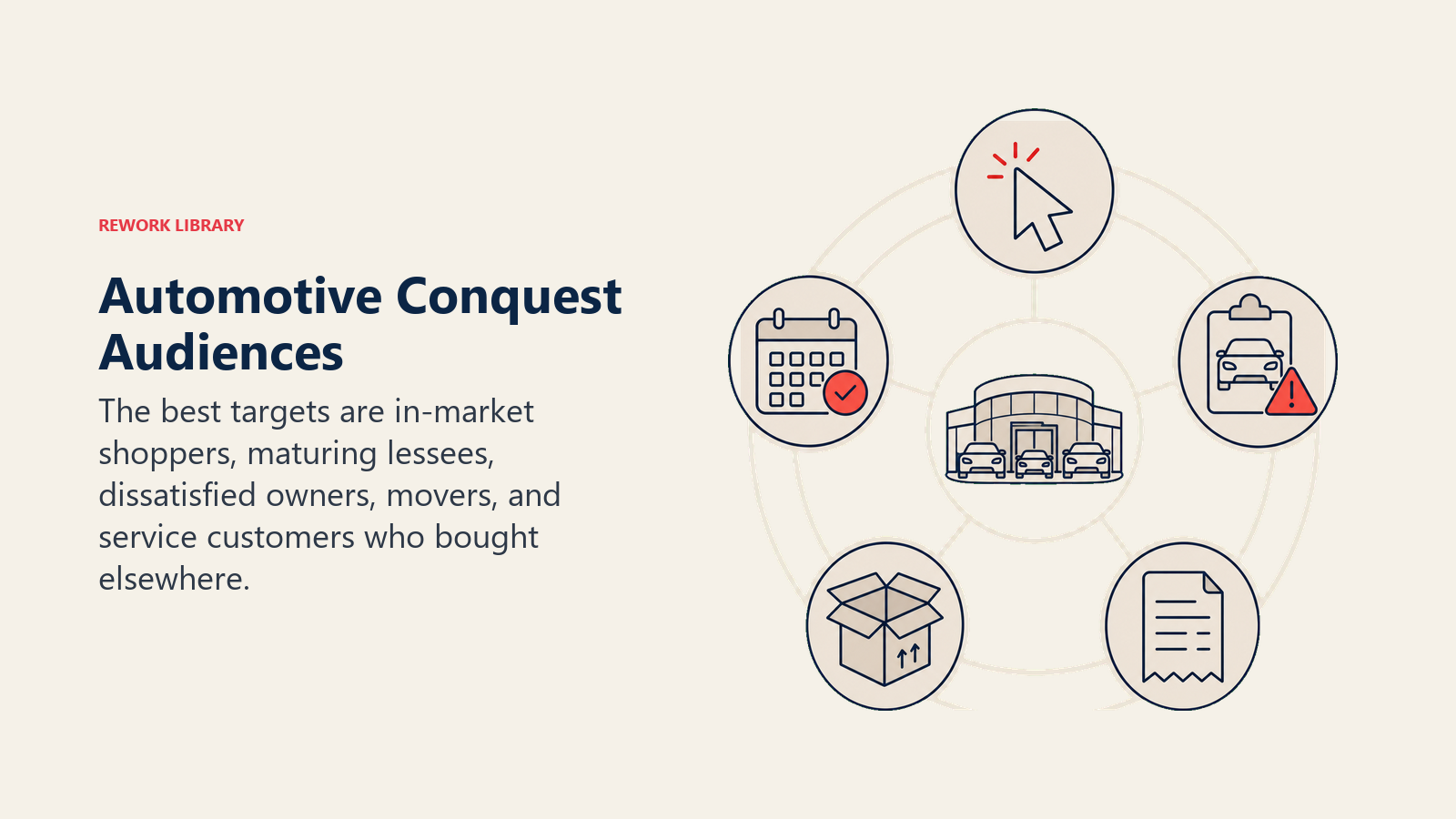
Service dissatisfaction indicators flag customers ready to switch dealers. Someone who purchased from a competitor but now services at your dealership is already voting with their wallet. Someone who leaves negative service reviews at competitor dealerships is actively unhappy. Both groups are highly receptive to conquest messaging. Leverage service-to-sales strategies to convert them.
Equity-rich competitor customers have financial motivation to trade. A customer with $8,000 equity in their 2021 CR-V could switch to your Pilot with similar payments. Use data providers or DMS insights to identify competitor brand owners in your service database with positive equity positions.
Warranty expiration triggers create natural consideration points. When manufacturer warranty ends (typically 36 months/36K miles), maintenance costs increase. This prompts many owners to consider whether to keep and repair or trade and upgrade. Target competitor brand owners at 35-40 months of ownership with trade-in offers.
Digital Conquest Tactics
PPC competitor keyword campaigns capture customers searching for specific competitors. Bidding on "[Competitor Name] Toyota" or "[Competitor Name] reviews" puts your ad above their organic listing. Learn more about automotive PPC advertising. The ad copy should emphasize differentiation, not disparagement: "Compare [Your Dealership]'s pricing and service ratings." This is legal and common practice. Geo-fencing competitor dealerships serves ads to anyone who visits their physical location. Set a radius around competing dealerships. When someone enters that geo-fence, they see your display ads for 30 days. Messaging: "Also consider [Your Dealership] - 5 miles closer with 4.8-star rating." This captures active shoppers considering multiple dealers.
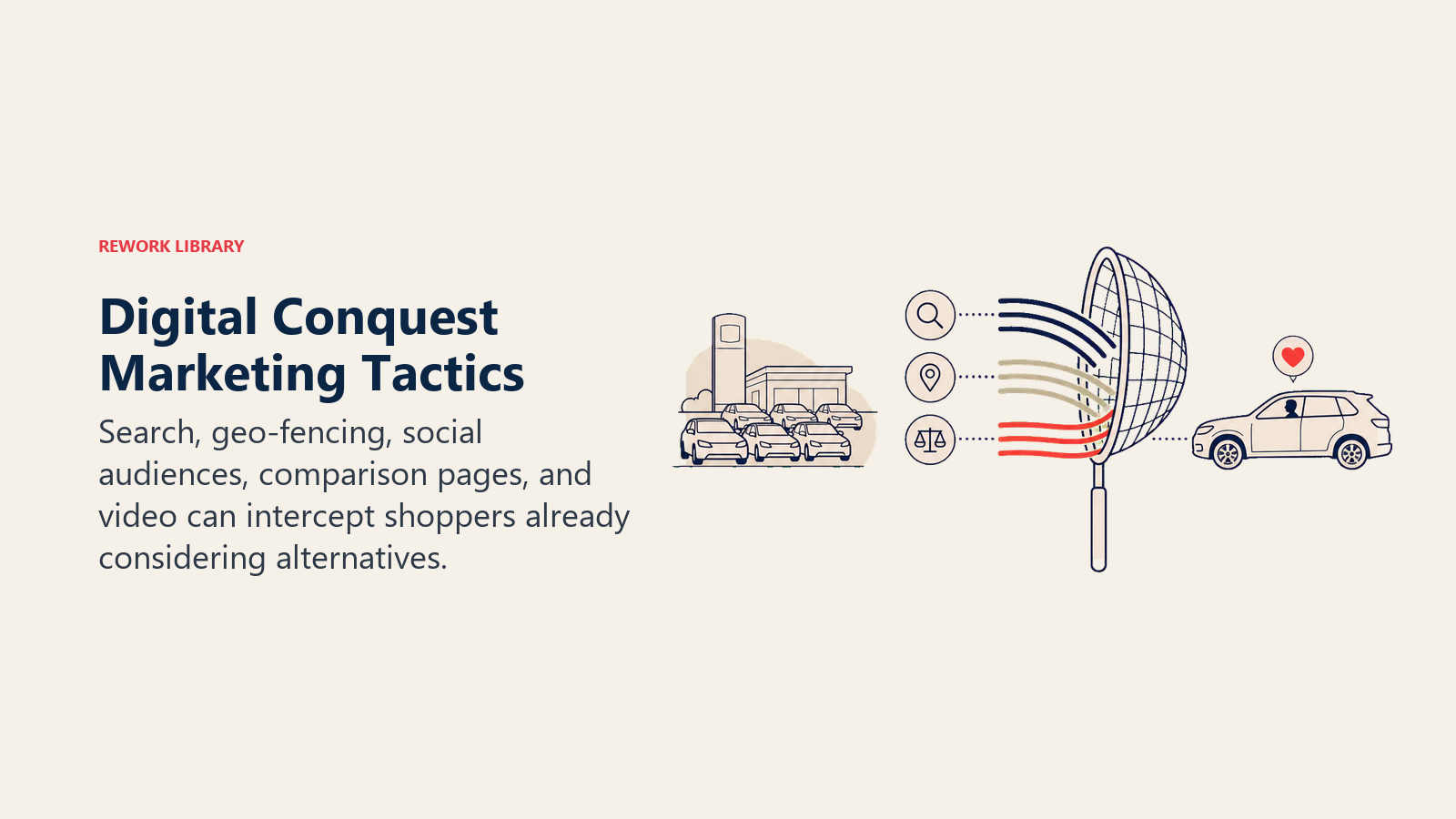
Retargeting competitor website visitors requires third-party data partnerships. Platforms like Lotlinx or AutoFi can identify visitors to competitor websites and serve them your ads. This works because website visitors are actively shopping. Show them why your inventory, pricing, or reputation deserves consideration.
Social media lookalike audiences expand conquest targeting. Upload your customer list to Facebook. Create lookalike audiences, people demographically and behaviorally similar to your buyers. These lookalikes often include competitor customers with similar profiles. Serve them inventory ads and brand differentiation content.
Programmatic display targeting uses behavioral and demographic data to reach conquest audiences. Target people in-market for vehicles (visiting automotive sites), living in competitor service radius, matching buyer demographics, with household income supporting your inventory price points. Programmatic allows precise targeting without geographic or keyword limitations.
OEM Conquest Incentive Programs
Manufacturer loyalty vs conquest offers create strategic choices. Loyalty incentives reward brand repeat buyers with $500-1,000 rebates. Conquest incentives offer similar amounts to competitor brand owners who switch. Understand which programs apply to each customer. A conquest incentive can offset brand preference for price-sensitive buyers. Documentation requirements must be met for conquest rebates. Most programs require proof of competitor brand ownership (registration or lease agreement) showing 6-12 months of ownership. Collect documentation during initial contact. Missing documentation kills deals at the finance desk.
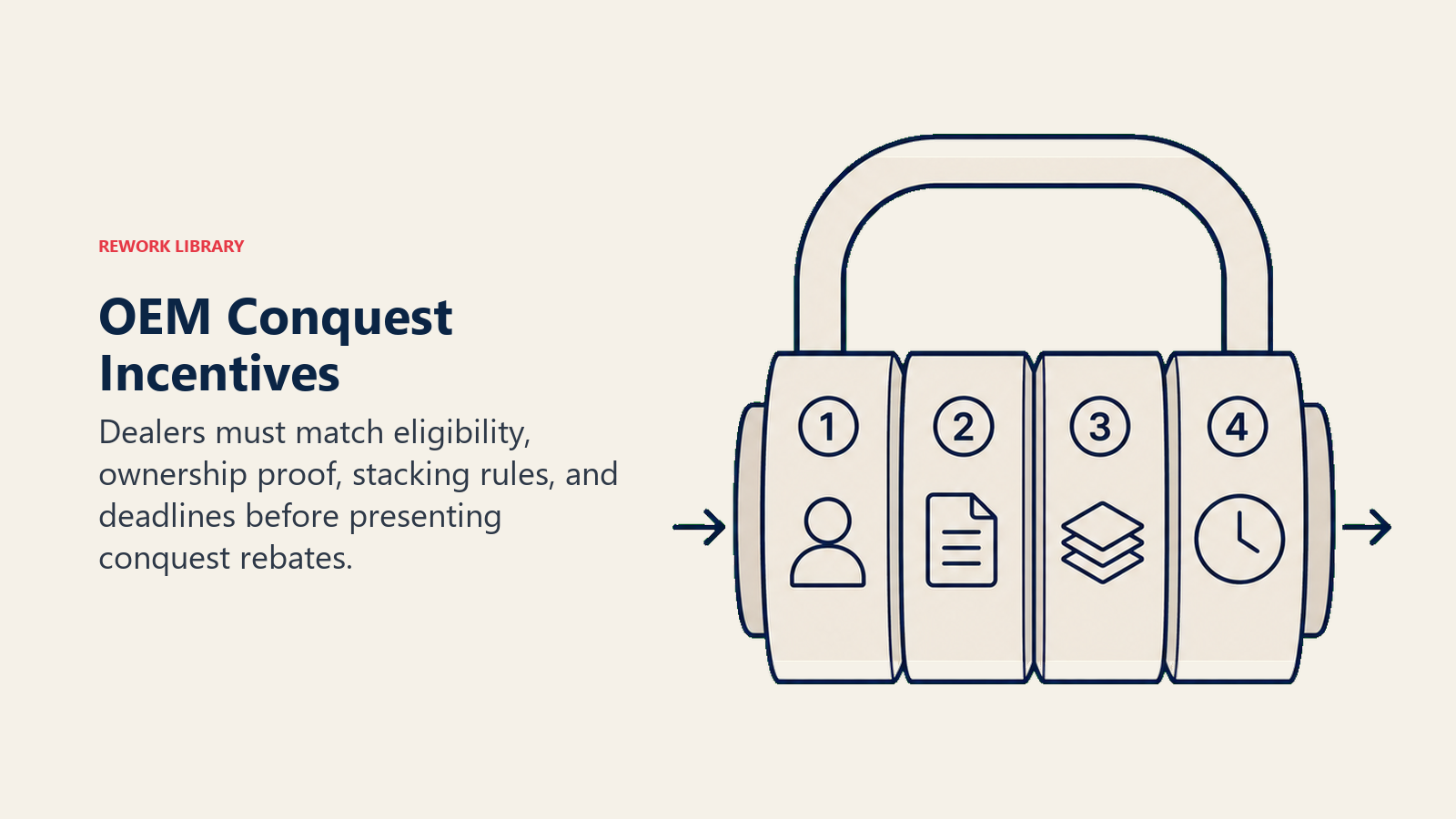
Trade-in conquest bonuses add incremental value. Beyond standard conquest rebates, some manufacturers offer additional $500-1,000 for trading a competitor brand vehicle. Stack these with other incentives (loyalty, military, college grad) for maximum value. A customer with multiple qualifications might see $3,000+ in combined incentives.
Marketing support from OEM often includes co-op funding for conquest campaigns. Submit conquest marketing plans (PPC, direct mail, events) for reimbursement. Many manufacturers cover 50-100% of conquest advertising costs. Use these funds, they're allocated whether you claim them or not.
Communicating conquest offers requires clarity and proof. Don't just mention "$1,500 conquest bonus", explain exactly who qualifies, which brands are included, and documentation needed. Link to OEM program details. Transparency builds trust and prevents deal frustration from customers who assumed they qualified but don't.
Messaging Strategy
Competitive differentiation focuses on your strengths, not competitor weaknesses. Don't say "Unlike [Competitor] who has terrible service..." Say "Our service department averages 4.8 stars with same-day appointments available." The implication is clear without disparagement. This approach is ethical, legal, and more persuasive. Value proposition clarity answers "Why buy from us instead of them?" in specific terms. Generic claims like "better service" mean nothing. Specific value: "Our service department has 5 Master Certified technicians, offers free loaner cars for repairs over 2 hours, and guarantees appointments within 24 hours." Specificity demonstrates real advantage.
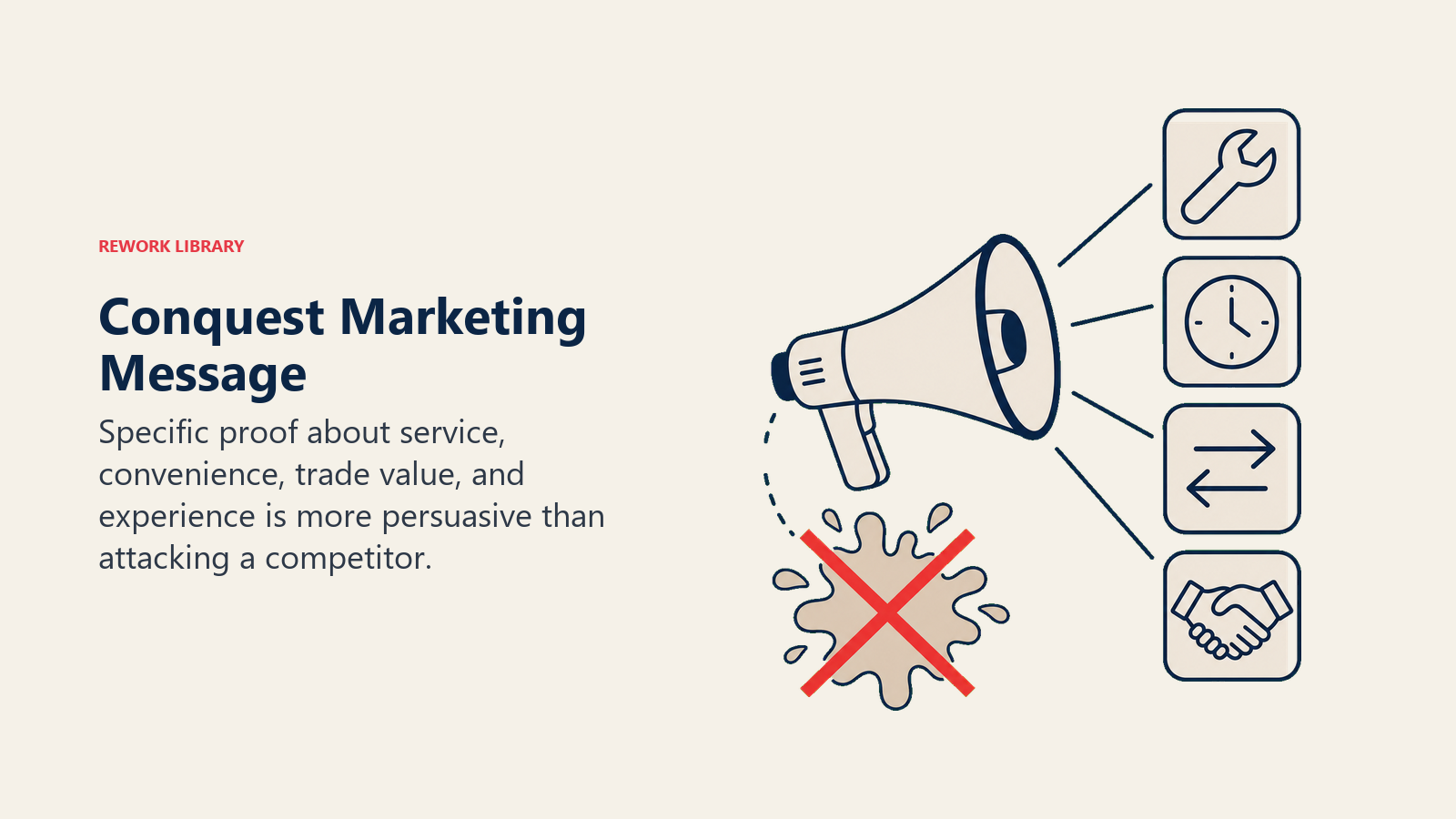
Trade-in equity emphasis creates financial motivation. "Your 2020 Accord has appreciated $4,200 since purchase due to market conditions. You have $6,800 in equity." This frames switching as financially beneficial, not disloyal. Numbers overcome emotional brand attachment.
Service experience advantages resonate with frustrated competitor customers. If your research shows competitor service departments are their primary pain point, make service excellence your primary conquest message. Include specific proof: service ratings, CSI scores, customer testimonials about service experience, free service amenities.
Total cost of ownership comparisons work when done fairly and transparently. Compare insurance costs, fuel economy, maintenance schedules, resale values, and financing rates. If your brand or dealership offers genuine TCO advantages, quantify them. A vehicle with $800 higher purchase price but $1,200 lower maintenance costs over 3 years is a better value. Industry analysis from McKinsey shows that evolving consumer expectations and retail models make value-based differentiation increasingly important in conquest strategies.
Service-to-Conquest Pipeline
Conquesting through service excellence turns non-customer service traffic into sales. 20-30% of service customers at most dealers didn't purchase their vehicle there. Provide exceptional service, capture their information, and market to them when they're ready to replace their vehicle. Learn about fixed operations strategy. This is long-term conquest strategy. Non-customer service campaigns specifically target people who service with you but purchased elsewhere. Email campaigns highlighting your trade-in values, sales experience, and customer testimonials from people who switched. These customers already trust your service, extend that trust to sales.
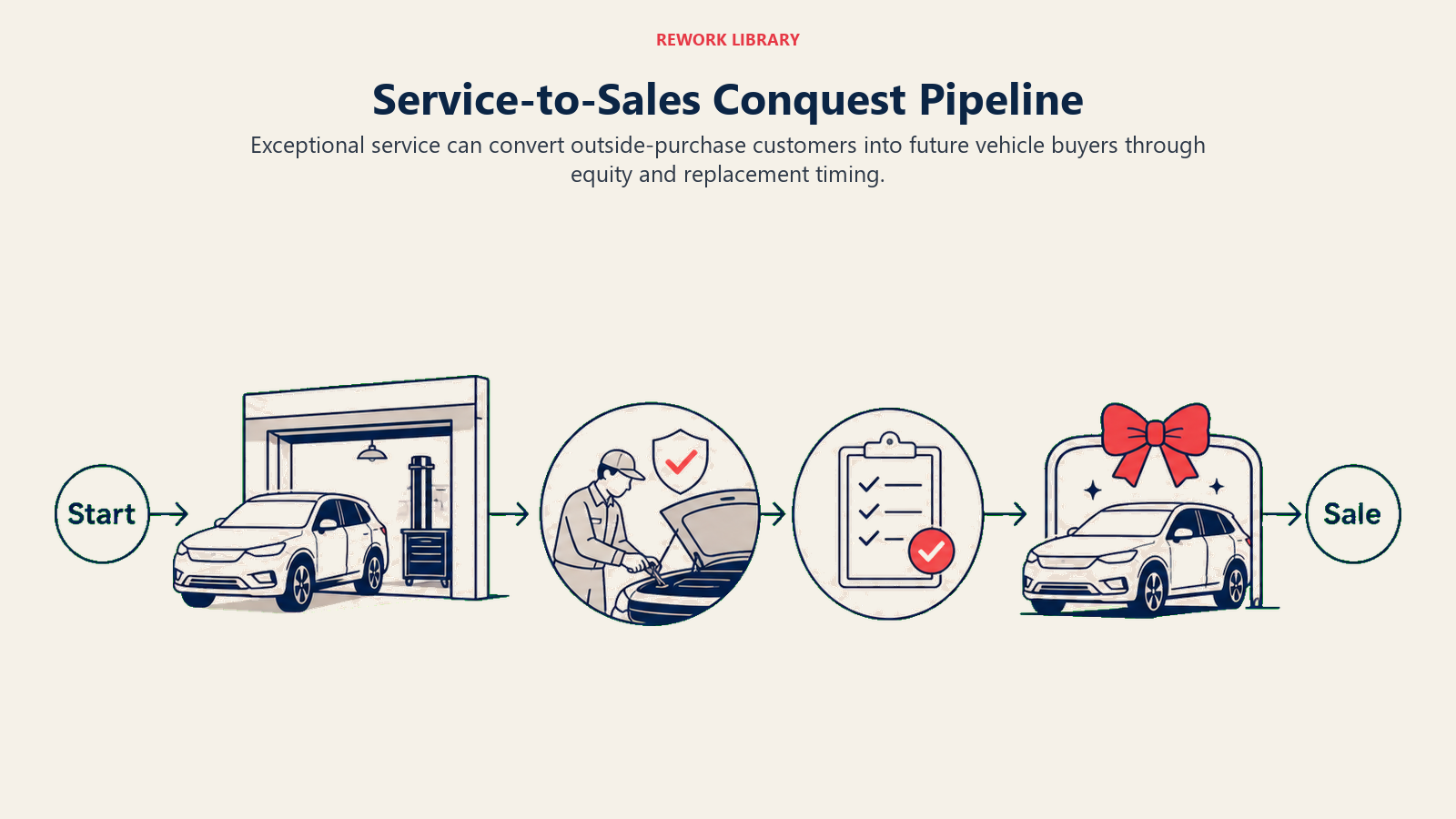
Recall campaigns targeting competitors identify conquest-ready customers. When a competitor brand issues a recall, target those owners with ads offering to perform the recall repair. Bring them in for free service, deliver excellent experience, and follow up with trade-in offers. This ethical approach provides value while creating conquest opportunities.
Competitive trade-in appraisals demonstrate fair dealing. "We'll beat any written trade-in offer by $500" signals confidence and fairness. Back this up with transparent appraisal processes. Customers frustrated by lowball trade offers from their current dealer become conquest converts.
Direct Mail Conquest Campaigns
Competitor owner list targeting uses registration data to identify specific brand owners. Mail to Honda owners in your market with conquest incentive offers. Personalize: "As a Honda Accord owner, you qualify for $1,000 conquest bonus when you trade for a Camry." Registration data makes this precise targeting possible.
Lease maturity mail campaigns target competitor brand lessees 3-6 months before lease end. These campaigns work because lessees must make decisions at lease termination. Offer competitive lease terms on your brand, highlight conquest incentives, and emphasize service excellence if their reviews indicate service dissatisfaction.
Trade-in value mailers with specific estimated values outperform generic "What's your car worth?" postcards. "Your 2020 CR-V is worth approximately $18,500 in trade. Get exact value and see what you could drive for similar payments." Specificity creates urgency and demonstrates you've already done the work.
Personalization and messaging should acknowledge their current brand relationship. "We know you've driven Toyota vehicles for years. Here's why 18,000 drivers in [City] switched to Honda in 2025." This respects their history while making the case for change. Don't insult their current choice, acknowledge it while presenting compelling alternatives.
Response tracking and ROI require coded mailers and dedicated landing pages. Use unique phone numbers or offer codes to track response. Direct mail typically costs $0.75-1.50 per piece. Conquest campaigns generating 0.5-1% response rates (5-10 responses per 1,000 mailers) that close at 15-20% justify the investment.
Ethical and Legal Boundaries
False advertising avoidance is non-negotiable. Every claim must be provable and accurate. Don't claim "lowest prices" unless you can document it. Don't guarantee specific savings without showing calculations. False advertising damages reputation and creates legal liability. Stick to specific, verifiable statements. Trademark usage guidelines allow comparative advertising but prohibit confusion. You can say "We offer competitive alternatives to [Brand]" but can't use their logos or brand marks in ways suggesting endorsement or affiliation. Comparative claims are legal; impersonation or false association isn't.
Fair comparison standards require apple-to-apple comparisons. Compare similar trim levels, model years, and equipment. Comparing your loaded model to their base model is misleading. Comparing lease terms with different mileage allowances or down payments is deceptive. Fair comparisons strengthen credibility.
Disparagement vs differentiation is the critical distinction. Differentiation: "Our service department has 12 bays and averages 2-hour wait times." Disparagement: "[Competitor] has terrible service that takes all day." The first is fact-based comparison. The second is subjective attack. Stay on the differentiation side.
Competitive intelligence ethics means gathering information through legal, public means. Reading competitor reviews, monitoring public pricing, tracking CSI scores, all ethical. Misrepresenting yourself to gather information, accessing competitor systems, or poaching customer lists, all unethical and potentially illegal. Use proper online review management to monitor reputation.
Conquest marketing works because customers are less loyal to brands and dealers than they were a decade ago. They'll switch for better value, superior service, or more convenient locations. Your job is identifying which competitor customers are ready to switch and demonstrating genuine advantages that justify that switch.
This isn't about being the cheapest or the most aggressive. It's about being demonstrably better in ways that matter to customers. When you can prove superior service, fairer pricing, better selection, or stronger value, and communicate that to customers currently settling for less, conquest becomes strategic growth instead of desperate poaching.
For the foundation of attracting these conquest customers, see Automotive Lead Generation Overview. Digital conquest heavily relies on Automotive PPC Advertising. Fair trade-in valuations are critical, learn more in Trade-In Appraisal Process. Equity mining applies to both your customers and conquest targets, see Equity Mining Strategy. And your reputation matters for conquest success, manage it with Online Review Management.

Senior Implementation Consultant