Service Marketing Campaigns - Drive Customer Pay Traffic to Fixed Ops - 2026 Guide
Turn this article into takeaways for your work.


Each assistant summarizes the article only for you and suggests best practices for your work.
Most dealerships spend heavily marketing new and used vehicles while treating service marketing as an afterthought. They rely on manufacturer co-op programs, send generic reminders, and wonder why customer pay traffic falls short of targets.
Dealerships investing 2-3% of fixed ops revenue in targeted service marketing see completely different results: 25-30% higher customer pay traffic than competitors who rely solely on OEM campaigns. The difference? Strategic campaign planning, customer database segmentation, multi-channel execution, and performance measurement. Cox Automotive's 2025 Service Industry Study found that dealerships have lost 12% of service visits to competition since 2018, with market share dropping to just 29%, making strategic service marketing more critical than ever.
Service marketing isn't about sending more emails. It's about reaching the right customers with relevant offers through appropriate channels at optimal times. When executed properly, service campaigns build predictable pipeline, improve service absorption rate, and drive incremental profit that far exceeds marketing investment.
Service Marketing Campaign Types
Your service marketing shouldn't be one-size-fits-all. Different customers need different messages at different times. Top-performing dealers run six distinct campaign types:
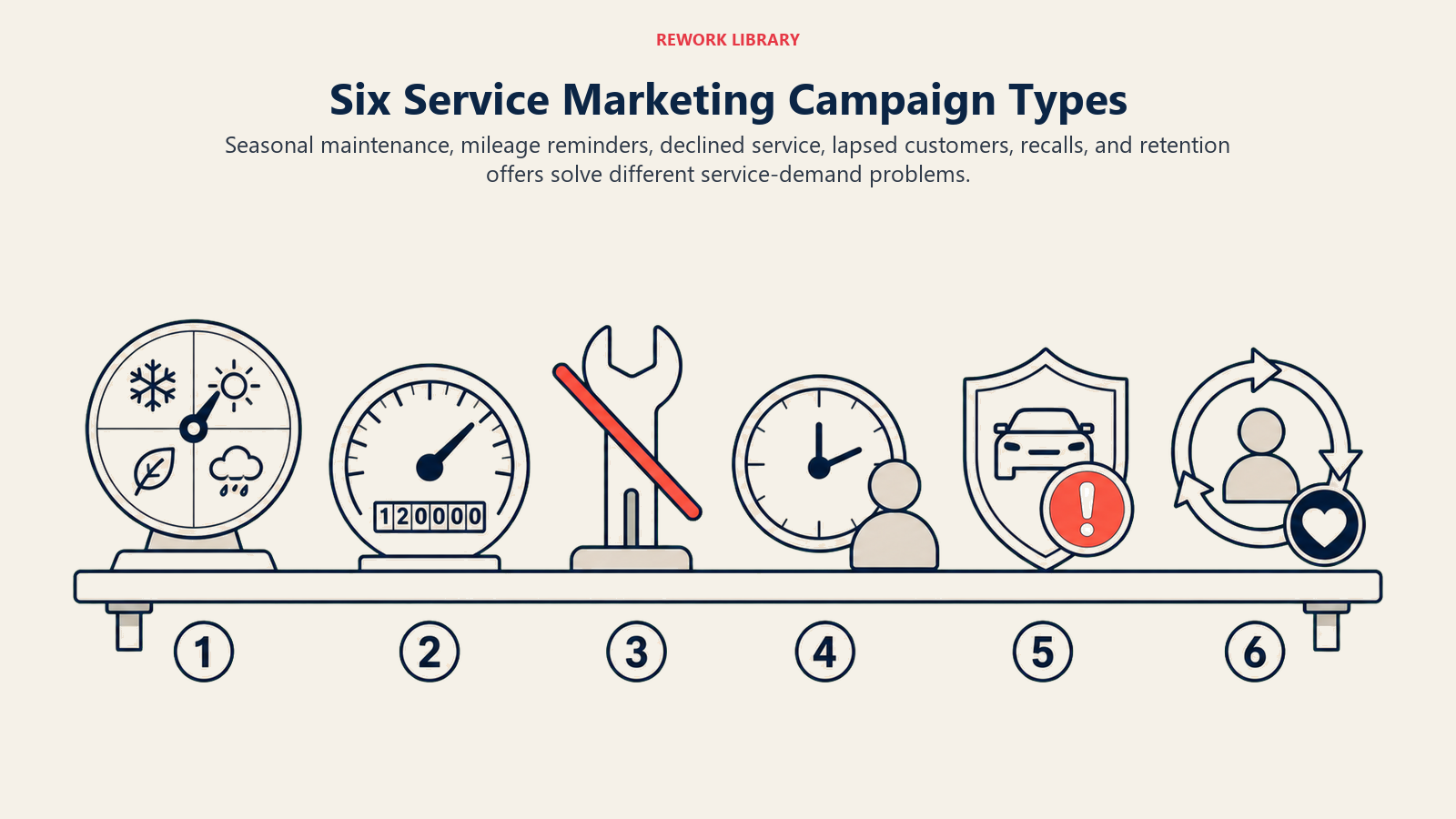
Seasonal maintenance campaigns align with weather and driving patterns. Winter preparation campaigns in October-November drive battery testing, coolant service, tire changeovers, and heating system checks. Summer campaigns in April-May focus on air conditioning service, coolant flushes, and tire rotations.
These campaigns work because the need is obvious to customers. Nobody wants a dead battery in December or a broken AC in July. You're not creating demand, you're capturing it before competitors do.
Mileage-based service reminders target customers approaching major service intervals. Your database contains purchase dates and mileage information. You can identify customers likely needing 30K, 60K, or 90K service within the next 30-60 days.
These campaigns generate high response rates because customers recognize the need. They're already thinking about major service. Your campaign makes it easy to schedule with your dealership rather than shopping around.
Conquest service offers target competitive brand owners in your database. Every dealer has customers who bought elsewhere but live in the market. Maybe they purchased from a dealer closer to work, or got a better deal across town. But for service, convenience and trust matter more than price. Apply conquest marketing strategy principles to service operations.
Offer competitive pricing on routine maintenance for these customers. Once they experience your service department, many become regular customers. The goal isn't maximizing margin on the first visit, it's winning service customer retention.
Lapsed customer win-back campaigns reconnect with customers who haven't serviced in 13-36 months. These customers aren't lost yet, but they're at risk. Maybe they had a poor experience, moved their service elsewhere, or simply forgot about you.
Win-back campaigns need compelling offers. A small discount or free service item can overcome inertia and restart the relationship. Once they return, focus on rebuilding trust through exceptional service. According to Cox Automotive research, only 54% of owners with cars two years old or newer returned to the dealership for service in 2025, down dramatically from 72% in 2023, making win-back campaigns essential for retention.
Recall and campaign notification marketing turns manufacturer recalls into service opportunities. When recalls are announced, proactively contact affected customers before they receive manufacturer notices. Offer convenient scheduling and highlight your ability to complete recall work plus any needed maintenance in a single visit.
Recalls bring customers to your service lane who might not otherwise visit. Turn these required visits into relationship-building opportunities by providing outstanding service and identifying additional needs.
Customer Database Segmentation
Effective service marketing requires knowing who you're targeting. Sending the same message to all customers wastes money and annoys recipients. Segment your database into distinct groups:
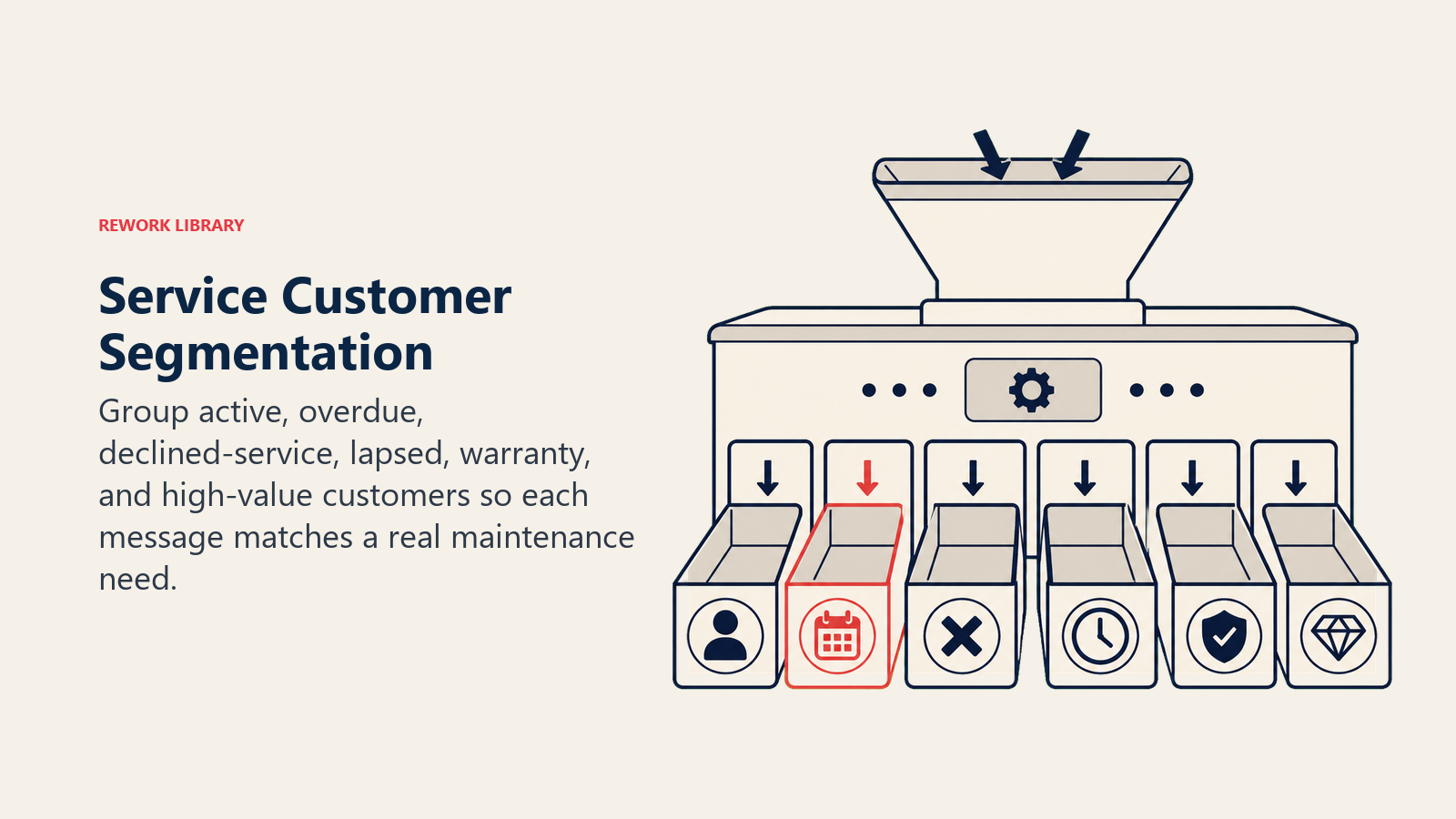
Active service customers serviced within the past 12 months represent your highest-value segment. These customers already trust your dealership. Marketing to this group focuses on retention, maintaining regular service intervals and increasing visit frequency through value-added services.
Response rates from active customers typically run 8-12% on well-timed campaigns. They're familiar with your dealership and more likely to respond to offers.
Lapsed customers who last serviced 13-36 months ago need reactivation. They have relationship history but something caused them to stop visiting. Maybe pricing concerns, convenience issues, or poor experience.
Win-back campaigns for this segment need stronger incentives. Expect 2-4% response rates initially. But successfully reactivating lapsed customers costs far less than acquiring new ones.
Sales customers who haven't serviced represent huge opportunity. These customers purchased vehicles from your dealership but service elsewhere. They already showed preference for your brand and sales experience. Converting them to service customers should be easier than conquest.
Target this group aggressively. Offer first-time service incentives. Highlight the benefits of servicing where they purchased. Response rates vary widely based on how recently they bought and competitive service options in your market.
Competitive brand owners in database might have serviced with you previously, inquired online, or visited for sales. They own brands you service but currently take their vehicles elsewhere.
Conquest campaigns for this segment need value positioning. Emphasize convenience, pricing competitiveness on routine maintenance, and service quality. Don't expect high response rates, 1-2% is typical. But the volume potential justifies the investment.
Multi-Channel Campaign Execution
Different channels work better for different message types and customer segments. Top service marketing programs use integrated multi-channel approaches:
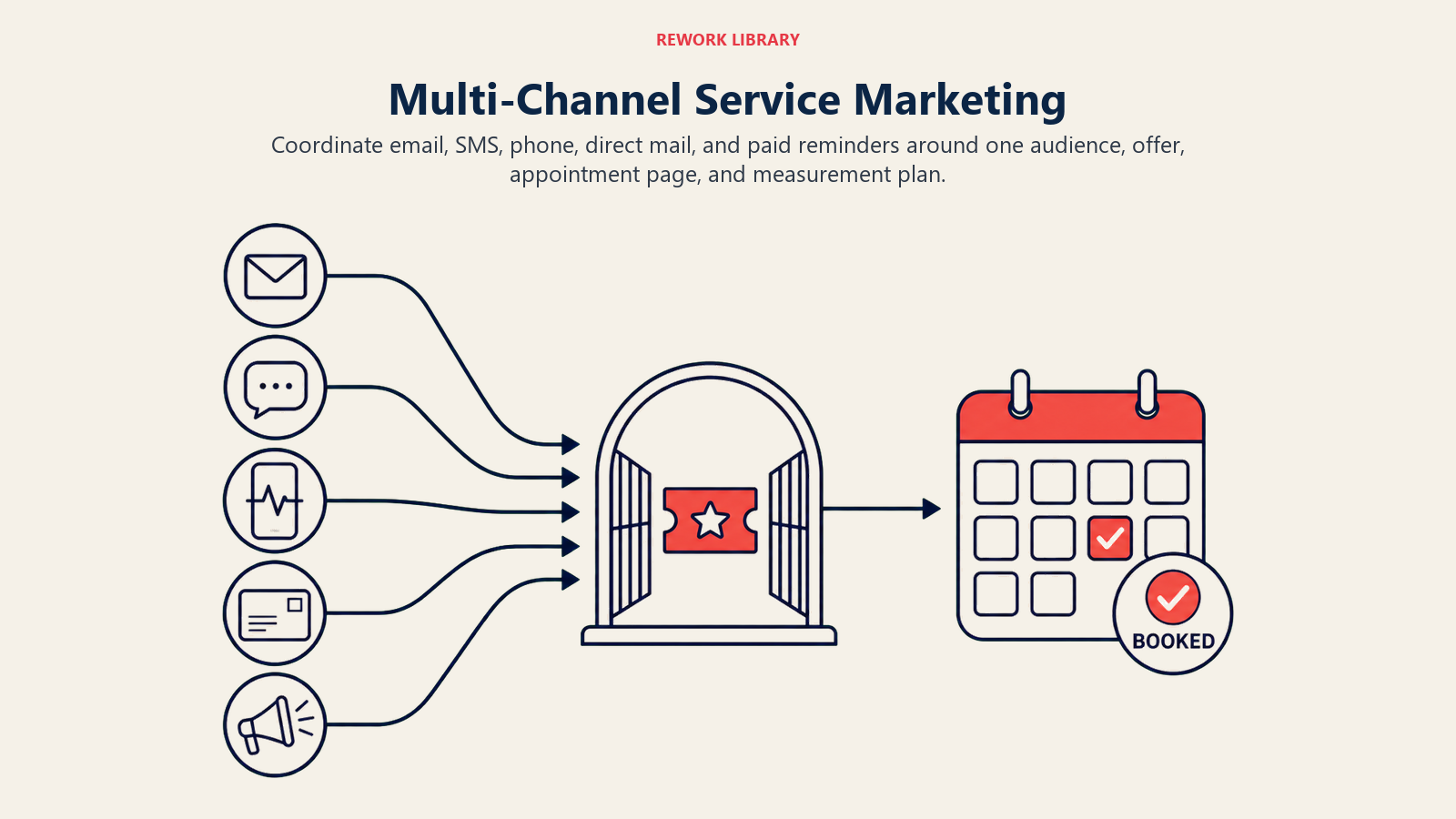
Email marketing delivers the highest ROI for service campaigns. It's low-cost, easily tracked, and allows personalized messaging based on customer data. Most dealers see 20-25% open rates on service emails and 8-12% click-through rates on well-crafted campaigns. Integrate with dealership email marketing strategies for vehicles.
But email effectiveness depends on list quality. Outdated email addresses and spam filters reduce deliverability. Clean your email list quarterly, removing hard bounces and customers who never engage.
Send service emails mid-morning Tuesday through Thursday. Avoid Mondays (too busy) and Fridays (attention shifts to weekend). Include clear calls to action with direct online service scheduling links.
Direct mail for high-value maintenance reminders still works despite digital dominance. For major service intervals (30K, 60K, 90K) or high-value customers, physical mail stands out. Response rates of 3-5% on major service reminders justify the cost.
Design matters. Generic postcards get ignored. Personalized letters with specific vehicle information and service recommendations generate much better response.
SMS/text messaging for urgent recalls and time-sensitive offers creates immediate awareness. Text open rates exceed 95% within 3 minutes. For recalls affecting safety or vehicle operation, texting ensures customers receive critical information.
But don't overuse texting. Too many messages annoy customers and trigger opt-outs. Reserve texts for genuinely urgent communications and last-minute appointment availability.
Social media for seasonal campaigns builds awareness and engagement. Facebook and Instagram allow geographic targeting and demographic filtering. Use social advertising to reach customers and prospects in your market area.
Social works better for awareness than direct response. Don't expect people to book appointments directly from Facebook ads. Instead, drive traffic to landing pages where they can learn more and schedule service.
Display advertising for conquest service targets competitive brand owners searching for maintenance information. Google Display Network and programmatic advertising can reach people researching "Toyota maintenance near me" or "Honda service specials."
Display advertising works for awareness and consideration stages. Combine display campaigns with retargeting to stay visible to people who visited your website but didn't schedule service.
Offer Strategy & Pricing
Your campaign offers need to create action without training customers to expect discounts. This balance is tricky but critical.
Discount vs. value-add approach matters more than discount size. A $39 oil change discount saves customers money but positions your dealership on price. A free multi-point inspection or complimentary tire rotation adds value without cheapening your brand.
Value-add offers work better for active customers who already trust you. Discounts work better for conquest and lapsed customers where price objections need addressing.
Package deals that drive higher RO values generate more profit than single-service discounts. Instead of discounting oil changes, create packages: oil change plus tire rotation plus multi-point inspection plus fluid top-off for one price.
These packages increase average repair order value while providing genuine customer value. Customers perceive they're getting more, and your service department generates higher revenue per visit.
First-time customer acquisition offers need aggressive pricing to overcome inertia. Customers service elsewhere due to habit, convenience, or relationships. Breaking these patterns requires compelling reasons to switch.
Offer significantly discounted first visits, even loss leaders if necessary. The goal is getting customers through your door and demonstrating service quality. Once they experience your dealership, retention depends on service excellence, not discounts.
Loyalty rewards for repeat service visits encourage frequency without constant discounting. "Every fourth oil change free" or "earn points toward major service" programs reward ongoing relationships.
Loyalty programs work best when simple and valuable. Complicated point systems confuse customers. Clear, achievable rewards drive behavior.
Campaign Performance Measurement
Marketing without measurement wastes money. Track these metrics for every campaign:
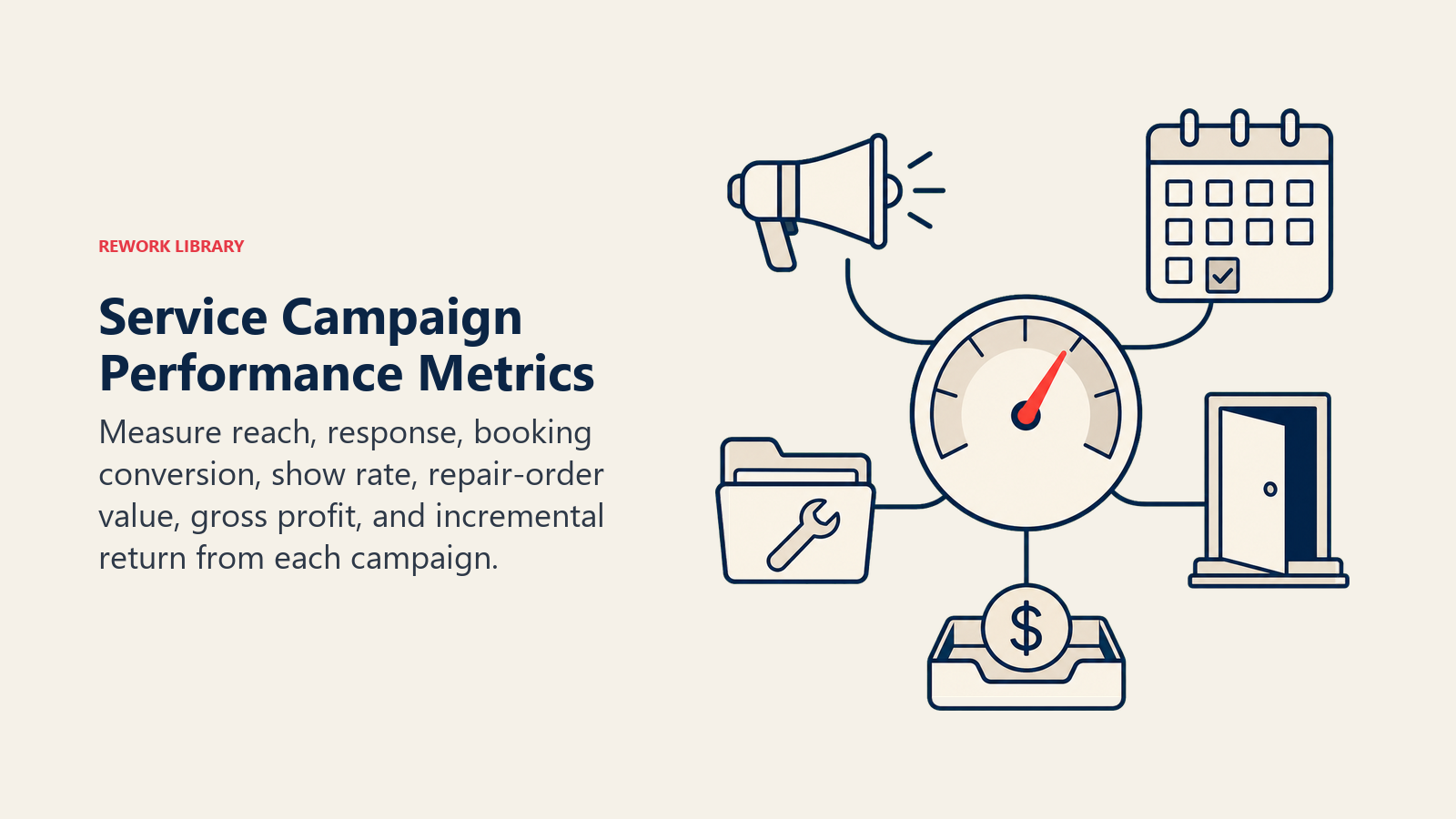
Response rate and appointment booking conversion show campaign effectiveness. Response rate measures how many customers engaged with your campaign, clicked email, called, visited website. Booking conversion measures how many actually scheduled appointments.
Industry benchmarks vary by campaign type and channel. Email campaigns typically generate 8-12% click-through rates and 25-35% of clicks convert to bookings. Direct mail generates 2-4% response with 40-50% booking conversion.
Compare your performance to benchmarks and your own historical data. Identify what's working and refine what isn't.
Show rate for campaign-driven appointments reveals whether customers who book actually arrive. Overall show rates should exceed 85%. Lower show rates indicate booking quality issues, wrong customers responding or scheduling problems.
Track show rates by campaign type. If conquest campaigns generate lower show rates than active customer campaigns, adjust messaging or qualification processes.
Average RO value from campaign customers determines campaign profitability. Some campaigns drive high volume but low revenue, like basic oil change specials. Others drive fewer appointments but higher values, like major service reminders.
Calculate revenue per campaign customer, not just appointment count. A campaign generating 50 appointments averaging $400 produces more revenue than one generating 100 appointments averaging $150.
Campaign ROI calculation and optimization requires tracking all costs against incremental revenue. Include creative development, list costs, channel fees (email service, postage, advertising spend), and staff time. Monitor through your dealership KPI dashboard.
Most successful service campaigns generate 300-500% ROI. If your campaigns fall below 200% ROI, something needs adjustment, targeting, offer, creative, or channel. Apply cost per sale analysis principles to service marketing.
OEM Co-Op Programs
Manufacturer co-op service marketing provides valuable funding but comes with restrictions and requirements.
Maximizing manufacturer service marketing funds starts with understanding available programs. Most OEMs offer quarterly co-op funding based on service volume or vehicle sales. These funds often go unused because dealers don't claim them or don't meet program requirements.
Review OEM marketing bulletins monthly. Identify available funds, eligible campaigns, and claiming deadlines. Assign someone responsibility for maximizing co-op utilization.
Compliance with co-op program requirements determines whether you receive reimbursement. OEMs typically require pre-approval for campaigns, use of approved creative and messaging, proof of execution, and performance reporting.
Document everything. Keep copies of all campaign materials, media receipts, and performance data. Submit claims promptly with complete documentation. Many dealers lose reimbursement due to incomplete paperwork or missed deadlines.
Combining dealer-funded and OEM-funded campaigns extends reach and frequency. Use OEM funds for broad awareness campaigns that meet program requirements. Use dealer funds for targeted campaigns addressing specific dealership opportunities.
For example, OEM co-op might fund seasonal maintenance campaigns. You fund lapsed customer win-back and conquest campaigns with dealer dollars. This combination maximizes total marketing investment.
Tracking co-op claims and reimbursement requires organized record-keeping. Create a tracking system showing available co-op funds, submitted claims, approval status, and received reimbursements.
Many dealers discover money left on the table because they didn't track available funds or missed submission deadlines. Systematic tracking ensures you capture all available reimbursement.
Building Your Service Marketing Calendar
Successful service marketing requires planning, not reactive campaigns. Build a 12-month calendar including:
January-February: Winter maintenance campaigns, lapsed customer win-back (post-holiday), competitive conquest offers.
March-April: Spring maintenance campaigns, major service reminders (30K/60K/90K), air conditioning service prep.
May-June: Summer preparation campaigns, pre-vacation inspections, tire services.
July-August: Back-to-school maintenance campaigns, competitive conquest (people servicing before school starts).
September-October: Fall maintenance campaigns, battery testing, winter tire changeover preparation.
November-December: Winter preparation campaigns, holiday loyalty appreciation, end-of-year major service reminders.
Layer ongoing campaigns over seasonal ones: monthly mileage-based reminders, quarterly lapsed customer outreach, and continuous recall notifications.
Plan creative and offers quarterly. This allows economies of scale in creative development while maintaining campaign freshness.
Implementation Roadmap
Start with your database. Clean your customer data, verify contact information, and establish segmentation criteria. You can't execute effective campaigns with poor data. Leverage automotive marketing automation tools for efficiency.
Next, select your initial campaign types. Don't try launching everything simultaneously. Start with seasonal maintenance campaigns and mileage-based reminders, they generate highest ROI with least complexity.
Choose your channels based on customer preferences and budget. Email provides the most cost-effective starting point. Add direct mail for high-value campaigns once email campaigns are optimized. Coordinate with fixed operations overview planning.
Measure everything from day one. Track response rates, conversion rates, show rates, and ROI. Use data to refine campaigns continuously.
Expand gradually. As you master basic campaigns, add conquest marketing, win-back programs, and additional channels.
Service marketing isn't expense, it's investment. The difference between dealerships with predictable service traffic and those constantly scrambling for customer pay work isn't market size or competition. It's systematic marketing that keeps service lanes full and profitable.