Post-Sale Follow-Up: The Automotive Sales Process Step Most Skip
Turn this article into takeaways for your work.


Each assistant summarizes the article only for you and suggests best practices for your work.
Post-sale follow-up is the stage of the automotive sales process that begins after vehicle delivery and turns a one-time buyer into a repeat customer. A structured cadence of timed touchpoints (day 0 through year one) generates 4 to 5 times more referrals and reviews than ad hoc contact while pushing service retention above 65 percent. It's the highest-leverage and most-skipped step in the entire dealership sales process.
Most dealerships treat vehicle delivery as the finish line. Salespeople move to the next opportunity. Managers focus on current month's sales. The customer who just spent $40,000 gets added to an email list and forgotten.
Then they wonder why service retention sits at 35%, referrals are rare, and online reviews trickle in slowly.
Systematic post-sale follow-up generates 4-5× more referrals and reviews than ad hoc approaches while creating service customer retention rates above 65%. The difference isn't massive effort. It's structured touchpoints that maintain relationships, address issues proactively, and position your dealership as ongoing partner rather than one-time seller. Cox Automotive research demonstrates the critical importance of this relationship-building: 74% of customers who service their vehicles at the selling dealership are more likely to purchase their next vehicle from the same dealer.
Yet implementation fails at most dealerships because follow-up gets delegated to whoever has time, messages lack strategy, and nobody measures results. Without structure, accountability, and measurement through dealership KPI dashboard, follow-up remains good intention without impact.
The Post-Sale Follow-Up Timeline
Effective follow-up requires specific touchpoints at strategic intervals. Random contact doesn't build relationships, but planned engagement does.
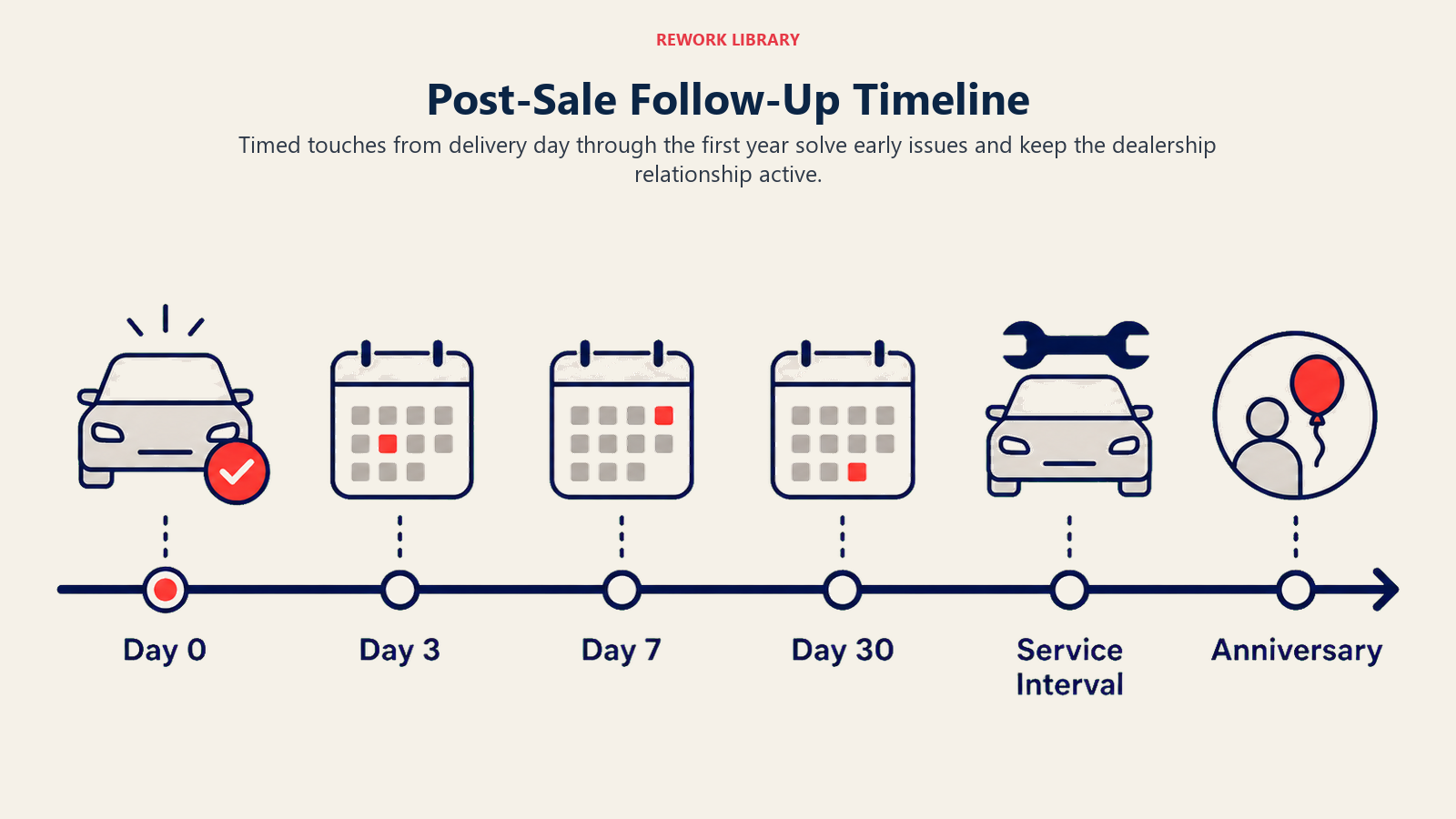
Day 0: Same-day delivery thank you arrives within 2-3 hours of delivery. A personalized text message or email from the salesperson: "Congratulations again on your new [vehicle model]! It was genuinely a pleasure working with you. If any questions come up, please reach out anytime."
This immediate acknowledgment reinforces positive delivery experience while relationship and excitement are peak. It shows the sale wasn't just transaction.
Day 3: Feature reminder and satisfaction check catches early confusion or issues. Many customers forget feature explanations from vehicle delivery experience. They're driving for a few days and encountering questions.
Call or text: "How are you enjoying your new [vehicle]? Any questions about features or anything we can help clarify?" Listen for confusion or frustration. Address issues immediately through automotive customer experience best practices before they become complaints.
Send helpful reminders: "Quick tip: here's how to pair your second phone to Bluetooth" or "Reminder: here's where your spare tire tools are located." These proactive helps demonstrate ongoing support.
Day 7: Comprehensive check-in and issue resolution provides opportunity for detailed conversation after first week of ownership. Most issues surface by day seven.
This should be phone call, not text. Spend 5-10 minutes discussing their experience. Ask specific questions: How's the vehicle performing? Have you figured out all the features? Any service or warranty questions?
If problems exist, resolve them immediately. Schedule service appointments if needed. Address concerns before they escalate to negative reviews or manufacturer complaints.
Day 30: First service reminder and review request transitions customers toward service retention and review generation through service marketing campaigns.
Remind them about first service timing, typically an oil change around 3,000-5,000 miles or 3-6 months. Offer to schedule appointment through service appointment scheduling. If they purchased maintenance plans, remind them coverage includes this service.
This is optimal timing for review requests. They've had enough experience to write meaningful reviews. Excitement remains high. Send direct review links making the process effortless.
Day 90: Satisfaction survey and referral request measures long-term satisfaction and activates referral programs.
Send brief satisfaction survey (5-7 questions). Focus on overall satisfaction, likelihood to recommend, and service department experience if they've visited.
Explain your referral program: "We grow through customer recommendations. If you know anyone shopping for vehicles, we'd love to help them. Here's information about our referral rewards program."
Months 4-12: Ongoing touchpoints and service reminders maintain presence without being intrusive. Monthly or quarterly contact keeps your dealership visible:
- Service reminders based on mileage and time intervals
- Educational content about vehicle features and care
- Seasonal maintenance recommendations
- Special event invitations (customer appreciation, new model launches)
- Birthday and vehicle anniversary acknowledgments
These touches maintain relationships until customers need next vehicle purchase or service.
Multi-Channel Follow-Up Strategy
Different messages work better through different channels. Effective follow-up uses the right channel for each touchpoint.
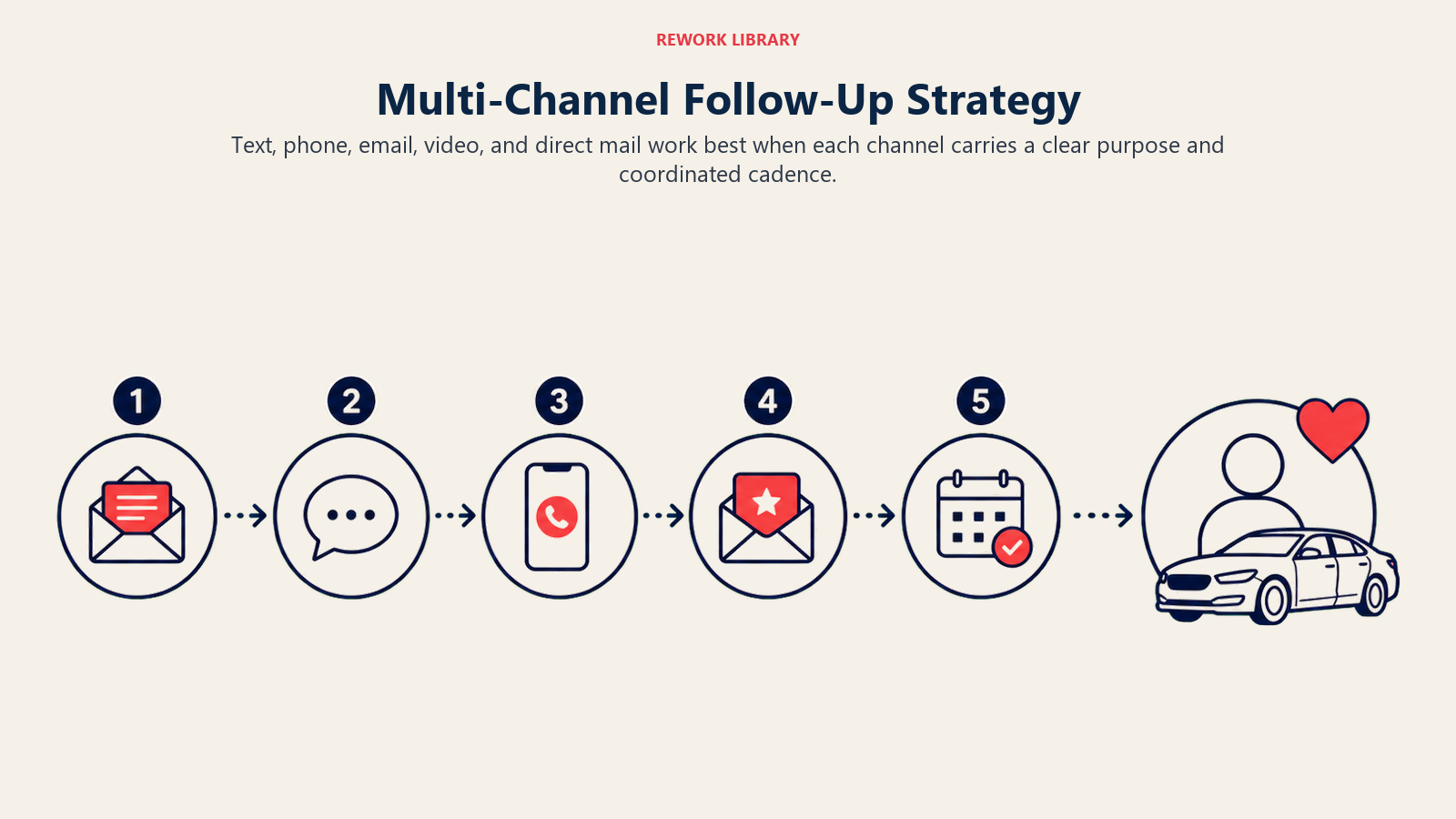
Phone calls for major milestones create personal connection. Day 7 check-in and day 90 satisfaction check should be voice conversations. Phone calls allow real dialogue, catching nuance and emotion that text misses.
But don't leave voicemails on first attempt. Text instead: "Hi [Customer], tried calling to check in on your new [vehicle]. When's a good time to connect for a few minutes?"
Text messages for quick check-ins work well for day 3 satisfaction check and service reminders. Texts get read within minutes and enable brief, convenient exchanges.
Keep texts conversational, not corporate. "Hi Sarah, quick check-in on your new RAV4, any questions I can help with?" beats automated messages that feel impersonal.
Email for educational content delivers longer-form information customers can reference later. Feature tutorials, maintenance guides, and seasonal service recommendations work well via email.
Segment email content based on customer purchase. Don't send truck towing guides to sedan buyers. Personalization improves engagement.
Video messages for personalization create stronger connection than text alone. Record 30-60 second videos on your phone thanking customers, checking in, or explaining features.
Video messages feel more personal than text while remaining convenient. Tools like BombBomb or Dubb make this easy.
Handwritten notes for VIP customers or major purchases create memorable touches. A handwritten thank you card arriving a few days after delivery stands out.
You can't send handwritten notes to every customer. Reserve them for VIP customers, large purchases, or customers who provided exceptional referrals.
Review Generation Process
Online reviews drive new customer decisions more than any advertising. Systematic review generation multiplies your online reputation impact.
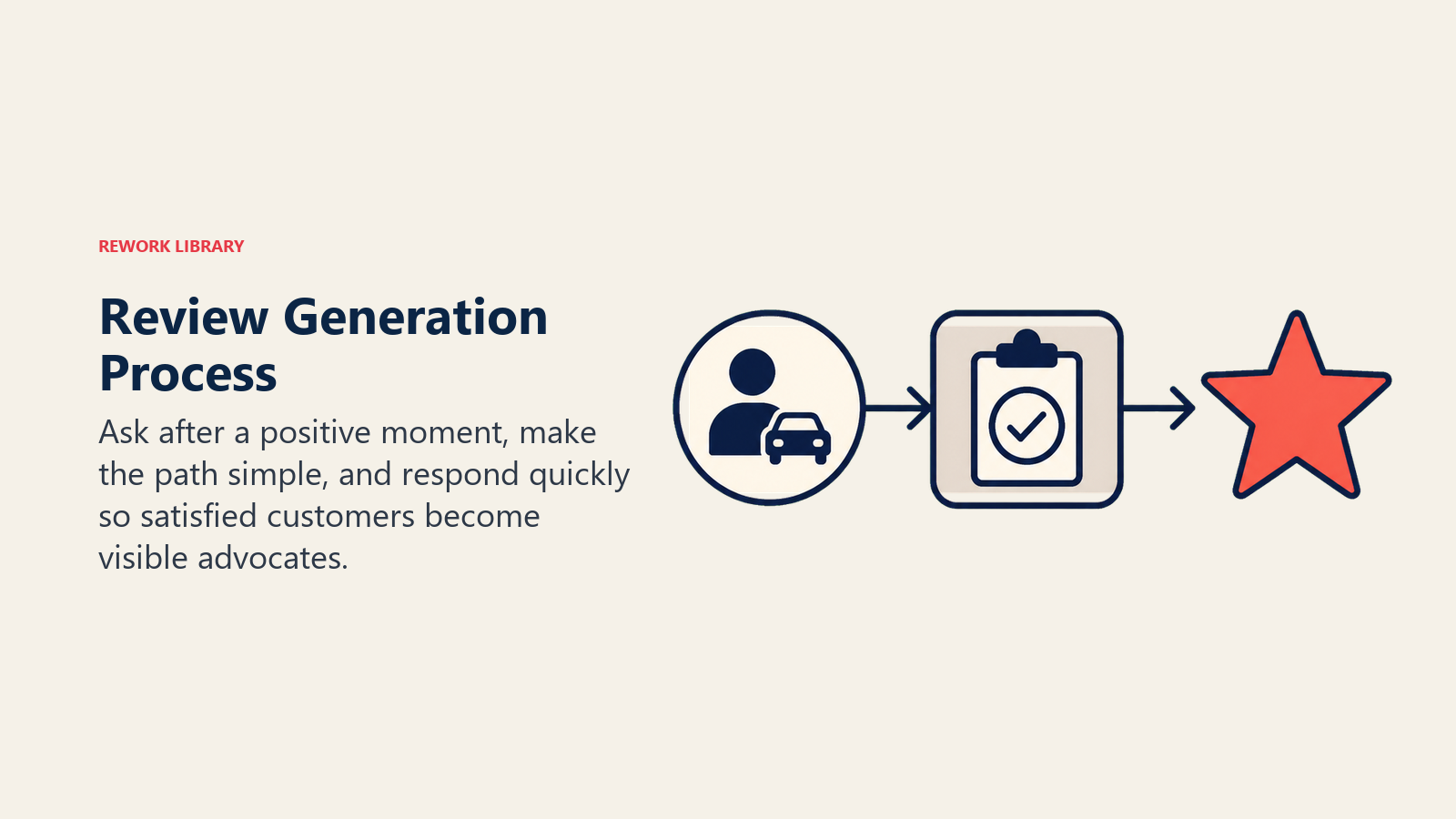
Optimal timing hits 7-10 days post-delivery. Earlier timing catches customers before issues surface. Later timing allows excitement to fade. 7-10 days balances experience and enthusiasm.
But flexibility matters. If day 7 check-in reveals problems, delay review requests until issues are resolved. Never ask dissatisfied customers for reviews. Fix their problems first.
Multi-platform review requests maximize visibility. Different customers shop different platforms:
- Google reviews appear in search results and maps
- Dealer.com reviews appear on your website
- DealerRater and Edmunds reviews influence car shoppers specifically
- Facebook reviews reach social connections
Request reviews for 2-3 platforms but make it easy. Don't ask customers to write separate reviews for each site. Many will repost the same review across platforms if you provide links.
Making the process effortless dramatically improves response rates. Send direct review links via text or email: "We'd really appreciate if you shared your experience. Here are quick links: Google | DealerRater | Facebook"
Each link should go directly to review submission page, not your general profile. Every extra click reduces completion.
Provide gentle guidance without dictating: "If you'd share what you appreciated about your experience, it really helps others making similar decisions."
Responding to reviews (positive and negative) shows active engagement. Thank customers for positive reviews within 24-48 hours. Acknowledge their specific comments: "Thanks for mentioning our delivery process, we're glad you appreciated the time we took."
Respond to negative reviews professionally and constructively. Don't argue or make excuses. Acknowledge concerns, apologize for shortcomings, and invite offline resolution: "We're disappointed we fell short of expectations. Please contact me directly at [phone] so we can make this right."
Public responses to negative reviews demonstrate customer service commitment to everyone reading reviews. Manage this systematically through online review management processes.
Referral Program Integration
Past customers provide highest-quality referrals. They understand your market, know your process, and can speak authentically about their experience. But referrals don't happen without systematic requesting through customer loyalty programs.
Explaining referral program at delivery plants seeds early. During delivery appointment: "We grow primarily through customer referrals. If you have positive experience with us, we hope you'll mention us to friends and family. We have a referral rewards program that benefits both you and anyone you refer."
Give them physical referral cards or digital referral links. But don't expect immediate action. Most referrals come later when friends mention they're shopping.
30-day and 90-day referral reminders reactivate referral awareness after they've had ownership experience. At 30 days: "Now that you've had time with your new [vehicle], if you know anyone shopping, we'd love to help them too."
At 90 days, make more direct request: "One of the ways we grow is through customer recommendations. Do you know anyone currently shopping for vehicles? We'd love opportunity to help friends or family."
Incentive structure should benefit both parties. Typical programs offer:
- $100-$250 credit or gift card to referring customer
- $100-$250 discount or gift to referred customer
- Donations to charity in customer's name as alternative to personal rewards
Make rewards meaningful enough to motivate but not so large they create uncomfortable obligation. Excessive rewards feel like bribes rather than appreciation. According to Deloitte's automotive customer loyalty research, brand loyalty has declined from 54-55% before COVID-19 to 51.6% in 2024, making well-structured referral programs increasingly important for sustainable dealership growth.
Tracking and fulfilling referral rewards requires systematic processes. When referred customers arrive, capture referrer information immediately. Thank referrers within 24 hours of referral purchase. Deliver promised rewards within 7-10 days.
Failed reward delivery destroys referral program credibility. Customers who refer friends expect acknowledgment and promised benefits.
Service Department Transition
Service retention determines lifetime customer value. Customers who service at your dealership for years generate more profit than initial vehicle sale. Post-sale follow-up creates this retention.
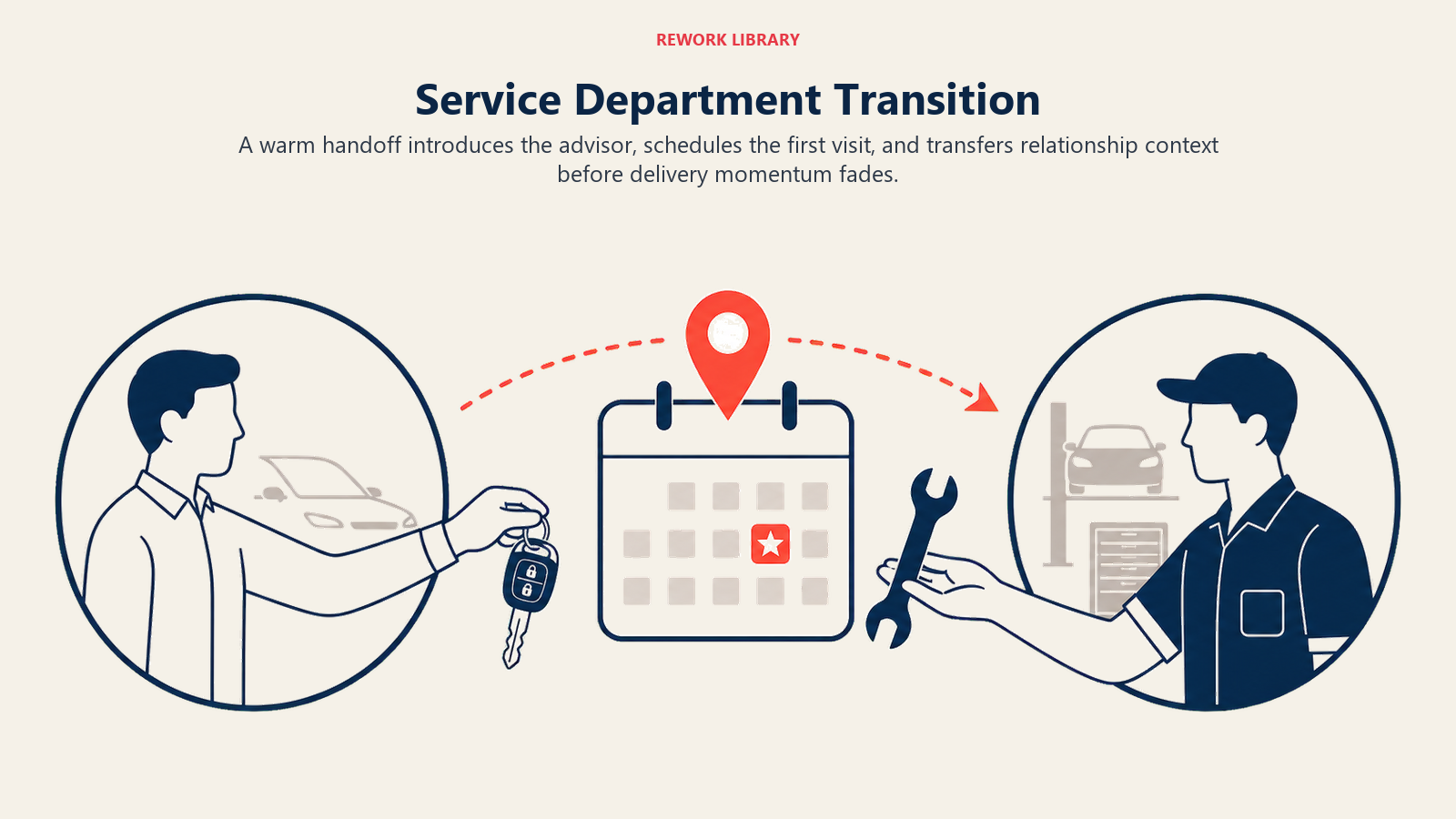
Service team introduction at delivery establishes personal connection. Walk customers to service department during delivery. Introduce service manager or advisor assigned to their account through service to sales pipeline integration.
This personal introduction makes future service visits comfortable. They're not calling strangers, they're contacting someone they've met. This supports fixed operations overview strategies.
First maintenance appointment scheduling should happen before customers leave delivery. Pre-scheduling dramatically increases likelihood they return to your dealership versus going elsewhere.
"Your first oil change will be around [mileage/date]. Let's get that scheduled now so you don't have to think about it." Even if they reschedule later, having appointment booked creates commitment.
Service reminder integration with follow-up maintains visibility around maintenance timing. If first service is due at 5,000 miles, estimate when that occurs based on typical driving. Send reminders starting 500 miles before.
"Your [vehicle] should be approaching first service interval. We have your appointment scheduled for [date]. Does that timing still work?"
Service advisor assignment for continuity provides consistent point of contact. Instead of random advisor assignment, give customers specific advisor who knows their history and preferences.
This relationship continuity improves communication, trust, and retention. Customers develop loyalty to people, not businesses.
Technology & Automation
Manual follow-up fails due to inconsistency and forgotten tasks. Technology ensures systematic execution.
CRM automated follow-up sequences trigger messages at appropriate intervals without requiring manual action through automotive CRM implementation. Set up automated sequences triggered by delivery date:
- Day 0: Thank you email/text
- Day 3: Satisfaction check text
- Day 7: Phone call reminder for salesperson
- Day 30: Service reminder and review request
- Day 90: Satisfaction survey and referral request
- Monthly: Ongoing touchpoints through automotive marketing automation
Automation ensures consistency across all salespeople and customers. But automated messages should feel personal, not robotic.
Two-way texting platforms enable conversational text exchanges from business numbers. Customers can respond to automated texts, creating real dialogue. Salespeople receive responses and can continue conversations.
Platforms like Podium, Kenect, or Kimoby integrate with dealership systems and manage text conversations at scale.
Video messaging tools make personalized video easy. Record short videos on phone, send via text or email, and receive notifications when customers watch.
BombBomb, Dubb, and Loom provide platforms optimized for sales video messaging. Videos create stronger personal connection than text alone.
Review generation software integration automates review requests and manages responses. Platforms like Birdeye, Reputation.com, or DealerRater tools send review requests automatically and alert you to new reviews requiring responses.
These tools track review performance by salesperson and dealership, enabling performance management.
Common Follow-Up Mistakes
Even with good intentions, follow-up fails when:
Following up without purpose. Random "just checking in" messages annoy customers. Every touchpoint should provide value, answering questions, offering help, sharing useful information, or making specific requests.
Being too aggressive too quickly. Daily contact feels desperate and pushy. Space touchpoints appropriately. Let customers breathe between contacts.
Ignoring customer preferences. Some customers prefer texts, others phone calls, some email. Ask during delivery: "What's the best way to stay in touch?" Then respect their preference.
Failing to personalize. Generic automated messages without personalization feel corporate and impersonal. Use customer names, vehicle models, and purchase details to make messages feel individual.
Not measuring results. Follow-up without performance tracking wastes effort on ineffective approaches. Track response rates, review generation, service retention, and referrals by follow-up type and timing.
Giving up too soon. One unreturned call doesn't mean customers don't want contact. Try multiple channels and times before assuming disinterest.
Implementation Roadmap
Start by documenting current follow-up practices. What happens today? Who's responsible? How consistent is execution?
Define your follow-up timeline with specific touchpoints, timing, and responsible parties. Create message templates for each touchpoint while allowing personalization.
Select CRM and automation tools supporting your strategy. Configure automated sequences and train staff on usage.
Assign follow-up responsibility. Who makes day 7 calls? Who monitors CRM task completion? Who responds to review replies? Clear ownership ensures execution.
Train sales team on follow-up importance and expectations. Show data on how systematic follow-up drives referrals, reviews, and service retention.
Measure and optimize based on results. Track review generation rates, service retention, and referral volume by salesperson. Recognize top performers and coach those falling short.
Most dealerships abandon customers immediately after delivery, treating sales as isolated transactions. Top performers understand vehicle purchase is relationship beginning, not ending. They invest in systematic follow-up that generates referrals, reviews, and service retention worth multiples of initial sale. For comprehensive strategies on building long-term customer relationships, see Owner Retention Marketing and Customer Loyalty Programs.
The question isn't whether follow-up is worth the effort. It's whether you can afford to keep ignoring post-sale relationship building while competitors capture lifetime customer value you're leaving on the table. To implement these strategies effectively, integrate follow-up with your Automotive CRM Implementation and track results through your Dealership KPI Dashboard. For service retention specifically, see Service Customer Retention strategies.
Post-Sale Follow-Up FAQs
Where does post-sale follow-up fit in the automotive sales process?
It's the final stage, beginning the moment a vehicle is delivered. While most dealerships treat delivery as the end, top performers treat it as the start of a relationship that drives referrals, reviews, and service retention.
What is the ideal post-sale follow-up timeline?
A proven cadence is day 0 (same-day thank you), day 3 (feature check), day 7 (comprehensive call), day 30 (first service reminder and review request), day 90 (satisfaction survey and referral request), then ongoing monthly or quarterly touchpoints through year one.
When is the best time to ask for a review?
Request reviews 7 to 10 days after delivery, once the customer has real experience but excitement is still high. If your day 7 check-in surfaces a problem, fix it first and delay the review request.
How much does systematic follow-up improve results?
A structured process generates 4 to 5 times more referrals and reviews than ad hoc contact and supports service retention rates above 65 percent, compared with the roughly 35 percent many dealerships see without it.
How do you keep follow-up consistent across a sales team?
Use CRM-triggered automated sequences tied to the delivery date, assign clear ownership for each touchpoint, and measure response rates, review generation, and service retention by salesperson so coaching is data-driven.