Service-to-Sales Pipeline: Converting Fixed Ops Customers into Vehicle Buyers - 2026 Guide
Turn this article into takeaways for your work.


Each assistant summarizes the article only for you and suggests best practices for your work.
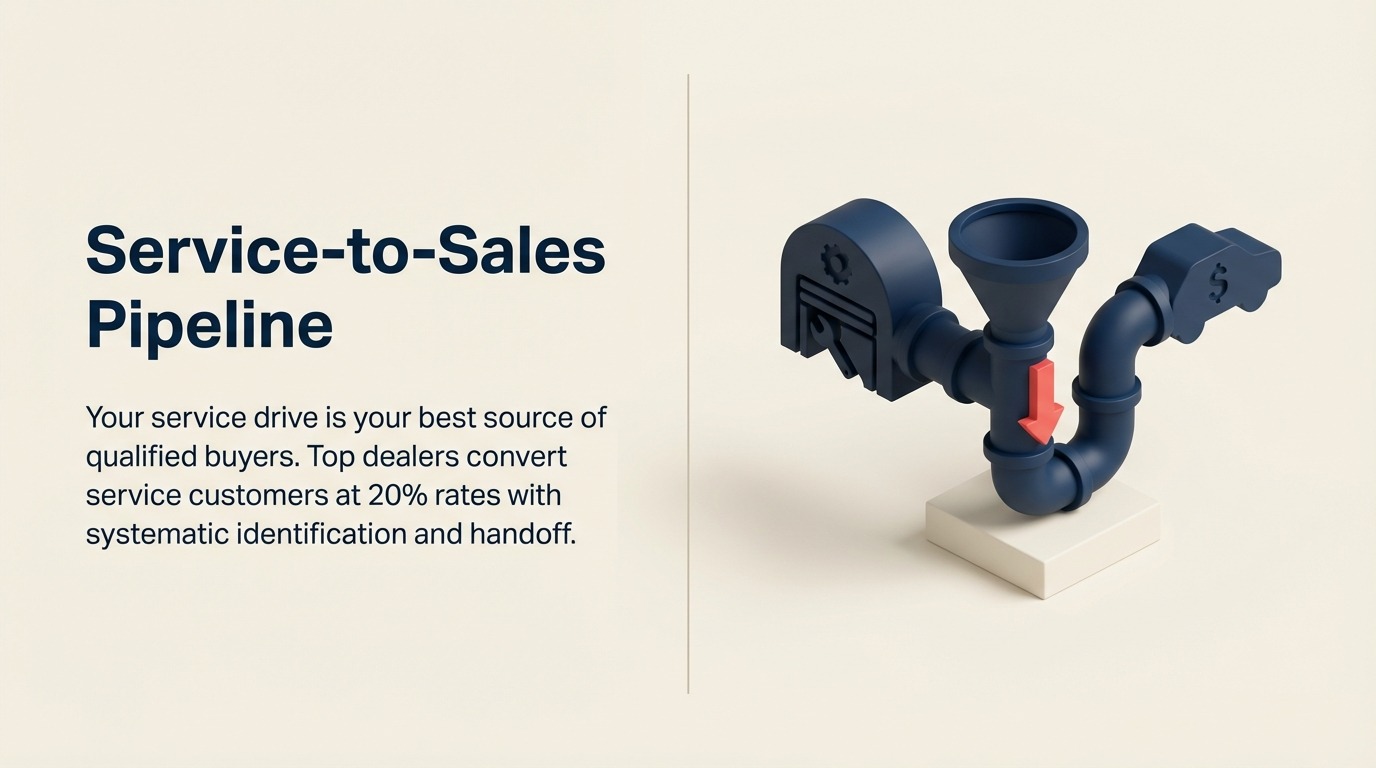
Your service drive is your best source of qualified buyers, 20% conversion rates at top dealers compared to 8-12% from paid internet leads. Yet most dealerships treat service and sales as separate businesses that happen to share a building.
The math is straightforward. A dealer servicing 1,000 customers monthly has 200 buying opportunities sitting in their service drive, customers whose vehicles are aging, breaking down, or approaching replacement cycles. These aren't cold prospects. They're existing customers who already trust your dealership enough to service there.
But without systematic processes for identifying, qualifying, and transitioning these opportunities, they drive away in their aging vehicles and buy from competitors with more aggressive conquest programs. The service-to-sales pipeline isn't about high-pressure sales tactics. It's about recognizing natural buying signals and providing value at the right moment.
The Service-to-Sales Opportunity
Average service customers per month range from 800 at small dealers to 1,500+ at high-volume stores. Even at the low end, that's 9,600 customer interactions annually. Each interaction is an opportunity to assess replacement readiness, build relationships, and identify buying triggers. According to NADA statistics, dealerships wrote more than 270 million repair orders in 2024, with service and parts sales exceeding $156 billion.
Natural replacement cycle awareness happens in service lanes. When a customer brings in a 2015 vehicle with 110,000 miles for a $1,800 transmission repair, they're making mental calculations: "Is it worth fixing or should I trade?" Your service advisor sees this moment. Most dealers don't act on it.
Trust is already established through service relationships. Customers who've serviced with you 3-5 times over 2-3 years trust your expertise, know your facility, and have positive (hopefully) experiences with your team. This trust transfers to sales, if the transition is handled professionally, not opportunistically.
Lower cost per sale vs paid leads makes service-to-sales the most profitable lead source. Internet leads cost $150-400 each. Service-sourced leads cost approximately $20-40 (mostly labor for the handoff process and initial follow-up). Close rates are 2x higher. Learn more about cost per sale analysis. Do the math: lower acquisition cost plus higher conversion equals significantly better ROI. According to NADA data, while fixed operations accounts for only 12-13% of total revenue, it produces over 60% of a dealership's net profits.
Lifetime value amplification happens when you sell to existing service customers. They're more likely to service with you post-purchase, refer friends and family, and become repeat buyers. First-time buyers might defect for better pricing elsewhere. Service customers who upgrade through you are building decade-long relationships. Cox Automotive research shows that dealerships have lost 12% of service visits to competition since 2018, making service customer retention and conversion to sales increasingly critical.
Identifying Sales Opportunities
Repair cost exceeding value thresholds is the clearest signal. When repair estimates exceed 30% of vehicle value, most rational buyers consider replacement. A $2,400 repair on an $8,000 vehicle triggers the "should I fix it or trade it?" conversation. This is your moment to present trade-in alternatives.
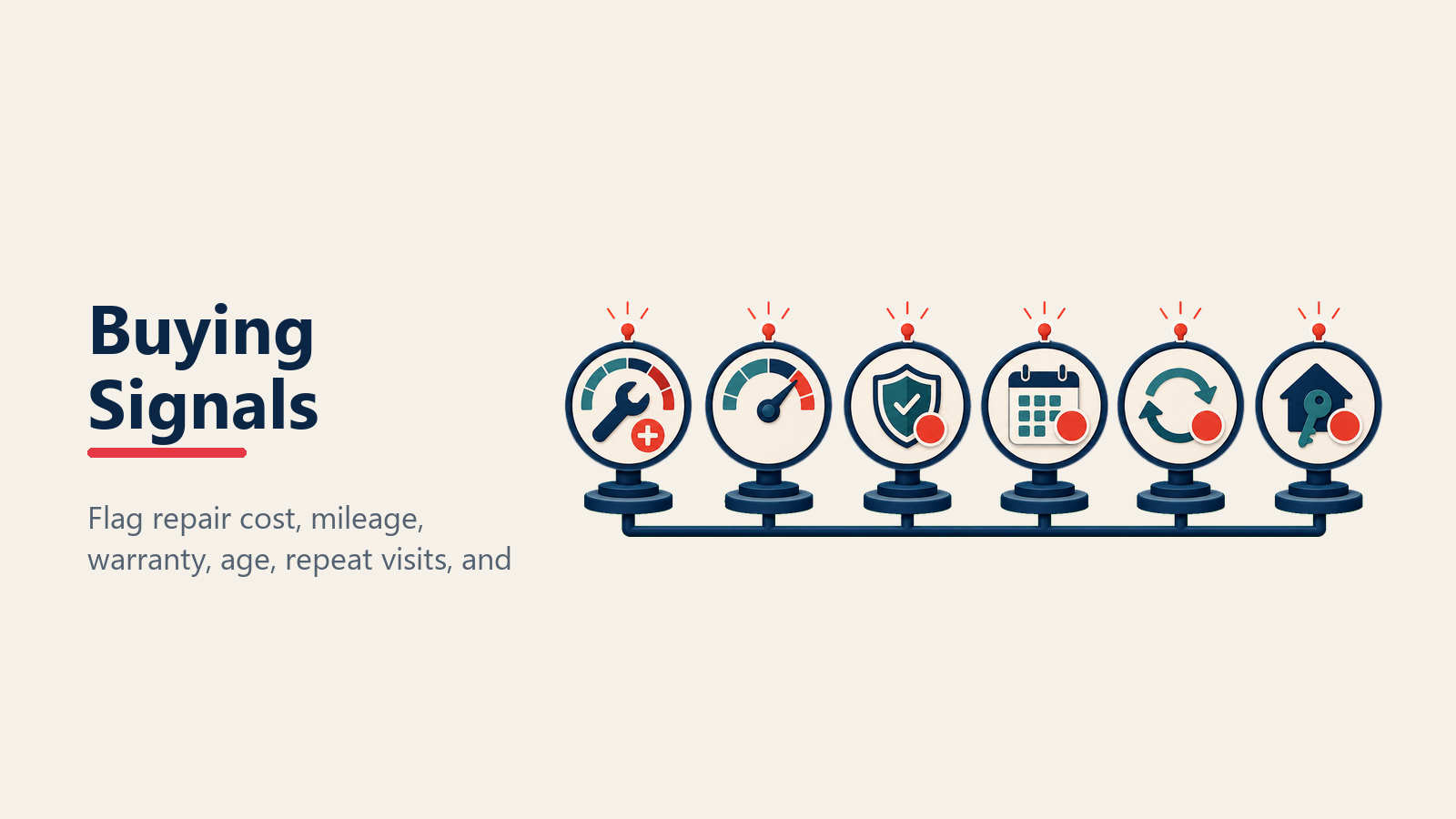
High mileage indicators above 100K miles statistically correlate with higher repair frequency and costs. Not every high-mileage vehicle owner is ready to trade, but they're more receptive to conversations about newer vehicles. Service advisors should note mileage on every RO (repair order) and flag anything above certain thresholds: 100K, 125K, 150K.
Warranty expiration timing creates both anxiety and opportunity. When factory warranty ends (typically 36 months/36K miles), customers face choices: buy extended warranty, accept repair risk, or trade before major repairs hit. Proactively addressing this 30-45 days before expiration positions you as advisor, not salesperson.
Age of vehicle becomes a factor at 7+ years. Even well-maintained vehicles face increasing repair frequency and costs after year 7. Technology becomes dated. Safety features are missing. Reliability concerns grow. Customers with 7+ year-old vehicles are statistically more likely to be in-market within 12 months than those with 2-4 year-old vehicles.
Multiple visits in short periods signal reliability concerns. A customer who visits service three times in six weeks with different issues is losing confidence in their vehicle. This pattern often precedes replacement decisions. Your CRM should flag multiple visits within 60-90 day windows for follow-up.
Life event indicators surface occasionally in service conversations. Service advisors hear about new babies, teenagers getting licenses, business expansions requiring trucks, relocations to areas with different weather. These life changes often prompt vehicle needs changes. Advisors trained to recognize and document these signals create natural sales opportunities.
Technology & Data Integration
DMS-CRM integration is mandatory for systematic service-to-sales programs. When a service RO is created, your CRM should automatically check: vehicle age, mileage, equity position, repair history, customer contact timeline. This data enables service advisors to identify opportunity without manual research.
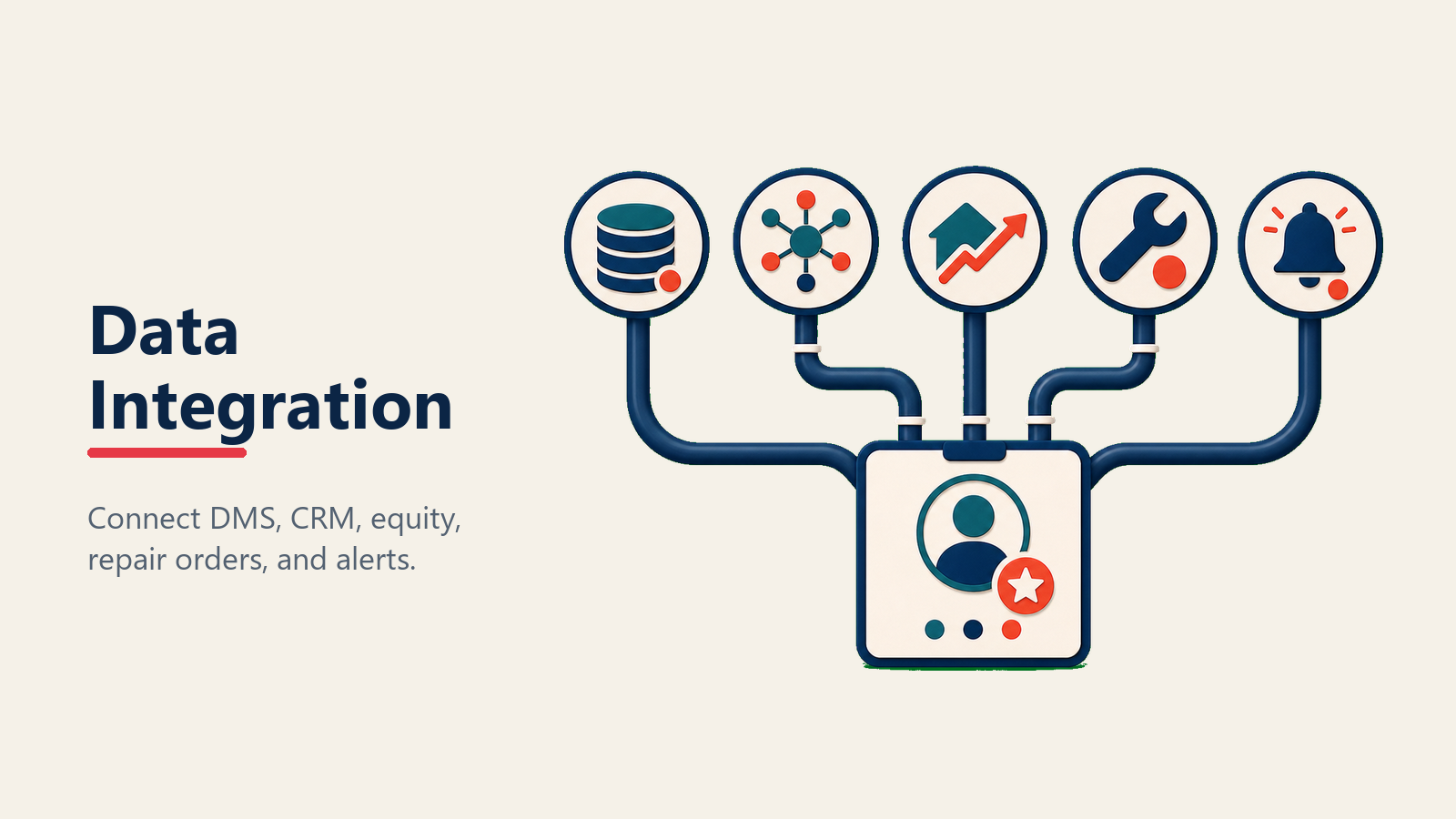
Service advisor dashboards should display opportunity triggers in real-time. When checking in a customer, advisors see alerts: "Vehicle has $6,200 equity," "Customer hasn't been contacted by sales in 180 days," "Repair cost equals 40% of vehicle value." These prompts guide conversations naturally.
Equity calculation tools provide immediate talking points. Integrate real-time market data (KBB, Black Book, NADA) with customer payoff information from your DMS. Calculate equity instantly. Service advisors can say, "By the way, your vehicle has about $5,000 in equity right now. Have you considered what you might trade up to?" This isn't pushy, it's information.
Trade-in value estimation during service check-in takes 60 seconds and provides immediate value. "While you're here for service, I ran a quick value check, your Camry is worth $17,500-$18,800 in trade right now. Market is strong." This plants seeds without asking for commitment.
Automated alert systems notify sales teams when service customers meet buying criteria. If a customer declines a $2,000+ repair, an automated alert should go to BDC or sales manager within 15 minutes. Speed matters, the customer is actively making decisions about their vehicle.
Service Advisor Training
Recognizing buying signals requires training and practice. Advisor should listen for: complaints about reliability, questions about vehicle value, concerns about upcoming expensive maintenance (timing belts, transmissions), comments about family size changes, or mentions of shopping for vehicles. Document these in RO notes for CRM capture.
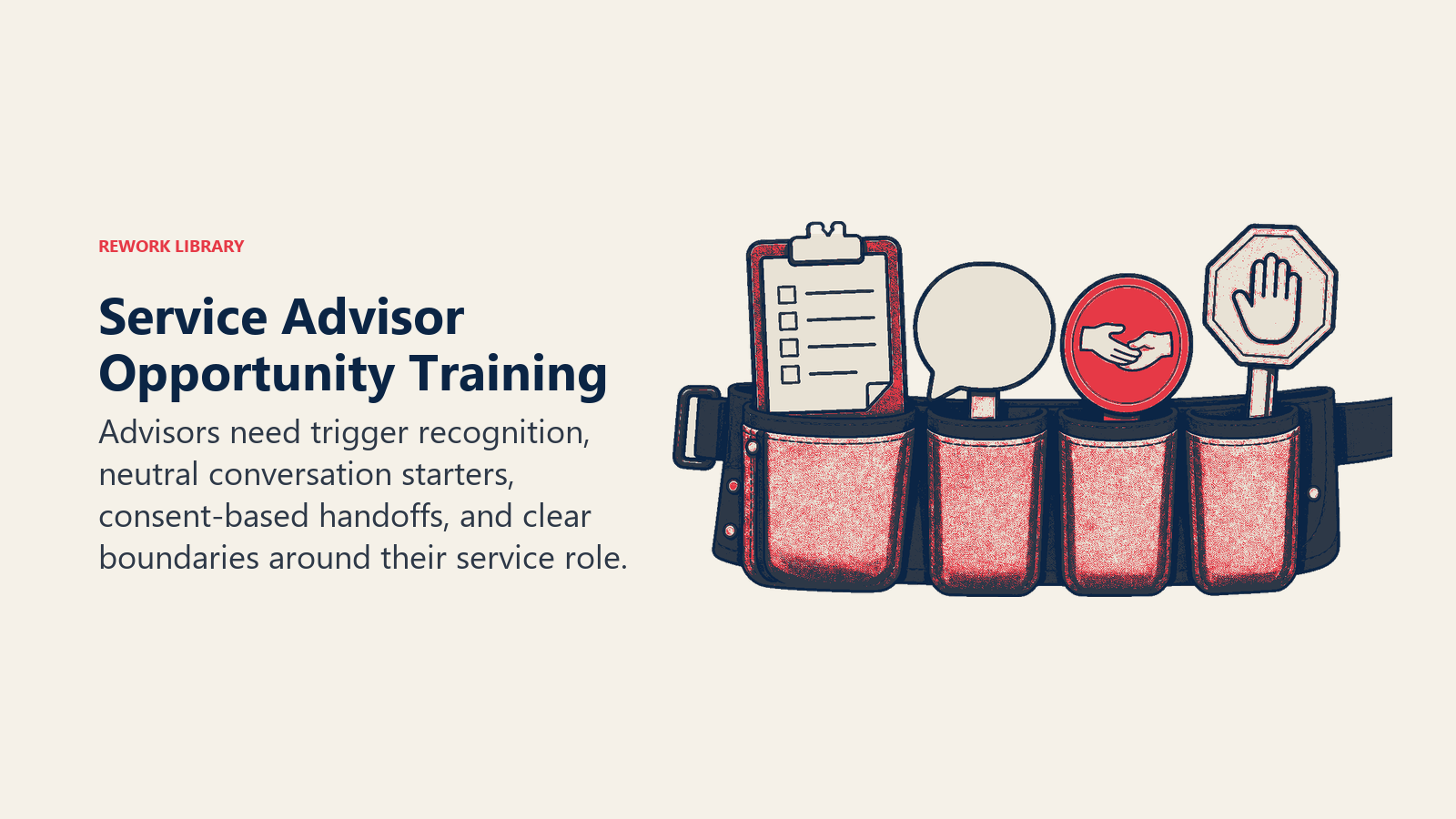
Soft introduction techniques prevent the hard-sell stigma. Rather than "You should talk to our sales team about trading," try "If you're open to it, I can have someone pull current market value on your vehicle while you wait. No obligation, just information." This low-pressure approach respects customer autonomy.
Equity conversation scripts provide structure without sounding robotic:
"I notice your Accord is a 2019 with 62,000 miles. Market value on these is really strong right now, you likely have significant equity. Mind if I have someone pull exact numbers while you're here for service? It's just information in case you're ever curious about upgrading."
This positions equity as positive news, not a sales pitch. Customers appreciate knowing their financial position.
Transitioning to sales team should be warm, not cold. "Let me introduce you to Maria from our sales team. I mentioned you might be interested in current value on your vehicle. She can pull exact numbers and show you what's available if you're curious. No pressure, just wanted to connect you while you're here."
Commission or spiff structures for service advisors align incentives. Flat $100-200 spiffs for service-to-sales conversions that result in deliveries incentivize participation without creating unethical behavior. Some dealers use tiered structures: $100 for handoff that leads to appointment, $200 for handoff that leads to sale.
Process & Handoff Workflow
Service advisor identification happens at check-in or during repair estimate discussion. Advisors review customer history, vehicle condition, and repair costs. If any buying signals present, they initiate soft conversation about vehicle value and trade options.
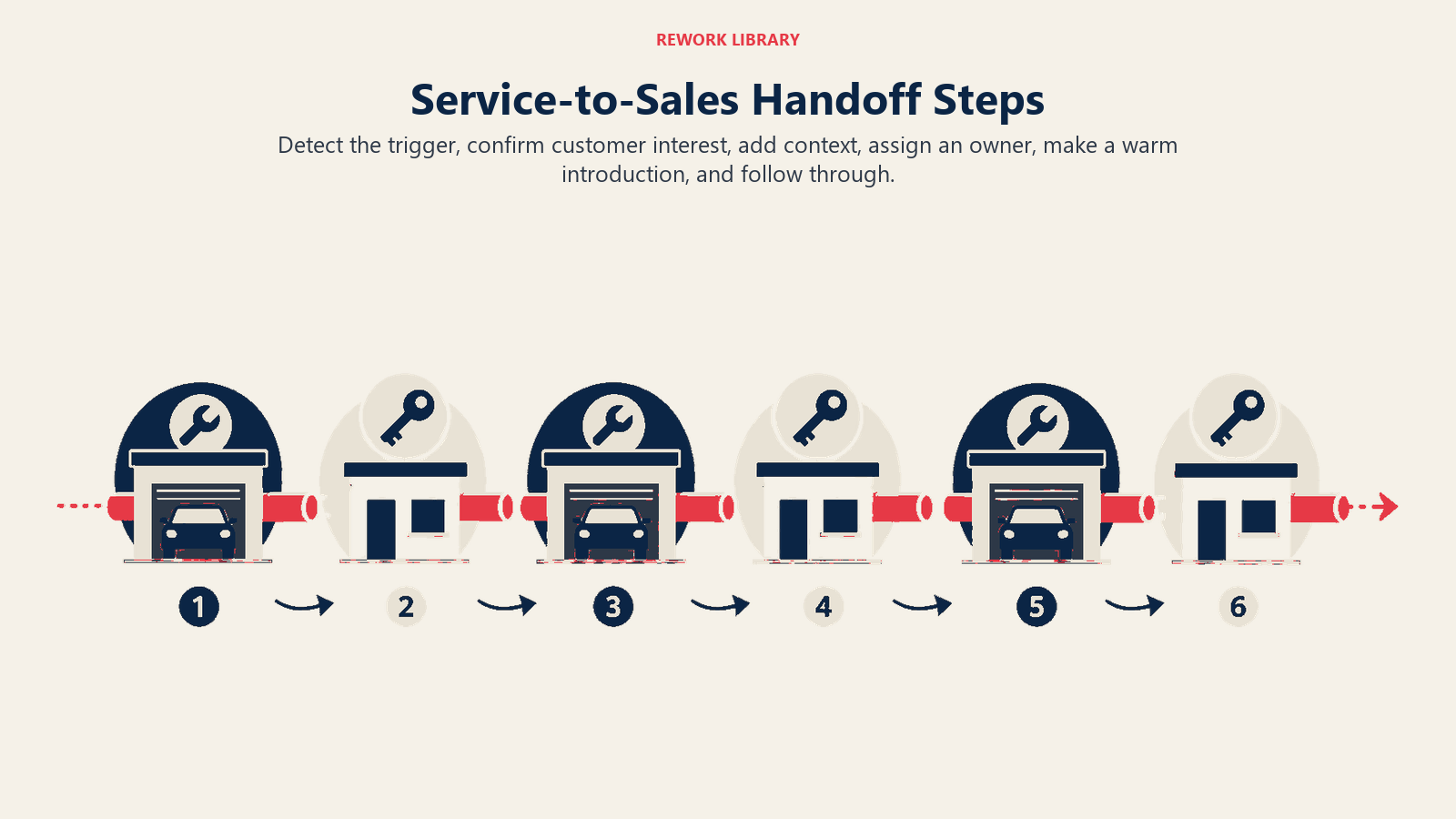
Warm handoff to sales is the ideal scenario. Advisor walks customer from service to sales area, introduces them by name to a specific salesperson, and provides context: "This is Jennifer. She's here for oil change on her 2018 CR-V. I mentioned you might be able to show her current trade values and what's available in the newer CR-Vs if she has 15 minutes." Then the advisor returns to service duties.
Digital handoff when immediate meeting is impossible uses technology to maintain momentum. Advisor captures customer agreement to be contacted, enters opportunity into CRM with detailed notes (vehicle condition, repair history, expressed interests), assigns to BDC or sales. Follow-up call happens within 2 hours: "Hi, your service advisor mentioned you might be interested in current trade values on your CR-V. Do you have 5 minutes to discuss?"
BDC follow-up protocols for declined immediate handoffs should be persistent but not aggressive. Day 1: initial call with trade value information. Day 3: email with market analysis and inventory suggestions. Day 7: follow-up call offering appointment. Day 14: final email with trade value reminder. If no response, add to long-term nurture campaign.
CRM task assignment ensures accountability. Each service-identified opportunity gets assigned to specific sales rep or BDC agent with expected follow-up timeline. Managers track follow-up completion rates, contact rates, and conversion rates by employee. This creates accountability without micromanagement.
Equity Mining for Service Customers
Positive equity calculation combines market value data with payoff information. Your DMS should have payoff amounts for financed vehicles. Pull current market values weekly via data providers. Calculate equity (market value minus payoff). Customers with $4,000+ equity are prime targets.
Market value vs payoff communication should be specific and sourced. "Based on Kelley Blue Book data from this week, your 2020 F-150 with 45,000 miles has trade value of $32,500-$34,200. Your payoff is approximately $26,800, which means you have $6,000-$7,400 in equity." Specificity builds credibility.
Lower payment opportunity positioning works when true. "With your equity position, you could potentially upgrade to a 2024 model and maintain similar monthly payments, especially with current interest rates and manufacturer incentives." Run actual numbers before making claims. False payment promises destroy trust.
New model benefits presentation focuses on safety, technology, efficiency, and reliability improvements. "The 2024 F-150 has significantly improved fuel economy, about 4 MPG better than your 2020. Over a year, that's approximately $800 in fuel savings. Plus upgraded safety tech like automatic emergency braking and blind spot monitoring."
Service-Specific Marketing Campaigns
Email campaigns to service database should segment by opportunity level. Don't blast everyone monthly. Target high-equity customers monthly, medium-equity quarterly, recent service customers with major repair bills within 7 days. Learn about dealership email marketing. Personalize based on vehicle, service history, and equity position.
SMS alerts for positive equity work when brief and valuable. "Hi John, market values have increased. Your 2019 Tacoma now has approximately $8,200 in equity. Reply YES to see current inventory and payment options or STOP to opt out." Keep under 160 characters. Make opt-out easy.
Direct mail for high-value targets justifies higher cost. Customers with $8,000+ equity in desirable vehicles (trucks, SUVs) warrant $2-3 personalized mailers with specific trade values, inventory recommendations, and VIP appointment offers. Response rates of 2-4% justify the investment.
Service appointment reminders with trade offers combine utility with opportunity. "Your Accord is due for 60K service. Schedule here: [link]. P.S. Current trade value on 2020 Accords: $18,500-$19,800. Curious about upgrading? Let us know." Learn more about service appointment scheduling. This feels helpful, not salesy.
VIP shopping appointments position trade-ins as exclusive opportunities. "Based on your positive equity position, we'd like to invite you to a VIP shopping appointment where we'll provide exact trade value, show current inventory matching your needs, and discuss payment options. No obligation, just information." Exclusivity appeals to high-value targets.
Overcoming Common Barriers
"Just here for service" objection is valid and should be respected. Response: "Completely understand. This is a service visit. I just wanted to make you aware of your equity position in case you ever do consider upgrading. No pressure today." Then execute excellent service. Pushiness destroys future sales opportunities.
Time constraints during service visits limit immediate sales conversations. Solution: capture information and permission for follow-up. "I know you're in a hurry today. Could I have someone call you later this week to discuss trade values and options when you have more time?" Most customers agree to future contact when current time pressure is acknowledged.
Service advisor hesitation often stems from commission concerns (fixed ops vs variable ops pay structures) or fear of damaging service relationships. Address this directly: explain spiff structures, emphasize customer value (helping them make informed decisions), and share success stories of advisors who've generated sales without damaging service customer retention.
Sales team follow-through inconsistency kills service advisor participation. If advisors refer 10 opportunities and sales never follows up effectively, advisors stop referring. Solution: track follow-up completion, report metrics to service advisors monthly, recognize top-performing sales people who close service referrals, and address non-performers.
Customer privacy concerns about sharing information between departments require transparency. Service intake forms should include: "May we have our sales team contact you about trade-in values and vehicle options? Yes/No." Get explicit permission. Don't assume that servicing with you grants permission for sales outreach.
Measuring Service-to-Sales Performance
Referrals from service department should be tracked in CRM with source code. Count how many opportunities service advisors identify and hand off monthly. Target: 15-25% of service customers flagged as potential opportunities based on defined criteria (equity, mileage, repair costs, vehicle age).
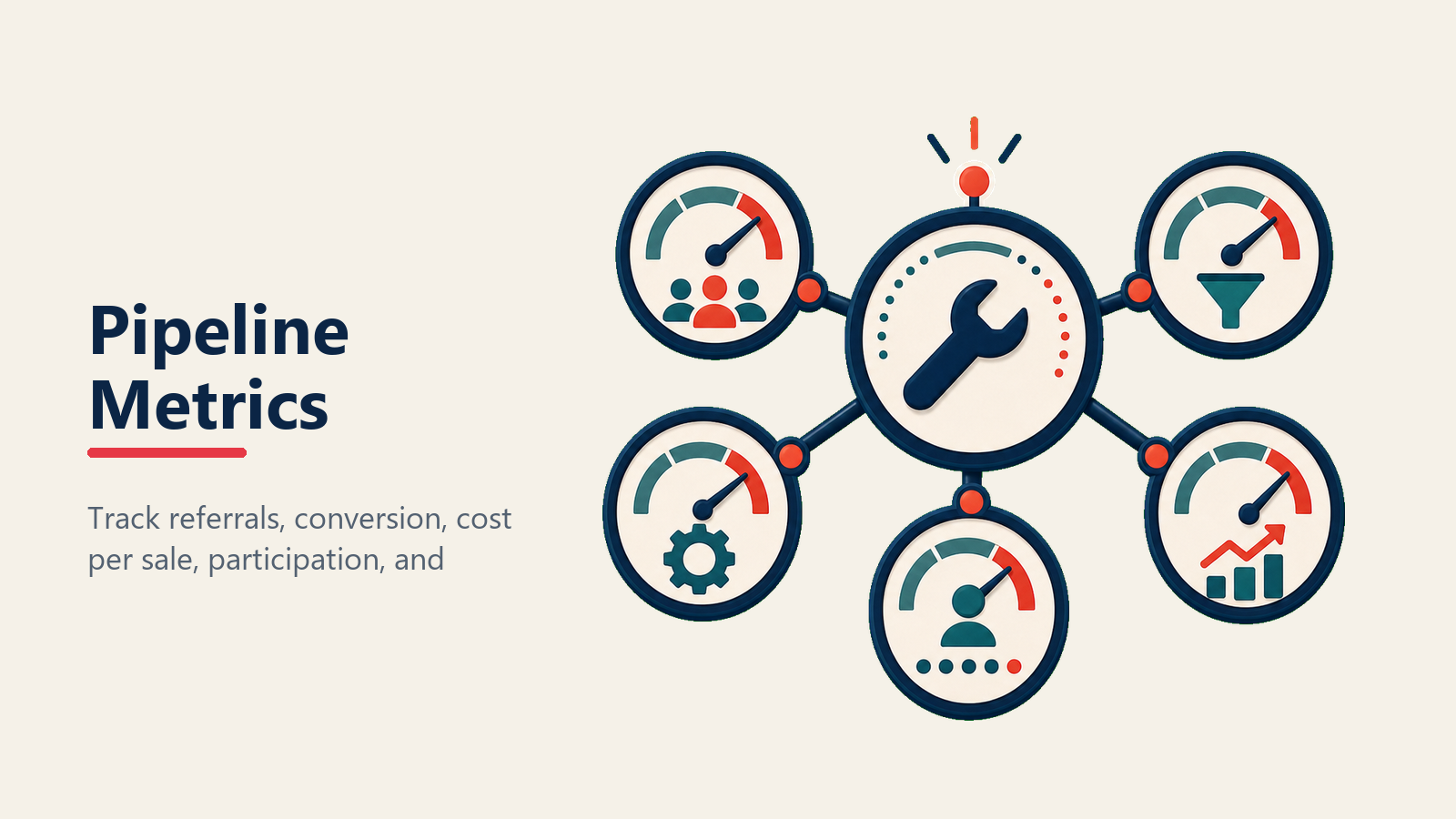
Conversion rate from service customers measures effectiveness of follow-up and sales process. Industry average: 12-15% of service-sourced opportunities convert to sales within 90 days. Top performers: 18-22%. Track this monthly and by individual sales rep to identify top performers and training opportunities.
Cost per sale is the lowest of all lead sources. Calculate labor cost for advisor time spent identifying opportunities ($10-15), BDC time on follow-up ($15-25), and advisor spiffs ($100-200 if deal closes). Total acquisition cost: $125-240 per sale compared to $1,200-2,400 for internet lead-sourced sales.
Service advisor participation rate indicates program health. What percentage of service advisors are actively identifying and referring opportunities? Target: 80%+ participation. Low participation signals training gaps, incentive problems, or follow-up failures destroying advisor confidence in the program.
Revenue per service customer measures total relationship value. Track annual revenue from each service customer including parts, service, and vehicle sales. Use dealership KPI dashboards to monitor performance. Top dealers generate $2,200-2,800 per service customer annually (combining all revenue streams) compared to $800-1,200 at dealers without service-to-sales programs. Deloitte dealership benchmarks show that top 30% performers achieve significantly higher fixed operations contribution through systematic service-to-sales processes.
Incentive & Compensation Design
Service advisor compensation structure should include both service productivity metrics and sales referral bonuses. Don't make sales referrals the primary compensation driver, that creates pressure customers will feel. Instead, offer meaningful but supplemental incentives: $100-200 per closed sale from their referral.
Sales team spiffs for service referrals recognize the different sales process. Service-sourced opportunities require less prospecting effort but more trust-based selling. Some dealers offer higher spiff on service deals ($100-150) compared to internet leads to incentivize prioritization of service referrals.
Department collaboration bonuses reward teamwork. If service department collectively generates 15+ sales monthly, entire service team gets $500-1,000 bonus split among advisors. This creates peer accountability, advisors encourage each other to identify opportunities.
Recognition programs for top performers in service-to-sales should be public and prestigious. Monthly awards for "Top Service-to-Sales Advisor" with cash bonuses and recognition in team meetings. Feature success stories in newsletters. Recognition motivates participation beyond just financial incentives.
The service-to-sales pipeline is the highest-ROI lead source available to any dealership. These customers already trust you, they're already on your property regularly, and many are showing clear buying signals. The only question is whether you have the processes, training, technology, and incentives to capitalize on this opportunity, or whether you'll let them drive away and buy from more aggressive competitors.
For broader context on lead generation strategies, see Automotive Lead Generation Overview. Service customers with positive equity are prime targets, learn more in Equity Mining Strategy. Your fixed ops foundation matters, check out Fixed Operations Overview. Keep those service customers loyal in Service Customer Retention. Fair trade valuations matter for conversion, see Trade-In Appraisal Process. And understand your metrics with Cost Per Sale Analysis.

Senior Implementation Consultant
On this page
- The Service-to-Sales Opportunity
- Identifying Sales Opportunities
- Technology & Data Integration
- Service Advisor Training
- Process & Handoff Workflow
- Equity Mining for Service Customers
- Service-Specific Marketing Campaigns
- Overcoming Common Barriers
- Measuring Service-to-Sales Performance
- Incentive & Compensation Design