Turn this article into takeaways for your work.


Each assistant summarizes the article only for you and suggests best practices for your work.
The average dealership receives 300-500 leads per month but converts less than 12% to sales. Walk into most showrooms and ask how many internet leads they got last month, and you'll get a number. Ask how many they sold, and you'll get excuses. "Low quality leads." "Price shoppers." "People just playing around online."
Meanwhile, top-performing stores in the same markets, using the same lead sources, convert 20%+ of their internet traffic. They're not getting better leads, they're managing the same leads systematically instead of randomly.
The difference between 12% conversion and 22% conversion on 400 monthly leads is 40 additional sales per month. At $2,500 gross profit per copy, that's $100,000 in monthly gross, or $1.2M annually. That's not from more marketing spend or better advertising, it's from not wasting the leads you already paid for.
Automotive Lead Landscape
Internet leads arrive from your website forms, third-party sources (Autotrader, Cars.com, TrueCar), and OEM programs (FordDirect, Toyota ClickPath). Each source requires different handling, website leads are hot and know your inventory, third-party leads are shopping multiple dealers simultaneously, OEM leads often include incentive information that must match your offers.
Phone-ups and inbound calls remain critical despite the shift to digital. 40% of serious buyers still call before visiting, and phone leads convert at 15-18% compared to 10-12% for form submissions. But most dealerships blow phone leads with weak BDC skills, voicemail dead-ends, and no callback protocols.
Walk-in showroom traffic seems straightforward until you realize 60% of walk-ins researched online first, many submitted leads to other dealers, and some are already working with your internet team without anyone knowing. Without proper systems, you double-handle the same customer or worse, let them leave because "someone will follow up later."
Service-to-sales opportunities represent your highest-converting lead source at 25-30% when properly managed. A customer sitting in your service drive with 85,000 miles on their trade, complaining about repair costs, is a better lead than most internet inquiries. But without systematic referrals from service advisors to sales, you're missing 50+ retail opportunities monthly.
Orphan owner and conquest leads come from DMS data mining, purchased lists, and trade-in tools. These "marketing-generated" leads convert at 2-5% but cost less than third-party internet sources. Many dealers ignore them entirely, focusing only on active shoppers while competitors farm their orphan owner base systematically.
Referral and repeat customers should be tracked separately from cold leads. A previous buyer referring their friend converts at 35-40%, but if your CRM treats them the same as a random AutoTrader inquiry, you're wasting high-value opportunities with low-touch generic follow-up.
Lead Management Technology Stack
CRM platform requirements start with automotive-specific functionality. General business CRMs like Salesforce don't understand deal structures, floor plans, F&I products, or automotive compliance requirements. VinSolutions, DealerSocket, Elead, and similar platforms build around how dealerships actually operate.
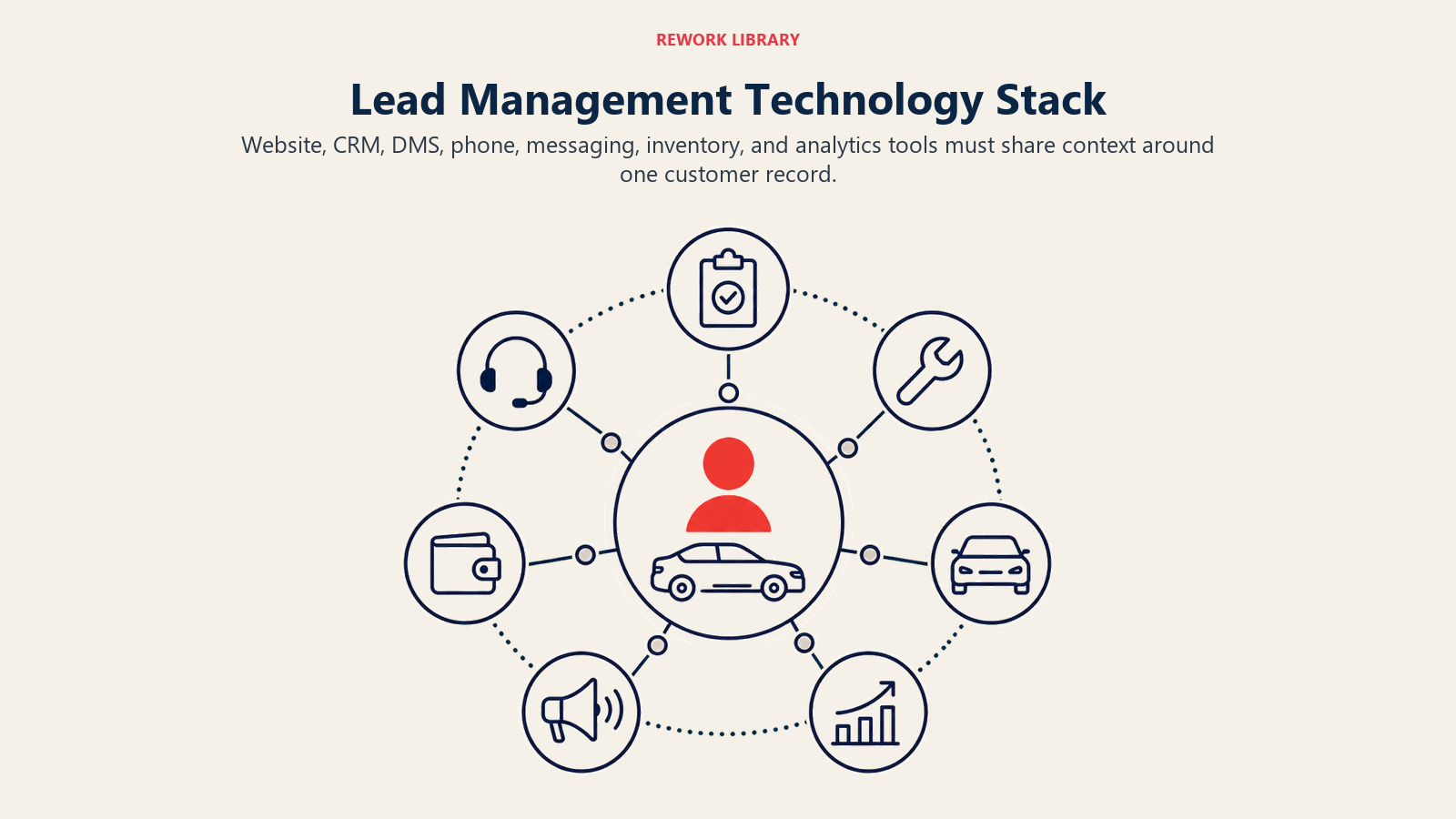
But CRM selection matters less than CRM utilization. A $15,000/month platform used poorly performs worse than a $3,000/month platform used systematically. Focus on adoption, process enforcement, and data cleanliness before worrying about feature checklists.
DMS integration and data flow determines whether your CRM reflects reality or fantasy. Real-time deal posting from DMS to CRM closes the loop, internet leads that become sales get credited properly, sold customers exit lead pipelines automatically, and sales consultants can't hide deals. Without integration, you're running two systems that never reconcile.
Lead provider API connections automate lead ingestion and eliminate manual entry. When an Autotrader lead arrives, it should auto-create in your CRM, auto-assign based on routing rules, and trigger immediate alerts, not sit in an email inbox waiting for someone to copy-paste it into the system.
Call tracking and recording systems (CallRail, DialogTech, built-in CRM tracking) prove whether your team actually contacts leads and reveal what's said during those calls. "I called them three times" means nothing without proof. Recorded calls show whether your BDC is following scripts, handling objections, or burning leads with aggressive closing attempts.
Text messaging platforms integrated with your CRM let you conduct entire conversations inside your lead management workflow. Standalone texting apps (business phone, personal cell) create data silos and accountability gaps. When all communication, calls, emails, texts, lives in the CRM record, you have complete lead history.
Email marketing automation separates into transactional emails (lead confirmations, appointment reminders) and nurture campaigns (educational content, price drop alerts). Transactional emails should be flawless and instant. Nurture campaigns run in the background, keeping your dealership in consideration for leads not ready to buy immediately.
Lead Routing & Assignment
Round-robin vs skill-based routing each solve different problems. Round-robin ensures fairness and prevents cherry-picking, every consultant gets equal shot at success. Skill-based routing maximizes conversion by matching lead characteristics to consultant strengths (luxury specialist gets BMW leads, credit expert handles subprime).
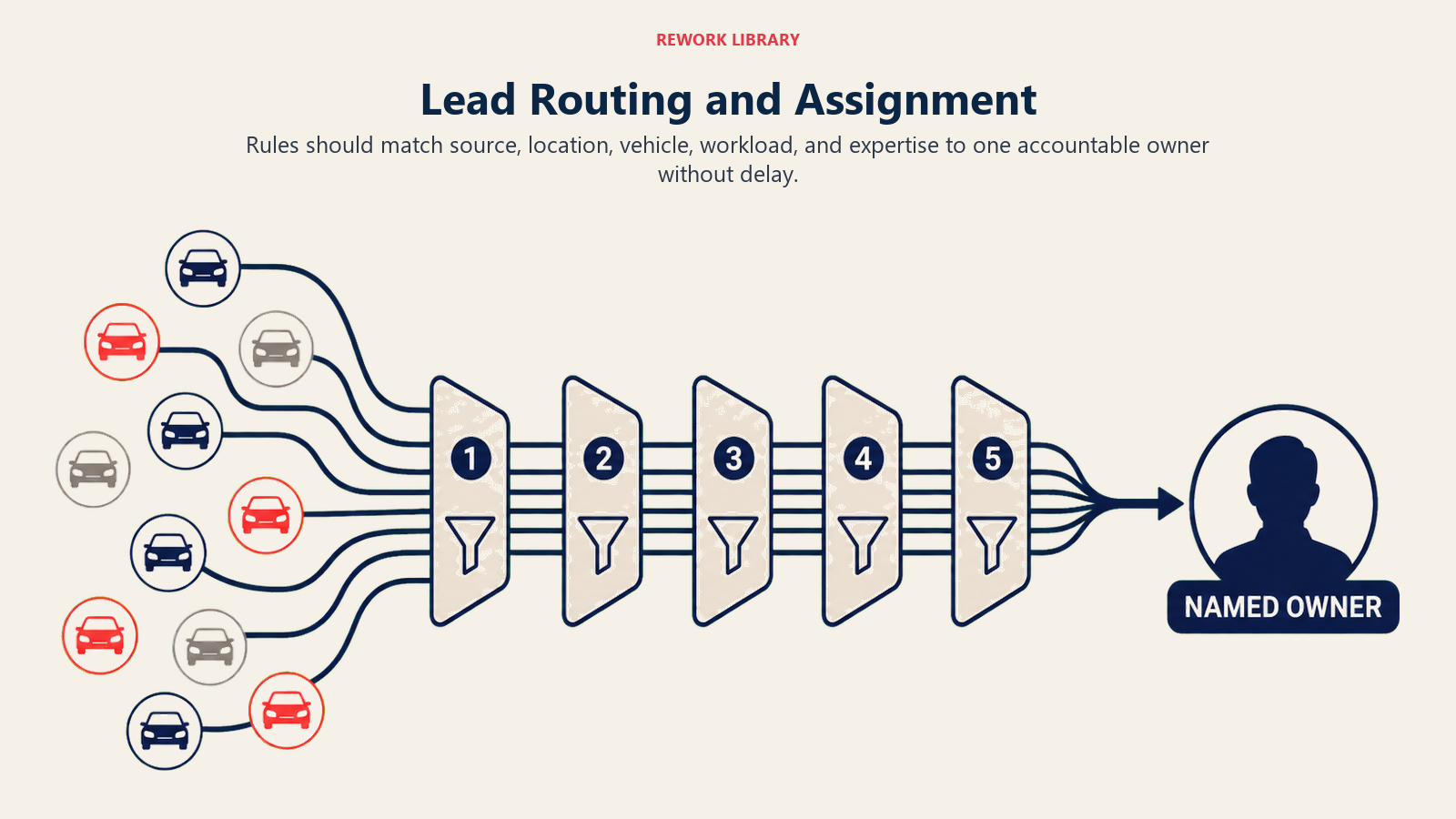
Most stores use hybrid approaches: round-robin during business hours for general internet leads, skill-based routing for high-value or special situations (conquest leads, service referrals, repeat buyers).
Lead source performance weighting adjusts assignments based on conversion data. If Cars.com leads convert at 8% while website leads hit 16%, you might distribute Cars.com leads equally but route hot website leads to top performers. The goal is maximizing total sales, not ensuring everyone gets identical opportunity to fail with low-quality sources.
BDC vs sales floor assignment logic depends on your operational structure. Dedicated BDC handles initial contact, qualification, and appointment setting, then hands confirmed appointments to sales floor. Sales floor assignment means consultants handle leads from first contact through delivery. Each model works, but mixing them randomly creates confusion and dropped leads.
New vs used specialization makes sense in larger stores where consultants develop deep knowledge in one segment. Used car specialists understand trade values, recon timelines, and certified programs. New car specialists know factory incentives, allocation, and order processes. In smaller stores, everyone handles both, specialization is a luxury of volume.
Time-based escalation rules prevent leads from dying in inactive pipelines. Example: if assigned consultant doesn't make contact within 60 minutes, lead escalates to BDC manager. After 4 hours with no contact, lead escalates to sales manager. After 24 hours, lead reassigns to next rotation. You're not penalizing consultants, you're preventing lead waste.
Cherry-picking prevention requires systematic assignment enforcement. When a hot lead arrives (positive equity, local buyer, specific vehicle request), every sales consultant wants it. Assignment rules must be non-negotiable and CRM-enforced. Managers who hand-assign leads to favorites destroy team morale and CRM adoption.
Response Time Standards
First response targets determine lead conversion more than almost any other factor. Research across thousands of dealerships shows leads contacted within 5 minutes convert at 3x the rate of leads contacted after 1 hour. The decay is immediate and brutal, 10 minutes vs 5 minutes shows measurable conversion drop.
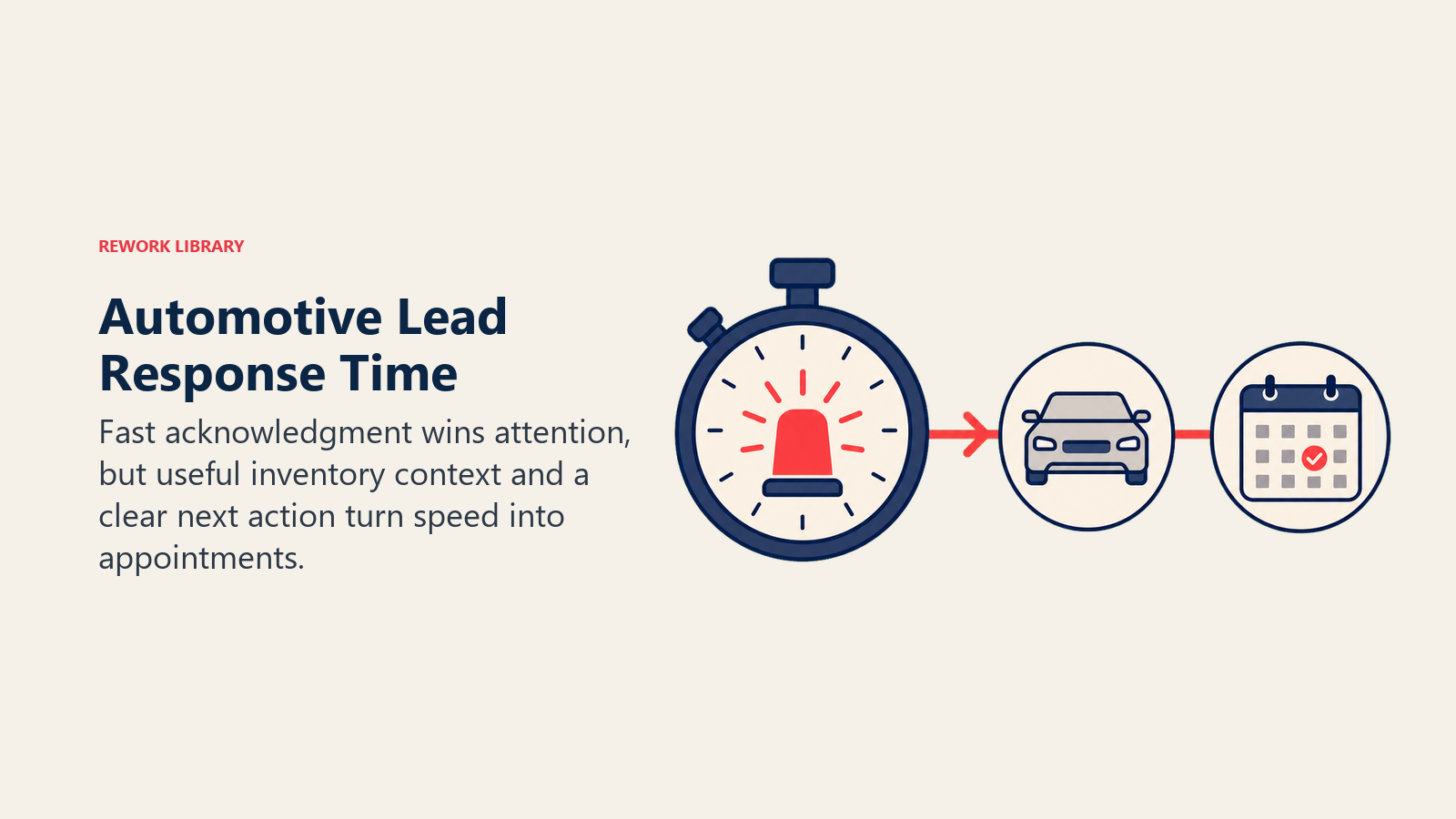
Top stores set 5-minute response targets for all internet leads during business hours. That requires dedicated BDC staff, mobile alerts, and consequences for missed targets. You can't achieve 5-minute response with floor consultants who are busy with showroom traffic.
Phone answer time requirements should hit 80%+ of calls answered within 3 rings during business hours. Every call rolled to voicemail is a potential lead lost to the next dealer on their list. If you're missing calls, you need more BDC coverage, not better voicemail messages.
Follow-up attempt schedules balance persistence with annoyance. Standard framework: 6 touches in first 48 hours (3 calls, 2 texts, 1 email), then 2 touches weekly for 4 weeks, then 1 touch monthly for 6 months following internet lead follow-up best practices. The goal isn't response on first attempt, it's staying top-of-mind until they're ready to buy.
Evening and weekend coverage expands reach to buyers researching after work hours. Leads submitted Saturday night need response Saturday night, not Monday morning. Many stores use evening BDC shifts (4 PM - 8 PM) to catch after-work traffic and weekend coverage (10 AM - 6 PM Saturday/Sunday).
After-hours lead handling options include: dedicated night BDC staff, outsourced overnight answering services, or automated text response with next-day callback promise. The worst option is no response until the next business day, you've lost the lead by then.
Speed-to-lead competitive advantage compounds when competitors are slow. If you respond in 5 minutes while three other dealers take 2+ hours, you're controlling the conversation before they even enter it. Speed becomes differentiation.
Multi-Channel Follow-Up Process
Phone call sequences and scripts provide structure without sounding robotic. First call: "Hi Sarah, this is Mike from Valley Honda. I see you requested information about our 2024 CR-V, are you looking to upgrade soon or just starting research?" That's conversational, not scripted word-for-word. The framework guides without constraining.
Subsequent calls change approach: second call references first attempt ("Tried reaching you earlier..."), third call provides value ("Wanted to let you know we just dropped the price on that CR-V..."), fourth call creates urgency ("Had another customer ask about this vehicle, want to make sure you get first shot at it...").
Email cadences and templates balance automation with personalization. Automated confirmations and appointment reminders should be flawless and instant. Educational emails (buying guide, comparison information) can be templated. But emails from consultants to specific leads need personalization, reference their specific vehicle interest, trade information, or previous conversation.
SMS text messaging strategy recognizes that open rates run 98% vs 20% for email. First text should be immediate and conversational: "Hey Sarah, this is Mike at Valley Honda. Just got your request on the CR-V. Quick question, are you looking to come in this week or gathering info first?" Simple, direct, not a marketing pitch.
Follow-up texts provide value: "Found another CR-V with the features you wanted, $1,500 less. Worth a look?" or "Saw you were interested in trade value, our system says $14-16K for your Accord. Want to confirm with photos?"
Video messages and personalization through tools like BombBomb or Vidyard increase response rates significantly, aligning with your automotive video marketing strategy. A 30-second video from the actual consultant standing next to the actual vehicle the customer inquired about beats generic email templates. It's higher effort but generates higher return on high-value leads.
Social media engagement works for relationship building, not immediate lead response. Commenting on a lead's public Facebook post or connecting on LinkedIn keeps you visible during their research process. But don't replace phone calls and texts with social media messages, use social as supplementary touchpoint.
Direct mail integration for high-value leads (luxury vehicles, repeat customers, conquest opportunities) adds physical touchpoint to digital follow-up. A handwritten note mailed same-day creates impression, but most stores can't execute consistently enough to justify the cost.
Lead Scoring & Prioritization
Hot, warm, cold classification helps teams focus energy appropriately. Hot: responded to contact, confirmed appointment, or showed urgency signals (coming in today, need vehicle this week). Warm: engaged in conversation but no commitment yet. Cold: no response after multiple attempts.
Consultants should spend 60% of their time on hot leads, 30% on warm leads, 10% on cold leads. Reality in most stores is inverted, they spend hours calling cold leads who will never respond while hot leads wait.
Engagement scoring algorithms track interaction history: opened emails, clicked links, returned to website, responded to texts. A lead who's visited your site 6 times in 3 days and opened every email is far more valuable than someone who submitted a form once and ghosted, as explained in automotive lead scoring.
Equity position weighting from online trade tools transforms lead scoring. A customer with $10,000 positive equity should be priority 1. Negative equity isn't disqualifying, but it requires different handling and realistic expectations.
Purchase timeline indicators come from lead forms and conversations. "Looking to buy this week" rates higher priority than "just starting to research." But many "3-6 months" timeline leads buy within 30 days when they find the right vehicle and right price, don't discard them.
Credit profile considerations factor into prioritization when you have credit scores or stated credit concerns. A 720+ score with positive equity is your easiest deal. A 580 score with negative equity requires subprime expertise and realistic vehicle matching, route accordingly.
Geographic and demographic factors influence conversion probability. Local leads (within 20 miles) convert at higher rates than 50+ mile radius leads. Age demographics matter, 65+ year-old leads respond better to phone calls, 25-35 year-olds prefer text.
Performance Management
Lead-to-appointment conversion tracking measures BDC effectiveness. Target: 30-40% of internet leads should convert to scheduled appointments. Below 25% indicates poor lead quality, weak follow-up, or unrealistic appointment setting. Above 45% might mean you're being too loose with what qualifies as "appointment." Industry benchmarks from Promodo show top-performing dealerships achieve significantly higher appointment rates through systematic lead management.
Appointment show rate monitoring separates qualified appointments from empty commitments. Target: 70-75% show rate. Below 60% means your appointment confirmation process is weak or you're booking appointments with people who aren't really committed. Above 80% suggests you're only booking slam-dunk appointments and leaving opportunity on the table.
Close rate by lead source reveals ROI reality. Website leads should close at 14-18%, third-party sources at 8-12%, service referrals at 25-30%. Track cost per lead vs close rate to calculate cost per sale by source. A $25 lead source closing at 10% costs $250 per sale. A $75 lead source closing at 20% costs $375 per sale. Buy more of the first one.
Sales consultant accountability comes from CRM data transparency. Every consultant's lead volume, response times, appointment rates, show rates, and close rates should be visible to management and peer-comparable. Public scoreboards drive performance through healthy competition.
Cost per sale analysis by lead source guides marketing budget allocation. Calculate: (lead source monthly cost) / (sales from that source) = cost per sale. Compare across sources, adjust budget to winners, cut losers using dealership analytics. Most stores keep buying sources that haven't worked in 18 months because "we've always used them."
Lead aging and velocity reports identify process breakdowns. If your average lead sits in "new" status for 4 hours before first contact, you have a response time problem. If leads spend 45 days in "appointment set" without closing, you have a follow-up problem. The data shows you exactly where leads die.
The dealerships converting 20%+ of their leads aren't doing anything magical. They respond fast, follow up persistently across multiple channels, route leads strategically, and hold people accountable for execution. It's systematic, measurable, and improvable, but only if you treat lead management as a discipline instead of an afterthought.
For specific BDC operational structure and staffing details, see BDC Operations Setup. To optimize response time specifically, review Lead Response Time Optimization. For understanding lead scoring frameworks in depth, reference Automotive Lead Scoring. To select and implement CRM platforms effectively, explore Automotive CRM Implementation. And for appointment-setting tactics that actually work, see Appointment Setting Best Practices.