Auction Buying Strategy for Dealerships - Maximize Used Vehicle Profitability - 2026 Guide
Turn this article into takeaways for your work.


Each assistant summarizes the article only for you and suggests best practices for your work.
The gap between successful and struggling used vehicle departments often comes down to auction buying discipline. Dealers who buy emotionally leave an average of $1,200 per vehicle on the table. Dealers who buy strategically turn that $1,200 into profit.
You see it every week at auctions. Buyers who chase vehicles past their max bid because they "really need inventory." Managers who ignore condition reports and discover $2,500 in unexpected recon costs. Dealers who buy vehicles they like instead of vehicles their market wants.
Auction buying isn't about finding deals. It's about mathematical discipline applied hundreds of times annually. Miss by $300 per vehicle across 200 annual auction purchases, and you've cost your department $60,000 in profit. Get it right, and that $60,000 flows straight to bottom line.
The Economics of Auction Buying
Before you bid, understand the complete cost structure.
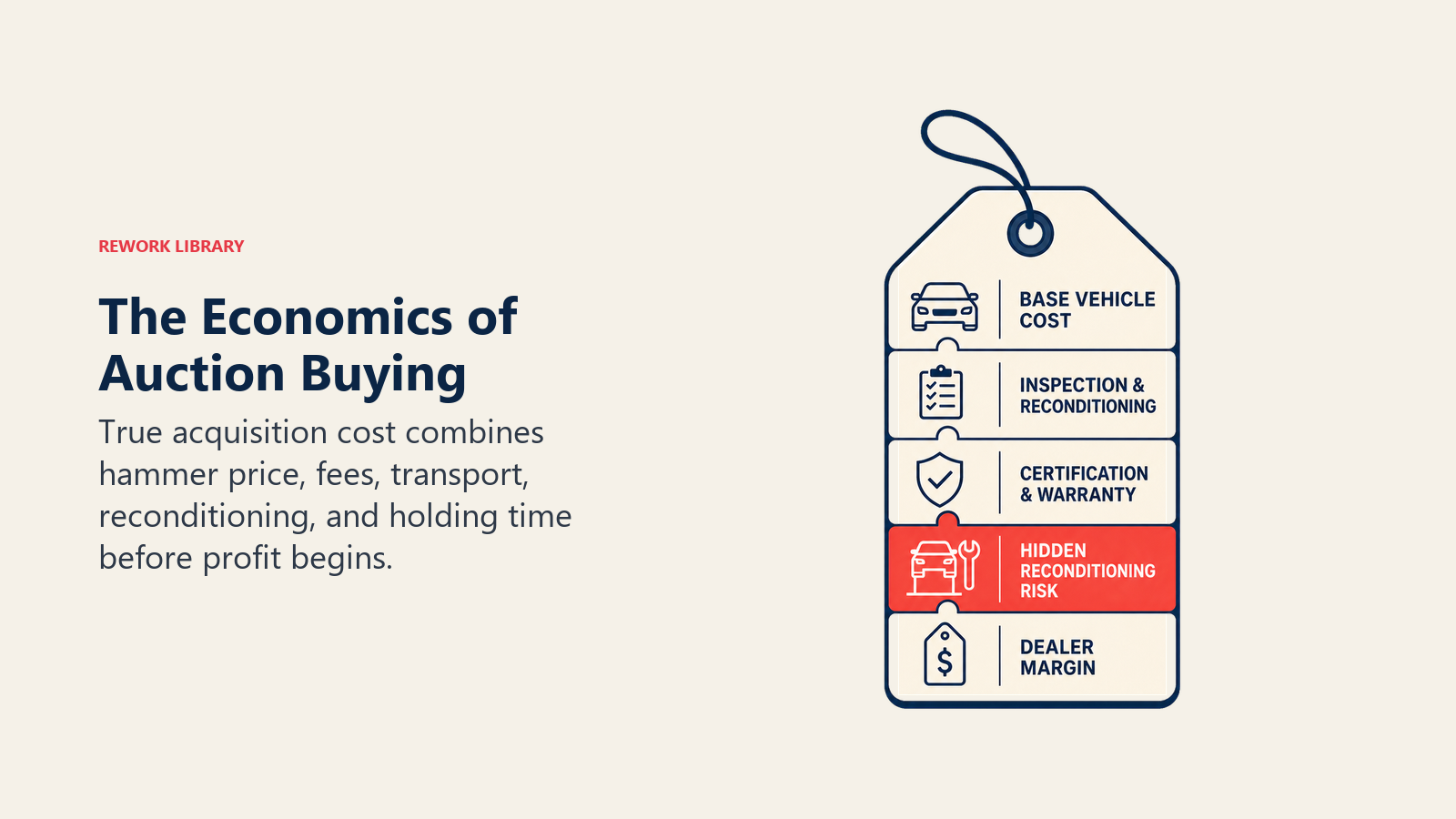
Auction fees add $200-600 per vehicle depending on price and auction house. Manheim typically charges $400-500 on a $20,000 vehicle. Online platforms like ACV Auctions may charge flat fees ($299-399) or percentage-based fees (2-3%). These fees are non-negotiable and non-refundable. Factor them into every buy decision.
Transportation costs vary by distance. Buying locally might cost $75-150 for transport. Buying 200+ miles away runs $300-500. Time matters too, local transport takes 1-3 days, distant transport takes 5-10 days. Every extra day delays recon and retail availability.
Reconditioning costs are where most buyers fail. They budget $800 and spend $2,200. Understanding vehicle merchandising standards helps set accurate recon budgets. Accurate recon estimation requires walking the vehicle, checking tires, inspecting brakes, testing mechanical systems, evaluating cosmetic needs, and adding 20% contingency. Most vehicles need $1,200-2,000 in recon at retail-quality standards.
Floorplan interest accrues daily once you take possession. Understanding floorplan financing is critical for auction buyers. At 6% annual rate, a $20,000 vehicle costs $3.29 per day in interest. Over 45 days to sale, that's $148. Over 75 days, it's $247. Fast turn matters not just for cash flow but for direct cost savings.
Target front-end gross by vehicle segment establishes your profitability floor. Most dealers target $2,500-3,500 gross on vehicles $15,000-30,000. Below $2,500 gross, the vehicle isn't worth the risk and effort. Above $4,000 gross, you're probably overpriced relative to market. Set segment-specific gross targets and don't buy vehicles that can't achieve them.
Impact of market day supply on pricing power determines how aggressive you can price. When your market has 35 days supply of Camrys, you've got pricing power. When market day supply is 85 days, you're in a commodity market and must price aggressively. Check market day supply before buying, it tells you whether you can price for profit or must price for volume.
Pre-Auction Planning
Winning happens before you ever walk into the auction.
Analyzing your turn data determines what you need to acquire. If trucks turn in 28 days and sedans take 62 days, buy more trucks. Review inventory turn optimization for deeper strategies. If vehicles priced under $18,000 turn in 22 days and vehicles over $28,000 take 71 days, focus acquisition on the $15,000-25,000 range. Your historical turn data is the best predictor of future performance.
Creating age, mileage, and price point targets based on local market prevents buying vehicles your market doesn't want. If your market buys 3-6 year old vehicles under 70,000 miles, don't buy 8-year-old vehicles with 92,000 miles just because the price is attractive. Acquisition criteria should be written, specific, and religiously followed.
Setting maximum allowable cost by segment backs into acquisition limits from retail pricing strategy. If similar vehicles retail for $24,500 in your market, and you need $3,000 gross, factor in $1,500 recon, $450 auction fees, and $250 transport, your max cost is $19,300. That's your walk-away number before bidding starts.
Reviewing wholesale-to-retail velocity by make and model reveals which vehicles sell fast and which sit. Honda Accords might turn in 24 days. Nissan Altimas take 53 days. Both are mid-size sedans, but market preference differs. Prioritize makes and models with proven turn history in your market. Don't diversify for diversification's sake.
Physical vs Digital Auction Strategy
Each channel has advantages and requires different tactics.
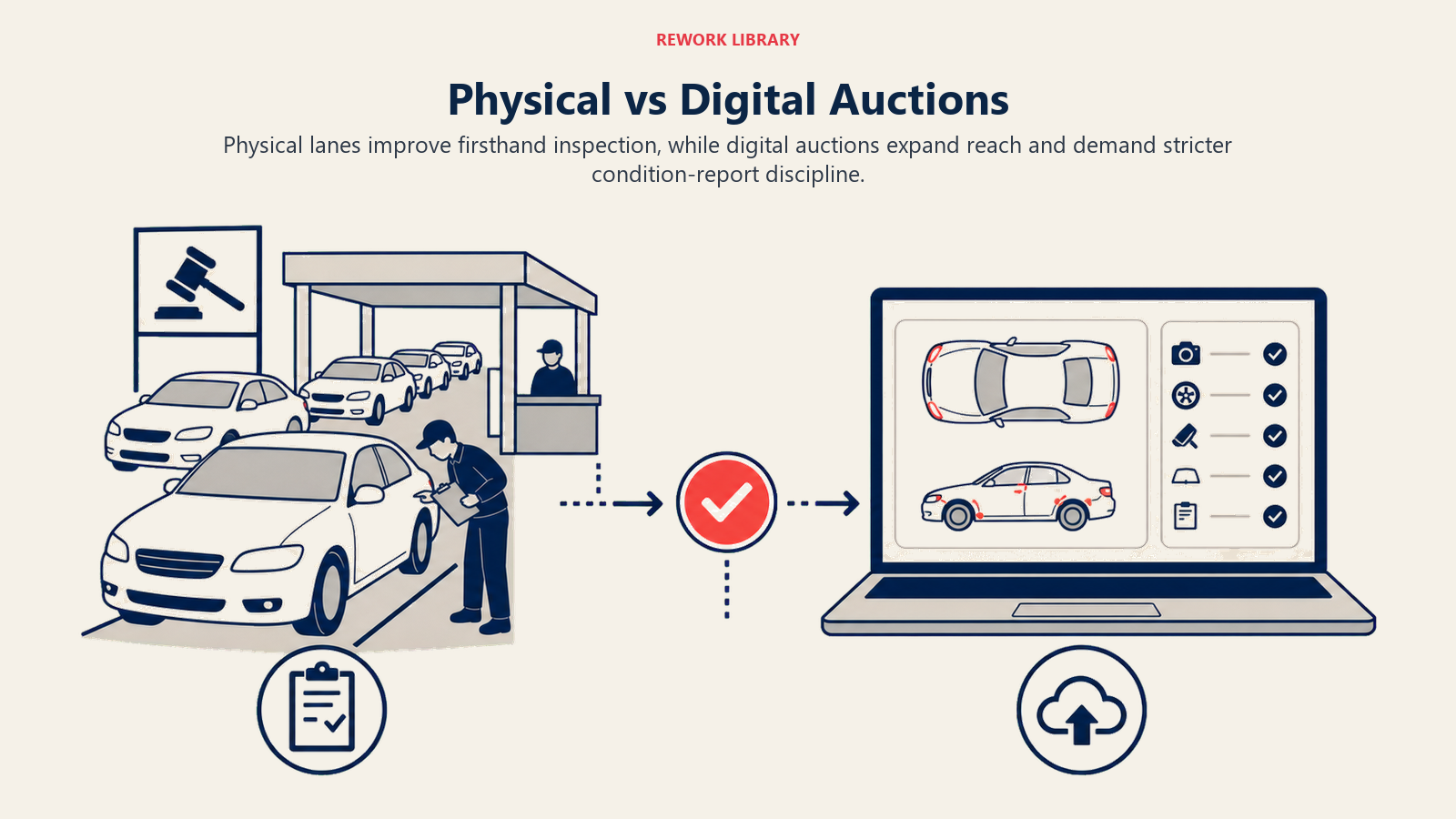
When to attend in-person vs bid online depends on vehicle value and inspection needs. High-value vehicles ($30,000+) warrant in-person inspection. Condition reports miss things. Commodity vehicles under $20,000 can be bought online safely if you account for condition uncertainty in your bid limits.
OVE (Online Vehicle Exchange) bid strategies require understanding platform mechanics. Many digital auctions use proxy bidding, you set max bid, the system bids incrementally for you up to your max. This prevents auction fever but requires accurate max bid calculation. Set it too low, you lose vehicles. Set it too high, you overpay. Calibration takes practice.
Simulcast auction tactics blend physical and digital buying. You're bidding online against in-person buyers. In-person buyers have inspection advantage. You have convenience and lower time cost. Bid slightly more conservatively on simulcast purchases to account for inspection uncertainty. The 5-10% discount offsets risk.
Building relationships with auction reps provides access and insight. Reps can pull vehicles for closer inspection, provide history beyond condition reports, and notify you when specific makes and models are coming. These relationships develop through consistent buying, prompt payment, and treating reps professionally. They're people, not obstacles.
Vehicle Evaluation at Speed
Auctions move fast. You need rapid evaluation frameworks.
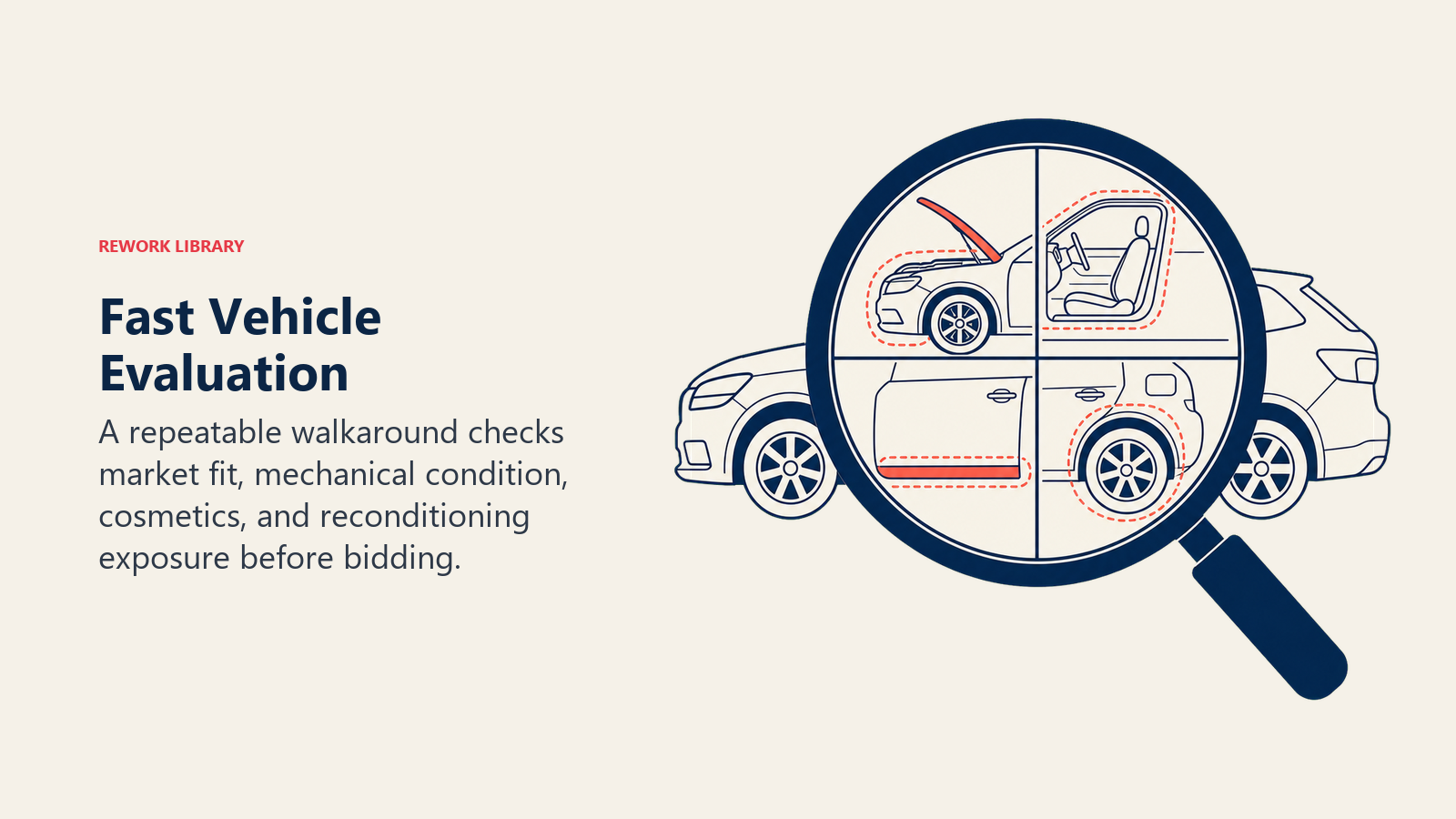
Quick condition assessment framework starts with the 30-second walk-around. Stand back and look at the vehicle's overall presentation. Does it look cared for or neglected? Walk around checking panel gaps, paint condition, tire wear patterns, and glass condition. Pop the hood and look for oil leaks, belt wear, and fluid levels. This 30-second assessment eliminates 60% of vehicles from consideration.
Reading condition reports effectively requires understanding code language. "Minor wear" often means more wear than you'd like. "Small dent" might be small or might be significant depending on location. "Runs and drives" is the minimum standard, it doesn't mean it runs well or drives smoothly. Condition reports establish arbitration protection but rarely capture everything. Discount for uncertainty.
Red flags that justify immediate pass include frame damage, salvage or branded titles, major mechanical issues (check engine light, transmission problems, engine noise), flood indicators (musty smell, water lines, corroded electrical), significant cosmetic damage requiring major paint work, and mismatched VIN or title discrepancies. Any of these issues should trigger an immediate pass regardless of price.
Estimating reconditioning costs accurately comes from experience and checklists. Tires: $600-1,000 for four. Brakes: $400-800 for pads and rotors. Detail and minor cosmetic: $200-400. Dent removal: $300-800 depending on size and location. Mechanical repairs: highly variable, budget $500-1,500 for older vehicles. Total recon typically runs $1,200-2,500 for retail-ready vehicles.
Bidding Discipline & Psychology
The psychology of auctions is designed to make you overpay.

Setting hard stop prices before bidding begins eliminates emotional decision-making. Write down your max bid. When bidding reaches your max, stop. Don't round up "just $200 more." That $200 is the difference between profit and breakeven. Hard stops require discipline, but discipline compounds into profit over hundreds of purchases.
Avoiding auction fever and emotional bidding means recognizing the physiological response to competitive bidding. Your heart rate increases, adrenaline spikes, and rational thinking diminishes. This is intentional auction design. Combat it by stepping away when you feel emotional investment in a vehicle. Let it go and move to the next opportunity.
When to let vehicles go is simple: when bidding exceeds your max bid, walk away. Elite buyers pass on 70-80% of vehicles they evaluate. Average buyers try to win 40-50%. The difference is the elite buyers are profitable on the 20-30% they win. Average buyers break even or lose money because they chased too many vehicles past rational limits.
Tracking "ones that got away" vs overpays creates accountability. After every auction, review vehicles you bid on but didn't win. Research what they actually sold for and where they're now priced retail. If you consistently lose vehicles that retail for $3,500 more than your max bid, you're too conservative. If vehicles you win consistently need $1,000 more recon than expected, you're too aggressive. Adjust based on data.
Post-Auction Process
Auction buying doesn't end when you win the bid.
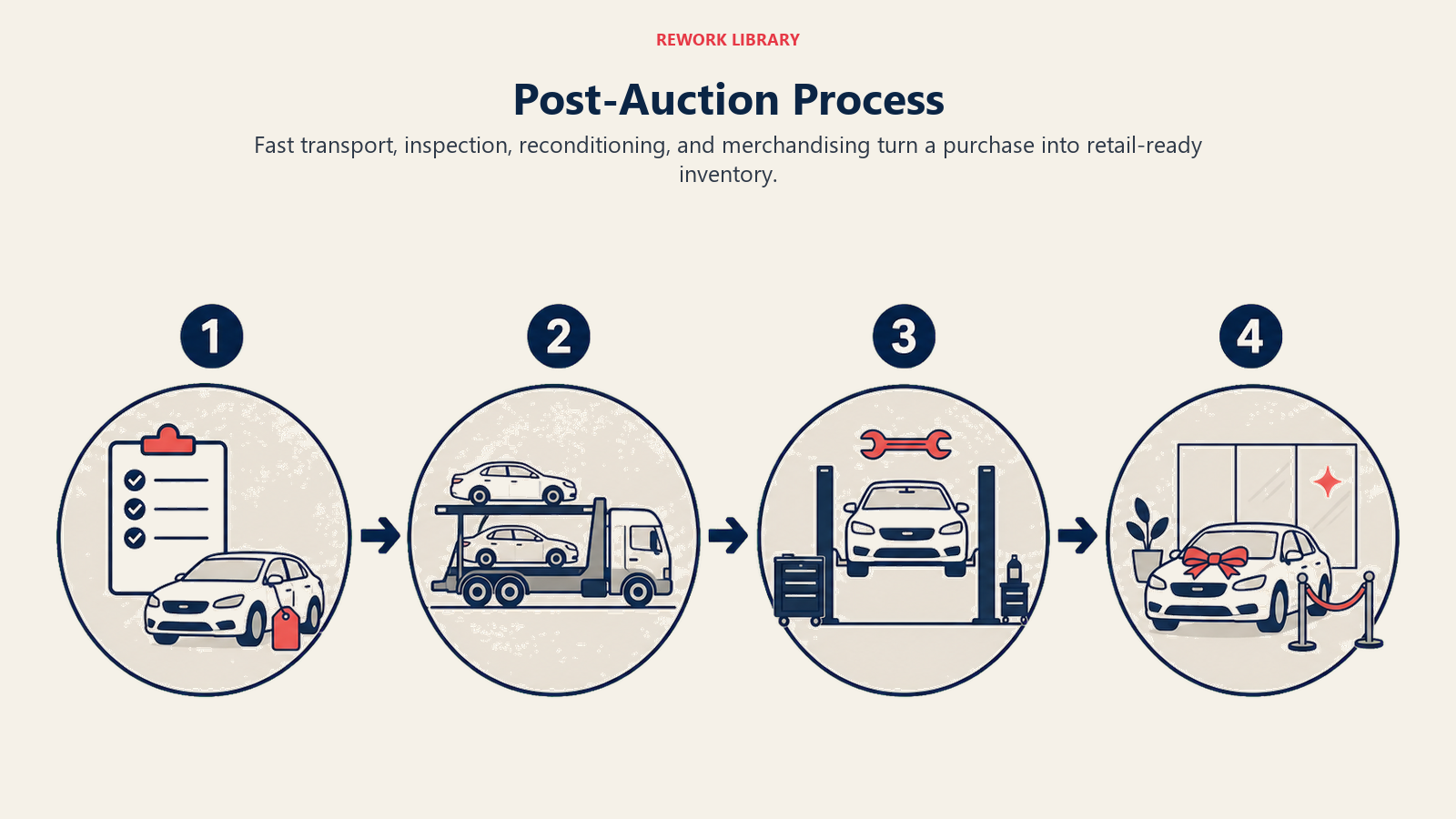
Title work and transport coordination should be automated. Most auctions handle title transfer, but you need to ensure floorplan financing is in place, transport is scheduled, and receiving processes are ready. Delays here cost money and slow inventory turn. Set up automated workflows so vehicles flow from auction to lot seamlessly.
Getting vehicles to recon fast matters more than most dealers realize. Every day between auction purchase and retail availability is lost profit. Target 24-hour turnaround from arrival to recon start. Service departments often deprioritize wholesale recon behind customer pay and warranty work. This is backwards, recon vehicles are inventory investments sitting idle. They deserve priority.
Tracking actual vs estimated recon costs reveals whether your estimation accuracy needs improvement. If you consistently estimate $1,200 and spend $1,800, you're either underestimating or your service department is overcharging. Resolve the discrepancy. Accurate recon estimation is foundational to profitable auction buying.
Measuring auction ROI by source shows which auctions produce best results. If Manheim physical auction purchases average $2,900 gross at 38-day turn, and ACV digital purchases average $2,600 gross at 42-day turn, Manheim is your better source. Concentrate buying where ROI is highest.
Platform-Specific Strategies
Different auction platforms require different approaches.
Manheim auctions are the largest physical auction network. They offer the best selection but highest competition and highest fees. Manheim buyers tend to be professional, experienced dealers, you're competing against experts. Their Market Insights provide valuable data on wholesale pricing trends. Your edge comes from faster recon and stronger retail operations, not from buying cheaper than everyone else. Buy quality vehicles, recon fast, retail efficiently.
ADESA auctions provide broader selection with slightly less competition than Manheim in most markets. ADESA condition reports tend to be thorough. Transportation networks are solid. ADESA can be your primary or secondary source depending on local auction access. Test both Manheim and ADESA to determine which offers better value in your market.
ACV Auctions revolutionized digital buying with transparent condition reports, extensive photos, and fast transactions. ACV inspection reports are detailed with 40+ photos per vehicle. Arbitration policies are clear. Transaction speed is fast, buy Monday, receive Wednesday. The downside is you're buying entirely on photos and reports. Be conservative with condition assessment and bid accordingly.
BacklotCars focuses on dealer-to-dealer trades facilitated through digital platform. You're buying from other dealers, not consumers. This typically means cleaner vehicles with faster title work. BacklotCars also offers "buy now" pricing alongside auction bidding. If a vehicle fits your criteria and buy now price makes sense, skip the auction and lock it in immediately.
OVE (Online Vehicle Exchange) from various providers lets you bid remotely on physical auction vehicles. You get most benefits of physical auction (in-person inspection reports, wide selection) without travel costs. The challenge is you're competing against buyers who physically inspected the vehicle. Bid 3-5% below what you'd bid in person to account for inspection disadvantage.
Common Auction Buying Mistakes
Learn from others' failures.
Buying vehicles you like instead of vehicles your market wants is the most common mistake. Your personal preference is irrelevant. If you love Corvettes but your market buys Camrys, stock Camrys. Check your ego and buy what sells.
Ignoring market day supply creates stocking mistakes. If your market already has 75 days supply of Silverados, adding more Silverados to inventory guarantees slow turn. Check market inventory levels before buying. Don't add to oversupplied segments.
Underestimating recon costs by $500-1,500 per vehicle destroys profitability. The vehicle looked good at auction but needs $2,200 in work to retail properly. You budgeted $1,000. That $1,200 difference is your gross profit evaporating. Always add 20% contingency to recon estimates.
Chasing specific vehicles past max bid because you "need inventory" is emotional buying. There will always be another vehicle next week. Overpaying to fill inventory today costs more than waiting for the right vehicle at the right price tomorrow.
Failing to arbitrate bad vehicles within the arbitration period costs you money. You discover frame damage not disclosed in the condition report. If you don't arbitrate within 48 hours (or whatever the policy states), you own a bad vehicle. Inspect thoroughly immediately upon arrival and arbitrate aggressively when warranted.
Buying vehicles without clear retail pricing strategy means you're guessing. Before you bid, know where you'll price the vehicle retail. If you can't confidently estimate retail price, you can't calculate max bid. Don't buy vehicles hoping you'll figure out pricing later.
Building Auction Buying Discipline
Systematic discipline beats talent over time.
Create written acquisition criteria that define exactly what you buy. Age range, mileage limits, condition standards, makes and models, price ranges, title requirements. When a vehicle doesn't meet criteria, pass, regardless of price. Criteria eliminate 70% of vehicles from consideration, letting you focus on the 30% that fit your strategy.
Use bid calculators and worksheets that force you through the economics before bidding. Estimated retail price minus target gross minus recon minus fees minus transport equals max acquisition cost. Don't skip this math. Write it down for every vehicle you bid on.
Review auction purchases weekly in team meetings. Which vehicles are turning quickly? Which are sitting? What was your actual recon vs estimated? What's your gross profit tracking? This accountability creates learning and improvement. Celebrate wins, diagnose losses, adjust strategy.
Track metrics that matter: average acquisition cost, average recon cost, average gross profit, average days to turn, percentage of vehicles wholesaled, auction ROI by source. These metrics reveal whether your auction strategy is working or needs adjustment.
Partner with service to optimize recon. Your service manager is your partner in profitability. Fast, quality, cost-effective recon makes auction buying profitable. Slow, expensive recon kills margins. Meet weekly with service management to review recon performance and resolve bottlenecks.
Advanced Tactics for Experienced Buyers
Once you've mastered basics, add sophistication.
Buying counter-seasonally creates opportunities. Buy convertibles in winter, 4×4 trucks in summer, luxury vehicles during tax season slowdowns. Counter-seasonal buying faces less competition, creating better pricing. You'll hold inventory longer, but the margin improvement offsets holding costs if you time it right.
Building lane-specific strategies improves efficiency. Some lanes consistently have better values because they run at less popular times. Late afternoon lanes after most buyers leave. Early morning lanes before crowds arrive. Specific vehicle type lanes that don't match most buyers' acquisition criteria. Identify these lanes and focus effort there.
Developing regional arbitrage opportunities by buying in low-price markets and retailing in high-price markets captures geographic price differences. A $20,000 vehicle in Texas might retail for $23,000 in Colorado due to 4×4 demand. If you can source inventory from low-price regions efficiently, arbitrage creates margin improvement.
Using data analytics to identify undervalued makes and models reveals opportunities others miss. Some vehicles consistently sell at auction for $1,500-2,000 below retail market value because buyers overlook them. Find these patterns and exploit them. You need volume and data to identify patterns, but the payoff is consistent profit.
Auction buying isn't about finding deals. It's about executing disciplined strategy hundreds of times, making fewer mistakes than competitors, and compounding small advantages into significant annual profitability. Combined with effective automotive inventory strategy and new vehicle inventory management, auction excellence drives used vehicle department success. The dealers winning at auctions aren't lucky. They're systematically better at evaluation, bidding discipline, and post-purchase execution. That's replicable, if you're willing to build the systems.

Senior Implementation Consultant