Certified Pre-Owned (CPO) Programs - Build a Premium Used Vehicle Brand - 2026 Guide
Turn this article into takeaways for your work.


Each assistant summarizes the article only for you and suggests best practices for your work.
Certified Pre-Owned programs represent one of the rare opportunities in automotive retail where you can charge more, sell faster, and create genuine customer value, all simultaneously. Franchise CPO programs consistently deliver $1,800-$2,500 more front-end gross per unit compared to comparable non-certified vehicles. According to Wikipedia's overview of certified pre-owned programs, manufacturers or their dealers buy, inspect and refurbish used items, then resell them at a premium over normal market prices with extended warranty backing. And they do it while shortening sales cycles and reducing price negotiation.
The reason is simple: third-party credibility. When shoppers see "Certified Pre-Owned" backed by a manufacturer warranty, it eliminates their biggest concern about used vehicles, reliability risk. They'll pay premium pricing for that peace of mind. And because the certification provides objective validation of quality, price negotiations become less contentious. The vehicle either meets certification standards or it doesn't. That binary eliminates much of the subjective haggling around condition.
But not all CPO programs are created equal. Some dealers treat certification as a checkbox, run the inspection, certify everything that passes, hope for premium pricing. The best dealers treat CPO as a strategic brand-building tool that creates clear differentiation in a crowded used vehicle market.
Understanding CPO Economics
The typical OEM CPO program costs $800-1,200 per vehicle including certification fees, required repairs, and warranty costs. That sounds expensive until you compare it to the gross profit premium. If you're achieving an extra $2,200 in front-end gross on certified units, you're netting $1,000-1,400 more than you would selling the same vehicle non-certified.
But the financial benefit extends beyond initial margin. CPO vehicles typically sell 8-12 days faster than comparable non-certified inventory. Those saved days reduce floorplan interest and depreciation. On a $30K vehicle financed at 7% interest, every 10 days of faster turn saves about $58 in floorplan costs. Multiply that across 100 CPO sales per year and you're saving $5,800 in carrying costs.
Marketing support from OEMs amplifies your investment. Most franchise CPO programs include co-op advertising dollars, national advertising exposure, and branded marketing materials. These benefits are hard to quantify but real, your certified inventory benefits from manufacturer-level marketing that would cost tens of thousands to replicate independently.
Close rates on CPO inventory run 5-10 percentage points higher than non-certified vehicles because shoppers arrive pre-qualified and motivated. The certification has already overcome their primary objection. Your sales team spends less time defending vehicle quality and more time on finance presentation and delivery. This efficiency gain might be the most valuable but least visible benefit of a strong CPO program.
Franchise OEM vs. Independent Programs
Franchise OEM CPO programs carry the most credibility with shoppers because they're backed by the manufacturer. Toyota Certified, Honda Certified, Ford Blue Advantage, these brands have national advertising and established reputation. Shoppers trust them. And that trust translates directly into premium pricing capability and faster turns.
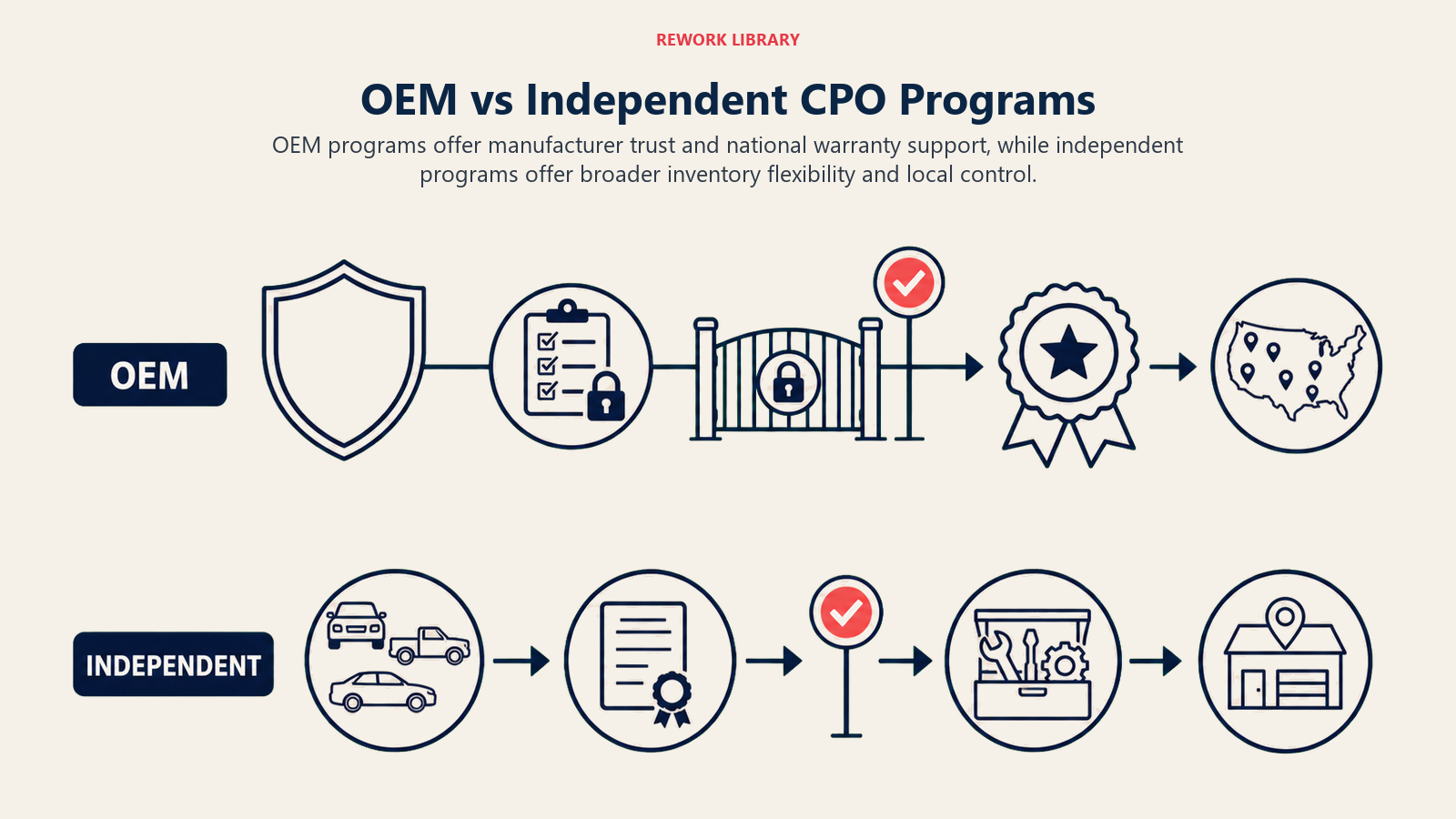
The requirements for OEM certification are strict: age limits (typically 5-7 years), mileage caps (usually 75K-85K), clean title history, comprehensive multi-point inspections (often 150+ points), and manufacturer-backed warranty coverage. Consumer Reports notes that while warranty benefits vary by manufacturer, CPO programs typically provide extended coverage that gives second owners another year or two of protection. These standards ensure consistent quality but they also limit which inventory qualifies. You'll typically certify only 30-40% of your used inventory through OEM programs.
Independent CPO programs from providers like JM&A, Fidelity, or Concord offer more flexibility. You set the inspection standards. You choose which vehicles qualify. And you're not limited to franchise brands, a Toyota dealer can certify a Honda or Mazda through independent programs. The warranty backing is third-party rather than manufacturer, which carries less weight with shoppers but still provides credibility.
Some dealers create proprietary "Select" or "Premium" programs that mimic CPO structure without third-party warranty backing. These can work in specific markets where the dealer's reputation is strong enough to stand behind the certification independently. But you're sacrificing the third-party credibility that makes CPO valuable, and most shoppers will discount your proprietary program compared to manufacturer-backed alternatives.
The optimal approach for franchise dealers is hybrid: use OEM certification for in-brand inventory that qualifies, and independent certification for off-brand units where you want premium positioning. This maximizes your certified inventory percentage while maintaining the credibility advantage of manufacturer backing where it's available.
Selecting Vehicles for Certification
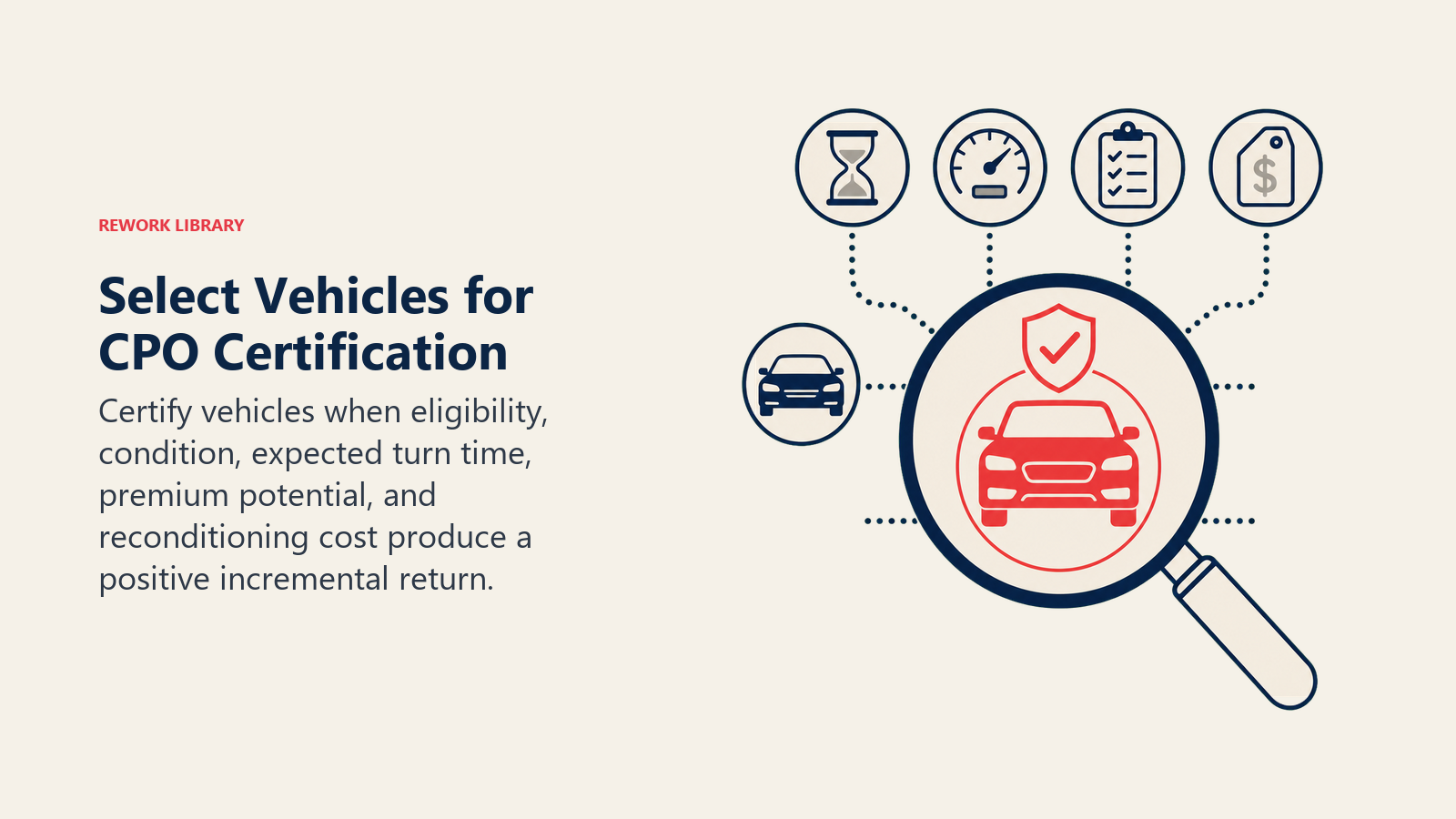
Not every qualified vehicle should be certified. Certification costs money, and if the vehicle will sell quickly anyway without certification, you're sacrificing margin unnecessarily. Strategic selection focuses certification dollars where they deliver maximum impact.
High-demand, low-supply units often don't need certification to move quickly. If you've got a 2-year-old Tacoma with 25K miles in a market where those sell in 20 days regardless, certification might not add value. The vehicle will command premium pricing based on condition and market dynamics alone. Save your certification dollars for vehicles where it solves a specific selling challenge.
Vehicles with minor condition issues benefit most from certification because it overcomes shopper skepticism. A 4-year-old Accord with 55K miles and some paint chips won't photograph perfectly, but certification says it's mechanically sound and backed by warranty. That credibility offsets cosmetic concerns. Without certification, those cosmetic issues create negotiation leverage that costs you more than certification would have.
Off-brand inventory, the Mazda on your Toyota lot, needs certification more than in-brand units because shoppers question why you're selling it. Certification answers that question: "We inspected it thoroughly, it meets our standards, and we're backing it with warranty." Without that validation, shoppers assume there's a reason you're carrying off-brand inventory and discount accordingly.
Age and mileage sweet spots differ by market, but generally, 3-5 year old vehicles with 35K-65K miles deliver the best CPO ROI. They're young enough to meet strict certification standards without major repairs, old enough that shoppers value warranty coverage, and priced where the $2,000 premium is proportional (easier to justify on a $28K vehicle than a $15K vehicle).
Reconditioning to Certification Standards
OEM inspection processes are comprehensive, 100 to 150+ points covering every mechanical, electrical, and safety system. The inspection identifies required repairs (anything affecting safety or function) and recommended repairs (items within specification but showing wear). Understanding the difference is critical to managing reconditioning costs.
Required repairs must be completed before certification. If the inspection reveals brake pads at 3mm, they must be replaced. If a tire is below tread depth standards, it must be replaced. These aren't negotiable. Budget for these repairs when acquiring vehicles, an auction unit purchased $1,000 below market isn't a bargain if it needs $1,800 in required repairs to certify.
Recommended repairs require judgment. If an item is within spec but the inspector notes it'll need replacement in 10K miles, do you fix it now or not? The answer depends on margin opportunity and customer perception. For high-visibility items (tires showing age, worn wiper blades, minor paint issues), fix them. The customer will notice and it affects their perception of quality. For items unlikely to be noticed (shocks that pass spec but aren't perfect), you might skip the repair.
Cosmetic standards matter more than many dealers realize. Certification focuses on mechanical condition, but shoppers evaluate cosmetic condition when determining whether your vehicle justifies premium pricing. Deep cleaning, paint correction, wheel refinishing, interior odor elimination, these aren't part of certification requirements but they're essential to capturing certification pricing premiums.
Documentation and paperwork must be meticulous. Every inspection point should be documented. Any repairs performed should be recorded with parts and labor details. This documentation provides ammunition when shoppers question why they should pay premium pricing. "Here's the 152-point inspection report. Here's $2,200 in reconditioning receipts. Here's the manufacturer-backed warranty." That evidence justifies premium pricing objectively.
Marketing CPO Value Effectively
Online vehicle merchandising for CPO inventory requires clear differentiation from non-certified units. Use CPO badges prominently on primary photos. Lead descriptions with certification status. Explain what certification means, don't assume shoppers understand the value. Many don't realize CPO includes warranty coverage, inspection validation, and manufacturer backing unless you tell them explicitly.
CPO-specific landing pages on your website concentrate certified inventory in one place and allow targeted marketing campaigns. These pages should educate shoppers on your program's benefits, display available certified inventory, and provide clear calls-to-action. Many dealers syndicate general used inventory to third-party sites but fail to create dedicated CPO experiences that command premium attention.
The value proposition you communicate should be shopper-focused, not dealer-focused. Instead of "150-point inspection performed," say "Every mechanical and safety system inspected and verified." Instead of "Manufacturer-backed warranty," say "Drive with confidence knowing you're protected by [Brand] warranty coverage." Translate program features into shopper benefits.
Warranty coverage deserves special emphasis because it's often the most valuable component from a shopper perspective. Detail the coverage: powertrain warranty terms, comprehensive warranty coverage, roadside assistance, trip interruption protection. Break down the value in dollars: "This warranty coverage would cost $2,800 to purchase separately." That context helps justify your premium pricing.
Video content works exceptionally well for CPO marketing because it allows you to explain value in detail. A 90-second video walking through your certification process, showing actual inspection procedures, and explaining warranty benefits builds credibility that static photos and text can't match. These videos cost little to produce but significantly impact conversion rates.
F&I Integration and Total Profitability
CPO vehicles create natural F&I opportunities because shoppers who value certification typically value additional protection products. Extended warranty attachment rates on CPO should run 40-50%, compared to 25-30% on non-certified used vehicles. The shopper has already demonstrated they value protection, extending that protection beyond manufacturer coverage is a logical next step.
Gap insurance becomes an easier sell on CPO because shoppers are typically financing higher amounts due to premium pricing. And because CPO units tend to be newer with higher values, the gap between loan balance and actual cash value is more substantial. Frame gap insurance as extending the same peace-of-mind philosophy that attracted them to CPO in the first place.
Service contract sales on CPO vehicles focus on extending coverage beyond manufacturer warranty term and expanding coverage to items not included in base CPO warranty. Don't position service contracts as competing with CPO warranty, position them as extending the CPO philosophy of comprehensive protection across the ownership experience.
Total CPO program profitability should be calculated holistically: front-end gross premium, F&I income lift, reduced carrying costs from faster turn, and saved sales time from higher close rates. Many dealers focus only on front-end gross and miss the broader profitability picture. A complete analysis often shows CPO programs delivering $3,000-4,000 more total profit per unit than non-certified alternatives.
Building a Sustainable Program
The dealers who succeed with CPO long-term treat it as a core business strategy, not an occasional tactic applied to random inventory. They establish acquisition criteria that source certifiable inventory intentionally. They train sales teams on certification value proposition. And they measure program performance rigorously.
Monthly CPO metrics should track: percentage of eligible inventory certified, gross profit premium vs. non-certified comparable units, days to sale comparison, F&I penetration rates, and total profitability per unit. These metrics identify whether your program is delivering expected returns and where adjustments are needed.
Sales team training on CPO value is often neglected. Many salespeople treat certification as just another checkbox rather than a compelling story. Training should cover: exactly what the inspection includes, what warranty coverage provides, why shoppers should value certification, and how to overcome "I don't need that" objections. Role-playing these conversations builds confidence and consistency.
Inventory allocation decisions should favor certifiable vehicles when you're equally interested in two acquisition opportunities through your automotive inventory strategy. If you're choosing between a 4-year-old in-brand sedan that clearly qualifies for certification and a 7-year-old off-brand unit that doesn't, the strategic choice favors the certifiable unit assuming similar profit potential. Build inventory that supports your CPO program goals.
Making CPO Work for Your Dealership
Certified Pre-Owned programs succeed when they're implemented strategically rather than opportunistically. The economic benefits, $1,800-$2,500 gross premium, faster turn times, higher close rates, increased F&I income, are compelling. But they only materialize when you select appropriate inventory, recondition to high standards, market the value effectively, and train your team to sell the benefits.
Start by analyzing your current used inventory through a CPO lens. What percentage would qualify for OEM certification? What percentage could be certified through independent programs? What reconditioning investment would be required? This analysis establishes baseline program potential and identifies whether you need to adjust acquisition strategy to source more certifiable inventory.
Then commit to program implementation across eligible inventory, not just occasional high-profile units. Inconsistent certification confuses shoppers and dilutes brand impact. If shoppers see some qualified units certified and others not, they question your standards. Consistent application builds program credibility and market recognition.
The $2,000+ gross premium that successful CPO programs deliver doesn't happen by accident. It's earned through meticulous reconditioning, clear value communication, and confident presentation by sales teams who understand what they're selling. Master these elements and you'll build a premium used vehicle brand that differentiates your dealership and drives sustainable profitability above market averages.

Senior Implementation Consultant