Online Pricing Transparency: Win the Automotive Sales Response Race
Turn this article into takeaways for your work.


Each assistant summarizes the article only for you and suggests best practices for your work.
Transparent online pricing speeds up automotive sales response by sending higher-intent leads who already know your price, which cuts back-and-forth and shortens the path to a showroom appointment. Dealers that show clear, all-in pricing see 20-35% higher lead form submissions and faster, more qualified phone calls. The trade-off is slightly lower lead volume in exchange for sharply better lead quality and close rates.
82% of car buyers research online before visiting dealerships. They spend hours comparing vehicles, reading reviews, calculating payments, and trying to determine what they'll actually pay. But only 31% find the pricing information they encounter helpful or transparent. This gap is critical because 91% of consumers say trust is important when deciding which dealership to purchase from, with trust and price equally weighted in the dealership selection process.
That massive gap between what customers want and what dealers provide costs the industry billions in lost internet conversions. Shoppers who can't figure out your real price move on to dealers who are clearer. Or they arrive at your showroom already frustrated and defensive, ready for a fight over pricing.
The question isn't whether you should display prices online, customers expect it. The question is how much transparency serves your business while still protecting gross profit and meeting manufacturer requirements.
Some dealers thrive with complete transparency. Others maintain profitability with strategic disclosure. But every dealer pays a price for opacity, whether they realize it or not.
The State of Automotive Pricing Online
Consumer expectations have been shaped by Tesla, Carvana, and CarMax, brands that show clear, all-in pricing with no negotiation. Whether you like these companies or not, they've established a baseline for what modern car buyers expect online. McKinsey research projects that online sales will make up 10 to 25 percent of global automotive sales by 2025, making pricing transparency increasingly critical. Understanding the full automotive customer journey helps you meet these expectations.
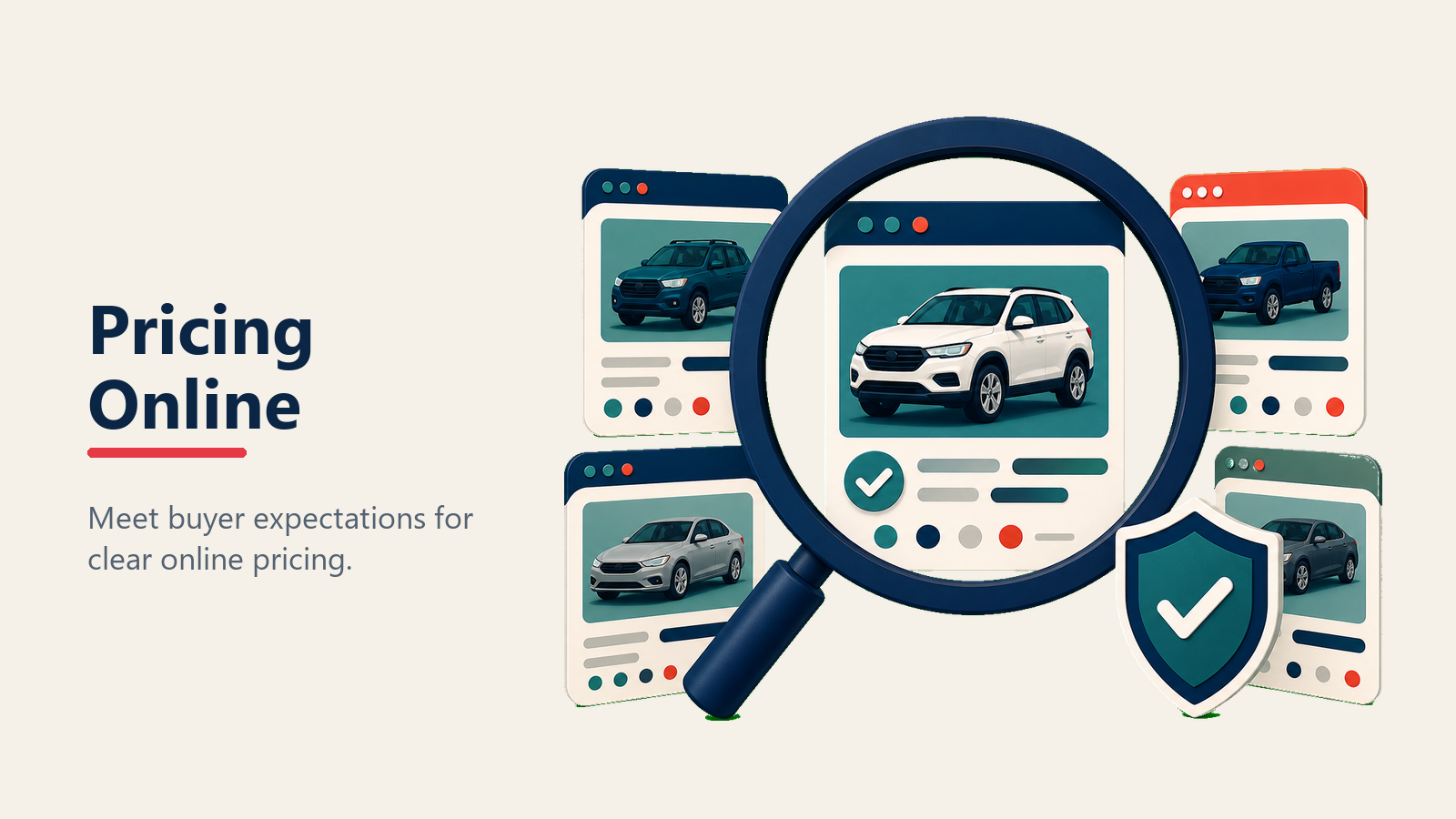
Current dealer pricing practices fall across a spectrum. Some show full out-the-door pricing with all fees disclosed. Others display MSRP with asterisks and fine print about incentives customers may not qualify for. Many hide pricing entirely behind "Call for price" or "See dealer for details." According to NADA research, the majority of consumers want more transparency from dealers, especially when it comes to pricing, making accurate vehicle valuation and clear pricing essential for building consumer trust.
Legal and regulatory considerations vary by state. Some states require fee disclosure. Others restrict certain pricing practices. Your state's attorney general website should have guidelines, but consult with your attorney to ensure compliance.
OEM requirements add another layer of complexity. Manufacturers often have rules about how you can advertise pricing, what discounts you can display, and how you present incentives. Violating these can cost you allocation, bonuses, or co-op advertising funds.
The dealers winning online find the sweet spot, maximum transparency within legal and manufacturer constraints, presented in ways that build trust while protecting margin.
Pricing Transparency Models
There's no one-size-fits-all approach. Different models work for different markets, dealer philosophies, and competitive environments.
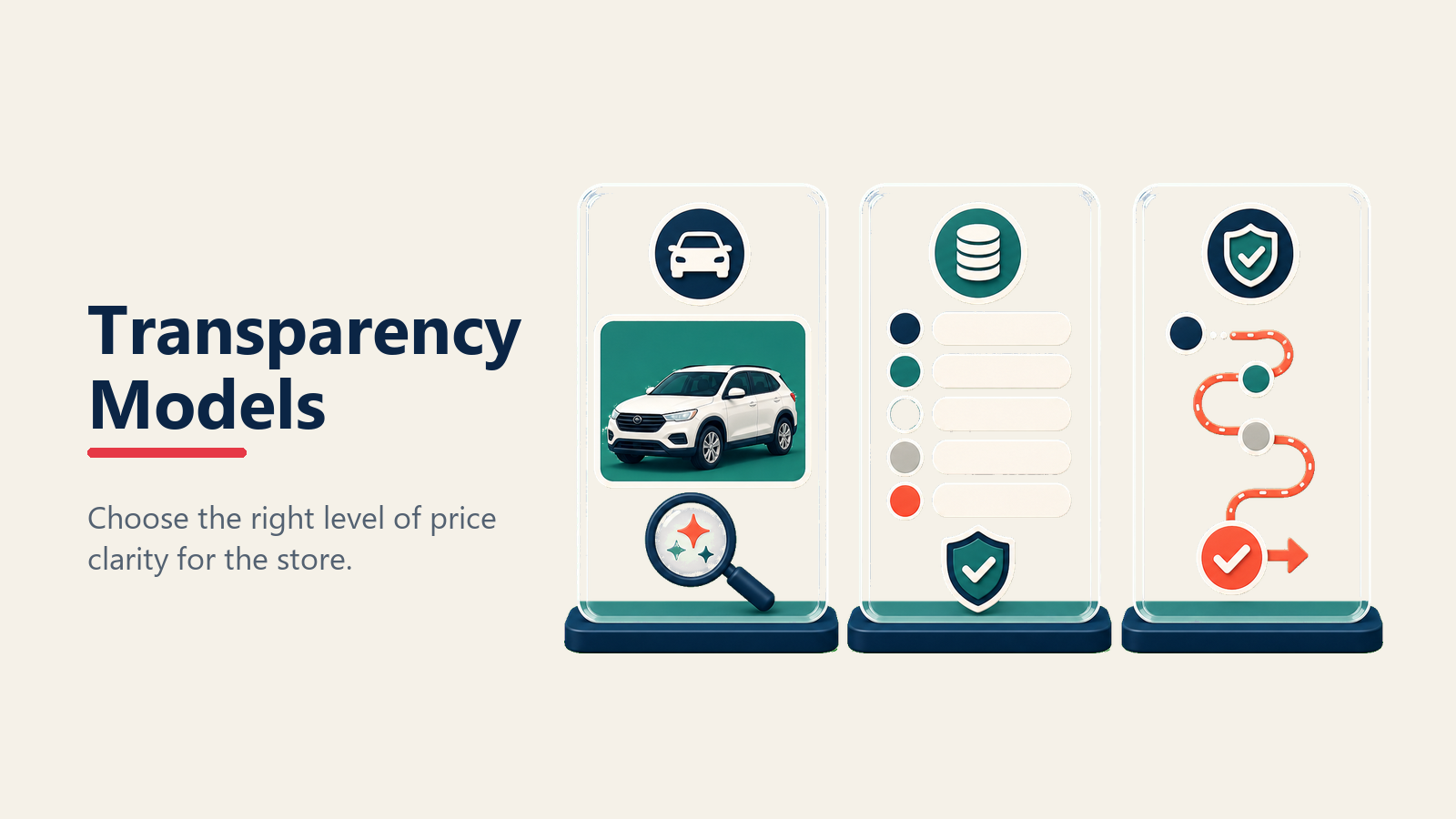
Full transparent pricing (all-in, out-the-door) shows customers exactly what they'll pay including all fees, taxes, and dealer add-ons. This maximizes trust and eliminates pricing surprises but can put you at a disadvantage against dealers showing lower advertised prices that don't include fees.
Market-based pricing with disclaimers displays competitive prices with explanations: "Market price includes $1,500 in available rebates. See dealer for details." You're showing an attractive price while reserving flexibility for the actual transaction.
MSRP with incentive transparency works well for new vehicles. Show the MSRP, then clearly list manufacturer rebates, dealer discounts, and special financing offers. Let customers see the breakdown and understand how you arrive at your advertised price.
Competitive market pricing uses real-time market data to price inventory competitively, showing customers your price relative to local market averages. "Priced $1,200 below market average" provides context without revealing full cost structure.
No-haggle vs traditional negotiation models represent opposite philosophies. No-haggle pricing (Saturn, CarMax model) offers one price, non-negotiable, maximum transparency. Traditional negotiation starts with advertised price and allows room for discussion. Both can work, pick one and be consistent.
The key is consistency. Don't show transparent pricing on some vehicles and hide it on others unless there's a clear reason (like special order or incoming inventory). Inconsistency breeds distrust.
Impact on Digital Metrics
Pricing transparency directly impacts how customers interact with your website and whether they convert to leads.
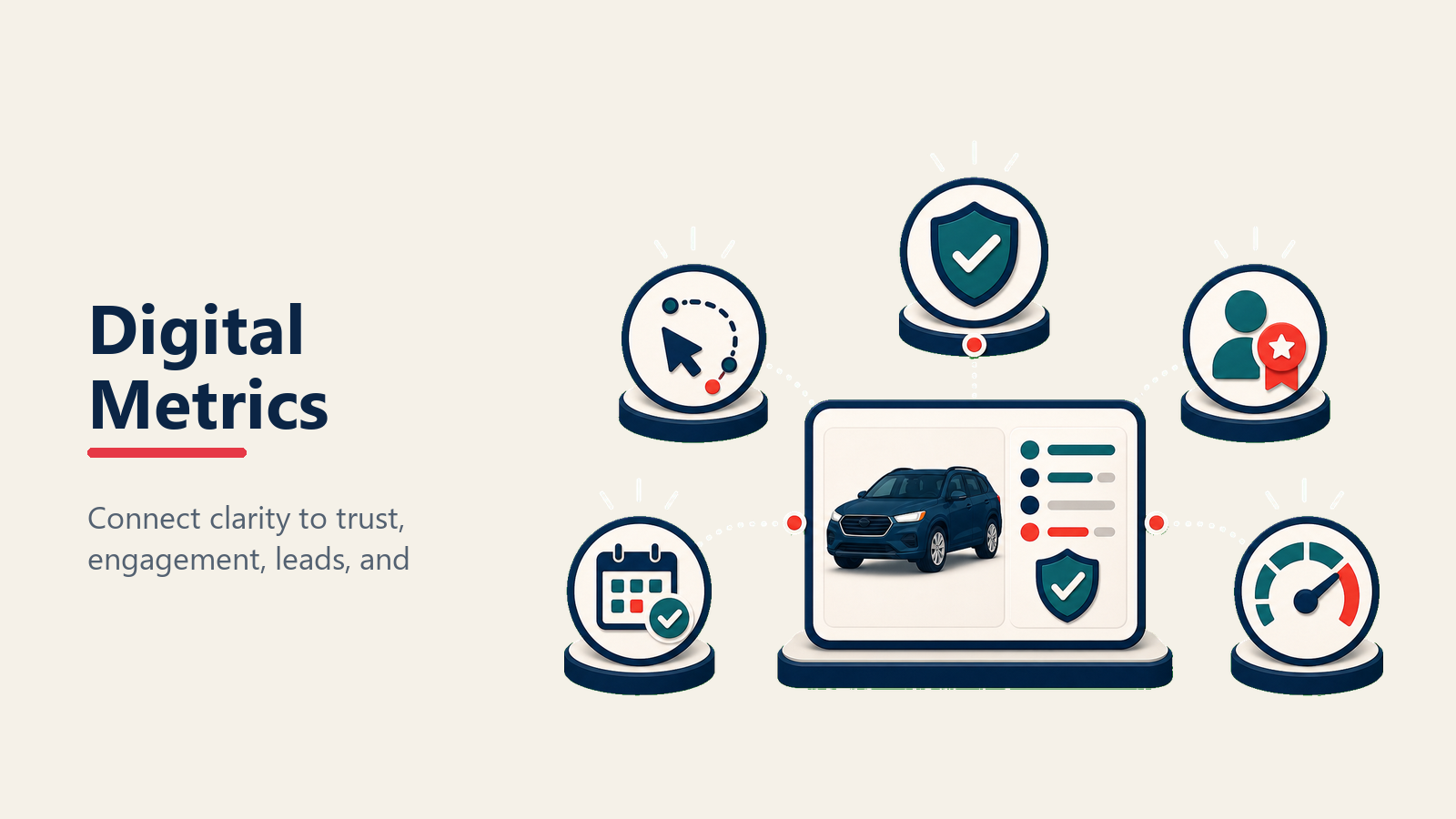
VDP engagement and time-on-page increase with clear pricing. Customers spend 30-40% longer on VDPs when they can see real prices and payment information. They're calculating, comparing, and mentally committing.
Lead form submission rates improve 20-35% when pricing is transparent. Customers who know your price are more qualified leads, they're not just fishing for information, they're seriously considering a purchase.
Phone call conversion also increases, but the nature of calls changes. Fewer "What's your best price?" calls. More "Is this vehicle still available?" and "Can I schedule a test drive?" Higher-intent conversations.
Showroom appointment rates go up when customers know what to expect. They're not worried about walking into a pricing ambush. They've already decided your price is in their range.
Internet close rates typically improve with transparency because leads are more qualified. But here's the nuance: your total lead volume might decrease slightly while lead quality increases significantly. Would you rather have 200 tire-kicker leads or 150 serious buyers?
The dealers I've seen struggle with transparency are usually the ones who were generating high lead volume from attractive but misleading advertised prices. When they switch to honest pricing, lead volume drops but close rates double. Do the math on which scenario generates more sales.
Technology Implementation
Displaying accurate, real-time pricing requires integration between your DMS, website, and pricing strategy.
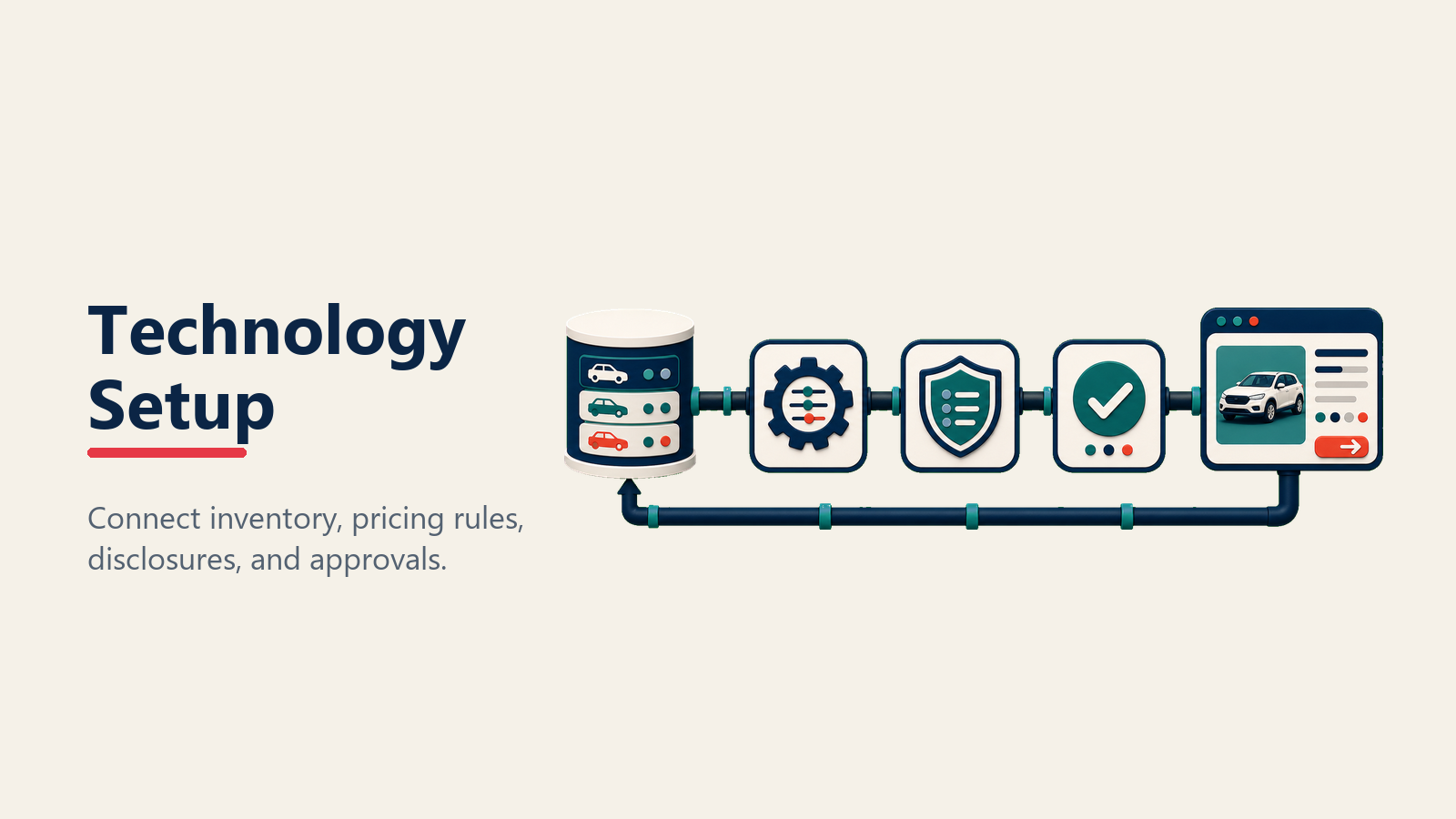
DMS integration should automatically update your website when you change vehicle pricing in your dealer management system. Manual updates create inconsistencies and errors. Customers find vehicles priced $2,000 less online than in your showroom, and trust evaporates. Strong DMS integration best practices prevent this.
VDP pricing display best practices include showing the price prominently above the fold, explaining any discounts or incentives clearly, and providing context (market comparisons, savings calculations). Use simple language, not dealer jargon.
Fee transparency and explanation matters as much as vehicle price. Customers understand that documentation fees, registration, and taxes add to the cost. They hate surprise fees with vague names. "Dealer prep" and "market adjustment" fees should be explained or eliminated.
Trade-in value integration lets customers see their net cost. Show vehicle price, estimated trade value, and calculated difference. This makes the buying decision more concrete and personalized. Implement online trade-in tools effectively.
Payment calculator accuracy is critical. Don't show 2.9% APR rates when the average customer gets 6.5%. Use realistic rates based on average credit profiles, or better yet, integrate with lenders for real-time rate quotes based on soft credit pulls.
If your payment calculator shows $325/month online but the actual payment is $415 when they arrive at the dealership, you've wasted everyone's time and destroyed trust. Better to show $415 from the start and convert qualified buyers.
Competitive Strategy
Pricing transparency isn't just about customer experience, it's a competitive positioning tool.
Market positioning through pricing signals who you are. Premium pricing with exceptional service and selection? Discount pricing with high volume and efficiency? Your online pricing strategy should align with your brand positioning.
Conquest opportunities emerge when competitors hide pricing or use deceptive practices. Customers researching multiple dealers appreciate the one who's straightforward. Be that dealer.
Price matching policies can work if promoted clearly online. "We'll match or beat any advertised price from local dealers" gives customers confidence while allowing you to stay competitive without automatically being the lowest price.
Promotional pricing strategies like end-of-month specials, model year closeouts, or special finance rates create urgency. But only if customers can see and understand the limited-time nature of offers. Smart inventory pricing and aging strategies support this.
Inventory-specific pricing tactics recognize that not all vehicles should be priced the same way. Fresh trade-ins might have more room for negotiation. Aged inventory needs aggressive pricing. Highlight vehicles priced to move with special badges or callouts.
Your competition is advertising prices online whether you like it or not. The question is whether you'll compete on transparency and trust or hide and hope customers don't compare.
Managing Gross Profit Concerns
This is the real concern keeping dealer principals up at night. Will pricing transparency destroy front-end gross?
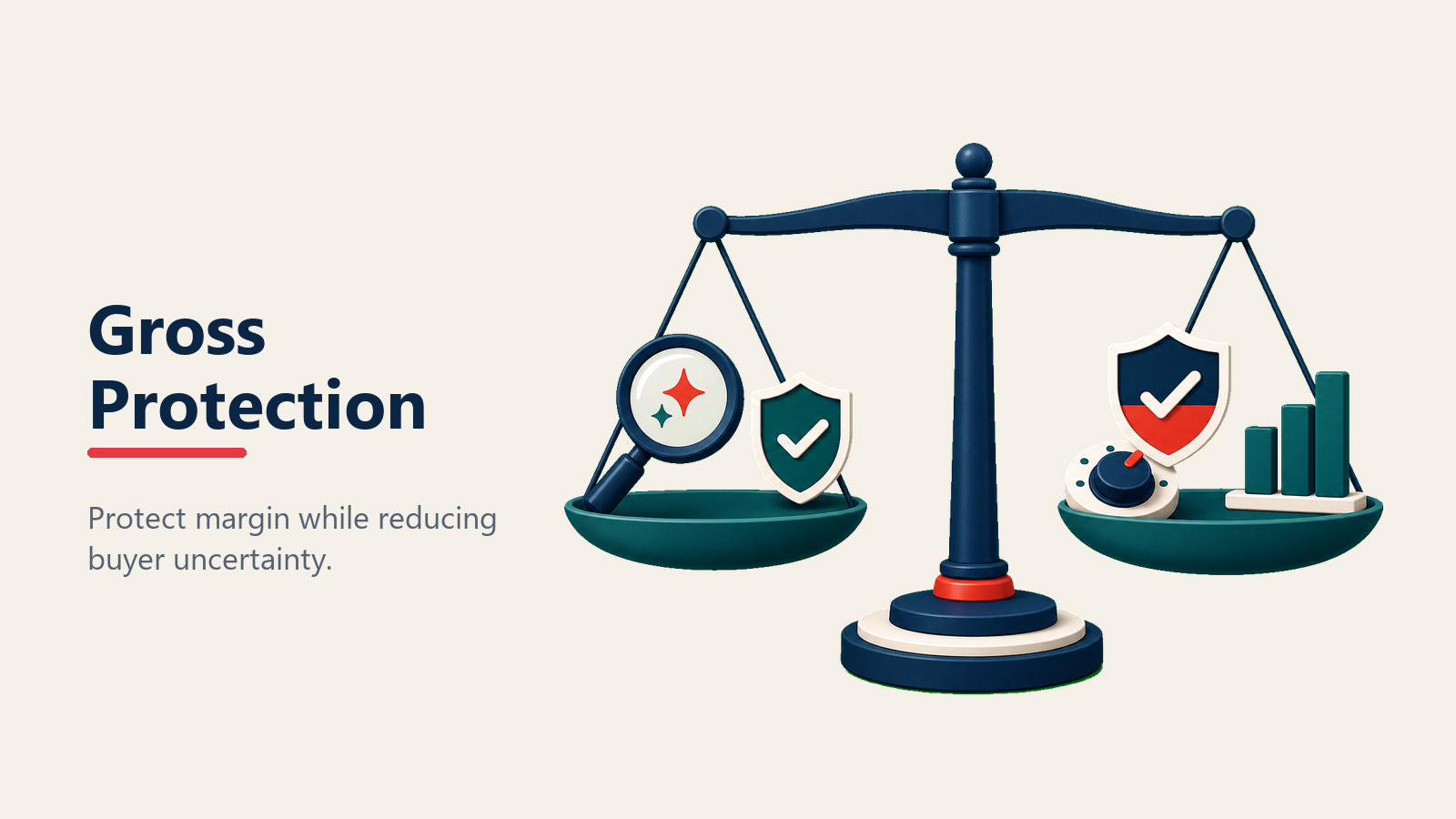
It can, if you let it. But it doesn't have to.
Protecting margin with transparent pricing requires shifting from margin on every deal to average margin across all deals. You'll have customers who buy at your advertised price with minimal negotiation. You'll have others who still negotiate. The average is what matters.
Volume vs margin strategies are fundamental to this decision. Higher volume at lower margin per unit, or lower volume at higher margin? Tesla sells hundreds of thousands of cars with zero negotiation and healthy profits. Some luxury dealers sell dozens per month at $5,000+ front gross. Both work. Pick your model and track gross profit optimization.
Back-end profit optimization becomes more important when front-end gross compresses. Transparent vehicle pricing doesn't mean you can't present F&I products effectively. In fact, customers who trust your vehicle pricing often trust your F&I recommendations more.
New vs used pricing strategies can differ. New vehicles often have manufacturer-advertised pricing that limits flexibility. Used vehicles have more variability. Some dealers use transparent pricing on new, traditional negotiation on used. Or vice versa.
Special finance desk opportunities exist when you serve credit-challenged customers who value approval over absolute lowest price. These customers care more about getting financed than saving $500. Transparent pricing builds trust that increases finance penetration.
The dealers maintaining gross with transparent pricing focus on value, not just price. Service, selection, convenience, trust, and experience all create value customers will pay for. Hide behind opaque pricing and you're competing purely on price. That's a race to the bottom.
Sales Team Training & Processes
Transparent pricing changes how your sales team operates. They need training, scripts, and processes that align with your online pricing strategy.
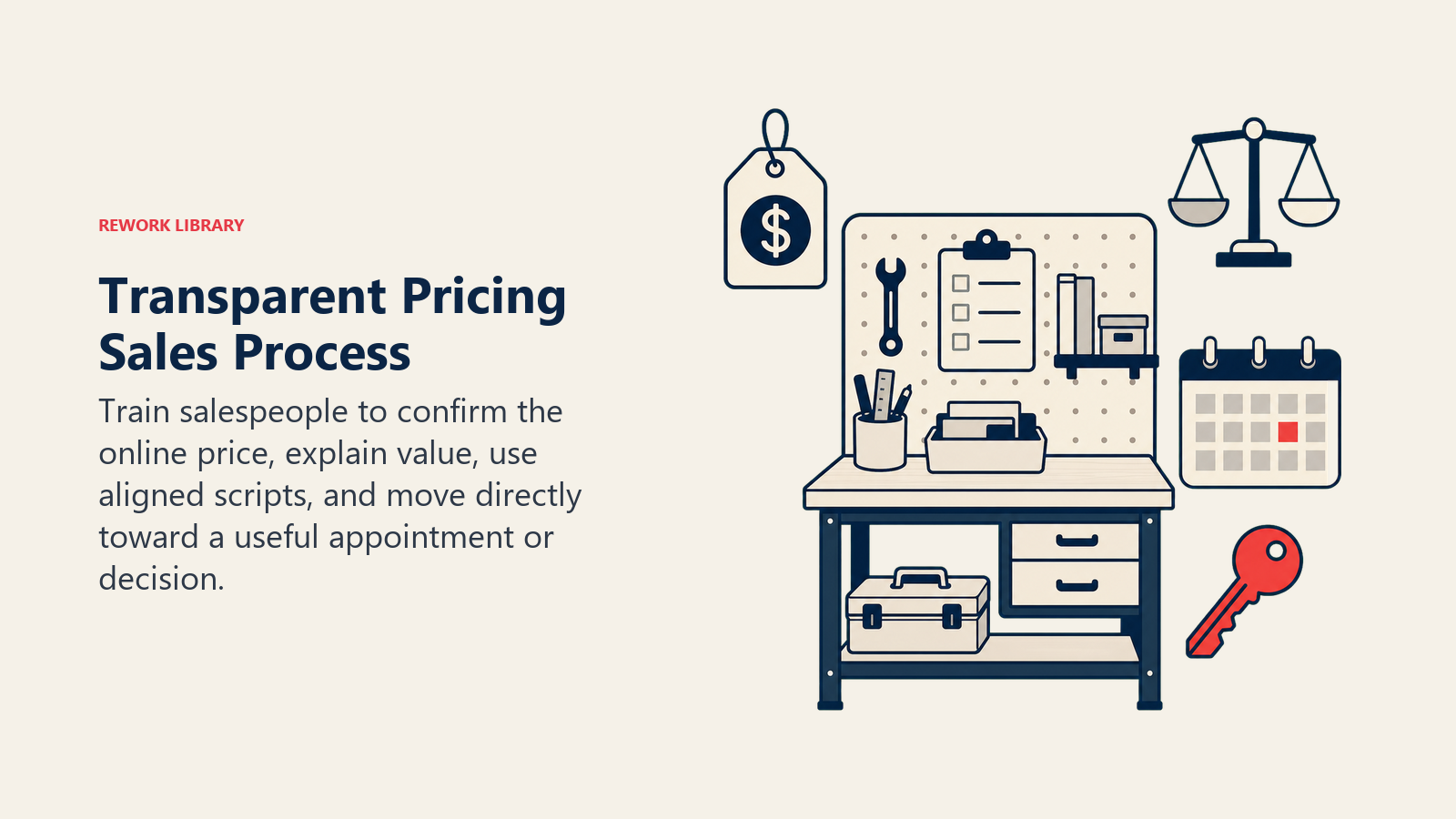
Handling pricing conversations becomes simpler when online and in-store prices match. "Yes, that's our real price. Here's what's included and why it's a great value." No dancing, no games, no "let me talk to my manager." Train your team on negotiation and closing techniques that align with transparency.
Phone scripts for pricing inquiries should confirm the online price, provide additional context, and move toward appointment setting. "Yes, the CR-V is priced at $28,995. It's been on our lot for just 12 days and has 18,000 miles. When would you like to see it?" Strong phone skills matter.
Email templates for pricing disclosure that explain your pricing, highlight value, and differentiate from competitors. "Our advertised price includes our full reconditioning process, 30-day warranty, and free first oil change. Here's how we're different from dealers advertising lower prices..."
Showroom presentation alignment ensures your sales team doesn't undermine the trust you built online. If you advertised transparent pricing, don't immediately drop $1,000 when customers arrive. That teaches them not to trust your online prices.
Overcoming price objections shifts from defending your margin to explaining your value. "I understand you found one $800 cheaper across town. Let me show you why our customers choose us even when we're not the lowest price." Then demonstrate service, selection, convenience, or other differentiators.
Your sales team will resist transparent pricing initially, especially if they're used to having room to negotiate. They'll worry about losing deals to customers who don't negotiate. Train them on the benefits: more qualified leads, shorter sales cycles, higher customer satisfaction, and better online reviews that drive future business.
Moving Forward
Pricing transparency isn't about giving away profit. It's about building trust in a market where customers have endless information and alternatives.
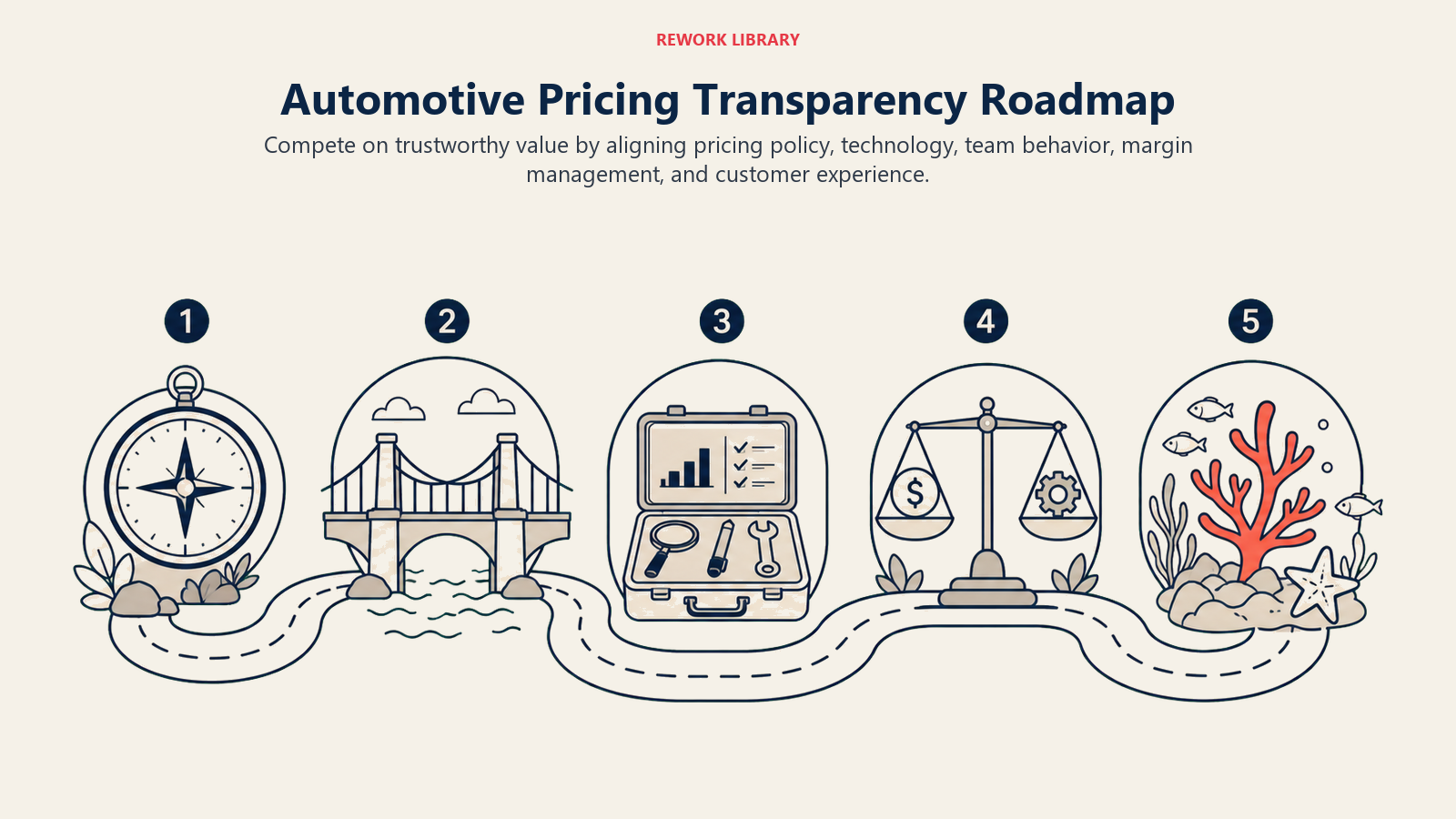
The car business is changing. Customers have access to more data, more comparison tools, and more options than ever. The dealers who fight this trend, who cling to opaque pricing and negotiation tactics that frustrate modern buyers, will struggle as younger, digitally-native customers become the primary market.
But transparency doesn't mean you can't be profitable. It means you have to compete on value, not just price. It means your gross profit comes from delivering an experience worth paying for, not from information asymmetry.
Start by evaluating your current pricing disclosure. Are you showing MSRP when you're actually selling $5,000 below? Are you hiding fees that add up to $2,000? Are your payment calculators using fantasy interest rates?
Fix the obvious credibility gaps first. Then experiment with greater transparency. Test it on a subset of inventory. Measure lead quality, conversion rates, and gross profit. Learn what level of transparency works for your market and your customers.
And remember: you're not just competing with other dealers anymore. You're competing with the expectations that Tesla, Carvana, and every other transparent pricing model has created. Meet customers where they are, or lose them to dealers who will. Monitor your performance with dealership benchmarking.
For implementing the technology infrastructure to support transparent pricing, see Automotive Digital Retailing and Vehicle Detail Page Optimization. For managing the leads generated by transparent pricing, explore Automotive Lead Management and Internet Lead Follow-Up. For dealers considering no-haggle pricing models, review One-Price Selling Strategy.
Frequently Asked Questions about Online Pricing Transparency
How does pricing transparency improve automotive sales response?
When shoppers can see your real, all-in price online, the leads that reach you already know the number and are ready to act. That removes the "what's your best price" volley, so your team responds to higher-intent buyers and moves faster toward a test drive or appointment. Dealers typically see lead form submissions rise 20-35% and phone calls shift from price-fishing to availability and scheduling.
Does transparent pricing hurt gross profit?
It can if you let advertised price become a race to the bottom, but it does not have to. The shift is from chasing margin on every deal to managing average margin across all deals, while protecting back-end F&I profit and competing on service, selection, and trust. Many dealers hold gross steady because transparent vehicle pricing increases trust in their F&I recommendations.
How much pricing should a dealership show online?
Show as much as legal and manufacturer rules allow: the vehicle price, clearly explained fees, available rebates, and a realistic payment estimate. Avoid surprise fees with vague names and avoid payment calculators using fantasy interest rates. The goal is no gap between the online price and the showroom price.
Will transparent pricing reduce my lead volume?
Total lead volume may dip slightly because tire-kickers self-select out, but lead quality and close rates rise. Most dealers find that fewer, more serious leads produce more actual sales than a larger pool of price-shoppers who never buy.