Needs Assessment in Automotive: Uncovering True Buying Motivations Beyond Features
Turn this article into takeaways for your work.


Each assistant summarizes the article only for you and suggests best practices for your work.
Sales consultants who skip needs assessment present an average of 2.3 vehicles before finding the right match. They waste time showing wrong vehicles, lose credibility with each mismatch, and watch customers grow frustrated with the process. Research shows that putting customer experience in the driver's seat is the new key to automotive success.
Consultants who invest 10-15 minutes in proper discovery present 1.1 vehicles on average and close 40% more deals. They match inventory to actual requirements on the first try, demonstrate expertise through understanding, and build commitment through alignment.
Discovery drives efficiency and profit. Yet most automotive sales training treats it as a quick checkbox, ask a few generic questions, then rush to showing vehicles. This approach fails with modern buyers who expect consultative selling, not product pushing. Deloitte research emphasizes that digital technologies are transforming the car buying experience, requiring more sophisticated discovery approaches.
Effective needs assessment isn't interrogation. It's conversation that reveals not just what customers think they want, but why they want it, what they're really trying to accomplish, and what concerns might prevent purchase.
Purpose of Needs Assessment
Before showing a single vehicle, you need to understand the customer's situation comprehensively. Discovery serves multiple critical purposes.
Understanding vs Assuming Customer Needs:
Assumptions kill deals. The customer looking at trucks might not need towing capacity, they might just like how trucks look. The family with three kids might not want a minivan, they might value status over practicality. Never assume.
Ask, listen, and understand what they actually need versus what you think they need.
Matching Inventory to Actual Requirements:
You can't recommend the right vehicle without knowing their requirements. Needs assessment creates the foundation for intelligent recommendations that feel personalized rather than generic.
Identifying Decision Criteria Priorities:
Every buyer weighs factors differently. One prioritizes safety above everything. Another cares most about fuel economy. A third values technology features. Understanding priority order helps you position vehicles effectively.
Uncovering Emotional Motivations:
People buy cars emotionally and justify logically. Surface needs assessment captures the logical justifications ("I need third-row seating"). Deep discovery uncovers emotions ("I want my kids to be safe" or "I want to feel successful").
Emotional motivations drive decisions more than practical requirements.
Discovering Budget and Payment Realities:
You can show the perfect vehicle, but if it's $200/month over budget, you're wasting everyone's time. Understanding budget parameters upfront enables realistic recommendations.
Assessing Purchase Timeline and Urgency:
Timeline determines approach intensity. Buyers purchasing within two weeks need urgency and efficiency. Shoppers planning to buy in three months need nurturing and education. Misreading timeline creates pressure mismatches that kill deals.
Creating the Discovery Environment
Where and how you conduct discovery affects what customers share. Get the meet and greet right and they'll open up. Get it wrong and they'll stay guarded.
Seating Customers Properly:
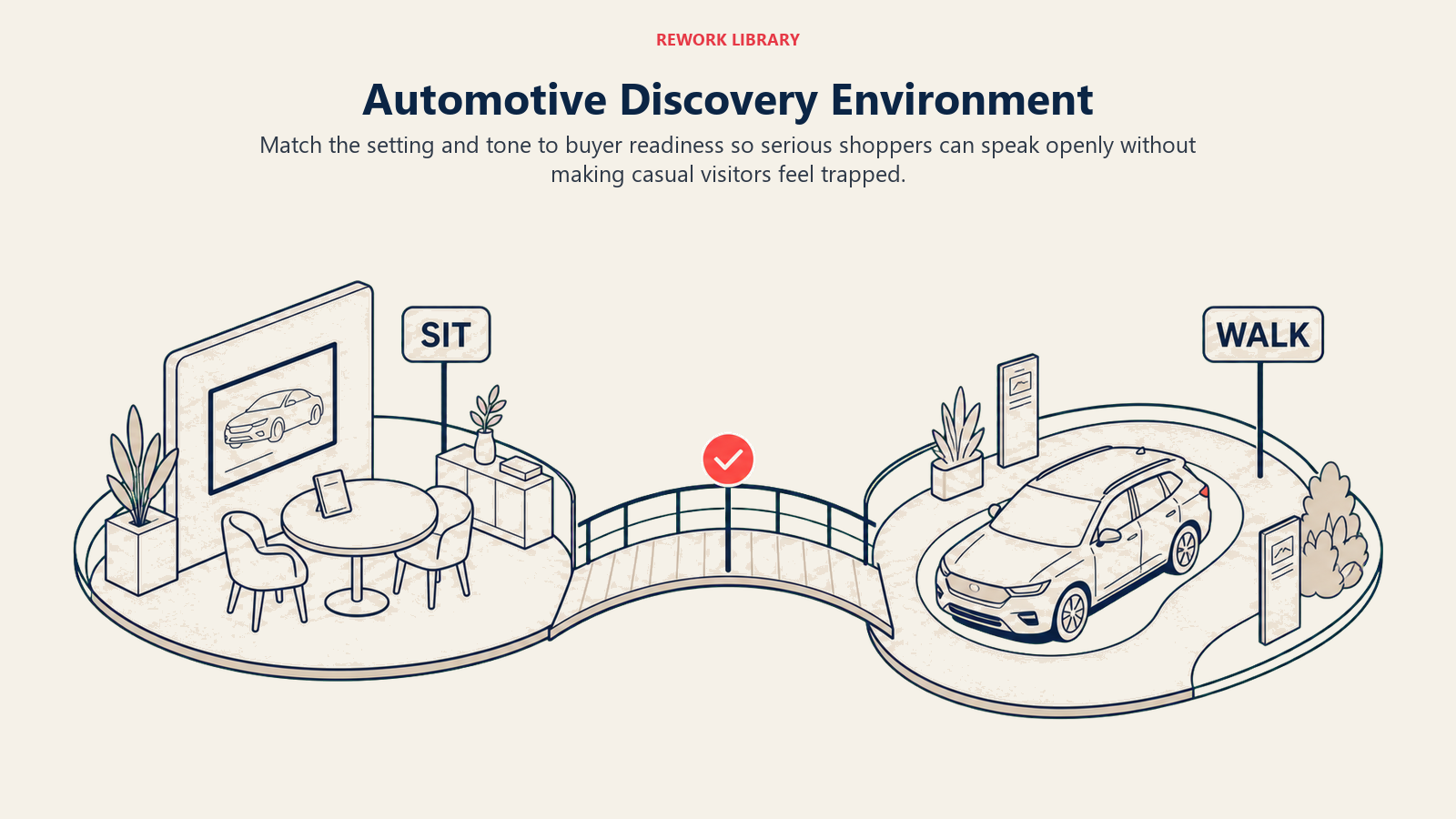
For serious buyers, invite them to sit down: "Let's grab a seat so we can talk about what you're looking for." This signals you're taking them seriously and investing time in understanding their needs.
For casual shoppers, keep discovery conversational while standing or walking. Don't force formality they're not ready for.
Desk versus casual seating creates different dynamics. Desks feel official and business-like. Lounge areas feel relaxed and conversational. Match the setting to the customer's energy.
Building Permission to Ask Questions:
Before launching into discovery questions, establish permission: "Do you have a few minutes for me to ask some questions about what you're looking for? It'll really help me point you in the right direction."
This frames questions as helpful rather than intrusive.
Relaxed Conversation vs Interrogation:
Discovery should feel like friendly conversation where you happen to learn what you need to know. It shouldn't feel like an interview or interrogation.
Ask a question, listen to the answer, ask a natural follow-up based on what they said, repeat. Let the conversation flow rather than mechanically checking boxes on a list.
Note-Taking Without Being Robotic:
Taking notes shows you're listening and care about details. But staring at a notepad while robotically recording answers creates distance.
Make eye contact during their answers, jot quick notes during natural pauses, reference your notes to show you remember details.
Active Listening and Acknowledgment:
Repeat back what you hear to confirm understanding: "So safety is your top priority because of the new baby?" This shows you're listening and gives them opportunities to clarify or add information.
Making Customers Feel Heard:
The best discovery makes customers feel like you genuinely understand their situation. They should leave discovery thinking "this person really gets what I need" rather than "that person just asked a bunch of questions."
Essential Discovery Questions
Certain questions are foundational to understanding any customer's situation. These aren't scripts to robotically follow, they're topics to explore through conversation.
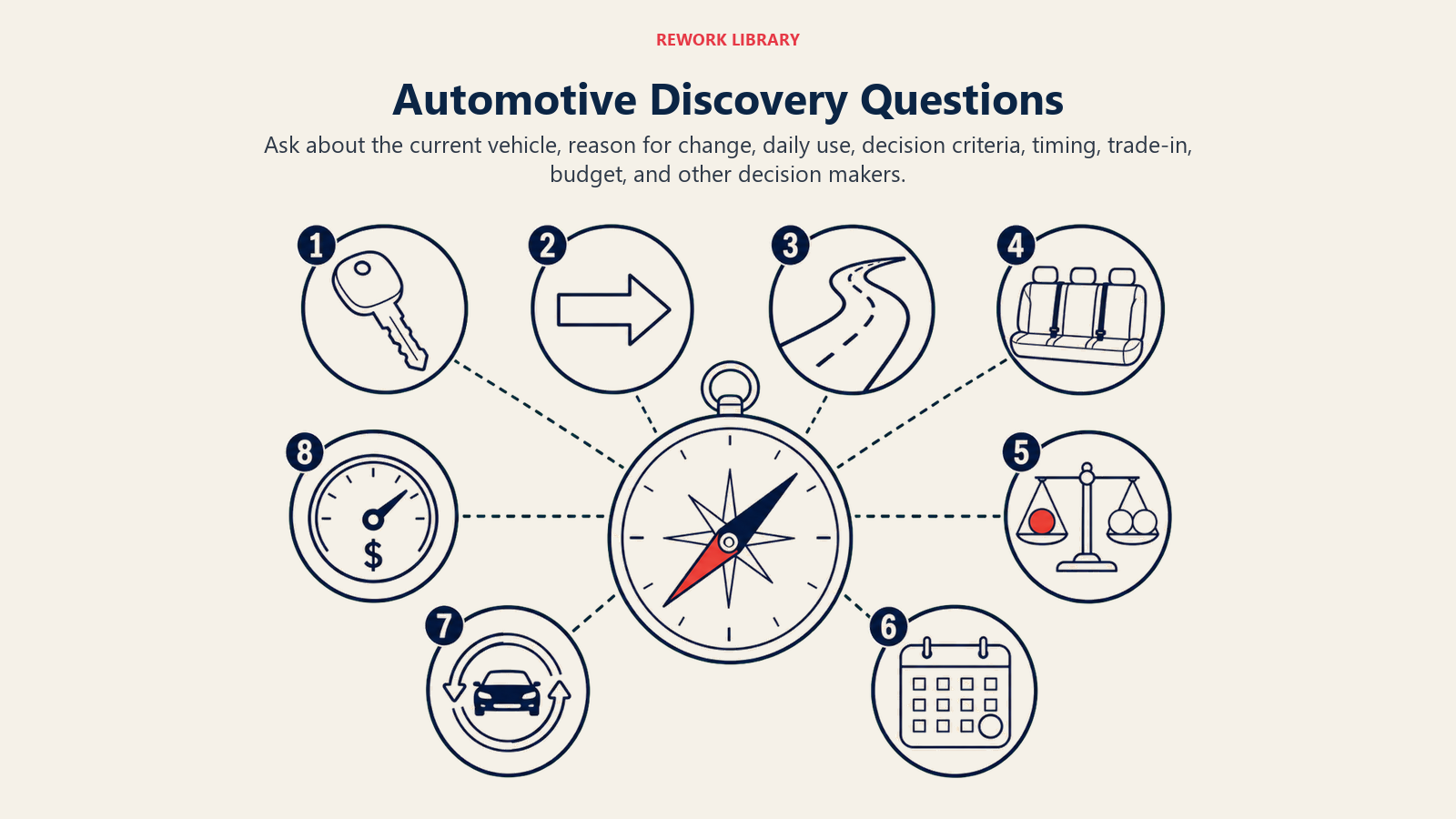
Current Situation: What are you driving now? How long have you had it?
This establishes baseline context. It tells you what they're used to, what experience they're coming from, and potentially what they're trying to move away from.
Follow-ups: "What do you like about it?" "What are you ready to change?"
Motivation: What's prompting you to look at vehicles?
This reveals the trigger, lease ending, vehicle problems, life changes, desire for something different. Understanding the prompt explains urgency and emotional drivers.
Follow-ups: "When did you start thinking about replacing it?" "What made you decide now?"
Usage: How do you plan to use the vehicle?
Daily commute, family hauling, weekend adventures, work purposes, usage patterns determine appropriate vehicle types and features.
Follow-ups: "How long is your commute?" "What kind of roads do you drive most?" "Do you do much highway driving?"
Passengers: Who else will be driving or riding?
Family size, car seats, elderly passengers, pets, passenger considerations affect vehicle size, configuration, and feature priorities.
Follow-ups: "Do you need car seat anchors?" "Will anyone else be driving this regularly?" "Do you ever carry more than [number mentioned]?"
Features: What features are most important?
This reveals priorities and allows you to understand what they value. But don't just accept the first answer, probe deeper to understand why those features matter.
Follow-ups: "Why is [feature] important to you?" "Have you had that feature before, or is it new?" "What else is on your must-have list?"
Budget: What monthly payment works for your budget?
This is the make-or-break question many consultants avoid because it feels uncomfortable. But showing vehicles they can't afford wastes everyone's time and damages credibility. According to Wikipedia's automotive finance overview, understanding payment structures and financing options is essential for matching customers with appropriate vehicles.
Approach it naturally: "Just so I'm showing you things that make sense, what monthly payment range fits your budget?"
Follow-ups: "Is that with trade-in equity applied?" "Are you flexible if we find the perfect vehicle?"
Timeline: When are you hoping to make a decision?
Timeline determines your entire approach. Same-day buyers need urgency and efficiency. Month-long shoppers need patience and nurturing.
Follow-ups: "What's driving that timeline?" "Is anything preventing you from moving sooner?" "What needs to happen before you're ready to decide?"
Trade: Will you be trading in your current vehicle?
Trade equity affects budget, down payment, and deal structure. Understanding trade situations upfront prevents surprises later.
Follow-ups: "Do you know what you owe on it?" "Have you gotten any other trade valuations?" "Would you consider selling it privately instead?"
Advanced Qualification
Beyond basic discovery, experienced consultants probe deeper into factors that affect deal structure and close probability.
New vs Used Preference and Rationale:
Understanding why they prefer new or used reveals budget consciousness, depreciation concerns, warranty importance, and status considerations.
"Are you looking at new, used, or either?" Then: "What's important to you about [their answer]?"
Lease vs Finance vs Cash Decision Factors:
Payment structure dramatically affects monthly budget and deal structure. Understanding preferences and rationale enables better recommendations.
"Have you thought about whether you want to lease or finance?" Then explore why that structure appeals to them.
Brand Loyalty or Conquest Opportunity:
Previous ownership experiences create loyalty or openness to switching. Understanding brand relationships helps position your inventory.
"Have you owned [your brand] before?" "What made you decide to look at [different brand]?"
Previous Ownership and Satisfaction:
Past experiences predict future preferences. What they loved about previous vehicles indicates what to highlight. What they hated indicates what to avoid.
"What did you love about your last vehicle?" "What drove you crazy?"
Decision-Maker Dynamics:
Who needs to approve this purchase? Spouse, parent, business partner? Understanding decision dynamics prevents surprises when "I need to talk to my wife" kills deals.
"Are you making this decision on your own, or is someone else involved?" "Will they be joining us today?"
Credit Situation Awareness:
Credit affects approval, rates, and deal structure. But this is sensitive territory requiring tactful approaches.
"Have you thought about financing?" "Do you know roughly where your credit stands?" Never: "What's your credit score?"
Uncovering Emotional Drivers
Logical needs get customers to your showroom. Emotional drivers get them to buy. Deep discovery uncovers emotions beyond surface-level requirements.
Status and Image Considerations:
Some buyers care deeply about what their vehicle says about them. Others don't care at all. Understanding this helps you position vehicles correctly.
Listen for clues: mentions of what neighbors drive, concerns about appearances, emphasis on premium brands, interest in luxury features.
Safety and Family Protection:
Parents with young children often prioritize safety above everything else. This emotional driver trumps price, features, and preferences.
When customers mention kids, explore safety concerns: "How important are safety features to you?" Then highlight safety ratings and technologies.
Adventure and Lifestyle Alignment:
Enthusiast buyers want vehicles that enable their lifestyle, off-roading, camping, road trips, outdoor activities. The vehicle becomes a tool for adventure.
"What do you like to do on weekends?" often reveals lifestyle alignment opportunities.
Practicality vs Desire Conflict:
Many buyers struggle between what they want and what they need. They want the sports car but need the SUV for the family. Understanding this tension helps you find vehicles that balance both.
"If you could have any vehicle without worrying about practical considerations, what would you choose?" Then: "Now, what does your practical side say you need?"
Fear of Making the Wrong Decision:
Car purchases are major financial commitments. Many buyers fear making expensive mistakes. Acknowledging and addressing this fear builds trust.
"What concerns you most about making this decision?" Then address those specific concerns.
Excitement and Aspiration:
Positive emotions drive purchases too. Buyers excited about new technology, styling, or capabilities make faster decisions when you connect with that excitement.
Listen for enthusiasm and amplify it: "You seem really excited about [feature]. Want to see it in person?"
Budget & Payment Discussion
Budget conversations are uncomfortable for many consultants, leading them to avoid the topic until negotiation. This wastes time and damages trust.
Approaching Payment Conversation Tactfully:
Frame budget questions as helpful rather than qualifying: "I want to make sure I show you vehicles that fit your budget. What monthly payment range works for you?"
This positions the question as customer service rather than sales qualification.
Monthly Budget vs Total Price Focus:
Most buyers think in monthly payments, not total price. Discover their payment comfort zone, then work backward to appropriate price ranges.
"Most people focus on monthly payments. What range fits your budget comfortably?"
Trade Equity and Down Payment Discovery:
Equity and down payment dramatically affect budget. A customer with $8,000 in trade equity can afford higher-priced vehicles than someone with negative equity.
"Do you know roughly what you owe on your trade?" "Were you planning to put any cash down?"
Desired Term and Structure:
Some buyers want 48-month loans for faster payoff. Others prefer 72-84 month terms for lower payments. Understanding preferences helps structure deals appropriately.
"How long do you typically finance vehicles?" "What term makes you comfortable?"
Payment Sensitivity and Flexibility:
Understand how rigid budget constraints are. Some buyers have hard limits. Others have flexibility if the right vehicle justifies it.
"If we found the perfect vehicle but the payment was $50 higher, is that a dealbreaker or could we make it work?"
Affordability vs Approval Reality:
What customers think they can afford doesn't always match what lenders will approve. Tactful credit qualification prevents showing vehicles they can't actually purchase.
"Have you been pre-approved for financing?" "Do you have a sense of where your credit stands?"
Documenting & Using Discovery
Information is only valuable if you capture and use it. Proper documentation makes discovery actionable.
CRM Documentation Standards:
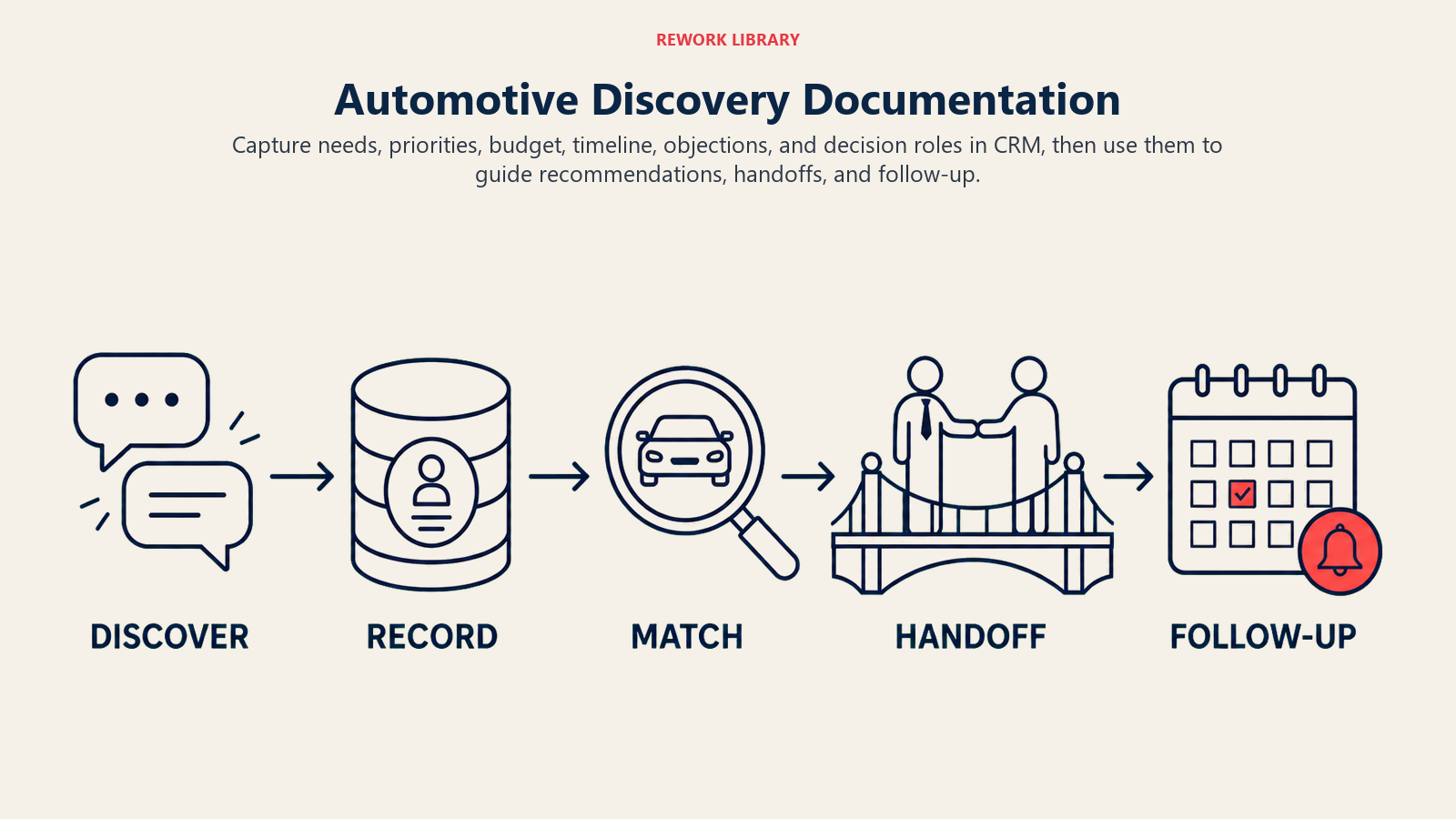
Document everything learned during discovery in your CRM: needs, wants, priorities, budget, timeline, objections, family situation, decision makers. This information guides your current interaction and future follow-up.
Sharing with F&I and Management:
Brief managers and F&I on customer situation, priorities, and concerns before they get involved. This context helps them personalize their approaches rather than starting from scratch.
"Just a heads up, safety is their top priority because they're expecting their first baby. They're sensitive about monthly payment but have flexibility for the right vehicle."
Referencing Throughout Presentation:
Use discovery information during presentations to show you listened: "You mentioned safety was your top concern, let me show you the crash test ratings for this model."
This reinforces that discovery had purpose and that you care about what they told you.
Handling Changing Requirements:
Needs sometimes evolve during the process. Stay flexible and adapt: "I know you initially said you wanted an SUV, but based on what you're telling me now, have you considered sedans?"
Qualifying Out Wrong Customers:
Sometimes discovery reveals customers who aren't good fits, unrealistic budgets, timelines too far out, requirements your inventory can't meet. It's better to recognize this early and focus your time where it has the highest return.
"Based on what you've told me, I don't think we have exactly what you're looking for right now. But I'd be happy to keep an eye out and let you know when something matching your needs comes in."
Building Commitment Through Alignment:
When customers see that you've accurately understood their needs and recommended vehicles that genuinely fit, they feel understood. This builds commitment and trust that carries through to close.
The consultants who close at 35%+ rates aren't the slickest talkers. They're the best listeners. They invest time in discovery, ask deeper questions, and recommend vehicles that actually match customer needs.
Skip discovery and you're guessing. Guess wrong enough times and you lose the customer.
Do discovery right and you'll present the right vehicle, to the right person, at the right price, at the right time. That's when deals close easily. Build on this foundation with vehicle presentation and demo, test drive best practices, objection handling in automotive, trade-in appraisal process, and negotiation and closing techniques.