Automotive Dealership Growth Model: 3-Engine Guide 2026
Turn this article into takeaways for your work.


Each assistant summarizes the article only for you and suggests best practices for your work.
Most dealerships hit a ceiling they can't break through. They sell the same unit count year after year, watch margins compress, and wonder why competitors keep pulling ahead. The problem isn't market conditions or factory allocation. It's the absence of a real growth architecture.
Here's what actually happens: 80% of dealerships plateau because they're running three separate businesses that don't talk to each other. Sales chases volume. Service books appointments. F&I tries to hit PVR targets. Nobody's connecting the dots between these engines, so growth stalls even when individual departments perform well.
The Three-Engine Revenue Model
Your dealership runs on three distinct profit engines, and understanding how they interconnect determines whether you scale or stagnate. Variable Operations includes new and used vehicle sales. This is where most dealer principals focus their energy, but here's the reality: front-end gross profit averages just $1,200-$2,500 on new vehicles. Used vehicles perform better at $2,500-$4,000, but neither delivers sustainable profitability alone. The variable operations engine generates showroom traffic and builds your customer database. It's not where you make money - it's how you fill your service drive and create F&I opportunities.
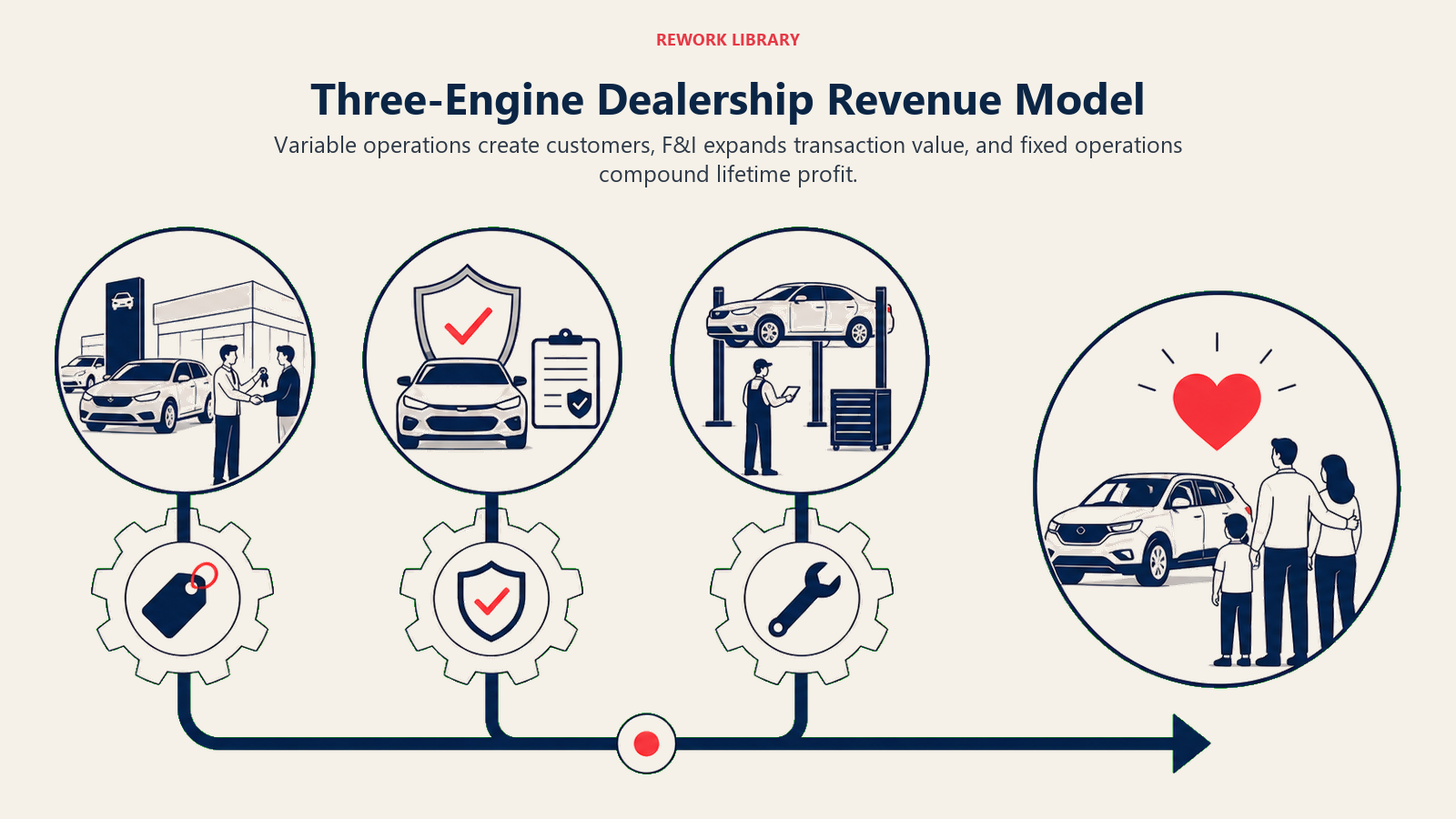
Fixed Operations covers service and parts, and this is your stability engine. Customer pay service generates 60-70% gross margins compared to warranty work at 10-15%. When your service department absorbs 100% or more of your total dealership overhead, you've built a foundation that doesn't collapse when vehicle sales slow down.
But most dealerships run service absorption rates between 70-85%, which means they're dependent on vehicle gross to cover fixed costs. That's a vulnerable position. According to NADA industry data, dealerships that achieve service absorption above 100% demonstrate significantly stronger financial resilience.
Finance & Insurance represents 40-60% of your total gross profit while generating zero inventory costs or floor plan interest. A well-run F&I department produces $1,800-$2,200 PVR (per vehicle retail) by bundling extended warranties, GAP insurance, maintenance contracts, and other products that protect customers and drive dealer profit.
The magic happens when these three engines work together. Service customers become sales prospects. Sales feed service retention. F&I penetration improves when customers trust your service experience. That's the growth model nobody's teaching at 20 groups.
Front-End vs Back-End Profit Dynamics
Let's talk about where money actually comes from in 2026, because it's not where it came from in 2005. Front gross (the profit from the vehicle sale itself) has been under pressure for two decades. Manufacturer incentives, online pricing transparency, and digital retailing all compress margins. You're lucky to hit $2,000 front gross on a new vehicle sale, and that's before sales commissions, marketing costs, and floor plan interest.
Back gross (F&I products) became the profit center because it's the only place customers can't price-shop. You can't compare a VSC quote from your dealership against another dealer's VSC the way you compare vehicle pricing. F&I products are presented, explained, and sold in the business office after the customer already committed to the vehicle.
That's why top-performing dealerships obsess over F&I training, product menu design, and back-end PVR. It's not about pushing products customers don't need. It's about protecting customers from costly repairs while generating the margin you need to operate.
Service creates the third profit layer. A customer who services with you for 5 years generates $3,000-$5,000 in gross profit beyond the initial vehicle sale. They also become your best source for repeat and referral sales, which cost 70% less to acquire than conquest customers.
When you map the full profit picture, here's what emerges: the vehicle sale creates the relationship, F&I generates immediate profit, and service drives lifetime value. You can't optimize one without the others.
The Modern Growth Flywheel
Growth compounds when you build systems that feed each other, and the modern dealership flywheel starts with digital lead generation. Digital leads convert to showroom traffic when your BDC responds in under 5 minutes. Data shows a 10x drop in conversion when response time exceeds 30 minutes, but most dealerships take 45-90 minutes to follow up on internet leads. Fast response times don't just book more appointments - they book higher-intent customers who show up and buy.
Sales convert to service retention when your delivery process includes service scheduling, not just key handoff. The best dealerships book the first service appointment before the customer leaves delivery. They explain the service value proposition. They introduce the service advisor who'll handle their account. This single process drives 60-80% first-service retention compared to industry average of 35-40%.
Service creates equity mining opportunities because you're tracking vehicle health, mileage, and ownership duration. When a customer's vehicle hits 60,000 miles and they're outside warranty, that's your signal to initiate a trade conversation. When they've owned the vehicle for 4+ years and have $5,000+ in equity, that's your upgrade opportunity.
Repeat and referral customers lower customer acquisition cost from $800-$1,200 per sale down to $200-$400. They close faster, negotiate less, and buy more F&I products because they trust your store. This is how you scale profitably while competitors burn cash on third-party lead sources.
The flywheel accelerates with each rotation. More digital efficiency drives more sales. More sales create more service customers. More service customers generate more equity opportunities. More repeat business compounds your market share.
Critical Growth Leverage Points
Not all improvements deliver equal results, and smart dealer principals focus on the leverage points that move the entire system. Lead response time generates 5x impact because it determines which leads enter your funnel. If you respond to digital inquiries in under 5 minutes with a phone call and text message, your appointment-set rate jumps from 8-12% to 30-40%. That's not incremental improvement - that's transformational. You need CRM automation that routes leads instantly to BDC agents, tracks response times, and escalates non-responses. You need scripts that move from qualification to appointment setting in under 90 seconds. And you need management oversight that holds the team accountable to speed standards.
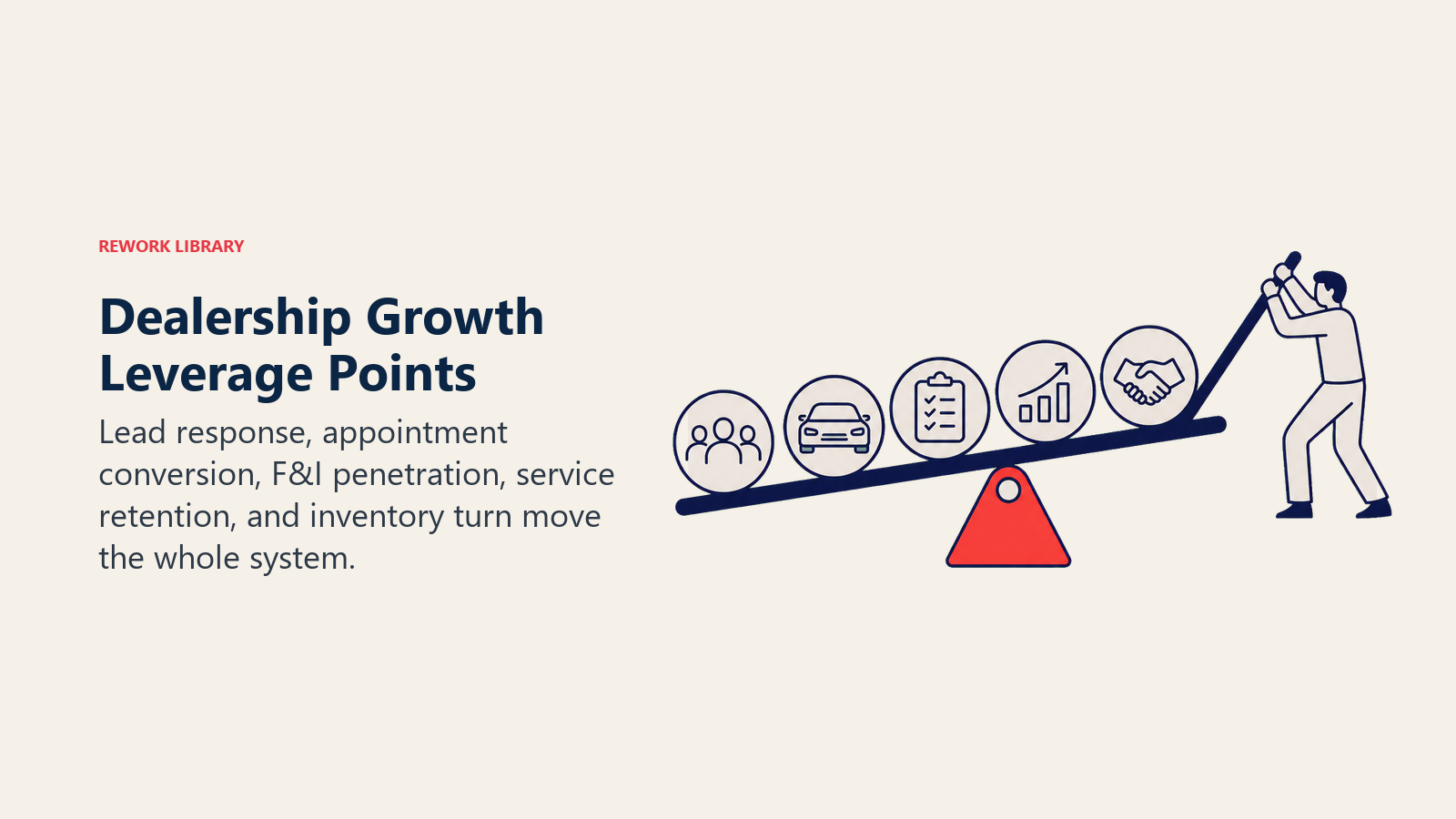
Service-to-sales conversion unlocks hidden revenue because you're already investing to bring these customers to your dealership. When a service customer mentions trade interest, repair costs, or vehicle age, your service advisor should route them to sales immediately. Top dealerships convert 3-5% of service customers to vehicle sales annually. Average stores convert less than 1%.
Build the process: service advisor qualification questions, CRM integration between service and sales, sales manager follow-up protocols, and incentive structures that reward cross-department collaboration.
F&I PVR optimization requires product menu design, presentation skills, and compliance excellence. Dealers averaging $1,400 PVR leave $600-$800 per unit on the table compared to best-in-class stores at $2,000-$2,200. Over 100 units per month, that's $60,000-$80,000 in monthly gross profit.
Invest in F&I training that goes beyond compliance to sales psychology. Design menus that present value, not price. Use digital presentation tools that improve customer comprehension. And measure F&I performance by product, by finance source, and by individual business manager.
CSI-driven retention determines your service absorption rate and long-term customer value. Dealerships with 90%+ CSI scores retain 70-80% of customers for service. Dealerships below 85% CSI lose customers to independent shops and quick-lube chains. J.D. Power's Customer Service Index shows that satisfaction with dealer service directly correlates with long-term customer retention and repeat purchase behavior.
Customer satisfaction isn't about being nice - it's about delivering what you promised, when you promised it. Transparent pricing, accurate time estimates, shuttle service, customer lounges, and follow-up calls all contribute to CSI and retention.
The Economics of Scale in Dealerships
Your cost structure creates natural volume thresholds, and understanding these thresholds helps you set realistic growth targets. Fixed costs (facility rent, utilities, management salaries, DMS subscriptions, insurance) don't change much whether you sell 75 units or 125 units per month. This creates leverage when you grow - each incremental sale contributes more to profit because you're not adding proportional costs.
But there's a ceiling too. At some point you max out showroom capacity, service bay utilization, or lot space. That's when growth requires facility expansion, which adds a new layer of fixed costs.
Volume thresholds vary by franchise. Domestic brands often require 100+ units per month to hit manufacturer targets and qualify for stair-step bonuses. Luxury brands might be profitable at 40-50 units. Import franchises typically need 75-100 units. Know your breakeven, and know your optimal operating range.
Multi-franchise dealerships gain significant advantages through shared infrastructure. One GM can oversee multiple rooftops. One BDC can handle leads for multiple brands. Service facilities can share equipment and technicians. Back-office functions (accounting, HR, IT) spread costs across multiple profit centers.
This is why consolidation continues in the industry. Larger dealer groups achieve 15-20% better margins than single-point stores simply through cost efficiency and resource sharing. Cox Automotive research demonstrates that consolidation trends are reshaping the automotive retail landscape, with multi-franchise operations showing superior profitability metrics.
Growth Constraints & Bottlenecks
Before you build an aggressive growth plan, identify what will actually limit your expansion. OEM allocation controls new vehicle inventory for most franchises. If your manufacturer caps allocation at 150 units per month, you can't sell 200 no matter how good your marketing. You can request allocation increases based on sales performance, CSI scores, and facility investment, but you're working within manufacturer controls.
This is why used vehicle operations became essential. They're not allocation-constrained, they generate higher margins, and they fill inventory gaps when new vehicle supply tightens.
Physical showroom capacity matters more than dealer principals admit. If you can only handle 8 customer interactions simultaneously and your closing process takes 2-3 hours, you max out at 20-25 Saturday deliveries. Growing beyond that requires process efficiency or facility expansion.
Some dealers solve this through express delivery processes, digital retailing that moves financing online, or dedicated delivery bays separate from the showroom.
Technician availability determines service capacity, and technician shortage is real. The industry needs 76,000 new techs annually but only graduates 44,000 from training programs. If you can't hire qualified technicians, you can't grow service revenue or support expanding vehicle sales.
Smart dealers invest in apprenticeship programs, competitive technician pay, and retention incentives. They also optimize bay utilization through shift scheduling and efficient workflow design.
Working capital requirements increase with inventory growth. Floor plan lines finance vehicle inventory, but you still need capital for facility improvements, technology investments, and operating cash flow. Growing from 100 to 150 units per month might require $2M-$3M in additional floor plan capacity and $500K in working capital.
Plan growth with your lender, not after you've committed to expansion.
Building Your Growth Architecture
Sustainable growth requires structured execution, not random improvement projects. 90-day growth sprints create focus and accountability. Pick one major initiative per quarter: BDC response time improvement, F&I PVR enhancement, service retention upgrade, or digital marketing optimization. Define specific targets, assign ownership, implement systems, and measure results before moving to the next sprint. This beats the scattered approach where you try to fix everything simultaneously and finish nothing.
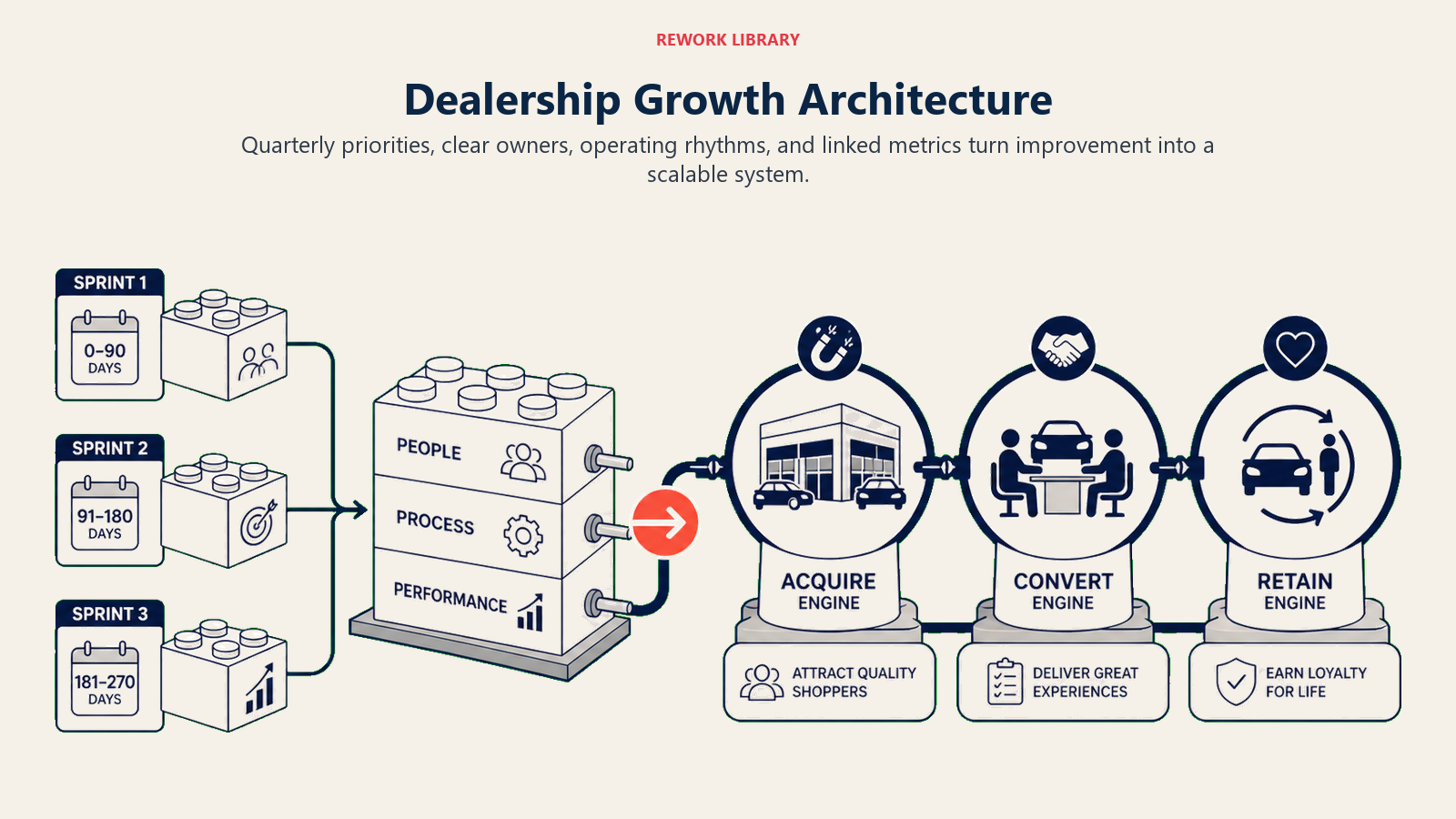
Department-level KPIs ensure every team knows their growth contribution. Sales needs to track lead response time, appointment set rate, show rate, close rate, and gross per unit. Service tracks customer retention rate, hours per RO, labor efficiency, and parts-to-labor ratio. F&I monitors PVR, product penetration, and chargeback rate.
Post these KPIs publicly. Review them weekly. Tie compensation to performance. What gets measured gets managed.
Cross-functional coordination means service advisors understand sales goals, sales managers respect service retention, and F&I managers support customer satisfaction. Monthly all-hands meetings, shared performance dashboards, and cross-department incentives build the culture.
When service refers a trade opportunity to sales, and sales rewards the service advisor, you're building the right system.
Technology infrastructure enables everything else: CRM for lead management, DMS for operational data, digital retailing for online transactions, service scheduling for retention, marketing automation for customer communication, and analytics dashboards for performance visibility.
Don't buy technology because it's trending. Buy technology that solves a specific bottleneck in your growth architecture.
The dealerships that scale from $30M to $50M to $75M in annual revenue don't have different market conditions. They have better systems. They connect the three revenue engines. They optimize leverage points. They remove constraints before hitting them. And they execute with discipline that compounds over years, not quarters.
That's the growth model that actually works. Build it intentionally, and your dealership will be the one pulling ahead while competitors wonder why they're stuck.