Internet Lead Follow-Up: Multi-Touch Sequences That Convert Digital Shoppers - 2026 Guide
Turn this article into takeaways for your work.


Each assistant summarizes the article only for you and suggests best practices for your work.
The average internet lead receives 1.3 follow-up attempts before being abandoned. Meanwhile, converting an internet lead requires an average of 8-12 touches. This gap between effort and results explains why most dealerships convert less than 12% of leads.
Your BDC agent calls a lead at 10am. No answer. Leaves a voicemail. Sends an email. Marks the lead "attempted contact" and moves to the next one. That lead sits in the CRM for three days until someone else tries again, gets no answer again, and the lead eventually goes cold.
Meanwhile, the customer is legitimately interested, they're just busy. They're at work when you call. Their inbox is full. They're shopping five other dealerships and can't keep everyone straight. They need multiple touches across multiple channels before they engage.
The dealers converting 25-30% of internet leads aren't smarter or luckier. They're more persistent and more systematic. They follow up 10-15 times over 30 days using phone, email, text, video, and social media. Cox Automotive data shows that internet leads contacted within five minutes convert at 25-32%, but most leads require multiple follow-up attempts before they engage. They provide value in every touch. They make it easy for customers to respond.
This article outlines exactly what they do and how you can replicate it.
Follow-Up Strategy Framework
Effective follow-up requires strategy, not just activity.
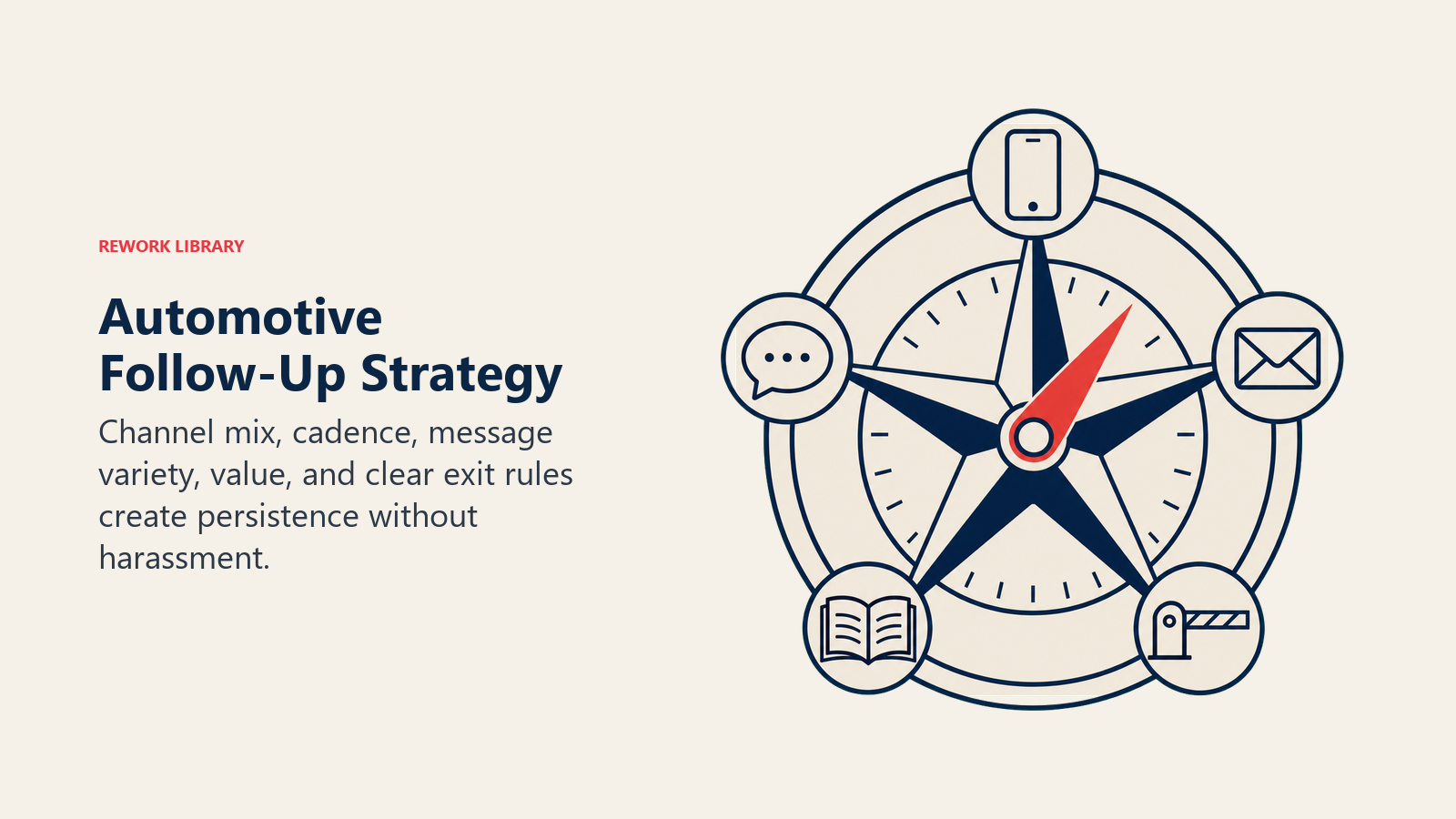
Multi-channel approach recognizes that customers consume information differently. Some people answer phones but ignore emails. Others reply to texts but let calls go to voicemail. A few prefer video messages or social media DMs. You need to reach customers where they actually pay attention, which means trying multiple channels.
Frequency and persistence without harassment is a delicate balance. You want to stay top-of-mind without becoming annoying. The key is varying your message and providing value. If every touch says "Just checking in, are you still interested?" you're harassing. If each touch offers new information, answers different questions, or highlights different vehicles, you're adding value.
Value-driven messaging vs "just checking in" separates effective follow-up from noise. "Hi, just wanted to see if you're still interested in the Civic" is lazy. "Hi Sarah, I noticed Honda just announced an additional $1,000 rebate on 2026 Civics through month-end. This brings your EX model down to $27,450. Want to discuss payment options?" is valuable.
Long-term nurture vs short-term conversion requires different tactics at different stages. The first seven days is about converting hot leads quickly. Days 8-30 is about keeping warm leads engaged until their timing aligns. After 30 days, you're nurturing long-term prospects who may buy in 60-90 days or longer.
Lead lifecycle stages and appropriate tactics mean recognizing where customers are in their buying journey. Someone who submitted an inquiry yesterday needs aggressive phone follow-up. Someone who inquired four weeks ago but hasn't engaged needs value-driven email nurture. Someone who test drove but didn't buy needs specific objection handling and competitive alternatives.
When to recycle or retire leads is judgment-based but necessary. After 15-20 touch attempts over 60 days with zero engagement (no answers, no replies, no email opens), leads should be retired from active follow-up. But don't delete them, move them into long-term drip campaigns with monthly touches. Some customers take 6-12 months to buy.
First 24 Hours Follow-Up
The first day determines whether leads become opportunities or ghosts.
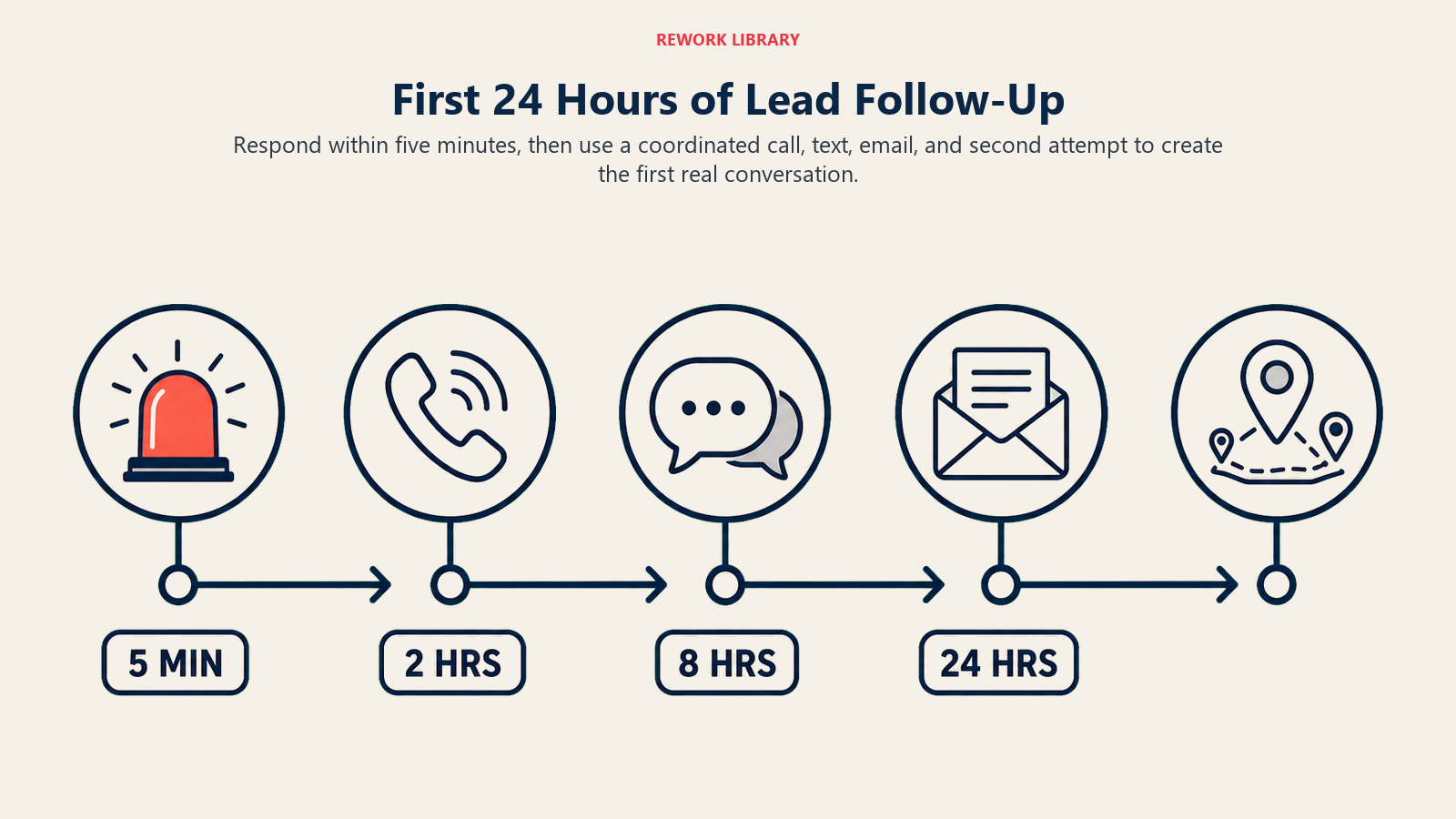
Immediate response (under 5 minutes) has been covered in lead response time optimization, but it bears repeating: your first attempt should happen within five minutes of lead arrival. This dramatically increases contact rates and conversion rates. If you can't respond within five minutes, you've already lost ground to competitors.
First phone call approach should be conversational, not scripted-robot. "Hi Sarah, this is Marcus from Honda of Springfield. You just submitted an inquiry about the white Civic EX on our website, I'm looking at it right now and wanted to make sure you had all the details. Did I catch you at a good time?" Reference their specific inquiry, acknowledge what they were looking at, and ask permission to continue the conversation.
Acknowledgment email or text should fire immediately even if you're preparing to call. "Hi Sarah, we received your inquiry about the 2026 Civic EX. I'm pulling details now and will call you in the next few minutes. -Marcus, Honda of Springfield." This shows responsiveness and manages expectations.
Second attempt timing should be 2-4 hours after the first attempt. If you call at 10am and get voicemail, try again at 1pm. Don't wait until tomorrow. Many customers are in meetings or driving when you first call but are available a few hours later. Different time of day = different result.
Evening follow-up strategy catches customers after work hours. Many internet leads submit inquiries during business hours but can't talk until evening. If you tried at 10am and 2pm, try again at 6:30pm. Don't assume customers won't answer calls after 5pm, some prefer evening contact when they're home and relaxed.
Voicemail and email synchronization means your messages should complement each other. If your voicemail says "I'll send you vehicle details via email," actually send that email within minutes. If your email says "I just left you a voicemail," make sure the voicemail actually went through. Synchronized multi-channel touches feel professional and coordinated.
Days 2-7 Intensive Phase
The first week is your highest-leverage opportunity.
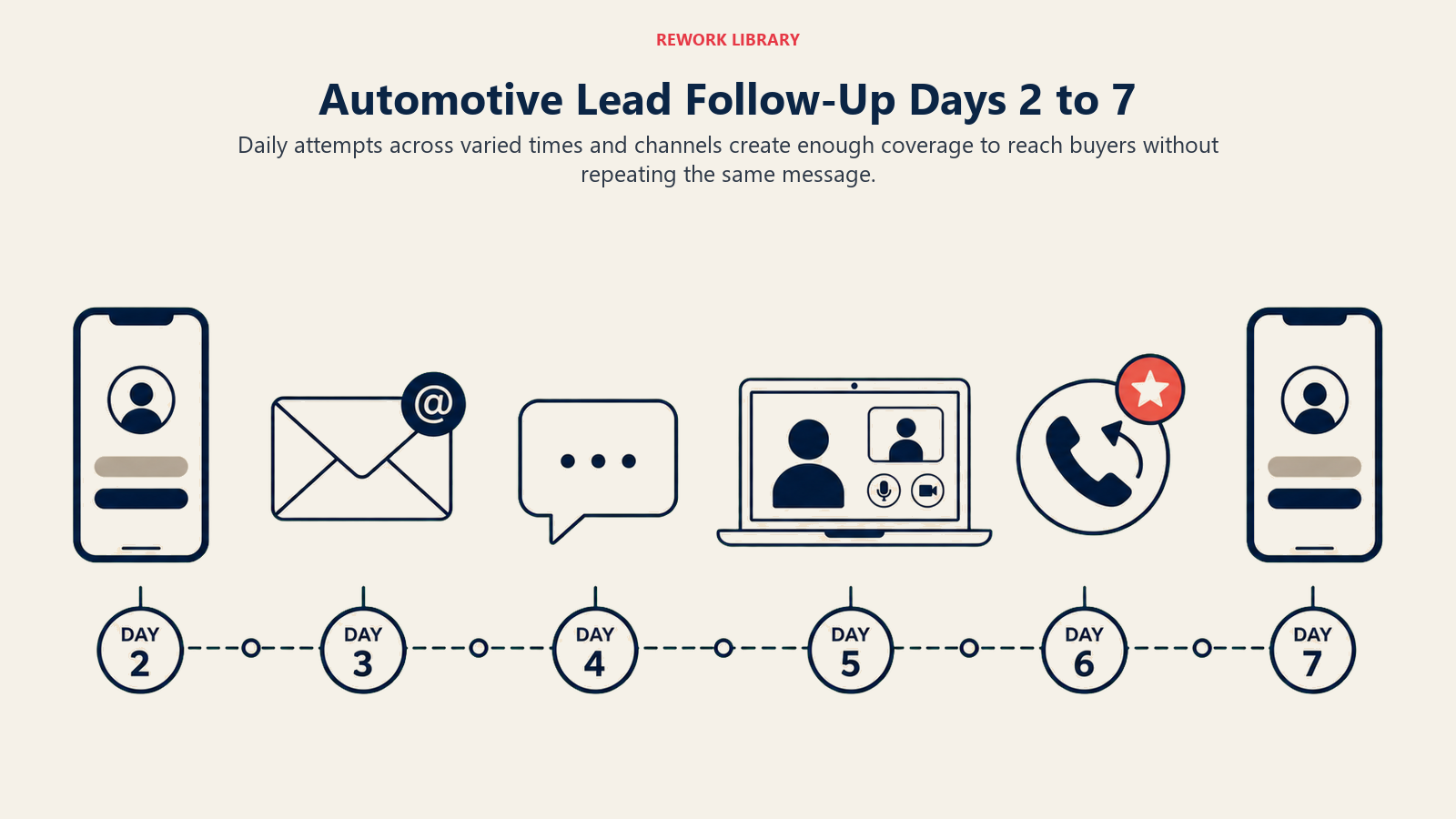
Daily contact attempt schedule should be aggressive but not robotic. Call once per day at different times. Send one email and one text every 2-3 days. Leave one voicemail per day maximum. Try different times: morning (9-11am), lunch (12-1pm), afternoon (2-4pm), evening (6-8pm). Peak calling times vary by market and demographic.
Varying communication channels prevents channel fatigue. Don't call three times in a row and give up. Try: call, email, text, call, video message, call, email. Each channel has different response rates. Some customers who ignore calls religiously will reply to texts instantly.
Different value propositions per touch keep your outreach fresh. Touch 1: "Here are the details on the Civic EX you looked at." Touch 2: "I wanted to mention we have similar Civic Sport models that might interest you." Touch 3: "Honda just announced new financing rates, 0.9% for 60 months." Touch 4: "I appraised your trade and wanted to share the value." Each message provides new information or addresses different concerns.
Peak call time optimization varies by customer demographics. Retirees often answer mid-morning (9-11am). Working professionals answer lunch (12-1pm) or evening (6-8pm). Small business owners sometimes answer early (7-9am) or late (8-9pm). McKinsey research confirms that 70% of auto customers start their journey digitally, making multi-channel follow-up essential. If you're not reaching someone, vary your timing.
Engagement-based adjustments mean changing tactics based on response. If a customer opens every email but never answers calls, shift to email-heavy follow-up. If they answer once then go dark, reference that conversation in future touches: "When we spoke Tuesday, you mentioned you wanted to discuss payment options, I have those ready when you'd like to talk."
Early appointment opportunities should be offered in every touch. Don't assume customers will volunteer to come in. Make it easy: "I have availability tomorrow at 2pm or Thursday at 11am if you'd like to see the vehicle. Which works better?" Offer appointments even if customers haven't expressed strong interest, sometimes they're just waiting for you to suggest next steps.
Weeks 2-4 Active Nurture
After the first week, shift from intensive outreach to consistent nurture.
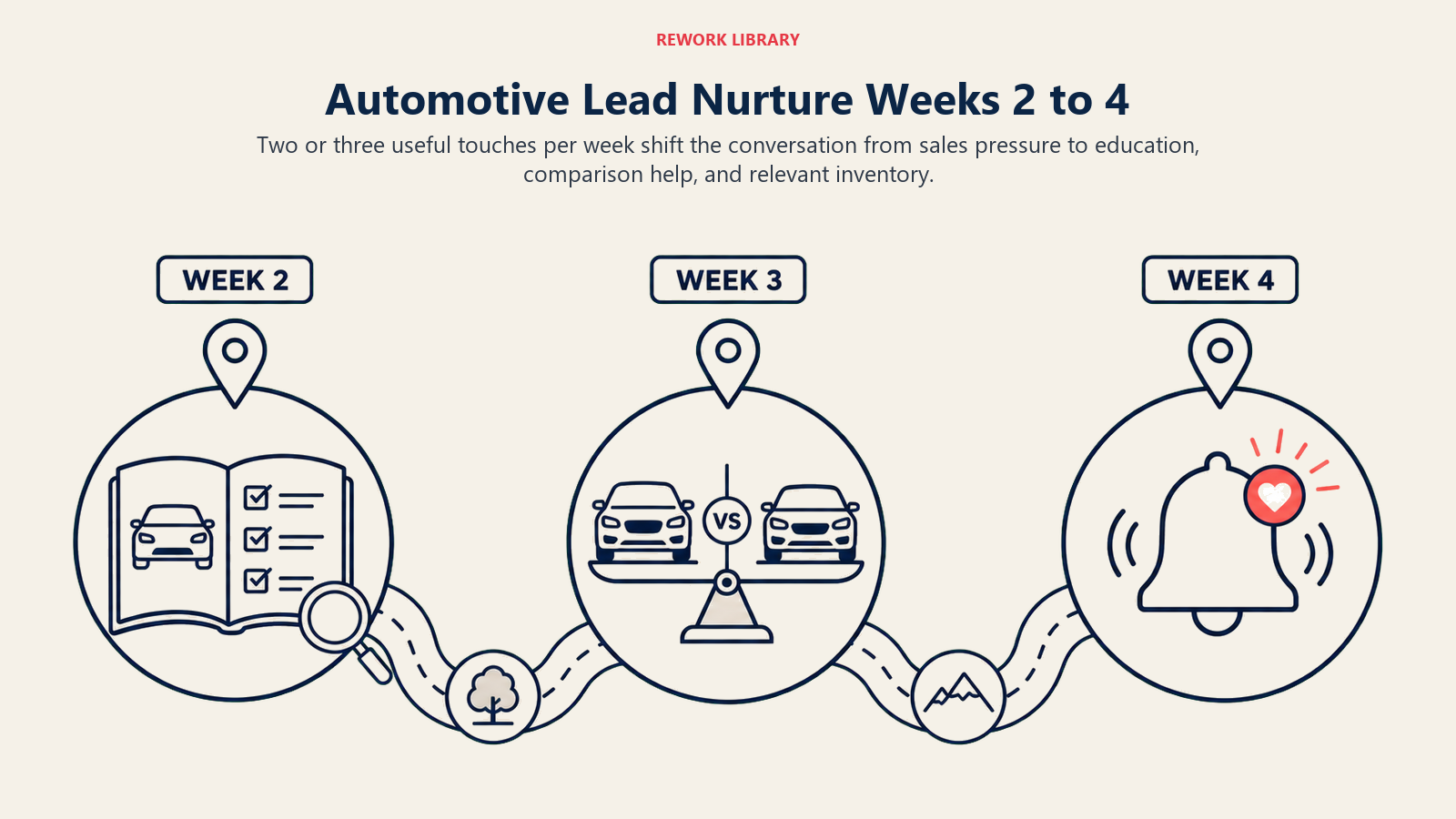
2-3 touches per week cadence maintains presence without harassment. You're staying visible but giving customers breathing room. Typical schedule: Monday call, Wednesday email, Friday text. Or: Tuesday call, Thursday video message, next Monday email. Consistent but not overwhelming.
Educational content delivery shifts from sales pitches to value-added information. Send helpful articles: "5 Things to Check When Buying a Used Vehicle" or "How to Get the Best Trade-In Value." Share videos: walkarounds of vehicles they viewed, explanation of safety features, comparison of trim levels. Content marketing positions you as helpful advisor, not pushy salesperson.
Inventory match updates keep your dealership top-of-mind. "Sarah, I know you were looking at white Civic EXs. We just got a new one in with the upgraded wheels and sunroof package. Want to see photos?" This works because you're providing relevant new information, not just "checking in."
Incentive and pricing changes create natural follow-up opportunities. When manufacturers announce new rebates, financing specials, or lease programs, you have legitimate reasons to contact every lead interested in those vehicles. "Honda just extended their 0.9% financing program through month-end, this saves you about $1,200 in interest on the Civic EX you looked at."
Trade value or payment option focus addresses the two biggest customer questions. If you haven't discussed their trade yet, reach out: "I can pull a quick appraisal on your current vehicle if you'd like, takes about 5 minutes over the phone." If you haven't discussed payments: "I worked up some payment scenarios on the Civic EX, we're looking at $435/month with your trade. Want to go through the details?"
Re-engagement trigger events include email opens, website returns, or form submissions. If a customer hasn't engaged in 10 days but suddenly opens your email, call within an hour. "I noticed you opened my email this morning about the Civic, did you have any questions?" Website visits and return visits to VDP pages are even stronger signals, respond immediately.
Long-Term Nurture (30-90+ Days)
Some customers take months to buy. Stay in touch without annoying them.
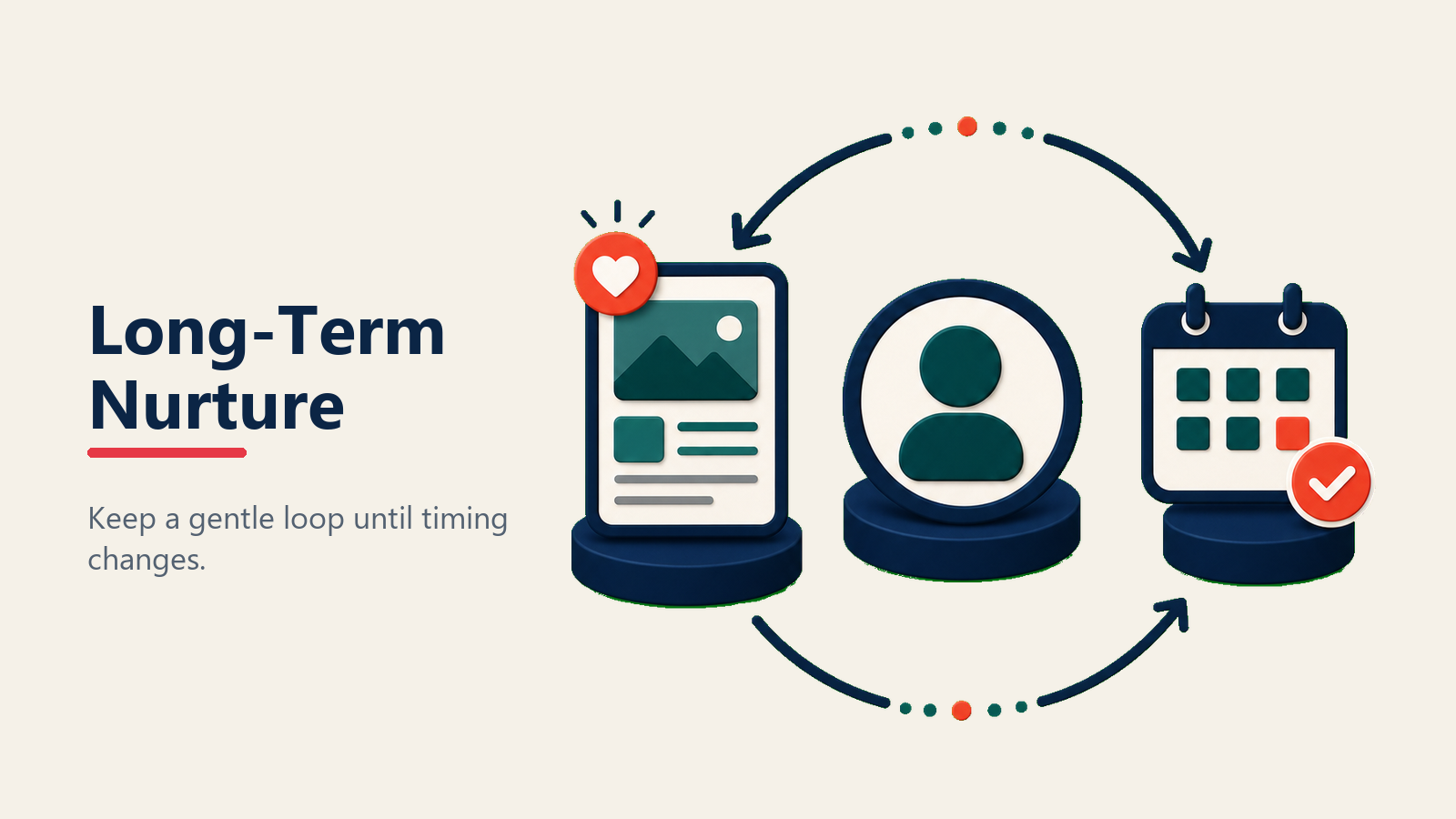
Weekly or bi-weekly contact is enough for long-term leads. You're maintaining visibility until their timing improves. These touches should be low-pressure and value-driven. "Checking in, are you still in the market for a Civic or did your plans change?" gives customers easy outs while keeping the door open.
Automated marketing integration handles long-term nurture efficiently. Your CRM should have drip campaigns: pre-built email sequences that deliver relevant content over time. Set up campaigns for different vehicle types based on lead nurturing sequences. Automation handles the touches while your BDC focuses on hot leads.
Seasonal and event-based outreach creates natural re-engagement opportunities. Tax refund season (February-April), summer sales events, Labor Day, Black Friday, year-end clearance, these events justify reaching out to dormant leads. "Sarah, I know you looked at Civics back in March. Honda's running year-end clearance with 0% financing and $2,500 rebates. Worth revisiting?"
Model year changes and new inventory announcements work similarly. "The 2027 Civics just arrived with updated styling and new features. Want to see how they compare to the 2026 you looked at?" New inventory is always a valid reason to contact old leads.
Personal check-ins from salespeople add human touch to automated nurture. Once per month, BDC agents should personally call their oldest warm leads: "Hi Sarah, Marcus from Honda. I know you looked at Civics a few months ago and haven't heard from us in a while. Just wanted to check if you're still in the market or if your plans changed?" These personal touches sometimes revive leads that automated campaigns can't.
Reactivation campaigns target leads that went cold. Create a "last chance" sequence: "Sarah, I noticed we haven't connected in 90 days. Are you still vehicle shopping or did you already purchase? If you bought elsewhere, congrats! If not, I'd love to help. Either way, let me know so I can update your preferences." Some customers will reply just to close the loop, creating re-engagement opportunities.
Content & Messaging Strategy
What you say matters as much as how often you say it.
Value-driven subject lines and openers determine whether your messages get read. "Following up on your inquiry" gets ignored. "New $1,500 rebate on Civic EX you viewed" gets opened. Lead with the value or news, not your desire to follow up.
Personalization beyond first name shows you're paying attention. "Sarah, I noticed you looked at three different Civic trim levels on our site. Wondering if you're trying to decide between them or just researching options?" This proves you reviewed their actual behavior, not just their name in a database.
Vehicle-specific information sharing provides legitimate value. Send walkaround videos of the specific vehicle they inquired about. Share detailed spec comparisons if they looked at multiple models. Provide real payment examples with their trade scenario. Specific information beats generic sales pitches.
Comparison and research tools help customers make decisions. "Here's a side-by-side comparison of the Civic EX vs Sport, many customers struggle with this choice." "Here's what the Civic costs compared to Corolla and Mazda3 in similar configurations." Help customers with their research and they'll remember you when they're ready to buy.
Video messages and walkarounds create personal connection. Record 30-60 second videos on your phone: "Hey Sarah, Marcus here. I'm standing next to the white Civic EX you looked at. Wanted to show you it's still here and point out a few features you might not have seen on the website." Video messages get 3-5x higher response rates than text-only emails.
Social proof and urgency elements remind customers that vehicles sell. "The Civic EX you looked at had two other inquiries this week, if you're still interested, let's schedule time for you to see it before it sells." This creates urgency without being manipulative. "Three of our last five Civic buyers came from Springfield area, seems like everyone's looking at these." Social proof builds confidence.
Technology & Automation
Systems enable consistency at scale.
CRM workflow automation handles routine follow-up tasks. Set up workflows: "When lead enters system, send acknowledgment email. Wait 5 minutes, create call task. If no answer, wait 3 hours, create second call task. If no answer, send follow-up email. Wait 1 day, create third call task." Workflows ensure nothing falls through cracks.
Drip campaign configuration provides consistent messaging. Create email sequences for different scenarios: "New Lead 30-Day Sequence," "Test Drive No-Purchase Follow-Up," "Price Quote Follow-Up." Each sequence delivers 8-12 emails over 30-90 days with relevant content timed to typical buying cycles.
Task and reminder systems keep agents accountable. Every unanswered call should create a follow-up task. Every email sent should create a reminder to check for responses. Every appointment scheduled should create confirmation and reminder tasks. Your CRM should be telling agents what to do next at all times.
Response detection and sequence pausing prevent annoying engaged customers. If someone replies to your email or answers your call, automated sequences should pause immediately. You don't want customers receiving a pre-scheduled email after they've already had a conversation with you. Smart automation detects engagement and adjusts accordingly.
Multi-channel sequence orchestration coordinates touches across phone, email, text, and video. Your system should schedule: "Monday 10am - Call. Monday 10:15am - Email. Tuesday 2pm - Text. Wednesday 9am - Call. Thursday 3pm - Video email." Orchestrated sequences ensure varied timing and channels without manual planning.
Performance tracking and optimization measure what's working. Track response rates by channel (email vs text vs call), by time of day (morning vs afternoon vs evening), by message type (vehicle details vs incentives vs trade value). Use this data to refine your sequences over time.
Real-World Implementation
Here's a complete 30-day follow-up calendar you can implement:
Day 1:
- 0 min: Auto-acknowledgment email
- 5 min: First phone call + voicemail
- 3 hours: Follow-up email with vehicle details
- 6 hours: Text message introduction
Day 2:
- Morning: Second phone call + voicemail
- Afternoon: Video message with vehicle walkaround
Day 3:
- Afternoon: Third phone call
- Evening: Email with payment scenarios
Day 4:
- Morning: Text message with inventory update
- Afternoon: Fourth phone call
Day 5:
- Afternoon: Email with comparison information
Day 6:
- Morning: Fifth phone call
- Afternoon: Video message with new information
Day 7:
- Morning: Text message check-in
Days 8-14:
- Three total touches: call, email, text (Monday/Wednesday/Friday)
Days 15-21:
- Two touches: call and email (Tuesday/Friday)
Days 22-30:
- Two touches: email and call (Monday/Friday)
After 30 days, transition to weekly or bi-weekly touches based on engagement level.
The Follow-Up Reality
Most dealers give up too early. They make 2-3 attempts, get no response, and move on. But 80% of sales happen after the fifth touch, and the average internet customer needs 8-12 touches before they respond.
Your competition is probably making 2-3 attempts. If you make 15 attempts, you'll capture the 80% of deals they're abandoning.
But quantity without quality doesn't work either. Fifteen "just checking in" calls accomplish nothing. Fifteen valuable, varied, multi-channel touches with vehicle-specific information, changing incentives, helpful content, and personal videos? That wins deals.
Build your system, automate what you can, personalize what you can't, and commit to following up until customers buy from you or explicitly tell you to stop.
Most leads aren't dead, they're just waiting for you to try again. For more on improving your internet sales process, explore automotive lead scoring, phone skills for automotive, appointment setting best practices, and automotive marketing automation.