Dealership Email Marketing: Building Revenue from Your Customer Database - 2026 Guide
Turn this article into takeaways for your work.


Each assistant summarizes the article only for you and suggests best practices for your work.
A 15,000-customer database generates $2M in annual revenue with proper email strategy. Most dealerships achieve $200K. The difference isn't database size, it's systematic communication.
The average dealership sits on 8,000-20,000 customer records: past buyers, service customers, unconverted leads. This database represents customers who've already raised their hand and said "I might do business with you." Yet most dealers send them nothing more than generic monthly specials that get 3% open rates.
Top-performing dealers run 12-15 distinct email campaigns targeting specific customer segments with relevant, timely messages. They generate 38:1 ROI, $38 in revenue for every $1 spent on email marketing. This isn't magic. It's automation, segmentation, and value-based messaging.
The Email Marketing Opportunity
The average 100-vehicle-per-month dealership has 12,000 customer records in their DMS. That database breaks down to roughly 2,500 sales customers (past buyers), 8,000 service customers (including many non-purchasers), and 1,500 unconverted leads from the past 24 months.
Email ROI averages 38:1 across industries. According to industry research, automotive performs even better at $40-44 ROI per dollar spent when campaigns are properly segmented and automated. Compare this to direct mail (18:1), paid search (12:1), or display advertising (8:1). No other channel delivers comparable returns with the same scalability.
Permission-based marketing advantages are substantial. These customers opted in by doing business with you or submitting a lead form. They expect to hear from you. Open rates for dealership emails run 22-28% compared to 15-18% for cold outreach. Click-through rates average 3.2% vs 0.8% for non-permission-based campaigns.
Integration with DMS and CRM data enables precise targeting. You know what they bought, when they bought it, their service history, their equity position, their lease maturity date. This data allows personalization that generic advertising can't match. An email saying "Your 2021 F-150 is worth $8,000 more than you owe" gets opened. A blast email about "Amazing Truck Deals" gets deleted.
Building Your Email Database
Customer data sources start with your DMS. Export all sales and service customers from the past 5 years. This gives you a foundation of actual customers. Add lead data from your CRM for prospects who inquired but didn't buy. Include website form submissions, chat conversations, and phone inquiries.
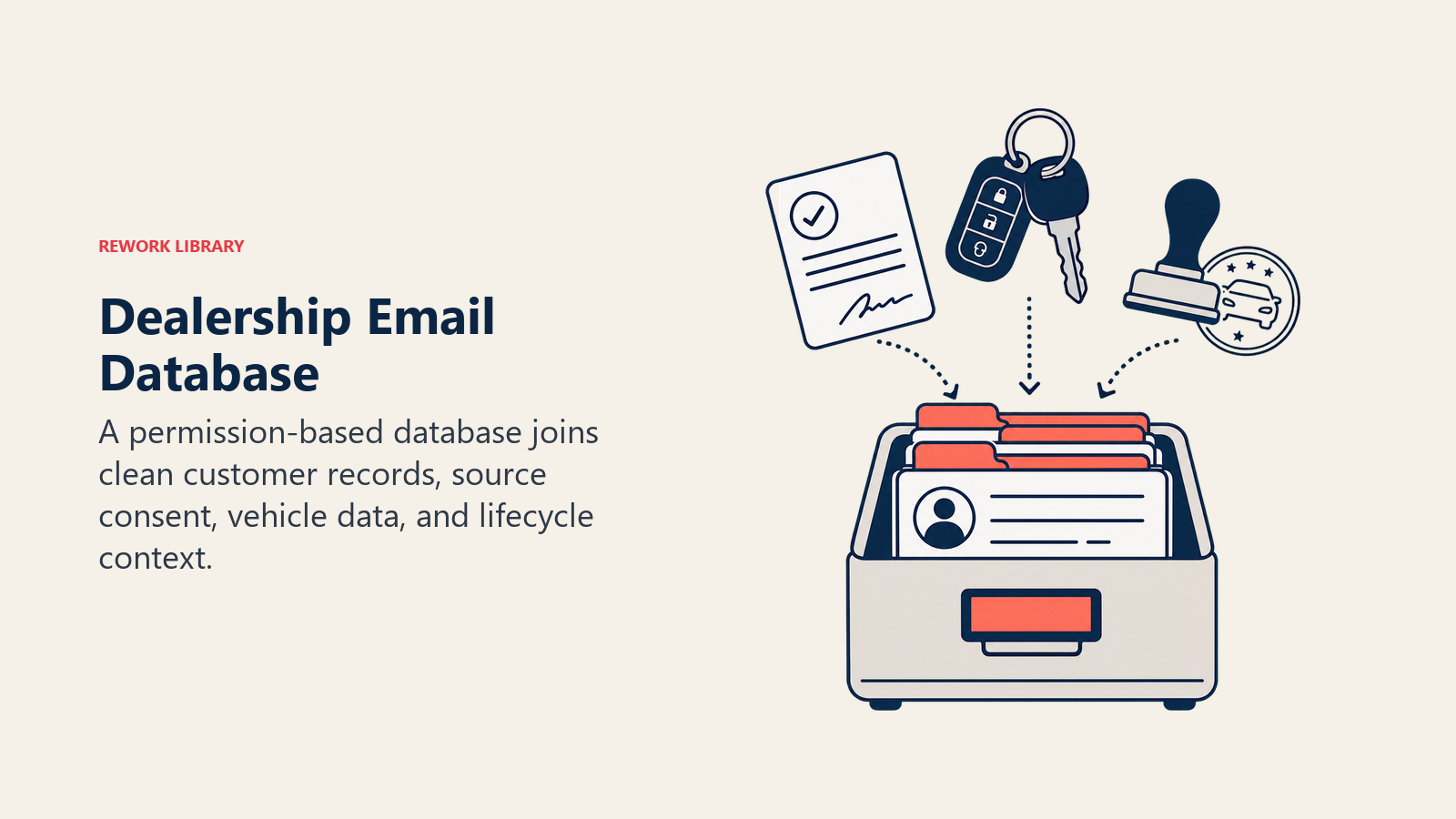
Opt-in strategies and compliance require understanding CAN-SPAM regulations. Existing customers (anyone who purchased or serviced with you) have an established business relationship, you can email them. Leads who submitted forms with your privacy policy visible also qualify. What you can't do: buy email lists, add people who never interacted with you, or send commercial emails to personal contacts.
List segmentation separates good email programs from great ones. Start with these essential segments:
- Active leads (inquired within 90 days, haven't purchased)
- Sales customers by purchase date (0-12 months, 12-24 months, 24-36 months, 36+ months)
- Service-only customers (service with you, never purchased)
- Positive equity customers (owe less than current market value)
- Lease maturity (6 months, 3 months, 1 month from lease end)
- Inactive customers (no service visit in 12+ months)
Data hygiene requires ongoing maintenance. Run email validation tools quarterly to remove invalid addresses (hard bounces). Monitor engagement metrics and suppress emails to recipients who haven't opened in 6+ months. Update customer records when they make purchases or service visits. Clean data drives deliverability and protects sender reputation.
Email Campaign Types
Lead Nurturing sequences convert inquiries into appointments. The average car buyer takes 14 days and 8 touchpoints to make a decision. Your automated lead nurturing sequence should provide value at each step: immediate response confirming inquiry, vehicle comparison information, financing education, trade-in value insights, and appointment scheduling prompts.
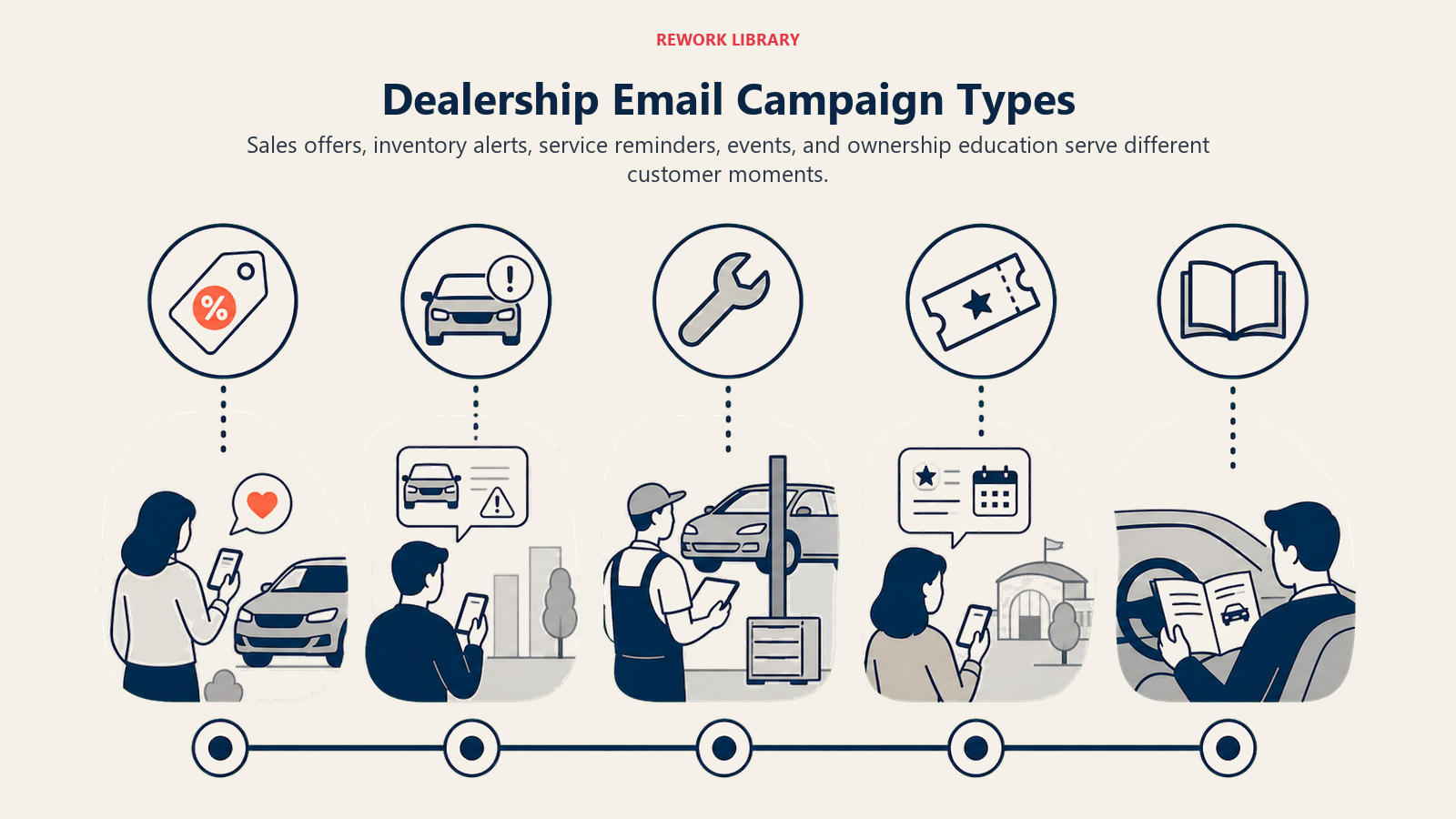
Service Reminders drive fixed ops revenue and customer retention. Automated emails triggered by mileage intervals (5K, 10K, 15K) or time periods (6 months since last visit) recover 18-25% of lapsed customers. Include specific services due, estimated pricing, and online scheduling links. These emails open at 35%+ because they provide genuine value.
Equity Mining campaigns identify customers in strong trade positions. Monthly emails to customers whose vehicles have appreciated in value or whose loan balances have decreased substantially generate 12-15 appointments per 1,000 emails sent. The message is simple: "You have $X in equity. Here's what you can drive for the same payment."
Inventory Alerts match new arrivals to customer preferences. If a customer test-drove a Tacoma but didn't buy, notify them when you get a Tacoma that matches their criteria. These targeted alerts convert at 8-12% compared to 0.5% for generic "new inventory" blasts. Improve your inventory strategy with automotive inventory management.
Loyalty Campaigns maintain engagement during non-purchase windows. Birthday emails with service discounts, purchase anniversary emails recognizing their ownership experience, referral incentive campaigns, these keep your dealership top-of-mind during the 3-4 years between purchases.
Promotional Campaigns for sales events and incentives work when sent to the right audience. Don't blast your entire database with every weekend sale. Target customers likely to be in-market based on vehicle age, equity position, and service patterns. A targeted promotion to 2,000 qualified recipients outperforms a generic blast to 15,000 unqualified contacts.
Lead Nurturing Sequences
Day 0 (Immediate Response) confirms their inquiry and sets expectations. This email should send within 5 minutes of form submission. Include: confirmation you received their request, timeline for personal follow-up, link to the vehicle they inquired about, and your direct contact information. Open rates exceed 65% when sent immediately vs 35% when sent hours later.
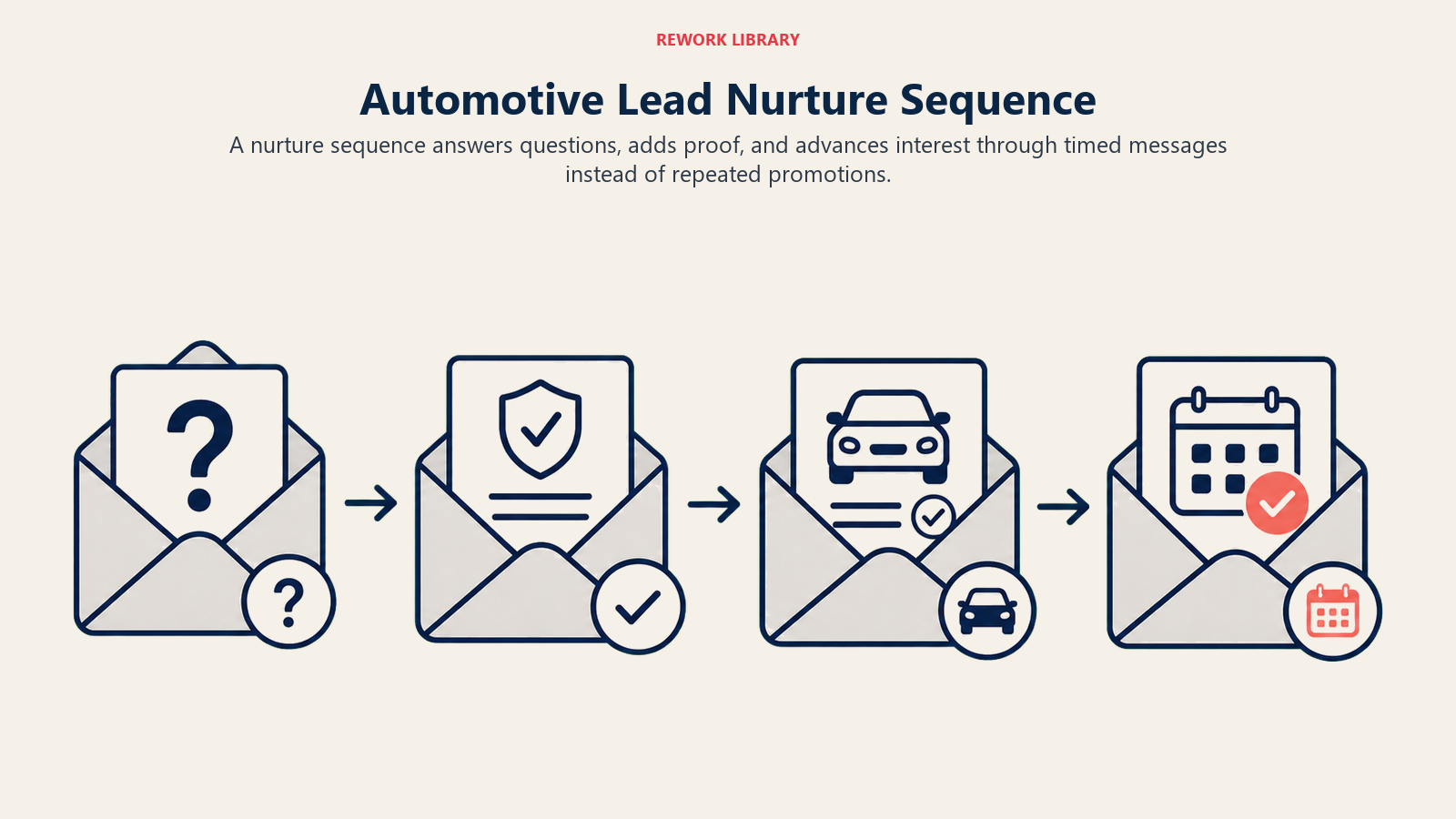
Day 1-3 (Value Proposition) differentiates your dealership and the specific vehicle. Why buy from you versus the dealer across town? Include: customer testimonials, vehicle history report summary, competitive pricing analysis, available incentives, trade-in value estimator. The goal is demonstrating value, not pushing for immediate commitment.
Day 4-7 (Objection Handling) addresses common purchase barriers. Most buyers at this stage are weighing options and concerns. Send content about: financing options and credit solutions, warranty and protection products, trade-in process and fair valuations, vehicle inspection process, or comparison with competitor vehicles they're likely considering.
Day 8-14 (Urgency and Closing) creates motivation to act. Without being manipulative, communicate real scarcity: "This vehicle has 3 inquiries this week," inventory turn rates, pending price changes, or expiring incentives. Include a specific call-to-action: schedule a test drive, get pre-approved, receive a trade appraisal.
Personalization strategies dramatically improve conversion. Use merge fields for their name, the specific vehicle year/make/model they inquired about, their trade-in vehicle if known. Reference their timeline if they mentioned it in the inquiry. Send from a real person (salesperson or BDC rep) with photo and direct phone number, not "sales@dealership.com."
Service Retention Emails
Service due reminders based on mileage and time prevent customer defection. Your DMS knows when they last serviced and estimated annual mileage. Trigger emails at appropriate intervals: "Time for your 30K service" or "Your vehicle is due for oil change based on 6 months since last visit." Include service menu pricing and direct scheduling links.
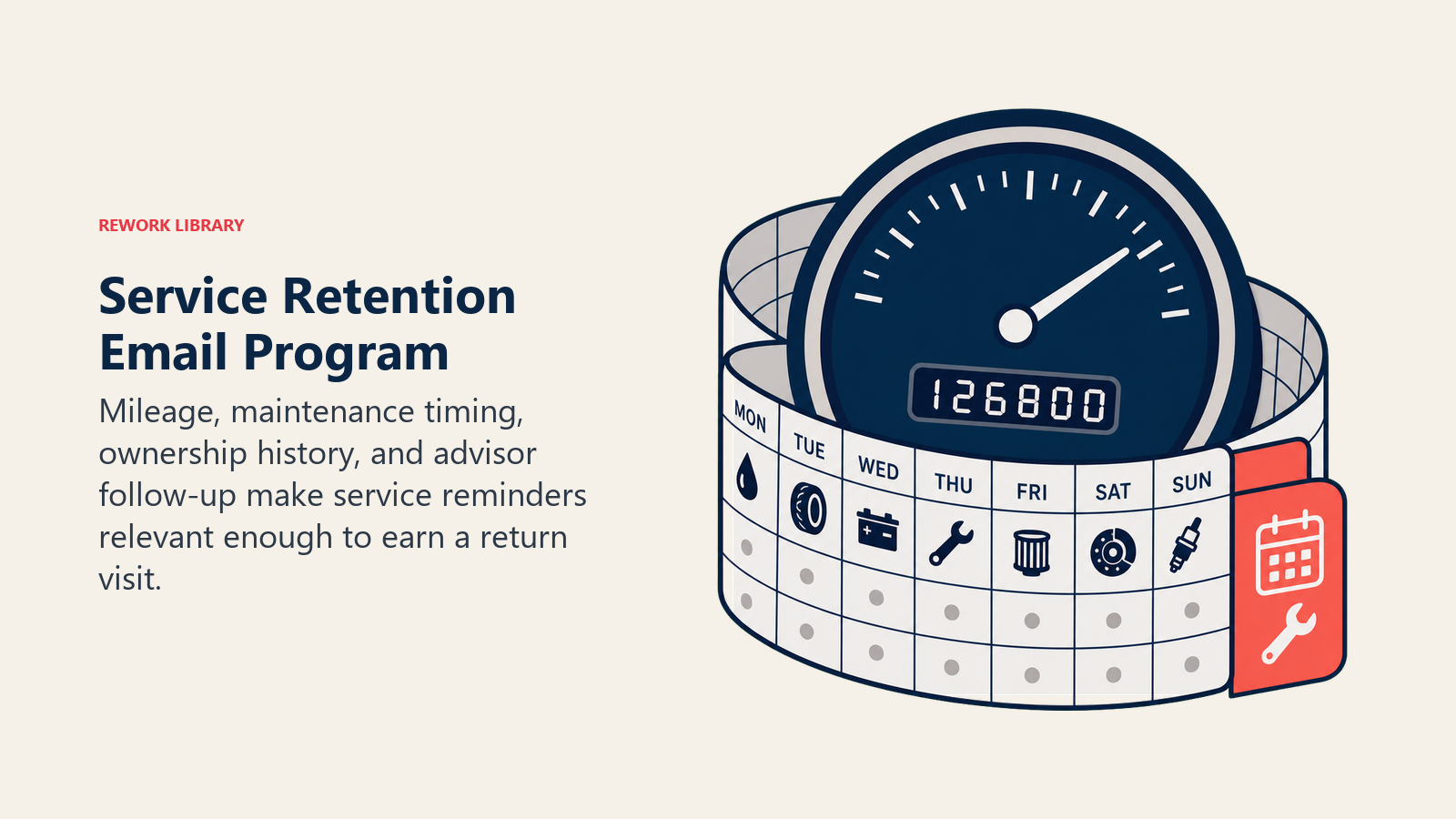
Post-service follow-up accomplishes two goals: quality control and sales opportunity identification. Send within 24 hours of service completion asking for feedback on their experience. Include CSI survey link. Use responses to identify service issues before they become negative reviews. Flag high repair costs as sales opportunities, customers who just spent $2,500 fixing an aging vehicle are prime prospects.
Recall notifications position you as their trusted advisor. When manufacturers issue recalls affecting vehicles in your customer base, send targeted emails explaining the recall, safety implications, and easy scheduling for the repair. This builds trust and gets customers in the door where service-to-sales conversations can happen.
Seasonal maintenance campaigns leverage weather and calendar events. Fall: winter prep packages, tire changeover, battery testing. Spring: AC system checks, road trip safety inspections. These campaigns create service demand during typically slow periods and demonstrate proactive care for their vehicle.
Service-to-sales crossover opportunities require coordination between fixed ops and sales. Flag service customers who meet trade criteria (high mileage, expensive repairs, aging vehicle) and include soft trade-in messaging: "By the way, your 2018 Accord has $4,200 in equity. See what you could drive for a similar payment." Learn more about service-to-sales pipelines. This plants seeds that sales can follow up on.
Equity Mining Campaigns
Identifying positive equity customers requires DMS-CRM integration. Your system should calculate current market value (using data feeds from KBB, NADA, Black Book) minus outstanding loan balance. When equity exceeds $3,000, that customer becomes a prime target. Run this calculation monthly as market values fluctuate.
Lease maturity outreach starts at 6 months before lease end. The sequence includes: 6-month email introducing lease-end options, 3-month email with current lease buyout vs market value analysis, 1-month email with specific replacement vehicles matching their needs. Dealers running systematic lease maturity campaigns retain 45-55% of expiring leases vs 15-20% without campaigns.
Market value updates for customers in long-term ownership generate surprise and interest. "Your 2020 Silverado has appreciated $6,200 since you bought it due to market conditions" creates urgency. These aren't common anymore after market normalization, but they work when used vehicle values spike.
Trade-in appraisal offers move customers from consideration to action. Rather than generic "What's your trade worth?" messages, send specific estimates: "Based on our records, your 2019 Camry with estimated 48K miles is worth $16,800-$18,200 in trade. Get your exact value here." Specificity builds credibility.
New model launch campaigns target current owners of the outgoing generation. When the 2026 F-150 launches with significant updates, email your 2021-2024 F-150 owners highlighting improvements. Position it as an upgrade opportunity, not a critique of their current vehicle. Include their equity position and payment comparison for the new model.
Email Design Best Practices
Mobile-first design isn't optional. 62% of dealership emails are opened on mobile devices. Single-column layouts, large touch-friendly buttons, and 14pt+ font sizes ensure readability. Test every email on both iPhone and Android before sending. A desktop-optimized email that's unreadable on mobile wastes 62% of your opportunity.
Clear CTA placement drives action. The primary call-to-action should appear above the fold on mobile (visible without scrolling). Use contrasting button colors that stand out from your brand palette. Make buttons large, minimum 44x44 pixels for easy tapping. Include the same CTA at the bottom for readers who scroll through content.
Image optimization balances visual appeal with deliverability. Too many images trigger spam filters. All-image emails with no text get blocked. Aim for 40% images, 60% text ratio. Use alt text for all images so the message makes sense even if images don't load. Keep total email size under 100KB for fast loading.
Branded templates maintain consistency and professionalism. Create 3-5 templates for different campaign types: lead nurturing, service reminders, sales promotions, equity alerts. Include your logo, brand colors, dealership contact information, and social media links. Consistency builds recognition and trust.
Plain text vs HTML strategy depends on campaign type. Urgent personal outreach (BDC follow-up, sales consultant direct emails) performs better as plain text, it feels personal and gets past spam filters. Marketing campaigns (monthly specials, event invitations) work better as HTML for visual impact. Use both strategically.
Deliverability & Compliance
Sender reputation determines whether your emails reach inboxes or spam folders. Email providers track complaint rates, bounce rates, and engagement metrics for your domain. Maintain complaint rates below 0.1% and hard bounce rates below 2%. High engagement rates (opens, clicks) boost reputation and improve deliverability.
Avoiding spam filters requires following best practices: don't use ALL CAPS in subject lines, avoid spam trigger words (FREE, LIMITED TIME, ACT NOW), include your physical dealership address, provide clear unsubscribe options, and maintain consistent sending patterns (don't go from 0 emails to 10,000 overnight).
CAN-SPAM compliance requirements are straightforward: include your dealership's physical address in every email, honor unsubscribe requests within 10 business days, don't use deceptive subject lines or header information, and identify the message as an advertisement if it's commercial in nature. According to the FTC, violations carry penalties of up to $53,088 per email.
Unsubscribe management should be simple and immediate. One-click unsubscribe links are required by Gmail and Yahoo as of 2024. Process unsubscribes immediately, sending email to someone who unsubscribed damages reputation and violates regulations. Consider preference centers where customers can choose email frequency or topics rather than unsubscribing completely.
Authentication protocols (SPF, DKIM, DMARC) prove your emails are legitimately from your domain. Work with your email platform or IT provider to configure these records. Gmail and Yahoo require DKIM and SPF at minimum. DMARC provides additional protection against spoofing and phishing. Proper authentication dramatically improves inbox placement rates.
Email Performance Metrics
Open rates vary by campaign type. Lead nurturing averages 35-45%, service reminders 40-50%, equity mining 25-30%, promotional campaigns 18-25%. Track open rates by segment and campaign to identify what resonates with different audiences. Declining open rates signal list fatigue or poor targeting.
Click-through rates measure engagement beyond opening. Industry average is 2.5-3.5% for automotive emails. Higher CTR indicates compelling content and clear calls-to-action. Low CTR with high open rates means your subject lines work but content disappoints. Test different CTAs, button placements, and offer structures to improve clicks.
Conversion tracking connects email activity to revenue. Use UTM parameters in all email links to track website behavior in Google Analytics. Configure CRM to capture email source when leads convert to appointments. Calculate how many email recipients scheduled appointments, purchased vehicles, or booked service. This data determines true ROI.
Revenue attribution requires tracking the full customer journey. A customer might open 5 emails over 3 months before visiting the dealership. Give partial credit to all touchpoints, not just the last click. Most email platforms integrate with CRM systems to track multi-touch attribution. This reveals the compounding value of consistent email communication.
A/B testing strategy improves performance over time. Test one variable per campaign: subject line, send time, CTA copy, offer structure, email length. Run tests with statistically significant sample sizes (minimum 1,000 recipients per variation). Implement winners and continue testing. Small improvements compound, a 0.5% conversion improvement generates 5 extra sales monthly at a 100-sale dealership. Email marketing benchmarks show that automotive industry open rates average 22-28%, providing clear targets for performance measurement.
Automation & Technology
Email platform selection should match your sophistication level. Entry-level dealers start with Constant Contact or Mailchimp ($20-80/month) for basic campaigns. Mid-level dealers need automotive-specific platforms like DealerSocket, VinSolutions, or Elead ($200-500/month) that integrate with DMS and CRM. Enterprise dealers build custom solutions with platforms like Salesforce Marketing Cloud or Adobe Campaign.
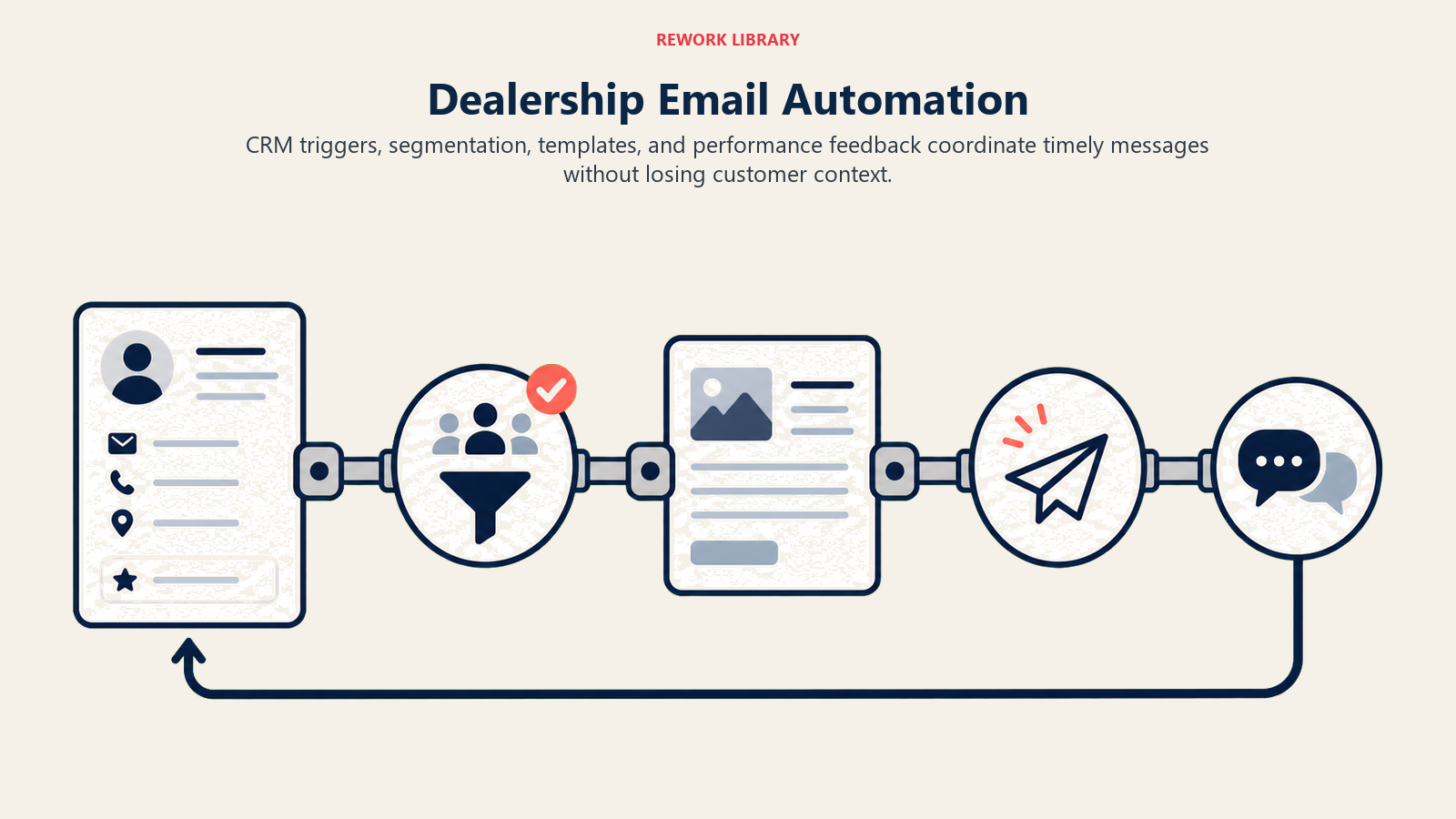
DMS/CRM integration eliminates manual work and enables real-time personalization. When a customer services their vehicle, that data should automatically update their email segment. When equity position changes, they should automatically enter or exit equity mining campaigns. Integration also enables closed-loop reporting, tracking which emails generated service appointments or vehicle sales.
Trigger-based campaigns run automatically based on customer actions or data changes. Examples: welcome email when someone makes first purchase, service reminder 5 months after last visit, equity alert when market value exceeds loan balance by $5,000. Set up triggers once with automotive marketing automation, they run forever without manual intervention.
Dynamic content personalization shows different content to different recipients in the same email. A trade-in section appears only for customers with positive equity. Service offers appear only for customers overdue for maintenance. Inventory recommendations match their past purchase preferences. This increases relevance without creating 50 different email versions.
Start with the campaigns generating immediate revenue, service reminders and equity mining. Then build out lead nurturing sequences. Add loyalty campaigns last. The goal isn't doing everything immediately. It's building a systematic approach that turns your customer database from a dormant list into a revenue-generating asset.
For more on converting those email leads into sales, see Automotive Lead Management. To build effective follow-up sequences, check out Lead Nurturing Sequences. Service customers deserve special attention, learn more in Service Customer Retention. For equity mining strategies, see Equity Mining Strategy and Owner Retention Marketing. To automate these processes, explore Automotive Marketing Automation.

Senior Implementation Consultant