Service Absorption Rate - The Single Most Important Dealership Metric - 2026 Guide
Turn this article into takeaways for your work.


Each assistant summarizes the article only for you and suggests best practices for your work.
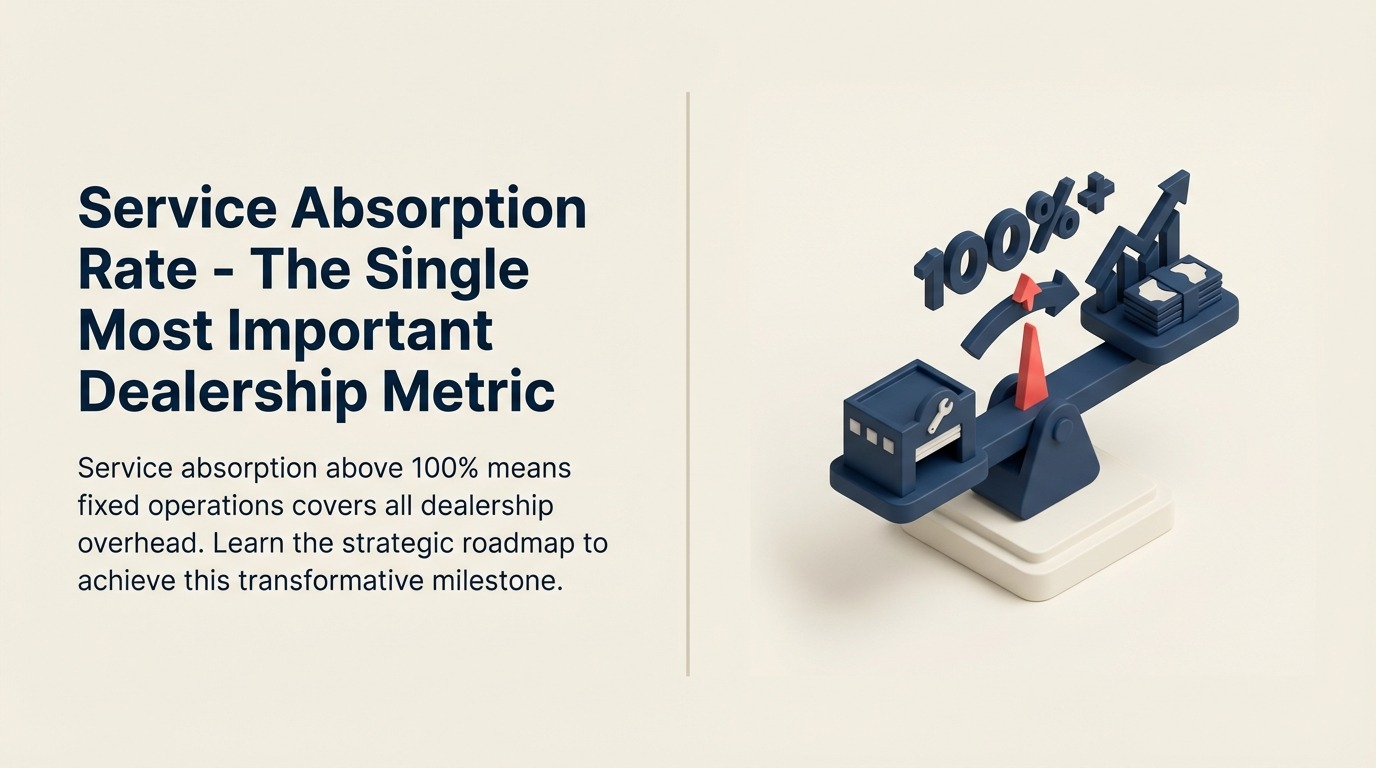
Service absorption rate is the share of a dealership's total fixed expenses that the fixed operations departments (service, parts, and body) cover through their own gross profit. Above 100% means fixed ops pays every bill in the store on its own, so dealers who reach it shift from depending on variable sales gross to sustainable profitability regardless of market conditions.
When your service and parts departments generate enough gross profit to pay every single bill in the dealership, you've achieved what most dealers only dream about. Sales gross becomes pure profit. Market downturns don't threaten your operation. You're running a business built on recurring revenue, not one-time transactions.
But here's what most dealer principals don't realize: the path to 100% absorption isn't about working harder. It's about working smarter on four specific levers that compound over time. Understanding the broader dealership revenue model and service business economics provides context for why absorption matters so much.
What Service Absorption Really Means
Service absorption measures how much of your total dealership expenses your fixed operations covers. The formula is simple:
Service Absorption = (Fixed Ops Gross Profit ÷ Total Dealership Expenses) × 100
Fixed ops gross profit includes service labor gross, parts gross, and sublet gross. That's it. You're not counting sales department gross, F&I income, or anything else. Just the recurring revenue from customers bringing vehicles back for service and repairs.
Total dealership expenses include everything except variable sales expenses directly tied to selling vehicles. You're counting rent, utilities, administrative salaries, general manager compensation, facility costs, and all fixed departmental expenses. Some dealers exclude sales department variable expenses to get a cleaner fixed ops measurement.
Let's look at real numbers. A mid-sized import dealership might have $450,000 in monthly dealership expenses. Their fixed ops generates $380,000 in gross profit. That's 84% absorption, close, but not quite there.
Now consider what happens when that same dealership hits $475,000 in fixed ops gross. They're at 106% absorption. Every dollar of sales gross is now profit. The entire business model shifts.
Where Most Dealerships Stand Today
The industry average hovers between 70-85% absorption depending on brand, market, and dealer management sophistication. According to NADA (National Automobile Dealers Association) research, dealerships with 70% customer retention can expect 90% or better fixed absorption rates. That's not terrible, but it means you're still dependent on sales gross to keep the lights on.
Luxury brands typically run higher absorption rates, BMW, Mercedes, Lexus dealers often see 90-110% because of higher labor rates and premium parts margins. Domestic brands struggle more, with many sitting at 65-75% absorption.
The problem isn't the brand. It's the approach. Too many dealers treat service as a customer accommodation rather than a profit center. They underprice labor, don't invest in service advisor training, and miss the recurring revenue opportunity right in front of them.
When you assess your current state, you need three numbers: your trailing 12-month fixed ops gross, your trailing 12-month total expenses, and your absorption percentage. Most dealers can't quote these numbers off the top of their head. That's the first problem to fix.
The Four Levers That Move Absorption
You can't improve what you don't measure, and you can't move service absorption without understanding which levers to pull. There are four.
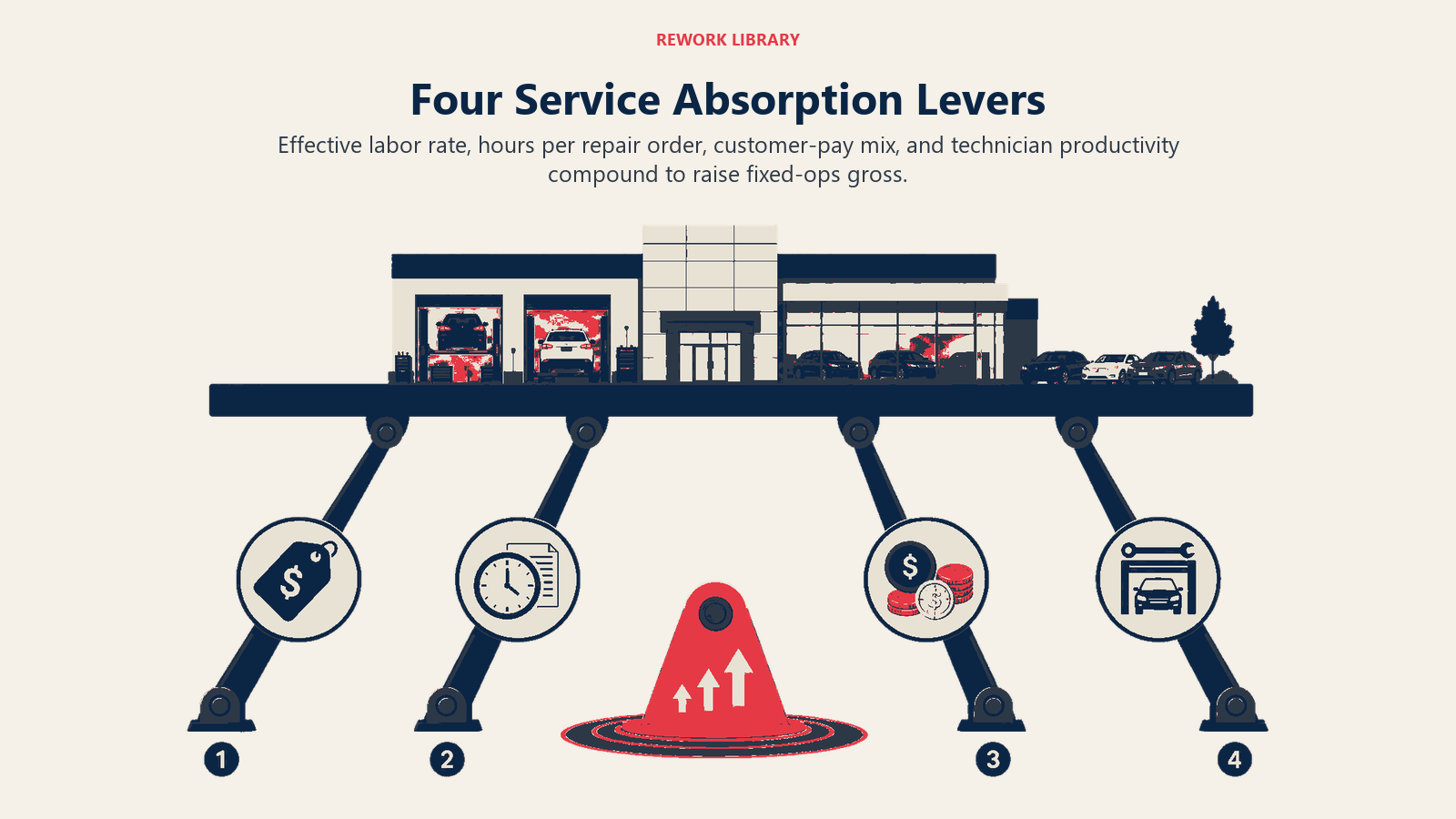
Effective Labor Rate (ELR) is the actual labor rate you collect after discounts, warranties, and internal work. You might door-rate $165 per hour, but if you're collecting $142 after all adjustments, that's your ELR. According to McKinsey research on dealer profitability optimization, dealers can improve fixed-cost absorption through workflow efficiency and productivity upgrades. Improving ELR by $10 per hour can add $50,000+ to annual gross profit without selling a single additional hour.
Hours Per RO measures how much work you're identifying and selling on each repair order. The difference between a $65 RO and a $125 RO isn't luck, it's process. Top dealerships train service advisors to conduct thorough multi-point inspections, use digital vehicle inspection tools to show customers exactly what their vehicle needs, and present recommendations in a consultative way.
Customer Pay Mix determines how much of your business comes from high-margin customer pay work versus lower-margin warranty repairs. A dealership running 65% customer pay will always outperform one at 45% customer pay, even with identical labor rates and hours per RO.
Expense Control is the fourth lever, but it's the one you should touch last. You can't cut your way to 100% absorption if you're not investing in the tools, training, and people required to grow gross profit. Smart expense management matters, but revenue growth matters more.
Increasing Your Effective Labor Rate
Most dealers undercharge for their expertise. They look at the independent shop down the street charging $125 per hour and feel pressure to stay competitive. But they're missing the value proposition.
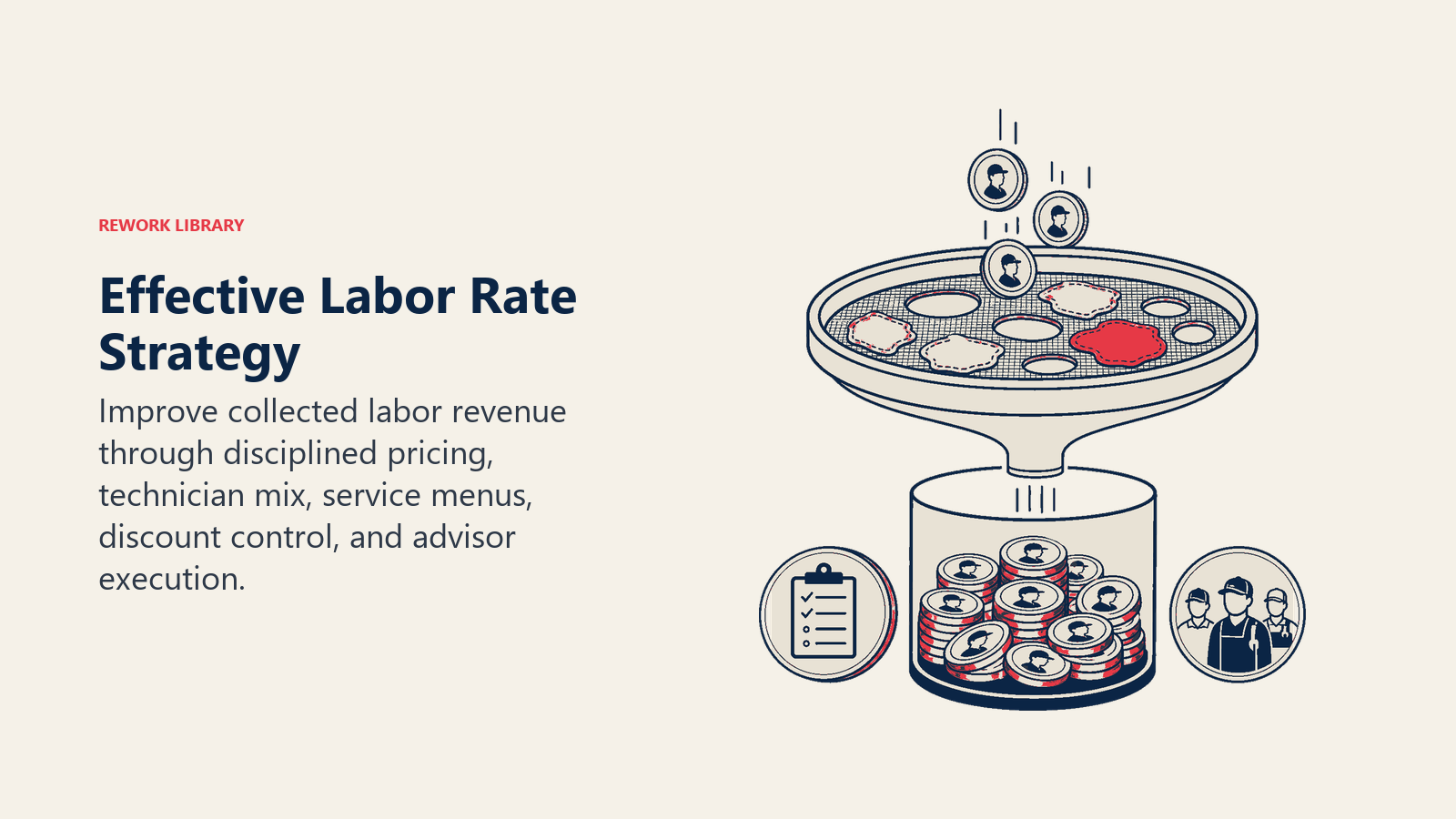
You have factory-trained technicians. OEM diagnostic equipment. Access to technical service bulletins. A parts department stocked with genuine parts. Climate-controlled facilities. Loaner vehicles. A warranty on the work. That's worth a premium.
Start by conducting a market survey. What are other franchised dealers charging in your market? Not independent shops, dealers. If you're $15-20 below the market average, you're leaving money on the table.
Then implement menu pricing for maintenance packages. Instead of quoting "oil change - $49.95" and hoping to upsell during the visit, create a bronze/silver/gold maintenance package structure. Bronze might be a basic oil change. Silver adds tire rotation and multi-point inspection. Gold includes all that plus cabin air filter, exterior wash, and fluid top-offs.
Customers don't resist paying more when they understand what they're getting. They resist feeling nickeled and dimed. Menu pricing solves that problem while increasing your effective labor rate.
Premium services justify premium rates. Paint protection, ceramic coating, nitrogen tire fills, engine flushes, these aren't gimmicks if they're genuinely beneficial. They're opportunities to increase labor sales at higher margins while giving customers options.
But here's the critical part: you must train service advisors to communicate value. They can't just hand someone a menu and walk away. Wikipedia's overview of automotive service explains that major services are typically performed every 30,000 to 45,000 kilometres (19,000 to 28,000 miles), which dealers can leverage when explaining package timing. They need to explain why the silver package makes sense for a customer at 45,000 miles, or why the gold package is the smart choice before a road trip.
When you increase your door rate, do it with conviction. Send a letter to active customers explaining the rate change, the investments you've made in training and equipment, and the value they receive. Most customers won't blink. The ones who complain probably weren't profitable anyway.
Growing Hours Per RO Through Better Inspections
The average hours per RO across all dealerships sits around 1.8-2.2 hours. Top performers consistently hit 2.8-3.5 hours. The difference isn't that their customers need more work, it's that they're better at identifying what vehicles actually need and presenting those recommendations effectively.
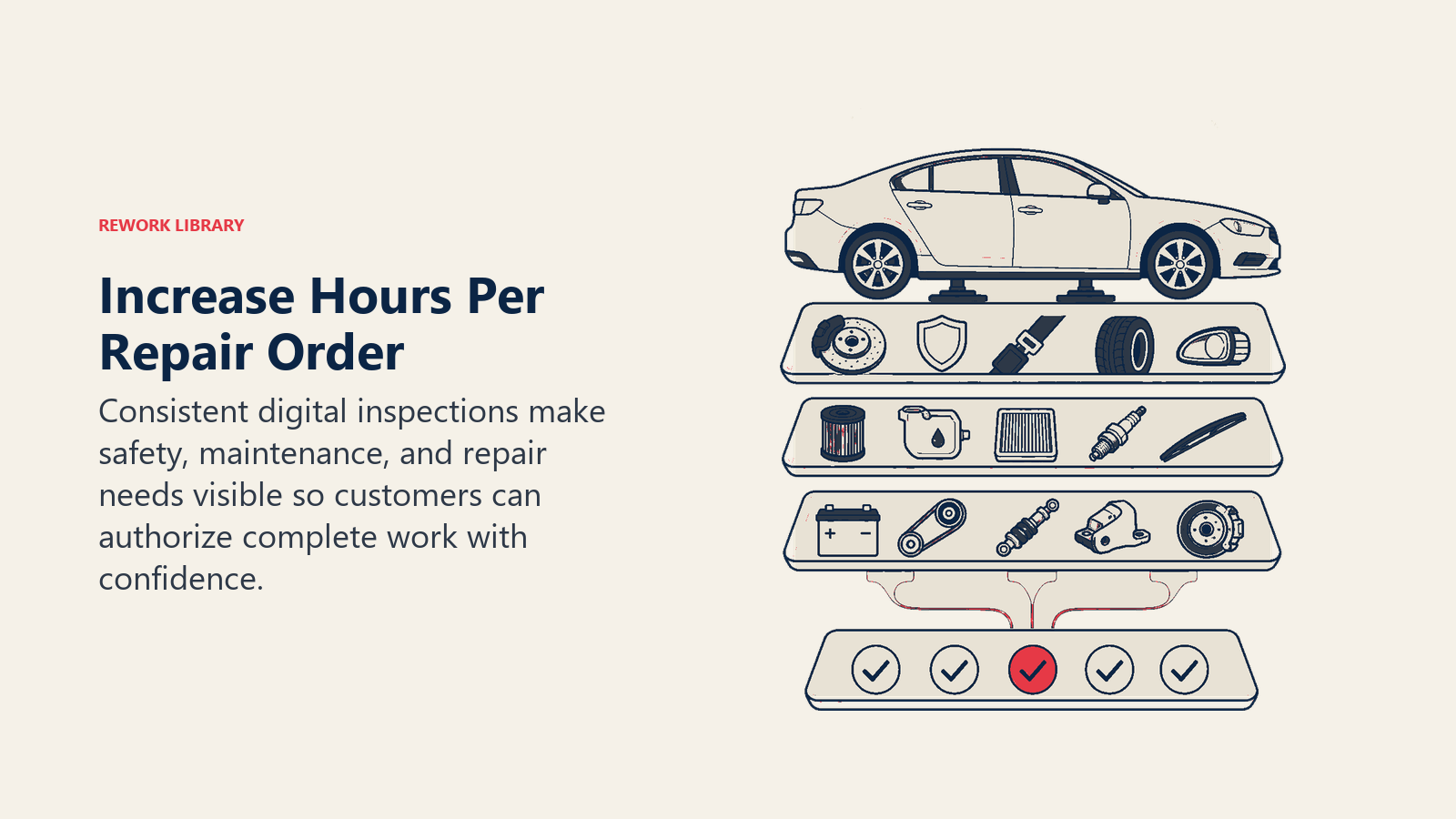
Multi-point inspections are table stakes. Every vehicle that comes through your service drive should get a thorough inspection, not just a quick glance. Tires, brakes, fluids, filters, belts, hoses, suspension, battery, lights, the inspection should touch every major system.
But paper inspections sit in a drawer. Digital vehicle inspection tools transform the process. When a service advisor can text a customer photos of their worn brake pads, a video of their technician demonstrating the suspension noise, and a clean checklist of red/yellow/green items, approval rates skyrocket.
The DVI companies all claim 30-40% increases in hours per RO after implementation. That's not marketing hype. Customers approve work when they can see what's wrong and understand why it matters.
Your inspection process should classify recommendations into three categories. Red items are safety concerns that need immediate attention, brake system problems, tire safety issues, critical leaks. Yellow items are maintenance that's due soon based on mileage, time, or condition. Green items are things that look good and don't need attention yet.
Lead with red items. Don't bury a brake safety concern behind four other recommendations. Start the conversation with "Here's what's critical for safety," then move to "Here's what we should address in the next 30-60 days," and finish with "Here's what looks good."
Training service advisors on selling skills is non-negotiable if you want to grow hours per RO. They're not order-takers. They're consultants who help customers make informed decisions about vehicle maintenance. That requires communication skills, technical knowledge, and confidence.
Role-playing helps. Record service advisors presenting recommendations and review the recordings with them. What phrases work? Where do they lose customers? How can they improve?
The best advisors track their own hours per RO and compete with themselves to improve. When you make it visible, measurable, and part of the performance conversation, behavior changes.
Optimizing Your Customer Pay Mix
Warranty work keeps technicians busy, but it doesn't build absorption. You're getting reimbursed at warranty rates (often $30-50 below your door rate) and you can't add meaningful labor sales beyond what the warranty pays.
Customer pay work is where you make money. A brake job pays full labor rate. A 60K service at menu pricing generates strong gross. An alignment, tire replacement, or battery installation, all pure customer pay profit.
The goal is to shift your mix toward 60-70% customer pay. Here's how that happens.
Service marketing campaigns drive customer pay traffic. If you're not actively marketing to your customer base, you're waiting for them to remember you exist. That's not a strategy.
Create targeted campaigns around seasonal maintenance like winter tire changeovers, summer road trip prep, back-to-school vehicle checkups. Use your DMS and CRM data to identify customers who haven't visited in 6-9 months and invite them back with a compelling offer.
Conquest service campaigns bring new customers into your service drive. Direct mail to competitive brand owners in your market. Digital advertising targeting people searching for service near you. Partnerships with local businesses for employee service benefits.
Every service customer is a potential sales customer. When someone brings a 7-year-old vehicle in for a $800 repair, that's an equity mining opportunity. Your service advisor should be equipped to check trade-in value, introduce them to a sales consultant, and start a conversation about replacement.
The service-to-sales pipeline is one of the most underutilized profit centers in most dealerships. You've already built trust through quality service. The customer is standing in your store. The transition from service to sales should be seamless.
Reducing warranty dependency also means capturing more warranty-out customers. When someone's manufacturer warranty expires at 36 months/36,000 miles, they often disappear to independent shops because they assume dealers are too expensive. Prove them wrong with competitive pricing, transparent communication, and service packages designed for higher-mileage vehicles.
Measuring Progress Toward 100% Absorption
You can't manage absorption annually and expect to hit your targets. This is a monthly metric that requires consistent monitoring and course correction.
Calculate absorption by department. What's your service absorption? Parts absorption? Combined fixed ops absorption? Body shop if you have one? Breaking it down helps you identify which areas need attention.
Track the trend line, not just the number. Are you improving month-over-month? Quarter-over-quarter? Year-over-year? A dealership at 75% absorption that's been growing 1-2% per month is in a much better position than one stuck at 82% for two years.
Seasonal patterns matter. Most dealerships see stronger service traffic in spring and fall, weaker in summer and winter holidays. When you understand your patterns, you can plan marketing campaigns and staffing accordingly.
Benchmark against manufacturer standards and 20-group data. Where do you rank? What are top performers doing differently? The goal isn't just to hit 100% absorption, it's to be in the top quartile of your brand.
Report absorption to ownership monthly. This isn't a metric to hide or downplay. When dealer principals understand the direct correlation between absorption and dealership value, they invest in the strategies that move the needle.
Celebrate milestone achievements with your team. When you hit 80% for the first time, that's worth recognizing. When you cross 90%, throw a team lunch. When you hit 100%, bonuses are warranted. People support what they help build.
The 12-24 Month Roadmap to 100%+ Absorption
You're not going from 72% absorption to 105% in 90 days. This is a systematic improvement process that compounds over time.
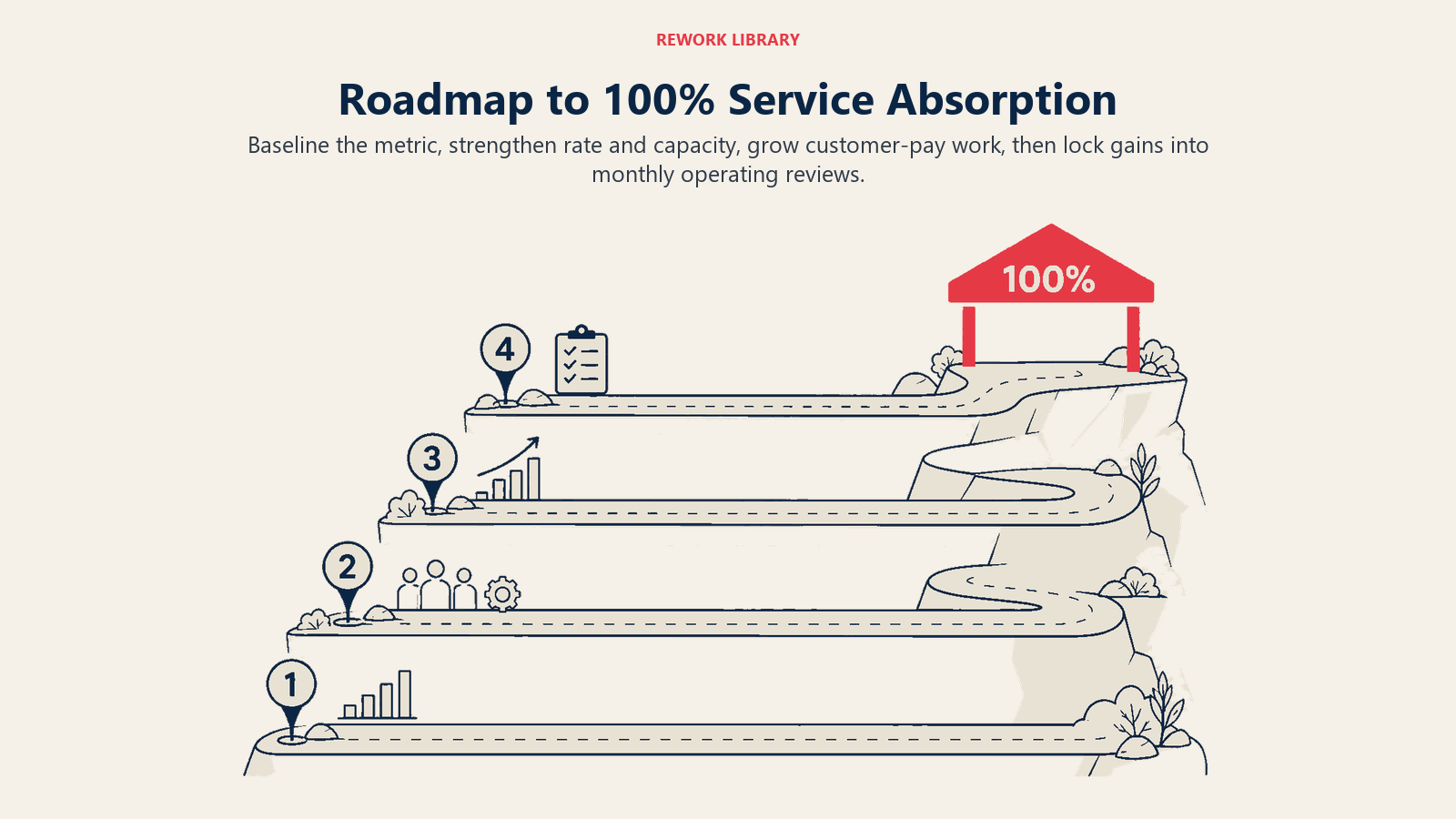
Months 1-3: Assessment and Foundation
- Calculate current absorption and establish baseline through dealership KPI tracking
- Audit effective labor rate and identify pricing gaps
- Implement or upgrade digital vehicle inspection tools
- Begin service advisor training on inspection and presentation
Months 4-6: Process Implementation
- Launch menu pricing for maintenance packages
- Roll out systematic multi-point inspection process
- Deploy first customer pay marketing campaign
- Establish monthly absorption tracking and reporting
Months 7-12: Optimization and Scaling
- Refine service advisor selling skills through ongoing training
- Expand service marketing calendar with quarterly campaigns
- Focus on customer pay mix improvement strategies
- Measure and optimize hours per RO by service advisor
Months 13-24: Mastery and Sustainability
- Achieve and maintain 100%+ absorption
- Build bench strength in service department leadership
- Create predictable fixed ops gross profit month-over-month
- Develop service-to-sales pipeline that drives incremental vehicle sales
The dealers who transform their operations don't chase every shiny object. They pick the right strategies, implement them systematically, and measure obsessively through data analytics. For detailed tactics on each lever, see Service Advisor Selling Skills for hours per RO improvement, Parts Department Optimization for margin enhancement, and Service Marketing Campaigns for customer pay mix improvement.
Service absorption above 100% isn't just possible, it's the standard every dealer should target. When you get there, you've built a business that generates wealth regardless of what the sales department does. That's the definition of a sustainable dealership. Track your progress through Dealership KPI Dashboard and understand the broader context in Fixed Operations Overview. For customer retention that drives repeatable service revenue, implement Service Customer Retention strategies.
Frequently Asked Questions about Service Absorption Rate
What is service absorption rate?
Service absorption rate is the percentage of a dealership's total fixed expenses covered by the gross profit of its fixed operations departments (service, parts, and body shop). The formula is fixed ops gross profit divided by total dealership expenses, times 100. At 100% absorption, fixed ops pays every fixed bill in the store, so all front-end sales gross becomes profit.
What is a good service absorption rate?
The industry average sits between 70% and 85%. Luxury franchises often run 90% to 110% thanks to higher labor rates and parts margins, while many domestic dealers sit at 65% to 75%. Top-quartile dealers target 100% or higher, the point at which the service and parts business alone keeps the dealership solvent regardless of vehicle sales.
How do you calculate service absorption rate?
Divide your trailing 12-month fixed ops gross profit (service labor gross plus parts gross plus sublet gross) by your trailing 12-month total fixed dealership expenses, then multiply by 100. For example, $380,000 in fixed ops gross against $450,000 in monthly expenses equals 84% absorption.
How can a dealership improve its absorption rate?
Pull four levers: raise the effective labor rate you actually collect, grow hours per repair order through thorough digital inspections, shift the mix toward higher-margin customer pay work, and control fixed expenses last. Revenue growth on the first three levers moves absorption faster than cost cutting alone.
Why does service absorption matter?
High absorption makes a dealership resilient. When fixed ops covers overhead, vehicle sales gross becomes pure profit and market downturns stop threatening the business. It also lifts dealership value, since buyers pay more for stores with predictable, recurring fixed ops income.

Senior Implementation Consultant
On this page
- What Service Absorption Really Means
- Where Most Dealerships Stand Today
- The Four Levers That Move Absorption
- Increasing Your Effective Labor Rate
- Growing Hours Per RO Through Better Inspections
- Optimizing Your Customer Pay Mix
- Measuring Progress Toward 100% Absorption
- The 12-24 Month Roadmap to 100%+ Absorption