Ancillary Products Strategy - Maximizing Backend PVR Beyond VSC & GAP
Turn this article into takeaways for your work.


Each assistant summarizes the article only for you and suggests best practices for your work.
Most F&I managers focus intensely on VSC and GAP sales. That makes sense, these core products generate the highest individual PVRs and carry the strongest commission rates. But here's what average F&I managers miss: an additional $300-$600 in PVR sits waiting in ancillary product sales.
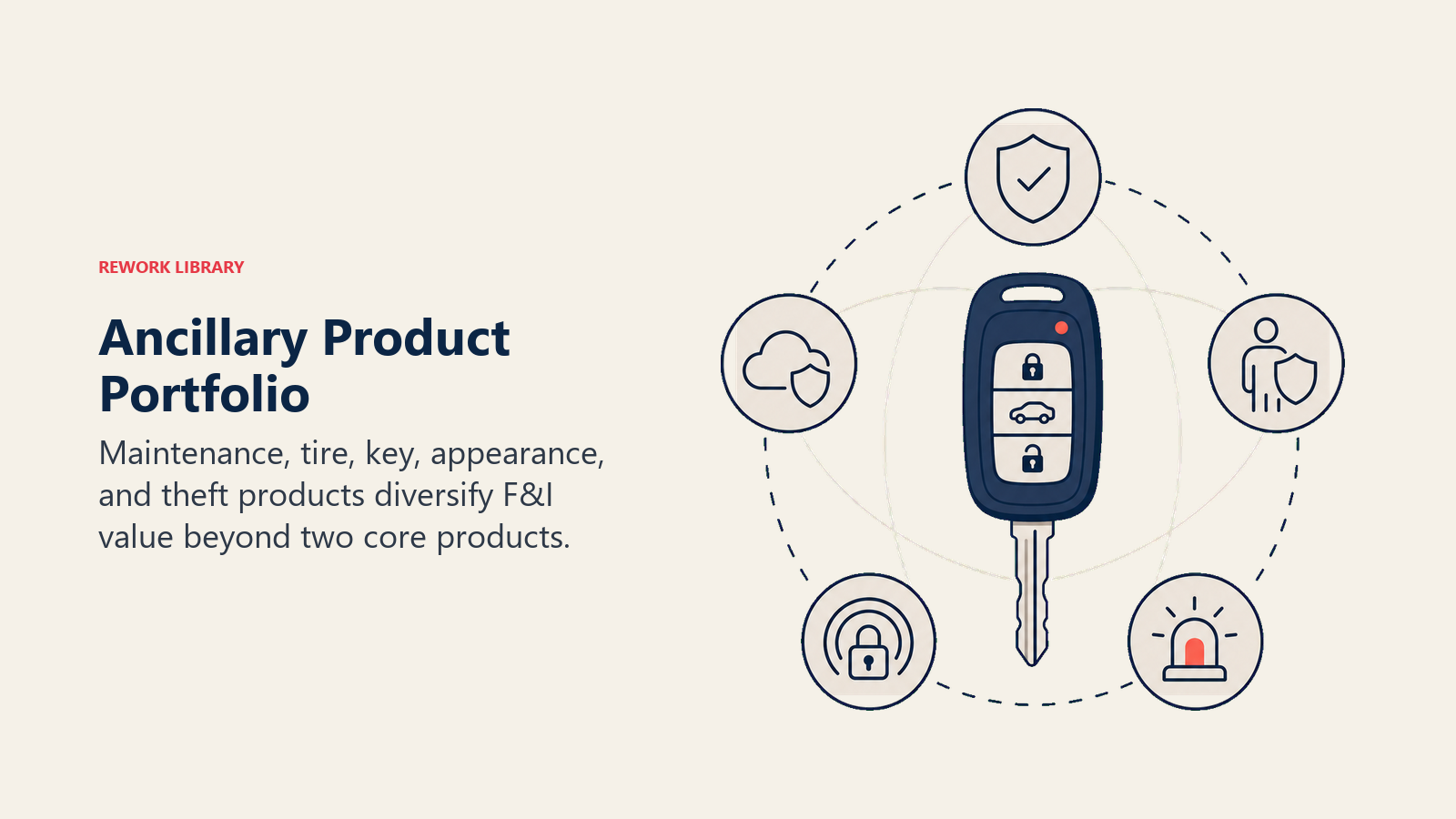
Maintenance plans. Tire and wheel protection. Key replacement coverage. Appearance protection. Theft deterrent products. Individually, these add $15-$30 monthly payment. Together, they transform a $1,500 PVR deal into a $2,100 PVR without significant resistance because the incremental cost feels minimal.
Top-performing F&I departments don't view ancillary products as optional add-ons. They build comprehensive protection packages where ancillary items complement core VSC and GAP coverage. The result? Higher penetration rates, increased customer satisfaction (when products are needed), and substantially improved backend profitability.
This guide breaks down the complete ancillary product strategy, from portfolio selection to package design to penetration rate optimization.
Ancillary Product Portfolio - Beyond VSC and GAP
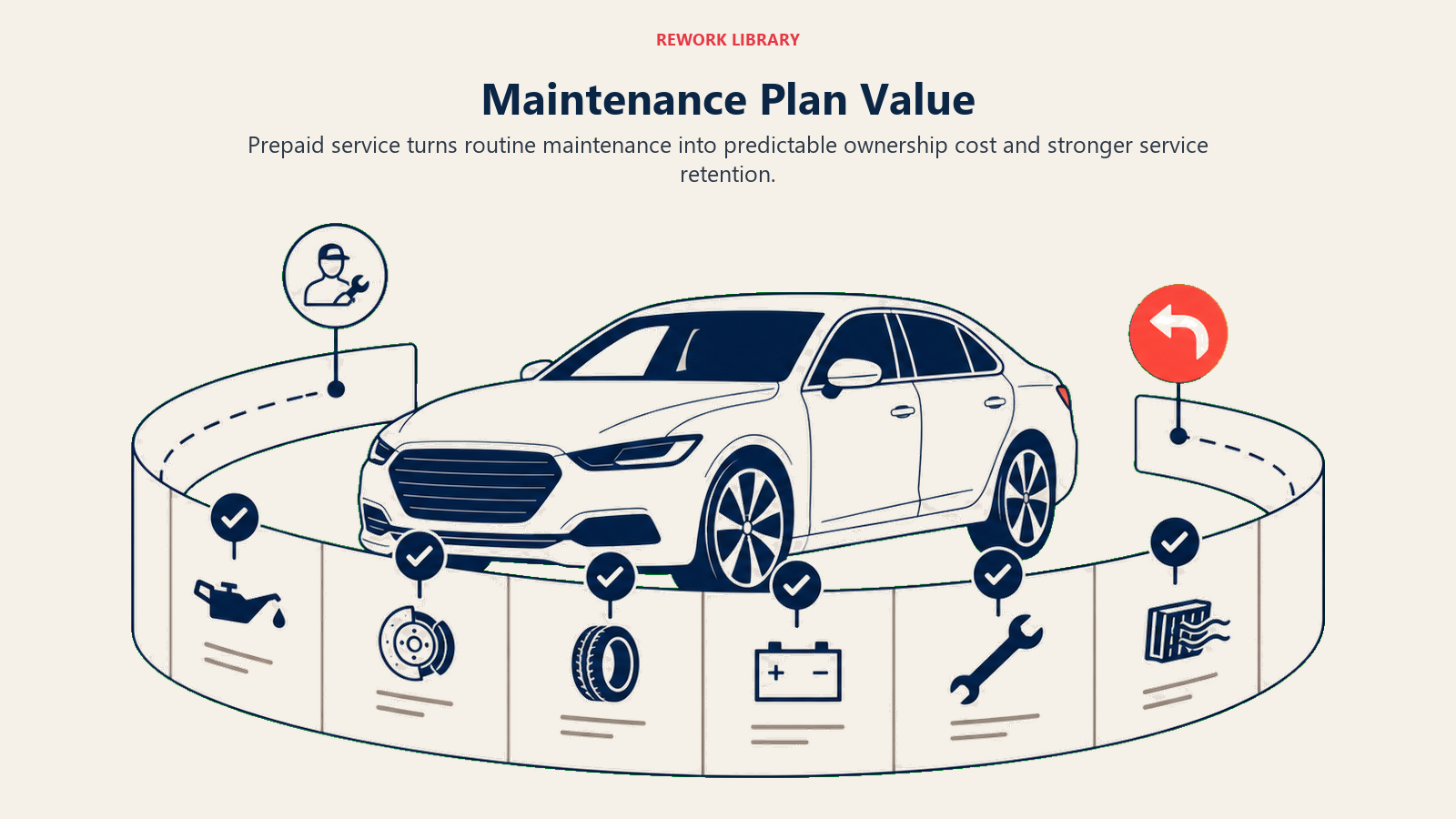
Your ancillary product menu should include 4-6 high-value items complementing core coverage. More products create menu clutter and decision paralysis. Fewer products leave PVR opportunity on the table. Maintenance/Prepaid Maintenance Plans: Scheduled service coverage including oil changes, filter replacements, tire rotations, inspections, and sometimes brake service. Pricing typically runs $800-$1,800 depending on coverage duration and vehicle type.
Value proposition: customers will definitely need these services. Prepaying locks in today's pricing and eliminates future service decision-making. Strong retention tool for service department.
Tire & Wheel Protection:
Covers tire damage from road hazards (nails, potholes, debris) and wheel cosmetic or structural damage. Also includes mounting, balancing, and sometimes alignment. Pricing: $600-$1,200.
Value proposition: tires are expensive ($200-$400 each) and damage is common. One tire replacement justifies coverage cost. Wheel repair runs $150-$300 per wheel. Low payment impact ($10-$15/month) drives high penetration.
Key Replacement Coverage:
Covers lost, stolen, or damaged key fob replacement plus lockout service. Modern keys cost $300-$600 for replacement. Pricing: $300-$500.
Value proposition: replacement cost shock. "Your key costs $450 to replace. This coverage costs $8 per month." Easy math. Perfect for customers with teenage drivers or multiple key fobs.
Theft Deterrent Products:
VIN etching, GPS tracking, or LoJack-style recovery systems. Pricing: $200-$1,500 depending on technology.
Value proposition: insurance discount positioning (some carriers offer 5-10% premium reduction), vehicle recovery capability, and visible deterrent effect. Works well in high-theft areas or with high-theft-target vehicles.
Appearance Protection:
Paint protection (ceramic coating or sealant), fabric protection, interior surface coating, and windshield treatment. Pricing: $500-$1,500.
Value proposition: maintaining vehicle appearance preserves resale value. Paint correction costs $500-$2,000. Fabric/upholstery cleaning runs $200-$400. This prevents damage rather than repairs after the fact.
Paintless Dent Repair Plans:
Covers minor ding and dent removal through PDR process. Pricing: $400-$800.
Value proposition: shopping cart dings, parking lot damage, hail damage (minor). PDR costs $75-$150 per repair. Coverage pays for itself after 4-5 incidents.
Windshield Protection:
Covers windshield repair and replacement including calibration for advanced driver assistance systems (ADAS). Pricing: $300-$700.
Value proposition: windshield replacement costs $300-$1,000. ADAS calibration adds $200-$500. One replacement justifies coverage. Rock chips are inevitable in most regions.
Product Selection Strategy - Building Your Menu
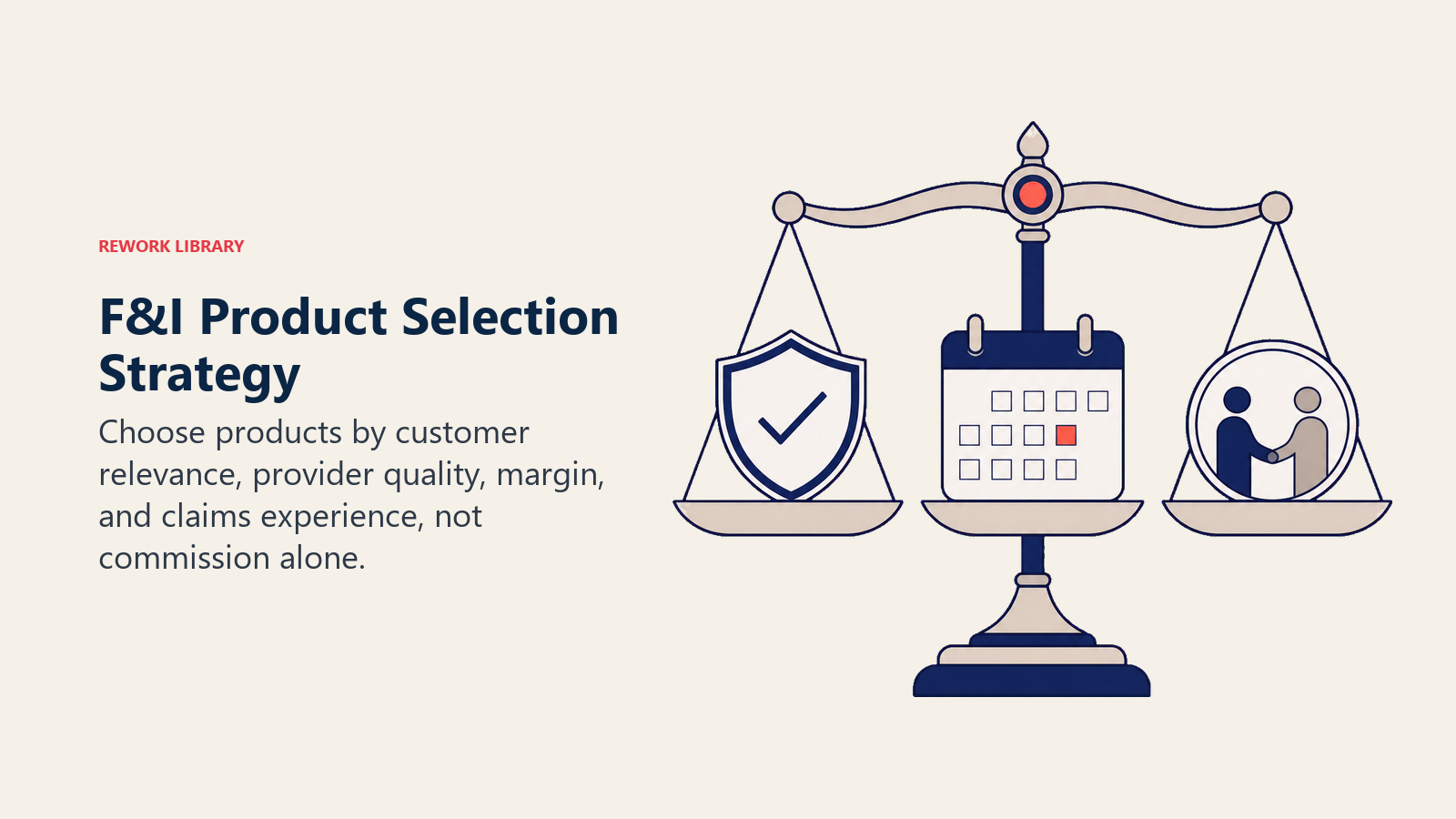
You can't sell everything. Choose 4-6 ancillary products based on customer demand, profitability, and regional fit. Customer Demand and Claim Frequency: Review claim data from your administrators. Which products get used most? High claim frequency indicates genuine customer value. Products with zero claims suggest poor fit or overpricing.
Tire and wheel protection typically shows high claim usage. Windshield protection depends on regional rock chip frequency. Key replacement shows moderate claims (not frequent, but costly when needed).
Profit Margin by Product:
Calculate dealer cost vs. retail price for each offering:
- Maintenance plans: 20-30% margin (pass-through to service department)
- Tire & wheel: 50-65% margin (high commission product)
- Key replacement: 60-70% margin (very high commission)
- Appearance protection: 40-60% margin (often includes immediate service)
- Theft deterrent: 30-50% margin depending on technology
Balance high-margin products (key replacement, tire & wheel) with customer value items (maintenance plans).
Provider Reputation and Support:
Research administrator claims reputation. A+ rated companies with responsive claims handling. Read customer reviews. Ask your service department about claim processing experience.
Poor claims support destroys customer satisfaction and your reputation. Better to exclude a product than partner with unreliable administrator.
Pricing Competitiveness:
Compare your retail pricing to:
- Aftermarket alternatives (Costco tire coverage, insurance policy add-ons)
- Manufacturer programs (OEM maintenance plans)
- Standalone service providers (paint coating shops, tracker companies)
If your price exceeds alternatives by 30%+, expect resistance. If you're within 10-20%, value-add services justify premium.
Menu Real Estate Limitations:
Your F&I menu physically limits products shown. Most software supports 6-8 products maximum. Prioritize items with highest combination of:
- Commission profitability
- Customer demand
- Penetration rate potential
- Service department integration (for retention)
Don't clutter menus with low-value offerings. Focused menus convert better than overwhelming options.
Maintenance Plan Positioning - Scheduled Service Coverage
Maintenance plans represent your best service retention tool while adding backend profit. OEM Manufacturer Plans vs. Aftermarket: Toyota ToyotaCare, Ford Premium Maintenance, Honda Service Plus, etc. These carry manufacturer branding and integrate with dealer service networks. Pricing is often higher, but customer perception is excellent.
Aftermarket plans (EasyCare, Zurich, etc.) offer better dealer profitability. Coverage is similar, but lacks manufacturer branding. Position based on customer trust level and price sensitivity.
Coverage Scope:
Define exactly what's included:
- Oil and filter changes (frequency?)
- Tire rotations (how many?)
- Multi-point inspections
- Cabin and engine air filters
- Brake inspections and service?
- Coolant flushes?
- Transmission service?
More comprehensive coverage justifies higher pricing but must align with manufacturer maintenance schedule to deliver value.
Term and Mileage Options:
Structure options matching typical ownership:
- 3 years/45,000 miles (short-term owners)
- 5 years/60,000 miles (average ownership)
- 7 years/100,000 miles (long-term owners)
Higher mileage drivers need coverage reflecting actual usage. Someone driving 20,000 miles annually needs different coverage than 12,000-mile driver.
Transferability for Resale Value:
Transferable maintenance plans add resale value. Private party buyers love prepaid maintenance. Highlight this benefit:
"When you sell this vehicle in 5 years, the remaining maintenance plan transfers to the new owner. This adds value to your vehicle and makes it more attractive to buyers. It's a selling point, not just service coverage."
Service Department Integration:
Maintenance plans drive service customer retention and customer loyalty. Work with your service manager to ensure:
- Easy scheduling for plan holders
- Clear communication about covered services
- No upsell pressure during covered visits
- Appointment reminder system
Poor service experience during covered maintenance destroys plan value and dealership reputation.
Tire & Wheel Protection - High-Penetration Opportunity
Tire and wheel protection achieves some of the highest penetration rates among ancillary products when positioned correctly. Road Hazard and Cosmetic Damage Coverage: Coverage includes:
- Tire damage from nails, screws, potholes, debris
- Tire replacement when repair isn't possible
- Wheel repair or replacement (cosmetic and structural)
- Mounting, balancing, and valve stems
- Sometimes includes alignment after impact damage
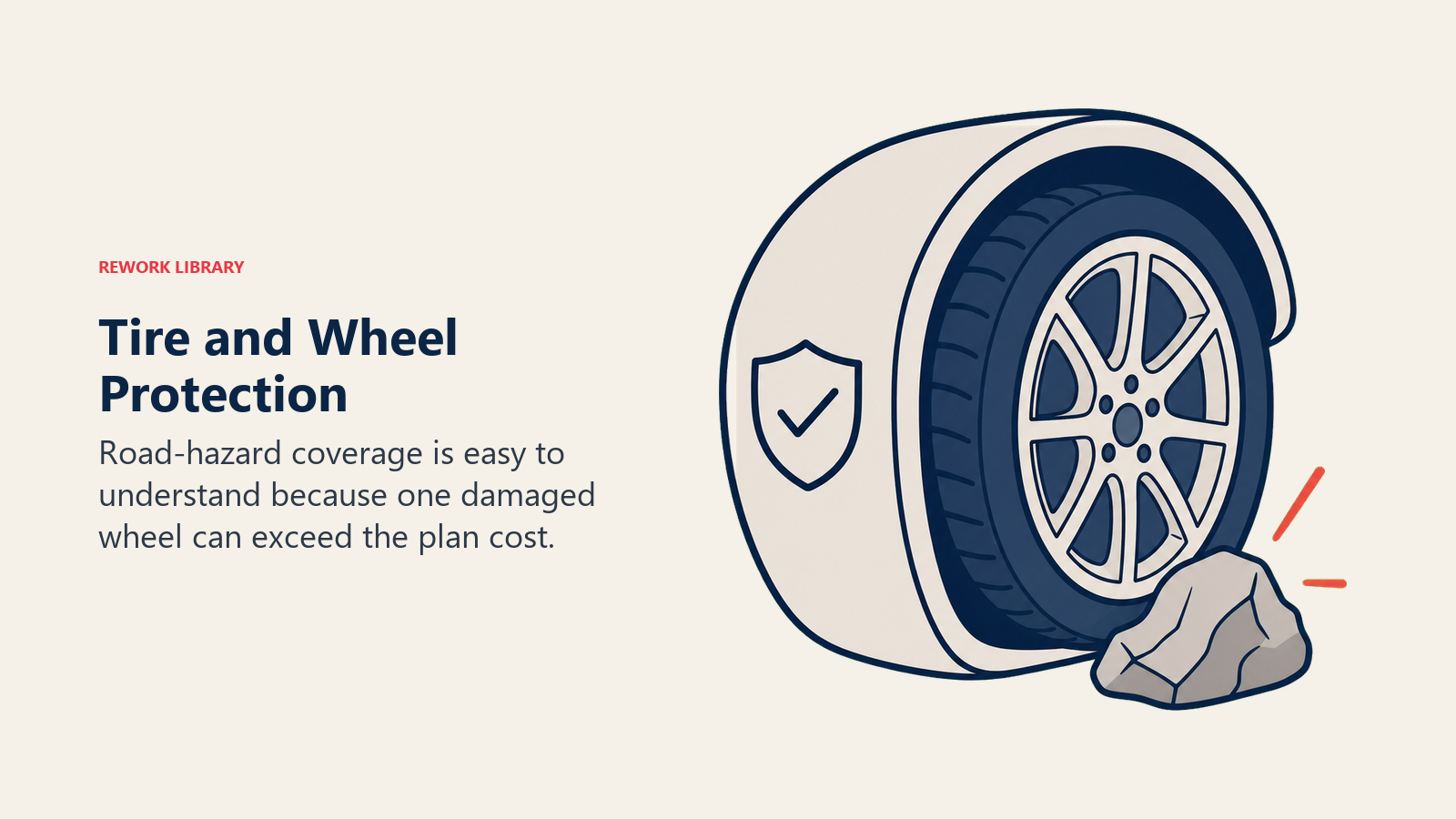
One pothole hit can destroy a tire ($250) and crack a wheel ($400). Coverage pays for itself with a single incident.
Regional Considerations:
Tire and wheel protection value varies by region:
- Northern states: pothole damage from freeze-thaw cycles
- Construction areas: nail and debris frequency
- Mountain regions: sharp rock road hazards
- Urban areas: curb rash and parking damage
Know your market. Michigan dealerships sell tire & wheel protection easily. California dealerships face more resistance. Adjust positioning and pricing accordingly.
Wheel Repair and Replacement:
Modern wheels cost $300-$800 each for OEM replacement. Alloy wheel repair runs $150-$300 per wheel. One curb rash incident justifies coverage cost.
Show customers their specific wheel replacement cost. Look up OEM pricing for their vehicle. That $600 wheel cost makes $12 monthly payment look trivial.
Low Payment Impact ($10-20/Month):
Tire and wheel protection adds minimal payment impact. On 72-month financing:
- $695 coverage = $9.65/month
- $895 coverage = $12.43/month
- $1,095 coverage = $15.21/month
Position as: "Tire and wheel protection is $12 per month. Your tires alone cost $1,000 for a set. One damaged tire or wheel and this pays for itself."
Claim Process Simplicity:
Tire and wheel claims are simple, drive to participating tire shop or dealer, get repair/replacement, coverage pays directly. No complicated paperwork or approval process. This ease of use drives customer satisfaction and repeat purchases.
Key Replacement Coverage - Modern Key Cost Reality
Car keys used to cost $10. Today they're $300-$600 miniature computers. This reality shift creates natural demand for key replacement coverage. $300-600 Replacement Cost for Modern Fobs:
Modern key fobs include:
- Proximity sensors for keyless entry
- Push-button start transponder
- Remote start functionality
- Security encryption
Replacement requires: new fob hardware ($150-$400), programming ($50-$150), and sometimes towing if stranded ($100-$200). Total: $300-$600.
Pull up specific replacement cost for the customer's vehicle. "Your key fob costs $485 to replace according to [manufacturer] parts department. This coverage costs $7 per month. One lost key pays for 69 months of coverage."
Lockout Service Inclusion:
Most key replacement plans include lockout service. Locked keys in car? Administrator sends locksmith. This added benefit increases perceived value.
"Beyond lost key replacement, this includes unlimited lockout service. AAA charges $50-$100 for lockouts. This covers it completely."
Lost Key Replacement:
Lost keys represent the primary claim. Someone loses keys, needs replacement immediately. Without coverage, they're paying $500 out of pocket. With coverage, administrator handles cost and coordinates replacement.
Positioning for Customers with Children/Multiple Drivers:
Families with teenage drivers or multiple key fob users face higher loss probability. Position key coverage specifically for these customers:
"You mentioned your 16-year-old will be driving this vehicle. Teenager plus car keys equals inevitable loss or damage at some point. This coverage eliminates that $500 surprise expense when it happens."
Parents immediately understand this value proposition.
Theft Deterrent Products - VIN Etching and GPS
Theft deterrent products face more resistance than other ancillary items. Position them carefully based on customer profile and regional theft rates. Insurance Discount Positioning:
Some insurance carriers offer 5-10% premium reduction for approved anti-theft devices. If your product qualifies, lead with insurance savings:
"This GPS tracking system qualifies for 10% insurance discount with most carriers. That's about $120 annually in insurance savings. Coverage costs $995, so you're recovering $1,200 over 10 years through insurance savings alone, before considering theft recovery value."
Always verify insurance discount eligibility. Don't promise discounts you can't deliver.
Recovery Statistics and Technology:
Modern GPS tracking enables real-time vehicle location and rapid recovery. Companies like LoJack claim 90%+ recovery rate for tracked vehicles. This statistic supports value positioning.
"If your vehicle is stolen, police receive real-time location data. Recovery probability jumps from 50% to over 90% with active tracking. That's the difference between losing $35,000 and recovering your vehicle."
Visible Deterrent Value:
VIN etching and window stickers advertising tracking create visible deterrent effect. Thieves target easier vehicles without protection. The deterrent value prevents theft before it occurs.
Warranty and Guarantee Terms:
Some theft products include theft guarantee, if vehicle isn't recovered, administrator pays [amount] toward replacement. Highlight this financial backup.
Appearance Protection - Paint, Fabric, and Surface
Appearance protection faces significant resistance because aftermarket alternatives exist and customer perception varies widely. Ceramic Coating vs. Traditional Sealants:
Modern ceramic coatings create chemical bond with paint, providing 3-5 year protection. Traditional sealants last 6-12 months. If selling ceramic coating, emphasize durability difference and professional application value.
Aftermarket ceramic coating runs $500-$2,000. Dealership pricing should fall in this range to remain competitive.
Fabric Protection for Families and Pet Owners:
Interior fabric/leather protection adds real value for families with kids or pet owners. Spills and stains are inevitable. Protection makes cleanup easy and prevents permanent damage.
"You mentioned you have two young kids. This vehicle's interior will face juice spills, food stains, and muddy shoes. Fabric protection creates barrier preventing permanent staining. Without it, professional interior detailing costs $300-$500 after stains set in."
Profile customers appropriately. Families and pet owners see value. Single professionals without kids often don't.
Windshield Treatment:
Hydrophobic windshield treatment improves visibility in rain and reduces ice buildup. It's a nice-to-have, not essential coverage. Bundle with appearance protection package rather than selling standalone.
Cost vs. Aftermarket Alternative Comparison:
Research local paint coating shops, detailing services, and ceramic coating installers. Know their pricing. If competitors charge $1,500 for similar service and you're asking $1,800, justify the $300 difference with warranty coverage and convenience value.
If competitors charge $800 and you're asking $1,800, expect resistance and low penetration.
Package Selling Strategy - Bundling for Higher PVR
The secret to maximizing ancillary product PVR is package selling, not individual product selling. Creating Product Packages (Premium, Standard, Basic):
Design three packages:
Premium Package ($3,495):
- VSC Exclusionary 7yr/100K
- GAP Insurance
- Maintenance Plan 5yr/60K
- Tire & Wheel Protection
- Key Replacement
- Appearance Protection
Standard Package ($2,295):
- VSC Stated Component 5yr/60K
- GAP Insurance
- Maintenance Plan 3yr/45K
- Tire & Wheel Protection
Basic Package ($1,495):
- VSC Powertrain 5yr/60K
- GAP Insurance
Premium becomes your anchor. Standard is your target. Basic is your floor. Most customers choose Standard after seeing Premium pricing.
Payment-Based Presentation:
Don't show package prices. Show monthly payment impact:
- Premium Package: +$48.54/month
- Standard Package: +$31.88/month
- Basic Package: +$20.76/month
"For complete protection including service coverage, tire and wheel, and key replacement, we're looking at $32 per month. That's about $1 per day for comprehensive vehicle protection."
Payment framing makes packages feel affordable.
Remove vs. Reduce Approach:
When customers resist payment increase, offer coverage reduction within the package rather than removing products entirely:
"If $32 monthly feels high, we can reduce VSC coverage from exclusionary to stated component. That brings payment to $26 per month while keeping all the other coverage, maintenance, tire and wheel, key replacement, GAP. You're getting comprehensive protection while saving $6 monthly."
This preserves more PVR than removing products entirely.
Visual Menu Design for Package Comparison:
Digital F&I menus should display packages side-by-side:
| Coverage | Premium | Standard | Basic |
|---|---|---|---|
| VSC | ✓ Exclusionary | ✓ Stated Component | ✓ Powertrain |
| GAP | ✓ | ✓ | ✓ |
| Maintenance | ✓ 5yr | ✓ 3yr | , |
| Tire & Wheel | ✓ | ✓ | , |
| Key | ✓ | , | , |
| Appearance | ✓ | , | , |
| Monthly | +$48.54 | +$31.88 | +$20.76 |
Visual comparison makes Standard package look like balanced choice between Premium overkill and Basic insufficient coverage.
Penetration Rate Optimization - Product-Specific Tactics
Achieving high penetration requires product-specific selling approaches. Default Inclusion Language:
"Your protection package includes maintenance plan, tire and wheel coverage, and key replacement. These are included at $34 per month unless you'd prefer to waive any of this coverage."
Notice the language: "included unless waived" rather than "would you like to add." Penetration rates double with this framing shift.
Customer Profiling for Product Fit:
Match products to customer needs:
- Families with kids → Appearance protection, key replacement
- Long-term owners → Maintenance plan, extended VSC term
- High mileage drivers → Tire & wheel protection, comprehensive maintenance
- Luxury vehicle buyers → Premium appearance protection, theft deterrent
- Budget-conscious → Focus on tire & wheel (high claim rate), avoid appearance protection
Don't push every product on every customer. Match offerings to profile.
Pre-Selling Through Sales Process:
Train sales staff to introduce F&I products during vehicle presentation:
- "The maintenance on this vehicle is completely covered for the first 5 years, so your only expense is fuel and insurance."
- "This comes with complete tire and wheel protection, you won't pay anything if you hit a pothole and damage a wheel."
Pre-sold customers arrive at F&I desk expecting coverage, not hearing about it for the first time.
Payment Impact Minimization Presentation:
When adding ancillary products, never show cumulative payment impact. Show incremental additions:
- Base payment: $485/month
- With VSC and GAP: $512/month (+$27)
- Add maintenance plan: $525/month (+$13)
- Add tire & wheel: $535/month (+$10)
- Add key replacement: $542/month (+$7)
Each addition feels minimal because you're showing incremental impact, not cumulative. Going from $485 to $542 (+$57) feels different than adding $13, then $10, then $7 sequentially.
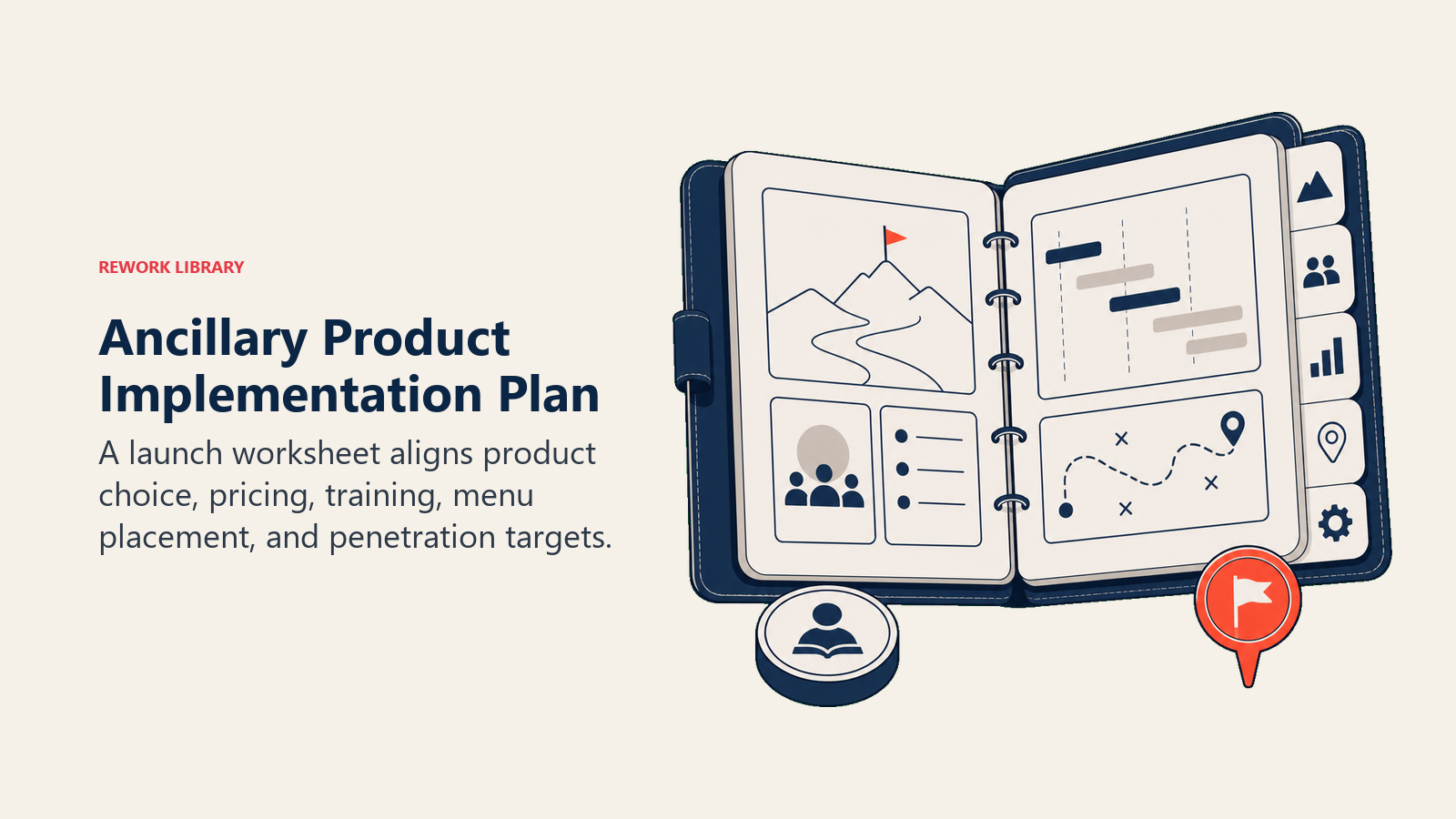
Ancillary Product Implementation Worksheet
Product Selection (Choose 4-6):
- Maintenance plan (OEM or aftermarket?)
- Tire & wheel protection
- Key replacement coverage
- Theft deterrent (GPS/LoJack/VIN etch)
- Appearance protection (paint/fabric)
- Paintless dent repair
- Windshield protection
- Other: _______________ For Each Selected Product:
- Administrator reputation verified
- Dealer cost confirmed
- Retail pricing set (competitive check completed)
- Commission structure understood
- Coverage terms and exclusions documented
- Claim process and customer support verified
Package Design:
- Three packages created (Premium, Standard, Basic)
- Each package includes core products (VSC, GAP)
- Ancillary products distributed across packages
- Monthly payment calculated for each package
- Visual comparison chart created for menu
Presentation Strategy:
- Default inclusion language prepared
- Incremental payment impact format designed
- Remove-vs-reduce responses prepared
- Customer profiling criteria defined
- Pre-selling approach shared with sales team
Penetration Rate Tracking:
- Baseline penetration measured by product
- Monthly penetration goals set
- Commission structure rewards penetration
- Manager tracking dashboard created
- Review process established for low-penetration products
Customer Profiling Matrix:
| Customer Type | Recommended Products |
|---|---|
| Families with children | Appearance, key replacement, maintenance |
| Long-term owners (5+ years) | Maintenance, extended VSC, tire & wheel |
| High mileage (20K+ annual) | Tire & wheel, comprehensive maintenance |
| Luxury vehicle buyers | Premium appearance, theft deterrent |
| Budget-conscious | Tire & wheel (high value), basic maintenance |
| First-time buyers | Education focus, start with tire & wheel |
Ancillary products represent pure PVR upside. Your sales team already closed the deal. Your F&I manager already sold VSC and GAP. Adding maintenance plans, tire and wheel protection, and key replacement increases backend profit by $300-$600 per unit with minimal additional effort.
But success requires strategy. Don't throw products at customers randomly. Design packages. Use default-inclusion language. Match products to customer profiles. Show incremental payment impact. And track penetration rates religiously.
When you optimize ancillary product strategy, your $1,800 average PVR climbs to $2,200-$2,400. That's $40,000-$60,000 additional monthly gross profit on 100 units, without selling a single additional vehicle. That's the power of backend excellence.
And your customers? They're covered for the services they'll actually need, protected against the expenses they'd otherwise pay out-of-pocket, and satisfied with the value received. That's sustainable profitability built on genuine customer benefit.
External Resources
- Building F&I Compliance - The ACE Group - Five best practices for F&I process compliance including ancillary products
- F&I Compliance 2025 - VelociFI - Checklist and regulations for ancillary product sales
- NADA Dealership Fundamentals - Industry training on F&I product strategy and compliance

Senior Implementation Consultant
On this page
- Ancillary Product Portfolio - Beyond VSC and GAP
- Product Selection Strategy - Building Your Menu
- Maintenance Plan Positioning - Scheduled Service Coverage
- Tire & Wheel Protection - High-Penetration Opportunity
- Key Replacement Coverage - Modern Key Cost Reality
- Theft Deterrent Products - VIN Etching and GPS
- Appearance Protection - Paint, Fabric, and Surface
- Package Selling Strategy - Bundling for Higher PVR
- Penetration Rate Optimization - Product-Specific Tactics
- Ancillary Product Implementation Worksheet
- External Resources