EV Service & Parts Revenue: Adapting Fixed Ops for Electric Vehicle Growth - 2026 Guide
Turn this article into takeaways for your work.


Each assistant summarizes the article only for you and suggests best practices for your work.
Electric vehicles need 40% less maintenance than gas cars. No oil changes. No transmission service. No exhaust systems. That threatens $3,000+ in annual per-vehicle service revenue that keeps your fixed operations profitable.
But dealers adapting their service department strategy early are finding new, often higher-margin revenue streams that offset traditional maintenance losses. The key is getting ahead of the transition instead of waiting until EVs represent 30% of your sales and watching service revenue collapse.
The EV service challenge is real. But it's also solvable, if you understand what changes, what stays the same, and what new opportunities emerge.
The EV Service Challenge
The numbers tell a stark story. A typical gas vehicle generates $3,000-4,000 in annual service revenue through scheduled maintenance, fluid changes, filter replacements, and wear item service.
An EV generates $1,800-2,400 in annual service revenue, roughly 40% less. That gap comes from eliminated services: no oil changes ($500/year), no transmission service ($300/year), no exhaust system repairs ($200/year), reduced brake service ($300/year), fewer fluid changes ($200/year).
Maintenance intervals are longer too. Gas cars typically see the service drive every 5,000-7,500 miles for oil changes. EVs might not come in for 10,000-15,000 miles. Fewer visits mean fewer opportunities for upsells, inspections, and customer pay work.
Parts consumption drops significantly. No oil, no filters (beyond cabin air), no spark plugs, no belts (most EVs), minimal brake pad replacements due to regenerative braking. Your parts department's revenue per EV is a fraction of ICE vehicles.
The timeline for impact depends on your market's EV adoption rate. If EVs represent 5% of your sales today, the impact is minimal. But when that hits 20-30%, likely within 3-5 years in progressive markets, your service revenue will feel it unless you adapt.
EV Maintenance Requirements
EVs don't eliminate maintenance, they just change what needs servicing. The U.S. Department of Energy's Alternative Fuels Data Center provides comprehensive guidance on EV maintenance requirements, noting that all-electric vehicles have significantly reduced maintenance needs compared to conventional vehicles.
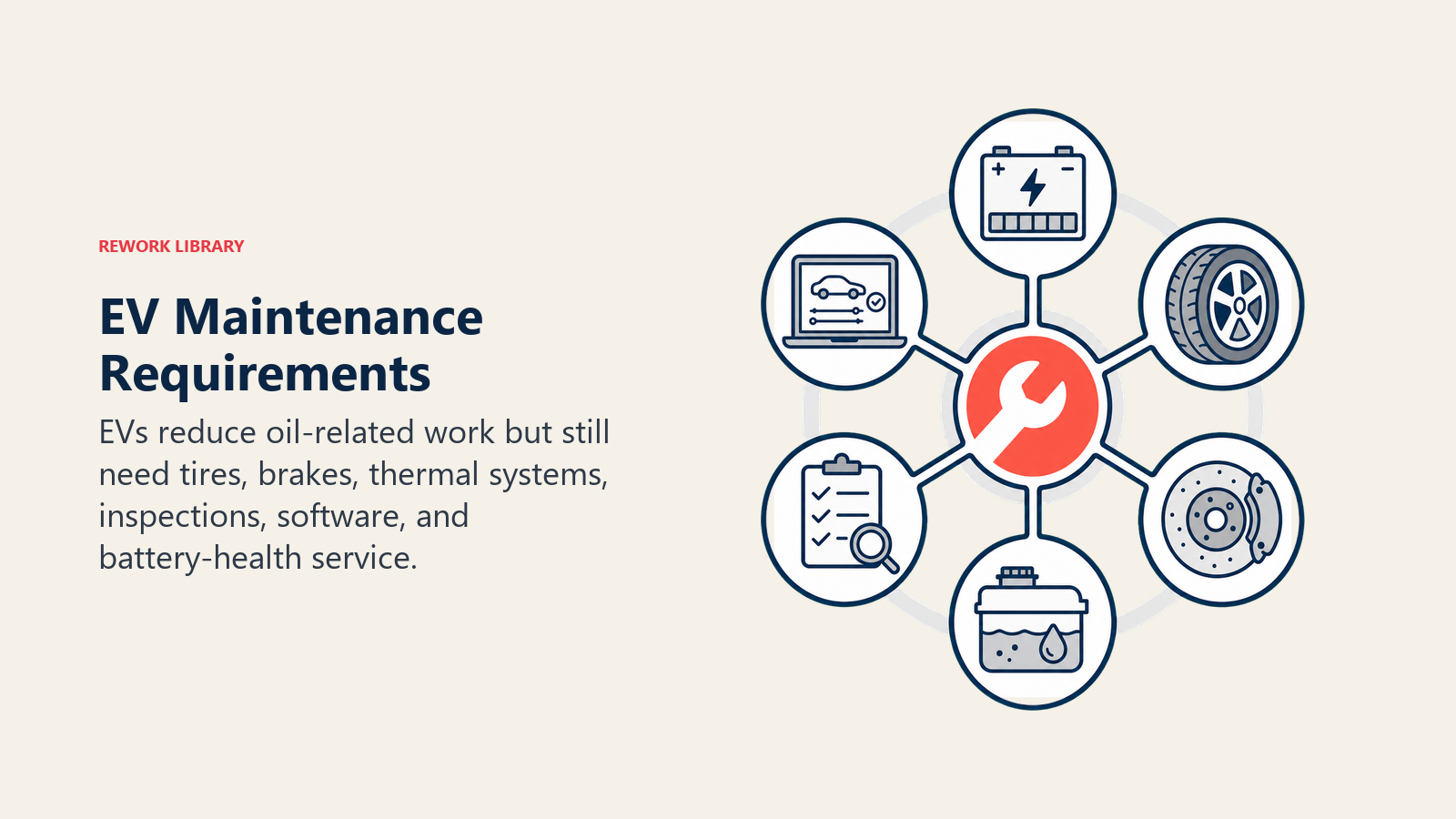
Tire rotations and replacements become more frequent, not less. EVs are heavier due to battery weight, causing 20-30% faster tire wear. Research from J.D. Power's 2024 U.S. Original Equipment Tire Customer Satisfaction Study found that EV tires naturally wear faster due to greater vehicle weight and higher torque, with studies showing that adding 1,000 pounds to a vehicle can increase tire wear by about 20 percent. And performance EVs with instant torque can shred tires. Premium tire sales and more frequent rotations create opportunity.
Cabin air filter replacement continues on the same schedule as gas cars, typically annually or every 15,000 miles. This is low-revenue but maintains customer contact.
Brake fluid service is still necessary but less frequent. Regenerative braking reduces brake use dramatically, but brake fluid still absorbs moisture and degrades. Service every 3-4 years instead of 2-3.
Coolant service for battery and motor systems is EV-specific. While EVs don't have radiator coolant like gas engines, they do have thermal management systems for batteries and electric motors requiring fluid service every 3-5 years.
Wiper blades and washer fluid are identical to gas cars. Small revenue but part of regular maintenance.
12V battery replacement is often overlooked. EVs have a traditional 12V battery for accessories and systems. These fail just like in gas cars and need replacement every 3-5 years.
Software updates and diagnostics create new service opportunities. EVs require regular software updates for performance, features, and sometimes recalls. Some manufacturers charge for diagnostic time. Others include it in warranty. Know your OEM's policies.
New EV Revenue Opportunities
The services EVs don't need get headlines. The services they do need, and gas cars don't, create profit.
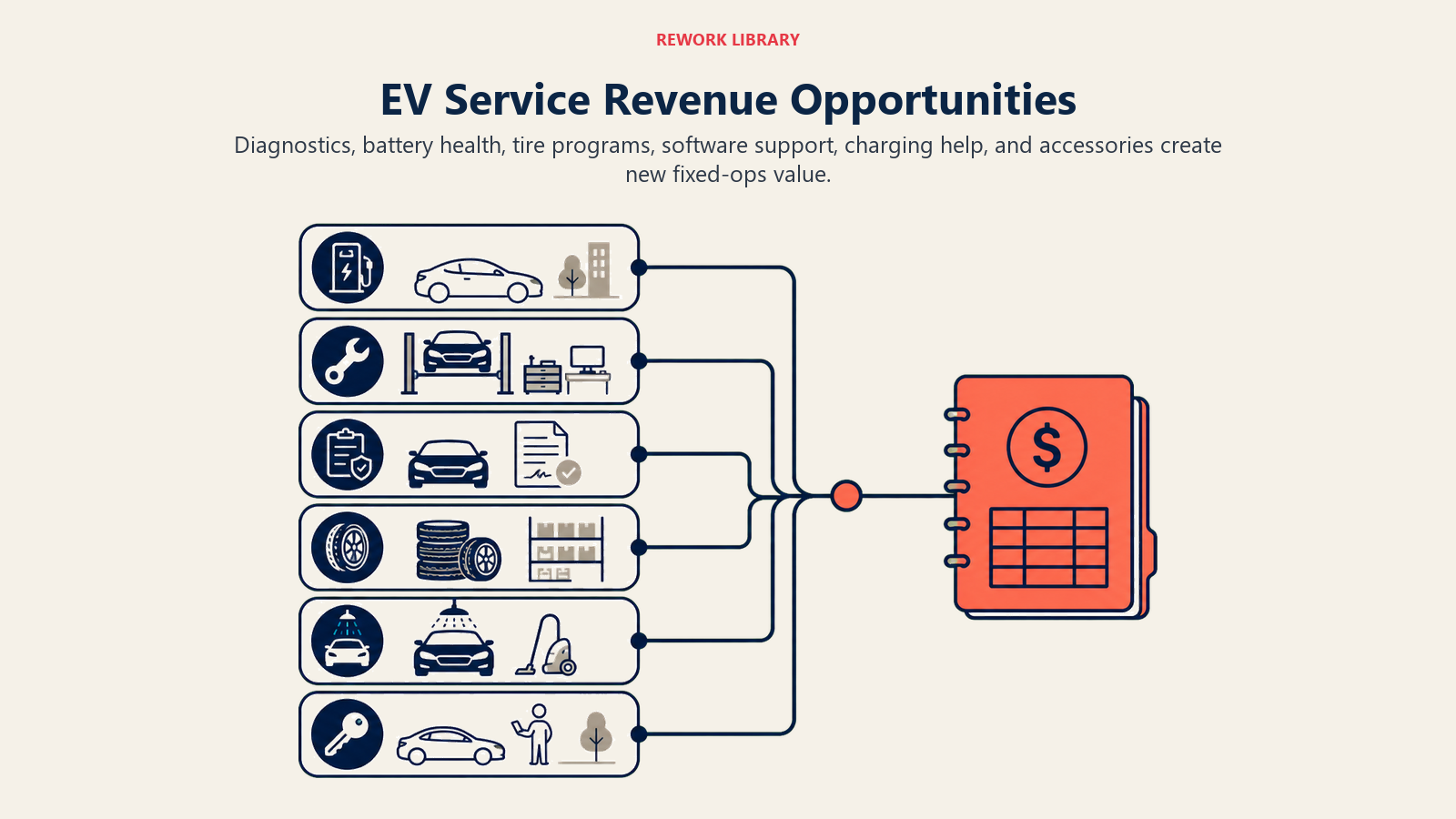
Battery health inspections and diagnostics are EV-specific and valuable. Offering annual battery health checks at $50-100 provides peace of mind and identifies degradation issues early. According to Geotab's 2025 study of over 22,700 electric vehicles, the average battery degradation rate increased to 2.3% per year, with high-power DC fast charging identified as a dominant stressor leading to higher degradation rates. This is especially valuable for used EV buyers.
High-voltage system inspections require specialized training and tools, justifying premium labor rates. Annual inspections checking connections, insulation, and component condition protect customer safety and dealership liability.
Charging system diagnostics and repair address a common customer pain point. Onboard charger failures, charging port issues, and home charging troubleshooting bring customers to your service drive, and they'll pay diagnostic fees comparable to engine diagnostics.
Software updates and programming could become a revenue stream if your OEM allows it. Even if warranty covers updates, you can charge for convenience services like priority scheduling or mobile update services.
Battery conditioning services are emerging. Some dealers offer thermal conditioning before long trips or battery balancing services to optimize performance. Pricing models are still developing, but early adopters charge $100-200.
Thermal management system maintenance for battery cooling and heating is specialized work. Inspections, fluid service, and component replacement generate revenue comparable to traditional cooling system work.
High-voltage component replacement commands higher labor rates. When a drive unit, onboard charger, or battery module needs replacement, labor rates run 20-30% higher than standard rates due to safety requirements and specialized certification.
EV-Specific Accessories and Parts
Don't overlook the parts counter opportunities.
Charging cables and adapters are consumable items EV owners need. Stock Level 1 and Level 2 charging cables ($150-400), adapters for different plug types ($50-200), and replacement connector covers. Margins are strong at 40-50%.
Portable chargers (Level 2 mobile units) retail for $500-800 with good margins. Position these as solutions for customers without home charging or who need flexibility through ancillary product sales.
Weather protection accessories address battery thermal management. Winter tire packages, battery thermal wraps (for extreme climates), and heated steering wheel retrofits sell well in cold markets.
Performance upgrades and modifications are emerging. Aftermarket wheels, suspension components, and software tunes (where allowed) create enthusiast revenue similar to gas performance markets.
Tire and wheel packages optimized for EVs include low-rolling-resistance tires, aerodynamic wheel designs, and tire pressure monitoring. Package pricing with installation drives revenue.
Interior technology accessories leverage EVs' tech-forward buyer demographics. Dash cams, advanced phone mounts, wireless chargers, and interior ambient lighting sell well.
Technician Training and Certification
You can't service EVs safely or profitably without proper training.
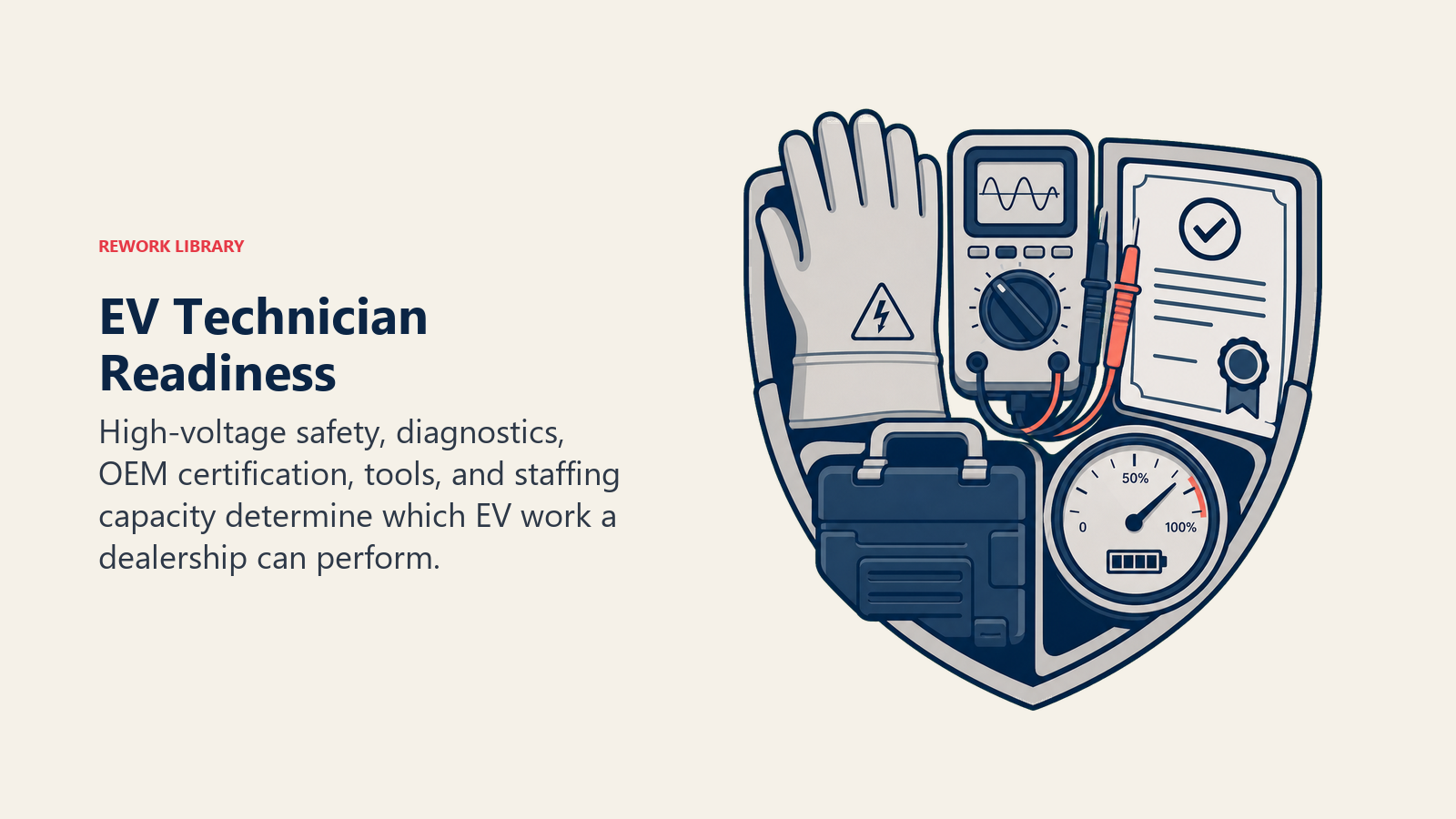
High-voltage safety training is mandatory. OSHA requires safety training for anyone working on vehicles with high-voltage systems (typically defined as over 50V). EVs run 400-800V systems. Proper training prevents fatal accidents and limits liability.
OEM EV certification programs teach brand-specific systems, diagnostic procedures, and service requirements. Manufacturers typically require certification to perform warranty work on EVs. Certification courses run 3-5 days and cost $2,000-5,000 per technician.
Diagnostic tool and software training is ongoing. EVs generate different trouble codes, use different diagnostic procedures, and require different scan tools than gas vehicles. Budget for new tools ($5,000-15,000) and ongoing training as part of your service department operations.
Battery management system expertise separates competent from expert technicians. Understanding state of charge, state of health, cell balancing, and thermal management diagnostics enables advanced troubleshooting.
Ongoing education is critical as technology evolves. EVs update via over-the-air software more frequently than gas cars change oil. Your technicians need continuous learning to keep up.
Recruit EV-experienced technicians if possible. Former Tesla service techs, independent EV shop technicians, or techs with electronics backgrounds adapt faster than traditional mechanical techs.
Service Pricing Strategy
Labor rates for EV work should reflect specialization and investment.
Charge higher labor rates for EV work than standard rates. If your shop rate is $150/hour for gas cars, EV work should be $175-200/hour. Justify this with specialized training, certification requirements, and safety procedures.
Battery and high-voltage system diagnostic fees should match or exceed engine diagnostic fees. If you charge $150 for engine diagnostics, charge $175-200 for high-voltage diagnostics.
Software update pricing models vary by OEM. Some include updates in warranty. Others allow dealers to charge. Where allowed, $50-100 for software updates is reasonable given the time and risk.
Balance warranty versus customer pay work carefully. Most EV maintenance is customer pay (tires, wiper blades, 12V battery, etc.). But high-voltage repairs are often warranty. Ensure proper warranty submission to maximize reimbursement.
Price competitively versus independent shops but don't race to the bottom. Independent shops can service EVs too, often at lower rates. Compete on expertise, OEM certification, warranty support, and customer experience, not just price.
Marketing EV Service Capabilities
Build your EV service business proactively.
Lead with certified EV service messaging on your website, social media, and service drive signage. "Certified EV Service Center" and technician certifications build trust.
Run conquest marketing to Tesla and other brand owners. Many EV owners discover their brand's mobile service isn't as convenient as promised. Independent shops can't perform warranty work. Position your dealership as the certified alternative.
Create service-to-sales opportunities by offering trade-in appraisals during service visits. An EV owner bringing their 3-year-old vehicle for battery health inspection might be ready to upgrade. Your sales team should know which service customers are EV owners.
Develop EV owner loyalty programs with benefits like priority scheduling, discounted charging cable accessories, complimentary battery health checks annually, and exclusive EV owner events.
Offer pre-paid maintenance packages for EVs. Structure these around required services (tire rotations, cabin filters, brake fluid, coolant, inspections) at a discount versus pay-as-you-go. Pre-paid plans lock in future revenue and increase retention.
Sell extended warranty and service contract offerings specific to EVs covering high-voltage components, battery degradation beyond OEM warranty, and charging system failures. Partner with service contract providers to offer these at F&I.
Future-Proofing Fixed Ops
Think long-term, not just about next quarter.
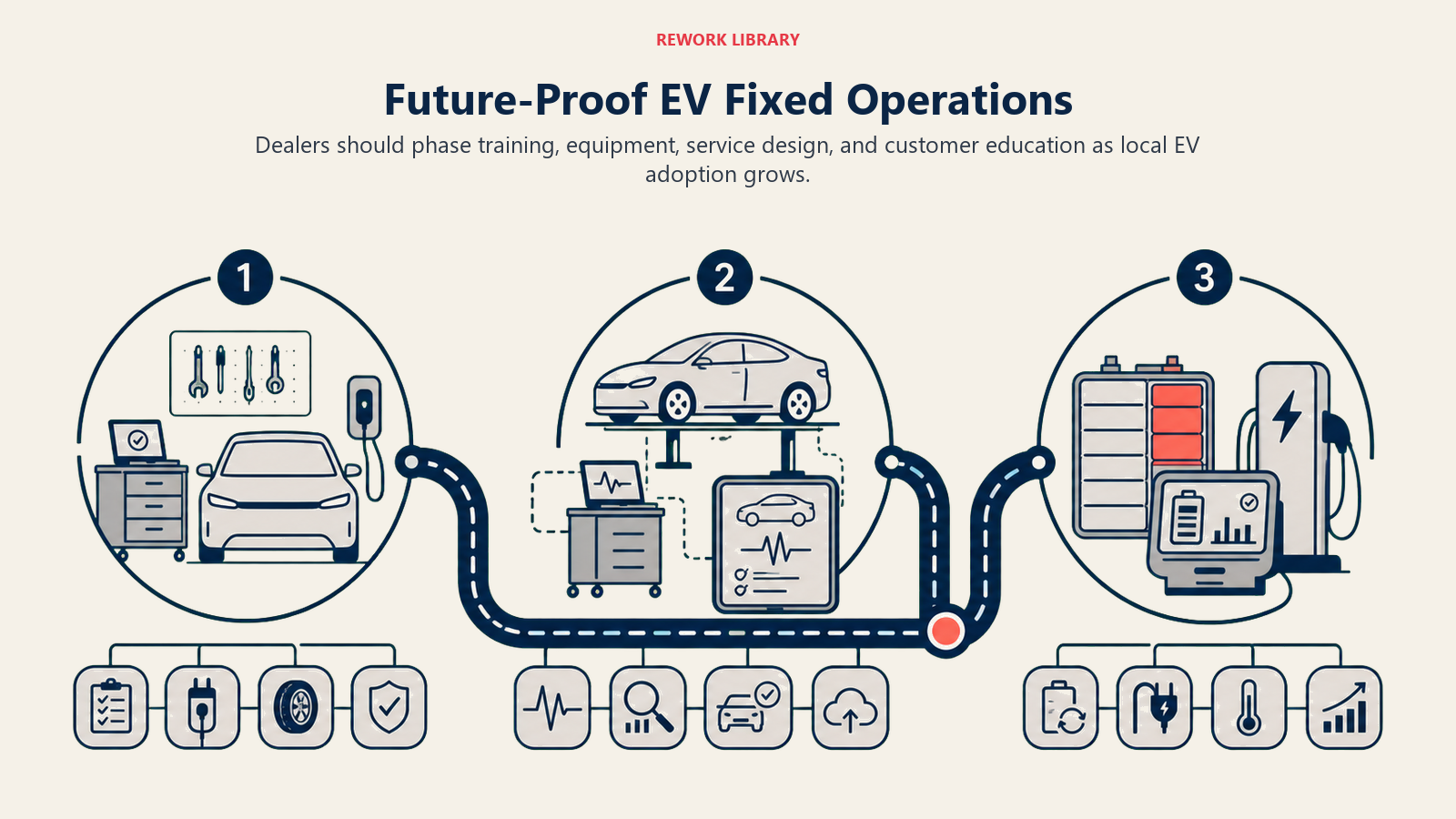
Forecast EV mix and revenue impact realistically. Model scenarios: 10% EV mix, 25% EV mix, 50% EV mix. Calculate revenue impact using current per-vehicle service revenue for gas versus EVs through your dealership KPI dashboard. McKinsey research shows global demand for lithium-ion batteries crossed 1.0 terawatt-hours in 2024 and likely reached nearly 1.6 TWh in 2025, signaling the accelerating EV transition. This exercise clarifies urgency.
Diversify revenue streams beyond traditional maintenance. Collision work, body shop services, accessory installations, detailing, and window tinting don't care whether the vehicle is gas or electric.
Balance ICE and EV service capabilities during the transition. You need both for the next 10 years minimum. Don't abandon gas vehicle expertise prematurely, but don't ignore EV training either.
Plan shop layout and equipment for EV service. High-voltage work requires isolated bays, proper ventilation (battery fires), specialized lifts rated for heavier vehicles, and charging capability in service stalls through service marketing campaigns.
Review insurance and liability policies. Servicing high-voltage systems increases risk. Ensure your insurance covers EV-specific incidents including battery fires, high-voltage electrical accidents, and software-related failures.
Monitor industry trends and adapt proactively. Battery technology, charging infrastructure, and EV service requirements evolve rapidly. Join industry groups, attend conferences, and network with early-adopter dealers to stay ahead.
The EVs-kill-service-revenue narrative oversimplifies reality. Yes, traditional maintenance revenue declines. But new opportunities emerge for dealers who invest in training, certification, tools, and marketing.
Fixed ops directors who wait until EVs represent 30% of sales before adapting will scramble to catch up. Those who start now, building expertise, certifying technicians, marketing capabilities, and creating new service products, will maintain profitability through the transition.
The question isn't whether EVs will impact your service revenue. They will. The question is whether you'll adapt proactively or reactively. And that choice determines whether your fixed ops thrives or struggles over the next decade.