Objection Handling in Automotive: Converting 'I Need to Think About It' to Sales - 2026 Guide
Turn this article into takeaways for your work.


Each assistant summarizes the article only for you and suggests best practices for your work.
Here's what new salespeople don't understand: objections aren't rejection. They're buying signals. When a customer says "your price is too high" or "I need to think about it," they're not walking away. They're asking you to give them a reason to move forward. Research shows that 80% of sales require handling five or more objections. The difference between top performers and average performers isn't that top performers get fewer objections. They just handle them better.
McKinsey research found that 70% of buying experiences are shaped by how customers feel they are being treated during objection discussions. Most objections aren't even about the thing the customer says they're about. "Your price is too high" often means "I don't see the value yet" or "I'm not sure I can afford the payment." "I need to talk to my spouse" often means "I'm not confident enough to commit right now." Your job is to uncover the real concern and address it, not just respond to the surface objection.
Understanding Objections: Types and Psychology
Objections fall into two categories: real and smoke screen. Real objections are genuine concerns that, if unaddressed, will prevent the sale. Smoke screen objections are instinctive defenses that customers throw up because they're not ready to make a decision or they want more information.
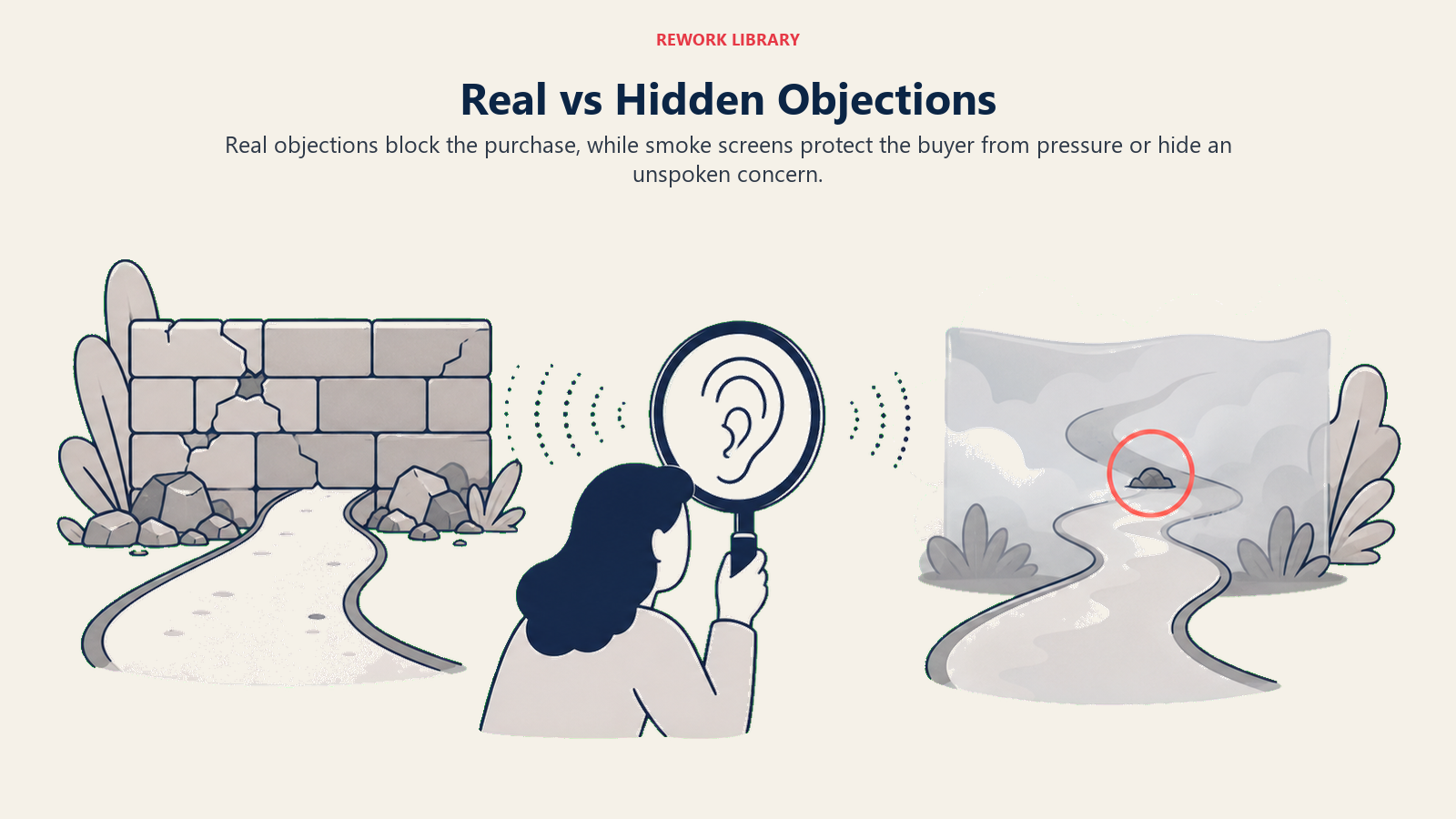
The key is isolating which type you're dealing with.
Real objections have specificity. "I can't afford more than $350 per month" is real. "I'm not sure about the price" is smoke screen. "I don't think this vehicle has enough cargo space for my equipment" is real. "I'm not sure this is the right vehicle" is smoke screen.
Smoke screen objections often come early in the process, before you've built value or addressed needs thoroughly. The customer hasn't test driven yet, but they're already saying "I need to think about it." That's not real. They're protecting themselves from sales pressure they anticipate.
Timing matters. Objections that come up early in the process are usually about information or confidence. Objections that come up during negotiation are usually about price, payment, or value. Objections that come up after you've agreed on numbers are usually about fear of commitment or missing authority.
Price objections are the most common and least honest. Very few customers walk away from vehicles they love because of a $1,000 price difference. They walk away because they don't see $1,000 of value difference or because the payment doesn't fit their budget. Your job is to reframe price objections as value discussions or payment discussions, much like how negotiation closing techniques focus on value over price.
Payment objections are more honest. If the customer's budget is $400 per month and you're at $475, that's a real gap. But it's also solvable through term extension, down payment increase, or product adjustments. Effective desking and deal structure provides the tools to bridge these gaps.
Trade value objections are emotional. Customers are attached to their vehicles. They overvalue them based on memories and effort invested. Your appraisal feels like criticism. Understanding this psychology helps you respond with empathy while maintaining your position, as covered in trade-in appraisal process.
Authority objections usually mean you failed to qualify properly. If you're negotiating with someone who doesn't have authority to decide, you're wasting time. But sometimes the missing decision-maker is a safety net the customer is using to avoid commitment.
The 4-Step Objection Handling Framework
This framework works for nearly every objection. Learn it, practice it, use it automatically.
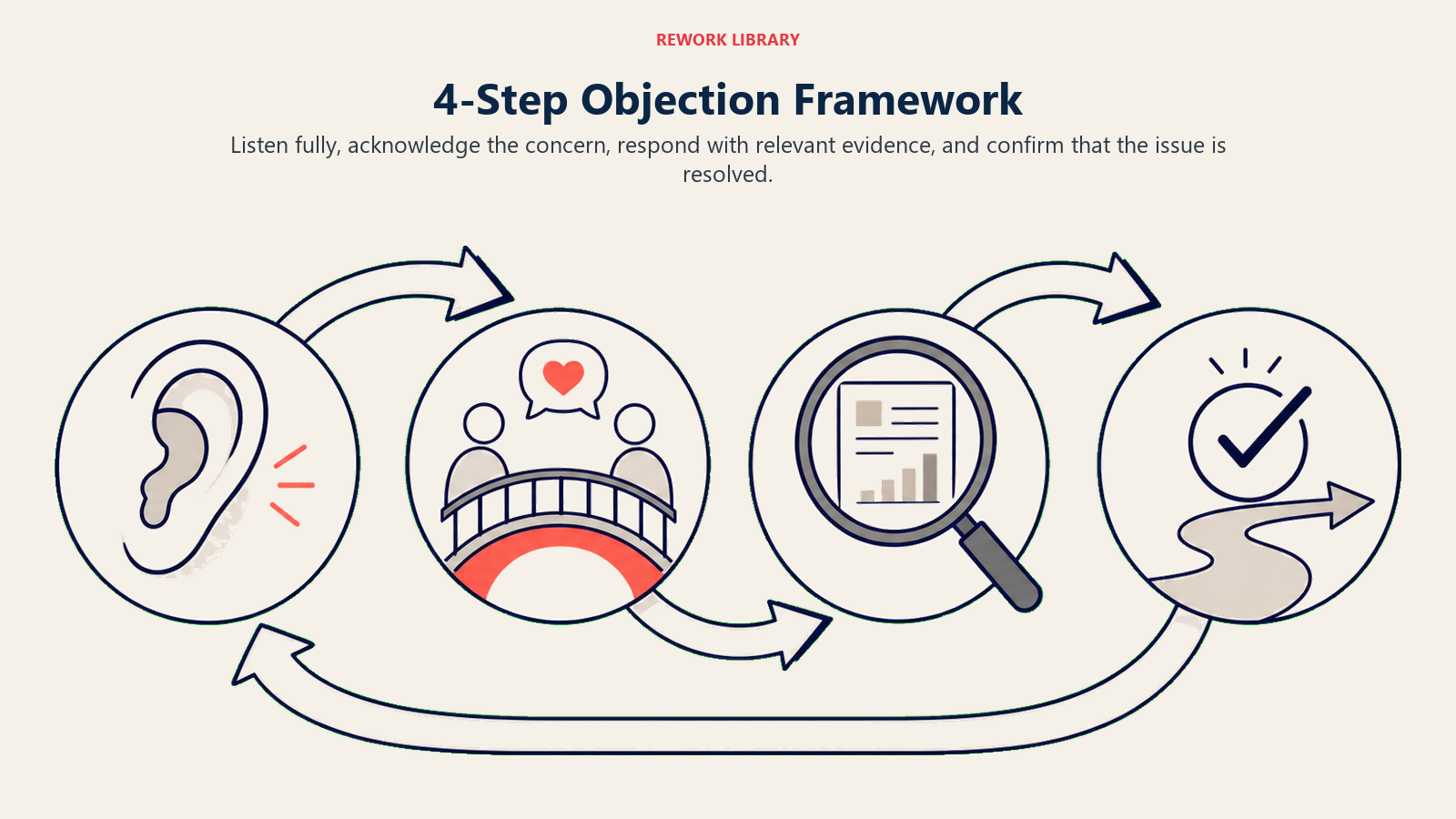
Step 1: Listen. Don't interrupt. Don't start formulating your response while the customer is still talking. Let them fully express the objection. Often, they'll talk themselves through it and reduce its severity. And you might learn something important about the real concern beneath the surface objection. Studies indicate that salespeople who exhibit patience during objections are 47% more likely to close deals.
Step 2: Acknowledge. Validate their concern without necessarily agreeing with it. "I understand. Price is an important consideration" or "I appreciate you being upfront about your budget." This defuses defensiveness. The customer doesn't feel like they need to fight to be heard.
Step 3: Isolate. This is the most important step. Determine if this is the only concern standing between you and a sale. "If we can address the payment concern, is this the vehicle you want?" If they say yes, you know you're dealing with a real objection worth solving. If they hedge or bring up other concerns, you haven't isolated the real issue yet.
Step 4: Resolve. Address the concern with evidence, options, or reframing. Your resolution should be specific and actionable, not vague reassurance. Don't say "we can work something out." Say "if we extend the term from 60 to 72 months, your payment drops to $395, which is within your budget. Does that work?"
This framework prevents you from chasing objections that aren't real, wasting energy on concerns that won't actually move the sale forward, and getting caught in endless negotiation loops. Apply these same principles throughout your automotive sales process.
Price Objections: "Your Price is Too High"
Price objections are rarely about the actual price. They're about perceived value or payment reality.
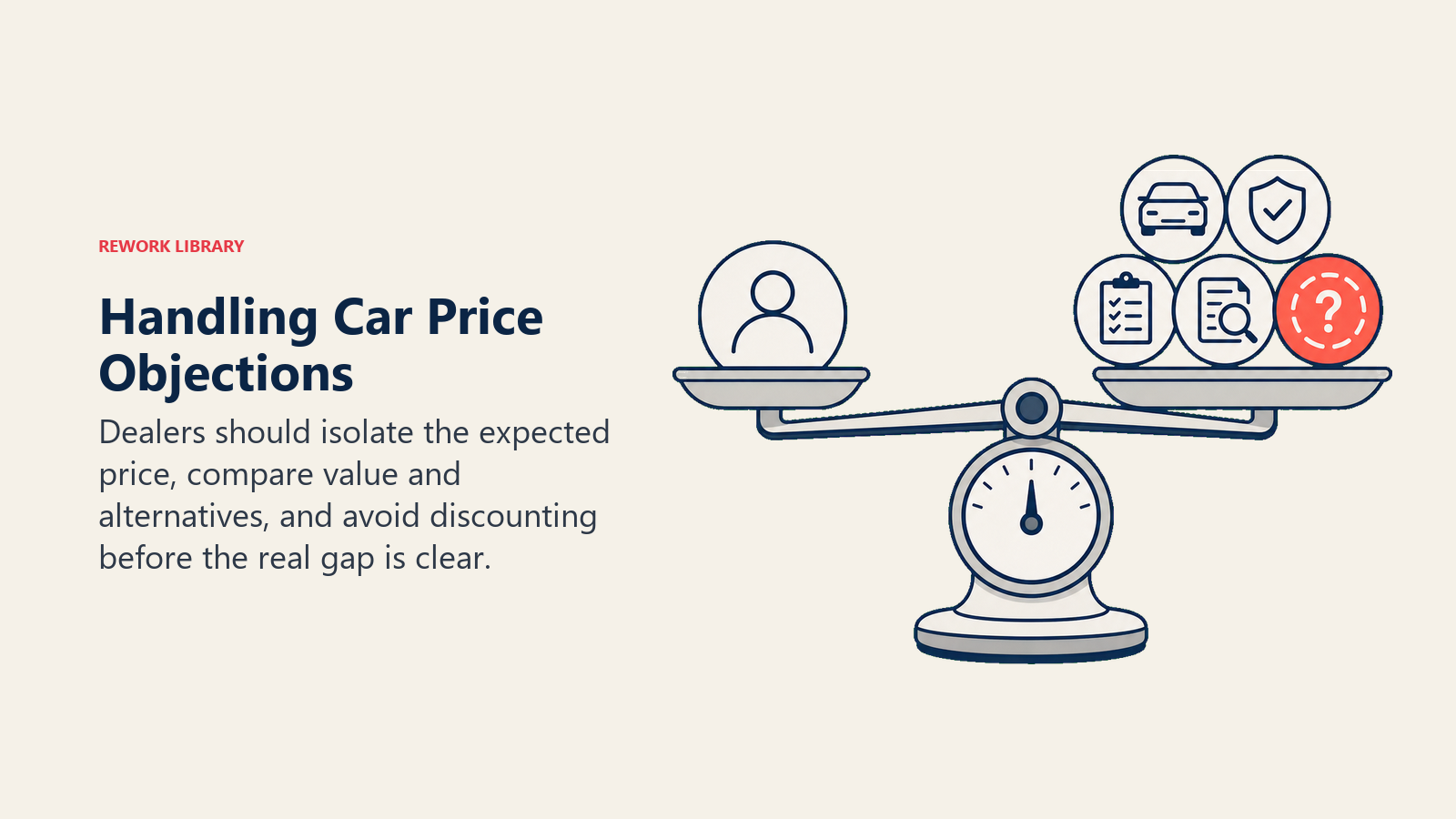
First response: "I appreciate you being direct. Help me understand, what price were you expecting?"
This question does two things. It reveals whether they have a specific competitive offer or if they're just fishing for a discount. And it forces them to articulate a number, which moves the conversation from vague dissatisfaction to specific negotiation.
If they say "I saw the same vehicle online for $2,000 less," you have something specific to address. "I'd be happy to look at that listing with you. Often, vehicles that appear similar have different equipment levels, mileage, or history. Let me pull up that listing and we can compare."
Sometimes they're right and you're not competitive. Sometimes they're comparing a base model to your loaded model. Either way, you're addressing reality instead of perception.
If they say "I don't know, it just seems high," you're dealing with a value objection, not a price objection. "I understand. Let's revisit what attracted you to this vehicle. You mentioned the safety features, the warranty, and the technology package. Those are the reasons this vehicle is priced where it is. When you compare the total value, not just the sticker price, how do you feel?" This aligns with the value-based approach in vehicle presentation demo.
Reframe to payment: "I hear you on the price. At the end of the day, what matters most is whether the payment fits your budget. What monthly payment would work for you?"
This shifts the conversation from price to payment, which is what actually matters to most customers. They don't care if the vehicle is $32,000 or $34,000. They care if the payment is $450 or $500. Understanding desking deal structure helps you navigate these payment conversations effectively.
Use value justification: "This vehicle is priced higher than the base model you mentioned because it includes the Technology Package ($2,400 value), upgraded wheels ($800), and the panoramic sunroof ($1,200). If you'd prefer to look at a base model to reduce the price, we can do that. But you'd be giving up the features you said were important." This connects back to what you learned during needs assessment.
This reminds them why they chose this specific vehicle instead of a cheaper alternative.
Payment Objections: "I Can't Afford That Payment"
Payment objections are more honest than price objections. If someone's budget is maxed out, that's real. But you have tools to address it.
First, isolate the budget: "I understand. What payment amount would be comfortable for you?"
If they say $350 and you're at $425, you have a $75 gap. That's solvable.
Options to reduce payment:
- Extend the term (60 months to 72 months saves roughly $40-50 per month per $10,000 financed)
- Increase down payment ($1,000 additional down saves roughly $18 per month)
- Consider a less expensive vehicle or trim level
- Remove optional F&I products from the deal (extended warranty, gap insurance)
- Increase trade value if you have room
Present options: "To get from $425 to $350, we have a few options. We could extend the term from 60 to 72 months, which brings the payment to $385. If you could increase your down payment by $1,500, that would get us to $352. Or we could look at a different trim level that's $3,000 less expensive. Which approach makes the most sense for you?"
You're not making the decision for them. You're giving them control over how to bridge the gap.
Don't apologize for payments. The payment is what it is based on price, interest rate, term, and down payment. Those are all adjustable, but you can't manufacture money out of thin air.
If the gap is unbridgeable, they want $300 per month and you're at $450, be honest: "I appreciate your budget parameters. Based on the vehicle you're looking at and the interest rate you qualify for, there's not a path to $300 per month without a significant down payment or moving to a less expensive vehicle. Would you like to explore other options that fit your budget better?"
This honesty builds trust even if it doesn't close this deal today.
Trade Value Objections: "That's Too Low for My Trade"
Trade value objections are emotional. The customer isn't just negotiating numbers. They're defending their vehicle, their judgment in purchasing it, and their maintenance efforts.
Acknowledge the emotion: "I completely understand. It's your vehicle, you've taken care of it, and you want to get fair value for it."
Then educate: "Let me walk you through how I arrived at this number. I pulled values from three sources, Black Book, Kelley Blue Book, and current auction data. For your 2019 Honda CR-V with 87,000 miles in good condition, the range is $13,500 to $14,200 wholesale. Our offer of $14,000 is at the top of that range."
Show them the data. Pull up auction results on your computer. Show them similar vehicles listed for sale. Make it about market reality, not your opinion.
Address the "I can sell it myself" objection: "You absolutely could sell it privately and potentially get more. Based on retail values, you might get $16,500-$17,000 if you find the right buyer. But that typically takes 30-60 days of advertising, dealing with test drives, negotiating, and handling paperwork. You'd also need to continue making payments and insurance during that time. Most people prefer the convenience of trading it in today and driving away in their new vehicle. But I understand if you want to try selling it yourself."
This acknowledges their option without devaluing your offer.
If they mention a competitive offer: "If another dealer offered you $16,000 in writing, I'd encourage you to take that offer. Our appraisal is based on current market conditions and the actual condition of your vehicle. If you have a better offer, it makes sense to go with them."
Sometimes this is a bluff and they'll back down. Sometimes it's real and you need to evaluate whether matching makes sense.
Frame it in total deal terms: "I know the trade value is less than you hoped. But let's look at the total picture. The new vehicle is $31,000, you're getting $14,000 for your trade plus $2,000 down, which brings your financing to $15,000. That puts your payment at $285 per month. The question isn't whether the trade value is perfect, it's whether the total deal makes sense for you."
This shifts focus from one number to the total value proposition.
Authority Objections: "I Need to Talk to My Spouse"
Authority objections usually mean you failed to qualify properly or the customer is using the missing decision-maker as a shield.
Best practice is preventing this objection through proper appointment setting best practices: "Will anyone else be involved in the decision, or is this your decision to make?" If they mention a spouse, partner, or parent, say: "Great. Let's make sure they're available to come in with you so we can address everyone's questions together."
But if you're already in the negotiation and they bring up the missing decision-maker, you need to handle it.
First, isolate: "I understand. Before you talk to them, I want to make sure we've addressed all of your concerns. If your spouse is on board, is this the vehicle and deal you want?"
If they say yes, you know the spouse isn't the real objection. They're uncertain and using the spouse as cover. Dig deeper: "What concerns do you think your spouse will have?" This often reveals the customer's own concerns.
If they mention specific concerns, "she's going to want to know about the safety features", address those concerns now: "Let me print out the safety ratings and feature list so you have that information. The vehicle has a 5-star overall safety rating and comes with automatic emergency braking, blind spot monitoring, and rear cross traffic alert."
Offer to include the spouse: "I completely understand. How about I give you a call this evening when you're both available? That way I can answer both of your questions and we can move forward together."
This shows respect for the decision process while keeping momentum.
Use the puppy dog close: "I understand you want to discuss it with your spouse. Here's an option: take delivery today, drive it home, let your spouse see it and drive it, and if for any reason you're not both happy, bring it back within 24 hours. Sound fair?"
This works because once the vehicle is sitting in their driveway and the spouse sees it, the emotional connection takes over.
Timing Objections: "I Need to Think About It"
This is the most common objection and the least honest. Nobody needs to "think about it" in a meaningful way. They either want the vehicle and need a concern addressed, or they don't want the vehicle and are being polite.
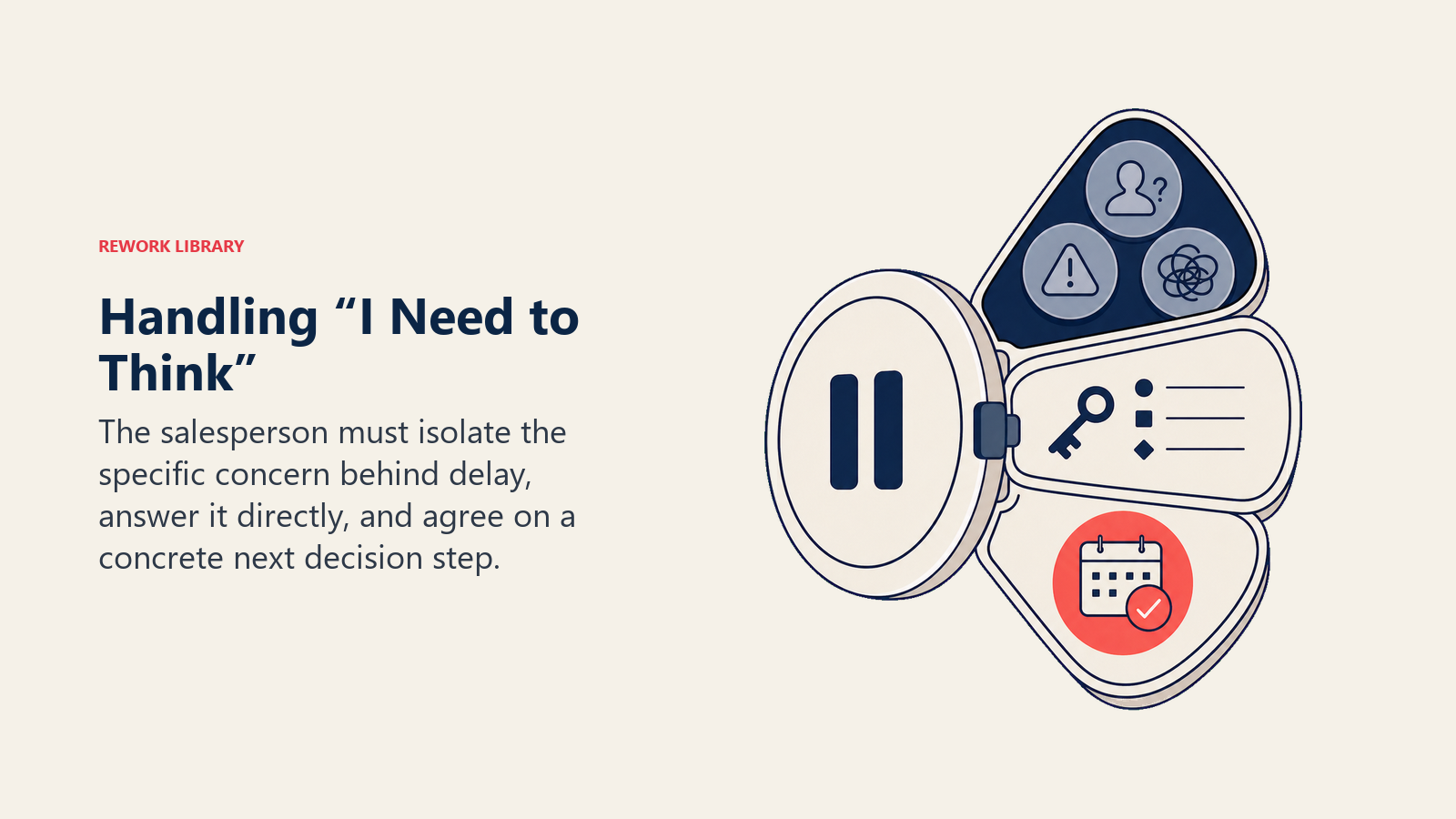
Your job is isolating the real concern.
"I completely understand. Buying a vehicle is a big decision. Let me ask you, what specifically do you need to think about?"
Then shut up and listen. They'll tell you the real objection.
If they say "just everything," push gently: "I appreciate that. To make sure I can help, is it the vehicle itself, the numbers, the timing, or something else?"
This forces them to narrow it down.
If they say "the numbers," you're back to a price or payment objection. "I understand. What part of the numbers, is it the payment, the trade value, or the down payment?"
If they say "whether this is the right vehicle," you might need to revisit needs assessment or show them alternatives. "I want to make sure we find the right vehicle for you. What concerns do you have about this one?"
If they say "whether this is the right time to buy," you're dealing with urgency or readiness. "I understand. Is there something happening that would make next month better than this month? I'm asking because we have some incentives expiring this month that could save you money."
Create urgency without pressure: "I completely understand wanting to think it over. Let me share a few things that might be helpful in your decision. This specific vehicle is one of only two we have with this color and equipment combination. There's another customer who test drove it yesterday and is supposed to call back today. I can't hold it without a deposit, but if you're serious, I can try to keep it available until you decide. How long do you think you'll need?" Understanding automotive inventory strategy helps you create genuine urgency.
This creates gentle urgency based on reality, not manufactured pressure.
The absolute truth close: "I'm going to be completely honest with you. I can tell you like the vehicle. The test drive went well, the numbers work with your budget, and this checks all the boxes you said were important. The only thing holding you back is fear of making a decision. That's totally normal. But if you walk out to 'think about it,' statistically you won't come back. Not because it's the wrong vehicle, but because the moment passes and life gets in the way. If there's a real concern, tell me now and let's address it. But if you're just nervous about committing, let's push through that together."
This is bold, but it works with customers who respect directness.
Advanced Techniques: Pre-empting and Reframing
The best objection handling happens before the objection comes up. Pre-empt common objections by addressing them proactively.
On price: "You're probably wondering why this vehicle is priced higher than the base model. Let me show you what's included in this trim level that makes it worth the difference."
On payment: "Before we get to specific numbers, what monthly payment range are you targeting? I want to make sure we structure something that fits your budget."
On trade value: "I want to set realistic expectations on trade value. The market for this model has been soft lately because of high inventory. I'll give you the most competitive number I can, but I want you to understand the market reality upfront." Pre-empting these concerns streamlines the trade-in appraisal process.
This doesn't eliminate objections, but it frames them on your terms before the customer brings them up defensively.
Use the "feel, felt, found" method: "I understand how you feel. Many of our customers felt the same way initially. What they found after driving the vehicle for a week is that the technology features and fuel economy more than justify the price difference."
This provides social proof that others had the same concern and were satisfied.
Trial close throughout the process: "If I can get the payment to $425, is that something that works for you?" This tests objections before you get to final negotiation.
Objections Are Part of the Process
Top performers don't fear objections. They expect them, welcome them, and use them to move the sale forward. Every objection is an opportunity to provide information, address concerns, and build confidence.
The worst thing you can do is avoid objections by cutting price prematurely or giving away gross without understanding the real concern. That's not sales. That's order-taking.
The best thing you can do is embrace objections as buying signals, use the 4-step framework to isolate and resolve them, and persist through multiple objections until you reach either a sale or a genuine impasse.
According to McKinsey research, every 1% rise in sales productivity is worth about $500,000 in revenues for the average US dealership. Most deals require handling 5-7 objections. If you give up after two or three, you're leaving money on the table and customers unsatisfied. Push through with confidence, empathy, and solutions, and you'll dramatically improve your close rate. Strong objection handling is fundamental to showroom traffic conversion and automotive customer experience. Master these techniques and watch your performance on the dealership KPI dashboard improve dramatically.

Senior Implementation Consultant
On this page
- Understanding Objections: Types and Psychology
- The 4-Step Objection Handling Framework
- Price Objections: "Your Price is Too High"
- Payment Objections: "I Can't Afford That Payment"
- Trade Value Objections: "That's Too Low for My Trade"
- Authority Objections: "I Need to Talk to My Spouse"
- Timing Objections: "I Need to Think About It"
- Advanced Techniques: Pre-empting and Reframing
- Objections Are Part of the Process