EV Customer Education: Building Confidence and Overcoming Barriers to Purchase - 2026 Guide

Turn this article into takeaways for your work.


Each assistant summarizes the article only for you and suggests best practices for your work.
Sixty-five percent of car buyers say they're "interested" in electric vehicles. But only 8% actually buy one. That 57-point gap is education. Dealers who systematically educate customers about EVs convert at three times the rate of those who don't.
The problem isn't the product. Modern EVs offer 250-350+ miles of range, 60,000+ public charging stations, and lower total cost of ownership than gas equivalents. The problem is knowledge. Most buyers have never driven an EV, don't understand charging, and base their concerns on outdated information.
Your sales team can either fight these misconceptions one customer at a time, or you can build systematic education that addresses common concerns before customers ever reach the showroom.
Understanding EV Customer Concerns
Start by knowing exactly what's holding buyers back. Research consistently identifies the same top concerns.
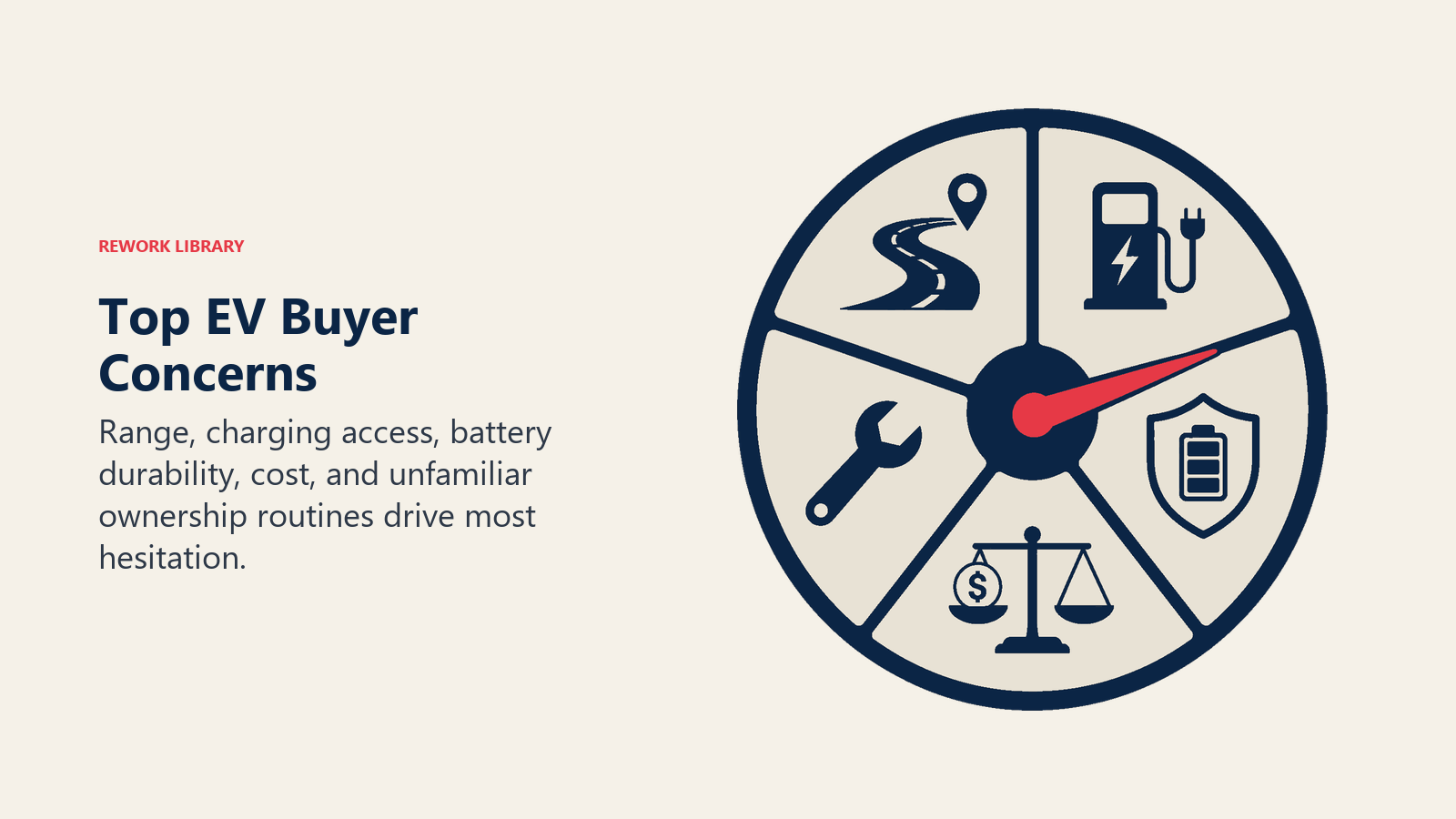
Range anxiety dominates every survey. "What if I run out of power?" drives purchase hesitation despite the reality that most EVs now offer ranges that exceed daily driving needs by 5-6x. The average American drives 37 miles per day. Even entry-level EVs provide 200+ miles of range.
But facts alone don't eliminate anxiety. You need to make range tangible and personal. Show customers their specific daily routes using customer journey mapping. Calculate their weekly mileage. Demonstrate that they'd need to charge just twice a week even with conservative range estimates.
Charging infrastructure availability creates real concern for buyers who don't understand how EV charging works. They picture running out of power with no station nearby. The reality: according to the U.S. Department of Energy Alternative Fuels Data Center, there are over 67,000 public DC fast-charging ports nationwide, growing by 20% annually. By 2030, the Department of Energy projects approximately 182,000 DC fast charging ports will be needed at public stations. Major highways have DC fast chargers every 50-75 miles. Urban areas have widespread Level 2 charging at shopping centers, workplaces, and parking garages.
Charging time versus gas fill-up speed represents a legitimate difference, but the comparison is flawed. Yes, you can't "fill" an EV in 5 minutes like a gas car. But you also don't need to. Most EV owners charge at home overnight, starting every day with a full "tank." The question isn't "How long does it take?" It's "When do you charge?" And the answer is "while you sleep" for 90% of charging.
Higher upfront cost perception persists despite narrowing price gaps and favorable total cost of ownership. The average new EV costs about $6,000 more than a comparable gas vehicle before incentives. After federal tax credits ($7,500), state incentives ($2,000-7,500 depending on location), and utility rebates ($500-1,000), many EVs are cheaper upfront, let alone over 5 years of ownership. Understanding automotive business economics helps frame these conversations.
Battery life and replacement cost fears come from outdated information about early-generation EVs. Modern EV batteries are warrantied for 8 years/100,000 miles minimum. According to EPA research on electric vehicle myths, battery replacements due to failure have been rare, at an average of 2.5%, and since 2016 have had less than a 0.5% failure rate. Real-world data shows 5-10% degradation in the first 5 years, then minimal additional loss. Replacement is rare within the vehicle's useful life and costs are falling rapidly.
Resale value uncertainty is based on early EV depreciation patterns that no longer hold. First-generation EVs depreciated quickly because battery technology improved rapidly, making older vehicles obsolete. Today's EVs from mainstream manufacturers hold value comparably to gas vehicles, especially as used car buyers discover operating cost savings.
Unfamiliarity with technology makes buyers cautious about what they don't understand. Regenerative braking, one-pedal driving, instant torque, charging apps, these are foreign concepts. And unfamiliar means risky to conservative buyers. Proper vehicle presentation and demonstration addresses these concerns.
Range Education and Reality
Range anxiety is the single biggest barrier to EV adoption. Address it systematically.
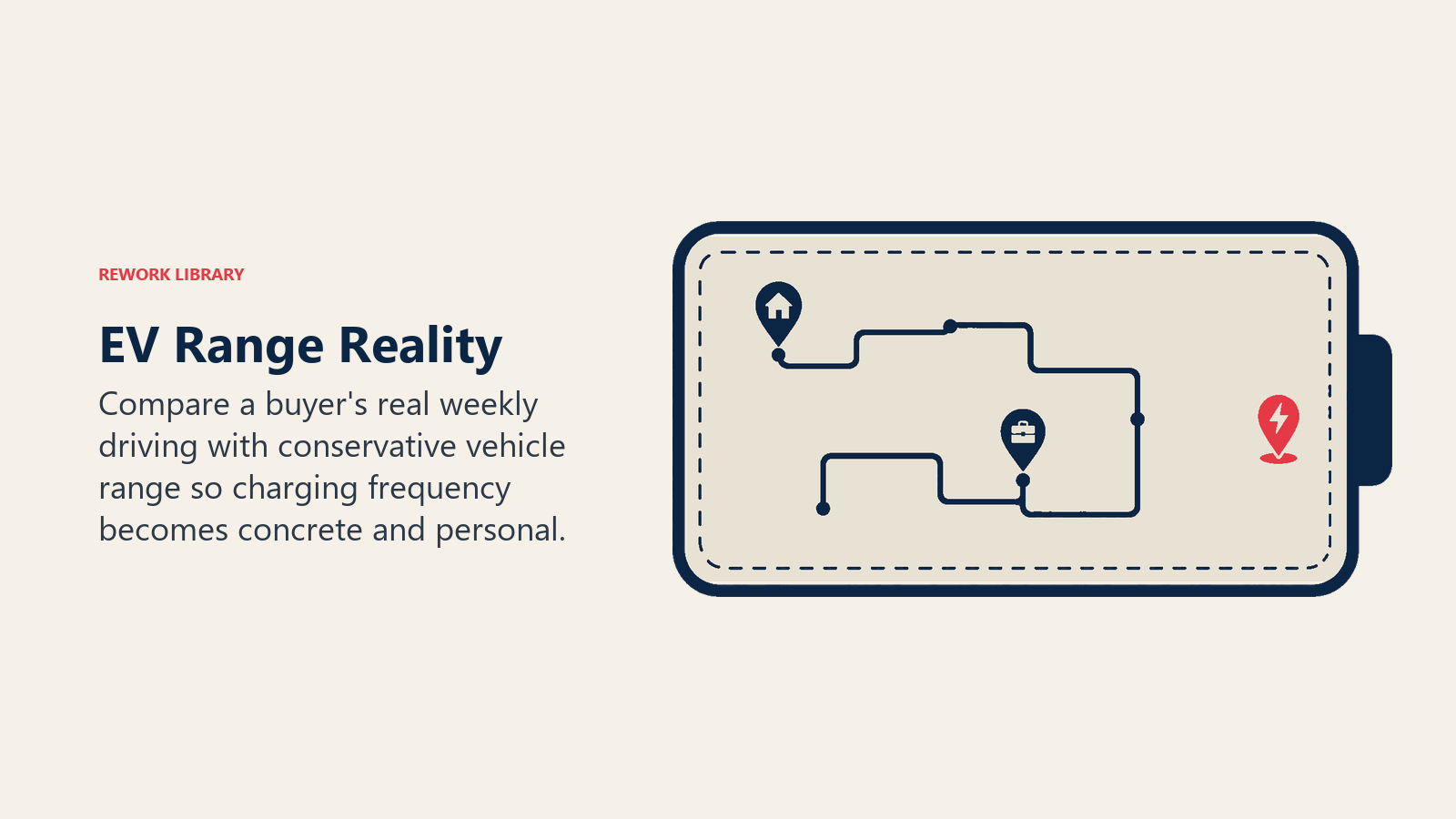
Start with average daily driving distance data. U.S. Department of Energy data shows Americans drive an average of 37 miles per day. Even heavy drivers rarely exceed 75 miles daily. Show customers this data, then ask about their personal patterns. Most will admit they drive far less than they think.
Explain real-world range factors honestly. Cold weather reduces range by 15-25% due to battery chemistry and cabin heating. Highway driving reduces range compared to city driving because regenerative braking doesn't engage. Aggressive acceleration eats range. But normal driving in normal conditions delivers close to EPA estimates.
Compare highway versus city driving efficiency. Gas cars are more efficient on highways. EVs are more efficient in stop-and-go traffic because regenerative braking recaptures energy. For urban and suburban drivers, this is a major advantage.
Address range degradation over time directly. "Won't the battery lose capacity?" Yes. Typically 5-8% in the first 5 years, stabilizing after that. A 300-mile range EV becomes a 280-mile range EV after 5 years. Still more than enough for daily driving.
Teach trip planning for long journeys. This is where you address the annual road trip objection. Show them PlugShare or your OEM's trip planner. Map their typical long-distance route (visiting family, beach trip, ski weekend). Identify charging stops. Most routes have DC fast chargers every 100-150 miles. A 20-30 minute charging stop adds 150-200 miles, enough for the next leg.
Use range-focused messaging and demonstrations in all your EV marketing. Create a simple graphic: "Average daily driving: 37 miles. Your EV's range: 270 miles. That's like having a gas car with a 220-gallon tank."
Charging Infrastructure Education
Make charging simple and tangible for buyers who've never plugged in a car.
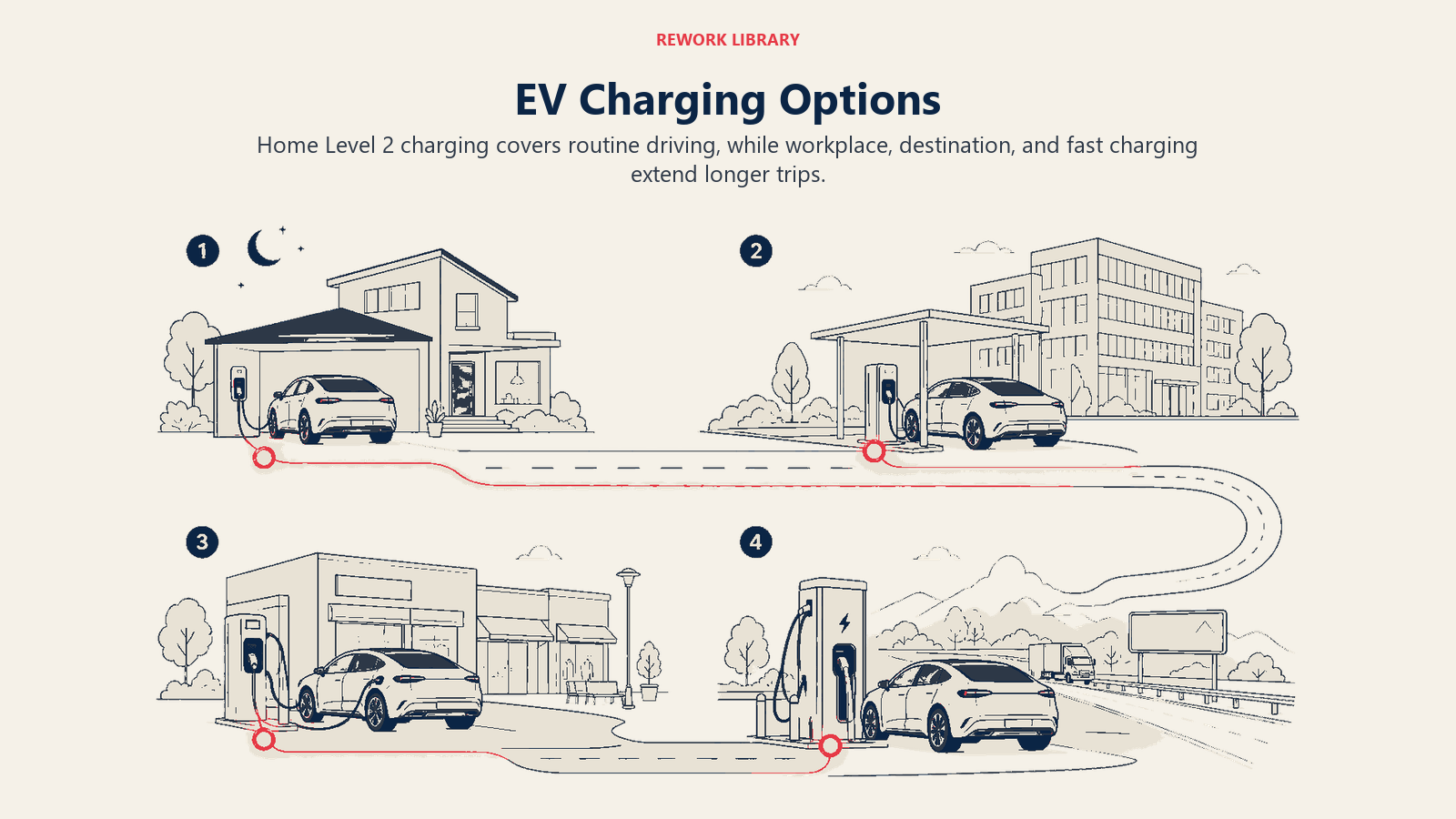
Start with home charging setup. Level 1 charging uses a standard 120V outlet, no special installation needed. It's slow (3-5 miles of range per hour) but works for low-mileage drivers. Level 2 charging uses a 240V circuit like an electric dryer. It adds 25-30 miles of range per hour. Most EV owners install Level 2 at home for $1,000-1,500 including equipment and electrician.
Explain the public charging network growth and availability. Over 60,000 stations nationwide, concentrated in urban areas and along major highways. Apps like PlugShare show real-time availability, connector types, and user reviews.
Break down fast charging capabilities and locations. DC fast charging adds 100-200 miles of range in 20-40 minutes. Networks like Electrify America, EVgo, and ChargePoint are expanding rapidly. Tesla's Supercharger network (now opening to non-Tesla EVs) offers the most coverage.
Clarify charging time by level with specific numbers. Level 1: 40-50 hours for a full charge. Level 2: 6-10 hours for a full charge. DC fast charging: 20-45 minutes for 80% charge (fast charging slows after 80% to protect battery health).
Highlight workplace and destination charging options. Many employers now offer free Level 2 charging as a benefit. Shopping centers, hotels, and entertainment venues increasingly provide charging to attract customers.
Create charging cost versus gasoline cost comparisons that show real savings. Electricity costs average $0.15/kWh. An EV getting 3 miles/kWh costs $0.05 per mile. A 25-mpg gas car at $3.50/gallon costs $0.14 per mile. That's $150-200 monthly savings for average drivers.
Total Cost of Ownership Education
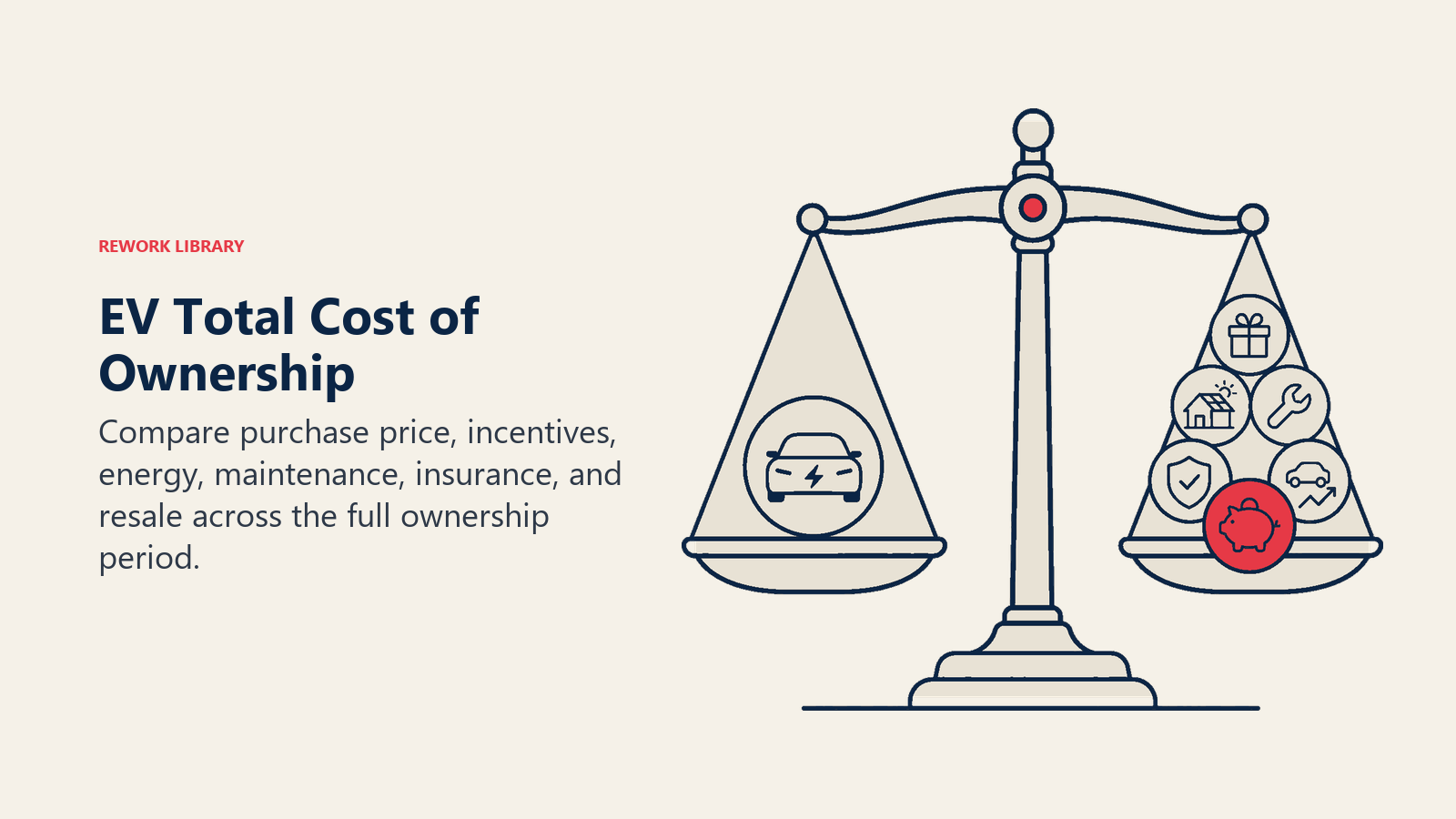
TCO is where EVs shine. Make the financial case clear and compelling.
Start with purchase price versus ICE comparable before incentives. A mid-size EV like a Chevy Equinox EV ($42,000) compares to a gas Equinox ($30,000). That's a $12,000 gap before incentives.
Apply the federal tax credit ($7,500 for qualifying vehicles). Now the gap is $4,500. In many markets, point-of-sale application means customers get this as a down payment or payment reduction immediately.
Add state and local incentives. California offers up to $7,500 additional. Colorado provides $5,000. New York offers $2,000. In California, the EV is now cheaper upfront than the gas equivalent.
Build a fuel cost savings calculator. Assume 12,000 annual miles. Gas car at 25 mpg and $3.50/gallon costs $1,680/year. EV at $0.05/mile costs $600/year. Annual savings: $1,080. Five-year savings: $5,400.
Calculate maintenance cost savings conservatively. EVs have no oil changes ($500/year saved), less brake wear due to regenerative braking ($200/year saved), no transmission ($100/year saved), fewer fluids ($100/year saved). Conservative annual savings: $500-900. Five-year savings: $2,500-4,500.
Account for insurance cost considerations. EVs often cost 5-15% more to insure due to higher repair costs and vehicle values. Add this to your TCO calculation for accuracy.
Present a 5-year TCO comparison showing purchase price, fuel costs, maintenance costs, insurance, and total cost. In most scenarios, EVs cost $3,000-8,000 less to own over 5 years despite similar or higher purchase prices.
Battery Health and Longevity Education
Battery anxiety is real. Address it with facts and warranties.
Explain battery technology fundamentals without getting too technical. Lithium-ion batteries power everything from phones to EVs. They degrade slowly over time but remain functional for decades. According to battery degradation studies, most EVs show just 1.8% average degradation annually, with many retaining 85-90% capacity after a decade. EV batteries are far more advanced than phone batteries due to sophisticated thermal management.
Highlight warranty coverage prominently. Federal regulations require 8 years/100,000 miles minimum. Most manufacturers offer 8 years/120,000 miles or better. Some, like Hyundai, offer lifetime battery warranties. This warranty covers capacity loss below 70%, which rarely happens within the warranty period.
Share real-world battery degradation data. Studies of Tesla Model S vehicles show 5% capacity loss in the first 50,000 miles, then degradation slows to 1% per 50,000 miles. After 200,000 miles, most still have 85-90% capacity.
Explain battery management systems and thermal management. Modern EVs actively heat and cool batteries to optimize performance and longevity. This is why EVs rarely experience the rapid degradation early adopters feared.
Teach charging practices that maximize battery life: avoid frequent DC fast charging to 100%, maintain charge between 20-80% for daily use, precondition battery in extreme cold before charging. But also emphasize that normal use won't destroy the battery, they're designed for real-world abuse.
Address end-of-life battery recycling and reuse. Batteries that fall below 70% capacity for vehicle use still work perfectly for stationary energy storage. Recycling programs recover valuable materials. There's no "landfill full of EV batteries" problem.
Educational Content and Tools
Systematic education requires systematic content.
Build a website EV education center and FAQ section covering all common questions: range, charging, costs, battery life, incentives, and model comparisons. Make it searchable and mobile-friendly.
Create interactive TCO calculators where customers input their daily mileage, local electricity rates, gas prices, and see personalized cost comparisons. Interactive tools engage better than static content.
Develop range confidence tools and trip planners integrated with charging networks. Let customers input their home address and common destinations to see charging options along their actual routes.
Produce video content including charging demonstrations (how to plug in, how to use public chargers), owner testimonials from real customers who overcame the same concerns, and vehicle walk-arounds highlighting EV-specific features.
Offer downloadable guides and comparison sheets: EV vs. gas cost comparison, home charging installation guide, incentive checklist by state, charging network guide.
Build email nurture sequences for EV consideration. A 6-email series covering range, charging, costs, incentives, technology, and next steps keeps prospects engaged over weeks as they research.
The EV Education Appointment
Convert online education into in-person confidence.
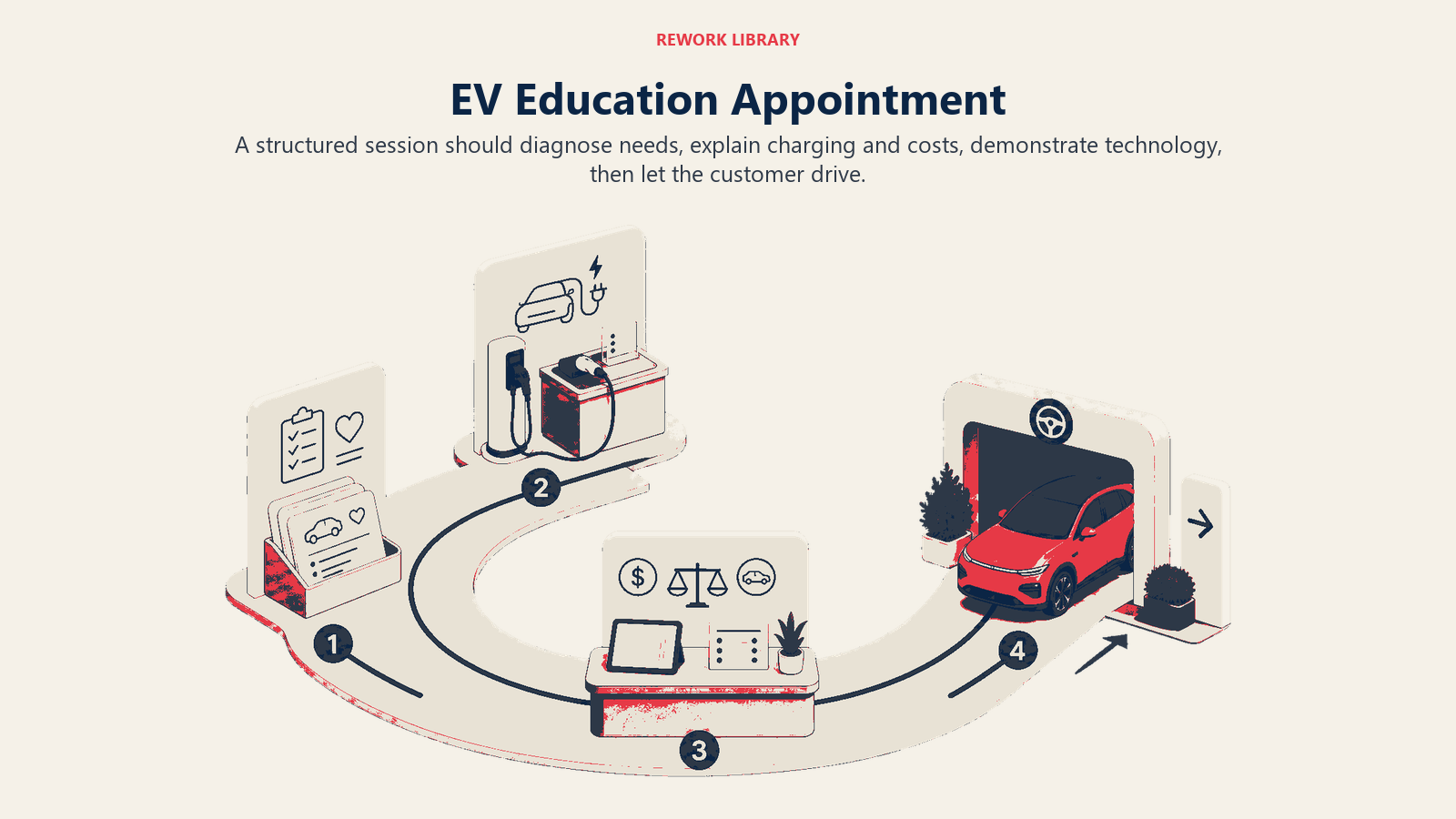
Start with needs analysis focused on driving patterns, charging access, and budget. Ask: "What's your daily commute?" "Do you have a garage or dedicated parking?" "What's your monthly fuel cost?" These questions determine EV suitability and set up value demonstrations.
Conduct a suitability assessment honestly. If someone drives 200 miles daily without workplace charging, a 250-mile range EV might not fit their lifestyle. Be candid. Putting someone in the wrong vehicle destroys trust.
Run a feature and benefit education session covering the specific EV they're considering. Don't rush. Spend 15-20 minutes on range, charging, costs, and features. Answer every question.
Provide a home charging consultation and setup discussion. Explain Level 1 versus Level 2. Offer installation services or electrician referrals. Address permitting and HOA concerns.
Present incentive and cost savings calculations personalized to their situation. Use their stated mileage, local electricity rates, and available incentives to show real numbers.
Offer an extended test drive, ideally 24-hour trial program. Let them charge at home, drive to work, run errands. Real-world experience eliminates concerns better than any sales pitch.
Multi-Channel Education Strategy
Meet customers where they are with consistent messaging.
Your website content and self-service tools should be comprehensive. Many buyers will research independently before ever contacting you. Make sure they find accurate, helpful information.
Email education sequences for EV leads provide progressive information. Email 1: Range basics. Email 2: Charging explained. Email 3: Cost comparison. Email 4: Incentive guide. Email 5: Customer testimonial. Email 6: Invitation to test drive.
Social media content and influencer partnerships reach younger, environmentally conscious buyers. Share customer stories, charging tips, road trip reports, and cost savings testimonials. Partner with local EV influencers for authentic reach. Leverage content marketing strategies for broader reach.
In-dealership EV displays and kiosks educate walk-in traffic. Interactive displays showing range maps, charging networks, and TCO calculators engage browsers who aren't ready to talk to salespeople yet.
Community events and ride-and-drive programs build confidence through experience. Host Saturday EV showcases with multiple vehicles, charging demos, owner panels, and test drives. Low-pressure education events convert at higher rates than traditional sales approaches.
BDC scripting for EV inquiries ensures consistent, accurate information. Train BDC agents to qualify EV interest, ask about driving patterns and charging access, and set education appointments (not just test drives).
Measuring Education Effectiveness
Track what works and optimize continuously.
Measure lead-to-appointment conversion for EV inquiries. If your gas car leads convert at 35% and EV leads at 18%, your education process needs work.
Track test drive-to-sale conversion for EVs versus ICE. Lower EV conversion means objections aren't being overcome. Higher conversion means your education is working.
Analyze time-to-sale for EV customers. Longer sales cycles are normal because buyers need more education. But track whether your process accelerates decisions or creates more confusion.
Survey customer satisfaction with education process. Ask: "Did we answer your questions about range and charging?" "How confident do you feel about owning an EV?" Scores below 8/10 indicate gaps.
Log common objections and track rebuttal effectiveness. If 40% of customers cite "range anxiety" and half of those buy anyway, your range education works. If nobody citing range anxiety converts, improve your approach.
Monitor content engagement analytics. Which FAQ pages get the most traffic? Which videos get watched completely? Which emails get opened? Double down on high-performing content.
The education gap is where most dealers lose EV sales. But it's also the biggest opportunity. Dealers who systematically educate customers turn interest into purchases, and build long-term relationships with buyers who appreciate the guidance. Combine education with strong EV sales strategy and customer experience management for maximum effectiveness.

Senior Implementation Consultant