Standard Work Documentation: Capturing the Best Known Method on the Shop Floor
Turn this article into takeaways for your work.


Each assistant summarizes the article only for you and suggests best practices for your work.
Put three experienced operators on the same job and watch them work. One reaches for the fixture first, then the part. Another does it in the opposite order. A third has a shortcut nobody taught them that shaves ten seconds but occasionally causes a quality slip. All three hit their numbers most days. None of them are doing the same job.
That variation feels harmless until a quality escape happens and nobody can say which method was actually being followed, or a top performer leaves and takes their unwritten shortcuts with them. Standard work documentation exists to close that gap: capturing the current best known way to do a job, not as bureaucratic paperwork, but as a working reference that makes deviation visible and improvement possible.
What Standard Work Actually Documents
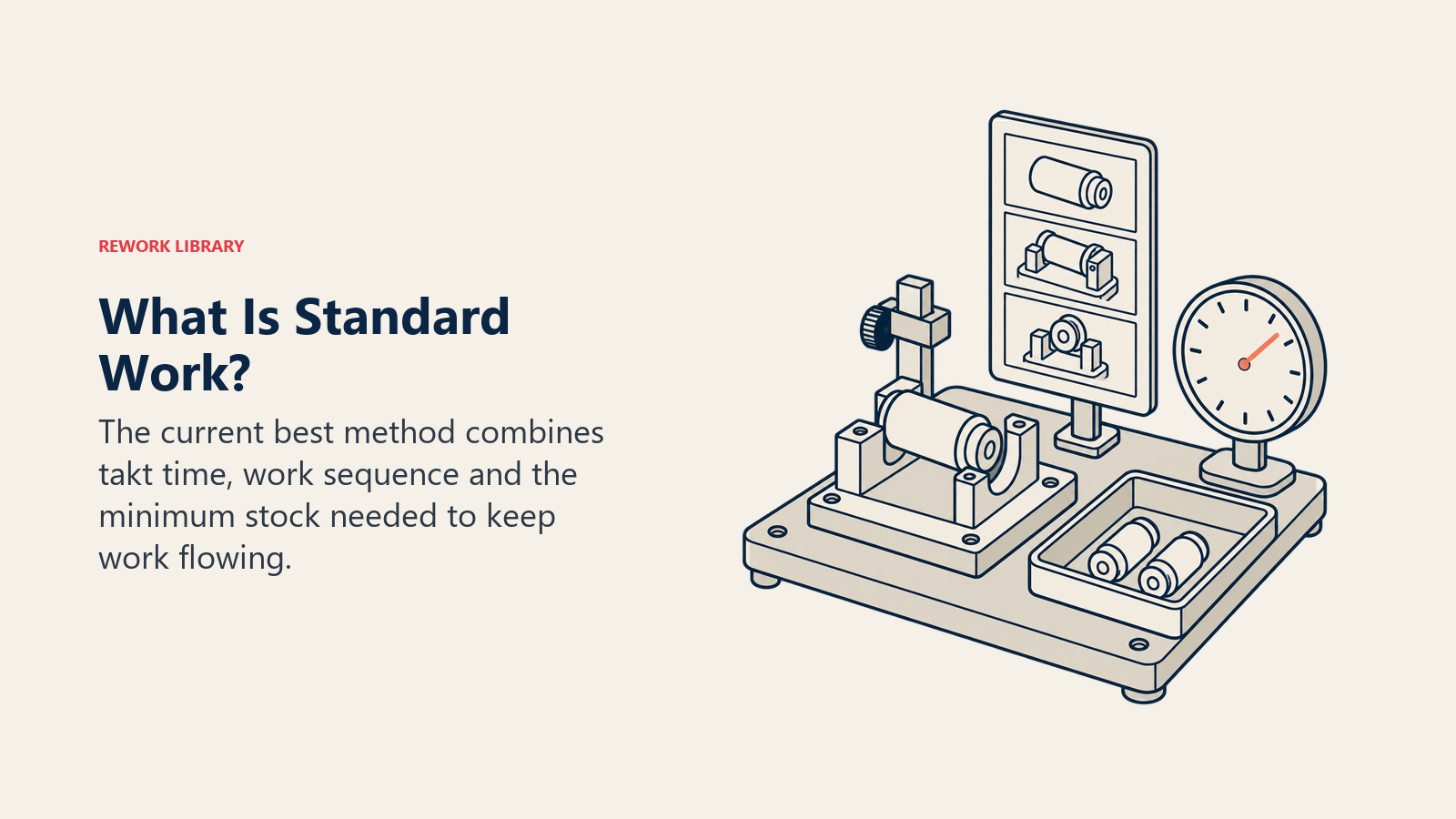
Standard work is built from three specific elements, not a general description of "how we do things around here."
Takt time is the pace of customer demand, calculated by dividing available production time by the number of units customers need in that period. It sets the rhythm every workstation on a line needs to match, and it connects directly to the capacity planning strategy work that determines what a line is expected to produce.
Work sequence is the specific order of steps an operator performs to complete the job safely, at quality, within takt time. This isn't a vague description. It's numbered steps: pick up part, orient it against the fixture, engage the clamp, cycle the press, remove and inspect. According to lean consultant Akinori Hyodo, writing for Shinka Management, standard work exists specifically so "anybody should be able to perform the same job in the same way," which only holds if the sequence is documented precisely enough to remove ambiguity.
Standard in-process stock, sometimes called standard WIP, is the minimum inventory of parts required at and between workstations to keep the line running smoothly without operators waiting on the next piece. Getting this number too low creates starvation and stoppages. Too high, and you're carrying inventory optimization waste that standard work is supposed to eliminate, not create.
Key Facts: Where Standard Work Actually Breaks Down
- Standard work documents work only when built from the three specific elements, takt time, work sequence, and standard in-process stock, rather than a general written description of the job (Shinka Management)
- An estimated 70 to 80% of standard work compliance issues trace back to management failures, unclear standards, insufficient training, missing tools at point of use, rather than operator error or willful deviation (Akinori Hyodo, Shinka Management)
Standard Work Sheets and Combination Tables
Documentation needs a physical or digital form that operators actually reference, not a binder that lives in a manager's office.
The standard work sheet is a single-page visual showing the workstation layout, the work sequence numbered in order, safety and quality check points, and the standard in-process stock quantity. It's posted at the workstation itself, where the operator can glance at it mid-shift, not filed away where checking it requires stopping the line.
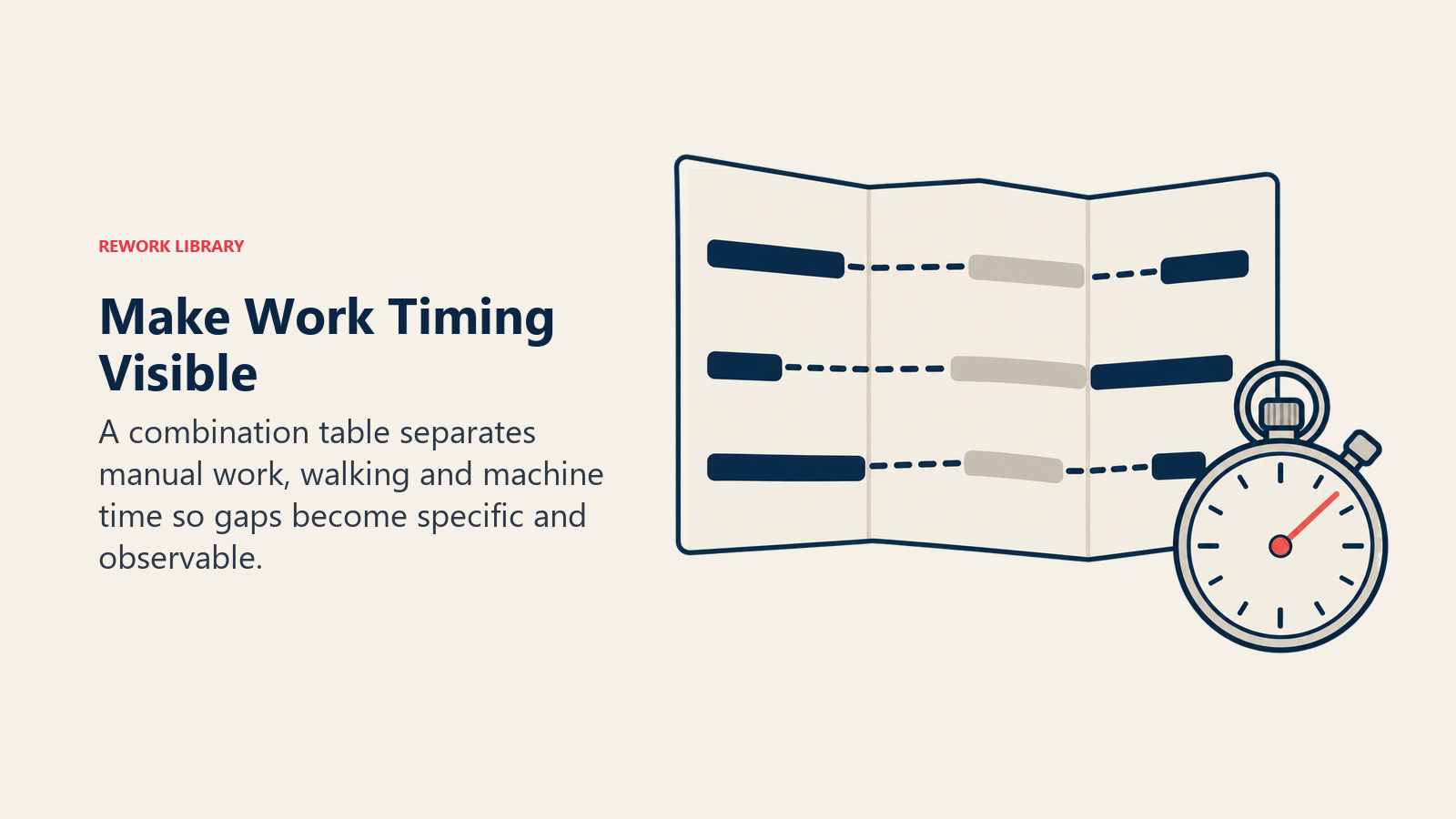
The standard combination table pairs the work sequence with time values for manual work, walking, and machine cycle time, laid out so a trainer or team leader can immediately see where an operator's actual pace diverges from the documented standard. This is the tool that turns "something feels off on this line" into a specific, addressable gap between documented time and actual time at a specific step.
Job element sheets go one level deeper for complex or safety-critical steps, breaking a single line item on the work sequence into detailed sub-steps with photos or diagrams. Reserve these for steps where getting the detail wrong creates real safety or quality risk, not for every single task, or the documentation burden becomes its own source of noncompliance. This is also where standard work intersects statistical process control: a job element sheet for a critical dimension should reference the same control limits an operator is expected to check during the run.
Building Standard Work That People Actually Use
Documentation created by an engineer at a desk, disconnected from the operators who run the job, produces standards nobody follows.
Build standard work sheets by observing the current best-performing operator doing the job, not by designing an ideal process from first principles. Time each element, note the exact sequence, and identify the specific technique that makes that operator faster or more consistent than others doing the same job. This connects standard work directly to the 5S workplace organization work that should already be in place, since a standard sequence only holds up if tools and materials are actually where the standard says they'll be.
Involve the operators who'll follow the standard in reviewing and refining the draft before it's finalized. A standard imposed without input gets followed when someone's watching and quietly abandoned when they're not. A standard built with operator input, especially input from the people whose current methods informed the draft, gets defended by the people using it.
Post it where the work happens, in the language operators actually speak, using pictures and diagrams over dense text wherever possible. A standard work sheet that requires careful reading to understand won't get referenced during a shift where seconds matter, and it should be simple enough to survive cross-training programs that move operators between stations without a lengthy relearning period each time.
Standard Work Versus Generic SOPs
Standard work documentation and a standard operating procedure aren't the same thing, even though the terms get used interchangeably in a lot of shops.
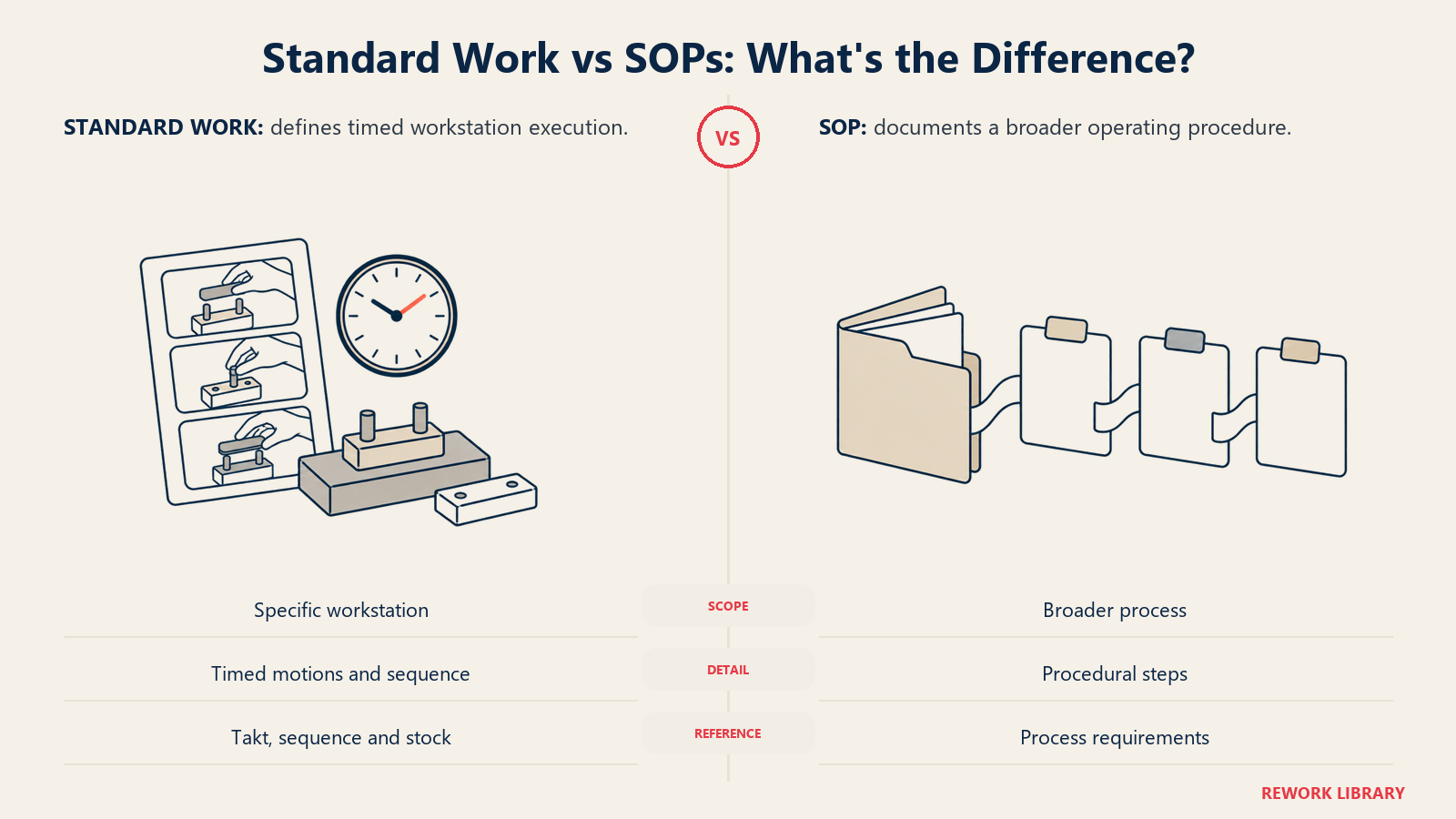
A generic SOP often documents a process at a high level, the steps a department follows to process an order or handle a nonconformance, without the takt-time-driven precision that shop-floor standard work requires. Standard work is specifically about the repeatable, timed, sequenced work at a single workstation tied to a specific production rate. Broader documentation needs, like the process controls covered in quality management systems, still matter, but they solve a different problem than the one standard work sheets are built to solve.
Confusing the two leads to standard work sheets that read like policy documents, too abstract to guide a specific motion at a specific workstation, or SOPs written with unnecessary takt-time precision that doesn't apply outside a paced production line.
Standard Work as the Baseline for Kaizen
Standard work isn't meant to freeze a process in place. It's meant to create a known baseline that makes improvement measurable.
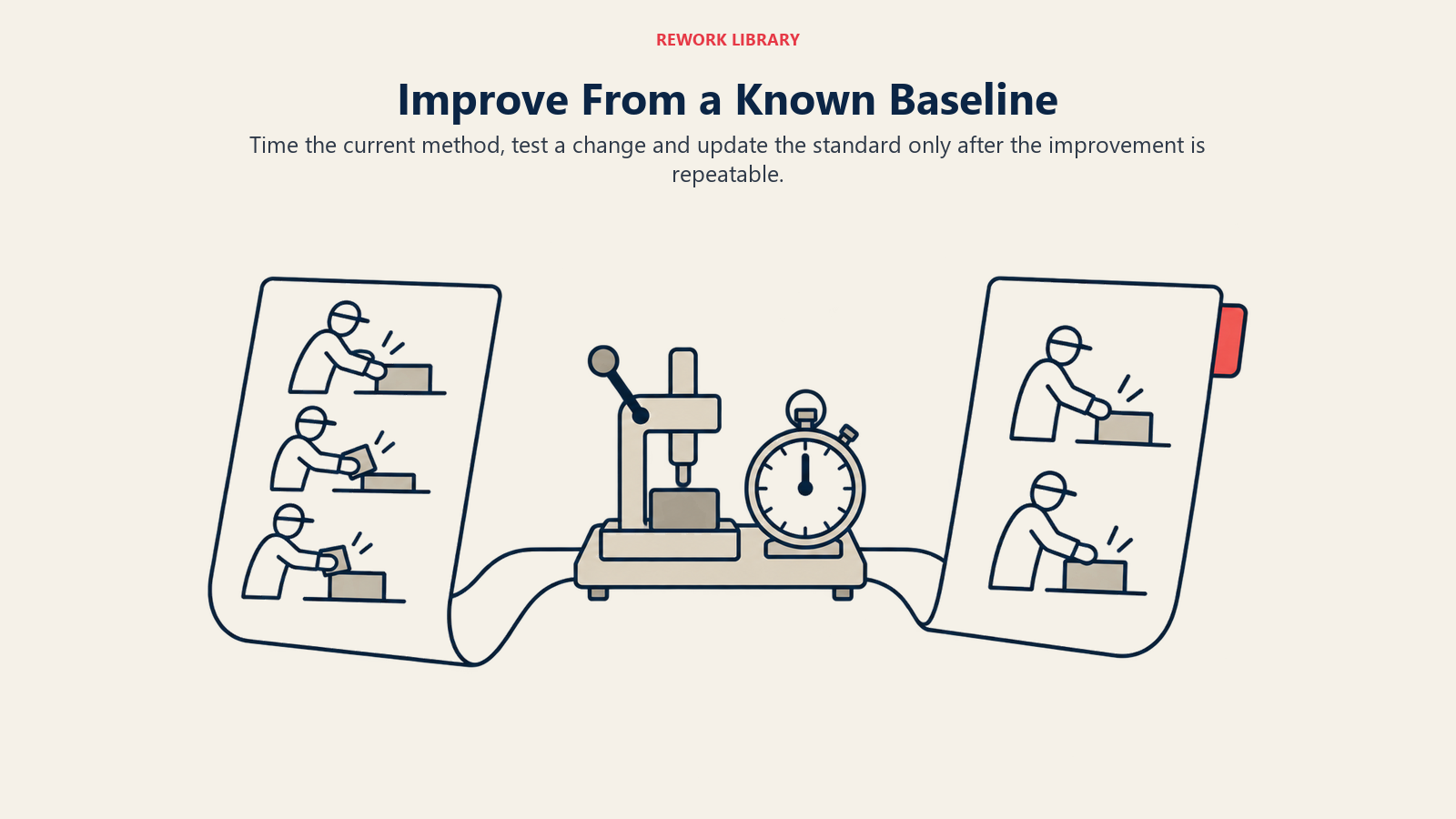
Without a documented standard, a kaizen continuous improvement event has nothing solid to compare against. Teams end up debating whether a change actually helped based on impressions rather than a documented before-and-after. With a standard in place, the kaizen team times the current standard, tests a change, and measures the new time against the documented baseline, then updates the standard work sheet once the improvement is validated and repeatable.
This cycle, document, follow, improve, redocument, is what separates standard work from a one-time compliance exercise. A standard work sheet that hasn't changed in three years on a line that's undergone multiple kaizen events isn't a sign of stability. It's a sign the documentation stopped keeping pace with the actual work being done, which quietly reintroduces the same tribal-knowledge variation standard work was supposed to eliminate. The same discipline shows up in value stream mapping work, where a future-state map is only credible if the standard work times feeding it are current.
Training and Certifying to Standard
A posted standard work sheet doesn't guarantee anyone follows it. Training and certification close that gap.
New operators should be trained directly against the standard work sheet and combination table, with a qualified trainer demonstrating the documented sequence rather than an experienced operator showing "how I do it," which may or may not match the current standard. This connects directly to broader skills training and development programs, since standard work training is one of the most concrete, measurable pieces of that broader curriculum.
Certification should confirm an operator can complete the job within takt time, following the documented sequence, at required quality, not just that they attended a training session. Recertify periodically and whenever the standard changes, and track certification status visibly so a team leader can immediately see which operators on a line are running an outdated version of the standard.
Auditing Compliance and Catching Drift
Standards drift the moment nobody's checking, usually gradually and for individually reasonable-sounding reasons.
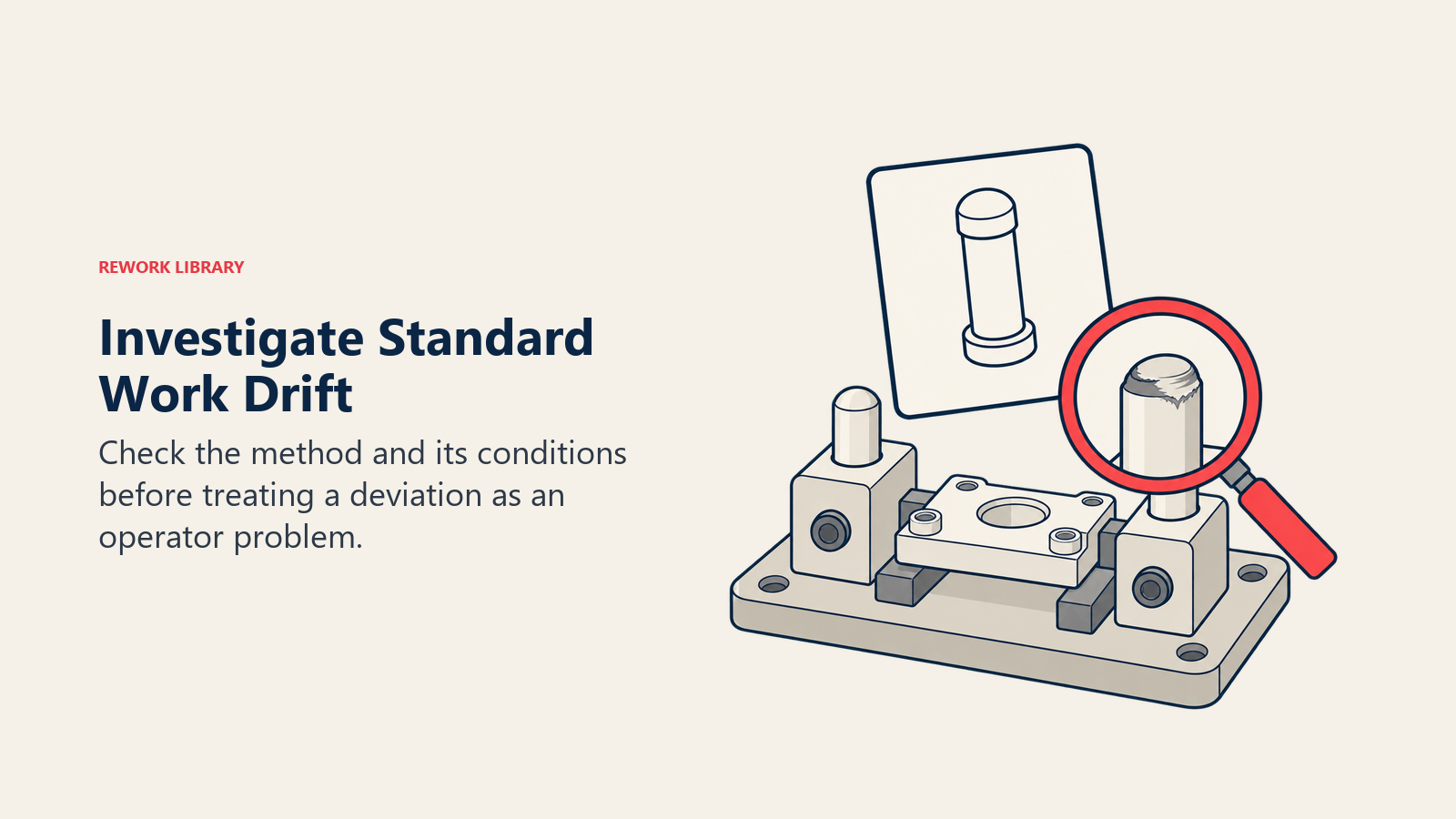
Layered process audits, where team leaders, supervisors, and managers each check standard work compliance at different frequencies, catch drift before it becomes the new unofficial standard. A team leader might check every shift, a supervisor weekly, a plant manager monthly. This connects to the audit discipline covered in root cause analysis methods, since a compliance gap found during an audit deserves the same rigor in understanding why it happened as a quality defect would.
When an audit finds an operator deviating from the standard, resist the instinct to treat it purely as a discipline issue. Ask why first. Sometimes the operator found a genuine improvement that should update the standard. Sometimes a tool is missing, a fixture is worn, or the documented time no longer matches equipment that's changed since the standard was written, in which case total productive maintenance gaps are the real root cause, not the operator. Given that most compliance issues trace back to something other than deliberate operator error, treating every deviation as a training or discipline problem misses the actual fix more often than it finds it.
Digital Tools and Version Control
Paper-based standard work sheets work, but they create version control problems as processes improve and standards multiply across a facility.
Digital standard work platforms, often built into manufacturing execution systems, let a single approved version display at the workstation, update centrally when a kaizen event validates a change, and maintain a clear audit trail of when and why a standard changed. This matters more as facilities scale: a plant running standard work across dozens of workstations on paper is one uncontrolled revision away from having operators running three different "current" versions of the same job simultaneously.
Whatever the format, paper or digital, the test is the same. Can an operator, mid-shift, glance at the workstation and immediately see the current approved sequence, without hunting through a binder or a shared drive folder that hasn't been updated since the last reorganization? If the answer is no, the documentation exists on paper but isn't actually functioning as standard work.
Standard work documentation is unglamorous compared to a major automation investment or a facility-wide kaizen blitz, but it's the foundation both depend on. You can't reliably measure the impact of an improvement without a documented baseline, and you can't train a new hire to full productivity quickly without a precise reference for what "correct" actually looks like at that specific workstation.
Frequently Asked Questions about Standard Work Documentation
What are the three elements every standard work document needs?
Takt time (the pace of customer demand), work sequence (the specific, numbered steps an operator follows), and standard in-process stock (the minimum inventory needed to keep the workstation running smoothly). A document missing any of the three is closer to a general work instruction than true standard work.
How is standard work different from a standard operating procedure?
An SOP typically documents a broader process at a departmental or organizational level. Standard work documents the specific, timed, sequenced motions at a single workstation tied to a production rate, with a level of precision an SOP usually doesn't need.
Who should be involved in creating standard work documentation?
The operators currently performing the job, ideally including whoever is the best-performing operator on that task, should be directly involved in observing, drafting, and reviewing the standard. Documentation created without their input tends to get ignored once management attention moves elsewhere.
How often should standard work be updated?
Whenever a validated kaizen improvement changes the process, whenever equipment or tooling changes affect timing, and as part of a regular audit cycle that checks whether the documented standard still matches what actually produces the best result. A standard that hasn't changed in years despite ongoing improvement work has likely fallen out of sync with real practice.

Co-Founder, Rework.com
On this page
- What Standard Work Actually Documents
- Standard Work Sheets and Combination Tables
- Building Standard Work That People Actually Use
- Standard Work Versus Generic SOPs
- Standard Work as the Baseline for Kaizen
- Training and Certifying to Standard
- Auditing Compliance and Catching Drift
- Digital Tools and Version Control