Manufacturing M&A Integration: A Practical Guide to Post-Merger Operations Success
Turn this article into takeaways for your work.


Each assistant summarizes the article only for you and suggests best practices for your work.
An aerospace parts manufacturer acquired a competitor to gain capacity and customer access. The deal made strategic sense. The price was fair. The integration was a disaster. Eighteen months after closing, they'd lost the target's best engineers, alienated major customers, and destroyed operational performance at both companies. Expected synergies never materialized. The acquisition destroyed value instead of creating it. The post-mortem concluded that the deal was sound. The integration was incompetent.
Most manufacturing M&A deals fail to deliver expected value. Not because the strategic logic was wrong or the price was too high. Because integration gets bungled. According to McKinsey research, companies that ensure team alignment early on witness 25% faster realization of synergies. Companies spend months on due diligence and negotiation, then wing integration. They underestimate complexity, move too fast or too slow, mismanage people, and fumble execution. The result is value destruction that could have been prevented with better integration planning and execution.
Integration Fundamentals
M&A integration isn't one approach. Different deals require different integration strategies. Forcing every acquisition into the same integration template guarantees failure because not all deals should be integrated the same way.
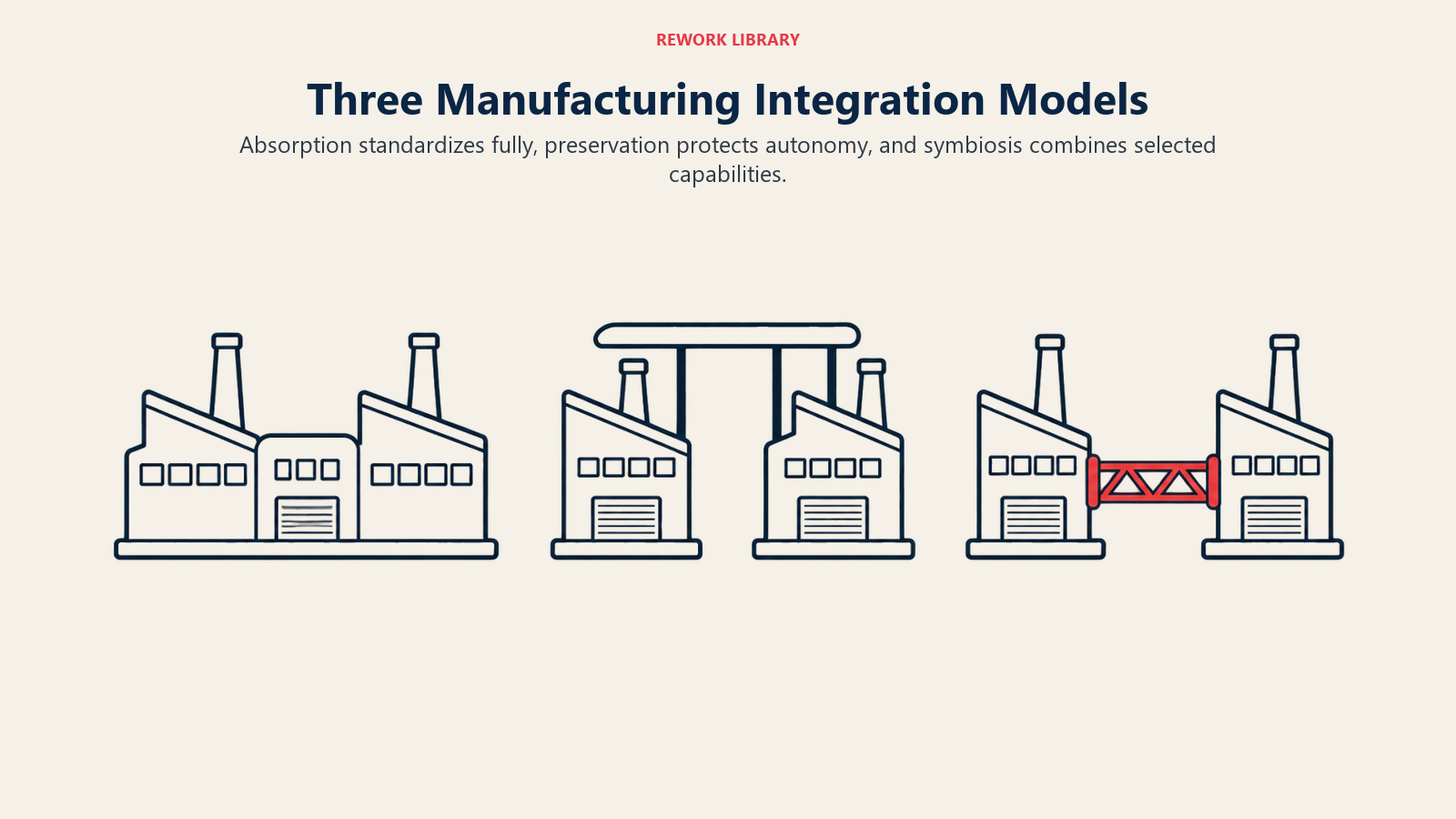
Absorption integration fully integrates acquired operations into the acquirer's systems, processes, and culture. The target essentially disappears as a separate entity. Absorption makes sense when the acquirer's capabilities are clearly superior, when standardization creates major synergies, or when the target is distressed and needs fixing. But absorption also destroys the target's unique capabilities and typically triggers talent flight.
Preservation integration maintains the target as a separate entity with its own systems and culture. The acquirer provides capital, governance oversight, and shared services but doesn't force operational integration. Preservation works when the target's capabilities are valuable and fragile, when the acquisition was about market access rather than operational synergies, or when cultural differences are large. But preservation also leaves synergies uncaptured and coordination minimal.
Symbiosis integration selectively integrates where synergies exist while preserving distinct capabilities. Manufacturing might integrate to consolidate plants and reduce costs. Sales might stay separate to preserve customer relationships. Engineering might share technology while maintaining separate product development. Symbiosis requires sophisticated analysis of where integration creates value versus where it destroys capability. Done well, it captures synergies while preserving strengths. Done poorly, it creates confusion about which systems and processes apply.
The right approach depends on strategic objectives, relative capabilities, cultural fit, and integration capacity. Don't default to absorption because it feels decisive or preservation because it seems safe. Choose based on what creates value in your specific situation.
Value Capture Opportunities
M&A integration creates value by capturing synergies and preventing value destruction. Understanding where value hides guides integration priorities.
Revenue synergies come from cross-selling, expanded market access, and combined offerings. But revenue synergies are notoriously hard to capture. They require sales coordination, product integration, and customer management that takes years. Don't build integration plans assuming quick revenue synergies. Hope for them but don't count on them.
Cost synergies from eliminating duplicate functions are more reliable. Two facilities making similar products can consolidate. Redundant administrative functions can merge. Purchasing can use combined volume for better pricing. These synergies are tangible and achievable if integration is executed competently. They also typically involve eliminating positions, which creates people management challenges.
Capability transfer shares best practices and expertise across the combined organization. If the target has superior quality systems, roll them out to legacy facilities. If the acquirer has lean manufacturing expertise, implement it at target sites. Capability transfer creates value without eliminating functions but requires identifying capabilities worth transferring and managing knowledge transfer effectively.
Capacity optimization balances production across the expanded facility network. Maybe the target has excess capacity in a region where the acquirer is constrained. Shifting production improves asset utilization and reduces capital needs. This requires understanding both networks' capabilities and being willing to reallocate production even when it disrupts existing operations.
Talent acquisition brings specialized expertise that's hard to develop organically. Sometimes the real value in an acquisition is the target's engineering team, operations leadership, or technical specialists. Retaining these people and leveraging their capabilities across the combined company can justify acquisition premiums. But talent leaves if integration is mismanaged. Talent retention is critical and challenging.
Integration Planning
Integration success depends more on planning discipline than deal structure. Good planning identifies priorities, sequences activities, allocates resources, and builds organizational readiness. Bad planning or no planning leads to chaos.
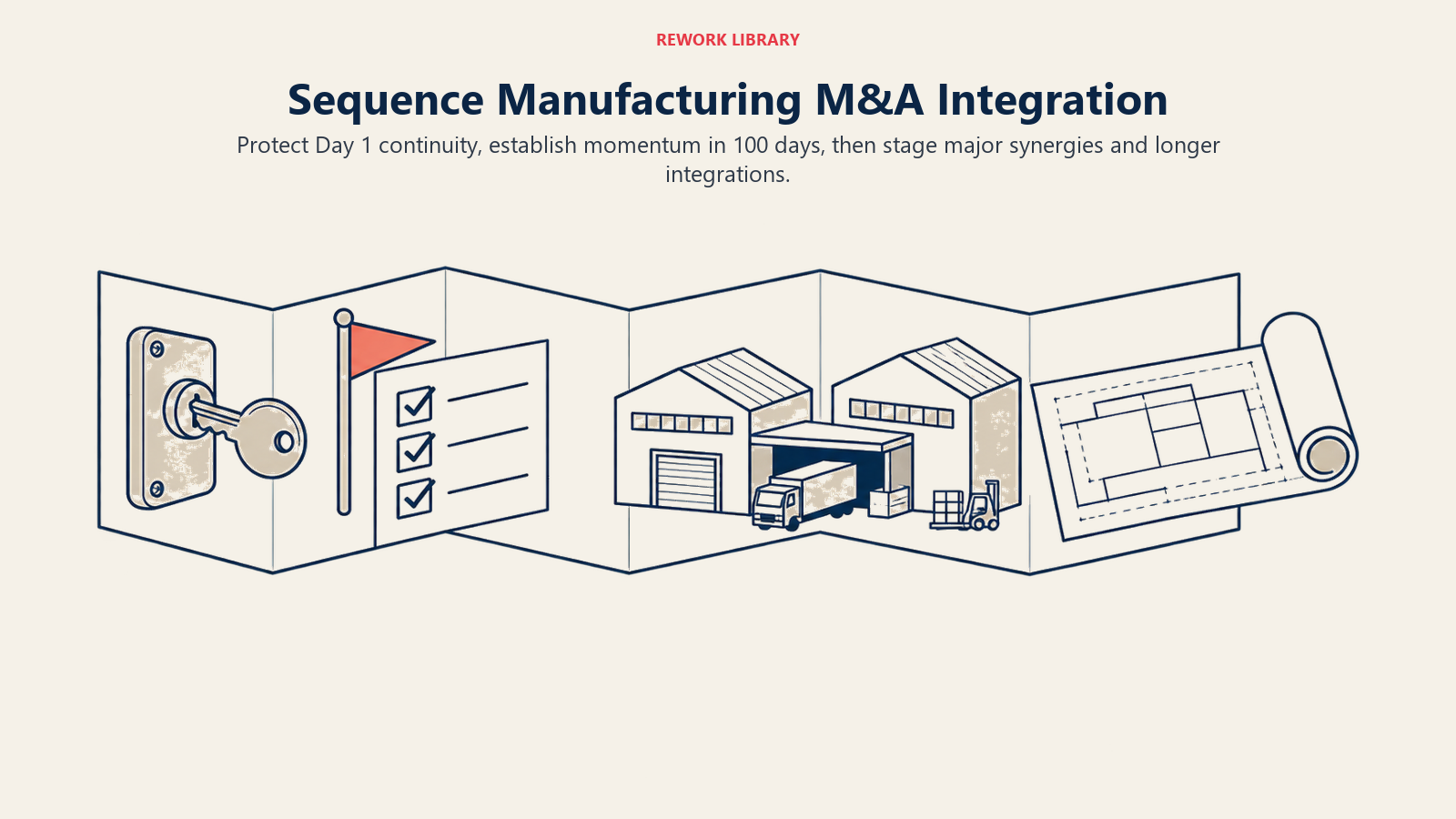
Day 1 readiness covers the basics that must work immediately after close. Payroll must run. Benefits must transfer. IT access must work. Customer orders must flow. These operational basics get taken for granted until they break. Day 1 planning ensures no one shows up to work after close and can't access systems or doesn't know who their boss is.
First 100 days establish momentum and set integration tone. Quick wins demonstrate that integration creates value. Critical talent gets retained through personal outreach and retention packages. Integration governance gets established. Communication cadence begins. The first 100 days determine whether integration starts positively or negatively. You can't fully integrate in 100 days, but you can set direction.
Year 1 milestones capture major synergies and complete critical integrations. Facility consolidations happen. IT systems migrate. Processes standardize. Organization design completes. Most value capture occurs in year one. Integration projects delayed past year one often never happen because urgency fades and people move to other priorities.
Multi-year roadmap addresses complex integrations that take longer than a year. Full IT integration might take 18 months. Plant consolidation and network optimization might span two years. Product portfolio rationalization might run three years. The roadmap provides visibility to long-term integration while focusing immediate effort on year one priorities.
Integration management office coordinates across work streams and maintains overall program discipline. M&A integration involves dozens of concurrent projects across functions. Without central coordination, projects conflict, dependencies get missed, and integration fragments. The IMO provides program management that functional leaders can't provide while running their businesses.
Operational Integration
Manufacturing operations integration involves physical assets, complex processes, and specialized expertise. This isn't like merging sales forces or finance functions. Equipment doesn't move easily. Processes take time to standardize. Quality systems require validation. Operational integration needs technical rigor and patient sequencing.
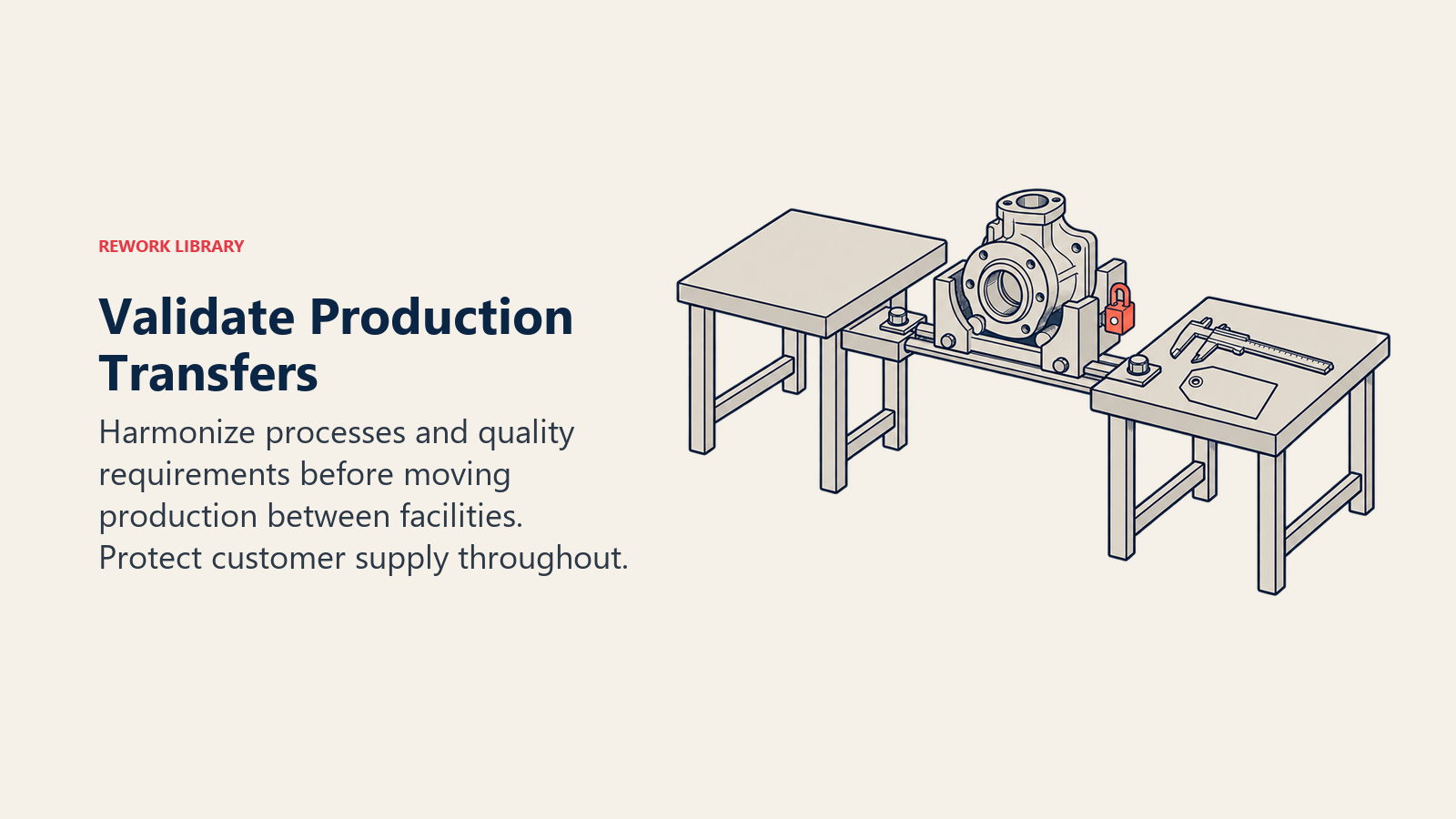
Production system harmonization standardizes how things get made. This might mean implementing the acquirer's processes at target facilities, adopting target processes where they're superior, or creating new standard processes that combine best of both. Harmonization enables products to move between facilities, simplifies training, and enables process improvements to benefit all sites. But it's expensive and time-consuming. Prioritize harmonization for products that should be made at multiple sites. Accept different processes where site specialization makes sense.
Quality system alignment ensures consistent standards and enables shared certifications. Customers care that products meet specifications regardless of which facility makes them. This requires common quality procedures, compatible management systems, and integrated quality data. If the target has important quality certifications, preserve them during integration. If the acquirer has superior quality capabilities, implement them at target facilities. Quality alignment can't be rushed without creating customer risk.
Supply chain consolidation combines supplier relationships and consolidates volume. But be careful. Target suppliers might serve unique products or have technical relationships that aren't easily replaced. Don't cancel supplier relationships just to consolidate without understanding what you're giving up. Consolidate commodity suppliers aggressively. Consolidate specialized suppliers carefully.
Facility rationalization closes or repurposes redundant sites. This is where major cost synergies hide but also where integration gets most complex. Closing plants involves moving equipment, transferring production, managing workforce reductions, and dealing with customer concerns about supply continuity. Plan facility moves meticulously. Execute deliberately. Rushing plant closures creates quality problems, supply disruptions, and customer defections that destroy more value than facility savings create.
Network optimization allocates production across combined facilities to minimize total system cost while meeting customer service requirements. This goes beyond closing redundant plants to redesigning how the entire network operates. What should each facility make? Where should inventory be staged? How should logistics flow? Network optimization captures value but requires sophisticated analysis and willingness to change established patterns.
People and Culture
M&A integration succeeds or fails based on how people are managed. Technical integration can be executed perfectly, but if talent leaves and culture clashes, the deal still fails.
Talent retention focuses on critical employees whose departure would harm the business. Identify key people early in due diligence. Approach them individually with retention packages that provide financial incentive to stay through integration. Retention packages typically vest over 12-24 months. This bridges the uncertainty period when people are most likely to leave.
Communication strategy provides transparency without creating panic. People worry about job security, reporting relationships, and culture fit. Communicate early, frequently, and honestly. Acknowledge uncertainty where it exists. Provide information as soon as it's available. Silence creates fear and triggers departures. Transparency builds trust even when news isn't all positive.
Organization design defines reporting structures, roles, and responsibilities in the combined company. This involves difficult decisions about which leaders stay, which leave, and which roles get eliminated. Make these decisions based on capability and fit, not tenure or deal side. Delaying organization decisions hoping everyone works it out creates paralysis. Decide quickly and clearly.
Cultural integration requires recognizing and addressing differences in values, practices, and norms. If the acquirer is entrepreneurial and the target is bureaucratic, those cultures won't naturally align. If the acquirer prioritizes speed and the target prioritizes precision, those values will create friction. Don't ignore culture hoping it works out. Explicitly address cultural differences and build integration that acknowledges both cultures' strengths.
Change management helps people work through the disruption and uncertainty that integration creates. Training on new systems. Support through organizational changes. Recognition of achievements during difficult transitions. Change management isn't soft stuff that can be skipped. It's essential infrastructure that determines whether integration changes actually stick.
Technology Integration
Manufacturing IT integration is particularly complex because production can't stop while systems get swapped. Integration must happen without disrupting operations.
ERP consolidation typically aims for a single system across the combined company. This enables integrated planning, financial consolidation, and operational visibility. But ERP migrations are risky, expensive, and time-consuming. Don't rush ERP integration. Plan thoroughly. Test extensively. Have rollback plans. A failed ERP cutover can shut down production for days or weeks.
Phased approaches migrate sites sequentially rather than everything at once. This limits risk and enables learning from early sites before tackling later ones. Start with smaller, less complex sites. Move to larger, more critical sites after validating the approach. Phasing reduces big-bang risk but extends integration timeline.
Interface strategies connect systems temporarily when full integration will take years. Building interfaces between disparate ERP systems provides interim integration while preserving operational stability. Interfaces cost ongoing maintenance and don't provide full integration benefits, but they bridge toward eventual consolidation.
Legacy system preservation accepts that some systems won't consolidate. If the target has specialized manufacturing execution systems that work well and integrate poorly with the acquirer's ERP, maybe preserve them. Not everything must be integrated. Some systems can stay separate if the cost of integration exceeds the benefit.
Learning and Improvement
M&A integration provides learning that improves future deals. Companies that treat each integration as independent event repeat mistakes. Companies that systematically capture lessons improve integration capability over time.
Post-integration reviews assess what worked and what didn't. Which synergies materialized? Which didn't? What took longer than expected? What cost more than planned? Where did you lose talent you meant to retain? Honest assessment builds organizational capability.
Integration playbooks document standard approaches, templates, and checklists from successful integrations. Future deals start with proven frameworks rather than reinventing integration from scratch. Playbooks should be living documents that incorporate lessons from each integration.
Integration capability development creates centers of excellence with specialized M&A integration expertise. Some companies do deals frequently enough to develop dedicated integration teams. These teams build expertise across multiple deals that deal teams assembled for single transactions can't match.
Cultural assessment improves over time. Early deals, companies often underestimate cultural differences and integration challenges. With experience, they get better at assessing cultural fit during due diligence and planning integration that addresses cultural realities.
Moving Forward
Manufacturing M&A integration requires technical competence, organizational discipline, and people management skill. It's among the most complex organizational challenges companies face. Success isn't guaranteed by good strategic logic or fair pricing. It requires excellent execution over extended periods under challenging conditions.
Don't underestimate integration complexity. Manufacturing operations are intricate systems with deep interdependencies. Changing them while maintaining production is like rebuilding aircraft engines in flight. Respect that complexity and plan accordingly.
Start planning during due diligence, not after close. The weeks between signing and close provide precious time for integration planning while the target remains separate. Use this time to understand operations in detail, identify risks, and prepare plans. Integration that starts planning after close is already behind.
Communicate relentlessly. People crave information during uncertainty. Provide it constantly even when news is partial or imperfect. Silence breeds rumors that are always worse than reality. Leaders who communicate frequently build trust that carries through difficult decisions.
Focus on value creation, not just synergy capture. The best integrations don't just cut costs through consolidation. They create better combined companies with capabilities neither had separately. This requires viewing integration as capability building, not just efficiency improvement. The mindset determines the outcome.
Remember that integration is means, not end. The goal isn't integrated operations. The goal is competitive advantage in your markets. Every integration decision should support strategic objectives. Integration for integration's sake adds cost and complexity without benefit. Integration that strengthens market position creates lasting value.
Learn More
