Manufacturing Quote-to-Cash: Streamlining from RFQ to Revenue Recognition
Turn this article into takeaways for your work.


Each assistant summarizes the article only for you and suggests best practices for your work.
A customer request for quote arrives Monday morning. Sales forwards it to engineering for technical review. Engineering sends it to production planning for capacity check. Planning requests material costs from purchasing. Purchasing needs time to get supplier quotes. By Friday, you finally respond to the customer:who placed the order with a competitor Tuesday afternoon.
Meanwhile, another order shipped three weeks ago but hasn't been invoiced because documentation is waiting for quality signatures. Your cash is tied up in completed work that hasn't been billed.
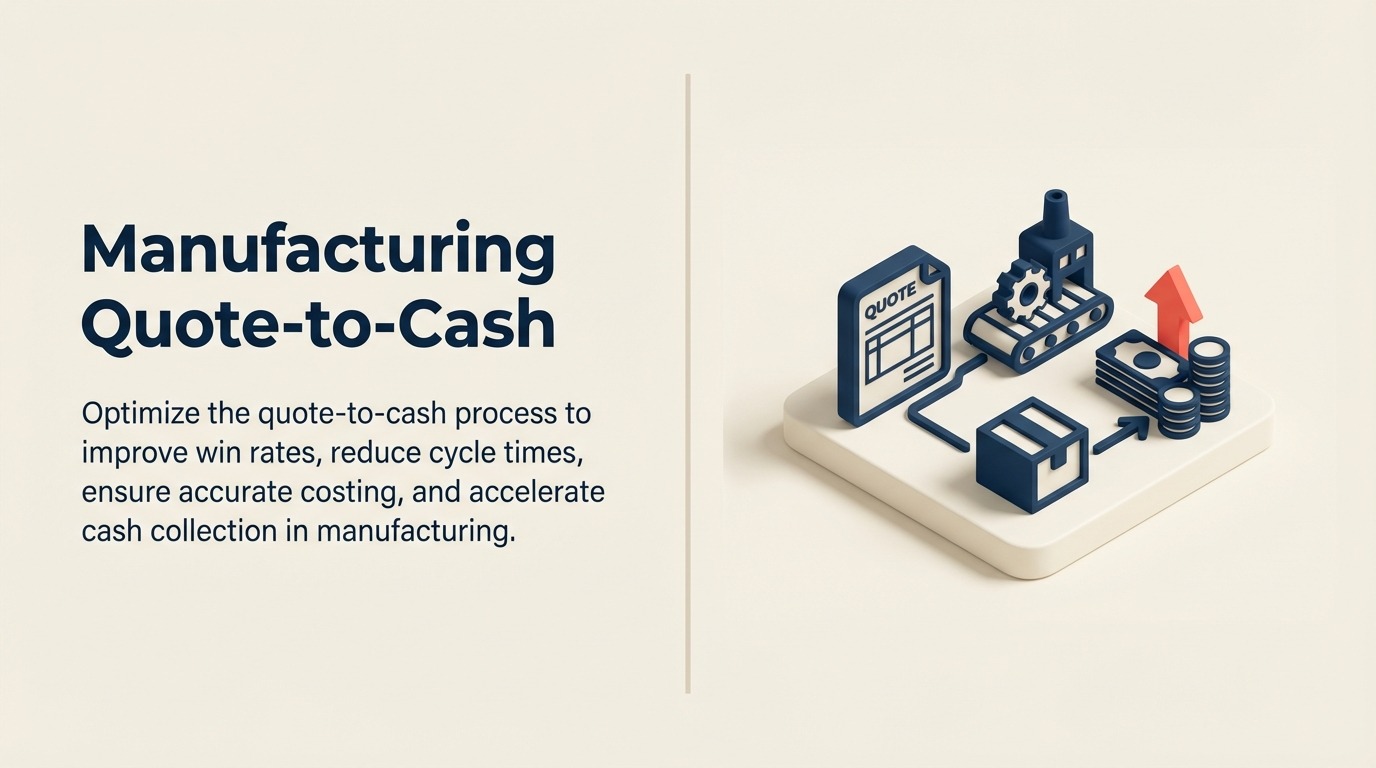
Quote-to-cash represents the entire revenue cycle from initial inquiry through cash collection. In manufacturing, this process is complex, involves multiple departments, and directly impacts competitiveness, cash flow, and customer satisfaction. Deloitte's research shows that autonomous quote-to-cash solutions using AI and ML can significantly improve process efficiency.
Every day of delay in quoting costs potential sales. Every day of delay in invoicing costs cash flow. Streamlining this process creates measurable competitive advantage.
Understanding the Quote-to-Cash Process
The quote-to-cash cycle encompasses every step from customer inquiry to revenue recognition and payment collection.
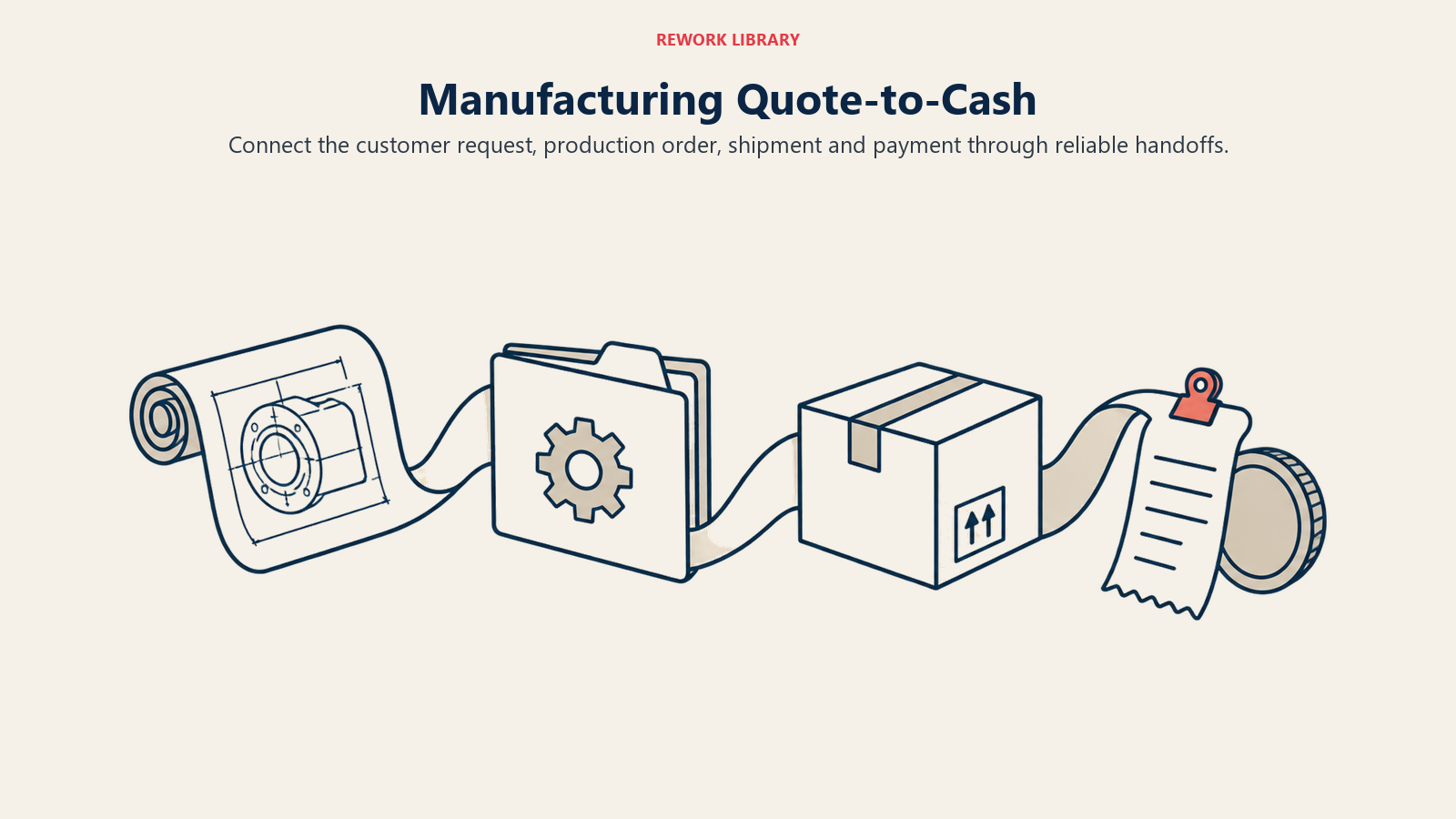
Process stages flow sequentially but with feedback loops: RFQ reception and qualification, technical feasibility assessment, cost estimation and quotation, contract negotiation and award, order entry and confirmation, production scheduling and execution, quality inspection and release, shipping and delivery, invoicing and revenue recognition, payment collection and application.
Each stage requires specific inputs, decisions, and handoffs. Delays, errors, or miscommunications at any stage ripple through the entire cycle.
Key stakeholders and handoffs multiply complexity. Sales interacts with customers and drives the process. Engineering assesses technical feasibility and specifications. Production planning evaluates capacity and lead times. Purchasing estimates material costs. Finance reviews margins and approves terms. Operations produces and ships. Accounting invoices and collects payment.
Each handoff is an opportunity for delay, misunderstanding, or error. The best processes minimize handoffs while ensuring appropriate expertise is applied.
Common bottlenecks and pain points include slow technical review delaying quotes, inaccurate cost estimates creating margin problems, poor communication causing missed quotes, order entry errors requiring rework, production delays impacting delivery commitments, documentation issues preventing invoicing, and collections problems extending days sales outstanding.
Identify your specific bottlenecks through data analysis and process mapping. Gartner's maturity model helps organizations assess their current quote-to-cash capabilities and identify improvement opportunities. Improvement efforts should focus on your actual constraints, not generic best practices that don't address your issues.
RFQ Management: Speed and Accuracy
The quote phase determines whether you even get the opportunity to compete.
Lead qualification and capacity assessment should happen immediately upon receiving an RFQ. Before investing time in detailed quotes, determine if the opportunity fits your capabilities and capacity. Can you produce this product? Do you have or can you get the necessary capacity? Does the timing align with your production schedule? Is the order size viable?
Disqualifying poor-fit opportunities quickly allows focus on winnable business.
Technical feasibility review evaluates whether you can meet customer requirements. This requires engineering assessment of specifications and tolerances, review of material and process requirements, identification of special tooling or equipment needs, and evaluation of quality and testing requirements.
Don't assume you can meet requirements without proper review. Commitments made without technical validation lead to quality problems and customer disappointment.
Information gathering and clarification ensures you understand requirements fully. Many RFQs lack complete information. Proactive clarification prevents quoting based on assumptions that prove wrong later.
Contact customers promptly with clarifying questions. This demonstrates engagement and prevents delays from back-and-forth later.
Response time commitments directly impact win rates. Many customers award business to the first responsive, qualified supplier. If your quote cycle is ten days and competitors respond in three days, you're losing opportunities before you even quote.
Set clear response time targets by quote complexity. Simple quotes for standard products might require 24-48 hour response. Complex custom quotes might need a week. But communicate timing to customers immediately so they know what to expect.
Quotation Process: Getting the Price Right
Inaccurate quotes create either lost sales (priced too high) or margin erosion (priced too low). Rigorous costing prevents both.
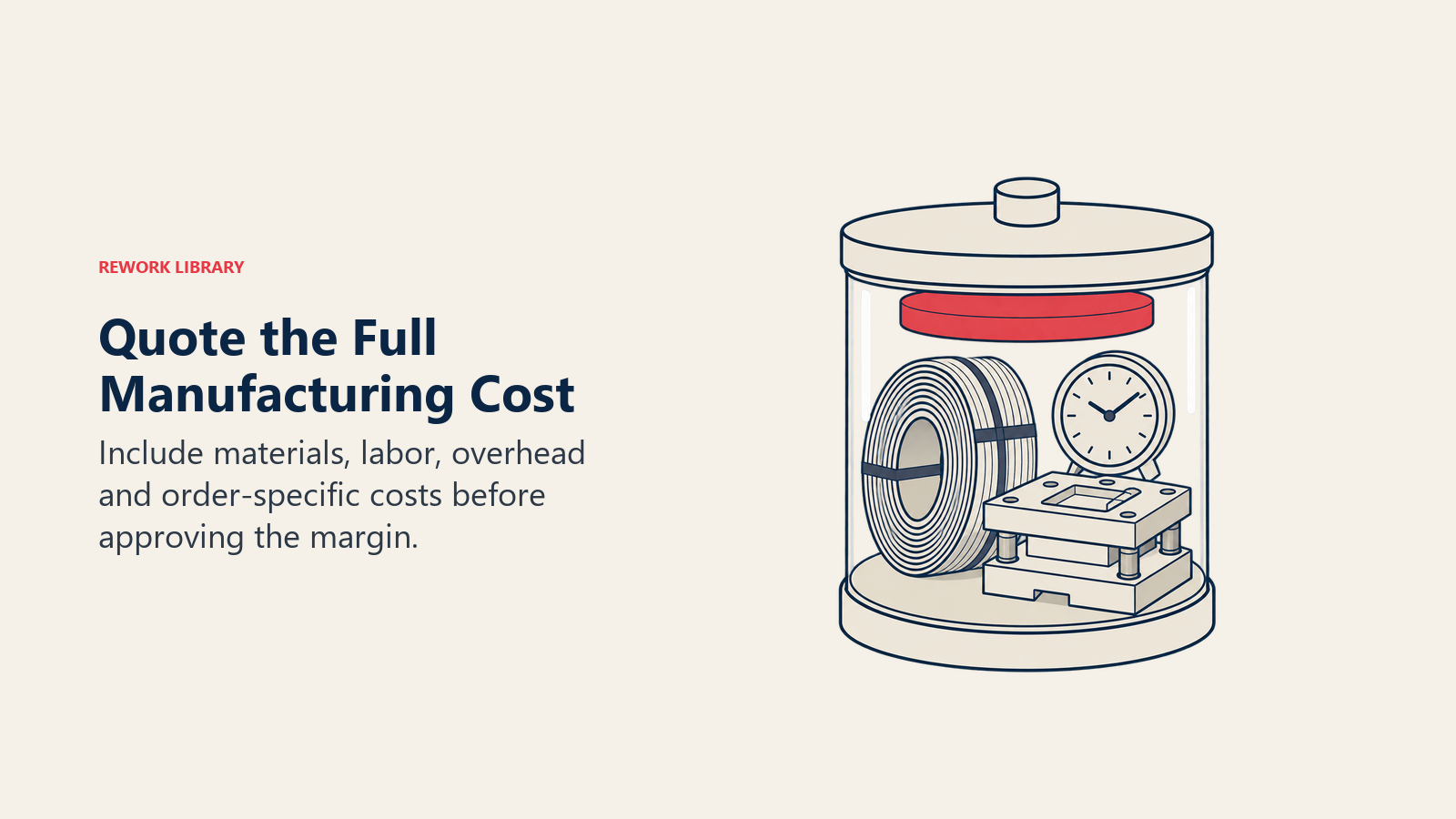
Cost estimation and build-up should include materials priced at current costs with appropriate buffers for volatility, direct labor based on realistic standard times or estimates, manufacturing overhead allocated appropriately, tooling and setup costs for new or low-volume products, quality inspection and testing requirements, packaging and shipping costs, and engineering or technical support required.
Document your cost estimates clearly. When actual costs later differ significantly from quoted costs, you need to understand why so you can improve future estimates.
Margin analysis and approval workflows ensure quotes meet profitability targets. Define minimum acceptable margins by product type, customer segment, or strategic value. Quotes below minimum margins should require explicit approval with business justification.
This discipline prevents sales from buying business with low-margin quotes that don't support your cost structure.
Terms and conditions definition protect you from unreasonable requirements. Standard terms should cover payment terms and conditions, delivery commitments and shipping terms, quality acceptance criteria, warranty and liability limitations, change order process, and intellectual property rights.
Custom terms for specific customers or situations should be reviewed by appropriate stakeholders before commitment.
Proposal preparation and review create professional, complete quotations. Well-structured quotes include clear product or service description, detailed pricing and payment terms, delivery commitments, quality and performance specifications, terms and conditions, and validity period.
Final review before sending prevents errors and ensures consistency with your pricing and margin policies.
Order Entry and Processing: Smooth Transition
Converting quotes to orders requires careful validation to prevent problems downstream.
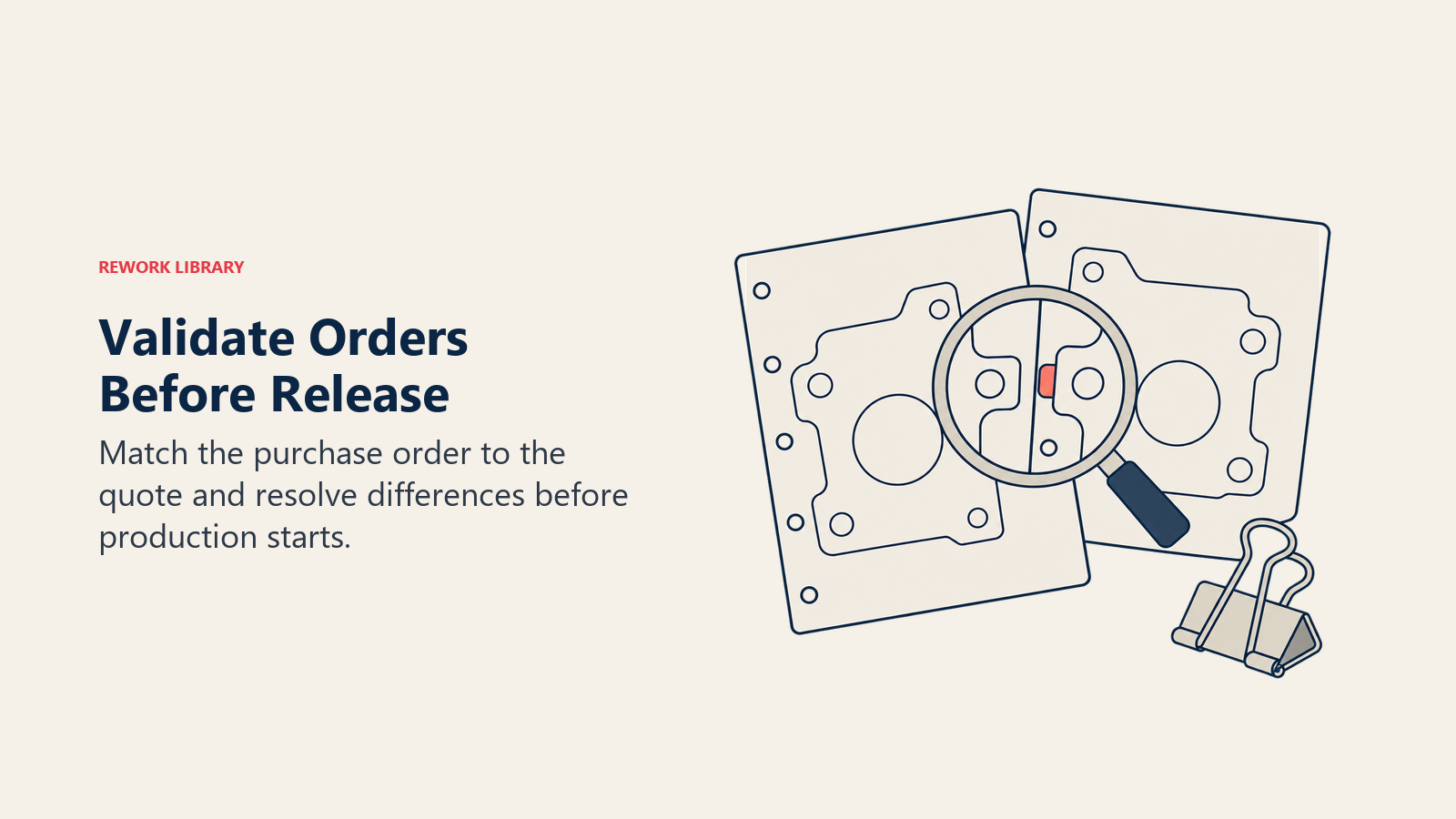
Contract review and acceptance confirms that the customer's purchase order matches your quote. Check quantities and pricing, delivery dates and shipping terms, specifications and requirements, and payment terms.
Resolve discrepancies before accepting orders. Changes discovered during production cost more to address than clarification during order entry.
Order entry and validation captures all necessary information accurately into your system. Verify customer information and shipping destination, product specifications and requirements, quantities and delivery schedule, pricing and payment terms, and special instructions or requirements.
Poor order entry data causes production errors, shipping mistakes, and invoicing problems. Invest in data quality at entry to prevent downstream waste.
Production scheduling and material planning trigger immediately upon order acceptance. Orders should flow automatically (or with minimal delay) into master production scheduling, material requirements planning, and capacity allocation.
Delays between order acceptance and production planning extend lead times unnecessarily and increase risk of missing commitments.
Customer communication and confirmation closes the loop. Send order acknowledgment promptly confirming receipt, expected delivery dates, and order details. This sets clear expectations and surfaces any misunderstandings early.
Fulfillment and Delivery: Execution Excellence
Production execution determines whether you deliver on your commitments.
Production tracking and updates provide visibility into order status. Track orders through production stages, identify on-time versus at-risk orders, and flag issues requiring intervention or customer communication.
Proactive updates to customers about order status:especially delays:maintain trust even when problems occur.
Quality control and inspection ensures products meet specifications before shipping. Final inspection should verify dimensional and functional requirements, visual and cosmetic standards, completeness and correct configuration, and documentation and certifications.
Don't ship products that don't meet requirements hoping the customer won't notice. Quality issues discovered after shipping cost far more to resolve.
Shipping and logistics coordination executes timely, cost-effective delivery. This includes packaging appropriate for product protection, carrier selection based on cost and service requirements, shipping documentation and labels, and tracking information communicated to customers.
Delivery delays in the final mile waste all the effort of on-time production.
Documentation and compliance completes the order record. Maintain quality certifications and test results, packing lists and shipping records, customer-specific documentation requirements, and compliance certificates as required.
Complete documentation prevents invoicing delays and supports customer receiving and inspection.
Invoicing and Collections: Completing the Revenue Cycle
You haven't completed the sale until you collect payment.
Accurate invoicing and delivery verification confirms the order was delivered as committed before invoicing. Verify delivery proof and customer receipt, invoice for actual quantities and configurations shipped, apply correct pricing and terms, and include required documentation and backup.
Invoicing errors create payment delays while you resolve disputes. Accuracy and completeness expedite payment.
Payment terms and collections process determines your cash conversion cycle. Standard terms should balance customer expectations with your cash flow needs. Net 30 or Net 45 is common in manufacturing but every day of terms costs you working capital.
Monitor accounts receivable aging closely. Follow up promptly on past-due accounts before they become seriously delinquent.
Dispute resolution and adjustments address customer issues quickly. When customers withhold payment due to quality issues, delivery problems, or invoicing errors, investigate promptly, resolve the underlying issue, and adjust invoices as appropriate.
Extended disputes tie up cash and damage relationships. Quick, fair resolution protects both.
Cash application and reconciliation closes the loop. Apply payments to correct invoices, reconcile discrepancies between invoice and payment amounts, and maintain accurate accounts receivable records.
Poor cash application creates confusion about what's been paid and what's outstanding.
Process Optimization: Continuous Improvement
Even effective quote-to-cash processes can be improved.
Cycle time reduction opportunities exist at every stage. Map your current process including wait times between stages, handoffs between departments, rework loops from errors, and approval bottlenecks.
Target the longest delays first. Reducing a ten-day bottleneck creates more value than optimizing a two-hour activity.
Automation and system integration eliminate manual handoffs and data re-entry. Modern ERP for manufacturing and CRM systems can automate quote generation from cost databases, order entry directly from approved quotes, production scheduling triggered by order acceptance, invoice generation upon delivery confirmation, and payment reminders and collections workflows.
Automation reduces cycle time, eliminates errors, and frees staff for higher-value activities.
Metrics and performance tracking reveal improvement opportunities and verify improvements are working. Track quote response time, quote-to-order conversion rate, order cycle time from entry to delivery, invoice cycle time from delivery to invoice, and days sales outstanding and collection effectiveness.
Review metrics regularly and investigate variances from targets.
Building Your Revenue Engine
Quote-to-cash isn't just an administrative process:it's your revenue engine. Optimize it systematically by mapping your complete process end-to-end, measuring cycle times and identifying bottlenecks, standardizing procedures and reducing variation, automating routine activities and handoffs, and training teams on their roles and interdependencies.
Companies with excellent quote-to-cash processes win more business through faster, more accurate quotes, deliver more reliably through smooth order execution, collect cash faster through timely, accurate invoicing, and operate more profitably through better pricing and margin discipline.
Your quote-to-cash process directly impacts competitiveness, customer satisfaction, and cash flow. Make it a competitive advantage, not an operational burden.
Learn More

Co-Founder, Rework.com
On this page
- Understanding the Quote-to-Cash Process
- RFQ Management: Speed and Accuracy
- Quotation Process: Getting the Price Right
- Order Entry and Processing: Smooth Transition
- Fulfillment and Delivery: Execution Excellence
- Invoicing and Collections: Completing the Revenue Cycle
- Process Optimization: Continuous Improvement
- Building Your Revenue Engine
- Learn More