5S Workplace Organization: How to Transform Manufacturing Efficiency Through Visual Management
Turn this article into takeaways for your work.


Each assistant summarizes the article only for you and suggests best practices for your work.
Walk into any struggling manufacturing facility and you'll see it immediately: tools scattered across workbenches, unclear labeling, equipment covered in dust and grime. Production teams waste hours each week searching for materials and dealing with breakdowns that proper organization could have prevented.
This disorganization doesn't just frustrate workers. It creates real costs: excess inventory hiding in corners, quality issues from contaminated work areas, safety hazards that lead to accidents. A leading aerospace parts manufacturer calculated they were losing $340,000 annually just from production delays caused by workers searching for tools and materials.
5S workplace organization tackles these hidden costs directly. But it's not about running a one-time cleanup campaign. The methodology creates visual management systems that make problems obvious, prevent waste from accumulating, and build habits that sustain improvements over time.
Understanding the 5S Methodology
5S originated in post-war Japanese manufacturing, refined by Toyota as part of the broader lean manufacturing principles system. According to ASQ (American Society for Quality), the name comes from five Japanese words that describe a systematic approach to workplace organization:
Sort (Seiri) means removing everything that isn't needed for current operations. This isn't just decluttering. It's a disciplined process of evaluating every tool, material, document, and piece of equipment against the criteria: Is this necessary for production? If not, it goes.
Set in Order (Seiton) creates specific locations for everything that remains. Tools return to shadow boards where their outline makes missing items obvious. Materials flow through designated pathways. Equipment has marked positions on the floor.
Shine (Seiso) combines cleaning with inspection. When operators clean their equipment daily, they spot oil leaks, loose bolts, and worn components before they cause failures. According to EPA's guidance on lean thinking, a clean workplace also makes it easier to identify abnormalities like spills or defects.
Standardize (Seiketsu) turns these practices into documented procedures that everyone follows consistently. Standard work instructions specify exactly how each area should be organized, cleaned, and maintained. Visual controls like color coding and labels make standards obvious.
Sustain (Shitsuke) embeds 5S into daily routines through audits, training, and leadership reinforcement. This final step determines whether 5S becomes permanent practice or gradually erodes back to chaos.
The methodology follows visual management principles. When everything has a designated place marked with labels, shadows, or floor markings, anyone can immediately see what's missing or out of place. This visual approach makes standards self-enforcing and problems self-evident.
Step-by-Step 5S Implementation
Successful 5S rollouts follow a structured phase-by-phase approach rather than attempting facility-wide implementation at once.
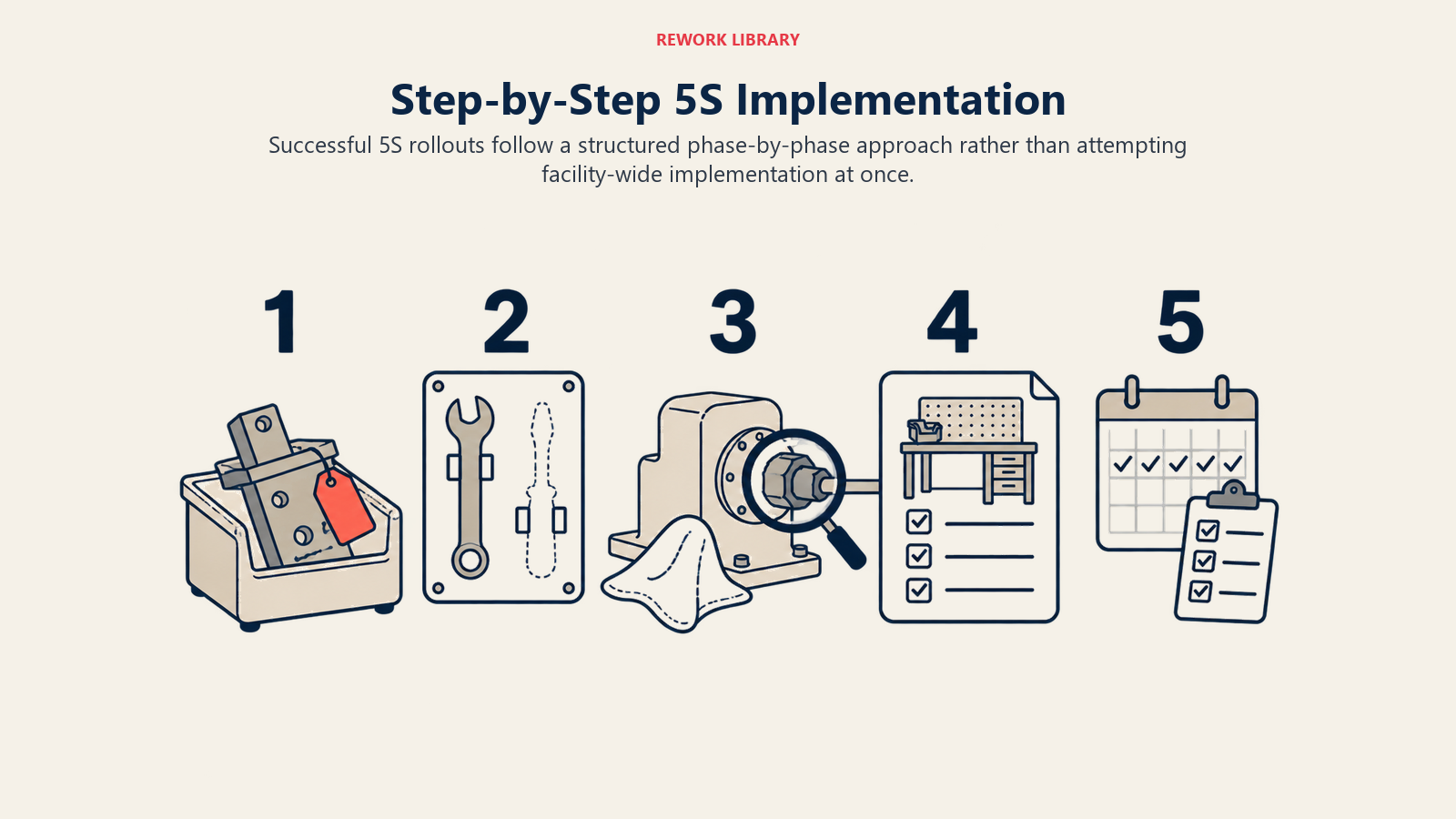
Phase 1: Sort (Seiri) begins with red-tagging. Teams attach red tags to every item in the target area that isn't clearly needed for current production. These tagged items move to a holding area for 30 days. If no one retrieves them during that period, they're discarded, returned to storage, or sold as surplus.
A medical device manufacturer applied this rigorously in their assembly department. They red-tagged 847 items in the first week. After 30 days, only 63 items had been retrieved from the holding area. The rest? Unnecessary inventory that was consuming 180 square feet of valuable floor space.
The sorting process reveals surprising waste. Extra tooling ordered "just in case" but never used. Obsolete fixtures for discontinued products. Documentation for equipment that was replaced years ago. Removing these items creates physical space and mental clarity.
Phase 2: Set in Order (Seiton) establishes designated locations using the principle of "a place for everything and everything in its place." Start by analyzing workflow: What tools and materials do operators need? How frequently? In what sequence?
Place frequently-used items within easy reach at point of use. Create visual indicators so anyone can immediately identify where items belong. Shadow boards work well for hand tools - the tool's silhouette on the board shows exactly where it goes and makes missing tools obvious at a glance.
Floor marking tape designates pathways, work areas, and equipment locations. A heavy equipment manufacturer uses different colored tape to indicate different zones: yellow for walkways, red for quality hold areas, blue for work-in-progress storage locations. Anyone can navigate the facility without asking for directions.
Label everything clearly. Industrial label makers create durable tags that identify contents, locations, quantities, and reorder points. But don't overlook simple solutions: a metal fabricator uses large printed photos showing exactly how tools should be arranged on each workbench.
Phase 3: Shine (Seiso) establishes cleaning as inspection. Operators receive 5-10 minutes at the end of each shift specifically for cleaning their work area and equipment. During cleaning, they're trained to spot abnormalities: leaking hydraulics, unusual vibrations, loose components, missing safety guards.
Create shine standards that specify exactly what gets cleaned, how thoroughly, and how often. An automotive parts supplier developed illustrated one-page standards for each work cell showing 15 specific inspection points operators check during daily cleaning.
Cleaning reveals equipment problems before they cause breakdowns. When operators wipe down CNC machines daily, they notice metal shavings accumulating where they shouldn't or coolant leaking from fittings. These early warnings prevent failures that would stop production for hours. This connects directly to total productive maintenance strategies where operators take ownership of basic equipment care.
Phase 4: Standardize (Seiketsu) documents the first three S's into consistent procedures everyone follows. Take photos of properly organized work areas and post them prominently. Create checklists for daily 5S activities. Develop visual standards like color coding systems used consistently across all departments.
Standards prevent gradual decay. Without documented expectations and visual references, each person interprets "organized" differently. Standards provide objective criteria for audits: either the workspace matches the photo standard or it doesn't.
An electronics manufacturer created laminated 5S standard cards for each workstation. One side shows a photo of proper organization, the other lists the daily shine checklist. Cards hang at each station where operators reference them multiple times per shift.
Phase 5: Sustain (Shitsuke) makes 5S permanent through leadership, accountability, and continuous improvement. Conduct weekly 5S audits using standardized scoring systems. Track audit results visibly on departmental scoreboards. Recognize teams that maintain high scores consistently.
But audits alone don't sustain 5S. Leadership behavior matters more. When supervisors and managers perform Gemba walks and immediately address 5S issues they observe, it signals that standards matter. When leaders ignore violations, standards erode quickly.
Schedule regular 5S events where teams refresh their workspaces, update standards for changed processes, and train new employees on 5S expectations. An industrial equipment maker runs quarterly 5S refresh events that combine improvements with friendly competition between production teams.
Measuring 5S Impact and ROI
Quantifying 5S benefits transforms a "housekeeping initiative" into a strategic improvement program that justifies continued investment.
Before-and-after studies establish baseline metrics, implement 5S, then measure changes. Key metrics include:
- Search time: How many minutes per shift do operators spend looking for tools, materials, or information? Time-motion studies can measure this precisely.
- Safety incidents: Slips, trips, falls, and ergonomic injuries often decrease significantly in well-organized work areas.
- Equipment downtime: Shine standards that include daily inspection typically reduce unplanned downtime by 15-30%, complementing overall equipment effectiveness initiatives.
- Floor space utilization: Removing unnecessary items and organizing materials efficiently often frees 20-25% of floor space.
- Productivity: Operators spend more time on value-adding work when tools and materials are immediately accessible.
A packaging manufacturer tracked these metrics through their 5S implementation. Search time decreased from 23 minutes per shift per operator to 4 minutes. With 85 operators, this recovered 1,615 minutes of productive time daily, worth approximately $52,000 annually in labor cost avoided.
Cost-benefit analysis compares implementation costs against quantified benefits. Implementation costs include training time, 5S supplies (labels, shadow boards, floor tape), and time spent on sorting and organizing activities. Benefits include labor cost recovery from eliminated search time, reduced injury costs, lower equipment repair costs from better maintenance, and freed floor space that defers facility expansion.
Most 5S implementations achieve positive ROI within 3-6 months. The aerospace manufacturer mentioned earlier spent $18,000 on their initial 5S implementation and calculated first-year savings of $340,000, primarily from eliminated search time and improved equipment reliability.
Continuous tracking maintains accountability and identifies areas needing attention. Many manufacturers use simple 5S audit scorecards that rate each area on a 5-point scale for each of the five S's, creating a maximum score of 25 points. Audits occur weekly or monthly with results posted visibly. These metrics complement broader manufacturing KPIs that track operational performance.
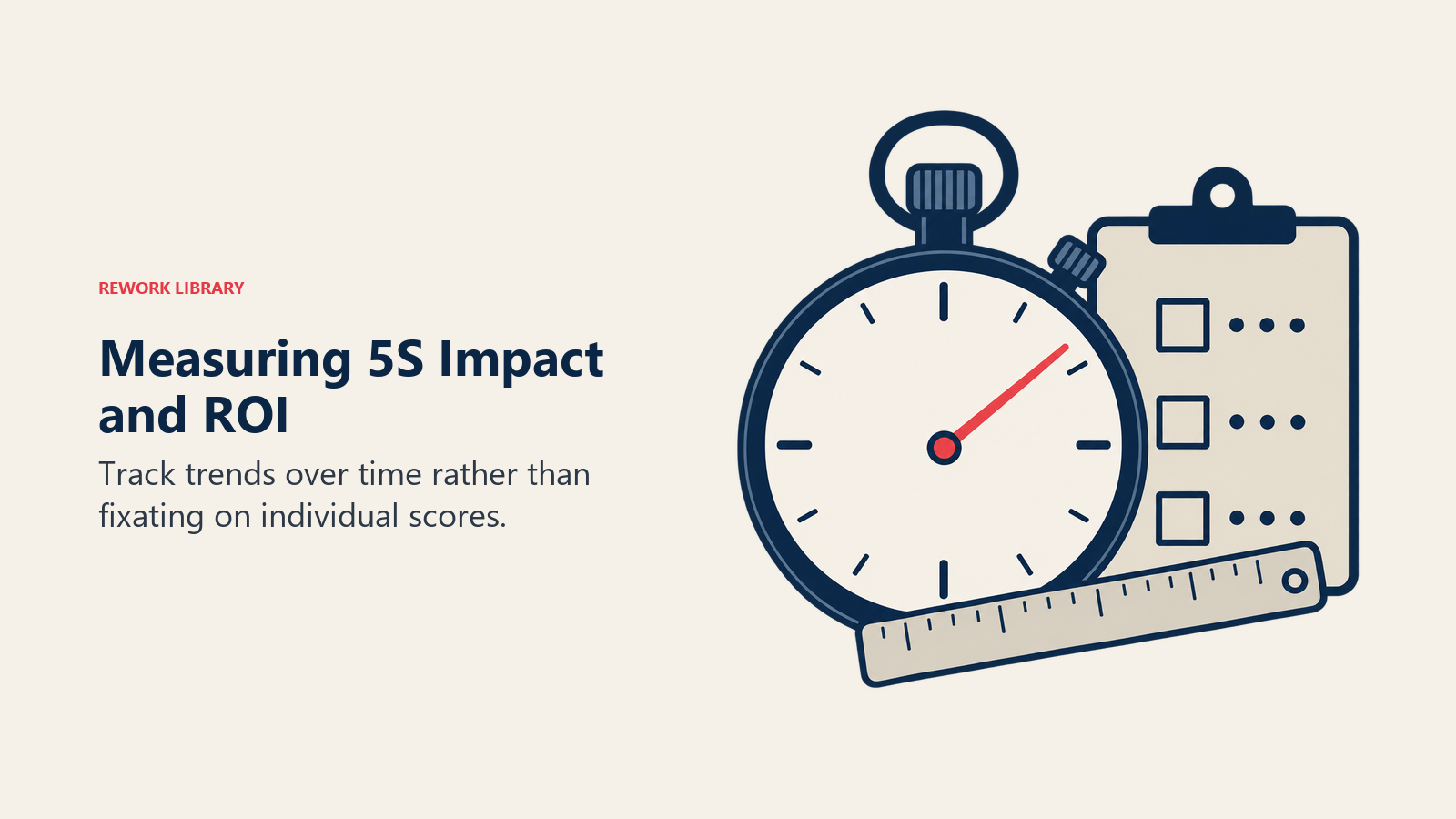
Track trends over time rather than fixating on individual scores. Is the area improving, stable, or declining? Declining scores trigger interventions: additional training, leadership engagement, or investigation of root causes preventing compliance.
Overcoming Common 5S Challenges
5S implementation encounters predictable obstacles. Understanding these challenges and planning for them improves success rates.
Employee resistance emerges when workers view 5S as extra work imposed from above rather than a tool that makes their jobs easier. Combat this through involvement: let teams decide how to organize their own work areas within 5S principles. When operators create their own shadow boards and labeling systems, they take ownership.
A machine shop struggled with 5S resistance until they shifted their approach. Instead of management dictating organization standards, they asked each machinist: "What tools do you use most often? Where would you like them positioned? What would make your work easier?" When operators designed their own 5S layouts, compliance improved dramatically.
Training also reduces resistance. Explain the why behind 5S: how disorganization creates waste that threatens competitiveness and job security. Show before-and-after examples from similar facilities. Connect 5S to daily frustrations operators already experience.
Sustaining momentum beyond initial implementation proves difficult. The Sustain S exists precisely because maintaining standards requires ongoing effort. Without sustained focus, workplaces gradually revert to previous disorganization.
Address this through systematic audits with visible accountability. Weekly scores posted where everyone sees them create peer pressure to maintain standards. Management reviews that include 5S performance send a clear message about priorities.
Some manufacturers tie compensation to 5S scores. An aerospace component producer includes 5S audit results in their quarterly bonus calculations. When 5S performance affects take-home pay, it receives appropriate attention.
Adapting 5S across different environments requires flexibility within the core principles. A clean room environment needs different 5S standards than a foundry. Administrative areas implement 5S differently than production floors.
The principles remain constant: eliminate unnecessary items, organize what remains, clean while inspecting, standardize the approach, and build sustaining habits. But specific practices vary. As ASQ notes, while 5S typically is associated with manufacturing, it can be practiced in almost any workspace, including physical work areas or virtual spaces such as digital desktops. Office 5S might focus on digital file organization and standardized email practices rather than tool shadow boards and floor markings.
A diversified manufacturer developed 5S templates for different environment types: machining, assembly, warehousing, and office. Each template provides example standards appropriate for that environment while maintaining consistent overall methodology. This same flexibility applies when adapting lean manufacturing principles to diverse operational contexts.
Creating a Culture of Continuous Improvement
5S's greatest value extends beyond organization and cleanliness. Properly implemented, it becomes a gateway to broader continuous improvement culture.
When 5S makes problems visible, it creates opportunities for problem-solving. That oil leak spotted during daily shine leads to preventive maintenance improvements. The excess inventory discovered during sorting triggers supply chain discussions about ordering practices. The safety hazard eliminated through proper organization prompts review of similar hazards elsewhere.
5S also teaches the discipline of standardized work and continuous improvement. Teams learn to document current state, implement improvements, standardize the better method, and sustain gains. These skills transfer directly to other improvement initiatives like kaizen continuous improvement events and quality problem-solving. Understanding value stream mapping helps identify where 5S creates the most impact by revealing flow constraints and waste accumulation points.
Facilities where 5S has become ingrained culture demonstrate different behaviors. Operators notice and immediately address items out of place rather than working around problems. Teams proactively update standards when processes change rather than letting standards become obsolete. Leaders reinforce 5S expectations through actions, not just words.
One industrial manufacturer describes 5S as their "continuous improvement foundation." Every formal improvement project begins with confirming the work area maintains high 5S standards. Their logic: if a team can't maintain basic organization and cleanliness, they're not ready for more complex improvements. This foundation supports more advanced initiatives like waste elimination strategies and manufacturing quality management.
Start your 5S journey by selecting a small pilot area that leadership can closely support. Implement thoroughly through all five S's before expanding. Measure results rigorously and share successes broadly. As you scale, maintain focus on sustainability through audits, leadership reinforcement, and connecting 5S to broader operational excellence goals.
Learn More
