Production Planning Fundamentals: Building Efficient Manufacturing Schedules
Turn this article into takeaways for your work.


Each assistant summarizes the article only for you and suggests best practices for your work.
Production planning is the backbone of manufacturing profitability. Poor planning creates chaos: late deliveries, excessive inventory, stressed workers, and unhappy customers. Great planning creates flow: on-time deliveries, optimized inventory, balanced workloads, and satisfied customers. The difference in EBITDA between these states can exceed 10 percentage points.
Yet many manufacturers treat planning as an administrative task rather than a strategic capability. They react to problems rather than anticipating them. They optimize locally rather than system-wide. And they wonder why competitors with similar equipment and labor costs achieve better results.
Understanding Production Planning
Production planning determines what to produce, when to produce it, and with what resources. According to APICS, production control is "the task of predicting, planning and scheduling work, taking into account manpower, materials availability and other capacity restrictions." It translates customer demand into detailed production schedules that balance customer service, resource utilization, and cost efficiency.
Scope and Objectives
Production planning scope extends from aggregate planning (months ahead) through master scheduling (weeks ahead) to shop floor scheduling (days and hours ahead). Each level provides progressively more detail while operating within constraints set by the level above. Your manufacturing business model shapes planning requirements.
The objectives are straightforward but often conflicting: meet customer delivery commitments, minimize inventory investment, maximize resource utilization, reduce production costs, and maintain workforce stability. Great planning balances these objectives rather than optimizing any single one at others' expense.
Planning is not forecasting, though forecasts inform planning. Forecasting predicts what customers will order. Planning decides how to fulfill those orders. Poor forecasting makes planning harder but doesn't excuse poor planning. Good planners work effectively even with imperfect forecasts.
Planning Hierarchy Levels
Strategic planning (1-5 years) determines capacity investments, facility locations, and major technology decisions. It asks: What production capability will we need? Where should it be located? What equipment should we invest in?
Tactical planning (3-18 months) determines production volumes, inventory targets, and workforce levels by product family. It balances demand forecasts with capacity constraints to create feasible plans. It asks: How much capacity do we need each quarter? What inventory should we carry? How many people should we employ?
Operational planning (days to weeks) creates detailed production schedules by individual product and work center. It sequences jobs, allocates resources, and manages materials. It asks: Which jobs run today? On which machines? In what sequence?
Time Horizons
Different planning activities require different time horizons. Capacity planning extends 12-24 months because equipment procurement and installation take time. Master scheduling typically covers 8-16 weeks to provide visibility for material procurement. Shop floor scheduling works 1-4 weeks out to guide daily execution.
Frozen, firm, and flexible zones structure planning horizons. The frozen zone (typically 2-4 weeks) locks schedules to enable reliable execution. The firm zone (4-12 weeks) allows limited changes. The flexible zone (beyond 12 weeks) permits substantial revisions as demand clarity improves.
The Production Planning Process
Effective production planning follows a systematic process that runs continuously, typically on weekly or monthly cycles depending on your business dynamics.
Demand Analysis
Planning starts with understanding demand: customer orders, forecasts, and service level targets. Firm orders provide certainty for near-term planning. Forecasts fill visibility gaps for longer horizons. Service level targets determine how much demand uncertainty you'll buffer against.
Aggregate demand by product family, time period, and priority. This reveals patterns that individual orders mask. It shows whether demand is stable or variable, seasonal or level, predictable or erratic. These patterns guide planning approach selection.
Segment demand by characteristics requiring different planning treatment. Made-to-order demand needs flexible capacity and responsive scheduling. Made-to-stock demand needs inventory planning and production smoothing. Mixing these without distinction creates confusion.
Capacity Assessment
Compare demand requirements against available capacity. Capacity includes equipment, labor, and materials. Bottleneck resources determine effective capacity regardless of non-constrained resources' capability. Thorough capacity planning and bottleneck analysis are essential.
Calculate capacity in planning-relevant units: machine hours, labor hours, or production units. Be realistic about available capacity. Theoretical capacity (24/7 operation) is useless for planning. Effective capacity accounts for downtime, maintenance, changeovers, and normal delays.
Identify gaps where demand exceeds capacity. These gaps require capacity expansion, demand management, or accepting unmet demand. Identify excess where capacity exceeds demand, which creates utilization challenges and cost pressure.
Resource Allocation
Allocate limited capacity across competing demands. Priority rules guide allocation: customer priority, due date urgency, contribution margin, strategic importance. Clear rules prevent political allocation that optimizes local interests over system performance. Your manufacturing value chain determines resource priorities.
Consider material availability alongside production capacity. Capacity without materials is useless. Material Requirements Planning (MRP) systems coordinate material availability with production schedules, but planners must verify MRP outputs make practical sense.
Balance workload across time periods. Wildly variable workloads create inefficiency: overtime and expediting during peaks, underutilization during valleys. Smoothing demand through production leveling improves efficiency even if it requires carrying modest inventory.
Schedule Creation
Convert resource allocations into detailed production schedules. According to APICS, while schedules themselves may quickly become outdated, the scheduling process is critical for operational success. Schedules specify which products to produce, in what quantities, when to start and finish, and which resources to use.
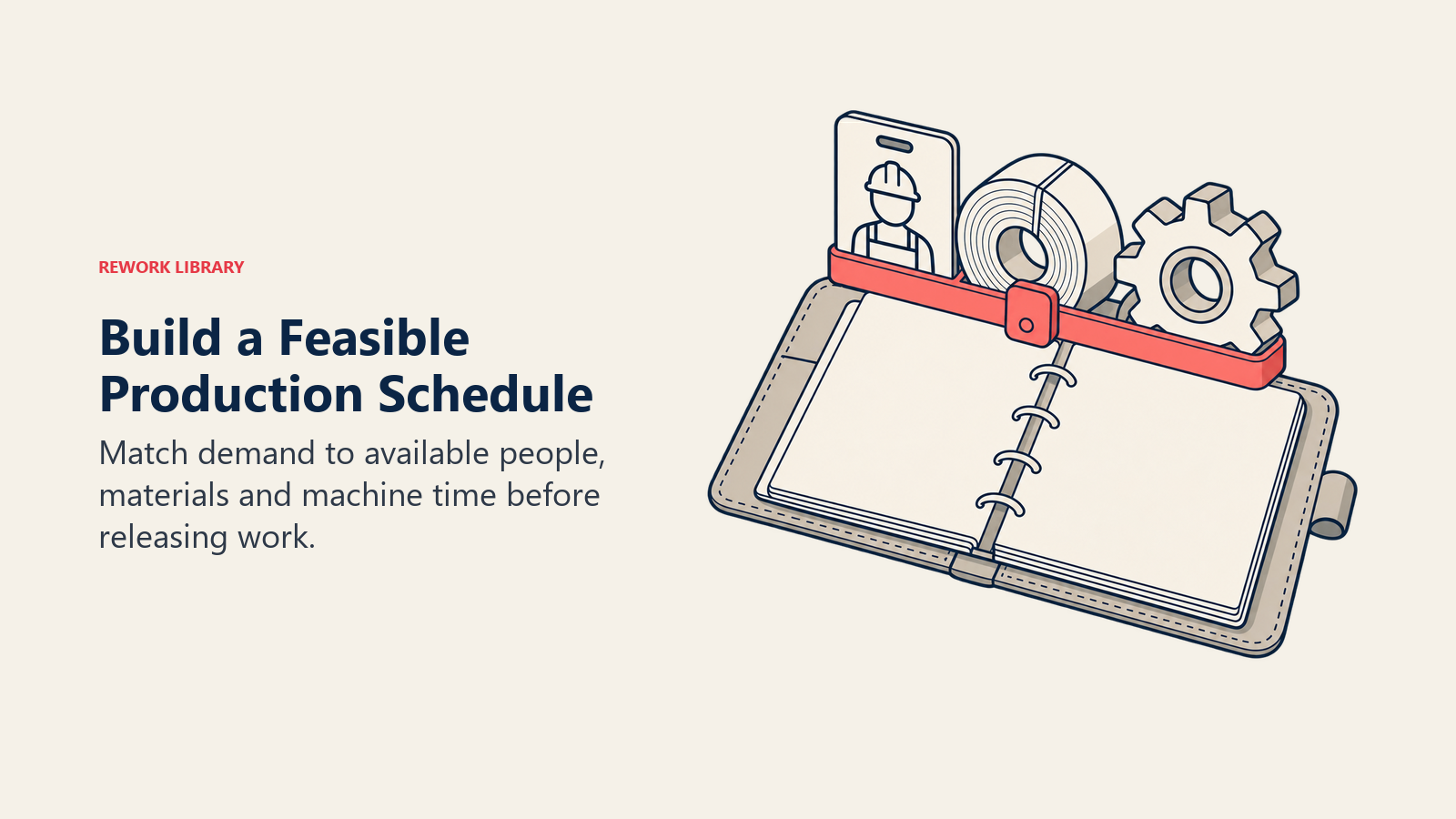
Schedules must be feasible: you can't plan more production than capacity allows, schedule materials before they arrive, or create physically impossible sequences. Infeasible schedules aren't plans; they're wish lists that guarantee failure.
Schedules should be optimized for key objectives: due date performance, changeover minimization, inventory reduction, or setup efficiency. But don't over-optimize. A slightly suboptimal schedule that's stable beats a theoretically optimal schedule that changes constantly.
Execution Monitoring
Monitor actual production against planned schedules. Deviations signal problems requiring response: material shortages, equipment failures, quality issues, or forecast errors. Early detection enables corrective action before problems cascade. Track manufacturing KPIs to measure plan vs. actual performance.
Compare key metrics: planned vs. actual production quantities, planned vs. actual completions, schedule adherence percentages. These metrics reveal whether execution matches plans and whether plans need adjustment.
Create exception reports highlighting significant deviations. Planners can't review every job every day. Exception reporting focuses attention on the 10-20% of jobs with problems rather than the 80-90% running fine.
Planning Methods: Different Approaches and When to Use Them
Multiple planning methods exist, each suitable for different manufacturing environments and business requirements.
Push vs. Pull Planning
Push planning schedules production based on forecasts and pushes products through manufacturing to inventory. Materials release to production according to schedule regardless of immediate demand. This works well for stable, predictable demand where forecast accuracy is high.
Pull planning triggers production only when downstream operations or customers consume products. Nothing produces until pulled by actual demand. This works well for variable demand where forecast accuracy is poor or where inventory reduction is critical.
Most manufacturers use hybrid approaches: push planning for long-lead procurement and capacity allocation, pull execution for final assembly and production timing. This balances planning stability with demand responsiveness.
MRP-Based Planning
Material Requirements Planning (MRP) systems calculate material and production requirements by exploding bills of materials and netting available inventory. MRP works backward from due dates to calculate start dates, considering lead times at each level.
MRP excels in complex products with many components and levels. It handles dependent demand (components needed because parent products are scheduled) systematically. But MRP assumes infinite capacity and doesn't account for resource constraints without additional capacity planning.
MRP works best with accurate data: bills of materials, inventory records, and lead times. Data accuracy below 95% creates planning chaos as MRP generates incorrect requirements and schedules.
Constraint-Based Planning
Constraint-based planning (Theory of Constraints / Drum-Buffer-Rope) focuses on bottleneck resources. It schedules bottleneck resources first to maximize throughput, then schedules other resources to support bottleneck schedules. Understanding your production bottlenecks is critical for effective planning.
This method prevents bottleneck starvation (the bottleneck stops because upstream operations didn't provide material) and non-bottleneck overproduction (non-bottlenecks produce more than bottlenecks can handle, creating excess WIP).
Constraint-based planning works well in focused operations with clear bottlenecks. It's less effective in job shops where bottlenecks shift based on product mix.
Finite vs. Infinite Capacity Planning
Infinite capacity planning creates schedules without considering resource constraints. It assumes unlimited capacity and schedules everything when materials arrive and due dates require. Then planners manually resolve resource conflicts.
Finite capacity planning respects resource limitations. It schedules only what resources can actually produce, deferring jobs when capacity is unavailable. This creates realistic schedules but requires sophisticated software.
Most manufacturers start with infinite capacity planning and add finite capacity planning as they mature. Infinite capacity works adequately when capacity significantly exceeds demand. Finite capacity becomes essential when capacity is tight.
Tools and Techniques: Practical Planning Resources
Effective planning requires appropriate tools, from simple spreadsheets to sophisticated software systems.
Planning Software
Entry-level planning uses spreadsheets and simple databases. This works for small manufacturers with limited products and straightforward processes. But spreadsheets don't scale and create manual work that sophisticated software automates.
Mid-level planning uses MRP II or ERP systems. These systems manage bills of materials, inventory, and scheduling in integrated databases. They automate routine planning tasks and provide visibility across operations.
Advanced planning systems use optimization algorithms, simulation, and artificial intelligence. They handle complexity beyond human capacity and find solutions humans would miss. But they require significant investment and sophisticated users.
Choose tools appropriate to your complexity and scale. Don't buy enterprise systems for job shops. Don't rely on spreadsheets when complexity exceeds manual management. Match tool capability to your requirements.
Visual Planning Boards
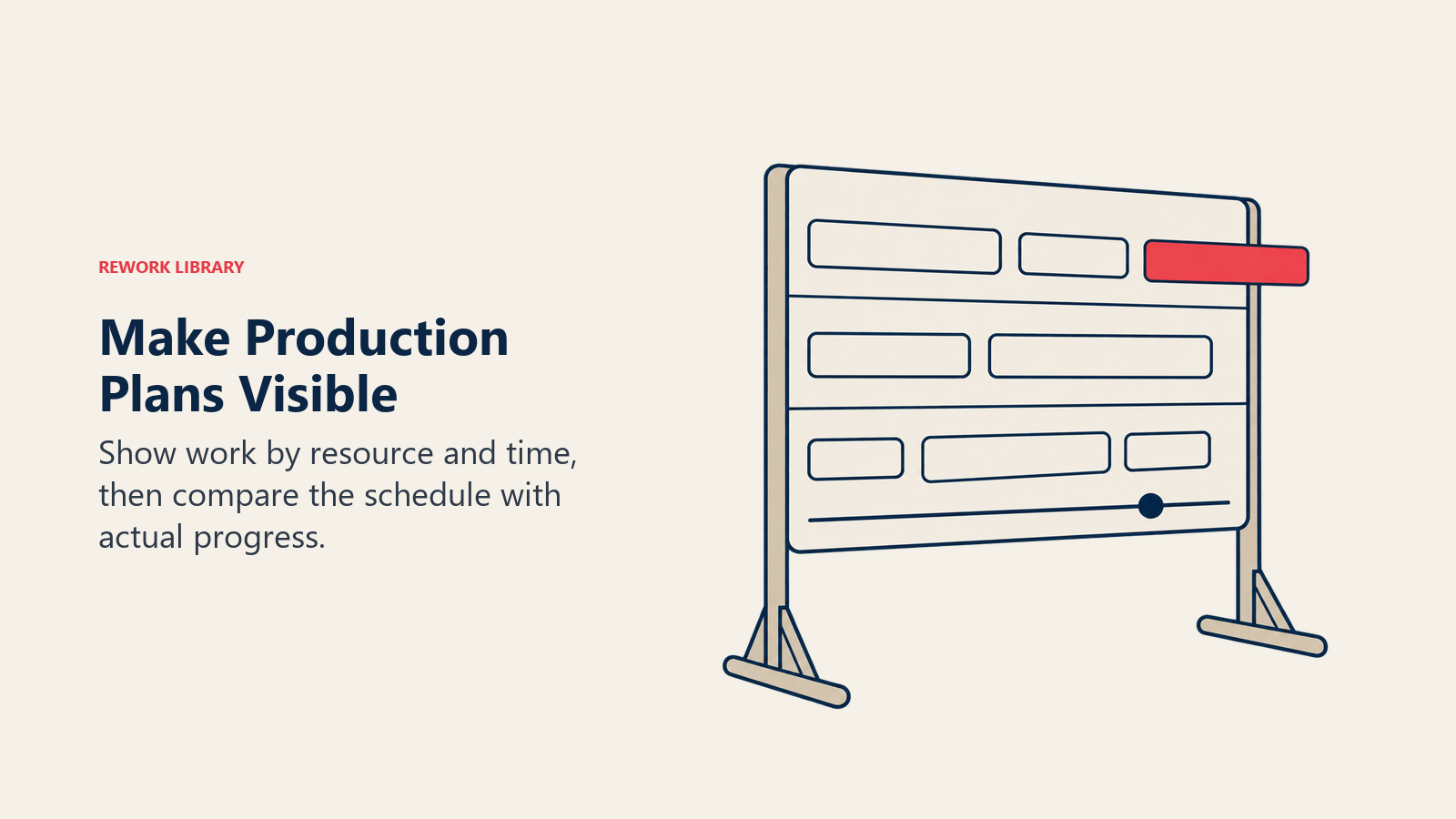
Visual planning boards display schedules in formats humans quickly comprehend. Gantt charts show jobs across time. Load boards show capacity utilization by resource. Queue boards show work waiting at each work center.
Visual planning isn't just for manual systems. Even sophisticated software benefits from visual schedule displays. Humans spot patterns and problems visually that they miss in data tables.
Create visual management systems that combine planning displays with execution feedback. Color-coding (on schedule, ahead, behind), progress indicators, and problem flags enable quick status assessment.
Collaborative Planning
Production planning isn't a solo activity. Effective planning requires input from sales (demand information), purchasing (material availability), operations (capacity status), and quality (yield rates and rework requirements).
Implement Sales and Operations Planning (S&OP) processes that bring these groups together monthly to align plans. S&OP balances demand and supply at aggregate levels before detailed planning begins.
Hold weekly planning meetings to review upcoming schedules, material status, and capacity issues. These meetings coordinate execution and resolve problems collaboratively rather than through finger-pointing.
Learn More
Build planning expertise with these related topics:
- Manufacturing Growth Model explains planning capability requirements at each growth phase
- Master Production Scheduling provides detailed MPS methodology
- Capacity Planning Strategy covers capacity analysis and expansion
- Demand Forecasting for Manufacturing improves demand visibility for planning
- Material Requirements Planning explains MRP logic and implementation
- Batch vs Continuous Production influences planning approaches
- Make vs Buy Decision Framework affects capacity planning needs
Building a Strong Planning Foundation
Production planning is one of manufacturing's highest-leverage activities. Great planning prevents problems rather than reacting to them. It enables smooth operations, high customer service, and strong profitability. Poor planning creates firefighting, customer disappointment, and profit erosion.
Build planning capability systematically. Start with clear processes and accurate data. Add appropriate tools as complexity grows. Develop planner expertise through training and experience. Create collaborative planning cultures where all functions contribute.
Most importantly, commit to planning discipline. Plans only create value when followed. Manufacturers who create beautiful plans then ignore them waste planning effort and destroy planning credibility. Make plans realistic, communicate them clearly, and execute them faithfully. That discipline transforms planning from administrative burden into competitive advantage.
