Waste Elimination Strategies: Identifying and Removing the 8 Wastes of Lean Manufacturing
Turn this article into takeaways for your work.


Each assistant summarizes the article only for you and suggests best practices for your work.
A precision machining company thought they ran efficiently. Their machines hummed constantly, operators stayed busy, and trucks delivered materials daily. Yet when consultants studied their operations, they discovered a shocking truth: only 23% of activity actually created value for customers.
The rest? Pure waste. Material handlers transported parts between distant work centers six times before completion. Operators waited for tooling, instructions, or materials. Machines produced batches far exceeding immediate needs. Inventory accumulated in corners. Quality issues required rework. The "efficient" operation was actually a hidden factory of non-value-adding activity consuming 77% of resources.
This pattern repeats across manufacturing. Research suggests typical operations waste 60-70% of resources on activities customers wouldn't pay for if they knew. Eliminating this waste doesn't require major capital investment. It requires learning to see waste clearly, quantify its impact, and systematically remove it through proven lean techniques.
The Eight Wastes of Lean Manufacturing
Lean manufacturing principles identify eight categories of waste using the acronym TIMWOODS. According to the Lean Enterprise Institute, originally there were seven wastes identified by Taiichi Ohno for the Toyota Production System, and as lean evolved, an eighth waste (non-utilized talent or skills) was added. Understanding each type helps identify waste hiding in plain sight.
Transportation waste involves unnecessary movement of materials, parts, or finished goods. Every time you move items between distant work centers, load and unload trucks, or relocate inventory in the warehouse, you're consuming resources without adding value. Transportation takes time, requires equipment and labor, risks damage, and creates no customer value.
An electronics manufacturer mapped material flow through their facility and discovered brackets traveled 2,400 feet through seven different locations before final assembly. They reconfigured the layout, grouping related operations into a single cell. Parts now travel 140 feet. Labor hours for material handling dropped 68%.
Inventory waste means holding more raw materials, work-in-process, or finished goods than immediately needed. Wikipedia notes that muda (waste) in lean manufacturing refers to activities that consume resources but create no value, and inventory is one of the most visible forms. Inventory consumes space, ties up capital, hides quality problems, enables overproduction, and risks obsolescence. It also represents all the other wastes accumulated within it: transportation to move it there, waiting while it sits, defects hidden inside it.
Motion waste refers to unnecessary movement by workers: walking to retrieve tools, reaching for materials, bending awkwardly, searching for information. Unlike transportation (moving materials), motion waste involves people moving more than necessary to complete their work. These movements fatigue workers, consume time, create ergonomic risks, and add no value.
A packaging operation videotaped their line workers and analyzed movements. They discovered operators walked an average of 4.2 miles per shift retrieving materials, tools, and paperwork. Simple workplace reorganization using 5S workplace organization principles cut walking to 1.1 miles, recovering 52 minutes of productive time per worker per shift.
Waiting waste occurs whenever people, materials, or equipment sit idle. Operators waiting for machines to finish cycles, machines waiting for material, assembly waiting for components from fabrication, everyone waiting for approvals or information. All waiting represents capacity you're paying for but not using productively.
Overproduction waste means making more than the next process needs or making it earlier than needed. Many manufacturers consider overproduction the worst waste because it creates or exacerbates all others: you must transport the excess, store it as inventory, move it multiple times, risk damage and obsolescence, and build defects into stock before discovering quality problems. Just-in-time production specifically targets this waste.
A furniture manufacturer produced components in large batches to "keep machines running efficiently." This created massive WIP inventory, required extensive warehouse space, and hid quality issues for weeks. When they shifted to smaller batches aligned with assembly schedules, inventory dropped 73% while defect detection time fell from 11 days to 6 hours.
Overprocessing waste involves doing more work than customers require: tighter tolerances than specifications demand, excessive inspection, redundant approvals, unnecessary documentation. Any processing beyond minimum requirements wastes resources.
Defects waste encompasses rework, scrap, warranty claims, returns, and all resources consumed identifying and fixing quality problems. Beyond direct costs, defects disrupt flow, create expediting, damage reputation, and require complaint handling. They represent paying to do work wrong, then paying again to do it right. Effective defect prevention strategies minimize this waste.
Skills waste acknowledges that underutilizing employee capabilities wastes human potential. As ASQ explains, the eighth waste was added to the original seven forms of waste, as resolving this waste is a key enabler to resolving the others. When operators can't suggest improvements, workers perform only narrow tasks, or you hire talented people for routine work, you waste intelligence, creativity, and problem-solving ability that could drive improvement.
Seeing the Invisible: Waste Identification Methods
Waste often becomes invisible through familiarity. People accept current conditions as "just how things are." Systematic identification methods reveal waste that experience has made invisible.
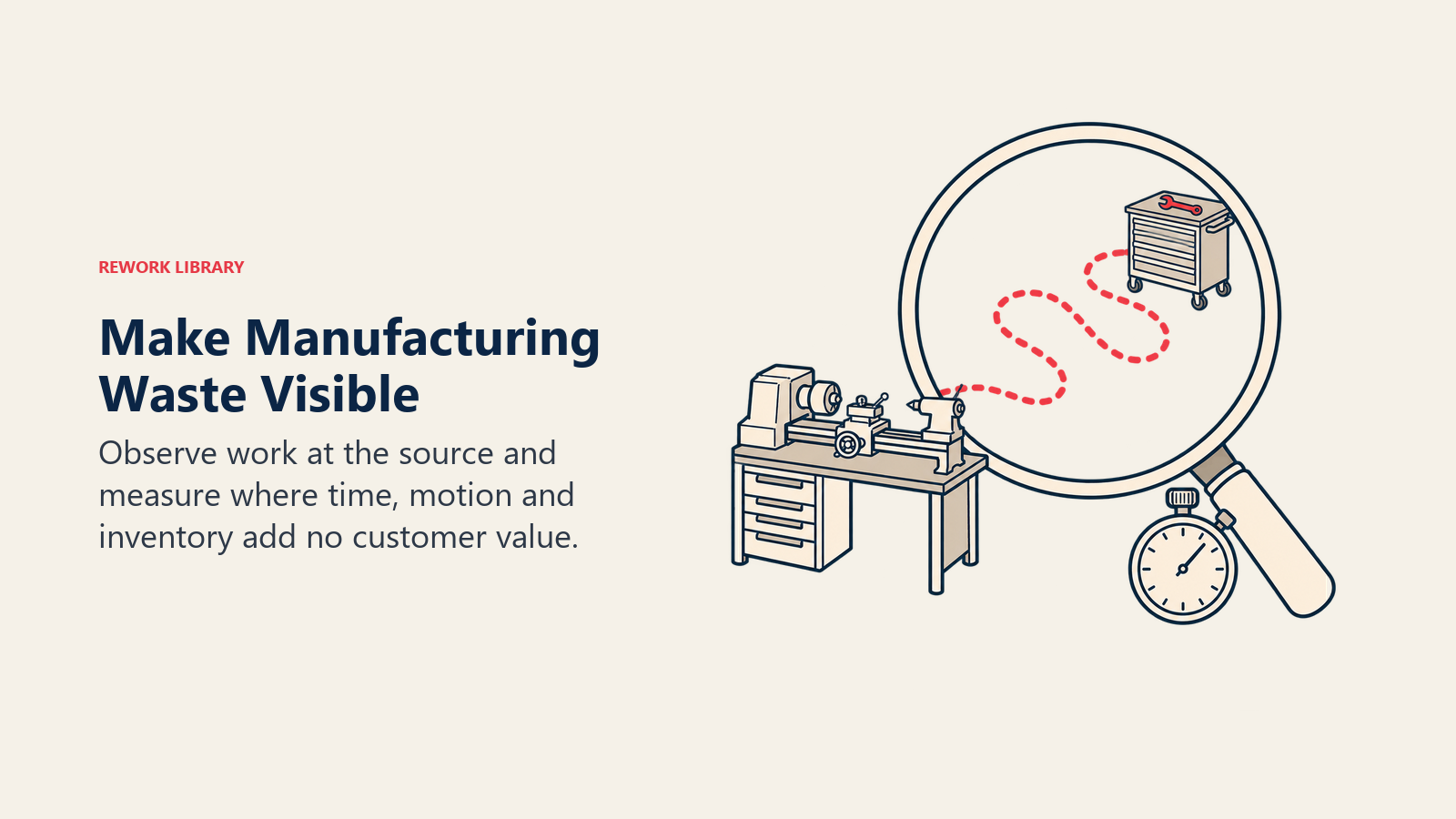
Value stream mapping visualizes every step from raw material to finished product, distinguishing value-adding activities from non-value-adding waste. Create a current-state map showing all process steps, transportation, waiting time, inventory, information flow, and lead times. Value stream mapping provides a systematic approach to this analysis.
Calculate the value-added ratio: total value-adding time divided by total lead time. Most manufacturers discover ratios of 5-15%, meaning 85-95% of time involves waste. This sobering reality motivates improvement while the map reveals specific waste to target.
Gemba walks take leaders to the actual place of work to observe operations directly. Don't review reports in conference rooms. Walk the floor systematically, watching material and information flow, timing activities, noting waiting and transportation, observing motion patterns, looking for inventory accumulation.
Train your eye to spot waste. When you see people walking, ask why materials aren't closer. When you see inventory, question why it exists. When you see waiting, investigate root causes. The Gemba reveals reality that reports often obscure.
Time studies and work sampling quantify how time actually gets spent. Shadow operators for full shifts, categorizing every activity: value-adding work, setup, waiting, walking, searching, rework, inspecting. The data often surprises: activities assumed to take 10% of time actually consume 40%.
A metal fabrication shop conducted two weeks of work sampling across all shifts. They discovered operators spent only 37% of time on value-adding machining. The rest: 18% waiting for material or instructions, 14% machine setup, 12% in-process transport, 11% first-piece inspection and quality checks, 8% tooling retrieval and management.
Data analysis and KPI review reveal waste patterns in metrics. High inventory turns suggest inventory waste. Poor on-time delivery points to waiting or quality problems. Low equipment utilization indicates bottlenecks or downtime. Customer complaints signal defects. Labor efficiency variance suggests motion or waiting waste.
Don't just report metrics. Investigate what they reveal about underlying waste. Declining OEE might indicate equipment reliability problems creating waiting waste. Growing WIP inventory suggests overproduction or bottleneck issues.
Prioritizing Waste Elimination Efforts
Every operation contains waste. But resources for improvement are limited. Prioritization ensures you attack waste that matters most.
Quantify waste impact in time, cost, and quality terms. Estimate hours consumed, calculate labor cost, factor space costs for inventory, assess quality impact. This analysis reveals which waste categories drain resources most significantly.
The machining company mentioned earlier quantified their waste systematically. Transportation waste consumed 240 labor hours weekly worth $7,800. Waiting waste from setup and material shortages cost 180 hours weekly or $5,850. Defects requiring rework cost $12,400 weekly in labor and scrap. These numbers justified improvement projects and demonstrated financial impact.
Quick wins versus strategic initiatives require different approaches. Quick wins are improvements you can implement immediately with minimal investment: reorganizing work areas to reduce motion, adjusting schedules to reduce waiting, implementing visual controls to prevent errors. Pursue these first to build momentum and credibility.
Strategic initiatives require planning, investment, and cross-functional effort: reconfiguring facility layouts, implementing pull production systems, deploying new technology. These deliver larger benefits but need formal project structures.
Pareto analysis identifies the vital few waste sources creating most impact. Track defect causes, downtime reasons, or inventory by part number. Typically, 20% of causes create 80% of waste. Focus elimination efforts on high-impact targets rather than spreading efforts across all waste equally.
An automotive supplier analyzed six months of scrap data. Five part numbers representing 8% of production volume created 67% of scrap cost. Focused improvement on these five parts reduced overall scrap 52% within three months, demonstrating Pareto's power.
Tactical Waste Elimination Strategies
Different waste types respond to specific elimination techniques.
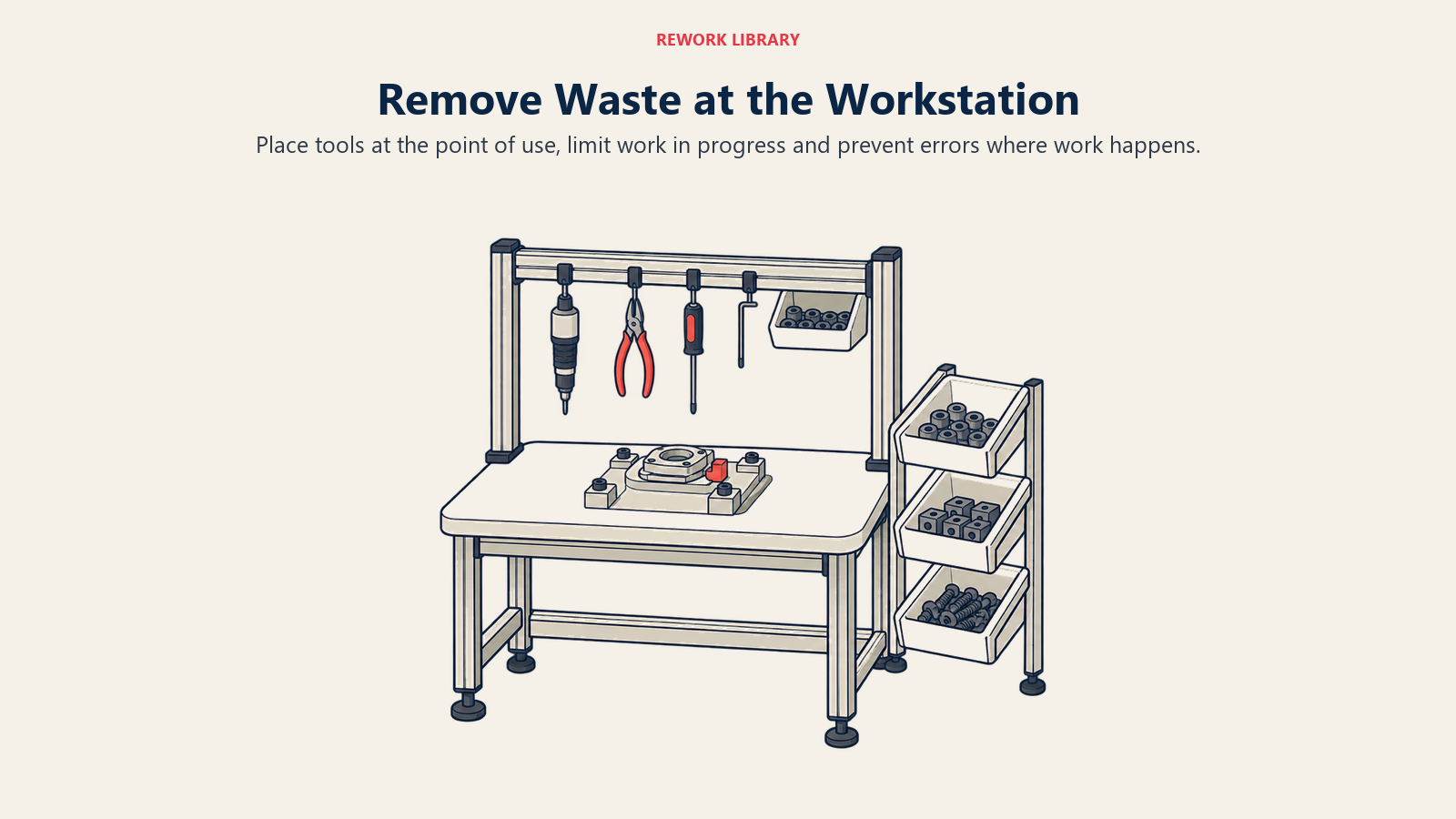
Layout optimization attacks transportation and motion waste. Reduce distance materials travel by grouping related operations into manufacturing cells. Place frequently-used tools at point of use. Design workstations to minimize reaching, bending, and walking. Use gravity flow racks to deliver materials ergonomically.
Pull systems and JIT eliminate inventory and overproduction waste. Produce only what downstream processes need when they need it. Use Kanban system implementation to authorize production based on consumption rather than forecasts. Reduce batch sizes to minimize WIP inventory.
Standard work and line balancing reduce waiting waste. Document the best-known method for each task, including time expectations. Balance workload across operators so no one waits while others stay busy. Identify and address bottlenecks that create waiting upstream or downstream.
Demand-driven production prevents overproduction. Align production schedules directly with customer orders rather than forecasts. Level production to create steady, predictable flow. Reduce batch sizes and changeover times to enable flexible response to actual demand.
Simplification eliminates overprocessing. Question every process step: is this necessary? Can we simplify it? Does the customer value this? Eliminate non-value-adding approvals, redundant inspections, and processes that don't affect customer-critical characteristics.
Quality at source prevents defects. Implement mistake-proofing devices that prevent errors. Train operators in quality standards and inspection techniques. Empower workers to stop production when problems occur. Address root cause analysis methods rather than inspecting defects out.
Skills matrices and job enrichment attack skills waste. Assess each employee's capabilities beyond their current narrow role. Provide cross-training to develop versatility. Involve frontline workers in improvement activities. Create channels for employee suggestions and problem-solving participation.
Sustaining Waste-Free Operations
Eliminating waste once doesn't guarantee it stays gone. Sustaining gains requires systematic approaches.
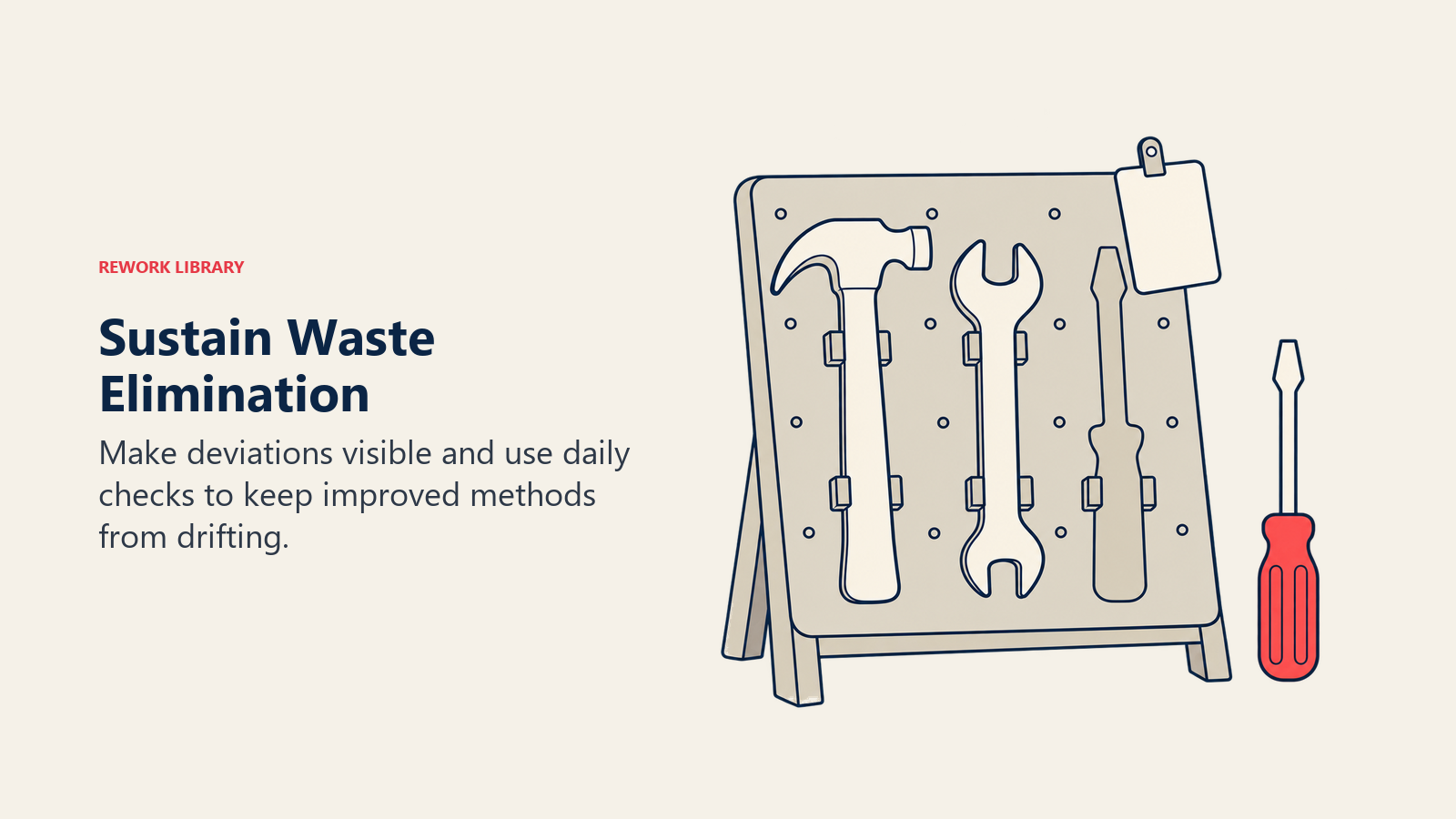
Visual management makes waste immediately obvious when it begins creeping back. Use floor markings to show proper material locations so accumulation stands out. Post standard work documents showing proper methods. Display performance metrics so deterioration triggers investigation.
A pharmaceutical manufacturer uses shadow boards for all tools and materials. When something isn't in its marked location, the gap is immediately visible. This simple visual control prevents the gradual disorganization that had previously required quarterly cleanup campaigns.
Standard work documentation captures improved methods so they become the new normal. Document optimal work sequences, quality checks, and timing expectations. Train all workers on standards. Update standards when improvements emerge. Standards prevent drift back to old habits while providing baselines for further improvement.
Continuous monitoring and problem-solving catches waste reemergence early. Track key metrics tied to each waste type. When metrics deteriorate, investigate immediately using root cause analysis. Treat waste reoccurrence as a problem requiring countermeasures rather than accepting it as inevitable.
Build waste identification into daily management routines. Leaders conducting Gemba walks should specifically look for waste. Team meetings should review waste metrics. Continuous improvement events should target waste systematically.
From Waste Identification to Cultural Transformation
The greatest waste elimination comes not from initial cleanup projects but from building cultures where everyone sees and eliminates waste daily. This connects to kaizen continuous improvement philosophy.
This requires making waste visible and unacceptable. When operators spot inventory accumulating, they should question why it's there. When setup takes too long, teams should work to reduce it. When defects occur, everyone should engage in prevention.
Train everyone to recognize the eight wastes. Provide time and permission for improvement activities. Respond enthusiastically when workers identify waste. Celebrate elimination successes prominently.
Manufacturers who master waste elimination develop remarkable competitive advantages. Their costs drop while quality improves. They respond faster to customer needs with less inventory. Operations become simpler, more reliable, and more profitable. Strong manufacturing quality management supports this transformation.
Start by selecting a contained area for intensive waste identification. Map the value stream. Quantify waste impact. Implement improvements systematically. Share results. Then expand the approach progressively across operations. Persistence transforms waste elimination from project to culture, from occasional to continuous, from cost to competitive advantage.
Learn More

Co-Founder, Rework.com