Manufacturing Growth Model: Strategic Framework for Scaling Production Business
Turn this article into takeaways for your work.


Each assistant summarizes the article only for you and suggests best practices for your work.
Scaling a manufacturing business isn't just about buying more equipment and hiring more people. The difference between companies that successfully scale and those that stumble lies in how they navigate critical transition points. A manufacturer that can produce 50 units profitably often can't simply multiply everything by ten to produce 500 units with the same margins.
Understanding the Manufacturing Growth Model
A manufacturing growth model defines the path a production business takes from startup to enterprise scale. According to McKinsey research on manufacturing growth, companies that address all available pathways to growth are 97% more likely to achieve profitable above-peer growth. It's not a linear journey. Each phase demands different capabilities, processes, and leadership approaches. Most manufacturers fail during transitions because they can't recognize when their current model has reached its limits.
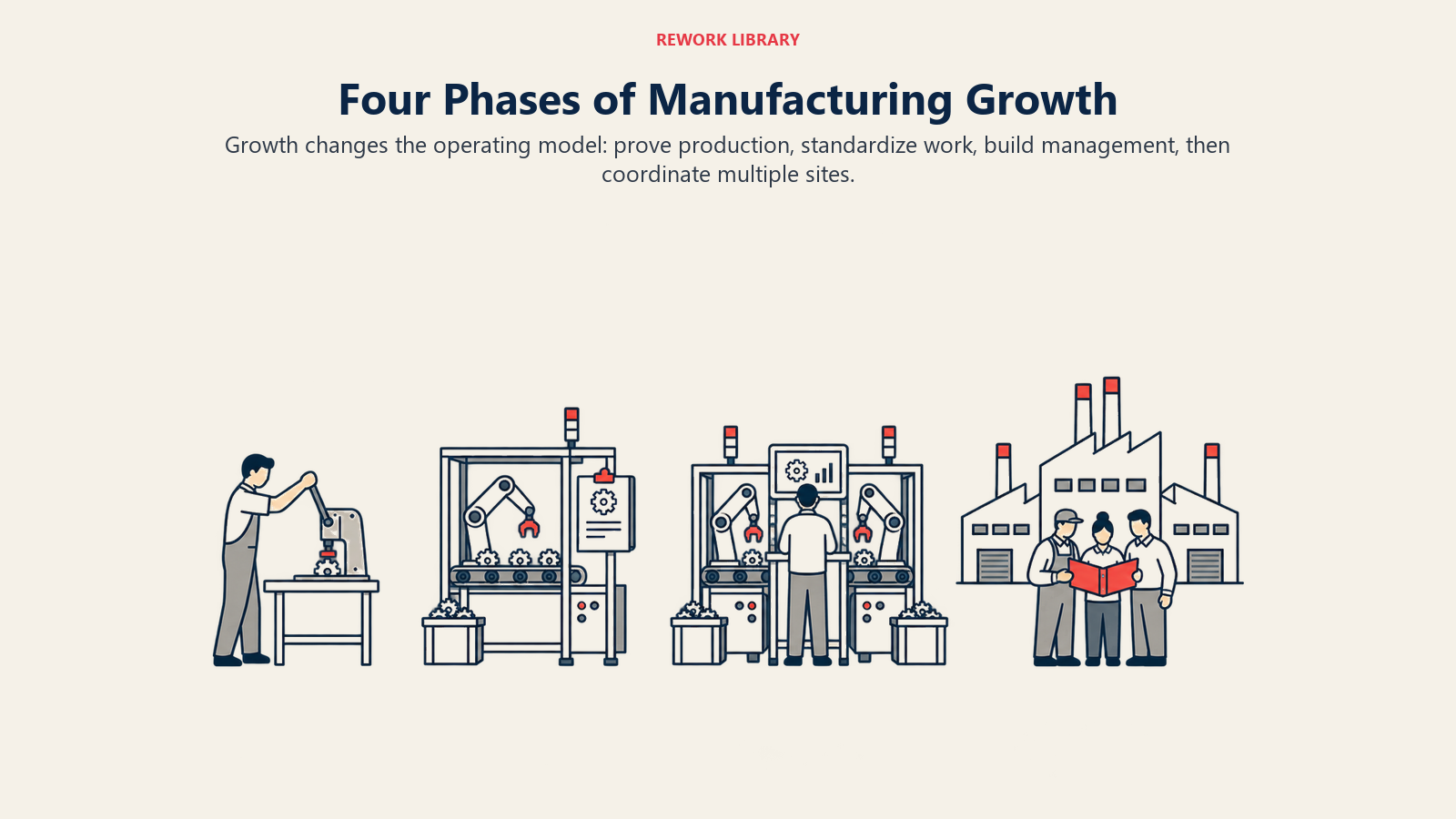
The growth model consists of four distinct phases: startup, scale-up, growth, and enterprise. Each phase has its own characteristics, challenges, and success factors. Research on business growth stages shows that understanding these phases is critical for sustainable development. Companies that try to skip phases or apply the wrong strategies for their current phase waste resources and create operational chaos.
Four Phases of Manufacturing Maturity
Phase 1: Startup (0-10 employees, <$2M revenue)
In the startup phase, manufacturers focus on proving their product-market fit and establishing basic production capability. Everything runs on founder knowledge and manual processes. The CEO probably still operates machinery. Quality control happens through visual inspection. Customer orders get written on whiteboards.
This phase works because of low volume and high involvement from key people. But it doesn't scale. The transition challenge comes when customer demand exceeds what the founder and initial team can personally handle. Many manufacturers get stuck here because they can't let go of manual control.
Phase 2: Scale-Up (10-50 employees, $2M-$10M revenue)
Scale-up manufacturers must systematize what previously lived in people's heads. They implement their first production planning systems, quality processes, and management structures. The founder can no longer personally oversee every order or production run.
This phase demands investment in equipment, systems, and talent before the revenue fully justifies it. Companies that underfund this phase create bottlenecks. Those that overfund it burn cash. The critical skill here is balancing investment timing with market demand growth.
Phase 3: Growth (50-250 employees, $10M-$50M revenue)
Growth-phase manufacturers operate multiple production lines or shifts. They've established repeatable processes but must continuously improve them. The organization needs middle management, specialized roles, and formal communication structures.
The transition challenge is professionalizing operations while maintaining the agility that got them there. Many companies hire experienced executives who bring "big company" processes that suffocate the culture. Others promote from within but lack the skills to manage complexity.
Phase 4: Enterprise (250+ employees, $50M+ revenue)
Enterprise manufacturers operate at scale across multiple facilities, product lines, or markets. They've built deep systems, strong management benches, and sophisticated supply chains. Growth comes more from optimization and market expansion than operational transformation.
The risk in this phase is bureaucracy killing innovation and responsiveness. Large manufacturers must consciously maintain entrepreneurial thinking within structured processes. They also face pressure to enter new markets or acquire competitors to maintain growth rates.
Critical Transition Points Between Phases
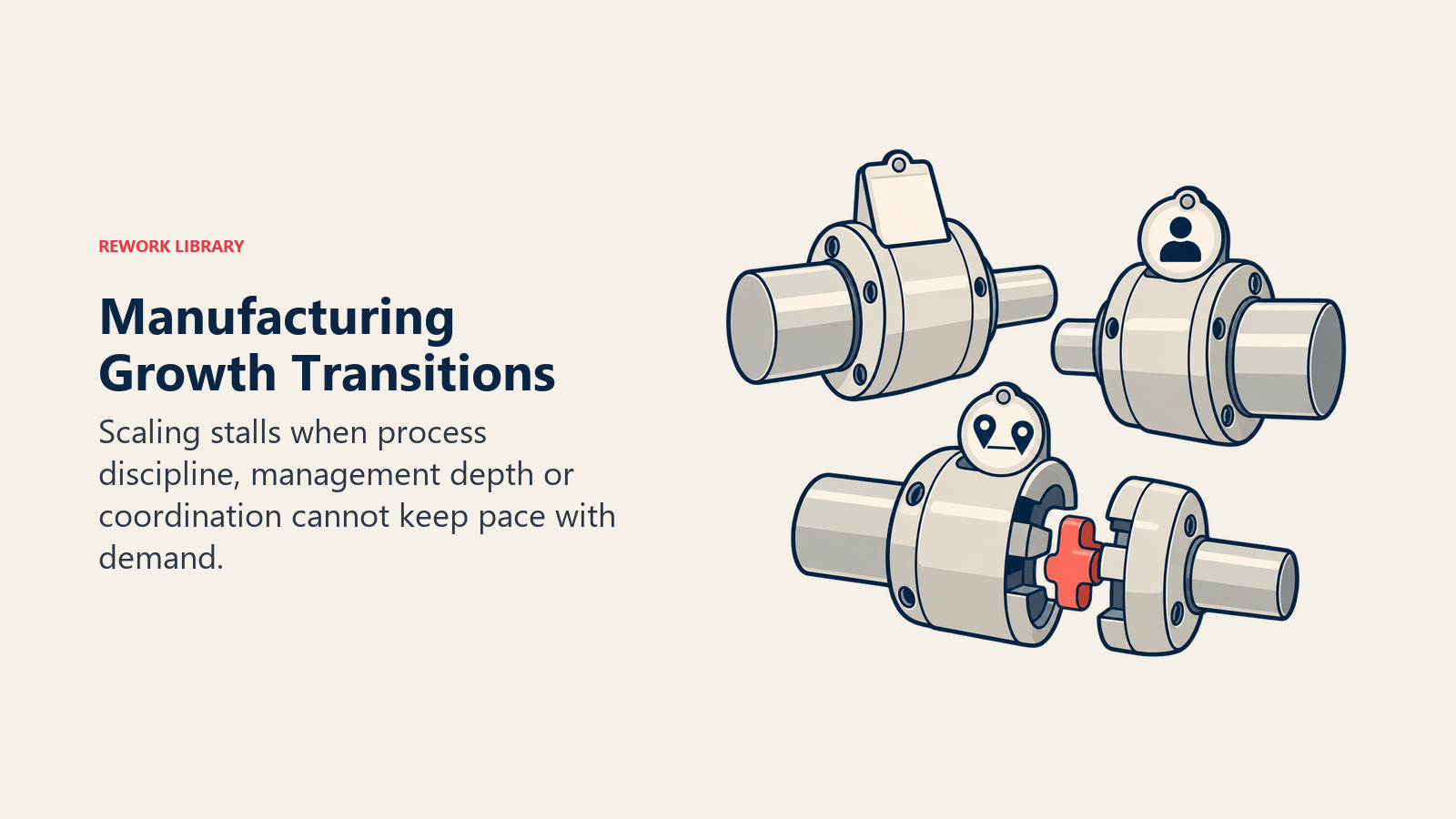
The most dangerous moments in manufacturing growth happen during phase transitions. Revenue might be growing, but the organization's capabilities lag behind. Three critical transitions cause the most failures:
Startup to Scale-Up: The Systematization Crisis
When manual processes can't handle volume, quality suffers and costs explode. Founders who can't transition from doing to managing create bottlenecks. The solution requires documenting processes, implementing basic MRP systems, and hiring people who can operate without constant supervision.
Companies successfully navigate this transition by accepting that they'll temporarily feel less in control. Systematization initially slows things down. But it's the only path to reliable growth.
Scale-Up to Growth: The Management Crisis
A single leadership team can't manage 50+ people and multiple production processes. Without middle management and functional expertise, communication breaks down and coordination fails. But adding layers too quickly creates political dysfunction.
The best manufacturers promote their best operators into team lead roles while hiring experienced managers for critical functions like operations, quality, and supply chain. They invest heavily in leadership development because tomorrow's managers must come from today's front line.
Growth to Enterprise: The Complexity Crisis
Multiple facilities, diverse product lines, and larger organizations create coordination challenges that informal communication can't solve. Systems must talk to each other. Processes must standardize across locations. Decision rights must clarify.
Enterprise manufacturers succeed by building infrastructure ahead of need. They implement ERP systems, formalize governance processes, and create centers of excellence that spread best practices across locations.
Growth Drivers: Key Factors That Enable Scale
Four primary drivers enable sustainable manufacturing growth. Companies must develop all four simultaneously. Overinvesting in any single driver while neglecting others creates imbalances.
Production Capacity Expansion
Capacity growth must slightly lead demand growth. Manufacturers who wait until they're at 100% capacity before expanding lose revenue during the investment period. Those who overexpand too early carry excess costs that destroy margins.
Smart capacity expansion happens incrementally. Add shifts before adding equipment. Outsource to contract manufacturers before building new facilities. Expand within existing footprints before acquiring new property.
Market Diversification
Manufacturers dependent on single customers or markets face existential risks. But diversification requires careful pacing. Each new market demands sales resources, technical adaptation, and potentially different business models.
The best sequence is expanding within existing markets (more customers in current segments) before entering adjacent markets (related products or geographies) and finally entering new markets (different industries or business models).
Operational Excellence
Growth magnifies operational problems. A 2% scrap rate with $2M revenue costs $40K annually. At $20M revenue, the same rate costs $400K. Process improvement becomes economically critical at scale.
Manufacturers should implement basic lean principles during scale-up, formalize continuous improvement programs during growth, and build quality into product and process design at enterprise scale.
Technology Adoption
The right technology at the right time accelerates growth. The wrong technology creates expensive complexity. Startup manufacturers need inventory and order management. Scale-up needs production planning. Growth needs integrated ERP. Enterprise needs advanced analytics and automation. Deloitte's 2026 Manufacturing Outlook reports that 80% of manufacturing executives plan to invest 20% or more of their improvement budgets in smart manufacturing initiatives.
Technology should solve current bottlenecks, not prevent future ones. Manufacturers who buy enterprise software while still in startup mode waste money on capabilities they don't need and complexity they can't manage.
Strategic Framework: Building Your Growth Roadmap
Effective growth planning requires honest assessment of current state, realistic target setting, and clear resource prioritization.
Assessing Current State
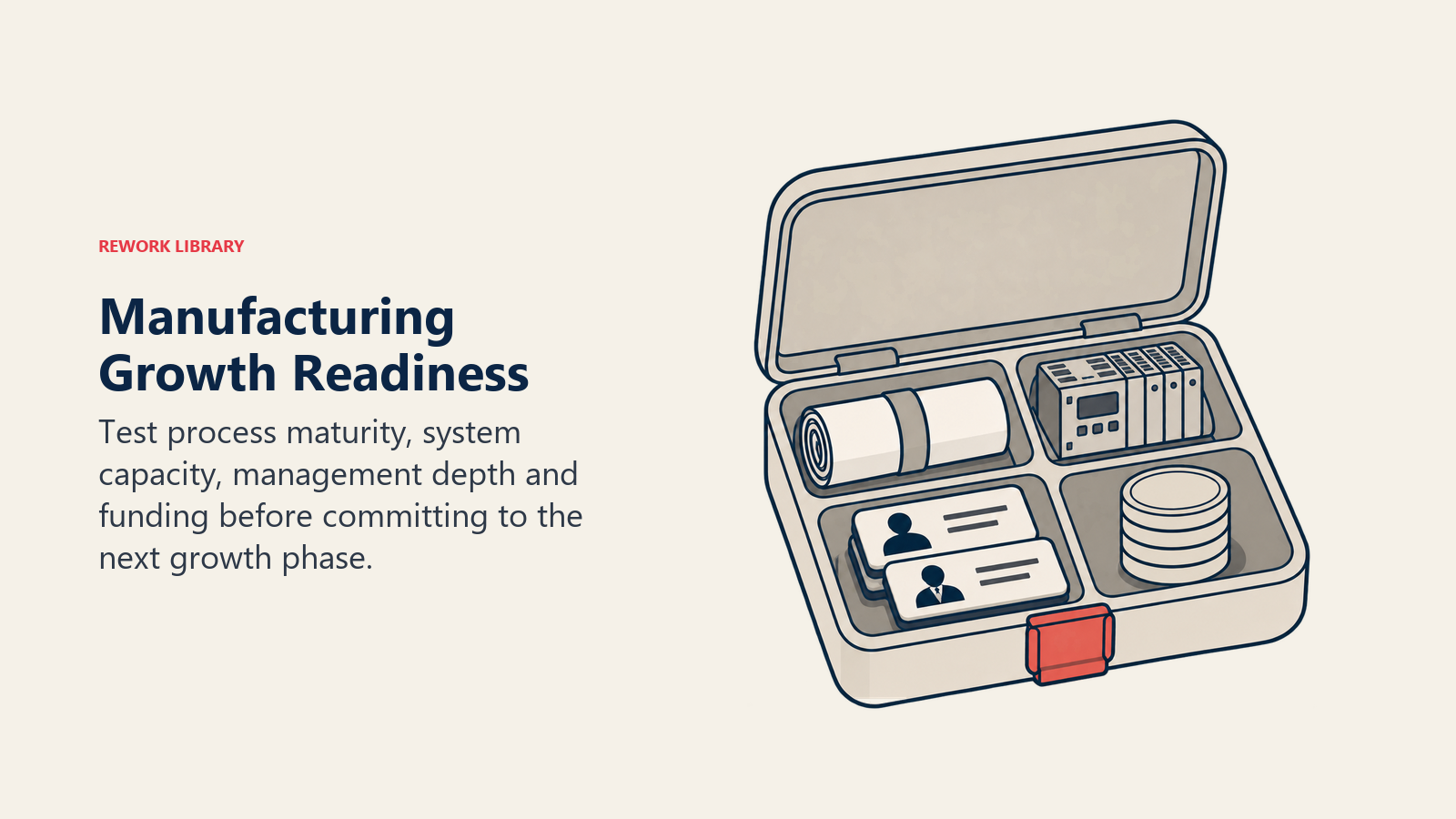
Identify which growth phase you're in by evaluating revenue, employee count, and operational characteristics. Then assess your readiness for the next phase across four dimensions:
Process maturity: Are critical processes documented and followed consistently? Can new employees execute them without extensive training?
System capability: Do your software systems support current volume and complexity? Can they handle 3x growth without replacement?
Management depth: Could your organization function if you removed the top three leaders? Do you have succession plans for critical roles?
Financial capacity: Can you fund growth from operations, or do you need external capital? What's your runway if growth stalls?
Identifying Bottlenecks
Growth constraints appear in predictable areas. Production capacity limitations create delivery delays. Working capital shortages force you to choose between growth and stability. Talent gaps leave critical roles unfilled. Supply chain fragility creates material shortages.
The primary bottleneck determines growth strategy. If capacity constrains growth, investments in equipment and space take priority. If talent constrains growth, recruitment and development demand focus. If working capital constrains growth, you need better cash management or external funding.
Setting Realistic Milestones
Aggressive growth targets motivate teams but create chaos if they exceed organizational capability. Conservative targets maintain stability but miss market opportunities. The right growth rate matches your industry, competitive position, and organizational maturity.
Most healthy manufacturers grow 15-30% annually during scale-up and growth phases. Faster growth usually requires extraordinary market conditions or significant capital investment. Slower growth suggests competitive or execution problems.
Set milestones across multiple dimensions: revenue and profit, operational metrics (OEE, quality, delivery), organizational capabilities (systems implemented, key roles filled), and customer metrics (retention, diversification).
Resource Allocation Priorities
Growth requires investment across equipment, systems, people, and working capital. Most manufacturers underinvest in systems and people while overinvesting in equipment. The visible assets (machines and facilities) consume resources that should develop invisible capabilities (processes and talent).
During scale-up, prioritize systems and people over equipment. You can outsource production but you can't outsource management capability. During growth, balance investments across all areas. During enterprise phase, prioritize efficiency improvements and market expansion over capacity expansion.
Implementation Roadmap: Practical Steps for Each Growth Phase
Startup Phase Implementation
Your primary goal is proving you can deliver quality products profitably. Focus on these priorities:
Document your production process in enough detail that someone else could execute it. Create basic work instructions for critical operations. Implement simple inventory tracking so you know what you have and where it is. Establish basic quality checkpoints that catch problems before shipping.
Don't invest in elaborate systems or formal processes. Use spreadsheets and simple tools. But do create the foundation for future systematization.
Scale-Up Phase Implementation
This phase demands significant process and systems investment. Your priorities:
Implement production planning software that manages jobs, schedules, and materials. It doesn't need to be enterprise ERP, but it must handle 3-5x current volume. Create standard operating procedures for every production process. Train multiple people on critical operations so you're not dependent on individuals.
Hire your first operations manager who brings process discipline. Establish basic financial controls that separate production costs from overhead. Begin measuring key metrics like on-time delivery, first-pass yield, and capacity utilization.
Growth Phase Implementation
Growth phase requires organizational infrastructure. Focus on:
Upgrade to integrated ERP that connects production, inventory, purchasing, and financials. Implement formal continuous improvement programs with regular kaizen events. Develop management talent through training and mentorship. Create functional departments with clear responsibilities.
Standardize processes across shifts and lines. Document and share best practices. Build redundancy into critical roles so vacation or turnover doesn't create crisis. Professionalize quality management with statistical process control.
Enterprise Phase Implementation
Enterprise manufacturers optimize what already works. Priorities include:
Implement advanced planning systems that optimize across facilities and products. Deploy real-time operational visibility through MES or IoT sensors. Build centers of excellence that spread best practices across locations. Develop formal innovation processes that generate new products and improvements.
Build strong succession planning that develops future leaders from current employees. Professionalize all support functions with specialized expertise. Build strategic partnerships with key suppliers and customers.
Learn More
To deepen your understanding of manufacturing growth strategies, explore these related topics:
- Manufacturing Revenue Streams explains how to diversify income sources for sustainable growth
- Manufacturing KPIs Overview covers the metrics that track your progress through growth phases
- Production Planning Fundamentals provides the process foundation needed for scale-up
- Capacity Planning Strategy helps you expand production capability strategically
- Lean Manufacturing Principles offers tools for building operational excellence
Building Sustainable Manufacturing Growth
The manufacturing growth model provides a roadmap, not a rigid formula. Your specific path depends on your products, markets, competitive position, and resources. But the fundamental pattern holds: successful growth requires matching organizational capabilities to market demands.
Too many manufacturers try to grow faster than their capabilities support. They add customers without adding capacity, increase complexity without improving systems, and expand markets without developing talent. The result is operational chaos that destroys the value they've built.
Sustainable growth comes from honest assessment of where you are, realistic planning for where you're going, and disciplined investment in capabilities ahead of demand. It's not the fastest companies that win. It's the ones that can scale reliably, maintain quality, and preserve profitability through each growth phase.

Co-Founder, Rework.com
On this page
- Understanding the Manufacturing Growth Model
- Four Phases of Manufacturing Maturity
- Critical Transition Points Between Phases
- Growth Drivers: Key Factors That Enable Scale
- Strategic Framework: Building Your Growth Roadmap
- Implementation Roadmap: Practical Steps for Each Growth Phase
- Learn More
- Building Sustainable Manufacturing Growth