Strategic Sourcing for Manufacturing: Data-Driven Procurement Excellence
Turn this article into takeaways for your work.


Each assistant summarizes the article only for you and suggests best practices for your work.
Every manufacturing company purchases materials, components, and services. Most treat purchasing as a tactical function focused on filling requisitions and negotiating prices. But procurement decisions determine your cost structure, quality levels, innovation capabilities, and supply chain resilience. The difference between reactive purchasing and strategic sourcing can represent 5-15% of total costs while fundamentally altering competitive positioning.
Traditional purchasing operates in a cycle of requests, quotes, and purchase orders. Someone needs parts, purchasing finds suppliers willing to provide them at acceptable prices, orders get placed. This reactive approach misses opportunities to optimize spend, develop better supplier relationships, and align procurement with business strategy. It treats purchasing as a necessary cost center rather than a value creation function.
Strategic sourcing transforms procurement from order fulfillment to competitive advantage. It uses data to understand spending patterns, analyzes supply markets systematically, and develops category strategies that balance cost, quality, risk, and innovation. Companies practicing strategic sourcing secure better terms, develop superior supplier relationships, and reduce total cost of ownership while competitors chase unit price reductions that often prove illusory.
From Purchasing to Strategic Sourcing
Strategic sourcing represents a fundamental shift in how organizations approach procurement. Traditional purchasing is transactional: requisitions arrive, buyers find suppliers, orders are placed. Decisions focus on individual purchases rather than category-level strategies. Relationships with suppliers remain arm's length and price-focused.
Strategic sourcing operates at a higher level. It starts with understanding spending across categories, identifying opportunities for consolidation and leverage. Rather than reacting to individual needs, sourcing develops strategies for entire categories of spend. Instead of treating each supplier independently, it optimizes the supplier portfolio. Decisions consider total cost of ownership, not just unit prices.
The seven-step sourcing process provides a framework for this strategic approach. Profile the category to understand current spending, suppliers, and specifications. Assess the supply market to identify alternatives and understand market dynamics. Develop a sourcing strategy appropriate for that category's characteristics. Generate competition through RFI, RFP, or RFQ processes. Negotiate contracts that capture value beyond initial bids. Implement the new sourcing arrangement. Monitor performance and continuously improve.
This process differs fundamentally from traditional purchasing's quote-and-buy cycle. Each step adds analytical rigor that uncovers opportunities reactive purchasing misses. The investment pays returns through better decisions grounded in data and market understanding.
Cross-functional sourcing teams ensure procurement decisions reflect all relevant perspectives. Engineers contribute technical requirements and supplier capability assessments. Quality provides supplier performance history and qualification criteria. Operations shares capacity requirements and timing constraints. Finance offers cost analysis and contract structuring. Procurement coordinates these inputs into coherent strategies that balance competing objectives.
Spend Analysis Foundation
You can't optimize spending you don't understand. Spend analysis provides the factual foundation for strategic sourcing decisions by revealing where money goes, who you're buying from, and what you're purchasing.
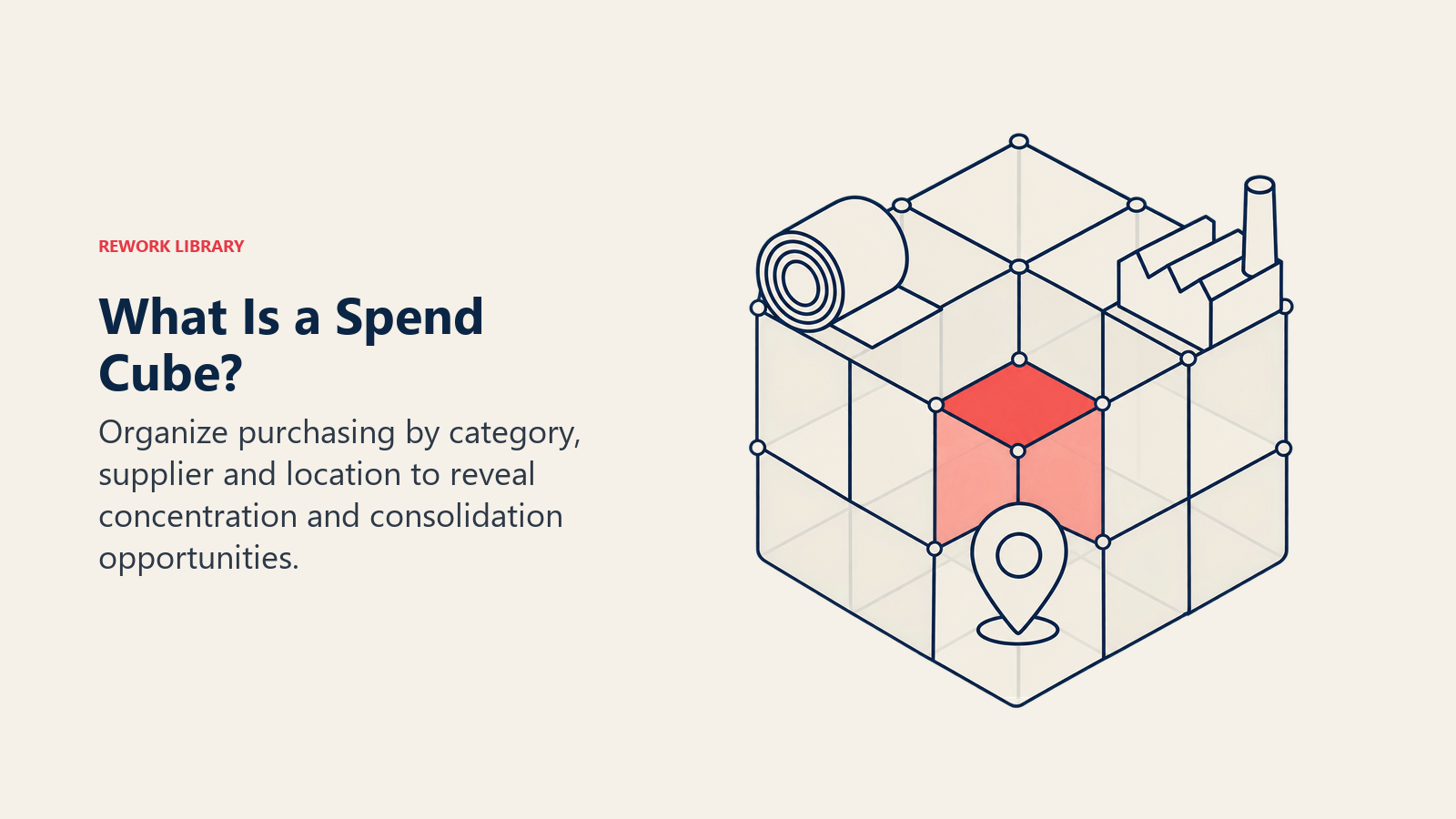
Start by consolidating spend data from all sources. Purchase orders, invoices, credit card transactions, and check registers all represent spending. Data often sits in multiple systems (ERP, procurement software, accounts payable), requiring integration for complete visibility. Clean and normalize this data so you can analyze it meaningfully. Standard supplier names instead of various abbreviations. Consistent commodity codes rather than different descriptions for the same item.
The spend cube organizes this data across three dimensions: what you buy, who you buy from, and where it goes. Slice spending by commodity category to see aggregate spending on electronics, chemicals, or services. View by supplier to identify your largest suppliers and spending concentration. Analyze by location to understand plant-level spending patterns. These perspectives reveal different optimization opportunities.
Pareto analysis identifies where to focus sourcing efforts. According to CIPS research, typically 20% of categories represent 80% of spending. Another 20% of suppliers account for 80% of purchase transactions. Focus strategic sourcing on high-value categories and streamline low-value purchases. Don't spend equal effort optimizing every category regardless of impact.
Spend analysis often surprises organizations with findings about their own purchasing. You're buying the same item from three suppliers at different prices. Ten different part numbers exist for functionally identical components. Spending for a category spread across dozens of suppliers, with no single supplier relationship strong enough for meaningful leverage. These discoveries alone justify the spend analysis investment.
Consolidation opportunities emerge from spend analysis. Combining volume with fewer suppliers increases leverage and reduces administrative costs. Standardizing specifications eliminates unnecessary variety that fragments spending and complicates inventory management. Regional consolidation reduces freight costs and simplifies logistics operations. Each consolidation type requires different approaches but share common benefits of leveraging scale.
Supply Market Analysis
Understanding your internal spending reveals only half the picture. Supply market analysis examines external factors determining what's possible and optimal for each category.
Supplier landscape assessment identifies available suppliers, their capabilities, and market positions. How many qualified suppliers exist? Are they large corporations or small specialists? Where are they located? What's their financial stability? Understanding the supplier universe helps you determine whether competitive markets exist or you face oligopolies requiring different strategies.
Market trends and capacity analysis reveals supply-demand balance and future dynamics. Is capacity tight, driving supplier power and prices up? Or is overcapacity forcing suppliers to compete aggressively? Are materials costs rising or falling? What technologies are emerging that might disrupt current supply patterns? These trends indicate whether timing favors buyers or sellers and inform negotiation strategies.
Should-cost modeling estimates what items should cost based on material inputs, labor content, and reasonable margins. This analytical technique breaks products into cost components, prices each at market rates, and adds appropriate overhead and profit. Should-cost gives you negotiating targets grounded in economics rather than supplier quotes. When actual costs exceed should-cost significantly, explore why. Suppliers might have inefficient processes you can help improve, or they might capture excessive margins.
Supply market intelligence comes from multiple sources. Supplier discussions provide insights into their markets and challenges. Industry reports and trade publications reveal trends. Visits to trade shows introduce new suppliers and technologies. Consultants and distributors share market knowledge. Continuous intelligence gathering creates information advantages competitors lack.
Understanding supply markets helps you develop appropriate sourcing strategies. When markets are competitive with many suppliers, aggressive competition and switching threats create leverage. When suppliers are few with limited alternatives, partnership approaches and longer-term commitments make more sense. When markets are rapidly changing, flexibility and shorter terms protect against obsolescence. Market reality should drive strategy, not theoretical preferences.
Sourcing Strategy Development
Different categories require different sourcing approaches. Strategic sourcing develops category-specific strategies rather than applying one-size-fits-all purchasing policies.
Make versus buy decisions determine whether to source externally or produce internally. This fundamental choice depends on strategic importance, capability requirements, cost economics, and capacity availability. Core competencies justifying internal production. Specialized capabilities better sourced externally. Cost advantages from scale suppliers possess. Capacity constraints forcing external sourcing. Revisit make-vs-buy periodically as conditions change.
Single versus multiple sourcing strategies balance efficiency against risk. Single sourcing uses volume for better pricing, simplifies quality management, and enables deeper supplier relationships. But it creates dependency and removes competitive pressure. Multiple sourcing maintains alternatives and competitive tension but fragments volume and increases management complexity. The right choice depends on supply risk, spend level, and supplier criticality.
Local versus global sourcing trades off different advantages. Local suppliers offer shorter lead times, easier communication, and reduced freight costs. Global suppliers might provide lower unit costs, unique capabilities, or specific materials. Consider total landed cost, not just FOB pricing. Factor in lead time impact on inventory and flexibility. Evaluate supply chain risk from distance and geopolitical factors.
Strategic sourcing decisions should align with business priorities. If time-to-market is critical, favor suppliers supporting rapid new product introduction. If quality is paramount, choose suppliers with proven quality systems even at price premiums. If cost reduction drives strategy, emphasize competitive low-cost regions. Sourcing strategy should flow from business strategy, not operate independently.
RFx Process Management
Competitive processes generate supplier competition that reveals market pricing and capabilities while demonstrating your willingness to consider alternatives.
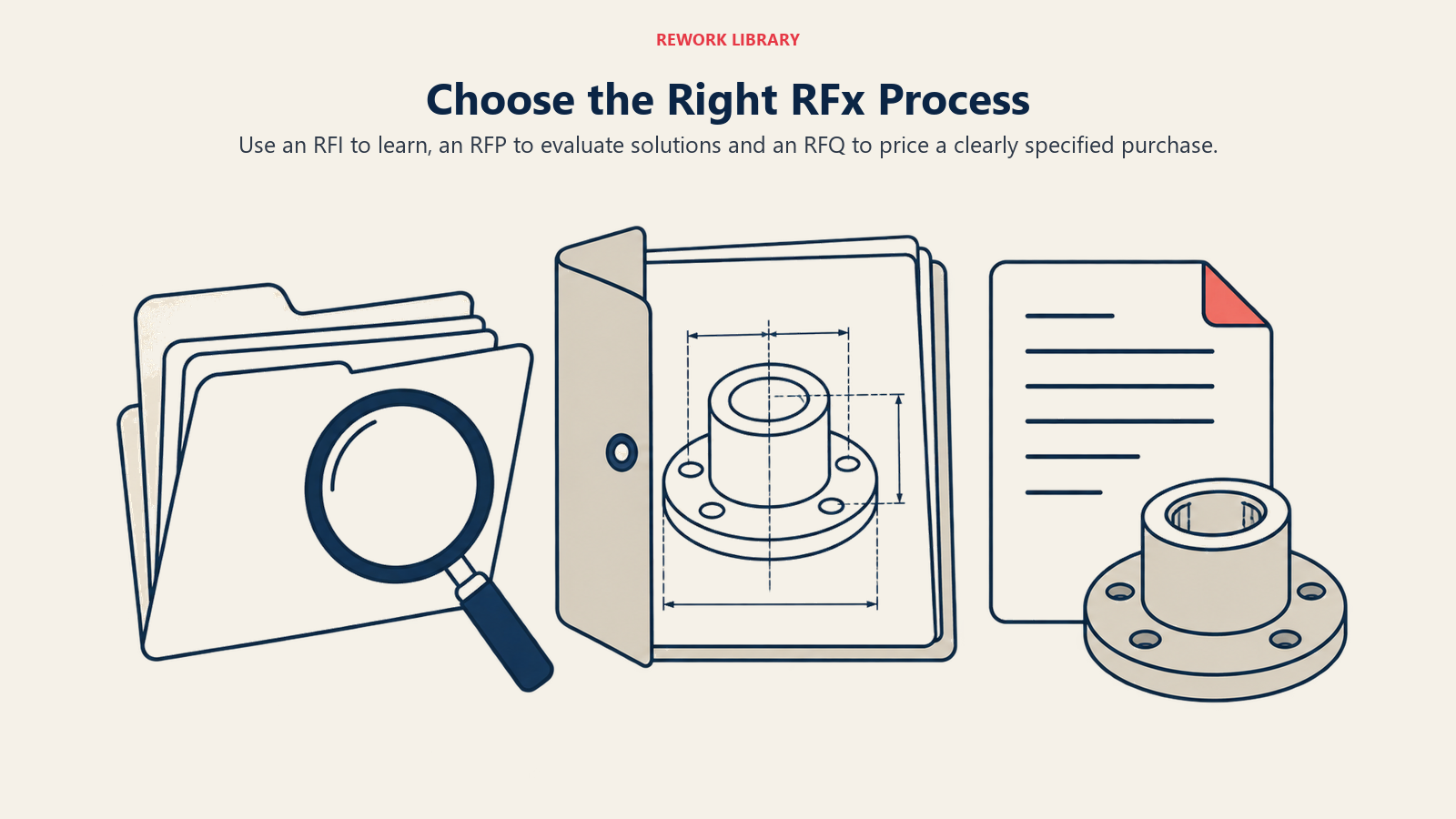
Request for Information (RFI) processes gather preliminary information when you're exploring new categories or suppliers. RFIs aren't binding commitments but fishing expeditions to understand what's available, typical pricing ranges, and supplier capabilities. Use RFIs early in sourcing cycles to build category knowledge before developing final requirements.
Request for Proposal (RFP) processes work well for complex purchases requiring detailed technical and commercial proposals. RFPs include specifications, volume projections, quality requirements, and evaluation criteria. Suppliers respond with technical approaches, pricing, and terms. Evaluation teams score proposals across multiple dimensions, selecting suppliers that best meet requirements rather than simply choosing lowest prices.
Request for Quotation (RFQ) processes suit straightforward purchases where specifications are clear and price is the primary selection factor. RFQs streamline bidding for commodity purchases and repeat buys. Suppliers quote prices for defined specifications, and you select based primarily on cost.
The key to effective RFx processes is clarity about requirements and evaluation criteria. Vague specifications produce vague proposals that can't be compared meaningfully. Hidden evaluation criteria make suppliers guess what matters, generating proposals that miss the mark. Communicate clearly, answer supplier questions transparently, and evaluate systematically against stated criteria.
Competitive processes signal to suppliers that you're serious about optimizing costs and performance. Even incumbent suppliers reduce prices when they know alternatives exist. But don't run competitions solely to squeeze incumbents if you intend to stick with them. Suppliers who invest proposal resources without reasonable winning opportunities eventually stop participating. Use competitive processes where you're genuinely open to changing suppliers.
Total Cost of Ownership
The lowest purchase price often hides the highest total cost. Total cost of ownership (TCO) analysis reveals all costs associated with purchased items, enabling better sourcing decisions.
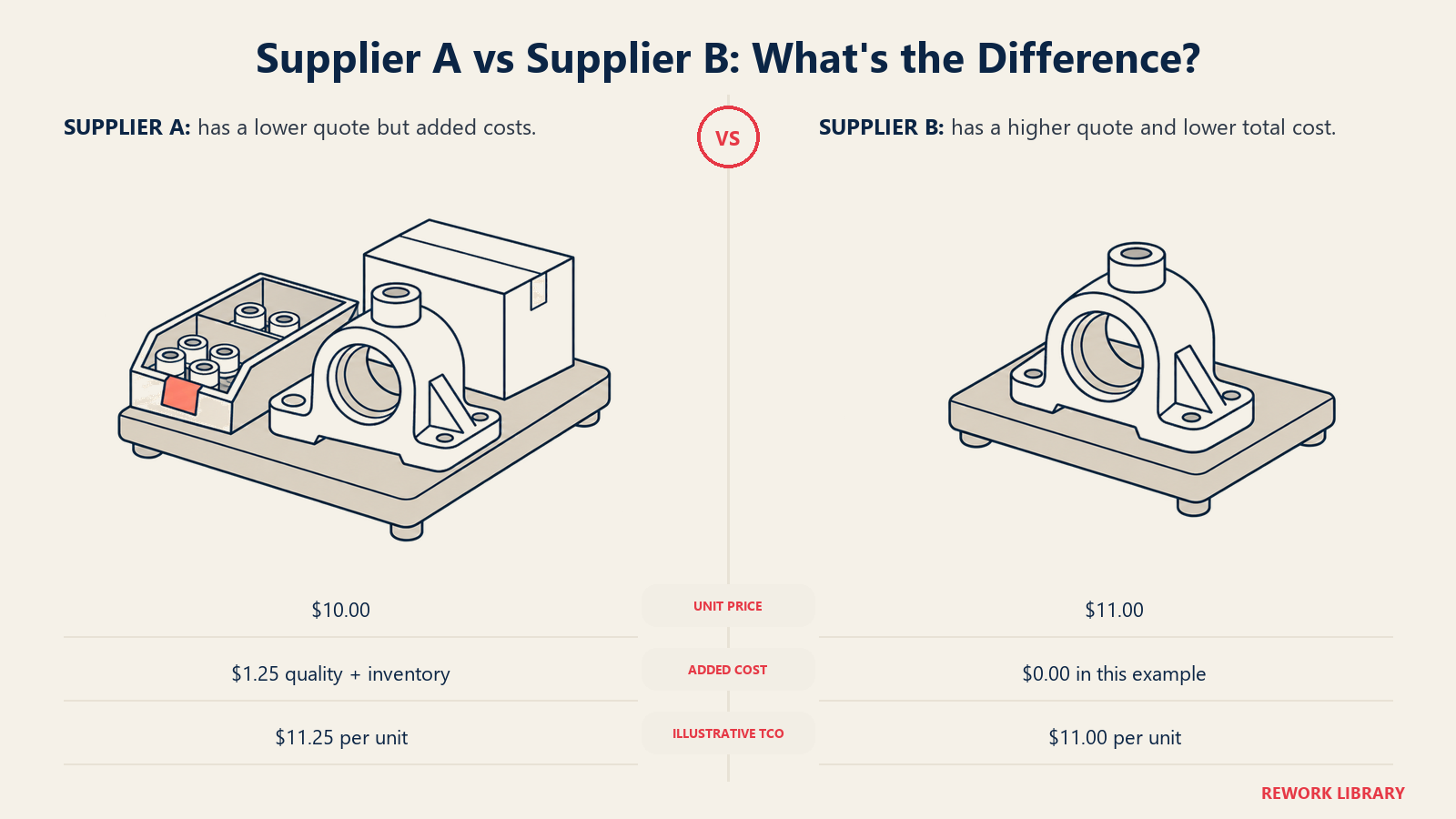
Beyond unit price, TCO includes quality costs from defects and rework. Delivery costs from freight, expediting, and excess inventory compensating for unreliable supply. Transaction costs from processing orders, invoices, and payments. Lifecycle costs from maintenance, energy consumption, and disposal. Opportunity costs from delayed time-to-market or lost production from supply failures.
Consider a component available from two suppliers. Supplier A quotes $10 per unit. Supplier B quotes $11. Traditional purchasing chooses Supplier A, saving $1 per unit. But TCO analysis reveals Supplier A ships 1,000 PPM defects requiring inspection and sorting costing $0.75 per unit. Their long lead times force you to carry extra inventory costing $0.50 per unit. Supplier B has zero defects and short lead times. Supplier B's TCO is $11.00 versus Supplier A's $11.25, making them actually cheaper despite higher unit prices.
Quality costs represent particularly important TCO components for manufacturers. Supplier defects cause incoming inspection costs, sorting and rework labor, production delays, excess inventory as buffers, and customer complaints from defects that escape. Preventing these costs through capable supplier quality programs produces far greater savings than minor unit price reductions from problematic suppliers.
Delivery reliability affects inventory costs significantly. Unreliable suppliers force you to carry safety stock protecting against late deliveries. Longer lead times increase pipeline inventory. Poor on-time performance causes expedited freight charges and production disruptions. These costs often exceed differences in unit pricing between reliable and unreliable suppliers.
Transaction costs seem trivial per-purchase but accumulate across thousands of transactions. Processing purchase orders, invoices, and payments costs $50-150 per transaction depending on automation levels. High-transaction, low-value purchases consume resources out of proportion to their spending. Consolidating suppliers and automating transactions reduce these costs.
Value engineering opportunities often emerge from TCO analysis. When you understand cost drivers beyond unit price, you can collaborate with suppliers to reduce total costs. Redesigning products for easier manufacturing might increase unit costs slightly while reducing quality and warranty costs significantly. Shifting to more automated suppliers might raise piece prices while dramatically improving delivery reliability and reducing inventory.
Negotiation and Contracting
Competitive processes establish market rates but negotiation captures additional value and establishes relationship terms.
Effective negotiation starts with understanding your leverage and supplier's motivations. Large volume means more leverage. Readily available alternatives increase your power. Urgency and limited options strengthen supplier positions. Know your BATNA (best alternative to negotiated agreement) before negotiating. This determines your walkaway point and negotiating confidence.
Negotiation should cover more than price. Payment terms affect working capital. Lead times determine inventory requirements. Minimum order quantities impact flexibility. Quality commitments establish expectations. Price adjustment mechanisms protect both parties from unexpected material cost changes. Strong relationships come from deals both parties view as fair, not one-sided victories leaving resentment.
Multi-round negotiations often achieve better results than single-shot offers. Initial proposals establish positions. Subsequent rounds involve trading concessions: you offer longer commitments in exchange for better pricing, accept shorter terms for flexibility. This give-and-take creates deals superior to fixed positions.
Contract structures codify negotiated terms while protecting both parties. Fixed-price contracts provide cost certainty but shift risk to suppliers who might pad prices to compensate. Cost-plus contracts share risk but require trust and cost visibility. Volume commitments secure capacity and pricing but reduce flexibility. Spot purchases maintain flexibility but forfeit volume discounts. Match contract type to strategic importance and market conditions.
Long-term agreements with strategic suppliers provide stability that enables investment and improvement. Three-year agreements with year-over-year cost reductions motivate supplier efficiency improvements they share through lower prices. Shorter terms with volatile commodities protect against being locked into unfavorable pricing. Contract length should reflect relationship importance and market predictability.
Continuous Improvement and Value Creation
Strategic sourcing isn't a one-time event but an ongoing process of optimization and improvement.
Performance monitoring tracks supplier delivery against commitments. Cost performance against targets. Quality metrics over time. Delivery reliability and lead time consistency. Regular reviews identify problems requiring attention and successes deserving recognition.
Cost improvement initiatives extract ongoing value from sourcing relationships. Demand cost reduction targets in long-term agreements (2-3% annually is typical). Collaborate with suppliers on lean improvement projects reducing costs for both parties. These might involve design changes, process improvements, or volume consolidation generating savings to share.
Category strategy reviews update sourcing approaches as conditions change. Supply markets shift, new suppliers emerge, your requirements evolve. Annual category reviews assess whether current strategies remain optimal or need adjustment through manufacturing supply chain strategy updates. Don't lock into strategies that made sense three years ago but no longer fit current reality.
Technology evolution constantly creates sourcing opportunities. New materials substitute for expensive traditional ones. Automation reduces labor content and cost through robotics and automation. Additive manufacturing enables different supply approaches for small volumes. Stay current with Industry 4.0 technology trends affecting your categories, evaluating whether new approaches offer advantages over current sourcing.
The most sophisticated strategic sourcing organizations create closed-loop systems where performance data feeds strategy updates. Poor supplier performance triggers category reviews and possible resourcing. Market changes prompt strategy adjustments. Volume shifts redistribute business according to performance. This continuous optimization generates compound returns over time.
Building Strategic Sourcing Capability
Strategic sourcing requires different skills than traditional purchasing. Developing these capabilities determines whether your sourcing efforts succeed or stall.
Analytical skills enable data-driven decision making. Spend analysis, should-cost modeling, TCO calculation, and market research all require comfort with data and quantitative methods. Invest in training procurement teams in analytical techniques or hire talent with these skills.
Market and category knowledge prevents generic strategies poorly fitted to specific situations. Deep understanding of supply markets, production processes, and cost drivers enables sophisticated sourcing strategies. Build knowledge through supplier visits, industry study, and cross-functional collaboration with technical teams who understand products and processes.
Negotiation skills capture value after analysis identifies opportunities. Preparation, leverage assessment, creative problem-solving, and deal structuring all contribute to negotiation success. Training in negotiation technique and providing opportunities to practice develop this critical competency.
Relationship management balances the competitive pressure strategic sourcing generates with partnerships that drive innovation and improvement. The best sourcing professionals can run aggressive competitions when appropriate while building collaborative relationships with strategic suppliers. These aren't contradictory but complementary approaches applied in different contexts.
Technology enablement amplifies human capability through software tools. Spend analysis platforms reveal patterns humans couldn't spot in raw data. E-sourcing tools streamline competitive processes and expand supplier participation. Contract management systems prevent commitments from being forgotten. Invest in tools that address your most significant challenges rather than buying comprehensive suites with features you'll never use.
Learn More

Co-Founder, Rework.com