Manufacturing Skills Training: Building Capability for Competitive Advantage
Turn this article into takeaways for your work.


Each assistant summarizes the article only for you and suggests best practices for your work.
The new CNC machine arrived three months ago. It's capable of producing parts 40% faster with better precision than your old equipment. But it's running at 60% of its rated capacity because only two operators are fully trained to run it effectively.
You invested $400,000 in the machine. You spent $80 on training.
This imbalance plays out constantly in manufacturing. Companies invest heavily in equipment, processes, and technology:but underinvest in developing the people who must use these tools effectively. The result: expensive assets that underperform because workforce capability lags behind equipment capability.
The manufacturers who dominate their industries have figured something out: skills training isn't an expense to minimize. It's a strategic investment that drives quality, productivity, safety, and competitive advantage.
Why Training Is Your High-Return Investment
Skills training generates measurable returns across every operational metric that matters.
Quality improves dramatically when operators are properly trained. A well-trained operator knows what good parts look like, understands the critical quality characteristics, recognizes when something's drifting out of spec, and knows how to make corrections before defects occur. Untrained operators produce scrap and rework:which cost far more than the training would have.
Productivity increases when people truly know their jobs. Fumbling with unfamiliar tasks, asking questions constantly, and working around problems you don't know how to fix all waste time. Confident, well-trained operators work faster and smoother because they've developed the knowledge and muscle memory that comes from proper training and practice.
Safety records improve when training covers not just procedures but the reasoning behind safety rules. When operators understand why certain precautions matter and what can go wrong, they follow safety procedures more consistently:even when no one's watching.
Equipment uptime increases when operators understand their machines well enough to perform proper setup, routine maintenance, and basic troubleshooting. Implementing overall equipment effectiveness practices enhances this capability. Operators who can identify and resolve minor issues prevent small problems from becoming major breakdowns.
Employee retention improves when companies invest in training. People want to develop new skills and grow in their careers. According to SHRM research, the cost of employee turnover can total 150% of an employee's annual compensation. Organizations known for good training attract better candidates and keep them longer. Turnover drops, which reduces recruiting and onboarding costs while maintaining institutional knowledge.
The financial case is straightforward. Calculate the cost of quality issues, productivity losses, safety incidents, and turnover. Even modest improvements in these areas pay for training programs many times over. McKinsey research shows that investing in the manufacturing workforce can deliver a 15% increase in throughput. Yet many manufacturers still treat training as discretionary spending to cut when budgets tighten.
Understanding What Skills Your Organization Really Needs
Effective training starts with knowing exactly what capabilities you need:not just today but as your operation evolves.
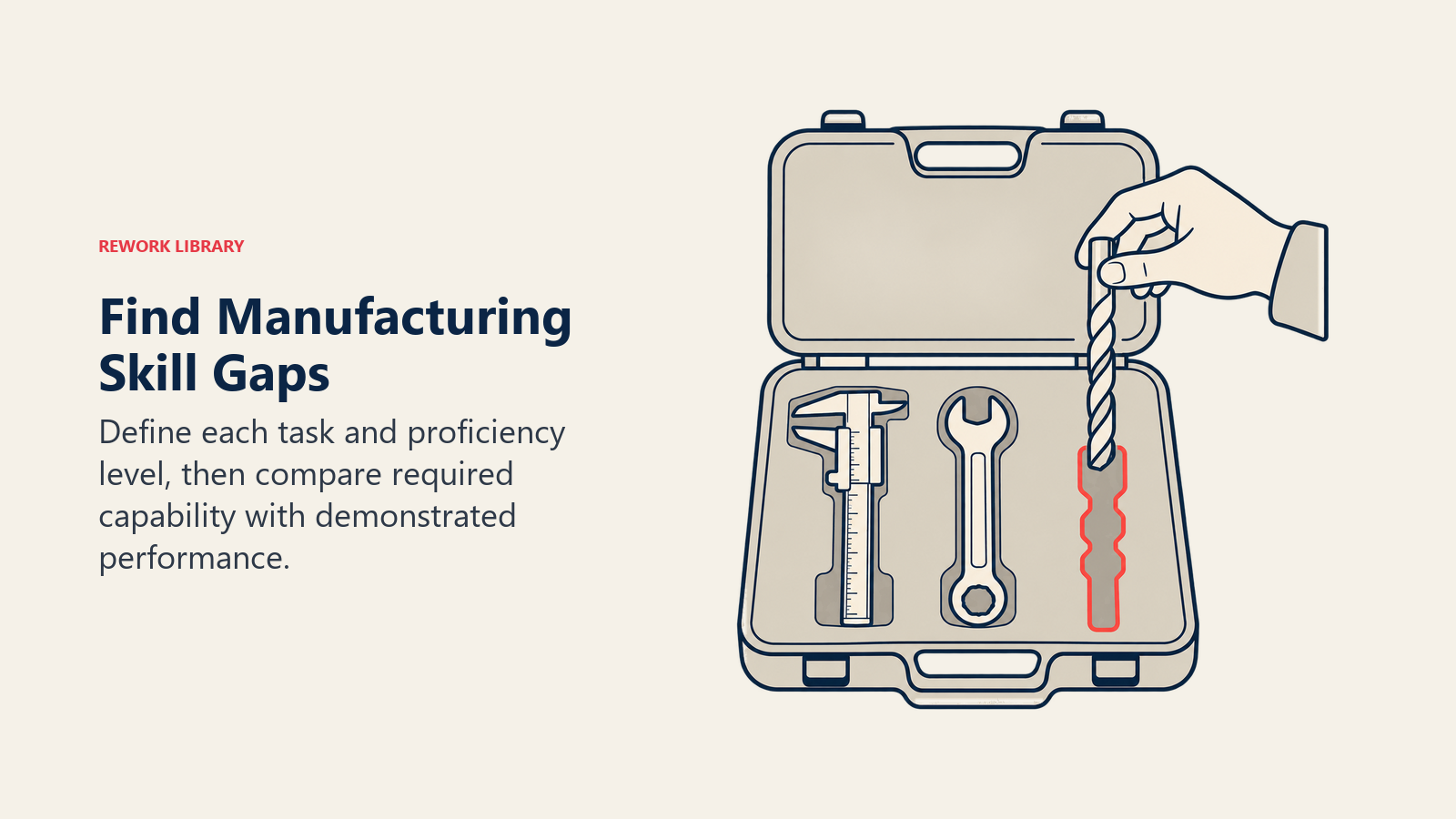
Job skills requirements form your foundation. For each role, what technical knowledge must someone have? What tasks must they perform? To what standard? This seems obvious, but many manufacturing roles have never been formally analyzed for specific skill requirements. People get trained on whatever the previous person in the role taught them, which may or may not be complete or correct.
Document your skill requirements systematically. Break complex jobs into discrete tasks. Identify the knowledge required for each task. Define the performance standard expected. This creates your competency model:the skills architecture that training must develop.
Pay attention to different levels of proficiency. Someone who's learning a task needs different training than someone who should be independently proficient or an expert who can troubleshoot complex issues and train others. Your skills model should reflect these levels.
Performance gaps reveal where current capability falls short of requirements. Track your quality issues, productivity losses, and safety incidents. Look for patterns. Are defects concentrated in certain operations? Do certain processes have lower productivity? These patterns often point to skill gaps.
Quality data is particularly useful. Applying manufacturing quality management principles helps identify these patterns. When you analyze root causes of defects, skill issues frequently appear. "Operator didn't follow procedure," "wrong setup," "failed to verify dimensions":these are often training issues disguised as quality problems.
Equipment and process changes create new training needs. Every time you install new equipment, implement new procedures, or launch new products, you create skill gaps. Your training plan must anticipate these changes and provide training before people need to use the new capabilities in production.
Future capability requirements deserve attention now because skills take time to develop. If you're planning automation, who will program and maintain those systems? If you're expanding capacity, where will the additional skilled workforce come from? If you're pursuing new markets with tighter quality requirements, what skills must improve?
Looking ahead 12-18 months at your business plans reveals training needs you should start addressing now, before they become urgent crises.
Choosing the Right Training Methods
Different skills require different training approaches. Using the wrong method wastes time and money while failing to develop capability.
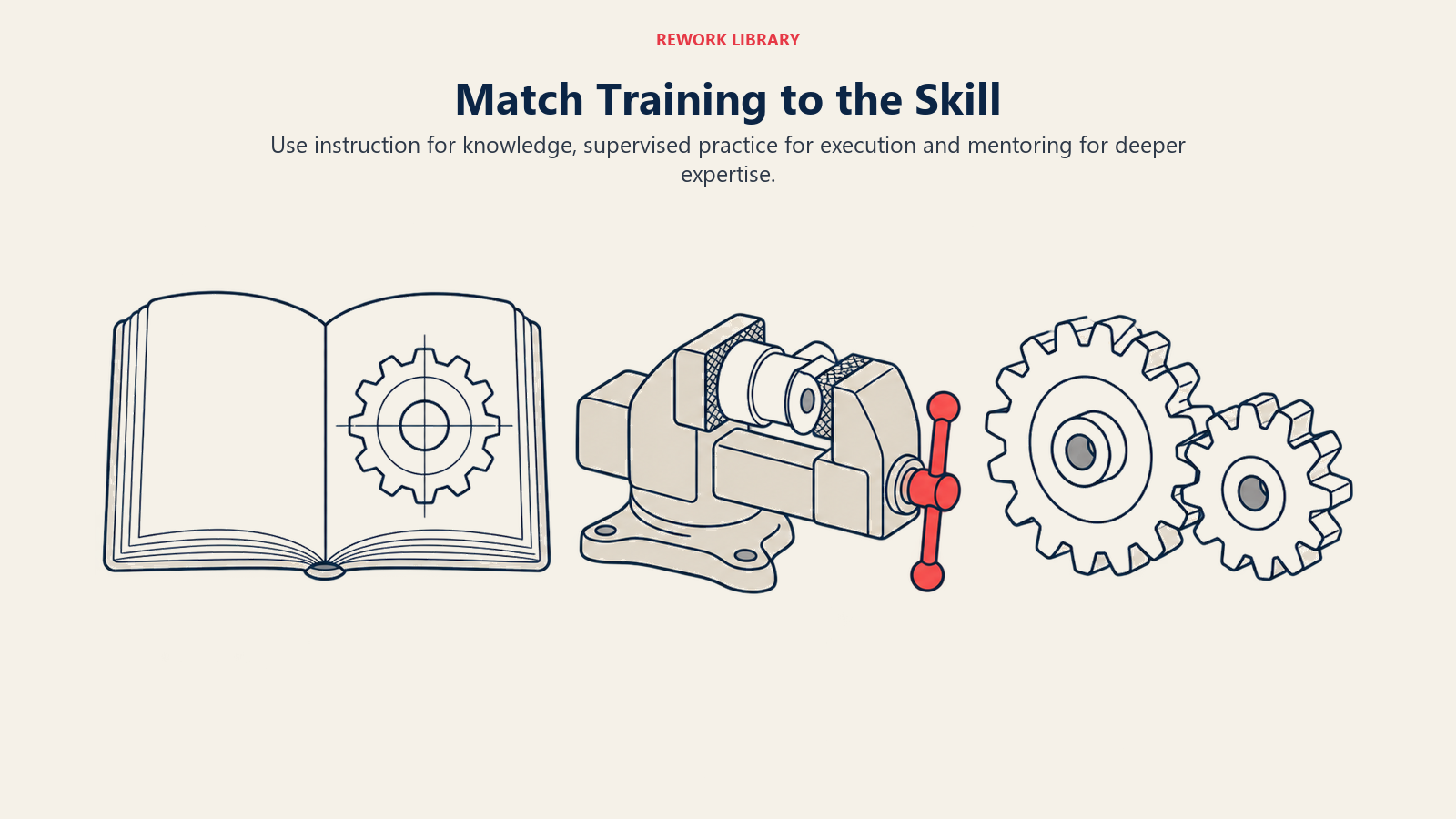
Classroom instruction works well for knowledge-based content that applies broadly. Safety procedures, quality systems, lean manufacturing concepts, blueprint reading, measurement techniques:these topics lend themselves to structured instruction with a group.
Classroom training is efficient for teaching theory and concepts, but it doesn't build hands-on capability. You can explain how to set up a machine in a classroom, but that doesn't mean someone can actually do it.
E-learning provides flexibility and consistency for knowledge content. Online courses allow people to learn at their own pace, repeat sections as needed, and complete training without taking operators off the floor simultaneously. E-learning works particularly well for onboarding content, compliance training, and refresher courses.
The limitation is the same as classroom training:it's not hands-on. Use e-learning to teach knowledge, but don't rely on it to develop physical skills or judgment.
Hands-on practice with supervision develops actual capability. The operator who will run the injection molding machine needs time on the actual machine (or high-fidelity simulator) with a qualified trainer watching, providing feedback, and preventing mistakes.
This hands-on training is more expensive and time-consuming than classroom or e-learning:one trainer working with one or two learners at a time. But it's essential for developing real operational capability. You can't learn to weld by watching videos. You must practice welding under supervision.
On-the-job training with qualified trainers provides learning while maintaining production. The new operator works alongside an experienced operator who explains the work, demonstrates techniques, coaches performance, and gradually increases the learner's responsibility as capability develops.
The quality of OJT depends entirely on who's doing the training. Effective shop floor leadership includes developing strong OJT trainers. Your best operators aren't automatically your best trainers. Some people who excel at the work can't explain how they do it or lack patience to teach others. Select and train your OJT trainers carefully:their capability determines the capability of everyone they train.
Apprenticeships and mentoring develop deep expertise over extended periods. For complex roles requiring years to master:toolmakers, maintenance technicians, quality engineers:structured apprenticeships that combine classroom learning with progressive hands-on experience produce the deep capability you need.
Job rotation and project assignments expand capabilities beyond a single role. Moving people through different areas develops broader understanding of how operations connect, creates flexibility in your workforce, and helps people understand different perspectives.
Designing Training Programs That Stick
Effective training isn't just delivering content:it's designing learning experiences that change behavior and build lasting capability.
Clear learning objectives define what people should be able to do after training. "Understand the injection molding process" is vague. "Set up the injection molding machine for product XYZ, run the startup sequence, verify the first article meets specifications, and troubleshoot three common problems" is specific and measurable.
When you can't articulate what someone should be able to do after training, you can't design effective training or evaluate whether it worked.
Content development starts with your competency models and learning objectives. What knowledge and skills must you teach to enable the desired performance? What's the logical sequence for teaching these elements?
Break content into digestible modules. Learning complex operations all at once overwhelms people. Teach the basics first, then build toward more advanced skills progressively. Each module should focus on related concepts or tasks, include practice opportunities, and conclude with demonstration of competency before moving forward.
Training materials and documentation make training consistent and provide references. Standard work instructions, setup sheets, troubleshooting guides, and quality checklists ensure everyone learns the same methods. They also provide job aids that people can reference when they need reminders.
Document your training content thoroughly. When you rely on undocumented knowledge in trainers' heads, training quality varies wildly and you lose capability when knowledgeable people leave.
Trainer qualification matters enormously. Whether you're using external trainers, internal subject matter experts, or designated training specialists, they must know the content deeply and be able to teach effectively.
Being an expert doesn't make someone a good trainer. Good trainers can explain complex concepts clearly, demonstrate techniques properly, adapt to different learning styles, provide constructive feedback, and assess whether learning is occurring. Train your trainers in how to train:it's not intuitive for most people.
Assessment and certification verify that learning happened. Don't assume that attending training means someone can perform the task. Test knowledge with exams or quizzes. Verify hands-on skills through demonstrations or work samples. Certify people as competent only when they can actually perform to the required standard.
This certification creates accountability. If someone is certified as qualified for a task, they should be able to perform it independently. If they can't, your training or assessment process failed:fix it.
Making Training Stick Through Implementation
The most common training failure isn't poor content or delivery:it's failing to ensure people apply what they learned.
Training schedules must balance learning needs with operational requirements. You can't train everyone at once without disrupting production, but you can't wait so long that urgent needs become crises.
Priority-based scheduling focuses on the most critical needs first: safety training that must happen before people work in hazardous areas, quality training before people produce parts for critical customers, equipment training before new machines go live, and skills for bottleneck operations that limit your capacity.
Build training time into your manufacturing workforce planning process. If you're hiring ten new operators, when will they be trained? Who will train them? What work can they do while still in training, and what must they master before working independently?
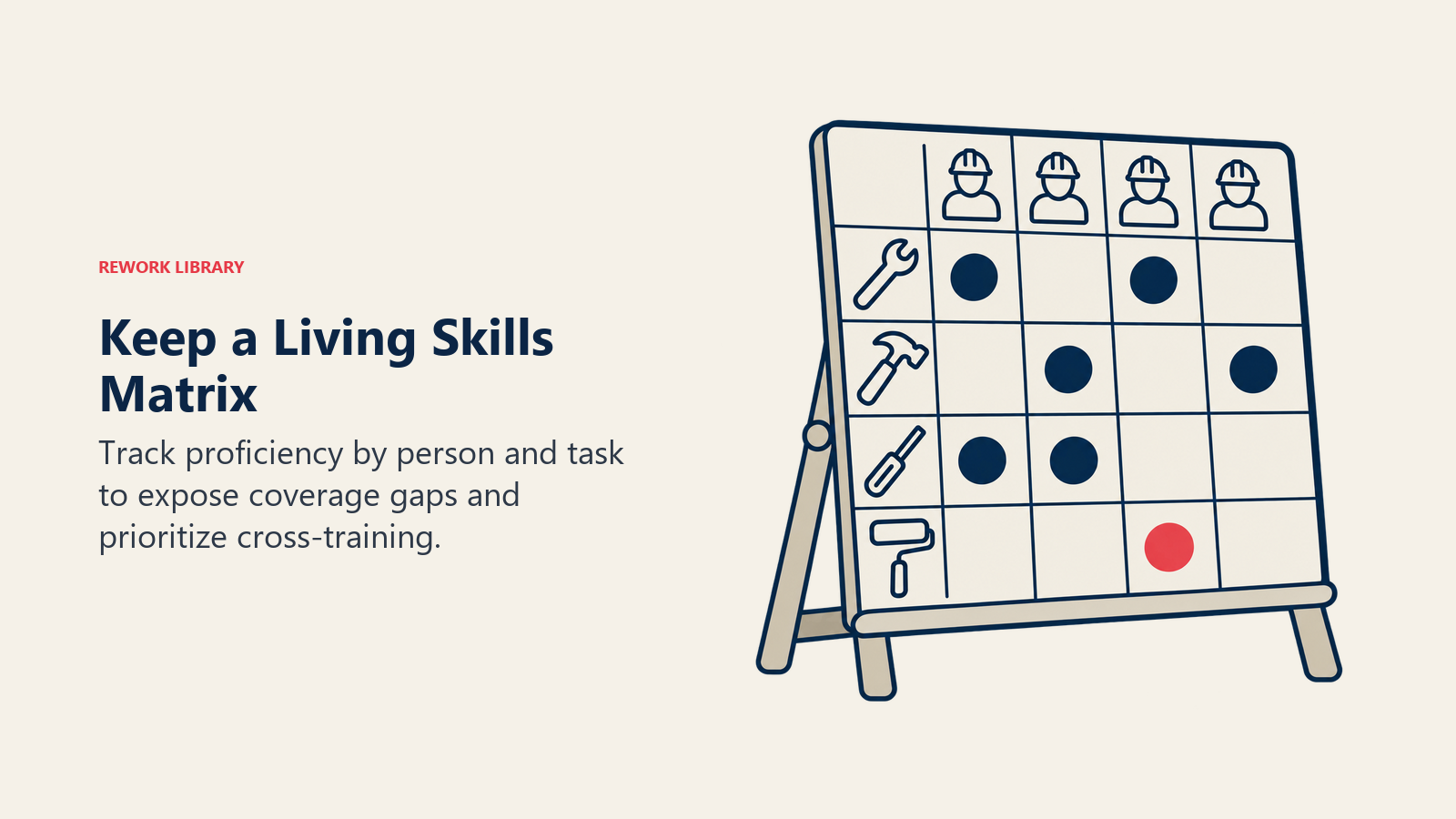
Skills matrices visualize your organization's capabilities and training needs. Create a grid showing all critical skills down the left side and all employees across the top. Mark each person's competency level for each skill: not trained, training in progress, competent, or expert.
This matrix instantly reveals your capability gaps, dependency risks (skills that only one or two people have), and training priorities. These matrices are also essential for effective cross-training programs. Update it monthly as people complete training and develop new skills.
Training effectiveness measurement tells you whether training is working. Track several metrics: time from hire to full productivity, quality performance during and after training, productivity of trained versus untrained operators, and skills assessment pass rates.
If people are passing assessments but quality problems persist in those operations, your training or assessment isn't rigorous enough. If time to productivity is stretching longer, your training process may be inefficient or incomplete.
Refresher training maintains skills that degrade without practice. Some tasks happen infrequently enough that people forget proper procedures. Complex or precise operations benefit from periodic refresher training even for experienced operators.
Emergency response procedures, infrequently used equipment, and tasks with high safety or quality stakes should have regular refresher training:don't wait until someone struggles to remember something critical.
Continuous learning culture extends beyond formal training. Encourage and support ongoing skill development through lunch-and-learn sessions where experts share knowledge, cross-training opportunities, problem-solving teams that develop analytical skills, improvement projects based on Kaizen continuous improvement principles that build project management capability, and access to external courses and certifications.
Organizations that value learning attract people who want to grow, create workforces that continuously improve, and develop the depth of capability that sustains competitive advantage.
Overcoming Common Training Obstacles
Even with commitment to training, you'll face predictable challenges.
"We're too busy to train" is the most common excuse for poor training. Operations are running flat-out, can't spare people from production, and training gets perpetually postponed. Meanwhile, quality issues, productivity losses, and safety incidents continue:often caused by inadequate training. McKinsey's analysis shows that effective workforce development programs benefit everyone.
Break this cycle by recognizing that poor training is why you're too busy. Untrained operators work slower, make more mistakes, and require more supervision. Training improves efficiency enough to create the capacity for more training.
Start small if necessary. Train during slow periods, train one or two people at a time, or train during equipment changeovers when production is down anyway. But start. The cost of not training exceeds the cost of finding time to train.
High turnover makes training feel futile. Why invest in training people who leave after six months? But inadequate training often causes turnover:people leave when they don't feel competent or don't see development opportunities. Good training can reduce the turnover that makes training seem wasteful.
Documentation gaps mean tribal knowledge trapped in people's heads. When your most knowledgeable operators retire or leave, their knowledge leaves with them. Documenting procedures and creating training content captures this knowledge and makes you less vulnerable to turnover.
Make documentation part of training development. When you train people, create the materials that enable consistent future training.
Resistance from experienced workers sometimes occurs when formal training is introduced. "I learned on the job and turned out fine:why do new people need all this formal training?" This attitude undermines training efforts and creates inconsistency.
Address this by involving experienced operators in training design and delivery. When they help create training content, they own it. When they serve as trainers, they're invested in the process. Recognition for training contributions makes the role valued rather than burdensome.
Building Capability That Drives Growth
Your workforce capability determines your operational ceiling. You can't outperform your people's skills. Every quality target, productivity goal, safety objective, and growth plan ultimately depends on having people with the skills to execute.
Organizations that systematically develop workforce capability create several competitive advantages. They can adopt new technologies faster because their workforce can learn to use them effectively. They can maintain higher quality standards because their operators have the skills to meet tight tolerances consistently. They can respond to customer needs more flexibly because their people can handle variety. They can grow faster because they can develop capability ahead of demand rather than constantly scrambling to catch up.
The investment is substantial but the return is clear. Training takes time, costs money, and requires organizational discipline. But the alternative:operating with an underskilled workforce:costs far more through quality losses, productivity gaps, safety incidents, turnover, and missed opportunities.
Treat skills training as strategic infrastructure, not discretionary expense. Build systematic training processes. Invest in development continuously. Measure results rigorously. Your capability to compete depends on it.
Learn More

Co-Founder, Rework.com
On this page
- Why Training Is Your High-Return Investment
- Understanding What Skills Your Organization Really Needs
- Choosing the Right Training Methods
- Designing Training Programs That Stick
- Making Training Stick Through Implementation
- Overcoming Common Training Obstacles
- Building Capability That Drives Growth
- Learn More