Inventory Optimization Strategies: Balancing Service Levels with Working Capital
Turn this article into takeaways for your work.


Each assistant summarizes the article only for you and suggests best practices for your work.
Walk through any manufacturing facility and you'll see money sitting on shelves, racks, and pallets. Raw materials waiting to enter production. Work-in-process between operations. Finished goods awaiting shipment. This inventory represents working capital locked away from other uses, storage costs accumulating daily, and risks of obsolescence or damage.
But suggest reducing inventory and operations teams panic. What happens when a supplier is late? How do you handle unexpected order spikes? Won't lower inventory cause stockouts that shut down production or miss customer deliveries? These concerns are legitimate through supply chain risk considerations. The challenge isn't choosing between inventory and service but optimizing the balance between them.
Most manufacturers manage inventory through intuition and safety factors accumulated over years. "We keep six weeks of raw materials because we always have." But rarely does anyone calculate optimal levels based on actual demand patterns, lead time variability, and service level targets. This leaves significant working capital improvements on the table while potentially providing more cushion than necessary for some items and insufficient protection for others.
The Inventory Optimization Framework
Inventory optimization means having the right inventory in the right place at the right time. Not too much, tying up cash and filling warehouses. Not too little, causing stockouts and disruptions. The right amount balancing working capital, storage costs, and service levels.
Working capital impact makes inventory optimization financially significant. Every dollar in inventory is a dollar unavailable for equipment, people, or growth initiatives. If you're carrying $10 million in inventory with a 15% cost of capital, that inventory costs $1.5 million annually before considering storage, insurance, and obsolescence. Reducing inventory by 20% frees $2 million in capital and cuts carrying costs by $300,000 yearly. These aren't trivial amounts.
Service levels measure how well inventory supports operations and customers. For raw materials, service means having materials available when production planning needs them. For finished goods, it means filling customer orders from stock. Service level targets determine inventory requirements: higher targets demand more inventory for protection, lower targets accept more frequent stockouts.
The optimization challenge involves finding the inventory level that minimizes total costs. Hold too much inventory and carrying costs are excessive. Hold too little and stockout costs from lost production or sales exceed the savings. The optimal point balances these competing costs, which varies by item based on characteristics like demand variability, lead times, and holding costs.
Different inventory categories serve different purposes and require different strategies. Raw materials support production schedules. Work-in-process represents partially completed units between operations. Finished goods enable customer service and decouple production from demand volatility. Maintenance, repair, and operations (MRO) inventory supports equipment upkeep. Each category needs appropriate management approaches reflecting its role.
ABC/XYZ Inventory Segmentation
Not all inventory items deserve equal management attention. Segmentation categorizes items for differentiated management strategies that focus resources where they matter most.
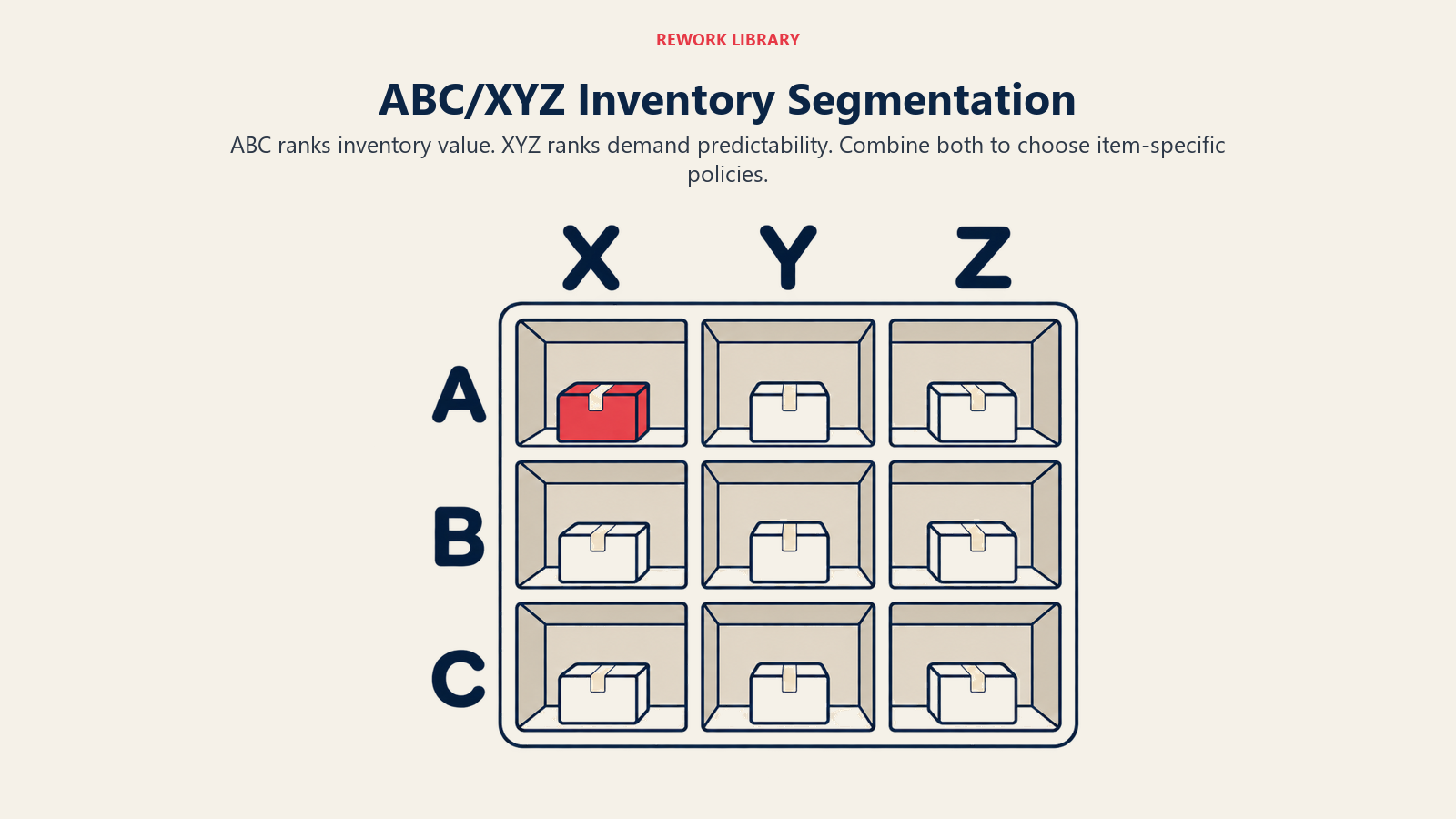
ABC classification segments items by value. A-items represent the highest value, typically 20% of SKUs comprising 80% of inventory value. These items deserve sophisticated management with careful optimization, frequent review, and tight controls. Small inventory reductions in A-items yield significant working capital returns.
B-items fall in the middle, representing moderate value and importance. They warrant systematic management but don't require the intensive attention A-items receive. Standard inventory policies and periodic review suffice for most B-items.
C-items represent low value, often 50% of SKUs accounting for only 5% of value. Don't waste expensive analyst time optimizing C-items. Simple policies like maintaining fixed months of supply or basic two-bin systems work fine. The cost of sophisticated C-item management exceeds any savings it produces.
XYZ classification segments by demand predictability. X-items show stable, predictable demand that forecasting models capture accurately. These items support lower inventory levels because you can predict requirements confidently.
Y-items have moderate variability, perhaps showing seasonal patterns or trending demand that forecasting handles reasonably well. They require more safety stock than X-items but remain manageable with good forecasting.
Z-items exhibit sporadic, unpredictable demand that forecasting struggles with. Intermittent demand items might sell nothing for months then have unexpected spikes. These items need different strategies than stable-demand items, perhaps stocking based on maximum historical demand rather than forecast-based methods.
Combining ABC and XYZ creates a matrix guiding strategy selection. AX-items are high-value, predictable items deserving sophisticated optimization models and frequent review. They represent your biggest opportunity for inventory reduction. CZ-items are low-value sporadic items where simple, low-maintenance policies make sense. The strategy for each segment should match its characteristics and business impact.
Economic Order Quantity Principles
Economic Order Quantity (EOQ) provides a mathematical approach to determining optimal order sizes that balance ordering costs against holding costs.
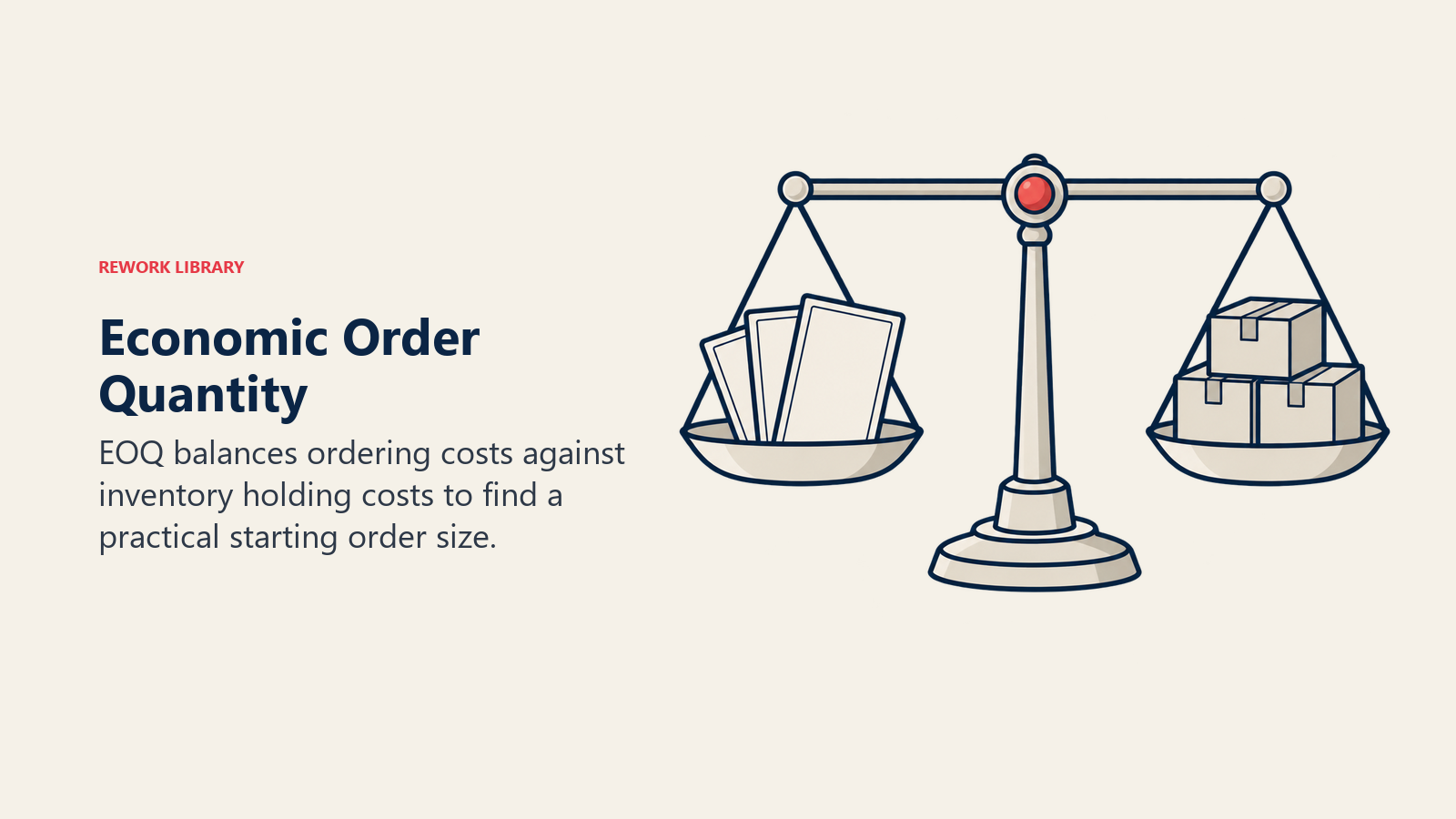
The basic EOQ formula considers three factors: annual demand, cost per order, and annual holding cost percentage. The formula calculates the order quantity minimizing total inventory costs. Order too frequently in small batches and ordering costs dominate. Order infrequently in large batches and holding costs from average inventory dominate. EOQ finds the sweet spot.
For a component with 10,000 units annual demand, $100 ordering cost, $50 unit cost, and 20% holding cost, EOQ calculates to approximately 447 units. Ordering this quantity balances the roughly $2,236 annual ordering cost (10,000/447 orders × $100 per order) against similar annual holding costs (447/2 average inventory × $50 × 20%).
EOQ assumptions include constant demand, instantaneous replenishment, and fixed costs. Real manufacturing rarely fits these assumptions perfectly. Demand varies, deliveries take time, and costs fluctuate. But EOQ provides a useful starting point even when assumptions aren't perfectly met. It's better than arbitrary order quantities based on convenient container sizes or round numbers.
Manufacturing environments need EOQ modifications. Production EOQ considers setup costs instead of ordering costs and assumes gradual production rather than instant replenishment. When you produce items internally, inventory builds gradually as production runs, not all at once. This changes the average inventory calculation and optimal batch size.
Quantity discounts complicate EOQ analysis. Suppliers often offer better per-unit pricing for larger orders. Pure EOQ might suggest 500-unit orders, but a volume break at 1,000 units significantly reduces unit costs. Modified EOQ analysis compares total costs at different price breaks, accounting for both higher inventory costs and lower unit prices of larger orders.
Don't treat EOQ as sacred. It provides analytically derived order quantities superior to guesses, but other factors matter. Supplier minimum order quantities, container sizes, and production run minimums might override theoretical EOQ. Use EOQ as a guide while considering practical constraints.
Reorder Point Determination
EOQ tells you how much to order. Reorder points tell you when to order. Setting reorder points correctly prevents stockouts while avoiding excessive safety stock.
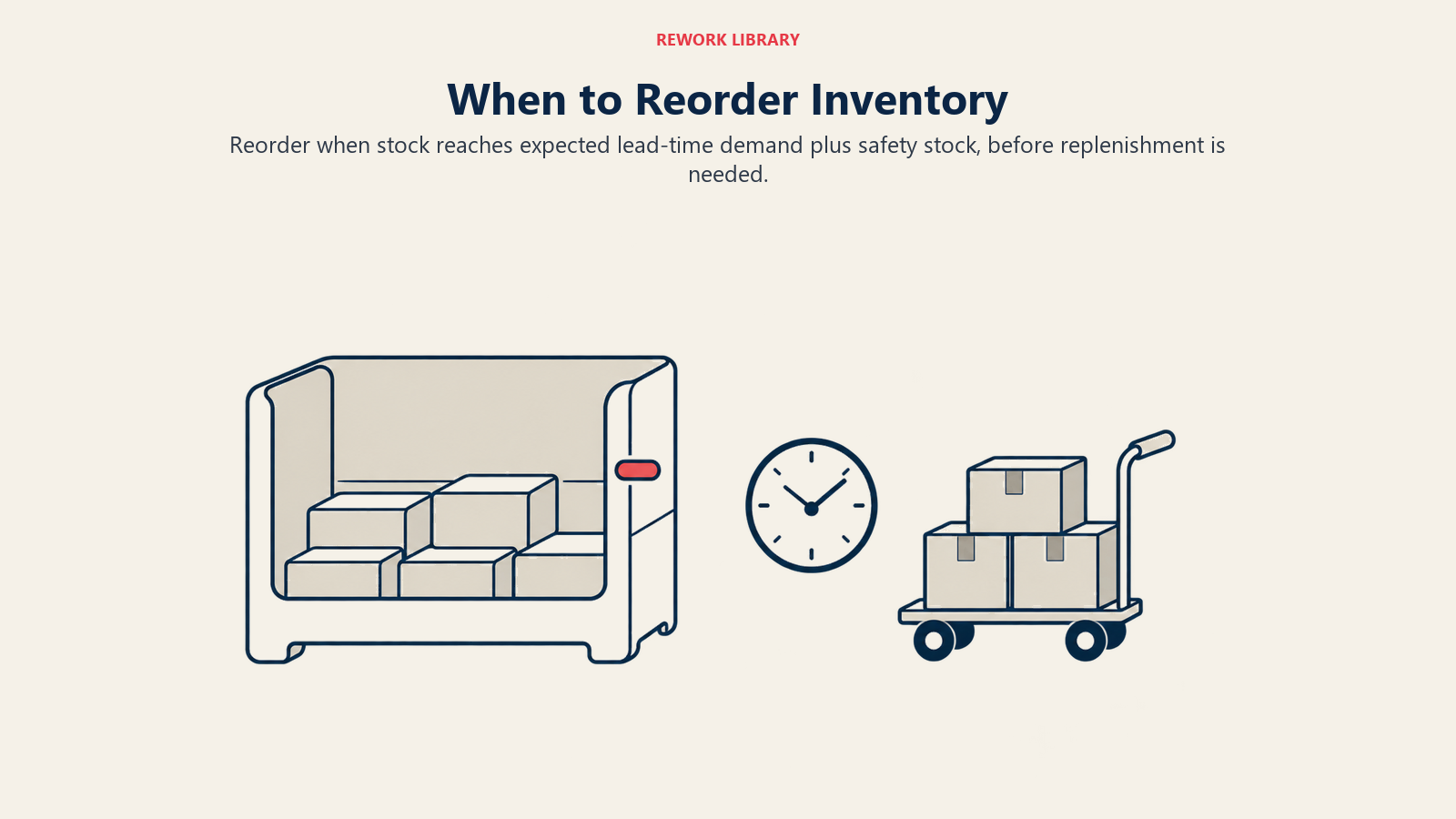
The basic reorder point equals lead time demand plus safety stock. If you use 100 units weekly and lead time is 3 weeks, reorder when inventory drops to 300 units plus safety stock. This triggers replenishment early enough that inventory lasts until the order arrives.
Lead time demand calculation depends on demand patterns. For stable demand, multiply average demand by lead time. For variable demand, you need statistical approaches accounting for demand uncertainty. Use historical standard deviation and desired service levels to determine safety stock requirements.
Dynamic reorder points adjust based on changing conditions rather than using fixed levels year-round. When lead times extend, reorder points should rise to protect against longer replenishment windows. When demand patterns shift seasonally, reorder points should reflect current demand rates rather than annual averages. Systems that adjust reorder points maintain service while minimizing inventory.
The reorder point model assumes continuous monitoring where you can order as soon as inventory drops below the threshold. This works for expensive items tracked precisely. But many items use periodic review, checking inventory weekly or monthly and ordering then. Periodic review reorder points must account for both lead time and review period, requiring additional inventory to last until the next review opportunity.
Tailored Policies by Item Category
Different items need different inventory management approaches. Cookie-cutter policies applied uniformly across all items produce suboptimal results.
Continuous review policies monitor inventory constantly, ordering when reorder points are reached. This suits high-value items where holding costs justify the tracking effort and you can order anytime. Expensive components, critical materials, and high-volume items benefit from continuous review and precise inventory management.
Periodic review policies check inventory at fixed intervals, ordering sufficient quantity to reach target levels. Weekly reviews for moderate-value items balance management effort with reasonable inventory control through ERP system integration. Monthly reviews work for lower-value items where daily tracking isn't justified. Periodic review is simpler but requires higher average inventory to cover both lead time and review period.
Min-max systems set minimum and maximum inventory levels. When periodic reviews find inventory below minimum, order up to maximum. This simple approach works well for low-value items where optimization sophistication isn't worth the effort. The minimum provides safety stock, and the maximum prevents excessive ordering.
Kanban systems for repetitive items trigger replenishment visually through cards or containers. When workers consume a container of parts, the empty container signals reordering. Kanban implementation works beautifully for stable-demand items in production environments, providing simple yet effective inventory control without computer systems.
Two-bin systems provide even simpler inventory management. Keep inventory in two bins. When the first empties, reorder and start using the second. The second bin's quantity equals lead time demand plus safety stock. When replenishment arrives, refill both bins. This remarkably simple system works perfectly for inexpensive fasteners, consumables, and other C-items.
Vendor-managed inventory (VMI) shifts inventory responsibility to strategic suppliers who monitor your usage and maintain agreed stock levels. This works well with strategic suppliers for high-volume, stable-demand items. Suppliers use demand data across multiple customers to optimize their production while ensuring you never run out.
Safety Stock Optimization
Safety stock protects against demand and supply uncertainty. Too little causes stockouts; too much wastes working capital. Right-sizing safety stock balances these concerns.
Statistical safety stock calculation uses demand variability and lead time uncertainty to determine buffer levels that achieve target service levels. The basic formula multiplies demand standard deviation by a service factor (Z-score) and the square root of lead time. A 95% service level target requires roughly 1.65 standard deviations of safety stock.
Service level targets should vary by item importance rather than applying uniform targets. Critical components enabling production can't stock out, so target 99% service level or higher. Standard components might target 95%. Low-value items where occasional stockouts don't cause major problems might accept 90%. Differentiated targets optimize total inventory investment.
Lead time variability requires additional safety stock calculations beyond demand variability alone. If suppliers consistently deliver in exactly 3 weeks, you need less safety stock than if delivery ranges from 2 to 5 weeks. Track supplier reliability performance and factor this variability into safety stock calculations. Unreliable suppliers force higher inventory investment.
Demand variability drives safety stock requirements. Items with erratic demand need more protection than steady-demand items. Analyze historical demand patterns through demand forecasting to quantify variability through standard deviation or coefficient of variation. Don't guess at variability. Calculate it from actual data.
Dynamic safety stock adjusts to changing conditions. During periods of higher demand, increase safety stock temporarily to maintain service levels. When suppliers face capacity challenges or materials shortages, add safety stock to buffer against delivery problems. After problems resolve, reduce safety stock to normal levels rather than maintaining crisis levels permanently.
Technology-Enabled Optimization
Inventory optimization software automates complex calculations and enables sophisticated strategies that manual management can't match.
Advanced planning systems evaluate thousands of items simultaneously, optimizing inventory levels across the entire supply chain. They consider demand forecasts, lead times, carrying costs, and service level targets to recommend optimal order quantities and timing. These systems outperform human judgment for routine optimization while freeing planners to focus on exceptions and strategic issues.
Demand forecasting integration connects inventory decisions to anticipated future demand rather than historical averages. When forecasts show demand increasing, inventory positions adjust proactively. When launches of new products will cannibalize existing ones, inventory runs down existing stock strategically. Forecast-driven inventory management responds to market dynamics more effectively than backward-looking approaches.
Real-time visibility through sensors and tracking systems provides accurate inventory data without manual cycle counting. RFID tags, barcode scanning, and IoT sensors maintain current inventory positions automatically. Accurate data enables better decisions while reducing stock discrepancies that force excess safety stock to compensate for uncertainty about what you actually have.
Simulation capabilities test inventory policies before implementing them. Model how proposed changes would have performed historically or under various scenarios through digital twin technology. Evaluate the trade-offs between service levels and inventory investment quantitatively rather than guessing. Simulation reduces risk of changes that sounded good theoretically but fail in practice.
Analytics and reporting turn inventory data into actionable insights. Which items carry excessive inventory relative to demand? Where do frequent stockouts occur? What's the trend in inventory turnover? Executive dashboards provide high-level visibility while detailed reports support analysis. Continuous monitoring identifies problems requiring attention and measures improvement over time.
Implementation Roadmap
Start inventory optimization with pilot programs on manageable scope. Select a product family or warehouse rather than attempting enterprise-wide optimization simultaneously. Learn what works, refine approaches, and demonstrate results before expanding.
Data quality improvement often represents the biggest initial challenge. Inventory systems might contain inaccurate records, forecasts might not exist, and lead time data might be missing or unreliable. Invest in data cleanup before sophisticated optimization. Garbage in, garbage out applies to inventory optimization as much as any analytical effort.
Establish baseline metrics before changes to demonstrate improvement. Measure current inventory levels, turnover rates, stockout frequency, and fill rates. These baselines provide comparison points showing whether optimization actually improved performance or just rearranged problems.
Policy development should reflect your inventory segmentation. Define appropriate strategies for each category rather than uniform policies. Document these strategies so the entire team understands the approach and applies it consistently.
Training ensures your team understands and correctly implements inventory optimization methods. Planners need to understand statistical approaches and how to use optimization tools. Warehouse staff need to understand why inventory levels change and how to execute new processes. Management needs to understand the trade-offs being managed and why immediate inventory reduction isn't always optimal.
Change management addresses resistance to new approaches. People comfortable with existing methods might resist optimization that changes their work. Involve them in pilot projects, share results that demonstrate benefits, and address concerns about changes. Successful optimization requires buy-in from people executing the strategies.
Measuring Success
Track inventory optimization results through multiple metrics that capture the balance between inventory investment and service performance.
Inventory turnover measures how efficiently you use inventory. Calculate annual cost of goods sold divided by average inventory value. Higher turnover means less capital tied up in inventory. Target turnover rates vary by industry and product characteristics, but the direction should be increasing over time as optimization improves.
Days of inventory represents average inventory in terms of daily demand coverage. If you carry $1 million inventory and daily COGS is $50,000, you hold 20 days of inventory. This metric intuitively communicates inventory levels and allows comparisons across product lines or companies.
Service levels measure how well inventory supports operations and customers. For raw materials, track how often stock is available when production needs it. For finished goods, measure order fill rates and on-time delivery. Service levels should maintain or improve even as inventory decreases. That's what optimization means.
Stockout frequency and duration quantify service failures. How often do stockouts occur? How long until replenishment? Even if overall service levels meet targets, frequent short stockouts might cause more disruption than metrics suggest. Track these operational impacts separately.
Working capital released measures the financial benefit of inventory reduction. If optimization reduces inventory from $10 million to $8 million, you've freed $2 million for other uses. Calculate the cost of capital savings and compare to optimization investment to demonstrate ROI.
Learn More

Co-Founder, Rework.com