Manufacturing Quality Management: Building Systems That Prevent Defects and Ensure Consistency
Turn this article into takeaways for your work.


Each assistant summarizes the article only for you and suggests best practices for your work.
A precision machining company won a major contract with an aerospace customer requiring 99.7% defect-free delivery. Their current performance ran around 96%:good by many standards but far short of aerospace requirements. Missing this target meant losing the contract that would drive 30% revenue growth.
The operations VP's first instinct was hiring more quality inspectors to catch defects before shipment. But the quality manager recognized inspection alone wouldn't solve the problem. They needed defect prevention, not just detection. This required transforming their entire approach to quality management.
They implemented comprehensive quality systems: design reviews that prevented problems before production began, process controls that maintained capability, operator training that built quality into every operation, supplier partnerships that ensured incoming material quality, and systematic problem-solving that eliminated root causes rather than symptoms. Eighteen months later, they'd achieved 99.8% defect-free delivery while reducing quality costs by 34%. Quality had become a competitive advantage, not just a compliance burden.
Modern Quality Management Fundamentals
Quality management has evolved from final inspection to integrated systems that prevent defects, ensure consistency, and drive continuous improvement.
Evolution from inspection to prevention represents quality management's most important transformation. Traditional approaches relied on catching defects through inspection after production. This incurred full manufacturing cost for defective units, wasted capacity producing scrap, and couldn't inspect quality into inherently flawed processes.
Modern quality management builds quality into products and processes from the beginning. Design quality into products so they're robust against variation. Create capable processes that consistently produce within specifications. Train workers to prevent errors rather than relying on inspection to catch them. This prevention-focused approach through defect prevention strategies costs less while delivering better results.
Quality planning, control, and improvement form an integrated system. Planning establishes quality requirements, designs products and processes to meet them, and creates control mechanisms. Control monitors processes, detects issues, and maintains capability. Improvement systematically eliminates problems and enhances performance.
Most quality problems stem from inadequate planning. When designs don't account for manufacturing reality, processes lack capability, or requirements remain unclear, no amount of inspection prevents defects. Effective quality management emphasizes upstream prevention through thorough planning.
Cost of quality quantifies the financial impact across four categories:
Prevention costs: training, process validation, supplier qualification, design reviews:investments that prevent defects from occurring.
Appraisal costs: inspection, testing, measurement equipment, audits:activities that detect defects.
Internal failure costs: scrap, rework, retesting, downtime from quality issues:problems caught before shipment.
External failure costs: warranty claims, returns, complaint handling, reputation damage:problems reaching customers.
Studies consistently show prevention and appraisal cost less than failure, often by ratios of 1:10 or more. Yet many manufacturers underfund prevention while spending heavily on inspection and failure. Shifting investment toward prevention dramatically improves both quality and profitability.
A medical device manufacturer analyzed their quality costs and found an 80/20 split: 80% of spending on appraisal and failure, only 20% on prevention. They systematically shifted resources toward prevention through process validation, operator training, and supplier development. Over three years, total quality cost dropped 41% while defect rates fell 76%.
Quality as everyone's responsibility means every employee affects quality outcomes, not just quality department personnel. As ASQ notes, a quality management system provides a framework to help an organization ensure that products or services consistently meet customer requirements and enhance customer satisfaction. Design engineers influence quality through design decisions. Purchasing impacts quality through supplier selection. Production workers create quality through proper execution. Maintenance affects quality through equipment condition. Leadership enables quality through resource allocation and priorities.
This universal responsibility requires clear quality expectations, appropriate training, empowerment to stop and fix problems, and accountability for results.
Strategic Quality Management Frameworks
Several comprehensive frameworks guide quality management system development.
Total Quality Management (TQM) pursues quality excellence through company-wide commitment. Core principles include customer focus (understanding and meeting customer requirements), continuous improvement (systematically enhancing processes and outcomes), process approach (managing activities as interconnected processes), employee involvement (engaging all workers in quality improvement), and data-driven decisions (basing actions on analysis rather than assumptions).
TQM implementations often struggle with excessive breadth and lack of measurable focus. Modern approaches incorporate TQM principles within more structured methodologies.
Six Sigma and DMAIC methodology applies statistical rigor to quality improvement. Six Sigma's name refers to processes capable enough that specifications lie six standard deviations from the mean, yielding 99.99966% conformance (3.4 defects per million opportunities).
DMAIC structures improvement projects: Define the problem and project scope, Measure current performance and collect data, Analyze root causes using statistical tools, Improve through tested solutions, Control by sustaining gains and preventing recurrence.
Six Sigma provides powerful tools for complex quality problems requiring rigorous analysis. But it demands significant training investment and works best for problems with sufficient data for statistical analysis.
Lean quality and built-in quality (Jidoka) emphasizes defect prevention through mistake-proofing, visual standards, and automatic detection. Jidoka, a Toyota Production System pillar, means building quality into processes so defects never reach subsequent operations.
This approach uses poka-yoke devices that prevent errors: fixtures that only accept parts in correct orientation, sensors that detect missing components, automated checks that verify critical characteristics. When defects occur, production stops immediately for problem-solving rather than continuing to produce bad parts.
An electronics assembly line implemented comprehensive mistake-proofing: component reels with RFID tags verified against work orders, vision systems confirmed proper component placement, weight checks detected missing parts. These automated quality gates reduced defects 89% while enabling operators to focus on value-adding work rather than extensive manual inspection.
ISO 9001 quality management system provides internationally recognized standards for quality management. According to ISO, ISO 9001 is the internationally recognized management system standard that specifies requirements for a quality management system, and with more than 1 million certified users, it is the most popular ISO standard. ASQ explains that ISO 9001:2015 helps organizations demonstrate their ability to consistently provide products and services that meet customer and regulatory requirements. ISO 9001 certification demonstrates systematic quality processes but doesn't guarantee superior quality outcomes. Some organizations achieve certification while maintaining mediocre quality. Others implement robust quality systems without seeking certification.
Use ISO 9001 as a framework guiding quality system development: document processes, establish metrics, conduct audits, manage nonconformances, pursue improvement. But focus on actual quality performance, not just certification status.
Industry-specific standards extend general quality management with sector requirements. Automotive (IATF 16949), aerospace (AS9100), medical devices (FDA QSR/ISO 13485), and food safety (FSSC 22000) each add specific requirements beyond ISO 9001's general framework.
These standards reflect industry lessons about critical quality factors and appropriate controls. Compliance provides market access and demonstrates capability to demanding customers.
Quality Planning: Designing Quality Into Products and Processes
Effective planning prevents most quality problems before production begins.
Voice of the Customer (VOC) identifies what quality means to customers. Don't assume you know. Conduct interviews, analyze complaints, review requirements documents, study competitive offerings. Translate customer language into specific measurable characteristics.
Customers might say they want "reliable" products. Quality planning must convert "reliable" into measurable requirements: mean time between failures exceeding 10,000 hours, warranty claim rate below 0.5%, specific environmental conditions the product must withstand.
Design FMEA and process FMEA systematically identify potential failures before they occur. Failure Mode and Effects Analysis evaluates what could go wrong, how likely failures are, how serious their consequences would be, and whether current controls adequately prevent or detect them.
Design FMEA analyzes product designs to identify potential failure modes in customer use. Process FMEA examines manufacturing processes to identify potential defects and their causes. Both methodologies produce risk priority numbers guiding where to focus prevention efforts.
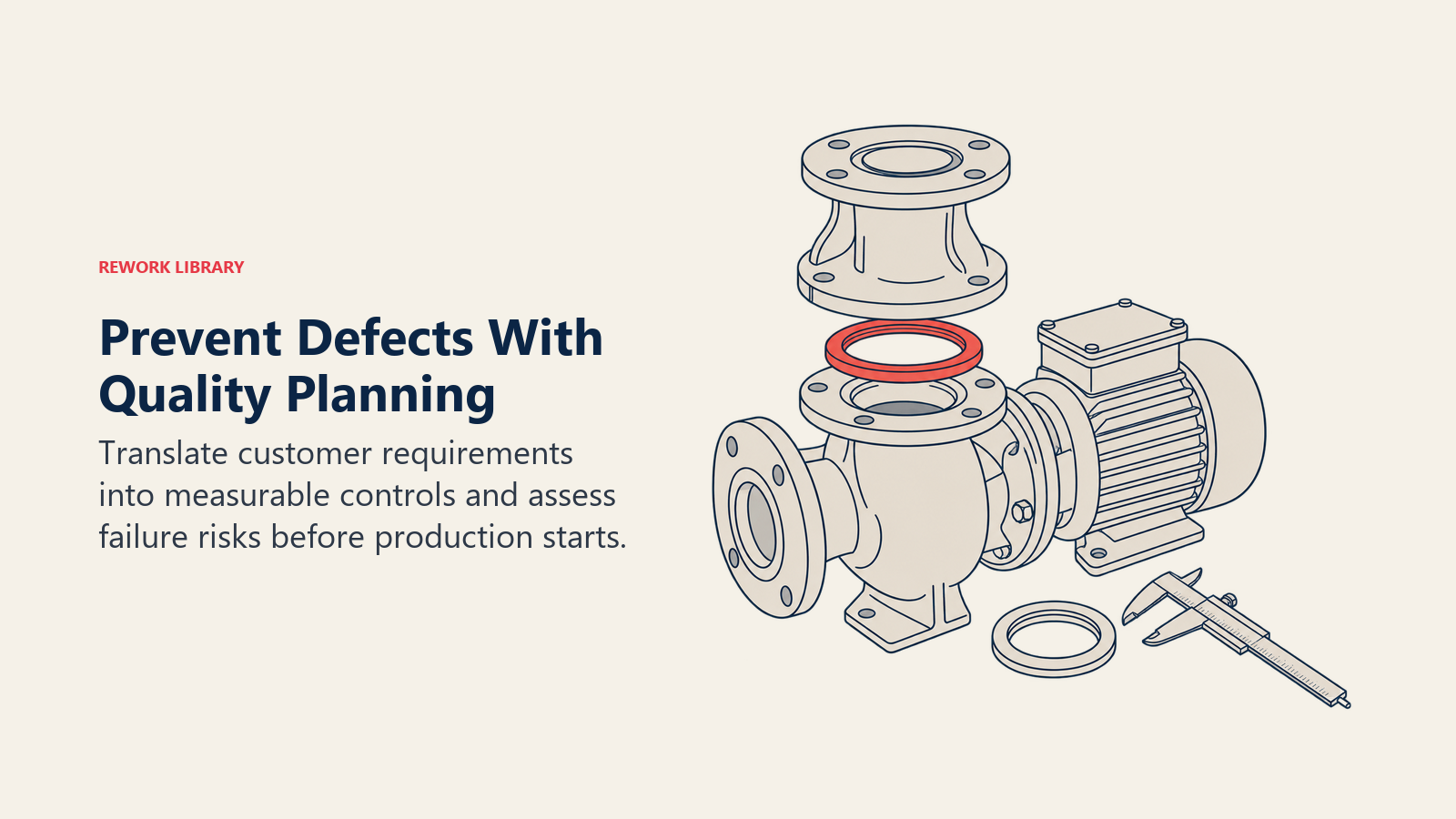
A pump manufacturer's design FMEA identified seal failure as a high-risk mode. Analysis revealed undersized seals for the pressure and temperature conditions. Redesigning with larger, temperature-resistant seals before production began prevented warranty problems that would have cost substantially more than the design change.
Control plans and critical characteristics define how quality will be monitored and controlled in production. Control plans specify what characteristics to measure, measurement methods, sample sizes and frequencies, specification limits, and responses to out-of-specification conditions.
Critical characteristics:features directly affecting safety, function, or regulatory compliance:receive enhanced controls: tighter specifications, increased inspection, specialized equipment, additional operator training.
Measurement system analysis (MSA) validates that measurement and inspection processes produce accurate, repeatable results. Even with capable processes, poor measurement can show false failures (rejecting good parts) or miss real failures (accepting bad parts).
MSA studies use statistical techniques assessing measurement variation compared to process variation and specification width. If measurement error consumes excessive tolerance, improve measurement capability before attempting process improvement.
Quality Control: Monitoring and Maintaining Capability
Control systems detect problems early and maintain process performance within acceptable limits.
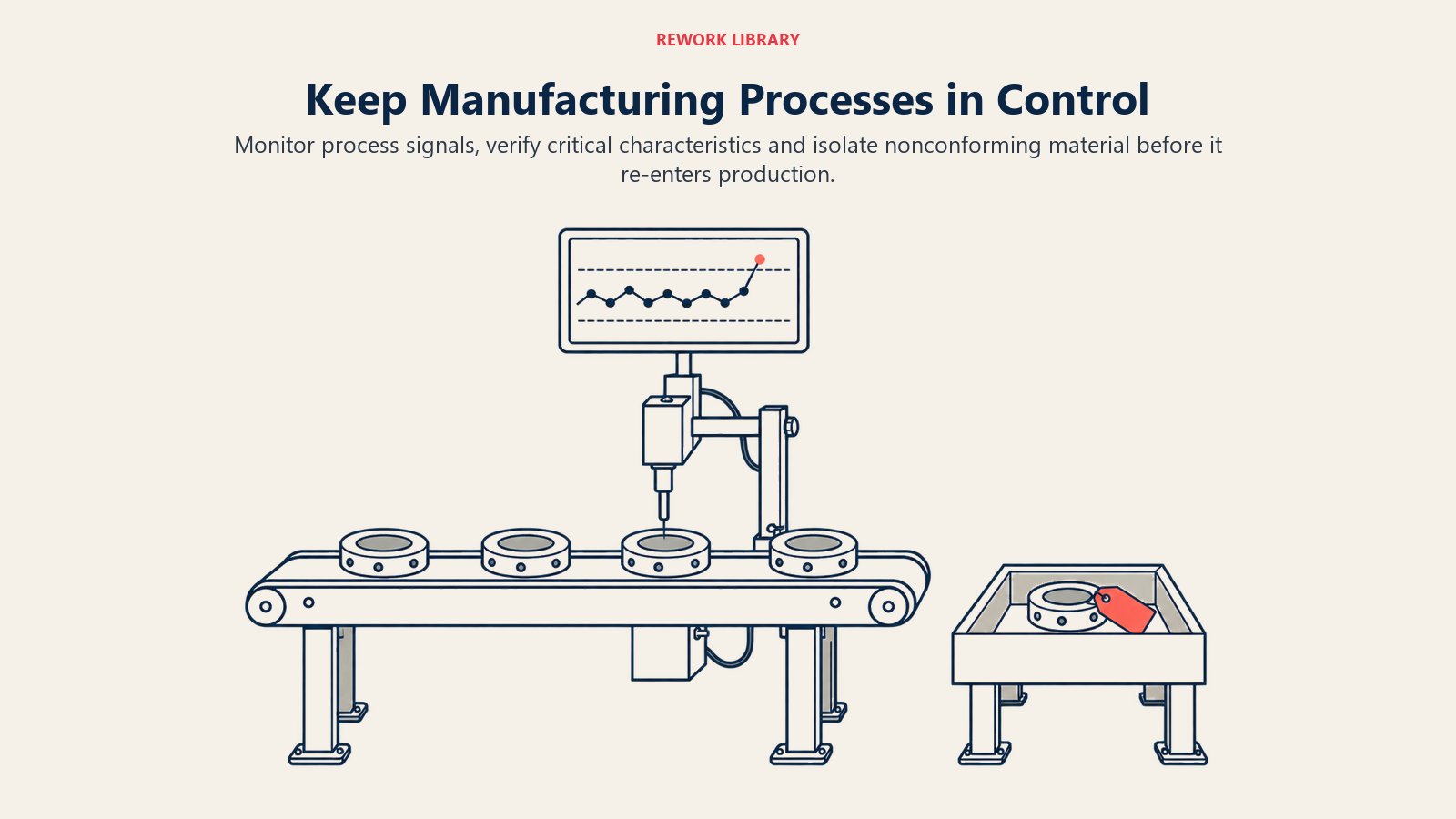
Statistical process control (SPC) uses control charts to distinguish normal process variation from abnormal signals requiring investigation. Plot measured characteristics over time. Control limits (typically three standard deviations from the mean) show expected variation ranges. Points outside control limits or non-random patterns signal process problems requiring correction.
SPC enables proactive quality management. By detecting process shifts before defects occur, operators can adjust processes maintaining capability rather than waiting for out-of-specification parts to trigger reactive response.
Inspection strategies must balance detection capability against cost. 100% inspection provides maximum defect detection but costs significantly. Sampling inspection reduces cost but risks missing defects. The right approach depends on defect consequences, detection difficulty, and inspection costs.
Use 100% inspection for critical safety features, characteristics where failures create severe consequences, low-volume production where inspection cost is minimal, or processes with insufficient capability.
Use sampling for high-volume production with capable processes, characteristics where failures create minimal consequences, or situations where inspection costs make 100% inspection economically unfeasible.
In-process verification versus final inspection represents another strategic choice. In-process checks catch problems early, preventing defects from compounding through subsequent operations and reducing rework costs. Final inspection provides last-chance detection before shipment but occurs after full manufacturing cost is incurred.
Effective quality control emphasizes in-process verification at critical points, using final inspection primarily as verification that in-process controls work effectively rather than primary defect detection.
Nonconforming material handling requires clear procedures: identify and segregate nonconforming materials, evaluate disposition options (rework, use-as-is with approval, scrap, return to supplier), implement corrections preventing recurrence, and maintain records for analysis.
Many quality systems fail not from inadequate detection but from poor nonconformance handling that allows defective materials to enter production inadvertently.
Quality Improvement: Systematic Problem-Solving
Continuous improvement systematically eliminates quality problems and enhances performance.
Corrective and preventive action (CAPA) provides structured processes for responding to quality issues. Corrective action addresses existing problems: identify root causes, implement fixes, verify effectiveness. Preventive action addresses potential problems: identify risks, implement controls, prevent occurrence.
CAPA effectiveness depends on thoroughness. Superficial problem-solving treating symptoms rather than root causes yields temporary fixes that fail to prevent recurrence. Systematic root cause analysis using tools like 5-Why, fishbone diagrams, or fault tree analysis reveals underlying issues enabling permanent solutions.
Root cause analysis methodologies structure investigation of quality problems. Five-Why questions iteratively ask "why" to drill from symptoms to root causes. Fishbone (Ishikawa) diagrams organize potential causes by category: material, method, machine, measurement, environment, people. Fault tree analysis graphically maps how combinations of events create failures.
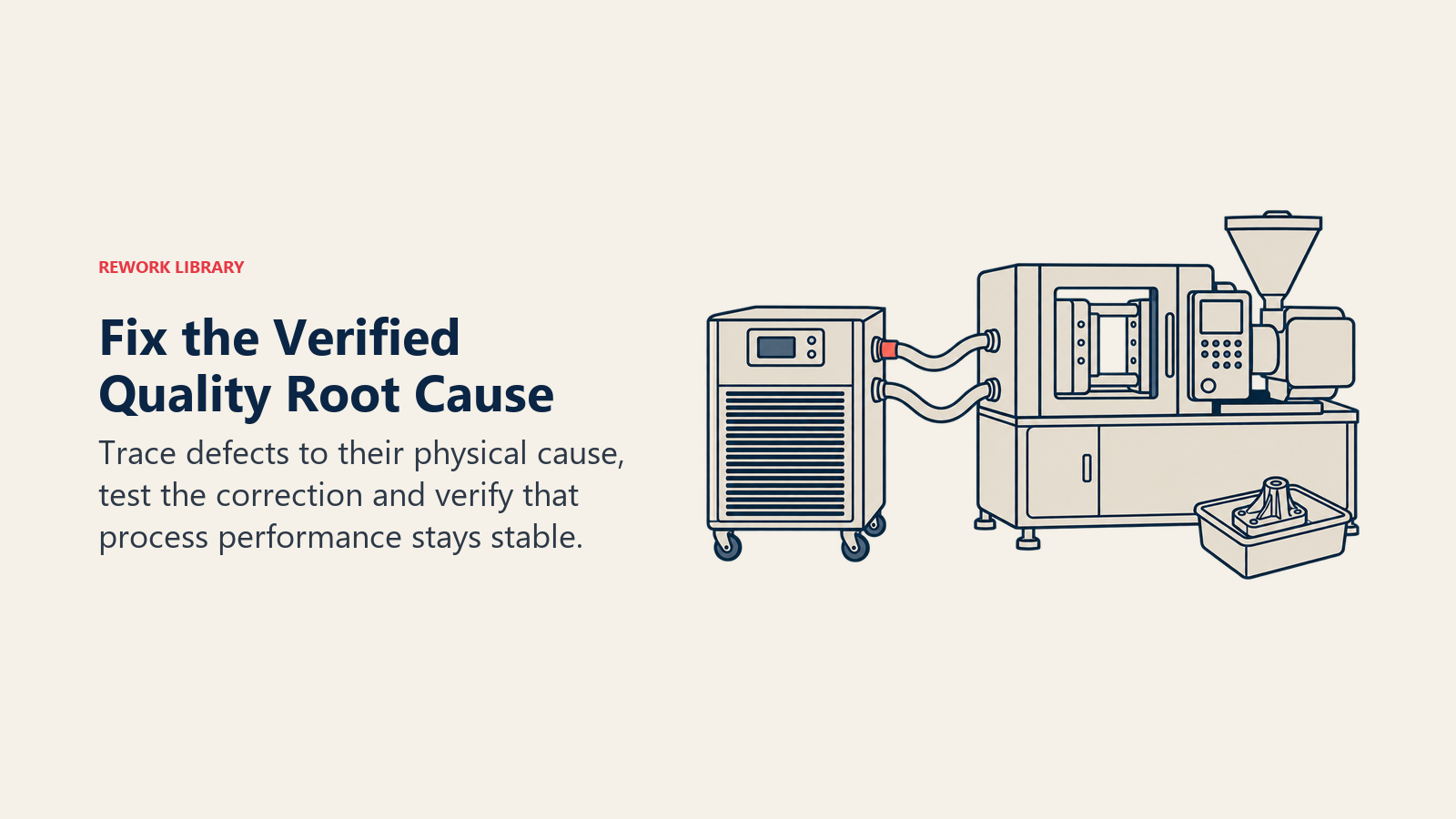
An injection molding operation suffered intermittent dimensional defects. Initial investigation blamed "process variation." Rigorous five-why analysis revealed the real root cause: cooling water temperature fluctuated because the chiller served multiple machines and demand spikes overwhelmed capacity. Installing a dedicated chiller eliminated variation that superficial analysis had accepted as normal.
Quality improvement projects apply focused resources to eliminate significant problems or enhance capabilities. Use project management discipline: clear scope and objectives, assigned ownership, resource allocation, milestone tracking, results verification.
Prioritize projects based on quality impact (defect frequency and severity), customer importance (are customers complaining?), cost impact (what does this problem cost?), and improvement feasibility (can we realistically fix this?).
Continuous improvement culture embeds quality improvement into daily work rather than relying solely on formal projects. This requires training everyone in basic problem-solving tools, providing time for improvement activities, responding quickly to suggestions, celebrating improvement successes, and integrating improvement into job expectations.
Building Organizational Quality Capability
Sustained quality excellence requires appropriate organizational structures, skills, and systems.
Quality organization structure should provide independence from production pressures while collaborating effectively with operations. Quality personnel report through dedicated quality leadership rather than production management, preventing conflicts where production volume pressures override quality concerns.
But avoid creating adversarial relationships where quality "polices" production. Instead, position quality as a service function helping operations achieve stable, capable processes.
Training and competency development builds quality skills throughout the workforce. Operators need training in work standards, quality requirements, measurement techniques, and problem identification. Engineers need FMEA, capability analysis, and statistical methods. Supervisors need quality system understanding and improvement facilitation skills.
Create training matrices showing required competencies and current proficiency. Develop training plans addressing gaps. Verify effectiveness through assessment, not just attendance records.
Supplier quality management extends quality systems upstream. Poor incoming material quality undermines even capable internal processes. Establish supplier quality requirements, conduct capability assessments before awarding business, monitor ongoing performance, and develop suppliers showing deficiencies.
Leading manufacturers work collaboratively with strategic suppliers, sharing quality techniques and providing technical assistance. This partnership approach develops capable supply chains rather than simply rejecting substandard materials.
Quality information systems collect, analyze, and report quality data enabling informed decisions. Track defect rates by product, process, and cause. Monitor supplier performance. Analyze warranty claims and customer complaints. Display metrics where workers and managers see them regularly.
Modern systems integrate quality data from multiple sources: inspection results, SPC charts, customer feedback, warranty claims. This consolidated view reveals patterns that isolated data sources miss.
Integrated Quality Management as Business Strategy
Quality excellence doesn't result from isolated quality department efforts. It emerges from integrated systems touching every business aspect: design, procurement, manufacturing, service, and improvement.
Organizations achieving quality leadership make it a strategic priority with CEO-level commitment and accountability. They invest systematically in prevention rather than accepting inspection and failure as inevitable costs. They build quality into products and processes rather than relying on heroic inspection efforts. They engage entire workforces in quality improvement rather than limiting responsibility to quality specialists.
These quality-focused organizations discover quality creates competitive advantages extending beyond defect reduction. Superior quality enhances reputation, commands premium pricing, reduces costs, improves customer loyalty, and enables market expansion.
Begin your quality journey by assessing current quality management maturity: do you primarily inspect problems out or prevent them? Are quality costs dominated by prevention or failure? Does quality improvement occur systematically or reactively? Use honest assessment to identify priority development areas, then build capabilities methodically.
Learn More
- Six Sigma in Manufacturing: Data-Driven Quality Improvement
- ISO 9001 Implementation: Building a Quality Management System
- Quality Control vs Quality Assurance: Understanding the Difference
- Statistical Process Control: Monitoring and Preventing Variation
- Root Cause Analysis Methods: Getting to the Heart of Manufacturing Problems
- Defect Prevention Strategies: Building Quality at the Source

On this page
- Modern Quality Management Fundamentals
- Strategic Quality Management Frameworks
- Quality Planning: Designing Quality Into Products and Processes
- Quality Control: Monitoring and Maintaining Capability
- Quality Improvement: Systematic Problem-Solving
- Building Organizational Quality Capability
- Integrated Quality Management as Business Strategy
- Learn More